ISSN-L: 2501 - 1235 Available on-line at: www.oapub.org/edu
doi: 10.5281/zenodo.3723937 Volume 6 │ Issue 3 │ 2020
INVESTIGATION OF QUALITY OF LIFE ACCORDING
TO THE EXERCISE BEHAVIOUR CHANGE STAGES
OF WOMEN STUDYING AT UNIVERSITY
Osman İmamoğlui
Yaşar Doğu Faculty of Sports Sciences, Ondokuz Mayıs University,
Samsun, Turkey
Abstract:
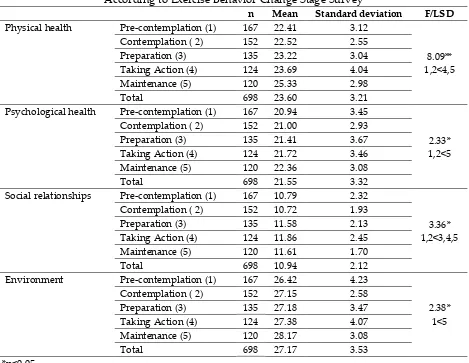
The aim of the study was the investigation of Quality of life according to the exercise behaviour change stages of women studying at university. 698 university students, who study in different departments, participated in the study. Quality of life and change in exercise behaviour survey were applied. One way ANOVA, LSD test and Student - t test were used in the study. The average age of University women was 27.50 years. In this study, physical health score, psychological health score, social health score and environmental scores vary according to the health status indicated by the students (p<0.05). In this study, in the case of physical health, the scores of those who are at the stage of Pre-contemplation and Contemplation are significantly lower than those of the students who are at the stage of Taking Action and Maintenance (p<0.05). In the case of psychological health, the scores of those who are at the stage of Pre-contemplation and Contemplation are significantly lower than those of the students who are at the Maintenance stage (p<0.05). In the case of social health, the scores of those who are at the stage of Pre-contemplation and Contemplation are significantly lower than those of the students who are in the preparation, Taking Action and Maintenance (p<0.05). In the case of environmental score, the scores of those who are at the Pre-contemplation stage are significantly lower than those of the students who are at the Maintenance stage (p<0.05). In conclusion, the perceived quality of life of University women according to their exercise behavior change stages were high before the tendency and low during the exercise but quality of life scores increased during continuity. Sedentary women should increase the percentage of continuity in exercise behaviors steps to improve quality of life. Quality of life level according to exercise behavior change stages should be investigated in a large number of women in different universities in Turkey and they should be orientated on exercise planning.
Keywords: university woman, quality of life, exercise behaviour
1. Introduction
The benefits of physical activity on health are thoroughly understood (Garber et al., 2011; Wen et al., 2011). The physical activity ranges between 17% in Southeast Asia to 43% in the Americas and in Eastern Mediterranean countries (Nakamura et al., 2013). Bandura (1993) notes that being physically active has a favorable effect on overcoming psychological and social problems. Physical inactivity among young and adult people is a serious cause for concern (Page and Zero, 2001). There are many research evidences that supports the positive effects of regular physical activity on well-being and private’s
health.Exercise and physical activity help to achieve better physical and mental health,
improve quality of life. Exercise is effective not only on health but also on many
parameters including speed (Aksoy and Aslan, 2019; Aksoy and Ağaoğlu, 2017; Atan et
al., 2012). In Turkey for people, the participation rate in regular physical activity was enhancement from 3.5% to 33% (Ceker et al., 2015). There are many factors that enable individuals to participate in physical activity. These were being healthy, looking good, social interaction, being popular, losing weight, healthy respiratory system etc. (Allender
at al., 2006; Alemdağ et al., 2016; Bostanci et al., 2019; Bostanci et al., 2019).
Participation in physical activity has decreased among adults in the world. The prevalence of a number of health problems has multiplication, especially in industrialized countries. It is recommended that people exercise to reduce health problems. Lifestyle appears to be comprehension the variables that predict a person’s
likelihood of engaging in and maintaining regular physical activity. Physically inactive individuals stay away from many health-related benefits than physically fit ones (Korepanova and Panachev, 2014; Aksoy and Karadeniz, 2020). These variables include age for people, their educational level, and the perceived benefits of physical activity, lifestyle, and chances to participate in physical activity (Mullineaux et al., 2001). Today, the research on physical activity adherence has shifted its focus to understanding the intentions that motivate people to engage in exercise (Marcus and Forsyth, 2008). Most people complain that time is inadequate; but some people use time effectively and can do more. Understanding how this can happen is the most important issue (Köse and Dönmez Uzun, 2019).
Various theories have been used to promote healthy behaviors for people. The Trans theoretical Model has been one of the most used models in health psychology
(Spencer et al., 2006). According this Trans theoretical Model, people’s attitudes toward
exercise are classified into five varied stages of change.
• Pre-contemplation - the first stage for people is with no intention to exercise.
• Contemplation: second stage for people is with the intention to exercise but not in
action.
• Preparation - people were who intend to take action in the next month.
• Action - fourth stage is for people who participate in regular exercise for a period
• Maintenance - final stage for people who participate in regular exercise for more than six months (Marcus & Forsyth, 2008).
The findings converge to show a higher risk of inactivity among female from male
(Aktener et al., 2006; Yıldırım et al., 2012; Çiçek et al., 2017). Today, there is an increase in the diseases related to lifestyle for people. Regular physical activities contribute to the reduction of morbidity and mortality and the improvement of the quality of life (Rejeski and Brawley, 2006; Bostanci et al., 2017). It has been demonstrated that physical activities play preventive and guardian role (Nelson et al., 2007; Warburton, 2006). Quality of life or health related quality of life was often related to the rate of physical function (Hsiao et al., 2014). The World Health Organization defines quality of life (QOL) as a person purpose-aligned cultural and value system by which an individual lives, relative to their goals, promise, living standards and interests.
The term health-related quality of life (HRQOL) refers to the physical, psychological, and social areas of health, seen as distinct domains that are influenced by
a person’s experiences, opinions, expectations, and sensations (Aaranson, 2010; Erbaydar et al., 2011). HRQOL can be defined as how well a person functions in their life. HRQOL is defined as a concept of sociology, economics and political science which encompasses
an individual’s emotional, social and physical well-being (Akranavičiūtė and Ruževičius, 2007; Ruževičius, 2012). There is found approaches based on humankind needs, subjective well-being, expectations, and phenomenological viewpoints (Bowling, 2005). A literature on well-being distinguishes between approaches based on preference satisfaction, objective lists, flourishing, hedonism, and life satisfaction (Peasgood et al., 2014). Quality of life, life satisfaction, happiness, and subjective well-being are very
interrelated (Ruževičius, 2016). A major challenge of the today concerning health is
related to changes in physical activity level due to societal trends that are leading to less activity than before (Hallal et al., 2012). Quality of life for people is that has attracted an
ever-increasing amount of interest. In time, was the perception’s changes of the meaning
of life. These values were influenced quality of life conception and all factors changes (Ferrer, 2004).
It is thought that the quality of life will change according to the stages of behavior change. For this purpose, the quality of life scores of sedentary women was examined according to the exercise behavior change stages.
2. Material and Method
2.1 Participation
The population consisted of female students of the Faculty of Sport Sciences, the Faculty of Education, the Faculty of Arts and Sciences and the Faculty of Engineering. 698 women student who completed the questionnaires correctly and who were not active athletes were subjected to statistical procedures.
were applied for data collection. In the personal information survey, the age, height and body weights of the women were asked.
2.1.1 World Health Organization Quality-of-Life Scale (WHOQOL-BREF)
The WHOQOL-BREF covers a 26-item instrument consisting of four domains. This are:
• physical health: 7 items,
• psychological health: 6 items,
• social relationships: 3 items, and
• environmental health: 9 items.
The WHOQOL-Bref-tr version consisted of 27 questions with a national question added during the Turkish validity studies. Added substance includes general QoL and
health satisfaction (Karakaş and Yaman, 2017). The WHOQOL-BREF assessment contains 4 domains of QOL:
• psychological health,
• physical health,
• environment, and
• social relationships (Yuh et al., 2004).
In this sdudy, The World Health Organization Quality of Life Scale Turkish Version (WHOQOL-BREF-TR) was used. Quality of life is considered to be better as the score highs. The Cronbach's alpha coefficient was found: In this study, physical area subscale is 0.78, psychological area subscale is 0.73, social area is 0.64, and environmental area is 0.82 and environmental area 0.80.
2.1.2 Physical Activity Stages of Change Questionnaire (PASCQ)
The PASCQ evaluates individuals’ exercise stages on their physical activity behaviors. The criterion validity of the Turkish version against physical activity levels was also confirmed by Cengiz, et al. (2010). Questions has measured with yes/no. The survey uses a scoring algorithm to classify individuals into five different stages of change.
According to Marcus & Lewis (2003), these are namely Pre-Contemplation, Contemplation, Preparation, Action, and Maintenance.
In Pre-contemplation, individuals do not change their high risk behavior in the foreseeable future (six months).
In Contemplation, people seriously intended to change their behavior in the next six months.
In Preparation, individuals intend to take action in the near future and usually in less than six months.
In Action, individuals have made overt behavior changes within the past six months.
In Maintenance, individuals have changed their behavior for more than six months (Nakamura et al., 2013). It was answered either “yes” or “no” based on their
• According questions is yes (1) and no (0);
• Pre-contemplation stage: If question 1 = 0 and question 2 = 0;
• Contemplation stage: If question 1 = 0 and question 2 = 1;
• Preparation stage: If question 1 = 1 and question 3 = 0;
• Decision/action stage: If question 1 = 1, question 3 = 1, and question 4 = 0;
• Maintenance stage: If question 1 = 1, question 3 = 1, and question 4 = 1 (Marcus and
Lewis, 2003).
In this study, the scale validity applied is 0.82.
2.2 Statistical analysis
The data was analyzed using the Statistical Package for Social Sciences (SPSS) Statistics (Version 23.0 for Windows; IBM). According to the Shapiro Wilk's test, the data showed a normal distribution. Comparisons of two continuous variables were performed using independent t test, ANOVA and LSD test.
3. Results
Table 1: Anthropometric Characteristics of University Women
Parameter Mean Standard deviation
Age (years) 27.50 6.12
Body Height (cm) 167.02 6.45
Body weight (kg) 62.19 9.13
BMI (kg/m2) 22.30 3.52
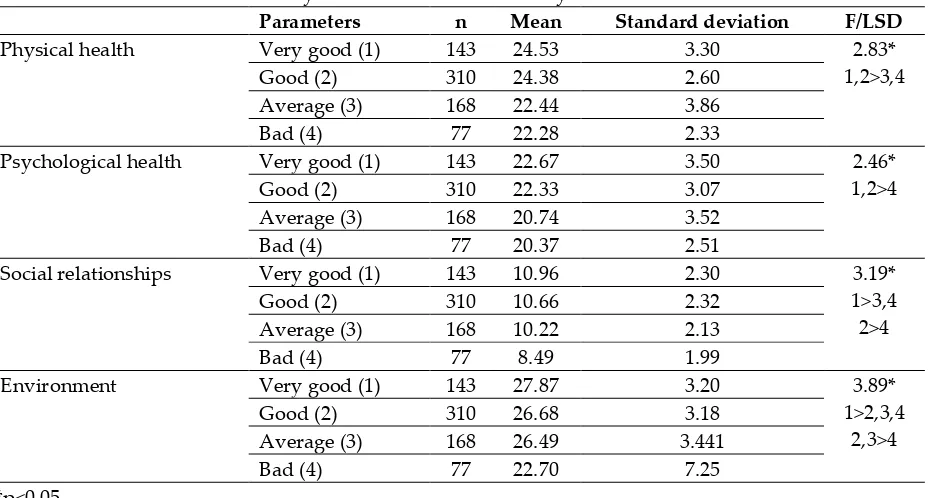
Table 2: University Women's Health Scale by General Health Status
Parameters n Mean Standard deviation F/LSD
Physical health Very good (1) 143 24.53 3.30 2.83*
1,2>3,4
Good (2) 310 24.38 2.60
Average (3) 168 22.44 3.86
Bad (4) 77 22.28 2.33
Psychological health Very good (1) 143 22.67 3.50 2.46* 1,2>4
Good (2) 310 22.33 3.07
Average (3) 168 20.74 3.52
Bad (4) 77 20.37 2.51
Social relationships Very good (1) 143 10.96 2.30 3.19* 1>3,4 2>4
Good (2) 310 10.66 2.32
Average (3) 168 10.22 2.13
Bad (4) 77 8.49 1.99
Environment Very good (1) 143 27.87 3.20 3.89*
1>2,3,4 2,3>4
Good (2) 310 26.68 3.18
Average (3) 168 26.49 3.441
Bad (4) 77 22.70 7.25
Table 3: University Women's Quality of Life Scores According to Exercise Behavior Change Stage Survey
n Mean Standard deviation F/LSD Physical health Pre-contemplation (1) 167 22.41 3.12
8.09** 1,2<4,5 Contemplation ( 2) 152 22.52 2.55
Preparation (3) 135 23.22 3.04 Taking Action (4) 124 23.69 4.04 Maintenance (5) 120 25.33 2.98
Total 698 23.60 3.21
Psychological health Pre-contemplation (1) 167 20.94 3.45
2.33* 1,2<5 Contemplation ( 2) 152 21.00 2.93
Preparation (3) 135 21.41 3.67 Taking Action (4) 124 21.72 3.46 Maintenance (5) 120 22.36 3.08
Total 698 21.55 3.32
Social relationships Pre-contemplation (1) 167 10.79 2.32
3.36* 1,2<3,4,5 Contemplation ( 2) 152 10.72 1.93
Preparation (3) 135 11.58 2.13 Taking Action (4) 124 11.86 2.45 Maintenance (5) 120 11.61 1.70
Total 698 10.94 2.12
Environment Pre-contemplation (1) 167 26.42 4.23
2.38* 1<5 Contemplation ( 2) 152 27.15 2.58
Preparation (3) 135 27.18 3.47 Taking Action (4) 124 27.38 4.07 Maintenance (5) 120 28.17 3.08
Total 698 27.17 3.53
*p<0.05
Table 4: Life Scale Points of Regular Physical Activity Participants in the Last 6 Months and 3 Years
Sports situation
Last 6 months Last 3 years
n mean t-tests N mean t-tests
Physical health
Yes 196 23.77
-1.32 142 24.65 -2.43*
No 502 23.05 656 22.00
Psychological health
Yes 196 21.91
-1.73 142 21.88 -2.02*
No 502 20.95 656 20.91
Social
relationships
Yes 196 11.32
-2.68* 142 11.22 -2.72*
No 502 10.37 656 10.35
Environment Yes 196 27.39
-1.29 142 27.74 -2.44*
No 502 26.59 656 26,48
4. Discussion
In this study, the average age of university student was 27. 50 years, Body height 167.02
cm, Body weight 62.19 kg, and BMI (Body Mass Index) 22.30 kg/m2 (Table 1).
Vural et al. (2010) in their study, showed that were no significant relation between
physical activity level and life quality of individuals. In other study, it was determined that depression and burnout levels of health care professionals were low and quality of
life was medium (Yıldırım et al., 2012). It was also determined that burnout, depression
and some of the variables have a unfavorable impact on the quality of life.
Başkan et al. (2017)’ study found out significant differences between people from cities having different population density in terms of physical and environmental field, and psychological field. No significant difference was found in terms of social field.
Başkan et al. (2017) showed that when the quality of life perception of Turkish public is considered, 58,7% of individuals surveyed are neither pleased nor dissatisfied and 26,8% of them replied as quite good.
Tavazar et al. (2014) reported plus effects of physical activity for support increased
HRQoL in young people with sedentary lifestyles. İnençli and Ziyagil (2017) found
significant differences in the means of physical and mental health depending on physical activity level in male and females. In this study, physical health score, psychological health score, social health score and environmental scores vary according to the health status indicated by the students (p <0.05). Physical health score is lower in students with poor and average health than students with good and very good health. It is worse than those who state their health well and very well. In general, the scale scores of those who have good and very good health are better than those who state health as average and bad (Table 2).
Uzun et al. (2017b) found out that the state and frequency of doing sport can increase the enjoyment in physical activity. It was also reported that stress levels
decreased in individuals who were doing sport (Deryahanoğlu et al., 2016).
Physical activity reduces incidence of illnesses such as diabetes, cardiovascular disease, the risk of obesity and the development of chronic diseases, and all-cause mortality. Physical activity strengthens bones and muscles, improves mental health and mood. Physical activity decreases depression and anxiety.
Physical activity promotes social and psychological well-being, and advanced academic performance (Hallal et al., 2006; Rasmussen and Laumann, 2013). Physical activity or exercises is providing effective an active and cheerful life for people, protection of the body against body diseases, avoidance of obesity by consuming any additional energy. Exercise has deceleration of aging and the organic regression caused by aging, optimization of the capacities of respiration and circulation systems and also maintenance of such capacity. Physical activity or exercises reducing neurotic stresses and increasing the preventive and protective effect of the mortality incidents caused by coronary vascular diseases. Physical activity or exercises provides protection of the health and functionality of the muscular joint tissues. Physical activity or exercises provides avoidance of loneliness through social cohesion and prevention of postural disorders
(Kılınç et al., 2016). In this study, there has been no significant difference in physical health, psychological health and environmental factors between sportsmen and non-sportsmen in the last 6 months (Table 4). There is a significant difference only in social relations sub-dimension (p <0.05). Also, in this study, significant differences were found between physiological health, psychological health, social relationships and environmental factors (p <0,05) between sportsmen and non-sportsmen in the last 3 years. In conclusion, the perceived quality life of women studying at university according to their exercise behavior change stages were high before the tendency and low during the exercise, but quality of life scores increased during continuity. Sedentary women should increase the percentage of continuity in exercise behaviors steps improve quality of life. Quality of life level according to exercise behavior change stages should be investigated in a large number of university women in different universities in Turkey and they should be orientated on exercise planning.
References
Aaranson N. K. (2010). What have you done for me lately? The value added by
health-related quality of life data in clinical trials. 3. Ulusal Sağlıkta Yaşam Kalitesi
Kongresi Kongre Bildiri ve Sunum Kitabı. 25-27 Mart, İzmir Türkiye. p.26
Akranavičiūtė, D., Ruževičius, J. (2007). Quality of life and its components’ measurement.
Engineering Economics, Vol. 2, p. 43-48
Aksoy Y., Ağaoğlu S. A. (2017). The Comparison of Sprint Reaction Time and Anaerobic Power of Young Football Players, Volleyball Players and Wrestlers, Kinesiologia Slovenica. 23(2),5-14.
Aksoy Y., Karadeniz S. (2020). Analysis of the Factors Preventing High School Students from Participating in Recreational Activities. Journal of Education and e-Learning Research, 7(1): 64-68.
Aktener, A. Y., Dulger, H. İ., Erkayhan, G. E., Gormeli, G., Kafadar, F. S., Yildiz, M., Keskinoglu, P., & Soyer, A., (2006). Obesity prevalence in reproductive age and postmenopausal women aged between 20-64 years in a semi-urban area. Medical Journal of Trakya University, 23 (3), 119-126
Alemdağ C, Alemdağ S, Özkara A. B. (2016). Physical activity as a determinant of
subjective happiness. Balt J Sport Heal Sci. No. 4(103), pp. 2–10
Allender S, Cowburn G, Foster C. (2006). Understanding participation in sport and physical activity among children and adults: A review of qualitative studies. Heal
Educ Res Theory Pract. No. 21(6), pp. 826–35.
Atan T. Tural E., İmamoğlu O., Çiçek G., Tural Ş. (2012). Physical activity levels of teachers and health professionals in Turkey. Health MED, 6(6),1935-1942.
Başkan, A. H., Zorba, E., & Bayrakdar, A. (2017). Impact of the population density on
quality of life. Journal of Human Sciences, 14(1), 506-518. doi:10.14687/jhs.v14i1.4416
Bostanci, Ö., Kabadayi, M., Mayda, M. H., Yılmaz, A. K., & Yılmaz, Ç. (2019a). The differential impact of several types of sports on pulmonary functions and respiratory muscle strength in boys aged 8–12. Isokinetics and Exercise Science, (Preprint), 1-6.
Bostanci, Ö., Mayda, H., Yılmaz, C., Kabadayı, M., Yılmaz, A. K., & Özdal, M. (2019b). Inspiratory muscle training improves pulmonary functions and respiratory muscle strength in healthy male smokers. Respiratory Physiology & Neurobiology, 264, 28-32.
Bostanci, O., Ozdal, M., Mayda, H., & Kabadayi, M. (2017). The effect of preparation period trainings on respiratory muscle strength of hearing-impaired judokas. Archives of Budo Science of Martial Arts and Extreme Sports, 13, 97-102.
Bowling A. (2005). Measuring health. Third. Maidenhead: Open University Press. Ceker, A., Cekin, R. & Ziyagil, M. A. (2015). Stages of exercise behavior changes in male
and females from different age groups. CBU Physical Education and Sports Sciences, 8(1), 11-20
Cengiz, C., Asci F. H., & Ince, M. L. (2010). Exercise stages of Change Questionnaire: its reliability and validity. Türkiye Klinikleri Journal of Sports Sciences, 2(1), 32-37.
Çiçek G., İmamoğlu O. Yamaner F., Türk N. (2017). Psychological Effects of Cardio Bosu
Exercise on Sedentary Women. International Journal of Sport, Exercise and Training Science, 3(3), 69-75
Deryahanoğlu, G., İmamoğlu, O., Yamaner, F., & Uzun, M. (2016). Anthropometric characteristics of sedentary women and comparison of their psychological states,
Journal of Human Sciences, 13(3), 5257-5268.
Erbaydar N. P., Bilir N., Özcebe L. H., Vaizoğlu S., Aslan D. (2011). Evaluation of
Ferrer, A. (2004). Happiness Quantified: A Satisfaction Calculate Approach. Oxford: Oxford University Press.
Garber C. E., Blissmer, B., Deschenes, M. R., Franklin, B., Lamonte, M. J., Lee, I. M., & Swain, D. P. (2011). Quantity and quality of exercise for developing and maintaining cardiorespiratory, musculoskeletal, and neuromotor fitness in apparently healthy adults: guidance for prescribing exercise. Medicine & Science in Sports & Exercise, 43 (7), 1334-1359
Hallal, P. C., Andersen, L. B., Bull, F.C., Guthold, R., Haskell, W., & Ekelund, U. (2012). Global physical activity levels: surveillance progress, pitfalls, and prospects. Lancet, 380(9838), 247-57.
Hallal, P. C., Victora, C. G., Azevedo, M. R., & Wells, J. C. (2006). Adolescent physical activity and health: A systematic review. Sports Medicine, 36(12), 1019-1030. Hsiao, Y., Wu, C.H., & Yao, G.,(2014). Convergent and Discriminant Validity of the
Wooqol-Bref Using a Multitrait-Multimethod Approach, Social Indicators Research, 116(3),971-978
Karakaş, G., & Yaman, Ç. (2017). Examination of the quality of life according to the
physical activity status of parents who have disabled individual, Journal of Human Sciences, 14(1), 724-737.
Kılınç, H., Bayrakdar, A., Çelik, B., Mollaoğulları, H., & Gencer, Y. G. (2016). Physical activity level and quality of life of university students, Journal of Human Sciences, 13(3), 3794-3806.
Korepanova Y. A., Panachev V. D. (2014). Students’ healthy life -style components study.
Russ J Phys Educ Sport., No. 9(2), 32–38
Köse B. Dönmez Uzun M. (2019). Time Management Behaviors of the Students who Study in Sports Sciences, Türkiye Spor Bilimleri Dergisi, 3(2),82-87
Lau Y, Yin L., (2010). Maternal, obstetric variables, perceived stress and health-related quality of life among pregnant women in Macao, China. Midwifery, 11-12 May. Marcus, B. H., & Forsyth B. H. (2008). Motivating people to be physically active. (2nd ed.)
Champaign, IL: Human Kinetics.
Marcus, B. H., & Lewis, B. A. (2003). Physical activity and stages of change of motivational
readiness for change model. President’s Council on Physical Fitness and Sport Research Digest, 4(1), 1-8.
Mullineaux, D., Barnes, C., & Barnes, E., (2001). Factors affecting the likelihood to engage in adequate physical activity to promote health. Journal of Sports Sciences, 19(4), 279-288.
Nakamura M., C. B. Papini, I. P. Teixeira, E. Sebastião, S. Gobbi, K. L. Cordeira, & E. Kokubun (2013). Concordance between Stages of Behavior Change Questionnaire and IPAQ, Motriz, Rio Claro, 19(4),776-782
Peasgood T, Brazier J, Mukuria C, Rowen D. (2014). A conceptual comparison of well-being measures used in the UK. Policy Research Unit in Economic Evaluation of Health and Care Interventions. Universities of Sheffield & York. EEPRU Research Report 026.
Rasmussen, M. Laumann, K. (2013). The academic and psychological benefits of exercise in healthy children and adolescents. European Journal of Psychology of Education, 28(3), 945–962.
Rejeski, W. J., & Brawley, L. R. (2006). Functional health: innovations in research on physical activity with older adults. Medicine and science in sports and exercise, 38(1), 93-99
Ruževičius J. (2016). Quality of Life and of Working Life: Conceptions and Research, 17th Toulon-Verona International Conference, Conference Proceedings ISBN 9788890432743, p.317-334
Ruževičius, J. (2012). Management de la qualité. Notion globale et recherche en la matière. Vilnius: Maison d’éditions Akademinė leidyba, p.432
Spencer, L., Adams, T. B., Malone, S., Roy, L., Yost, E., (2006). Applying the Trans theoretical model to exercise: a systematic and comprehensive review of the literature. Health Promotion Practice, 7 (4),428443
Tavazar, H., Erkaya, E., Yavaş, Ö., Tez, Ö., Zerengök, D., Güzel, P. & Özbey, S. (2014).
The research of the differences between physical activity and life quality in senior high school students, Special Issue on the Proceedings of the 3rd ISCS Conference, SI (1), 496- 510.
Uzun M., Yurdadön Ü., İmamoğlu O., Çon M., Çavuşoğlu G.,Taşmektepligil M. Y. (2017b). Determination of Secondary Schools Participation in Sportive Activities and States of Enjoying Physical Activities, Inonu University, Journal of Physical Education and Sport Sciences (IUJPESS), 4(1),38-52.
Uzun, M., İmamoğlu, O., Yamaner, F., Deryahanoğlu, G., & Yamaner, G. (2017a).
Examination of the factors which prevent to participate the recreative activities:Example of girls IN high school, Journal of Human Sciences, 14(1), 950-962.
Vural Ö., Eler S.,Güzel N. A. (2010). The Relation of Physical Activity Level and Life Quality at Sedentary Profession, SPORMETRE Journal of Physical Education and Sport Sciences, VIII (2) 69-75.
Warburton, D. E., & Nicol, C. W., & Bredin, S. S. (2006). Health benefits of physical activity: the evidence. Canadian medical association journal, 174(6), 801-809. Wen, C. P., Wai, J. P. M., Tsai, M. K., Yang, Y. C., Cheng, T. Y. D. C., Lee, M. & Wu, X.
(2011). Minimum amount of physical activity for reduced mortality and extended life expectancy: a prospective cohort study. Lancet, 378(9798), 1244-53.
Yaşartürk F., Uzun M., İmamoğlu O., Yamener F. (2016). Examination of the Obstacles
for the Participation of the Recreative Activities of Sedentary Women,International
Yıldırım G., İnce M. L. And Müftüler M. (2012).Physical Activity and Perceptions of Neighborhood Walk Ability among Turkish Women in Low and High Socio-Economic Environments: An Exploratory Study, Perceptual & Motor Skills: Exercise & Sport, 115, 2, 661-675.
Creative Commons licensing terms