ISSN-L: 2501 - 1235 Available on-line at: www.oapub.org/edu
doi: 10.5281/zenodo.3677572 Volume 6 │ Issue 2 │ 2020
LEVEL OF CARDIOVASCULAR ENDURANCE
AMONG DIPLOMA EDUCATION’S STUDENTS
OF UNIVERSITY OF MALAYA, MALAYSIA
Syed Kamaruzaman Syed Ali1i,
Foo Wai Kit2,
Imran Akhmad3,
Muhammad Chairad4
1,2Faculty of Education,
University of Malaya, Malaysia
3,4Faculty of Sport Science,
Medan State University, Indonesia
Abstract:
Cardiovascular endurance is related to the heart system. High levels of cardiovascular endurance indicate a person's heart system is healthy. This study aimed to measure the
level of cardiovascular endurance among diploma education’s students in education in
specializing in physical education and health. The design of this study is the One-Short Case Study. The number of subjects is 20. The number of male subjects was 12, while the female subject was 8. Beep test is used to measure the level of cardiovascular endurance of a student. The results showed 2 out of 20 students (10%) were score above average in cardiovascular endurance fitness, 3 students (15%) were score average in cardiovascular endurance fitness, 2 students (10%) score fair in cardiovascular endurance fitness, 8 students (40%) were score poor in cardiovascular endurance fitness and 5 students (25%) were score very poor in cardiovascular endurance fitness. The mean score for 20 students
was (m = 33.59; SD = 7.30) as rate as poor. Majority of diploma education’s students were
in the category of poor. This concludes that students with Diploma course in UM were poor in cardiovascular endurance since mean and mode in category of poor.
Keywords: cardiovascular endurance, physical education, university students, diploma students
1. Introduction
Each year the faculty of education, University of Malaya, will offer a diploma course in education. Courses offered include physical education and health. In semester 1, session 2019/2020, 20 applicants were selected as diploma students in education in physical education and health. They are potential future physical education teachers. Therefore, they need to have a better level of cardiovascular endurance compared to students who are not in the field of physical education and health. Cardiovascular endurance is one component of physical fitness. A person can reduce the risk of cardiovascular disease if they have a good level of physical fitness. Cardiovascular disease risk is associated with physical activity and physical fitness (Caspersen, Nixton, & DuRant, 1998; Despres, Bouchard, & Malina, 1990; Sallis et al., 1997; USDHHS, 1996, 2001, 2008).
An educational diploma course runs for one year, which is two semesters. Throughout their studies they will engage in a variety of physical activities. For example, game activities, sports and camping. These activities require a healthy and active body, including physical fitness that includes components of cardiovascular endurance. Students with high levels of cardiovascular endurance will be able to reduce the risk of injury and accidents. Therefore, before taking the diploma course in physical education, they need to be tested for cardiovascular endurance. Through the cardiovascular endurance test, the lecturer will be able to identify the student's cardiovascular endurance level. Having identified the level of cardiovascular endurance students will facilitate the lecturer to plan teaching activities. Accordingly, a study on the level of cardiovascular endurance among diploma students in education (physical education and health) should be conducted.
2. Literature Review
There have been several studies conducted on cardiovascular endurance. Abd Wahab, Mohd Zulkifli, Mohd Yunos (1999) conducted a comparative study of cardiovascular endurance levels between player of Terengganu Soccer Academic and player of Pahang Soccer Academic. Researchers used a 12-minute run test. The results show that there is no significant difference in the level of cardiovascular endurance between Pahang football academic players and Terengganu football academic players. The results of this study also show that cardiovascular endurance is one of the key elements for every football player.
after training to test for cardiovascular endurance. T-test is used to compare pre and post test results between groups. The results show that there are significant differences between groups. The group drinking orange juice showed an increase in cardiovascular endurance (p = 0.005). The results of this study show that orange juice can improve cardiovascular endurance among the University of Technology Malaysian varsity players.
While Prashant & Rohilla (2019) conducted research on cardiovascular endurance among new University of Haryana students. The findings of the study showed that of 180 students, 47% of students were poor, 48.5% were average and 4.5% had good cardiovascular endurance. Male students are 20% poor, 70% average and 10% good, while female students are 68% poor, 30% average, and only 2% are good cardiovascular endurance. Next, there are differences in the level of cardiovascular endurance between male and female students.
3. Material and Methods
The design of this study is the One-Short Case Study. The number of subjects is 20. The number of male subjects was 12, while the female subject was 8. The subject age is between 24 - 32 years. They have a sports science degree. The sampling method is convenience sampling. All subjects agreed to take the cardiovascular endurance test. Beep test (https://www.topendsports.com/testing/tests/20mshuttle.htm) is used to test the level of cardiovascular endurance students. The exam is conducted at the university gymnasium, the faculty of education.
3.1 Beep Test A. Procedure
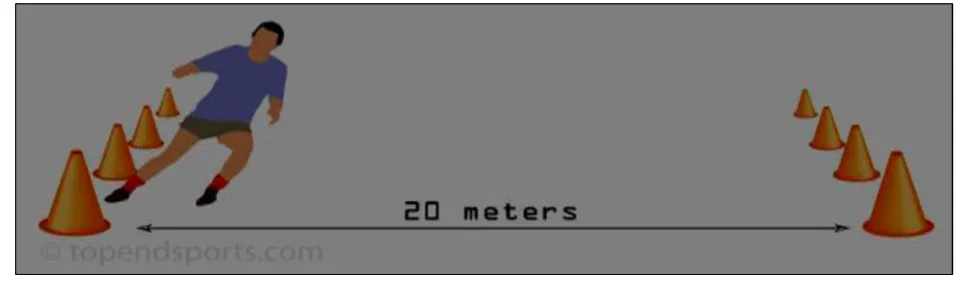
This test involves continuous running between two lines 20m apart in time to recorded beeps (Figure 1). For this reason, the test is also often called the ‘beep’ or ‘bleep’ test. The
participants stand behind one of the lines facing the second line and begin running when instructed by the recording. The speed at the start is quite slow. The subject continues running between the two lines, turning when signalled by the recorded beeps. After about one minute, a sound indicates an increase in speed, and the beeps will be closer together. This continues each minute (level). If the line is reached before the beep sounds, the subject must wait until the beep sounds before continuing. If the line is not reached before the beep sounds, the subject is given a warning and must continue to run to the
line, then turn and try to catch up with the pace within two more ‘beeps’. The subject is
given a warning the first time they fail to reach the line (within 2 meters) and eliminated after the second warning.
B. Equipment
C. Before the test
Explain the test procedures to the subject (many beep test audios have an explanation at the start of the recording). Perform screening of health risks and obtain informed consent. Prepare forms and record basic information such as age, height, body weight, gender, test conditions (particularly the weather and running surface). Measure and mark out the course. Ensure that the subjects are adequately warmed-up.
D.Scoring
The athlete's score is the level and number of shuttles (20m) reached before they were unable to keep up with the recording. Record the last level completed (not necessarily the level stopped at).
Figure 1: 20 meter Shuttle Run
4. Results and Discussion
As a result of the test beep, the data are analyzed and explained through Table 1 below.
Table 1: Descriptive Statistics for beep test score for student DPP in UM (N= 20)
Rating No. Percentage Mean Mode Std Deviation
Very Poor 5 25% 33.59
(Poor)
8 7.30
Poor 8 40%
Fair 2 10%
Average 3 15%
Above Average 2 10%
Good - -
Excellent - -
Total 20 100%
were in category of poor. This conclude that students with DPP course in UM were poor in cardiovascular endurance since mean and mode in category of poor.
The level of cardiovascular endurance is important for a diploma in education (physical education and health). However, the results show that the majority of diploma students (physical education and health) have low levels of cardiovascular endurance. The results of this study are in line with the findings of a study conducted on new students of the University of Haryana in medicine (P. Prashant & Ravi Rohilla, 2019). The findings of the study showed that of 180 students, 47% of students were poor, 48.5% were average and 4.5% had good cardiovascular endurance. Male students are 20% poor, 70% average and 10% good, while female students are 68% poor, 30% average, and only 2% are good cardiovascular endurance. Next, there are differences in the level of cardiovascular endurance between male and female students.
5. Recommendations
Cardiovascular endurance is one of the components of physical fitness. If someone has good cardiovascular endurance meaning that he or she also good level of physical fitness. As a candidate of physical education student, they must have a good fitness level because during physical education class many physical activities that they will do later. Maybe they cannot do well during conduct the class of physical education if their physical fitness still at a low level.
6. Conclusion
In general, diploma students (physical education and health) are found to have low levels of cardiovascular endurance. They should have good levels of cardiovascular endurance. This is because they will pursue a variety of physical activities throughout the course of their diploma (physical education and health) courses.
Acknowledgements
None.
References
Abd Wahab, Mohd Zulkifli & Mohd Yunos (1999). Penyeilidikan perbandingan tahap cardiovascular endurance pemain projek akademik bola sepak negeri Terengganu dengan Pemain projek Akademik Bola Sepak negeri Pahang. Degree Project Paper. Malaysia of Technology University.
Despres, J. P., Bouchard, C., & Malina, R. (1990). Physical activity and coronary heart disease risk factors during childhood and adolescence. Exercise and Sports Science Review, 18, 243-261.
Kong Chee Onn (2006). Kesan minum orange jus ke atas cardiovascular endurance di kalangan pemain bola baling, Universiti teknologi Malaysia. Sami K, 2005. Factors affecting the educational development in severe obese children. Degree Project Paper, Malaysia of Technology University.
P. Prashant & Ravi Rohilla (2019). Study of cardiovascular endurance in newly admitted medical students. International Journal of Advanced Research 6(12): 205-210. Sallis, J. F., McKenzie, T. L., Alcaraz, J., Kolody, B., Faucette, N., & Hovell, M. (1997). The
effect of a 2-year physical education program (SPARK) on physical activity and fitness in elementary school students. American Journal of Public Health, 87, 1328-1334.
U.S. Department of Health and Human Services [USDHHS] (1996). Physical activity and health: A report of the surgeon general. Atlanta, GA: Author.
U.S. Department of Health and Human Services [USDHHS] (2001). The Surgeon
General’s call to action to prevent and decrease overweight and obesity. Rockville,
MD: Department of Health and Human Services, Public Health Service, Office of the Surgeon General.
Creative Commons licensing terms