R E S E A R C H
Open Access
Self-interference suppression with
imperfect channel estimation in a
shared-antenna full-duplex massive MU-MIMO
system
Pengbo Xing, Ju Liu
*, Chao Zhai and Zhiyuan Yu
Abstract
In this paper, we consider a shared-antenna full-duplex massive MU-MIMO system and prove that the self-interference (SI) at the base station (BS) can be suppressed, though the direct-path SI exists and the signal/SI channel is imperfectly estimated. The BS is assumed to employ zero-forcing (ZF) or maximal-ratio transmission/maximal-ratio combining (MRT/MRC) method to linearly process signals. We propose a precoded SI channel training scheme by employing orthogonal sequences and downlink precoding, so the SI channel can be estimated like the signal channel with a much lower dimension. Based on the channel estimation, we further analyze the SI suppression by combining the SI removal and the large-scale antenna linear processing (LALP) method. Numerical results show that an additional 36 dB SI can be suppressed by combining the SI removal and the LALP suppression. We derive the tight closed-form lower bounds of the achievable rates for the combined suppression. Finally, we maximize the system spectral efficiency and energy efficiency based on the simulation and closed-form approximations.
Keywords: In-band full-duplex, Massive MIMO, Self-interference, MU-MIMO, Shared-antenna
1 Introduction
Massive multiple-input multiple-output (MIMO) and in-band full-duplex (IBFD) techniques have attracted inten-sive research interest because they can be used for broadband green communications [1–8]. IBFD can realize simultaneous bi-directional (uplink and downlink) data transmissions using the same time-frequency resource. Massive MIMO system exploits a large number of anten-nas at the transmitter to focus the energy into a narrow beam to improve the signal strength and mitigate inter-ference. Both techniques are promising to meet the ever-growing requirements of wireless data transmissions, but bring some design variations over the physical or higher layers [9–17].
The massive MIMO technique can significantly improve the spectral efficiency (SE) and energy efficiency (EE) while keeping a lower transmit power for both uplink and
*Correspondence: [email protected]
School of Information Science and Engineering, Shandong University, 27 Shanda Nanlu, 250100 Jinan, China
downlink [15, 18–20] by mitigating the detrimental effects of small-scale fading, noise, and interference [4]. With more antennas equipped, the signal processing becomes much easier than the traditional MIMO system [4, 19]. The massive MIMO system usually operates with time-division duplexing (TDD) rather than frequency-time-division duplexing (FDD). In the FDD system, channel state infor-mation (CSI) should be acquired by the feedback, and much overhead will be introduced with the increase of antenna-array scale [15], thus the antenna grouping and CSI compression techniques were studied to reduce the estimation overhead [16, 17]. While in the TDD system, channel reciprocity can be considered to reduce the over-head, as the downlink CSI can be acquired by the base station (BS) through the uplink training [18, 21].
The full-duplex (FD) technique can potentially double the spectral efficiency, but it faces the problem of self-interference (SI), which refers to transmitted signals that can be directly or indirectly received by its own receivers. Recently, much effort has been made to suppress SI
[22–25]. Riihonen et al. designed natural isolation, time-domain cancellation, and spatial SI suppression schemes [22]. Everett et al. proposed to exploit the antenna direc-tional isolation and cross-polarization to suppress the SI in the wireless propagation domain [23]. Bharadia et al. proposed analog circuit domain cancellation methods that can keep a copy of the transmitted signal and subtract it from the received signal [24]. An analog-and-digital hybrid SI cancellation method has been developed by Duarte et al. and can provide approximately 85 dB inter-ference suppression [25]. Recently, Ngo et al. proposed the loop interference cancellation technique in a separate-antenna relay system, where the SI can be suppressed with a large-scale antenna linear processing (LALP) method in a random reflected-path SI environment [26].
Sabharwal et al. discussed two methods of interfacing antennas to an IBFD wireless system: (i) separate-antenna FD and (ii) shared-antenna FD [1]. In the shared-antenna model, a bidirection circulator is used to transmit and receive signals without modifying many architecture stan-dards, thus the RF hardwares such as antenna, RF cable and filters can be saved [2]. At the same time, the non-linearities of the RF hardware, for example the circulators and amplifiers, introduce weak nonlinear distortions in such systems.
In this paper, we consider a shared-antenna FD mas-sive multiuser MIMO (MU-MIMO) system. In our sys-tem, a BS is equipped with a single antenna array, and it serves multiple users, each with a single antenna. Like [2], we ignore the nonlinearities introduced by the RF hardware, and focus on the linear processing in this model. A linear processing method, such as zero-forcing (ZF) or maximal-ratio transmission/maximal-ratio com-bining (MRT/MRC), is adopted for the signal precoding and decoding over the FD links. Unlike [26], we dis-cuss a Rician SI channel rather than Rayleigh channel model, the uplink and downlink channels in our model are completely dependent on each other, because the same antenna array is employed for the signal receive and transmission. The perfect channel reciprocity can be used to reduce the estimation overhead. Unlike [27], we consider the channel estimation for both the sig-nal and SI channels in this paper. A precode SI channel training scheme is adopted to estimate the SI chan-nel using the minimum mean-square-error (MMSE) technique. The main contributions of our work are summarized as:
• We consider both the non-random direct-path and the random reflected-path SI channels in this model. We prove that the Rician SI channel changes into Rayleigh channel when the downlink channel/SI channel is precoded. We also prove that the SI at BS with imperfect channel estimation can be
asymptotically suppressed, though the uplink-downlink channels are totally dependent and the line of sight (LOS) SI exists. It is shown that the capability of LALP suppression is proportional to the square root of the antenna array scaleM, which is different from the separate-antenna massive MIMO system. Because of the channel reciprocity, the signal channel estimation of the shared-antenna array is reduced by half compared with the separate-antenna arrays. • We estimate the SI through the precoded SI channel
with MMSE method, which is different from the traditional SI acquisition method. The estimation overhead and the dimension of pilots can be greatly suppressed compared with the direct estimation of the unprecoded SI channel. With the estimated SI, we can further analyze the SI suppression by
combining the SI removal and the LALP method. It is shown that an additional 36 dB suppression
capability can be achieved through combining the two methods. We also derive the closed-form lower bounds of the uplink achievable rates with imperfect CSI. The optimal SE and EE are further studied based on the rate lower bounds.
The rest of this paper is organized as follows. The system model is described in Section 2. Section 3 stud-ies the SI suppression and the uplink achievable rates. Section 4 analyzes the SE and EE. Numerical results and conclusions are presented in Section 5 and Section 6, respectively.
Notations: The boldface upper and lower-case letters represent matrices and vectors, respectively. The super-scripts [·]∗, [·]T, and [·]Hstand for conjugate, transpose,
and Hermitian transpose of matrices or vectors, respec-tively. The mathematical expectation is denoted asE{·}. ·and represents theEuclideannorm. The(i,j)th entry of a matrix is denoted as [·]ij. The trace of a square matrix
is denoted as tr(·). The−→a.s. representsalmost sure con-vergence.un = o(vn) andun = O(vn) denote that there
exists a constantC, such thatun=Cvnandun≤Cvn,∀n,
respectively.
2 System model
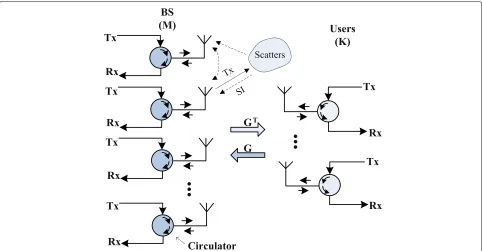
time-Fig. 1Data transmission and reception with SI at the BS in the shared-antenna FD massive MU-MIMO system
frequency resource. Therefore, theM×1 uplink received signal at the BS is given as
yBS =√puGxu+√pdGss+n, (1)
where the first term represents the desired signal, and the second term represents the SI from the downlink trans-mission.Gis theM×K channel matrix between theK users and the BS;xudenotes the symbols transmitted by
the K users with unit power E{xuxHu} = IK, pu is the
transmit power of each user;Gsis theM×MSI channel
matrix between the BS transceivers;sis the downlink pre-coded signal transmitted to theK users with unit power E{sHs} = 1; pd is the downlink transmit power; andn
represents the additive noise with zero mean and unit variance.
2.1 Channel model
The channel matrix G models the small-scale Rayleigh fading and the large-scale path-loss, so we have
G=HD1/2, (2)
whereH is theM×K matrix with i.i.d entries [4], rep-resenting the small-scale fading between theKusers and the BS, and the entryhmkis a circular symmetric complex
Gaussian (CSCG) random variable with zero mean and unit variance, i.e.,hmk ∼CN(0, 1);Dis aK×Kdiagonal
matrix of the large-scale path-loss with [D]kk=βk. Since the physical isolation and active analog SI can-cellation are performed preliminarily, it is reasonable to assume that the SI can be suppressed greatly [26, 28]. The
magnitude of the SI channel can be modeled as Rician distribution with LOS SI [29]. Therefore, we can write the matrixGs as the direct-path plus the reflected-path
coefficients, i.e.,
Gs = ¯Gs+ ˜Gs, (3)
whereG¯sis a complex deterministic matrix with [G¯s]mj= cmj, which represents the antenna intra-leakage and
inter-coupling coefficients related to the direct path, and G˜s
is a complex random matrix that represents the reflec-tion coefficients related to the reflected path. Similar to channel matrixG, random matrixG˜scan be expressed as
˜
Gs = ˜HsD˜1s/2, (4)
where H˜s is anM×M matrix with i.i.d. entries
repre-senting the small-scale fading. We suppose [H˜s]mj=hs,mj,
wherehs,mj is a CSCG random variable with zero mean
and unit variance, andD˜sis anM×Mdiagonal matrix of
the large-scale path-loss, where [D˜s]mm= β, namely, all
of the SI large-scale path-loss coefficients are assumed to be identical. This assumption is reasonable, as the antenna array size is much smaller than the distance to the scatters. If these coefficients are not identical, we can set all the ele-ments of SI channel matrixG˜sto be the maximum value
βmax, which represents the worst case, thenG˜sbecomes a
matrix with identical large-scale fading.
signal channel matrix are mutually orthogonal [4], and so do the vectors of the SI channel matrix. We then have
GHG
(6) and (7) are given in Appendix.
2.2 Channel estimation
Channel estimation is a prerequisite for SI suppression. Commonly, a series of orthogonal training sequences is sent within a period 2τ, which is a small part of the chan-nel coherence timeT. The channel training/estimation is performed in half-duplex. Therefore, theM×τ received pilot matrix for the uplink channel and SI channel at the BS can be written as
Yu=
where Pu and Pd are the transmit powers of pilot
sequences for the uplink and downlink, respectively. Sup-pose that the power of each pilot symbol equals the aver-age power of data transmission, then we havePu = τpu
and Pd = τpd; u = d are K × τ matrices whose
rows are the pilot sequences for the estimation of the signal channel and SI channel. The pilot matrices satisfy uHu =dHd =IK andτ ≥K;Ais anM×K
precod-ing matrix, which is used for downlink beamformprecod-ing and updated from the uplink channel estimation;NandNsare
M×τ AWGN matrices with i.i.dCN(0, 1)entries.
2.2.1 Signal channel estimation
The signal channel is estimated in the first training period
τ. Given Yu, the MMSE estimate of G can be written
distributed asCN(0, 1). Letdenote the estimation error ofG, then we have
G= ˆG+. (11)
According to the property ofstatistician’s Pythagorean theorem of the MMSE estimation [30], the estimation erroris independent ofGˆ. Therefore, thekth columns
ofGˆ andare mutually independent, and the elements of thekth vector are distributed asCN(0,βkˆ )andCN(0,βk)˜ ,
respectively, withβkˆ τpuβ2k
τpuβk+1andβk˜ βk τpuβk+1. Note that the shared-antenna array massive MIMO sys-tem has a single array, so the transmit and receive CSI are the same during the coherent time. We only need to esti-mate the uplink channel, and thus the estimation overhead is reduced by half. This is different from the separate-antenna arrays system, where the CSI of the receive and transmit arrays are different, the uplink and downlink CSI have to be estimated separately.
2.2.2 SI channel estimation
The SI channel is estimated in the second training period
τ. In fact, it is not necessary to estimateGs, we can
esti-mate the equivalent or precoded SI channelGsa instead,
which represents the product of Gs and A. The new
precoding matrix A can be updated for the SI channel estimation afterGˆ is acquired. BecauseGsahas the same
dimension as the uplink channel G, the training pilot length and pilot amount depend on the user numberK rather than the number of BS antennasM. Therefore, the dimension of the SI channel estimation can be decreased fromM×MtoM×K, and thus fewer orthogonal pilot sequences are needed. Note that the proposed training and estimation method is different from the traditional SI acquisition method where the SI is directly estimated with/without pilots [22].
The precoding matrixAis derived fromGˆ. For a linear precoding scheme such as ZF or MRT,Ais given as
A= normalization factors [26] satisfyingE{sHs} =1.
Proposition 1 In the shared-antenna FD massive MU-MIMO system, the SI equivalent channelGsa=GsAis an
M×K complex Gaussian matrix if K is fixed and M →
Proof. Please see Appendix.
treated as Rayleigh channel. Like the signal channelG,Gsa
can be estimated by MMSE ifYsis given. LetEdenote the
estimation error matrix ofGsa, we then have
Gsa = ˆGsa+E, (13)
2.3 Uplink decoding under precoded SI
Precoding can be used in the training phase for the SI channel estimation, and it can also be used in the data transmission phase for beamforming, which can help enhance the strength of the desired signal and reduce the interference to others. During the data transmission period, the ZF or MRT scheme is adopted by the BS for the downlink beamforming. Correspondingly, the BS receives the precoded SI from the transmitters, and it uses the ZF or MRC linear processing method for the uplink decoding. Supposexdis aK×1 data vector transmitted from the
BS to the users with unit powerE{xdxHd} = IK, ands=
Axd. (1) can be rewritten as
yBS =√puGxu+√pdGsAxd+n. (14)
To decode the uplink data ofK users, the BS receiver will multiply a linear matrix WT beforeyBS, which is a function of the signal channel estimation, i.e.,
WT =
With the uplink linear receiver at the BS, the user data can be decoded as
r=WTyBS =√puWTGxu+√pdWTGsAxd+WTn,
(16)
where√puWTGxu is the desired signal,√pdWTGsAxd
is the SI between the BS transceivers, and WTn is the additive noise.
Further, from (11) and (13), we have
r=√puWTGxˆ u+√puWTxu
+√pdWTGˆsaxd+√pdWTExd+WTn, (17)
where√puWTGxˆ uis the estimated signal,√pdWTGˆsaxd
is the SI from the estimation, √puWTxu and
√p
dWTExd are the estimation errors of the desired
signal and SI, respectively.
3 SI suppression and achievable rate
In the massive MIMO system, the white noise and the inter-user interference can be eliminated by an LALP method [15, 19, 31]. In this section, we consider the
shared-antenna FD massive MU-MIMO system and dis-cuss the combined SI suppression based on the estimated channels of signal and SI. We also derive the closed-form lower bounds of the uplink achievable rates, which can be used as a system performance metric.
3.1 SI suppression with LALP
In the TDD half-duplex (HD) system, the interferences are asymptotically orthogonal to the subspace spanned by the desired signals when the antenna-array scale M approaches infinity. The desired signal can be recovered by projecting the received signal in a desired subspace with linear processing [19, 26]. In the shared-antenna FD massive MU-MIMO system, the asymptotic orthogonal-ity property still holds true. Unlike the separate-antenna array system [26], the SI in our model includes the non-random direct-path interference, and the uplink channel is totally dependent on the downlink channel, as the same antenna array is employed to transmit and receive signals simultaneously.
Theorem 1In the shared-antenna FD massive MU-MIMO system, when the signal and SI channels are not perfectly estimated and ZF or MRT/MRC linear process-ing is adopted, the SI at the BS will vanish if K is fixed and M→ ∞.
Proof.We consider the SI term√pdWTGsAxdof (16).
From (5) and (7), we have GMHG = Dand trGsGHs = O(M2) when M → ∞. According to the properties of
MMSE estimation, we know that the estimated channels ˆ
GandGˆsaare independent on the estimation errorsand
E, respectively, and they are zero-mean complex Gaussian matrices as well. Substituting (12) and (15) intoWTGsA,
wheregˆiandgˆjare theith andjth column ofG, respec-tively. Thus, we have the SI term of (17)
√
pdWTGˆsaxd−→a.s. 0K×1, (22)
and √
pdWTExd−→a.s. 0K×1, (23)
for ZF and MRT/MRC linear processing schemes.
Remark:In the shared-antenna FD massive MU-MIMO system, the decoding matrix WT and the precoding matrix A in the SI term are totally dependent because of the channel reciprocity between uplink and downlink. This is different from the FD relay massive MIMO sys-tem where the source-relay and relay-destination channels are independent. According to Lemma 13 in [32] and Theorem 3.7 in [33], the LALP suppression capability is O(1/M1/2), and it is different from [26] where the LALP suppression capability isO(1/M)for the separate-antenna arrays.
Proposition 2 In the shared-antenna FD massive MU-MIMO system with imperfect channel estimation, if K is fixed and M→ ∞, the decoded uplink signal vector at the BS is
r−→a.s. √puxu, (24)
for the ZF precoding and decoding and
ˆ
D−1r−→a.s. √puxu, (25)
for the MRT/MRC precoding and decoding, where[Dˆ]kk=
ˆ
βkandβkˆ τpuβ2k
τpuβk+1, k=1,. . .,K .
Proof. According to (5), (11), (16), and Theorem 1, the results can be obtained.
3.2 Combined SI suppression
Practically, the number of antennas cannot be infinite, the LALP method cannot ideally suppress the SI, especially for the dependent shared-antenna array. As mentioned above, the SI in the FD massive MU-MIMO system can be estimated by the MMSE through a precoded SI channel training process, thus the known SI can be removed before the LALP suppression. After the SI removal, the remain-ing interference becomes much weaker, and the LALP can be further adopted to suppress the remaining SI. There-fore, the suppression capability is greatly improved by combining the two suppression methods.
As shown in (17), the term√pdWTGˆsaxdis known by
the BS. We can subtract it from the received signalr, so that (17) can be rewritten as
ˆ
r=√puWTGxˆ u+√puWTxu+√pdWTExd+WTn,
(26)
whererˆ=r− √pdWTGˆsaxd. Thekth decoded signal can
then be expressed as
ˆ
rk =√puwTkgˆkxk+√pu
K
i=1,i=k wTkgˆixi
+√pu
K
i=1
wTkδixi+√pd
K
i=1
wTkixdi +wTkn,
(27)
wherewk,gˆk,δi, andiare thekth orith column ofW,Gˆ,
, andE, respectively;xk andxdi are thekth andith
ele-ment ofxuandxd, respectively;√puwTkgˆkxkis the desired
signal from thekth user;√pu Ki=1,i=kwTkgˆixiis the
inter-user interference;√pu Ki=1wTkδixiis the estimation error
from the signal channelG;√pd Ki=1wTkixdi is the
esti-mation error from the SI equivalent channelGsaandwTkn
is the additive noise.
Theoretically, the SI and other interferences and noise can be suppressed as much as possible, and the achiev-able rate of users can approach infinity with the increase of the antenna array scale. Practically, tens or hundreds of antennas can be a good approximation of infinity [4, 34].
3.3 Achievable rate
In this subsection, we will discuss the uplink achievable rate of the shared-antenna FD massive MIMO system for the LALP and the combined suppression.
3.3.1 Combined method
From (27), thekth user uplink achievable rate is given as
Rk =E{log2(1+γk)}, (28)
whereγkis given as
γk= puwTkgˆk
2
pu
K
i=1,i=k
wTkgˆi2+pu
K
i=1
wTkδi2+pd
K
i=1
wTki2+wTk2
.
(29)
3.3.2 LALP only
If we estimate the signal channel and suppress the SI by the LALP method only, we have
rk =√puwkTgˆkxk+√pu
K
i=1,i=k wTkgˆixi
+√pu
K
i=1
wTkδixi+√pd
K
i=1
where gsa,i is the ith column of Gsa, i = 1, ...,K;
√p
d Ki=1wTkgsa,ixdi is the SI. Thekth user achievable rate
with imperfect estimation and the LALP method only can be expressed as
3.3.3 Perfect channel estimation
We compare the achievable rate of the imperfect case with the perfect case and verify the accuracy of the channel estimation. If the perfect CSI can be obtained, the signal channel estimation error and the SI terms can be removed from (32). By setting the estimation error as zero in (27), the uplink decoded signal of the kth user with perfect estimation can be obtained as
rk =√puwkTgkxk+√pu
achievable rate with perfect CSI can be given as
Rk =Elog21+γk, (34)
3.4 Achievable rate lower bounds of the combined method
From (28), we can derive the lower bounds of the achievable rates for the combined method with ZF and MRT/MRC linear processing.
Lemma 1In the shared-antenna FD massive MU-MIMO system, the random variable g˜i =
wTkgˆi
wTk is a
zero-mean complex Gaussian variable with varianceβiˆ, which is independent onwTk if K is fixed and M → ∞,
whereβiˆ = τpuβ2i
τpuβi+1, i=1, ...,K , i=k.
Proof.Please see Appendix A of [19].
Lemma 2In the shared-antenna FD massive MU-MIMO system, the random variable δi˜ = w
T kδi
wTk is a
zero-mean complex Gaussian variable with varianceβi˜, which is independent onwTk if K is fixed and M → ∞, whereβi˜ = βi
τpuβi+1, i=1, ...,K .
Proof.According to the optimum MMSE estimation property,δiis independent ofgˆifori= 1, ...,K. Similarly,
as the proof of Lemma 1, we can obtain the result.
Lemma 3In the shared-antenna FD massive MU-MIMO system, the random variable i˜ = w
T ki
wTk is a
zero-mean complex Gaussian variable with variance ρi˜, which is independent onwTk if K is fixed and M → ∞, whereρi˜ = M1 Mm=1 ρm,i
τpdρm,i+1, i=1, ...,K .
Proof.Please see Appendix.
Proposition 3With the combined scheme of SI removal and ZF large-scale antenna linear processing, the kth uplink achievable rate in the shared-antenna FD massive MU-MIMO system is lower-bounded by
RZk =log2 and Jensen’s inequality, from (28), we can obtain
Rk≥log2
Gaussian variables with variances of βi˜ and ρi˜, respec-tively, so we have
Rk≥log2
Then, by using the property of Wishart matrices E{tr(M−1)} =K/(M−K)(Lemma 2.10) in [34], we have Substitute (39) into (38), we can obtain the result.
Proposition 4With the combined scheme of SI removal and MRT/MRC large-scale antenna linear processing, the kth uplink achievable rate in the shared-antenna FD mas-sive MU-MIMO system is lower-bounded by
RMk =log2
for the MRT/MRC linear processing. Similarly, from (28) and by using Jensen’s inequality, we have
Then, by using the property of the Wishart matrix (Lemma 2.10) in [34], we get
Egˆk−2=E(gˆHkgˆk)−1= 1
(M−1)βkˆ , for M≥2. (42)
From Lemma 1, Lemma 2, and Lemma 3, by substituting (42) into (41), we obtain the result.
4 Spectral efficiency and energy efficiency The SE and EE are important performance metrics for next-generation mobile communication systems. In this section, we discuss the SE and EE of a shared-antenna FD massive MU-MIMO system with the combined SI suppression method.
4.1 SE and EE
4.1.1 SE and EE for the FD
Generally, the system SE can be defined as the sum-rate per site or sum-rate per cell. According to (28), the SE of the SI suppression and channel estimation in the shared-antenna FD massive MU-MIMO can be given as
Sf=
The EE is defined as the SE divided by the total transmit power, so we have
Ef =
In comparison, the SE and EE of the HD system can be given as
We can see that the SE of the HD system is smaller than that of the FD system when the antenna scale is large enough, because it transmits data only half of the time. In contrast, the EE is slightly higher because there is no SI and fewer training overhead in the HD system.
4.1.3 Lower bounds of SE and EE
Replacing Rk by RZk and RMk , we can obtain the lower
bounds of the SE and EE for the shared-antenna FD mas-sive MU-MIMO system with imperfect estimation. By substituting (36) and (40) into (43) and (44), we have
and
EAf = T−2τ TKpu
K
k=1
RAk, (49)
where the superscriptAis “Z” or “M”, which represents ZF or MRT/MRC. The lower bounds are in the closed form, so they can be easily used to show the system performance.
4.2 Maximizing SE and EE
4.2.1 Maximizing SE
The SE monotonically grows with the antenna array scale Mand the uplink transmit powerpu. We suppose thatM
andpuare fixed andMis large. In this case, only the
train-ing lengthτ affects the SE, and the optimization problem can be formulated as
max τ Sf(τ)
s. t. K≤τ ≤T/2, (50)
This problem is neither linear nor convex, and it is even difficult to solve using the linear search because of the expectation operation and the large dimensions of the channels. Fortunately, the SE can be approximated by the lower bounds of (48), because they are very close after the further SI suppression with the combined method, which can be seen in the subsequent simulations in next section. Then, the maximization problem can be approxi-mated as
max τ SAf (τ)
s. t. K≤τ ≤T/2. (51)
This problem can be numerically solved by the linear search, the simulation in the next section shows that this solution is global optimal when the antenna scaleM is large enough.
4.2.2 Maximizing the EE
The EE of the FD massive MU-MIMO system monotoni-cally increases withM, but not withpu. Because it has the
same solution as the SE forτ, here we only focus onpu.
The antenna-scaleMis large and fixed, so the problem of maximizing the EE can be expressed as
max
pu
Ef(pu)
s. t. 0<pu≤p0.
(52)
Similarly, the EE can be approximated by the lower bound in (49) when the antenna-array scale Mis large enough. The maximization problem can be modified as
max
pu E
A
f(pu)
s. t. 0<pu≤p0.
(53)
It can be numerically solved by the linear search, the simulation in the next section shows that this solution is also global optimal.
4.2.3 Tradeoff of EE versus SE
The maximal EE can be obtained at the point(τ∗, p∗u). However, the SE decreases monotonically with the decreasing pu. To keep a reasonable uplink throughput,
the SE is lower constrained. Therefore, the optimal p∗u should be constrained by the SE requirement. The opti-mal value p∗u is adopted if the minimum SE is satisfied; otherwise, the tradeoff value p∗u ,which meets the SE requirement, is used.
5 Numerical and simulation results
In this section, we present the performance results of the shared-antenna FD massive MU-MIMO system. All the users work in FD mode with a single antenna, and the insertion loss of the circulators is neglected. The number of users is given asK = 4. Unless stated otherwise, the system parameters are set as follows: The coherent time T of the uplink data transmission is 400 (symbol length), and the training lengthτ of each channel is 8. The nor-malized uplink powerpu and the downlink powerpdare
set as 10 dB and 13 dB, respectively. Similarly, as [26], the large-scale path-lossβk(k =1, 2, 3, 4) of the signal chan-nel is set as 0.749, 0.246, 0.125, and 0.635, respectively; The large-scale path-lossβof the SI channel is set as 0.6, and the direct-path SI coefficientcmjis set as arbitrary but
deterministic values in a circle on the complex plane with radius 0.33.
5.1 Achievable rate and lower bounds
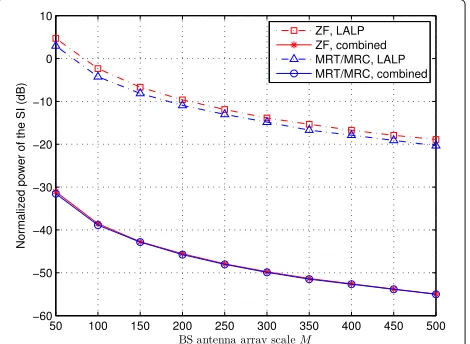
We obtain the numerical results according to (28), (31), (34), (36), and (40). The SI suppression and the achiev-able rate for the 2nd user are shown in Fig. 2 and Fig. 3, respectively. We can see that both the large-scale antenna linear processing method and the combined method can suppress the SI as well as the inter-user interferences and noise like [4, 15, 19, 26]. Our combined suppression
Fig. 3Achievable rate of the 2nd user with perfect/imperfect estimation vs. the antenna array scaleM
method significantly outperforms the LALP method. As shown in Fig. 2, at the scale ofM = 300, the SI level is -14 dB by using the ZF linear processing only. In contrast, the SI is -50 dB by using the combined method, provid-ing an additional 36 dB suppression. Hence, the achievable rates for the imperfect estimation are close to the perfect cases. For example, there are small gaps of approximately 1 bits/s/Hz for the ZF and 0.2 bits/s/Hz for the MRT/MRC with M = 50 in Fig. 3. Therefore, a higher data rate can be achieved at the same scale of the antenna array, or fewer antennas are required at the same data rate. For instance, the achievable rate increases from 5.3 bits/s/Hz to 8.5 bits/s/Hz at the antenna scaleM=300 for the ZF, while the scaleMdecreases from about 450 to 200 at the achievable rate of 5.1 bits/s/Hz for the MRT/MRC linear processing.
Figure 4 also shows the achievable rates and their lower bounds for the 2nd and 4th users. We can see that the lower bounds are very close to the simulation results when M is large enough. For example, there is a small gap of approximately 0.2 bits/s/Hz when M is 50 for the MRT/MRC, and the gap is even smaller for the ZF (the 2nd user). Therefore, it is reasonable to approximate the SE with the lower bounds.
5.2 SE and EE with SI suppression
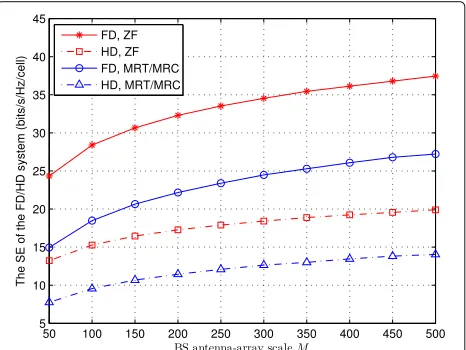
Figure 5 and Fig. 6 show the SE and EE of the FD and HD systems versus the antenna array scale according to (43), (44), (45), and (46). We can see that the SE gets larger with the increase of the antenna array scaleMfor both the HD system and the FD system. The SE of the FD system is almost twice as high as that of the HD, as shown in Fig. 5, when employing our combined suppression method.
The EE of the FD system is slightly lower than that of the HD system because of the residual SI in the FD system, but
Fig. 4Achievable rate lower bounds of the 2nd and 4th users with imperfect estimation vs. antenna array scaleM
the gaps are very small, so it is worth acquiring twice the SE by losing some EE. Furthermore, the EE grows with the increase of the antenna array scaleM, so the performance is much better than that of the traditional FD system when Mis large enough.
5.3 Maximizing SE and EE
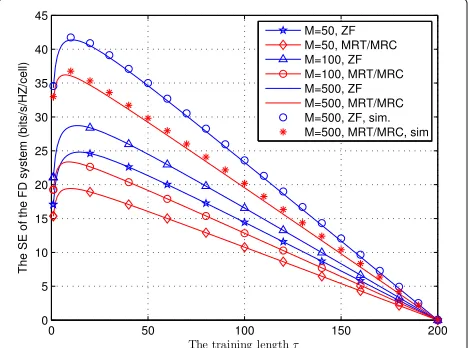
Figures 7 and 8 show the SE and EE of the FD system based on (51) and (53). The scaleMis supposed to be fixed and large enough. As shown in Fig. 7 and Fig. 8, both the SE and EE get higher at first and then turn lower. The approx-imate SE and EE are very close to the real values for large M, for example,M= 500. Since it is inefficient and time-consuming to search the optimal values with the Monte Carlo simulations, a good choice is to search the optimal values using the approximation. Simulations show that the SE increases whenτis small (τ <10), and decreases when
Fig. 6EE vs. antenna array scaleMfor the FD and HD systems
τ is large, this is because the channels can be trained and estimated more sufficiently with the increase ofτ. How-ever, the data transmission time will be shortened if τ is too big. The similar results can be seen for the EE in Fig. 8, because the SE increases quadratically withpuwhen
puis small, while it increases logarithmically when pu is
big. The SE or EE increases with the antenna array scale M, because more SI can be suppressed and less training time/uplink transmit power is required whenMis larger.
6 Conclusion
We introduced and analyzed a full-duplex massive MU-MIMO system with a single shared-antenna array at the BS. Either the ZF or MRT/MRC method can be adopted to linearly process signals, and a novel training scheme via the precoded SI channel is proposed to estimate the SI with a much lower dimension. We proved that the SI
Fig. 7SE vs. training lengthτfor the FD system
Fig. 8EE versus uplink transmit powerpufor the FD system
can vanish by using the large-scale antenna linear process-ing method even if the SI/signal channels are not perfectly estimated and the uplink/downlink channels completely depend on each other. By combining the SI removal and the LALP method, we show that the SI can be suffi-ciently suppressed. We also derived the closed-form lower bounds of the achievable rates and showed that they are very close to the simulation results. With the combination of the SI suppression, the “large enough” number of anten-nas can be scaled down, and the FD massive MU-MIMO system significantly outperforms the half-duplex system in terms of SE.
Appendix
Derivations of (6) and (7)
From (3), we have
GHs Gs
M =
(G¯Hs + ˜GHs )(G¯s+ ˜Gs) M
= (G¯Hs Gs¯ + ˜GHs Gs¯ + ¯GHs Gs˜ + ˜GHs Gs)˜
M . (54)
Since the direct-path interference is suppressed by the physical isolation and analog domain cancelation, the direct-path channel coefficients cmj are not infinity.
Because all of the entriescmj ofG¯s are bounded and all
of the entries ofG˜s are i.i.d. Gaussian random variables
with zero mean, we obtain [G¯HsG˜s]mj
M ≈ 0 whenMis large
enough, so we have
GHs Gs
M ≈
(G¯Hs G¯s+ ˜GHs G˜s)
From (6), we have Hence, we can obtain (6) and (7) whenMis large enough.
Proof of Proposition 1
Theith columngsa,iof matrixGsacan be written as
gsa,i=Gsai, (58)
whereai is theith column ofA, so themth entry ofgsa,i
can be given as
gsa,mi=gs,mai, (59)
Similarly, we can obtain
Egsa,mi2
for the MRT precoding.
Proof of Lemma 3
Theith columniof matrixEcan be written as
i=gsa,i− ˆgsa,i. (63)
Note that the correlation between wk and i is zero
becausewk andgsa,i are independent fori = k, and the correlation disappears fori = kwhenM→ ∞. Accord-ing to the optimum estimation of MMSE,iis a Gaussian
random vector, and the variance of the mth entry fori
is ρm,i
τpdρm,i+1. Similarly, from the Lyapunov central limit theorem [35] and Proposition 1, we can derive that the
variable i˜ = w
is a zero-mean complex Gaussian
variable, and the variance is
E|˜ i|2= 1
This work was supported by the National Natural Science Foundation of China (61371188), Research Fund for the Doctoral Program of Higher Education (20130131110029), China Postdoctoral Science Foundation (2014M560553), Special Funds for Postdoctoral Innovative Projects of Shandong Province (201401013).
Competing interests
The authors declare that they have no competing interests.
Received: 3 June 2016 Accepted: 2 January 2017
References
1. A Sabharwal, P Schniter, D Guo, DW Bliss, S Rangarajan, R Wichman, In-band full-dulex wireless: Challenges and opportunities. IEEE J. Sel. Areas Commun.32(9), 1637–1652 (2014)
2. S Hong, J Brand, JI Choi, M Jain, J Mehlman, S Katti, P Levis, Applications of self-interference cancellation in 5G and beyond. IEEE Commun. Mag. 52(2), 114–121 (2014)
3. EG Larsson, O Edfors, F Tufvesson, TL Marzetta, Massive MIMO for next generation wireless systems. IEEE Commun. Mag.52(2), 186–195 (2014) 4. F Rusek, D Persson, BK Lau, EG Larsson, TL Marzetta, O Edfors, F Tufvesson,
Scaling up MIMO: Opportunities and challenges with very large arrays. IEEE Signal Process. Mag.30(1), 40–60 (2013)
5. Z Zhang, X Chai, K Long, AV Vasilakos, L Hanzo, Full duplex techniques for 5G networks: Self-interference cancellation, protocol design, and relay selection. IEEE Commun. Mag.53(5), 128–137 (2015)
6. X Jia, P Deng, L Yang, H Zhu, Spectrum and energy efficiencies for multiuser pairs massive MIMO systems with full-duplex amplify-and-forward relay. IEEE Access.3, 1907–1918 (2015)
7. TL Marzetta, Noncooperative cellular wireless with unlimited numbers of base station antennas. IEEE Trans. Wireless Commun.9(11), 3590–3600 (2010)
8. JI Choi, M Jain, K Srinivasan, P Levis, S Katti, inProc. ACM MobiCom On. Achieving single channel, full duplex wireless communications, (Chicago, 2010), pp. 1–12
9. S Goyal, P Liu, SS Panwar, RA Difazio, R Yang, E Bala, Full duplex cellular systems: Will doubling interference prevent doubling capacity? IEEE Commun. Mag.53(5), 121–127 (2015)
10. KM Thilina, H Tabassum, E Hossain, DI Kim, Medium access control design for full duplex wireless systems: Challenges and approaches. IEEE Commun. Mag.53(5), 112–120 (2015)
11. Y Liao, K Bian, L Song, Z Han, Full–duplex MAC protocol design and analysis. IEEE Commun. Lett.19(7), 1185–1188 (2015)
12. L Wang, F Tian, T Svensson, D Feng, M Song, S Li, Exploiting full duplex for device-to-device communications in heterogeneous networks. IEEE Commun. Mag.53(5), 146–152 (2015)
13. M Heino, D Korpi, T Huusari, E Antonio-Rodriguez, et al, Recent advances in antenna design and interference cancellation algorithms for in-band full duplex relays. IEEE Commun. Mag.53(5), 91–101 (2015)
14. L Song, Y Li, Z Han, Resource allocation in full-duplex communicaitons for future wireless networks. IEEE Wireless Commun.22(4), 88–96 (2015) 15. J Hoydis, ST Brink, M Debbah, Massive MIMO in the UL/DL of cellular
networks: How many antennas do we need? IEEE J. Sel. Areas Commun. 31(2), 160–171 (2013)
16. X Rao, VKN Lau, Distributed compressive CSIT estimation and feedback for FDD multi-user massive MIMO systems. IEEE Trans. Signal Process. 62(12), 3261–3271 (2014)
18. L Lu, GY Li, AL Swindlehurst, A Ashikhmin, R Zhang, An overview of massive MIMO: Benefits and challenges. IEEE J. Sel. Topics Signal Process. 8(5), 742–758 (2014)
19. HQ Ngo, EG Larsson, TL Marzetta, Energy and spectral efficiency of very large multiuser MIMO systems. IEEE Trans. Commun.61(4), 1436–1449 (2013)
20. X Pang, W Hong, T Yang, L Li, Design and implementation of an active multibeam antenna system with 64 RF channels and 256 antenna elements for massive MIMO application in 5G wireless communications. China Commun.11(11), 16–23 (2014)
21. TL Marzetta, inProc. IEEE Asilomar Conference on Signals, Systems and
Computers (ACSSC06) On. How much training is required for multiuser
MIMO? (Pacific Grove, 2006), pp. 359–363
22. T Riihonen, S Werner, R Wichman, Mitigation of loopback self-interference in full-duplex MIMO relays. IEEE Trans. Signal Process.59(12), 5983–5993 (2011)
23. E Everett, A Sahai, A Sabharwal, Passive self-interference suppression for full-duplex infrastructure nodes. IEEE Trans. Wireless Commun.13(2), 680–694 (2014)
24. D Bharadia, E McMilin, S Katti, inProc. ACM SIGCOMM On. Full duplex radio, (Hong Kong, 2013), pp. 375–386
25. M Duarte, A Sabharwal, V Aggarwal, et al, Design and characterization of a full-duplex multiantenna system for WiFi networks. IEEE Trans. Veh. Technol.63(3), 1160–1177 (2013)
26. HQ Ngo, HA Suraweera, M Matthaiou, EG Larsson, Multipair full-duplex relaying with massive arrays and linear processing. IEEE J. Sel. Areas Commun.32(9), 1721–1737 (2014)
27. P Xing, J Liu, C Zhai, X Wang, L Zheng, Self-interference suppression for the full-duplex wireless communication with large-scale antenna. Trans. Emerg. Telecom. Technol.27(6), 764–774 (2016)
28. Z Zhang, Z Chen, M Shen, B Xia, Spectral and energy efficiency of multi-pair two-way full-duplex relay systems with massive MIMO. IEEE J. Sel. Areas Commun.34(4), 848–863 (2016)
29. M Duarte, C Dick, A Sabharwal, Experiment-driven characterization of full-duplex wireless systems. IEEE Trans. Wireless Commun.11(12), 4296–4307 (2012)
30. S Haykin,Adaptive Filter Theory, 4th edn. (Prentice-Hall, Upper Saddle River, 2002)
31. H Yang, TL Marzetta, Performance of conjugate and zero-forcing beamforming in large-scale antenna systems. IEEE J. Sel. Areas Commun. 31(2), 172–179 (2013)
32. J Hoydis,Random matrix theory for advanced communication systems, Ph.D. dissertation. (Supelec Univ., France, 2012)
33. R Couillet, M Debbah,Random matrix methods for wireless
communications, 1st edn. (Cambridge Univ. Press, New York, 2011)
34. AM Tulino, S Verdu, Random matrix theroy and wireless communications. Foundations Trends Commun. Inf. Theory.1(1), 1–182 (2004)
35. RJ Serfling,Approximation Theorems of Mathematical Statistics, 2nd edn. (John Wiley & Sons, New York, 1980)
Submit your manuscript to a
journal and benefi t from:
7Convenient online submission 7Rigorous peer review
7Immediate publication on acceptance 7Open access: articles freely available online 7High visibility within the fi eld
7Retaining the copyright to your article