e-ISSN: 2278-7461, p-ISSN: 2319-6491
Volume 7, Issue 6 [Jun 2018] PP: 16-21
The Effect of Non-Natural Disaster on Iraqi E-Services Situation:
Review and Conceptual Model
Saifuldeen H. Abdulrahman
1, Siti Sakira Kamaruddin
2And Nafishah Othman
3 1, 2, 3School of Computing, Universiti Utara Malaysia, 06010 UUM Sintok, Kedah, MalaysiaCorresponding Author: Saifuldeen H. Abdulrahman
Abstract:
During and after the latest civil conflict erupted since 2014, there is lack of studies that shed the light on the situation of the Iraqi e-services. These services, like another life subjects, influenced negatively by these harsh situations. The e-service could fit and serve affected citizens due to the difficulties and risks that hinder their access to the government premises. Affected citizens’ viewpoint during a non-natural disaster is critical to clarify the real situation of this kind of services. This study attempts to fill this gap in the literature and handling the lack of knowledge facing the services providers in unstable countries. This article shows firstly the conceptual model of the main fundamentals that lead to fruitful Iraqi e-services. These fundamental are availability, benefit, cost, Internet speed, satisfaction, routine, time, and flexibility. Secondly, this article illustrates the method and procedures that will be followed to survey the internally displaced people in Iraq regarding the situation of these services in such unstable environment.Keywords:
Civil Conflict, E-services, Internally Displaced People, Modelling, Service Delivery.--- Date of Submission: 31-05-2018 Date of acceptance: 15-06-2018
---I. INTRODUCTION
Various substantial changes in daily life nowadays caused by the prevalence of Information and Communication Technologies (ICT) [1, 2]. The majority of society sectors (i.e. organizations and governments) profoundly affected by the rapid developments in ICT. ICT promoted emerging fields as service dissemination methods (e.g. e-learning, e-commerce, e-services). ICT popularity plays a fundamental role in re-engineered entire service processes globally and serve government agencies in improving its interaction with beneficiaries and heighten their work performance [2-4]. Just as the daily life has been influenced positively by the ICT application, it is negatively affected by disasters and calamities. Different reigns and countries currently face various types of disasters. Governments are attempting to adopt more ICT to improve emergency response and rescue operations. Disasters can be divided into two types: natural disasters (e.g. earthquakes, floods, and hurricanes) and non-natural or man-made disasters (e.g. war, conflicts, and violence) [5-7].
The first inducement to carry out this study is that research on ICT in non-natural disasters are rare [3, 4, 8]. Existing studies on ICT usage in non-natural disasters had highlighted how the various technology applications are used by affected citizens to mitigate disaster impacts of disasters within an affected region. However, the researchers neglected the role of e-services during and after non-natural disasters [2-4, 8, 9]. In non-natural disasters (e.g. civil conflict erupted in Iraq since 2014), e-services are necessary because it is dangerous and difficult for the affected citizens such as Internally Displaced People (IDP) to reach to the government sites, and this is where these services could fit and serve the purpose [3, 8].
The second inducement is that the large-scale ICT projects (e.g., e-services) in post-conflict areas remain under extreme situations with numerous additional complicating features [1, 10]. This indicates that the situation of e-services has likely worsened after the ISIS war erupted in Iraq [11]. Steps to investigate the status of the Iraqi e-services to achieve successful implementation in war environment are necessary.
of the citizens‟ point of view, especially IDPs, to increase the usage acceptance of e-services in Iraq, as a one of countries suffering from non-natural disaster (conflicts and violence).
II. LITERATUREREVIEW
1.1 E-service in Iraq
Evaluating the Iraqi e-services‟ efficiency and technical sophistication is critical issue, because maybe it is not at the acceptable level to accomplish the governmental transactions. Iraqi e-services project at present reached the two-way interaction stage in the e-services projects development [23], which is satisfactory stage. The majority of Iraqi ministries in touch with the Iraqi citizens by many transactions for services they deliver. It is worth mentioning that many transactions can accomplish by relying (even partially) on Iraqi e-services, which helps to shorten steps and reduce the time and effort to accomplish the transaction [21, 24, 25]. Iraq has three main electronic centers for the delivery of e-services; Baghdad, Nasiriya, and Erbil. However, it is noteworthy that the offices belong to directorates of the Ministry of the Interior have suffered the largest crowds of IDPs [13, 26], because of the lack of identity documents and the seeking of IDPs to issuing missing documents [27].
There are many benefits achievable from the expansion of implementing these services in Iraq. Examples are the enhancement of good governance, transparency and accountability among the agencies; thus, increase the mutual trust between the government and their citizens. The e-services reduces the running cost of the government administration, so it makes the government budget more reasonable and masses-friendly. Finally, the government to business service will enhance and strengthen the intra-agency communication within all levels of the government and the entire society as well [28, 29]. According to [3, 8], the known advantages of e-services in stable environments, expansion in unstable and conflicted environments, because of the seriousness of a citizens‟ movement.
1.2 Internally Displaced People
This study will be conducted on the places with civil war and conflict situations which are non-natural disasters. The people in non-natural disasters experience different difficulties than those affected by natural disasters [5]; for example, war victims may face another threat while they in the recovery stage of a recent attack. Furthermore, most of the natural disasters are relatively small in scale, and they take place over a short time period; nevertheless, people who are in the middle of a war experience prolonged disturbances [34, 35]. Victims have to live and adapt to the ever-risky environment and deal with it in their daily lives. These types of victims who are residing in a place rife with the crisis have to develop persistent situational awareness during their day-to-day activities as disruptive forces (bombings and violent killing) can occur anywhere at any time. Hence, the victims‟ concerns and behaviors in war areas are different from those who affected by natural disasters. At the onset of 2014, major conflicts began between the Iraqi government forces and the terrorist organizations called the Islamic State of Iraq and Sham (ISIS). The battles raged on until the present time. To this end, the collapse of the Iraqi army as a result of the fighting led to the loss of over 1/3rd of the Iraqi land, that all came under the control of ISIS. This results in the displacement of 3.3 million citizen were driven away from their homes and businesses in the conflicted and occupied areas towards safer locations (North & South Iraq) as well as to the neighboring countries [36, 37].
The increasing number of displaced people still make many problems in various fields. One of the most significant problems that have arisen is with governmental service‟s fields. Due Iraqi government, until recently, have one channel based on paperwork in the majority of official transactions such as issuing passports, license, birth certificates, death certificates, paying the fines, and else. This channel requires the presence of citizens in government premises. However, according to the Ministry of Interior [14-16], interview with the General Manager of the Nationality Department [12] and with Director of Immigration and Nationality office in Erbil [13], one of the biggest problems faced by the Iraqi government is the great crowds on government premises in IDPs‟ host cities. Which adversely affect the workflow in these offices, or disrupted work completely.
The majority of the services required by the IDPs provided in the Iraqi e-services portal and Ministries‟ web pages – these include e-Passport, e-License, e-Fines, e-Birth Certificates and e-Death Certificates [21]. For instance, there are huge congestions on the passport offices made by the displaced citizens seeking to obtain passports [12, 13]. The number of people waiting outside the offices reaches the thousands a day, while the displaced can complete most of this transaction through the Iraqi e-services [21], this situation indicates to the lack of use of Iraqi e-services among IDPs.
IDPs are facing many challenges and conflicts (kidnapping and killing) as well as insecurity (violence environment). The current conflict affects their life making their move, travel or get help more difficult [3, 8, 27, 38]. The Iraqi displaced people are forced to travel frequently from remote areas (where shelters camps) to city centres to achieve many governmental transactions. Consequently, this may expose them to accidents and cause a great risk to their lives, especially when they are crowding outside the governmental offices making them targeted by terrorists [39, 40].
Moreover, according to the report made by IILHR [27], many displaced families were forced by ISIS to flee quickly without any form of identification. Other IDPs had their documents confiscated by ISIS forces or abandoned them to avoid detection (i.e. Christ, Shabak, Yazidis, Assyrians and Shiites). A late-2014 survey conducted by USAID indicated that 44% of all IDP families had one or more members without a critical national identity card [27]. This issue created some difficulties that further exacerbate the vulnerability of displaced minority members. In particular, lack of identification makes some services unavailable to IDPs and restricts their movement. Identity documentation is also critical for registration with the Ministry of Migration and Displacement, which allows the Iraqi government to track IDPs and provide them with Non-Food Items (NFI) support, such as heaters, stoves, blankets, carpets and plastic sheeting.
III. THEMATERIALANDMETHODS
Figure 2: The main success fundamentals of the e-services application.
Availability, in this case, means the awareness of the citizens about the availability of the governmental services on the Iraqi G2C-ICT services. The benefit, refer in this case to the perceived benefits of the G2C-ICT services for its users, and how it could increase their intention to use the services in the future. The cost in this case refer to the user's belief that using the G2C-ICT services will decreases the cost of governmental transaction. Regarding Internet speed, to investigate if available Internet speeds impact the G2C-ICT services in such difficult circumstances. As for the satisfaction with the service, denote the general satisfying of the citizens with the current G2C-ICT services in Iraq. Routine and time, in this situation refer to the sense of the extent to which G2C-ICT services lead to reduce the normal administrative routine and time in Iraq. As for flexibility, in this case is meant the perceived belief of the citizens that the Iraqi G2C-ICT services are flexible.
Because of the difficult humanitarian situation of the IDP and the hazardous environment surrounding them, the questionnaire should be as simple as possible. Thus, this study will use eight items with the dichotomous scale (yes or no) adapted and translated to Arabic from previous related literature [4, 41, 42], in order to mildly measure these eight fundamentals as illustrated in Table 2.
Table 1: The adapted items for the study
Fundamental Statement Answer
1-Availability I am aware about the availability of e-services in Iraq. Y N 2-Satisfaction In general I am satisfied with the current e-services in Iraq. Y N 3-Benefit I am aware of the benefits of the current e-services in Iraq. Y N
4-Routine E-services reduce the normal administrative routine in Iraq. Y N 5-Cost Usage of current e-services decreases the cost of citizen transaction. Y N 6-Time Current Use of e-services enables me to complete transactions more quickly. Y N
7-Flexibility The current e-services are flexible. Y N
8-Internet speed E-services are affected by Internet speed. Y N
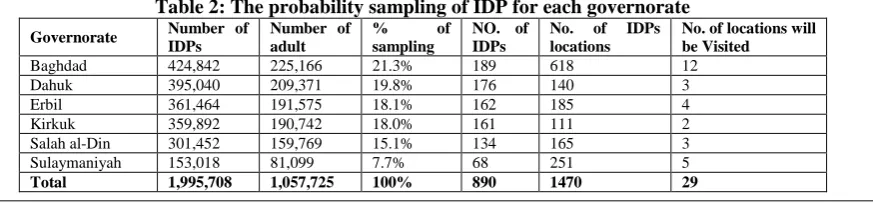
Individual IDP is considered to be the unit of analysis as it is the individual user who utilizes the e-services. After deciding the type of respondents, the task of getting the list of IDPs distributed across provinces of Iraq based on last statistics report and master list issued on 15th of May, 2018 from the International Organization for Migration-Iraq Mission [44]. These statistics indicate that Iraq has about 3.3 Million IDPs, distributed in all governorates of the Republic of Iraq. After piloting, pre-testing and translate the questionnaire, we will be required to complete security clearance procedure, because of the critical and sensitive circumstances in the study area. After that we will distribute the 890 copy of self-administered questionnaire to the adult IDPs settled in 29 places. The places located in the top six provinces in terms of the number of IDPs (Baghdad, Dahuk, Erbil, Kirkuk, Sulaymaniyah, and Salahuldeen).
Table 2: The probability sampling of IDP for each governorate
As shown in Table 3.5, in Baghdad, 189 questionnaire copies distributed because it hosts 225,166 adults constituting 21.3% of the total adult IDPs in the selected six governorates. In Dahuk a number of 176 questionnaire copies have been distributed as it hosts 209,371 adults IDP constituting 19.3% of the total adults IDP in the chosen six governorates. Kirkuk and Erbil host approximately the same number of IDPs; therefore, the number of questionnaire copies for each of them was 162 for Erbil and 161 for Kirkuk. Salah Al-Din hosts approximately 159,769 adult IDPs; therefore, 134 questionnaire have been distributed there. Finally, Sulaymaniyah take the lowest number of questionnaire copies because it hosts 81,099 adult IDPs.
Stratified Random Sampling will be used in this study. It is the most probable sampling design because the researchers can gain more information about a given sample size [45]. Following this further, 890 adult IDPs requested for their opinion concerning the status of e-services, adequate as a sampling size [45] and consistent with the study objective. Furthermore, regarding data analysis techniques, Statistical Package for Social Sciences (SPSS) V21 used in this study.
IV. CONCLUSION
The authors had presented the first parts of the research in this paper, i.e. the research background and problem, literature, objective, issues regarding Iraqi internally displaced people, the research materials and methodology that will be utilize. Research gap has been identified based on the reviewed literature, in which to clarify the situation of e-services from Iraqi IDP perspective after ISIS conflict erupted. This research is timely in the management era of non-natural disaster rampant in the world these days. Several governments (e.g. Iraq [14, 15, 46]) are trying to increase acceptance by highlighting and understanding the reasons behind the lack of use of e-services in such dangerous circumstances. This study attempts to help in reach efficient and wider implementation of e-services among IDPs, which will assist them in accomplishing the needed governmental transactions, saving their lives, money and time, and even contributing slightly to the alleviation of their daily suffering. Moreover, this will enhance transparency and aid in more cost-effective use of the government budget allocated for the IDPs.
As a second contribution, this study will provided valuable knowledge for the e-services‟ suppliers by clarification the situation of this service from the perspective of IDP as civil conflict affected citizens. This knowledge can support them in the development process of the e-services, and draw an effective strategy to increase the IDPs dependence on e-services instead of manual transact in such dangerous environment. As well, it will support the efforts towards alleviating the overcrowding on the governmental offices in the cities hosting IDPs. Thirdly, this study contribute to the existing body of knowledge in the area of IS studies that focus on utilizing ICT among long-term displaced people, particularly in the middle east environment, due to the scarcity in the field of such studies. Furthermore, this study can be used as agenda setting for scholars working in the field of conflicts and their effects on the ICT usage by citizens affected by war.
REFERENCES
[1]. A. Kealy and L. Stapleton, "Progress and Change in Post Conflict Developing Regions: Observations of A Longitudinal Grounded Theory Case Study of a Successful Large Scale ICT Adoption in Kosovo," IFAC-PapersOnLine, vol. 48, no. 24, pp. 77-82, 2015/01/01/ 2015.
[2]. W. J. A. Al-Nidawi, S. K. J. Al-Wassiti, M. A. Maan, and M. Othman, "A Review in E-Government Service Quality Measurement," Indonesian Journal of Electrical Engineering and Computer Science, vol. 10, no. 3, pp. 1257-1265, 2018.
[3]. A. Abraheem and A. Carl, "Conceptual Framework of eService delivery system in Developing Countries with a high level of Instability," SOCRATES, vol. 4, no. 3, pp. 13-34, 2016.
[4]. M. Al-Sammarraie and A. Khaleel, "Factors influence sustainability of egovernment services in most dangerous country in the world," presented at the The 15th Scientific Annual International Conference for Business, Jordan 18-20 April, 2016, 2016. [5]. B. C. Semaan and G. Mark, "'Facebooking' towards crisis recovery and beyond: Disruption as an opportunity," in Proceedings of
the ACM 2012 Conference on Computer Supported Cooperative Work, 2012, pp. 27-36: ACM.
[6]. D. C. Whybark, "Co-creation of improved quality in disaster response and recovery," International Journal of Quality Innovation, vol. 1, no. 1, pp. 1-10, 2015.
[7]. A. Alencar, "Refugee integration and social media: a local and experiential perspective," Information, Communication & Society, pp. 1-16, 2017.
[8]. A. Alsaeed and C. Adams, "E-service adoption in developing countries with instability status: The case of e-government in Syria," in Proceedings of the 15th European Conference on eGovernment 2015: ECEG 2015, 2015, p. 376: Academic Conferences Limited.
[9]. M. Al-Sammarraie, A. Faieq, and K. Al-Qasa, "An instrument design to measure the sustainability of technology in risky environments: Case study of Iraq," AIP Conference Proceedings, vol. 1761, no. 1, p. 020017, 2016/08/12 2016.
[10]. A. Kealy and L. Stapleton, "Rebuilding Hope in Post-conflict Regions: Telemedicine in Kosovo," in Ethical Engineering for International Development and Environmental Sustainability, M. Hersh, Ed.: Springer London, 2015, pp. 275-292.
[11]. ITU, "Measuring the Information Society Report 2017, ICT country profiles," 2017, vol. Volume 2 Available: https://www.itu.int/en/ITU-D/Statistics/Documents/publications/misr2017/MISR2017_Volume2.pdf.
[12]. Al_Sabah, "Start issuing passports for the displaced," in Iraqi Media Net, ed. Iraqi Media Net webpage: Al_Sabah Newspaper 2014. [13]. A. Dalshad, "Thousands of displaced people are trying to obtain passports in Erbil, in the hope of immigration," in Asharq
Al-Awsat, ed. London: Saudi Research and Publishing Co., 2014.
[15]. T. I. M. o. Interior. (2017). The General Directorate of Nationality visits the displaced persons camps in the Aweirij area and issues their citizenship certificate. Available: https://moi.gov.iq/index.php?name=News&file=article&sid=1480
[16]. IHCHR, "IHCHR calls on stakeholders to issue official documents to affected displaced families," IHCHR, Baghdad-Iraq2016, Available: http://ihchr.iq/index.php?name=News&file=article&sid=359.
[17]. IHCHR, "Diyala UNHCR office calls for the formation of a special committee to consider the problems of displaced persons," IHCHR, Baghdad-Iraq2018, Available: http://ihchr.iq/index.php?name=News&file=article&sid=664.
[18]. T. H. C. f. H. Rights-Iraq, "IDPs and Internally Displaced Citizens Report Submitted to UN Human Rights Headquarters," IHCHR, Baghdad-Iraq2015, Available: http://ihchr.iq/upload/upfile/ar/35.pdf.
[19]. M. S. Matthew. (2014). The Residents of Conflict Cities Wishing to Obtain a Passport. Available: http://baretly.net/index.php?topic=38674.0
[20]. A. Mohammed, "Iraq's Displaced Christians Seek New Identities in Baghdad," in Niqash, ed. Sulaimaniah 2014. [21]. Iraq Electronic Services. (2016, February 17). Iraq electronic services. Available: http://www.egs.iq/Default.aspx
[22]. M. Alallaq. (2015, October 28,). Prime minister launches national campaign for streamlining governmental procedures. Available: http://cabinet.iq/ArticleShow.aspx?ID=6253
[23]. A. T. Chatfield and O. Alhujran, "A cross-country comparative analysis of e-government service delivery among Arab countries," Information Technology for Development, vol. 15, no. 3, pp. 151-170, 2009/07/01 2009.
[24]. The Iraqi Ministry of Interior (2014, March 06). Intimation to the citizens of the occupied governorates. Available: http://moi.gov.iq/ArticleShow.aspx?ID=10564
[25]. E. Ibrahim, "A road map to a successful application of e-government in Iraq," Doctoral dissertation, Çankaya University, 2014. [26]. Alsabah, "Start issuing passports for the displaced," in Iraqi Media Net, ed. Iraqi Media Net webpage: Al-Sabah Newspaper 2014. [27]. IILHR, "Between the millstones: Iraq's minorities since the fall of Mosul," Brussels, Belgium2015, Available:
http://reliefweb.int/sites/reliefweb.int/files/resources/MRG_Rep_Iraq_ONLINE.pdf.
[28]. UN-ESCWA, "National profile of the information society In Iraq," United NationsSeptember 2007, Available: www.escwa.un.org/wsis/reports/docs/Iraq-07-E.pdf.
[29]. UNPAN, "UN e-government survey 2014: E-government for the future we want," UNITED NATIONS, New York2014, Available: http://unpan3.un.org/egovkb/Portals/egovkb/Documents/un/2014-Survey/E-Gov_Complete_Survey-2014.pdf, Accessed on: December 29, 2014.
[30]. UNCHR, "Analytical Report of the Secretary-General on IDPs," in "E/CN.4/1992/23," United Nations Commission on Human Rights1992.
[31]. UNHCR. (2015, Jan 03). Internally Displaced People. Available: http://www.unhcr.org/pages/49c3646c146.html
[32]. Institute for Economics and Peace, "Global peace index 2015," Sydney, AustraliaJune 2015, Available: http://static.visionofhumanity.org/sites/default/files/Global%20Peace%20Index%20Report%202015_0.pdf, Accessed on: June 22, 2015.
[33]. IDMC, "Global Report on Internal Displacement ", ed. United Nations General Assembly Internal Displacement Monitoring Centre, 2017.
[34]. S. M. Hoffman, "The worst of times, the best of times: Toward a model of cultural response to disaster," in The angry earth: Disaster in anthropological perspective, A. Oliver-Smith and S. M. Hoffman, Eds.: Psychology Press, 1999, pp. 134-155. [35]. B. C. Semaan, "Recovery, resilience and beyond: ICT use during ongoing disruption," Ph.D, University of California, Irvine, 2011. [36]. UNHCR, "Engaging with IDPs.," in "UNHCR planning on internal displacement," January 03,2015 2015, Available:
http://www.unhcr.org/5461e5f016.html.
[37]. UNOCHA, "Iraq: Displacement - humanitarian snapshot," Humanitarian Snapshot December 09,2014 2014.
[38]. A. Alsaeed, C. Adams, and R. Boakes, "Challenges to the successful implementation of egovernment initiatives in Middle-East Arabic countries and Syria: Literature Review," in tGov workshop, 2014, vol. 14.
[39]. A. D. Younus, "Investigation of a mobile government: A case study in Iraq," Doctoral Dissertation, Near East University, 2014. [40]. International Organization For Migration, "IOM response to the IDP crisis in Iraq," Unaited Nations09 December, 2014 2014,
Available: http://iomiraq.net/dtm-page.
[41]. N. Y. H. Lallo, "Critical Succes Factors, Instructors' Characteristics and Accounting Information System Course Content," Universiti Utara Malaysia, 2012.
[42]. M. Faaeq, "Factors affecting continued usage intention of electronic government among public servants in Iraq," Doctoral dissertation, Universiti Utara Malaysia, 0000807599, 2014.
[43]. I. H. Osman et al., "COBRA framework to evaluate e-government services: A citizen-centric perspective," Government Information Quarterly, vol. 31, no. 2, pp. 243-256, 2014.
[44]. International Organization for Migration, "Displacement Tracking Matrix Round 95," in "Iraq IDP crisis " 30 May, 2018 2018, Available: http://iraqdtm.iom.int/Downloads.aspx.
[45]. U. Sekaran, Research methods for business: A skill building approach 7th ed. Wiley, 2014.
![Figure 1: People internally displaced by conflict and violence (as of 31 Dec 2016) [33]](https://thumb-us.123doks.com/thumbv2/123dok_us/1367036.1646312/2.595.93.504.483.741/figure-people-internally-displaced-conflict-violence-dec.webp)