University of Huddersfield Repository
Ammari, Faisal Tawfiq
Securing Financial XML Transactions Using Intelligent Fuzzy Classification Techniques
Original Citation
Ammari, Faisal Tawfiq (2013) Securing Financial XML Transactions Using Intelligent Fuzzy Classification Techniques. Doctoral thesis, University of Huddersfield.
This version is available at http://eprints.hud.ac.uk/id/eprint/19506/
The University Repository is a digital collection of the research output of the University, available on Open Access. Copyright and Moral Rights for the items on this site are retained by the individual author and/or other copyright owners. Users may access full items free of charge; copies of full text items generally can be reproduced, displayed or performed and given to third parties in any format or medium for personal research or study, educational or notforprofit purposes without prior permission or charge, provided:
• The authors, title and full bibliographic details is credited in any copy; • A hyperlink and/or URL is included for the original metadata page; and
• The content is not changed in any way.
For more information, including our policy and submission procedure, please contact the Repository Team at: [email protected].
Securing Financial XML Transactions Using
Intelligent Fuzzy Classification Techniques
A Smart Fuzzy-based Model for Financial XML Transactions Security
using XML Encryption
By
Faisal Tawfiq Ammari
Submitted for the degree of Doctor of Philosophy School of Computing and Engineering
SECURING FINANCIAL XML TRANSACTIONS USING
INTELLIGENT FUZZY CLASSIFICATION METHODS
By
Faisal Tawfiq Ammari
ABSTRACT
Keywords
:
XML, financial transactions, fuzzy logic, fuzzy XML, XML
security, XML encryption, financial transactions, banking
The eXtensible Markup Language (XML) has been widely adopted in many financial institutions in their daily transactions; this adoption was due to the flexible nature of XML providing a common syntax for systems messaging in general and in financial messaging in specific. Excessive use of XML in financial transactions messaging created an aligned interest in security protocols integrated into XML solutions in order to protect exchanged XML messages in an efficient yet powerful mechanism.
However, financial institutions (i.e. banks) perform large volume of transactions on daily basis which require securing XML messages on large scale. Securing large volume of messages will result performance and resource issues. Therefore, an approach is needed to secure specified portions of an XML document, syntax and processing rules for representing secured parts.
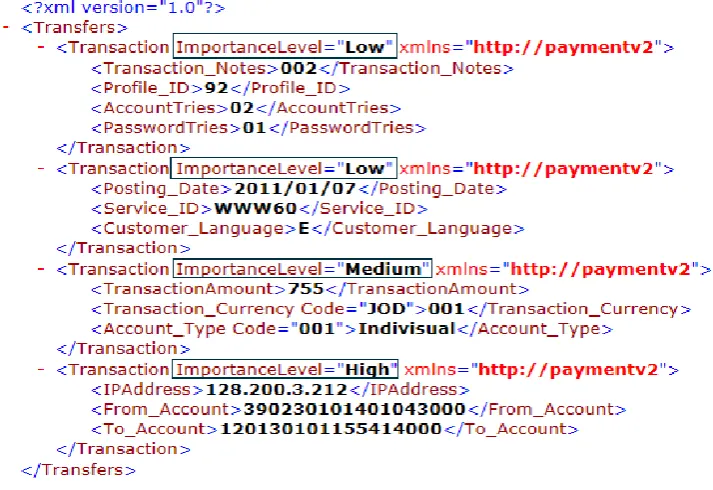
In this research we have developed a smart approach for securing financial XML transactions using effective and intelligent fuzzy classification techniques. Our approach defines the process of classifying XML content using a set of fuzzy variables. Upon fuzzy classification phase, a unique value is assigned to a defined attribute named "Importance Level". Assigned value indicates the data sensitivity for each XML tag.
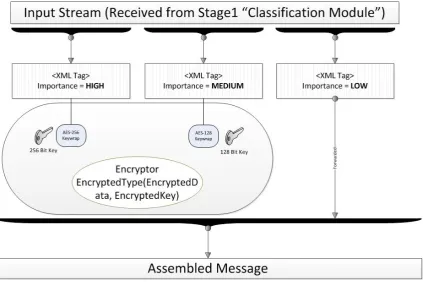
classified with "Medium" importance level; a key size of 256-bit is being used on tags classified with "High" importance level.
An implementation has been performed on a real-life environment using online banking system in Jordan Ahli Bank one of the leading banks in Jordan to demonstrate its flexibility, feasibility, and efficiency. Our experimental results of the system verified tangible enhancements in encryption efficiency, processing-time reduction, and resulting XML message sizes.
ACKNOWLEDGMENT
―I can do all things through him who strengthens me‖. First of all, I would like to thank
Christ, who made me believe in myself to complete this work and reach this important stage of my life to fulfil my dream.
I would like to express my appreciation to my supervisor, Professor Joan Lu, for her continuous guidance and great support through this journey. She showed a great dedication and commitment providing a provisional and exceptional support and encouragement to shed the light through my research.
Great appreciations go to Dr. Maher Aburrous for being a real support guiding me through this research. I am really grateful for all his paid efforts and support.
DEDICATION
To my beautiful wife, my partner, love of my life (Salam), who never stopped dripping the love from her heart to mine, who never stopped encouraging me, and who never stopped lighting my way through the journey towards success.
To my wonderful parents (Tawfiq and Amal), who never stopped believing in me, who never stopped supporting and loving me, and who never stopped drawing the smile on my face all the time during my long journey.
To My beloved Brothers (Tariq, Salem, Sultan, Waleed), who never stopped being by my side, who never stopped pushing me when needed, and who never stopped believing in me.
List of Acronyms and Abbreviations
AES Advanced Encryption Standard AI Artificial Intelligence
API Application Program Interfaces
CBA Classification based on Association Rule COG Centre of Gravity
DES Data Encryption Standard DOM Document Object Model DRM Digital Rights Management DSD Document Structure Description DTD Document Type Definition FL Fuzzy Logic
IDE Integrated development environment IDEA International Data Encryption Algorithm KDC Key Distribution Centre
KEK Key Encryption Key
kNN k-nearest Neighbour Classification LLSF Linear Least Squares Fit Mapping
OASIS Organization for the Advancement of Structured Information Standards
PKI Public Key Infrastructure
SAML Security Assertion Markup Language SAX Simple Application Interface for XML SVMs Support Vector Machines
SXMS Secure XML Management System TEK Traffic Encryption Key
TTP Trusted Third Party
UML Unified Modelling Language URI Uniform Resource Identifier
X-KISS XML Key Information Service Specification X-KRSS XML Key Registration Service Specification XAC XML access control
XACML XML Access Control Mark-up Language XEnc XML Encryption Syntax and Processing XKMS XML key management specification XML eXtensible Markup Language
XNI Xerces Native Interface
XSL eXtensible Stylesheet Language XSLT XSL Transformations
Contents
Abstract……….. 1
Acknowledgement………. 3
Dedication………..……… 4
List of Acronyms and Abbreviations……….. 5
Contents………..………... 7
List of Figures……….………... 12
List of Tables……….……… 16
List of Publications……… 17
Chapter 1
Introduction
……….……. 181.1 Overview……… 18
1.2 Research Motivation……….. 21
1.3 Aims & Objectives………. 22
1.4 Research Contribution……….……….…………. 23
1.5 Outline of the Thesis……….. 25
Chapter 2
Research Background………..
272.1 Introduction……… 27
2.2 XML Model………... 27
2.2.1 Well-formed XML...……….……. 29
2.2.2 XML Components...………..….……… 30
2.3.1 Document Type Definition (DTD)……….………... 32
2.3.2 XML Schema……….……… 32
2.3.3 RELAX NG……….……….. 33
2.3.4 Document Structure Description (DSD)……… 34
2.3.5 Schematron……… 34
2.4 XML API……….……….. 34
2.4.1 DOM Parser………... 35
2.4.2 SAX Parser……….……… 35
2.4.3 Java API for XML………. 35
2.5 Cryptographic Algorithms for confidentiality.……….………...…….. 36
2.5.1 Encryption Mechanism……….………. 36
2.5.2 Symmetric Cryptography………... 37
2.5.2 Asymmetric Cryptography………. 40
2.6 XML Security Models ……….. 41
2.6.1 XML Signature……….. 42
2.6.2 XML Encryption……… 45
2.6.2.1 Encryption for Multiple Recipients………. 49
2.6.2.2 Serialization of XML for XML Encryption…………. 50
2.6.2.3 Example of XML Encryption……….. 51
2.6.2.4 Example Implementations of XML Encryption…….. 52
2.6.2.5 Issues Regarding Attribute Values……….….. 53
2.6.3 XML Key Management………. 54
2.6.4 Security Assertion Markup Language (SAML)………. 56
2.6.5 XML Extensible Access Control Markup Language (XACML)……….. 57
2.7 Text Categorization………... 58
2.8.1 Fuzzy Sets and Crisp Sets……….. 60
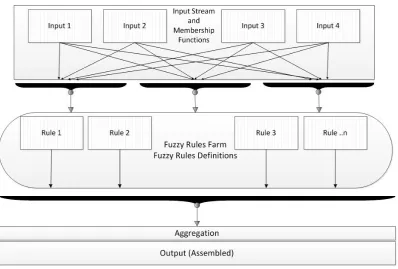
2.8.2 Fuzzy Inference Process……… 61
2.9 Chapter Summary……….. 63
Chapter 3
Literature Review………
643.1 Introduction……… 64
3.2 XML Encryption Models... 64
3.3 Fuzzy XML Modelling………... 71
3.4 Chapter Summary……….………. 77
Chapter 4
Intelligent Fuzzy-Based Financial XML Security Model
79 4.1 Introduction……… 794.2 Proposed Model for Securing XML Financial Documents... 80
4.2.1 Model Requirements……….……… 81
4.2.2 System Architecture and Design……….……….. 82
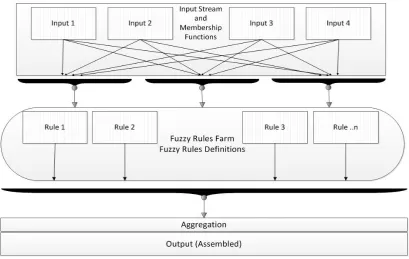
4.3 Fuzzy Classification Methodology ……….…….. 87
4.3.1 Fuzzify Input Stage……….…….. 88
4.3.2 Rule Evaluation Stage……….……….. 90
4.3.3 Aggregation of the Rule Output Stage……….………. 90
4.3.4 Defuzzification Stage……… 90
4.4 Fuzzy Classification Model ……….………. 91
4.5 Fuzzy Rule Base and Layers Categorization ……….………... 93
4.5.1 Rule Base for Layer 1 ……….…………. 93
4.5.2 Rule Base for Layer 2 ……….…………. 94
4.6 Encryption Model ………. 97
4.6.1 Element-wise Encryption………. 97
4.6.1.1 Element-wise Encryption Standard……… 98
4.6.1.2 Design Consideration………. 101
4.6.1.3 XML Message Schemas……… 102
4.6.2 Diffie–Hellman key exchange………. 104
4.6.2.1 D-H Process……….……….. 104
4.7 Message Utilization………...……… 107
4.8 Chapter Summary ………...……….. 107
Chapter 5
SXMS Model Implementation and Testing………...
1095.1 Introduction……… 109
5.2 Development Architecture and Used Tools ……….. 109
5.2.1 Used Tools……… 109
5.2.2 Development Architecture……… 110
5.3 System Implementation ……… 112
5.3.1 SXMS Implementation Requirements ……….………... 112
5.3.2 SXMS Implementation Process ……….………. 113
5.4 Testing Strategy ……….….…….. 115
5.4.1 Testing SXMS Behaviour……….……… 116
5.4.2 Testing SXMS‘s Functionality……….……….... 118
5.4.2.1 White-box Testing……….…….... 118
5.4.2.2 Black-box Testing……….….…….... 119
5.5 Testing Validation….……….……… 120
5.6 Testing Environment ……….……… 121
5.8 Fuzzy Classification and Encryption Testing ……….……….. 123
5.8.1 Testing Fuzzy Classification ………..………... 123
5.8.2 Testing XML Encryption ………..………….. 128
5.9 Chapter Summary……….………. 130
Chapter 6
Performance Evaluation - Implementation to Secure
Financial XML Messages using Intelligent Fuzzy-Based
Techniques………
131 6.1 Introduction……….... 1316.2 SXMS Performance Evaluation ……… 132
6.2.1 Evaluation Method……… 132
6.2.2 Evaluation Preparations……… 132
6.2.3 Evaluation Stages……….…….……… 133
6.3 Screenshots, Source Codes, and Pseudo Code Examples …….…..….. 146
6.3.1 Screenshot Examples……….……... 146
6.3.2 Source Codes Examples………..……….. 148
6.3.3 Pseudo Codes Examples………..………. 152
6.4 Chapter Summary………... 153
Chapter 7
Conclusions and Future Work………
1557.1 Conclusions……….……... 155
7.2 Future Work………... 159
References
………
162Appendix A:
Rules for Layer 1, Layer 2, and Layer 3………
169Appendix B:
Sample extracted data used in experiments……….……..
176List of Figures
Figure 2.1: Sample of a well-formed XML message ……….….. 30
Figure 2.2: DTD Example ……….………... 32
Figure 2.3: A RELAX NG Schema example ………... 33
Figure 2.4: A generic encryption system ………. 36
Figure 2.5: Symmetric cryptographic cycle ………. 37
Figure 2.6: Asymmetric cryptographic cycle ………... 40
Figure 2.7: XML Signature structure ………... 43
Figure 2.8: Enveloped, detached, and enveloping signatures ………... 44
Figure 2.9: XML Encryption structure ……….……… 46
Figure 2.10: <EncryptedData> element and components ………... 47
Figure 2.11: <EncryptedKey> element and components ………..…………. 47
Figure 2.12: W3C Encryption possibilities (modes)………...……… 48
Figure 2.13: Encrypting the encrypted content for multiple recipients (super-encryption)…………... 49
Figure 2.14: Sample XML financial message ………..……….. 51
Figure 2.15: Sample XML financial message after partial W3C encryption ….……… 52
Figure 2.16: The alt attribute (to be encrypted) of a video element ………….…….…. 53
Figure 2.17: Output of encrypting the alt attribute of the video element …….…..…… 53
Figure 2.18: Obtaining a validated public key by sender B for sender A ……….. 55
Figure 2.19: SAML assertion elements ………..……… 56
Figure 2.20: XACML components………..……… 57
Figure 2.22: Characteristic function of a fuzzy set ………...……. 61
Figure 2.23: Fuzzy inference process ……….………… 62
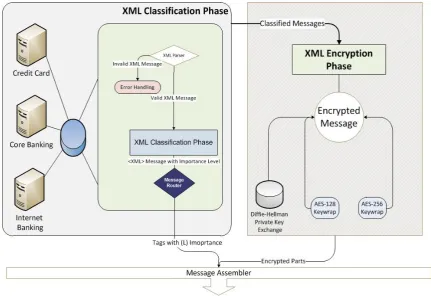
Figure 4.1: Main system components ………... 83
Figure 4.2: Fuzzy Inference System ………. 88
Figure 4.3: Input variable for transaction amount factor ………..…… 89
Figure 4.4: Output variable and ranges ……… 91
Figure 4.5: Classification Architecture of the importance level fuzzy mode (TAG Classification)………. 92
Figure 4.6: Layer 1 system structure (inputs and outputs)……… 94
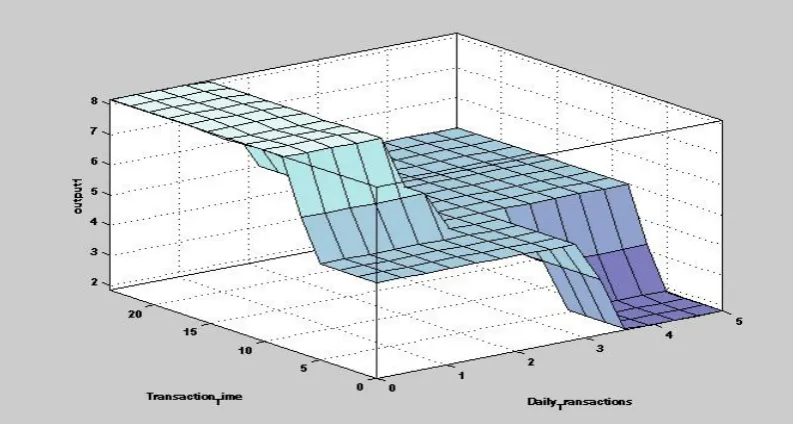
Figure 4.7: Surface structure in a three-dimensional view for layer 1……….. 94
Figure 4.8: Layer 2 system structure (inputs and output)……... 95
Figure 4.9: Surface structure in a three-dimensional view for layer 2….………. 96
Figure 4.10: Layer 3 system structure (inputs and output)……... 97
Figure 4.11: Surface structure in a three-dimensional view for layer 3……….………. 97
Figure 4.12: Encryption module architecture and design ………... 98
Figure 4.13: Classified message for element-wise encryption……… 100
Figure 4.14: XML message after element-wise encryption on selected parts…………. 101
Figure 4.15: XML Schema for core encryption ………. 103
Figure 4.16: XML schema for EncryptionInfos element………...………. 103
Figure 4.17: XML schema for KeyValue element……….. 103
Figure 4.18: XML schema for the ContentEncryptionMethod element……….……… 103
Figure 4.19: XML schema for the Reference element ……….….……. 104
Figure 4.20: XML schema for the EncryptedContent element……….……….. 104
Figure 4.21: Key exchange using the DH method……….………. 106
Figure 4.23: Message utilization………. 107
Figure 5.1: Model development architecture………...……. 112
Figure 5.2: Process for XML data fuzzy classification………. 113
Figure 5.3: Process for XML data encryption………..……. 115
Figure 5.4: Model behaviour states……….………….. 116
Figure 5.5: Sample data captured from the first set……….………. 122
Figure 5.6: Sample data captured from the second set………. 122
Figure 5.7: Set of fuzzy rules for layer 1………..…………. 125
Figure 5.8: Surface view for layer 1………. 126
Figure 5.9: Fuzzy classification chart for sample implementation……..….………… 127
Figure 5.10: Sample XML message after fuzzy classification phase………….………. 128
Figure 5.11: Sample XML message after encryption phase……….….. 129
Figure 6.1: Fuzzification stage (IF-THEN operators)………... 133
Figure 6.2: Comparison chart between SXMS and W3C model using 128-bit key…. 136 Figure 6.3: File size comparison between SXMS and W3C model using 128-bit…… 137
Figure 6.4: Performance comparison between SXMS and XML using 256-bit……... 139
Figure 6.5: File Size comparison between SXMS and XML using 256-bit key……... 139
Figure 6.6: Final performance comparison between SXMS and W3C models……… 140
Figure 6.7: Final file size comparison between SXMS and W3C models……… 140
Figure 6.8: Performance comparison between SXMS and W3C Standard using AES-128 Key……….………. 142 Figure 6.9: File size comparison between SXMS and W3C Standard using
AES-128 Key……….………...
143 Figure 6.10: Comparison between SXMS and W3C Standard using AES-256
Key………..
Figure 6.11: File size comparison between SXMS and W3C model using 256-bit key……….……….………
145 Figure 6.12: comparison between SXMS and W3C Standard using different keys 145 Figure 6.13: File size comparison between SXMS and W3C Standard using
different Keys………...…
List of Tables
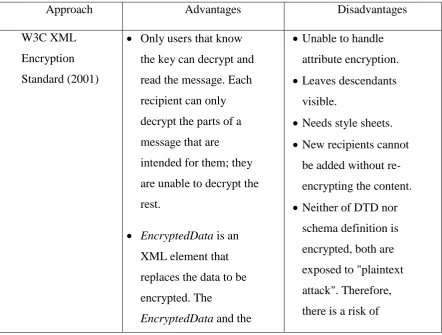
Table 3.1: XML Encryption Approaches ……….……….. 69
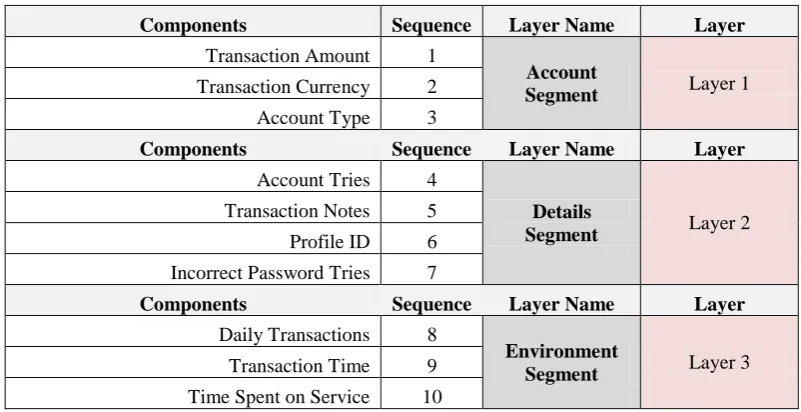
Table 4.1: Components and layers of XML message content ………..……...…... 92
Table 4.2: Rule base 1 for the account segment layer – layer 1………...…... 93
Table 4.3: Rule base 1 for the details segment layer – layer 2……… 95
Table 4.4: Rule base 1 for the environment segment layer – layer 3……….. 96
Table 5.1: Minimum hardware requirements to run main tools………….………. 113
Table 5.2: Testing Factors………..…... 120
Table 5.3: Sample of data classified for Layer 1…... 123
Table 5.4: Sample of data classified for Layer 2………..……….…….. 124
Table 5.5: Sample of data classified for Layer 3……….… 124
Table 5.6: Fuzzy Classification table for first sample implementation ….………. 127
Table 6.1: Stage 1 Sets detail………... 134
Table 6.2: Performance evaluation for stage 1 ………... 134
Table 6.3: Processing time and resulting file sizes using SXMS and W3C-128 Model……….. 135
Table 6.4: Processing time table using SXMS and W3C-256 Model (Full Encryption)………. 138
Table 6.5: Performance evaluation for stage 2……… 140
Table 6.6: Processing time table using SXMS and W3C-128 Model (Partial Encryption)………. 141
List of Publications
Journal Papers
1. Ammari, F., Lu, J., Aburrous, M., "Intelligent Banking XML Encryption using Effective Fuzzy Classification", Book Chapter - Emerging Trends in Information and Communication Technologies Security, ISBN 9780124114746 (Print), Elsevier, September-October 2013.
2. Ammari, F., Lu, J., Aburrous, M., ―Enhanced XML Encryption Using
Classification mining techniques for e-Banking transactions‖, (Submitted)
Conference Papers
1. Ammari, F., Lu, J., "Improved Banking XML Transaction Encryption Using Tag Fuzzy Classification," Proceeding of International Conference on Computer Applications Technology, Sousse, Tunisia, January 20-22 2013.
2. Ammari, F., Lu, J., Aburrous, M., ―Intelligent XML Tag Classification Techniques for XML Encryption Improvement‖, Proceeding of the 3rd IEEE International Conference on Privacy, Security, Risk and Trust, MIT, Boston, USA October 9-11, 2011.
Chapter 1
Introduction
1.1
Overview
eXtensible Markup Language (XML) (Bray, Paoli, Sperberg-McQueen, Maler, & Yergeau, 2008) has been widely adopted in many financial institutions in their daily transactions; this adoption has been due to the flexible nature of XML in providing a common syntax for systems messaging in general and for financial messaging in particular. Excessive use of XML in financial transactions messaging has created an aligned interest in security protocols integrated into XML solutions in order to protect exchanged XML messages by using an efficient yet powerful mechanism. There have been several approaches proposed by researchers to secure XML messages and there is a comprehensive collection of related works.
should be applied to entire XML data or portions of XML data. XML security solutions should provide a high level of security to ensure the confidentiality of information represented using the XML format. XML security must be integrated with XML data features and characteristics to keep the flexible nature of XML while integrating essential security technologies.
Due to the sensitive nature of financial transactions that use XML as their main messaging protocol, a security requirement should be fulfilled to protect exchanged XML messages by using a dynamic and efficient mechanism. The security mechanism should encrypt portions of XML data rather than whole messages, e.g. element-wise encryption should be used to protect sensitive parts within the XML message.
The specifications related to XML security published by W3C define the basic framework and rules that can be utilized across applications. The basic idea for XML security is to perform data encryption on XML messages whereby XML data confidentiality is achieved to ensure that the XML data structure, data content, and other sensitive information in XML data may only be accessed by legitimate parties. Confidentiality is generally associated with encryption mechanisms or access control technologies. XML key management (Hallam-Baker & Mysore, 2005) provides the basic key requirements for XML data confidentiality .
which is the process of encrypting parts of an XML document. The encryption process can be applied to more than one element in a given XML document; each is contained in another element. The element might enclose sub-elements, attributes, texts, or a mix of all mentioned items. The remaining parts of the document should remain intact as plaintext.
To avoid any performance or resource issues, a mechanism should be considered to choose which parts of the XML document should be encrypted on the fly, whereby the parts are selected based on smart criteria for detecting sensitive information within an XML document .
The fuzzy logic (FL) (L.A. Zadeh, 1965) approach can be used to distinguish sensitive parts within each XML document. FL provides an easy way to reach to a definite conclusion based upon noisy, vague, imprecise, ambiguous, or missing information. FL's approach for controlling problems imitates how a person would make a quick decision. FL includes a rule-based ‗IF X AND Y, THEN Z‘ approach for solving a control problem, rather than attempting to design a system in mathematical way. The FL model is relying on an operator‘s experience rather than their technical understanding of the system.
1.2 Research Motivation
Many businesses and financial institutions use XML in their basic transaction messaging, due to its flexible nature and structure. A solid security approach is required to ensure safe and trustworthy transactions either within the same institution or between different institutions (business to business). XML security specifications published by W3C have addressed XML encryption (Imamura, Dillaway, & Simon, 2002). XML encryption is mainly used to ensure XML data confidentiality and authenticity. However, institutions that deal with large volumes of transactions on a daily basis require a flexible and solid mechanism to process XML messages that performs element-wise encryption in a timely and efficient manner .
Encrypting sensitive information only within the XML document is a complicated issue to analyse; it needs to take into consideration the process of encrypting different portions within the XML document every time the message is transmitted. This is complex to analyse because the classification requires set of factors to consider.
Despite there are handful of applications available to secure XML messages, there are no known solutions that utilize fuzzy classification techniques in detecting sensitive information within each XML document.
The motivation behind our research is to create an effective, powerful, and intelligent model to classify XML messages by detecting sensitive information within XML documents, in order to perform element-wise encryption on selected parts .
then for applying element-wise encryption algorithms on selected portions extracted from XML data features and patterns. The proposed XML security model combines fuzzy techniques for the purpose of automating the fuzzy rules. The automation process is completed by extracting the set of fuzzy rules that are going to be deployed inside the fuzzy inference engine. Therefore, a set of IF-THEN rules are constructed using these fuzzy rules. The IF-THEN rules reflect the relations between different transaction characteristics and patterns and their associations with one another. These rules can then be used for the final stage, which uses element-wise encryption with different key sizes based on the importance levels assigned .
Our previous expertise in the banking and financial sector in Jordan shed the light on the importance of securing business and financial transactions based on XML. Many researches and case studies have been reviewed and evaluated in order to find a robust and flexible solution that can be used with ease and efficiency.
1.3 Aims & Objectives
Our prime aim is to build a system that secure financial XML messages that uses FL to classify XML content to perform XML encryption, in order to provide necessary data confidentiality for classified portions within an XML document. This mechanism enhances the performance of encrypting XML documents on high-volume transactions. In order to reach this aim, there are several objectives:
Our objectives can be summarized with the following points:
2. Build a resilient, intelligent, dynamic, and secure XML messaging system that uses artificial intelligence and FL to fetch and classify sensitive information within XML documents. The outcome system has to be adaptive, flexible, and efficient.
3. Illustrate feasibility and adaptability after analysing a large number of actual transaction datasets fetched over period of time reflecting internet banking transactions, phone banking transactions, and mobile banking transactions. 4. Present the applicability of applying an FL expert system in order to classify and
find out importance levels within XML documents. Fuzzy rules are being used for and driven by human expert knowledge on creating flexible and secure XML messaging systems.
5. Provide a solution that improves existing XML encryption approaches and illustrates a performance improvement over well-known XML encryption models, like W3C XML Encryption Recommendations. We illustrate the enhancements and processing improvements by securing only the necessary parts with high importance levels within XML documents.
We have implemented a quantitative research methodology to enable us achieving all above objectives, taking into consideration experimental studies, case analysis, data collection, testing, evaluation, and comparing final results.
1.4 Research Contribution
This research will contribute to the fields of XML security, fuzzy XML in general, XML encryption, and fuzzification, specifically in the following areas:
used in business and financial institutions. This technique encrypts XML documents efficiently by encrypting only the sensitive parts within each XML document by using a set of fuzzy variables. Significant processing time improvements have been recorded against a well-known approach (W3C XML Encryption Recommendations).
2. An efficient and secure XML model has been created to reduce encrypted XML file sizes, due to the fact that only essential parts within each XML document are encrypted, leaving other nodes intact without encryption. Reduce file sizes will reduced bandwidth used on large scale.
3. A fuzzy classification engine has been created to determine which parts within each XML document require encryption. The fuzzification engine works by assigning an importance level to each tag within the XML document. The importance level value is set by the engine for later encryption processing; the importance level is assigned using one of three values (high, medium, or low). The fuzzification process itself is based on fuzzy logic, which uses a combination of human expert knowledge and a set of IF-THEN operators. 4. A resilient XML encryption system has been created whereby future
enhancements can be achieved without the need to redesign the whole system. The encryption standards and algorithms used within the system are flexible and can be changed when needed; different encryption algorithms can be used to replace existing algorithms either to improve performance or to add more security.
financial analysts, a set of questionnaires, and a set of surveys. These ten characteristics define the classification criteria we will use in our fuzzy classification stage.
6. A desktop application has been designed and developed to test and validate our proposed model. Application developed based on reliability, feasibility, and extraction process of the mechanism. The application was programmed using the Java programming language.
1.5 Outline of the Thesis
Here to present a brief outline of the thesis:
In Chapter 2, the research background is discussed. XML models are included, XML application program interfaces, XML schema languages, cryptographic algorithms for data confidentiality, XML security models (with XML encryption standards described), text categorization, and FL models and design.
In Chapter 3, the literature review is presented. The contents of the literature review mainly focus on existing ideas and solutions related to XML encryption. It looks at the existing models, theories, and schemes of XML encryption for ensuring XML data confidentiality. Existing fuzzy XML techniques and models are also addressed to cover all aspects of our research.
description includes the main model design, concepts, and workflow that are used in this model .
An illustration of the system design and architecture and the tools used for implementing the system of the SXMS model is also given. A theoretical execution based on the case study is also offered. This section presents the classes for encrypting and decrypting XML messages based on the importance level assigned, as well as the process of building the final XML document by deploying the needed XML encryption with different key sizes based on XML data sensitivity for each XML portion .
In Chapter 5, a detailed system implementation has been described. Development architecture and used tools have been introduced to elaborate on how the system implemented. Used testing strategy, testing behaviour, testing data, and testing functionality have been introduced as well. Testing validation against W3C XML Recommendations (Imamura et al., 2002) has been presented to present SXMS advantage. Finally an independent testing for the major modules, fuzzy classification stage, and XML encryption has been illustrated.
In Chapter 6, the full performance evaluation stages are discussed. The evaluation stages are presented to give a clear idea of the mechanism we followed in our evaluation, presenting the basic components that we used in our evaluation and judgements. Finally, we provide screenshots of the developed application and samples of the source code used to develop this application .
Chapter 2
Research Background
2.1 Introduction
In this chapter we introduce the XML model with all its detailed components, and then we briefly introduce the XML language and its structure. Cryptographic algorithms and types are presented. The XML security model is presented as well. Specifically, we present XML digital signatures, XML Encryption, XML key management, SAML, and XACML security models. We then present the information retrieval mechanism in general and XML fuzzy classification specifically. Finally, we introduce the fuzzy logic model in details.
2.2 XML Model
nested document structures, and build document types by specifying a set of regular expression patterns (XML Schema or Document Type Definitions (DTD)). An XML document incorporates structure and data in one entity. Therefore, XML data is semi-structured data (S. Abiteboul, 1996).
The solid set of XML characteristics created an interest in building effective solutions to support the following advantages:
Extensibility: New fields and tags can be created when they are needed. There are no fixed set of fields.
Self-description: This feature allows any XML field to process an unlimited number of attributes.
Readability: XML is easy for humans or machines to read and understand. This feature facilitates the usage of XML by different applications and users.
Simplicity: XML code is easy to understand; also, it can be easily processed and deployed in different practices. Updating the existing XML Schema is an easy and straightforward operation.
Supports multilingual documents and Unicode: This is important for the internationalization of applications.
Interoperability: There is the ability to use XML documents in any industry without the need to make changes to the data itself. XML is treated as an independent unit from both the machine and software levels.
Portability: An XML document has the ability to represent different data types, such as ordinary text and binary files (images, videos, and sounds).
Syntax redundancy: This can affect human readability and system efficiency, and this can result in higher storage requirements and resource usage. Bandwidth limitations can prevent XML being deployed in certain applications.
A number of vague, unneeded features within XML: Efforts were made to create "Minimal XML", which led to the discovery that there was no consensus on which features were in fact obscure or unnecessary.
A wide range of data types are not supported in the basic parsing requirements: Some additional work might be required to process the desired data in the XML document.
A significant overhead for various uses of XML: This mainly applies where resources may be limited. This might happen because of the parser‘s limitations in recursing arbitrarily nested data structures or the missing feature of performing additional checking and validation for improperly formatted syntax or data.
Security concerns: These may arise when XML input is fed from unknown or untrusted sources
Difficulty in modelling overlapping data structures: This requires extra effort.
2.2.1 Well-formed XML
Figure 2.1: Sample of a well-formed XML message
2.2.2 XML Components
An XML document consists of elements that represent a piece of information. More specific information can be found in nested elements, such as character data, attributes, and entity references. These elements are marked up by the tags in a specific document. Between the start tag and end tag of an element there is the element content, presented as text content.
1. Elements: Elements start with an opening tag (<t>) and end with an ending tag (</t>). Everything between the starting and ending tags is called the element content. Each element has an element name (e), which should follow the following rules:
- The element name should not start with "XML" or "xml". - The element name is case sensitive.
- The element name starts with a character or an underscore.
- The element name consists of characters, numerals, underscores, and tabs. 2. Attributes: Attributes are information that can provide more information about
defined. For example, <book name="Learn C++ in 24 days"> is a book element with an attribute name that has the value "Learn C++ in 24 days".
3. Comments: Comments can be placed anywhere inside the XML document for further explanation or description. Comments are not part of the main document and can be used by using the start tag (<!—) and the end tag (-->).
4. XML declaration: An XML declaration supplies the XML processor with information such as encoding, version, and any other information related to the document. A declaration can be defined with a start tag (<?xml) and an end tag (?>).
5. Processing Instructions (PIs): PIs may occur anywhere in the XML document. Their main purpose is to carry specific instructions to the application. A PI is represented within the document in the form of : <?Target instructions for command?>.
6. CDATA sections: Using CDATA will tell the XML parser that there is no markup in the characters during the time of processing. Sections can be defined by using: <! [CDATA]!>.
2.3 XML Schema Languages
XML schema languages, like XML Schema (D. C. Fallside & Walmsley, 2004), DTDs, DSDs (M\oller, 2005), Schematron (Jelliffe, 2006), and RELAX NG (Makoto, Walsh, & McRae, 2001), are used to certify XML documents. The reason for certifying/validating a document is to verify whether the XML document conforms to a set of structural and content rules expressed in one of many schema languages. The validation procedure happens on at least four primary levels (Ray, 2003):
2. Data typing: Relates to the set of numbers, dates, and texts (patterns of character data).
3. Integrity: Relates to the linkage between resources and corresponding nodes. 4. Business rules: Relates to collections of tests such as spelling checks, checksum
results, etc.
2.3.1 Document Type Definition (DTD)
The Document Type Definition (DTD) (Hunter, Cagle, Dix, & Cable, 2001) is a set of rules that define the hierarchical structure of any XML document. The XML parser utilizes these rules to determine whether the XML document is valid or not. The DTD consists of four basic parts: elements, attributes, tags, and entities. A declared element specifies the name of the element and the valid content. Tags are used to indicate elements. Attributes are used to provide additional details about an element and can be used to describe element properties as well. Entities are the variables that can be reused within the document. Figure 2.2 illustrates a sample DTD example.
Figure 2.2: A DTD Example
2.3.2 XML Schema
XML Schemas can take the place of DTDs in most web applications. XML Schemas are written in XML and are present in well-formed XML documents. XML Schemas support data types such as string, date and time, and integers. XML Schemas can be used to construct complex data types as well.
2.3.3 RELAX NG
RELAX NG is a schema language for XML developed by ISO/IEC JTC1/SC34/WG1 (Makoto et al., 2001). RELAX NG is based on two languages. The first language is the Tree Regular Expressions for XML (TREX) designed by James Clark (Clark, 2001); the second language is the Regular Language description for XML (RELAX) designed by Murata Makoto (Makoto, 2002). The primary idea of RELAX NG consists of patterns that are formed to widen the range of the idea of the content model. In RELAX NG, a pattern is an expression of elements, text nodes, and attributes. The definitions of data types may be utilized for constraining the sets of values of text nodes and attributes. Figure 2.3 demonstrates an example of a RELAX NG Schema.
2.3.4 Document Structure Description (DSD)
A Document Structure Description is a schema language developed by combined efforts from BRICS and AT&T Labs (Klarlund, Møller, & Schwartzbach, 2000; M\oller, 2005). Constraints form the basic concept of a DSD. A restraint is used to define the content of an element, corresponding attributes, and its particular context. A pair consisting of an element name and a restraint forms the definition of an element. Element content is constrained by means of a content expression, which is a regular expression over element definitions. To force constraints on the context of an element, context patterns are used.
2.3.5 Schematron
Schematron is schema language based on rules developed by Rick Jelliffe at the Academia Sinica Computing Centre (ASCC) (Jelliffe, 2006). The main functionality of Schematron is to perform co-constraints checking in XML instance documents. A sequence of rules is defined by a Schematron document, which is grouped in a logical way in pattern elements. A context attribute is included within each rule and used by an XPath pattern to determine the elements to which the rule applies. Within each rule, a sequence of reports and elements are specified with a testing attribute, which considered an XPath expression. This expression is evaluated to a value of Boolean type for each node within the context.
2.4 XML API
2.4.1 DOM Parser
The DOM (Document Object Model) parser is utilized as a hierarchical object model to get XML document information (Hégaret, Whitmer, & Wood, 2005). The whole XML document's information is being read by DOM parser, and establishes the corresponding DOM object tree of nodes. The construction is being performed in main memory. This XML parser is appropriate for small to medium XML documents that may fit in memory. DOM can be utilized in document-centric document whereby the sequence of elements within the document is essential. The sequence of elements is preserved due to direct read from the document. It has multiple functions for traversing XML trees and other relevant functions like (insert, delete, and access nodes).
2.4.2 SAX Parser
The Simple Application Interface for XML (SAX) parser provides accessibility to XML information as a series of events. For every open tag, closing tag, and every #PCDATA and CDATA section, SAX activates an event. These events along with the corresponding sequences need to be interpreted by the document handler. SAX is suitable for medium to large XML documents; this is because there is no need to parse XML documents in main memory first. SAX is suitable for structured XML documents as well, as the sequence for elements not essential.
2.4.3 Java API for XML
languages. SAX (Simple API for XML) scans the XML document sequentially and throws up events that the programmer can handle. These events are thrown up by the parser when it detects the start document and end document tags, as well as the start element tag, including a list of all its attributes, end elements, and characters. The programmer should write suitable code for each event to process an entire XML document. Since each event occurs only once for each element, all the required work needed to process the document should be done in one cycle.
2.5 Cryptographic Algorithms for Confidentiality
2.5.1 Encryption Mechanism
The encryption mechanism is the process of transforming plaintext into ciphertext and vice versa. Plaintext is readable content that needs rendering to be unreadable. Ciphertext is encrypted plaintext in which no semantic content is available. An encryption mechanism transforms plaintext into ciphertext. A decryption mechanism transforms ciphertext back into plaintext. In order to be able to re-use a particular algorithm in many systems, the algorithm is parameterized by a key. Figure 2.4 illustrates encryption mechanisms.
Key: ―A sequence of symbols that controls the operations of encryption and decryption.‖
As illustrated in Figure 2.4, to encrypt plaintext (P), the encryption algorithm (E) is parameterized with a confidentiality encryption key (K). Ciphertext (C) is decrypted using the confidentiality decryption key ( ).
Encrypting plaintext (P) under the key (K) produces ciphertext (C) and is denoted as . The decryption of C under the key reproduces the plaintext P and is denoted as .
Cryptography uses two different types of encryption systems: symmetric encryption systems and asymmetric encryption systems.
2.5.2 Symmetric Cryptography
Symmetric encryption system: This type of encryption system is based on symmetric cryptographic techniques that use one secret key for both the encryption and decryption algorithms.
Symmetric cryptographic technique: This cryptographic technique uses a shared secret key. Symmetric encryption systems have the property that both the encryption key and the decryption key have the same value.
Secret Key: ―A key that is used with a symmetric cryptographic algorithm.
Possession of a secret key is restricted (usually to two entities)‖ (ISO10181-1). The secret key can be generated in various ways:
by the encrypting entity (encryptor) illustrated in figure 2.5;
by the decryptor;
by a trusted third party (TTP), like a key distribution centre (KDC); or
It can be derived from parameters in a key agreement protocol that is performed by both the encryptor and the decryptor.
If the key is not computed using a key agreement protocol, the key must be transported through a secure channel that is protected in terms of confidentiality and integrity. Additionally, the recipient(s) of the secret key must know the source of the key, i.e. data origin authentication for the transported key is necessary.
The ciphertext itself can be transported through an unprotected channel.
Symmetric cryptographic algorithm: ―An algorithm for performing encryption or the
corresponding algorithm for performing decryption in which the same key is required for both encryption and decryption‖ (ISO10181-1).
Algorithms that perform symmetric encryption are grouped into two classes: 1. Block ciphers
2. Stream ciphers
A block cipher processes blocks of plaintext to create blocks of ciphertext. A block is a string of n bits; such a block cipher is called an n-bit block cipher. Typical algorithms that are used in today‘s systems include:
3DES (Triple DES (Data Encryption Standard), also known as TDEA: Triple Data Encryption Algorithm)
IDEA (International Data Encryption Algorithm)
Various other block ciphers, like the other AES candidates (e.g. Blowfish or RC6).
The plaintext bit sequence is segmented into n-bit blocks, as the block cipher needs n bit as its input. To allow cases where the input length is not a multiple of n bit, a padding mechanism is usually used with a block cipher. The padding algorithm defines an unambiguous way in which each plaintext is extended to a length of a multiple of n bit. This is done even if the length of the plaintext is already a multiple of n bit. So, if a padding mechanism is used, the length of the ciphertext is larger than the length of the plaintext. After decrypting with the block cipher, the padded bits are removed from the decrypted data.
The mechanisms closely related to block ciphers are modes of operation. Modes define how the inputs and outputs of consecutive block cipher operations are combined. This is done to ensure that the same plaintext block results in different ciphertext blocks throughout the ciphertext stream and to chain the blocks together to prevent substitution attacks .
2.5.3 Asymmetric Cryptography
Asymmetric encryption system: ―Encryption system based on asymmetric
cryptographic techniques whose public transformation is used for encipherment and whose private transformation is used for decipherment‖ (ISO/IEC9798-1, 1997).
Asymmetric cryptographic technique: ―Cryptographic technique that uses two related
transformations, a public transformation (defined by the public key) and a private transformation (defined by the private key). The two transformations have the property that, given the public transformation, it is computationally infeasible to derive the private transformation‖ (ISO/IEC11770).
In an asymmetric encryption system, the encryption key K (also called the public key) and the decryption key K^(-1) (also called the private key) have distinct values, but these values have a mathematical relationship that is defined by the underlying cryptographic algorithm, as illustrated in figure 2.6
Figure 2.6: Asymmetric cryptographic cycle
Private Key: ―A key that is used with an asymmetric cryptographic algorithm and
whose possession is restricted (usually to only one entity)‖ (I.-T. X. I. 10181-1, 1996).
Public Key: ―A key that is used with an asymmetric cryptographic algorithm and that
A key pair consists of a public and the corresponding private key. The generation of a key pair can be performed by different parties:
The key pair can be generated by the decryptor. In this case, the decryptor can publish the public key in a directory service or directly send the public key to the encryptor. This case is shown in figure 2.6. Note that the channel for transporting the public key does not have to be protected in terms of confidentiality.
The key pair can be generated by a trusted third party. In this case, the private key must be transmitted to the decryptor via a channel that is protected in terms of confidentiality.
The private key must be protected by the decryptor. Regardless of which entity undertakes the key pair generation, the public key must be made available to the encryptor. The encryptor must be confident that the public key belongs to the decryptor. This can be achieved using digital certificates (if a trusted third party is available) or by transport through integrity-protected channels with data origin authentication enabled.
Asymmetric cryptographic algorithm: The most commonly used asymmetric encryption algorithm is the RSA algorithm, named after its inventors (Rivest, Shamir, & Adleman, 1978). The RSA algorithm is based on the difficulty of factoring large integers.
2.6 XML Security Models
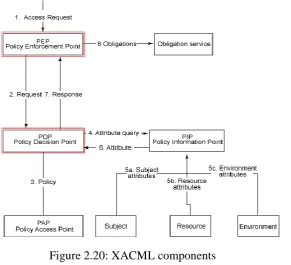
standards include XML Encryption (Imamura et al., 2002) to provide confidentiality, XML digital signatures (Bartel, Boyer, Fox, LaMacchia, & Simon, 2002) to cover integrity, XML key management (XKMS) (Hallam-Baker & Mysore, 2005) to provide public key registration and validation, XML Access Control Mark-up Language (XACML) (GODIK & MOSES, 2002) for stating authorization rules, and security assertion markup language -SAML (OASIS, 2002) to cover authentication and attribute assertions.
An XML security model needs to support the following:
1. A robust authorization mechanism whereby it can control accessibility to content and structure.
2. Ability to reuse existing security and cryptographic technologies when needed. 3. The ability to enforce security policies efficiently without the need to look up
the underlying document.
4. Schema information, characterizing exactly those elements accessible to each type of user.
2.6.1 XML Signature
XML Signature was first introduced by (Bartel et al., 2002), XML Signature defines a standard format to represent digital signatures in XML, it provides a method for efficiently employing digital signatures to XML resources. However, XML Signature may also be utilized to sign binary resources like videos, images, and sound files. Several resources within XML can be covered by one signature, whether it is a whole document, part of a document, or a binary document.
1. Exclusive XML Canonicalization Version 1.0, published by W3C (JOHN BOYER, EASTLAKE, & REAGLE, 2002).
2. Canonical XML Version 1.0, published by W3C Recommendation (J. Boyer, 2001).
3. XML Signature XPath Filter 2.0, published by W3C Recommendations (J. Boyer, Hughes, & Reagle, 2003).
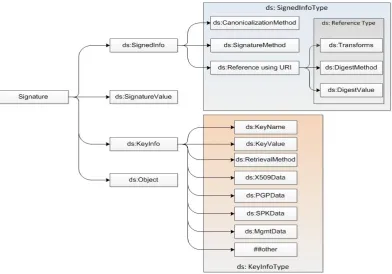
[image:45.595.116.509.318.592.2]The above specifications led W3C to publish a second edition (Bartel, Boyer, Fox, LaMacchia, & Simon, 2008). Figure 2.7 represents the XML Signature element‘s basic structure.
Figure 2.7: XML Signature structure
in the XML data (Weerasinghe, Elmufti, Rajarajan, & Rakocevic, 2006). Signature results are stored in the element <ds:SignatureValue>; element <ds:KeyInfo> contains the public key information that is used when the XML Signature is verified. The element <ds:Reference> within the element <ds:SignedInfo> is connected with each resource; A Uniform Resource Identifier (URI) identifies all resources. A digest of the referenced resource is included in the <ds:Reference> element. The <ds:SignedInfo> element can contain multiple <ds:Reference> elements. The element <ds:SignedInfo> contains references to the resources being signed. Therefore, an XML signature might be enveloping, enveloped, or detached taking into consideration each referenced resource. Figure 2.8 illustrates enveloped, detached, and enveloping signatures.
Figure 2.8: Enveloped, detached, and enveloping signatures
If the Signature element is within the referenced XML resource, then we call this signature an enveloped signature. If the signature references a resource that is separate from the Signature element, then we call this signature a detached signature. Finally if the signature references a resource that is contained within the Signature element, then we call this signature an enveloping signature. When the signature is enveloping, an instance of the object element is used to contain the resource.
element is not included in the digest of the XML resource being signed. Otherwise it would not be possible to calculate the correct digest, considering that the resource (from which the digest is to be calculated) would be subject to change when adding the digest to the Signature element. XML Encryption also uses <ds:KeyInfo> element, this element is defined by XML Signature. The <ds:KeyInfo> element is extended by XML Encryption with an <EncryptedKey> element, which might support the transport for a symmetric/secret key. The <KeyInfo> element is used by the XML Key Management Specification as well.
2.6.2 XML Encryption
XML Encryption was first released by W3C as a proposed recommendation (Eastlake & Reagle, 2002; Imamura et al., 2002), providing encryption for different sizes of units. The units may be a whole XML document, an element within a document, XML element content, or an attribute.
XML Encryption is an encryption technology that is optimized for XML data. A format is provided for using the XML processing rules in encryption and decryption processes. XML Encryption can be performed partially, which encrypts selected tags within the XML document, or multiple times, which enables the data to be encrypted multiple times. XML can be used to facilitate resolving XML data eavesdropping.
Hellman, 1976) exchange. By using the XML Encryption standard, we gain a number of benefits, including:
An XML element can act as a container for encrypted data, as a container for encrypted key material, or as a container for both. However, in order to act like a container, the XML element should contain XML Encryption information.
User data can be encrypted by using XML Encryption, like: - Full XML documents (Geuer-Pollmann, 2002) - Single elements inside an XML document
- The content of an element inside an XML document - Arbitrary binary content outside of an XML document
The ability to allow direct inclusion of the encrypted content in the container.
The ability to de-reference the encrypted content via the URI / transforms mechanism.
XML Encryption offers key management facilities for: - The symmetric wrapping of secret keys.
- Key transport of secret keys.
- Key agreement using a Diffie-Hellman key.
Figure 2.9: XML Encryption structure
element contains essential sub-elements that describe how the data is encrypted; the first sub-element is <EncryptionMethod>, which determines which encryption algorithm is used within the XML message. The second sub-element is <EncryptedKey>, which is used to transport encryption keys between the sender and receiver; it can also be used individually in a separate XML message. <KeyInfo> is the third sub-element and is used to specify the associated keying material. Another major element is <CipherData>, a mandatory element that provides the encrypted data. It must contain the encrypted octet sequence of the base64 encoded text of the <CipherValue> element. Another way is by providing a reference to an external location that contains an encrypted octet sequence location via another element called <CipherReference>. Figure 2.10 and figure 2.11 represent both the <EncryptedData> element and the <EncryptedKey> element with all their sub-elements.
Figure 2.10: <EncryptedData> element and components
The W3C XML Encryption Recommendation allows two different granularity levels: encryption of full sub-trees whereby a single element and all its descendants are encrypted, and encryption of sequences of sub-trees whereby a sub-tree can be a single node or a mixed sequence (comments, elements, text, and processing instructions).
Figure 2.12: W3C Encryption possibilities (modes)
Drawing A in figure 2.12 presents the encryption of a sub-tree rooted by the element ‗X‘. The element and all its descendants are encrypted into a single <EncryptedData> element.
Drawing B in figure 2.12 presents the encryption of the content of element ‗X‘. All children of the element and their respective descendants are encrypted into a single <EncryptedData> element.
Drawing C in figure 2.12 presents sub-tree encryption applied three times to each child of element ‗X‘. Each sub-tree rooted by a child node of element ‗X‘ is encrypted into a separate <EncryptedData> element.
Drawing D in figure 2.12 presents a way to use content encryption: two subsequent sub-trees are grouped together and are encrypted together.
2.6.2.1 Encryption for Multiple Recipients
1- Encrypting the same content: There are different ways to encrypt any resource intended for multiple recipients. The basic case is where all recipients have the privilege to see the same portion of the document, which means the content is encrypted only once, whereas the content encryption key is encrypted multiple times (once for each recipient). The document should include a single <EncryptedData> element for the encrypted content and an <EncryptedKey> element for each recipient, which includes the content encryption key encrypted under the recipient‘s key.
2- Super Encryption: When recipients are allowed to see different portions of a document, then there is a way to encrypt content for multiple recipients. Figure 2.13 illustrates the process of encrypting encrypted content multiple times.
Figure 2.13: Encrypting the encrypted content for multiple recipients (super-encryption)
The process of encrypting parts of an XML tree leads to the substitution of the existing plaintext structure with the appropriate XML Encryption element <EncryptedData>. Super-encryption applies when the <EncryptedData> element or its ancestors are encrypted.
both recipients A and B. Keys A and B are processed by recipient B. Key A is processed only by recipient A. After the two encryption steps, the main document contains the ‗R‘ element and two unencrypted notes along with the <EncryptedData> element, which has the encrypted element ‗S‘ and its descendants. Both recipients A and B can decrypt the outer <EncryptedData> element because they have key A. The decrypted element ‗S‘ contains the inner <EncryptedData> element.
The inner <EncryptedData> element can only by decrypted by recipient B because recipient B is the only one who possesses key B. There is a part in the document where recipient A is aware that he is not able to decrypt it. Recipient A can make an estimation of how large the plaintext (undecrypted) portion is. This estimation is based on the number of octets of the undecryptable ciphertext. Recipient B has both content decryption keys A and B and performs the decryption in two stages: decrypting the <EncryptedData> element containing ‗T‘ is performed after decrypting the
<EncryptedData> element that contains the ‗S‘ plaintext.
After performing the decryption process, the document is decrypted in full and is available to recipient B. Recipient B acknowledges that super-encryption of the innermost <EncryptedData> is done in order to prevent other users accessing the inner information.
2.6.2.2 Serialization of XML for XML Encryption
process, and then converted back from an octet string into a tree-based structure after the decryption process.
In order to encrypt portions of a given XML document, the application selects balanced portions of XML and serializes them into a UTF-8 encoded octet sequence.
Namespace nodes and associated attributes in the XML namespace need to be taken care of: moving encrypted data into a different context can lead to inconsistent results after the decryption process. Such issues happen if the decrypted plaintext uses namespace prefixes without defining them.
2.6.2.3 Example of XML Encryption
Figure 2.14 illustrates a sample XML message fetched from a real production environment. Considering the plaintext shown in figure 2.14, this represents a financial transaction containing public information about the transaction (payee name and branch code) and sensitive information (payee account).
Figure 2.14: Sample XML financial message
Figure 2.15: Sample XML financial message after partial W3C encryption
The <Transaction> element was substituted by an <EncryptedData> element of type element. The <EncryptedData> element contains the <CipherData> element, which uses a <CipherValue> element to save the encrypted <Transaction> element and all its descendants.
2.6.2.4 Example Implementations of XML Encryption
One of the most well-known implementations of XML encryption is XEnc (Imamura et al., 2002). XEnc is a stream-based prototype implementation that uses the Xerces Native Interface (XNI) of Xerces2. The implementation using XNI API achieves a reduction in processing time of 0.27%–26% for XML documents encryption that have sizes larger than 2KB and 34-88% reduction in decryption of XML documents of any size. Despite the reduced processing time, the issue has been raised as to whether XNI SAX API capable of parsing decrypted data efficiently.
2.6.2.5 Issues Regarding Attribute Values
XEnc uses element-wise encryption as a security mechanism, which secures both elements and content. Despite the flexible nature of XEnc. However, it is impossible to handle attribute encryption due to the XML Encryption Syntax and Processing rules. There are two solutions proposed by Simon (Ed, 2000), who first uncovered this issue. It is assumed that the alt attribute of the video element in figure 2.16 will be encrypted.
Figure 2.16: The alt attribute (to be encrypted) of a video element
The first solution was proposed to replace the targeted attribute that needs encryption with the <EncryptedDataManifest> attribute and adding other encryption details within the element. The output of this solution is illustrated in figure 2.17.
Figure 2.17: Output of encrypting the alt attribute of the video element
2.6.3 XML Key Management
XKMS stands for XML Key Management Specification. XKMS Version 1.0 was first submitted to the W3C in 2001 (Phillip M & Ford, 2001). XKMS Version 2.0 was proposed and published in 2005 by Hallam-Baker (Hallam-Baker & Mysore, 2005). The main objective of XKMS is to provide a way to implement a Public Key Infrastructure (PKI) in web services and applications (King, 2003). XKMS has been developed to facilitate PKI handling, providing a simplified interface through which the application can pass. XKMS simplifies PKI handling by moving the complexity of dealing with the PKI from the application to the XKMS service itself. The application is thus protected from primary complexities (O'Neill, 2003).
In both cases, X-KRSS provides mechanisms for authenticating clients. X-KISS defines two main services: locate service and validate service. <KeyInfo> element provides the data format that is needed for communicating key information; this element is defined by XML Encryption. Thus, it will facilitate the utilization of XKMS together with XML Encryption and XML Signature.
about a public key or it allow a client to fetch a public key. The validate service allows a client to fetch information about a public key or it allow a client to fetch a public key but it confirms that the information returned matches specific validation rules. The <KeyInfo> element defined by XML Encryption is used to provide the data format that