An Experimental Investigation for Parametric
Optimization of Wire-EDM of EN-24 using Brass
Wire
Jayant Vikram Singh1, Mohd Faizan Hasan2, Syed Asghar Husain Rizvi3
1, 2, 3
Mechanical Engineering Department, Integral University
Abstract: Due to the advancement of mechanical industry, the demands for alloy materials with high hardness, impact resistance and toughness are increasing. The Wire-EDM machine is specialized in cutting complex contours that are difficult cut using traditional cutting methods. Wire-EDM is a non-contact non-conventional process that produces high quality product that is difficult to achieve by using of conventional processes. The present study on Wire-EDM performed on EN-24 using brass wire as electrode is conducted to establish the influence of process parameters on material removal rate and wire offset. The experimental results concluded that both material removal rate and wire offset are mainly influenced by the peak current. Pulse on time was least influencing parameter for wire offset. Wire Tension was the second most influencing parameter for wire offset. It was also observed that larger craters were obtained at higher current.
Keywords:Wire-EDM, MRR, Wire-offset, EN-24
I. INTRODUCTION
Wire cut Electrical-Discharge Machining (Wire-EDM) is a variant of EDM which uses a thin wire (about 0.18mm) which serves as the electrode. Generally brass wires are usually used, which is fed slowly through a wire reel into the material and the electricity discharges through the wire cuts the work piece in form of sparks. In Electrical-Discharge Machining (EDM) Wire Cut is usually performed in a bath of dielectric (commonly used is water). If we observe the process under a microscope, the wire itself does not actually comes in contact with the metal to be machined; the electrical discharges in form of sparks remove small amount of material and then allows the wire to travel through the workpiece. A discharge take place between the two closest points of the anode and cathode, the intense heat is generated near the zone melts and evaporates the materials in the sparking zone.
S. B. Prajapati et al[1] through their research found that for cutting rate and surface roughness, the pulse ON and pulse OFF time are most significant. The spark gap and voltage are significant for the kerf. In another investigation carried by Goswami Amitesh et al [2], the investigation indicated that cutting speed and material removal rate (MRR), both increases with increase the level of pulse-on-time and peak current, whereas it decreases with increase in the levels pulse-off-time and spark gap voltage.Kuldeep Ojha et al [3] elucidated that despite a range of different approaches, all the research work in this area shares the same objectives of achieving more efficient material removal in addition with reducing the tool wear and improving the surface quality. The paper reports research on EDM relating to improvement in MRR along with some insight into mechanism of material removal. J.-P. Kruth and Ph. Bleys [4] carried the investigation and the results show that the maximum tensile stress and the penetration depth of tensile stress decrease with increasing number of finishing steps. For few cases residual stresses are observed in rough wire EDM process. The negative influence of residual stresses is removed after rough Wire-EDM machining of thin beams. The rough machining causes major deformation of the part that makes higher finishing impossible.
M. Durairaja et al [5] carried research for optimization of surface roughness of Stainless Steel (SS304) using brass wire of 0.25mm. Ghodsiyeh et al [6] carried a review of the research trends for WEDM to find the relation between different process parameters, that includes pulse on time, pulse off time, voltage, current, dielectric flow rate, wire speed, wire tension on different process measures like material removal rate (MRR), surface roughness (Ra), Kerf width, wire lag and wire wear ration and surface integrity factors. Moreover, it focused on different types of WEDM methods introduced and those which were earlier discussed. In addition the paper also highlighted different modeling and optimizing techniques and also discussed their advantage and disadvantage. The final part of the paper includes some recommendations about the trends for future WEDM researches.
developed to predict material removal rate and surface finish while machining AISID2 tool steel at different machining conditions. Neural network modeling and Simulated Annealing algorithm have been considered so as to predict and optimize the surface quality and cutting speed of the WEDM process during machining of SUS 304 stainless steel materials. The cutting speed and surface roughness of EDM process have been modeled through the response surface methodology and artificial neural networks (ANNs). L. Li et al [9] from their research showed that the EDMed surface topography shows dominant coral reef microstructures at high discharge energy, while random micro voids are dominant at low discharge energy. Surface roughness is found to be same for parallel and perpendicular wire directions, and the average roughness was significantly reduced at low discharge energy. It was found that at higher discharge energy, the thick white layers are discontinuous predominantly and non-uniform. Micro holes were also confined within the thick white layers and no micro cracks were visible in the subsurface. Trim cut at low discharge energy leads to thin white layers and it becomes more continuous, uniform, and free from micro voids. Compared to the bulk material, white layers have drastic reduction for micro-hardness because of significant thermal degradation. Moreover, it is also concluded that the surface alloying from wire electrode and water dielectric are influencing at high discharge energy, but this can be lowered by trim cuts at very low discharge energy.
N. Tosun et al [10] through their investigation found that the increasing pulse duration, voltage and wire speed, increases the surface roughness while the increasing the pressure of dielectric fluid decreases the surface roughness. They also modeled the variation of workpiece surface roughness with machining parameters by using a power function. Ravindranadh Bobbili et al [11] found that pulse-on time, pulse-off time, and spark voltage are significant variables to MRR and surface roughness (SR). Malik et al [12] carried out experiments on Tungsten Carbide Ceramic with graphite electrode and found that peak current was the most dominating factor that influences MRR and TWR while pulse duty factor is the least significant factor. It was also concluded that the pulse on time has major influence on surface roughness of the material while duty factor affect is least effecting.
II. EXPERIMENTATION
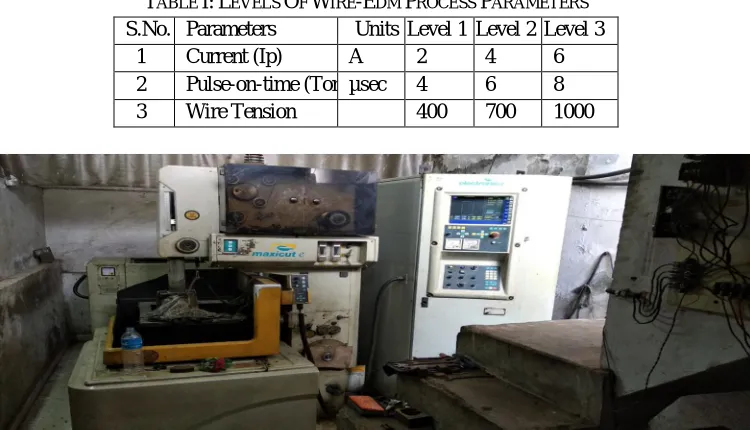
1) Machine: Electronica Maxicut Wire-EDM machine available at Dilawar Engineering Works, Lucknow.
2) Workpiece: Block of EN-24.
3) Tool: Brass wire of 0.25mm diameter.
4) Factors Under Consideration: Peak current, Pulse on time and Wire Tension.
5) Performance Measures: Material Removal Rate and Wire Offset.
6) DOE Technique: Taguchi Approach with L9 orthogonal array.
The parameters selected for present research are peak current, pulse on time and wire tension and the performance measures are material removal rate and wire offset. MRR was measured by calculating the weight loss of workpiece during machining and the machining time for the cutting of a specimen. Wire offset was measured using digital vernier calliper. The following table 1 shows the set of parameters with their levels.
TABLE I:LEVELS OF WIRE-EDM PROCESS PARAMETERS
S.No. Parameters Units Level 1 Level 2 Level 3
1 Current (Ip) A 2 4 6
2 Pulse-on-time (Ton)µsec 4 6 8
3 Wire Tension 400 700 1000
[image:2.612.123.498.507.722.2]Table I: Experimental Values Of Material Removal Rate And Wire Offset
Exp. No
Ip Ton WT
Material Removal Rate
(mm3/min)
Wire-offset (mm)
1 2 4 400 4.490 0.005
2 2 6 700 3.075 0.010
3 2 8 1000 1.951 0.020
4 4 4 700 4.761 0.005
5 4 6 1000 3.597 0.015
6 4 8 400 3.801 0.010
7 6 4 1000 3.953 0.015
8 6 6 400 3.613 0.025
9 6 8 700 3.313 0.030
III.RESULTSANDDISCUSSION
A. Material Removal Rate
The Material removal rate can be calculated by dividing the work piece weight loss (in grams) to the product of density of the work piece (gm/cc) and the machining time. Using the relation we can get the values of MRR which is shown in table below
= ℎ ( ) × 1000
× ℎ
= 0.8 ( ) × 1000
7.86 × 22.67= 4.490
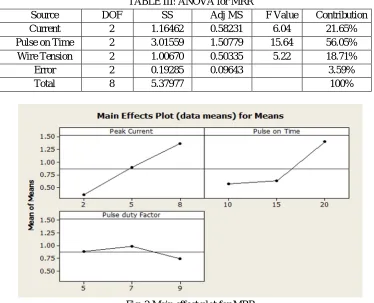
ANOVA was performed and is tabulated in table III. ANOVA reveals that the major influencing parameter for material removal rate is pulse on time with a contribution of 56.05%. Second most influencing factor is peak current with a contribution of 21.65% while the pulse duty factor is the least influencing factor for material removal rate and imparts a contribution of 18.71%.
TABLE III: ANOVA for MRR
Source DOF SS Adj MS F Value Contribution
Current 2 1.16462 0.58231 6.04 21.65%
Pulse on Time 2 3.01559 1.50779 15.64 56.05%
Wire Tension 2 1.00670 0.50335 5.22 18.71%
Error 2 0.19285 0.09643 3.59%
[image:3.612.121.495.422.725.2]Total 8 5.37977 100%
The figure 2 above presents the mean effect plot for MRR. It shows that as we increase the current, the MRR tends to increase but with further increase in Ip the MRR tends to reduce. The reason for drop of MRR at 6A current is due to the breakdown of spark in the dielectric due to the presence of debris of removed material between the spark gap. A small time is available to clear the gap between two consecutive sparks. Peak current is the second most influencing parameter for MRR and has a contribution of 21.65%. MRR reduces with increase in pulse on time. Pulse on time is the most dominating parameter for MRR and has a contribution of 56.05%. In the case of wire tension, a similar trend is followed as that for the case of pulse on time. The MRR reduces with increase in wire tension. Wire tension contributes 18.71% towards MRR.
B. Wire Offset
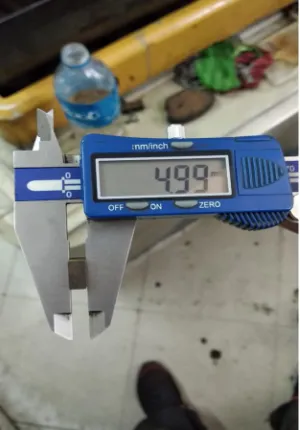
Wire off set in needed to make the part of the exact size while using the power settings provided for the particular material. Wire offset arise due to the force generated by electro discharge during cutting making electrode wire bend and deviate the tiny distance. Due to this force, the deviation induces a dimensional shift in the profile to be produced. The width of actual job profile Wa was measured by using Digital Vernier Calliper.
Dimensional shift (DS) is the perpendicular distance between the actual machined job profile from the programmed path in the first cut with zero wire offset setting. This is known as the Wire offset for first cut. Wire offset for rough cutting is equal to DS.
[image:4.612.210.396.290.459.2]DS = 0.5 (Wp – Wa)
Fig. 3 Wire Offset in Wire-EDM
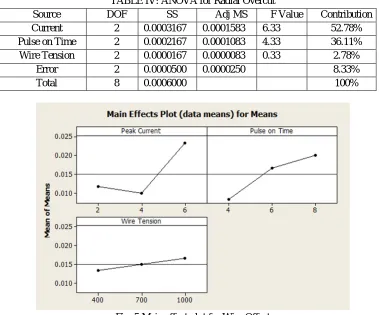
[image:4.612.237.387.493.708.2]ANOVA was performed and is tabulated in table IV. ANOVA reveals that the major influencing parameter for Wire offset is peak current with a contribution of 52.78% while pulse on time is the second most dominating parameter with a contribution of 36.11%. Wire tension has negligible influence on Wire offset and imparts a contribution of only 2.78%.
TABLE IV: ANOVA for Radial Overcut
Source DOF SS Adj MS F Value Contribution
Current 2 0.0003167 0.0001583 6.33 52.78%
Pulse on Time 2 0.0002167 0.0001083 4.33 36.11%
Wire Tension 2 0.0000167 0.0000083 0.33 2.78%
Error 2 0.0000500 0.0000250 8.33%
Total 8 0.0006000 100%
Fig. 5 Main effect plot for Wire Offset
The above graph shows the effect of input parameters on wire offset. Peak current is the most dominating parameters for wire offset and has a contribution of 52.78%. With Ip, the wire offset initially decreases but with further increase of Ip from 4 A to 6 A, the wire offset increases. This is due to the force exerted by sparks at higher current increases and hence the dimensional shift experienced is more. With pulse on time and wire tension, wire offset show an increasing trend. Pulse on time is the second most influencing parameter for wire offset with 36.11% contribution. As the intensity of spark increases, the force on wire increases and hence the wire offset increases. Wire tension is the least influencing parameter and contributes only 2.78% towards wire offset. The graph obtained is almost flat and has negligible influence on wire offset.
IV.CONCLUSIONS
This experimental study described the optimization of input machining parameters in Wire-Electrical Discharge Machining of EN-24 using L9 orthogonal array of Taguchi method. Factors like Current, pulse on time (Ton) and Wire Tension (WT) and their interactions have been found to play significant role in WEDM operation for maximization of MRR and minimization of Wire Offset. Following conclusions are made from the investigationexperimental study:
A. As we increase the current, the MRR tends to increase but with further increase in Ip the MRR tends to reduce. The reason for
drop of MRR at 6A current is due to the breakdown of spark in the dielectric due to the presence of debris of removed material between the spark gap. A small time is available to clear the gap between two consecutive sparks.
B. Peak current is the second most influencing parameter for MRR and has a contribution of 21.65%.
C. MRR reduces with increase in pulse on time. Pulse on time is the most dominating parameter for MRR and has a contribution
D. In the case of wire tension, a similar trend is followed as that for the case of pulse on time. The MRR reduces with increase in wire tension. Wire tension contributes 18.71% towards MRR.
E. Peak current is the most dominating parameters for wire offset and has a contribution of 52.78%.
F. With Ip, the wire offset initially decreases but with further increase of Ip from 4 A to 6 A, the wire offset increases. This is due
to the force exerted by sparks at higher current increases and hence the dimensional shift experienced is more.
G. With pulse on time and wire tension, wire offset show an increasing trend. Pulse on time is the second most influencing
parameter for wire offset with 36.11% contribution. As the intensity of spark increases, the force on wire increases and hence the wire offset increases.
H. Wire tension is the least influencing parameter and contributes only 2.78% towards wire offset. The graph obtained is almost
flat and has negligible influence on wire offset.
REFERENCES
[1] S. B. Prajapati ,N. S. Patel “Effect of Process Parameters on Performance Measures of Wire EDM for AISI A2 Tool Steel” International Journal of Computational Engineering Research
[2] Goswami Amitesh, Kumar Jatinder “An investigation into the machining characteristics of nimonic 80a using cnc wire-edm” International Journal of Advanced Engineering Technology E-ISSN 0976-3945
[3] Kuldeep Ojha, R. K. Garg, K. K. Singh “MRR Improvement in Sinking Electrical Discharge Machining: A Review” Journal of Minerals & Materials Characterization & Engineering, Vol. 9, , 2010
[4] J.-P. Kruth, Ph. Bleys “Measuring residual stress caused by Wire EDM of tool steel” Int. conf. on residual stresses,Germany, 1991
[5] M. Durairaja, D. Sudharsunb, N. Swamynathan “Analysis of Process Parameters in Wire EDM with Stainless Steel using Single Objective Taguchi Method and Multi Objective Grey Relational Grade” International Conference On DESIGN AND MANUFACTURING, IConDM 2013
[6] Danial Ghodsiyeh, Abolfazl Golshan, Jamal Azimi Shirvanehdeh “Review on Current Research Trends in Wire Electrical Discharge Machining (WEDM)” Indian Journal of Science and Technology 2013 ISSN:0974-6846
[7] Hari Singh, Rajesh Khanna “Parametric Optimization of Cryogenic-Treated D-3 for Cutting Rate in Wire Electrical Discharge Machining” Journal of Engineering and Technology, 2011
[8] Rajeev Kumar and Shankar Singh “Current Research Trends in Wire Electrical Discharge Machining: An Overview” International Journal on Emerging Technologies ISSN : 0975-8364
[9] L. Li, Y.B.Guo, X.T. Wei, W. Li “Surface integrity characteristics in wire-EDM of inconel 718 at different discharge energy” Seventeenth International Symposium on Electromachining
[10] N. Tosun, C. Cogun, and A. Inan “The Effect of Cutting Parameters on Workpiece Surface Roughness in Wire EDM” Machining Science And Technology 2003
[11] Ravindranadh Bobbili, V. Madhu, and A. K Gogi “Effect of Wire-EDM Machining Parameters on Surface Roughness and Material Removal Rate of High Strength Armor Steel” Materials and Manufacturing Processes, 2013, ISSN: 1042-6914