A STUDY TO ASSESS THE EFFECTIVENESS OF STRUCTURED TEACHING PROGRAMME ON
KNOWLEDGE OF ABG ANALYSIS AMONG STAFF NURSES OF ICU IN SELECTED
HOSPITALS OF GUWAHATI, ASSAM
Reshma Begum
Asian Institute of Nur
A R T I C L E I N F O
INTRODUCTION
Health is considered as one of the most important values in life and health as well as longevity should be protected and enhanced as much as possible. Early detection and treatment is one of the measures to prevent illness and also to reduce complications and death. ABG studies are concerned with respiration, the exchange of gases between the lungs and blood and between blood and tissues.
International Journal of Current Advanced Research
ISSN: O: 2319-6475, ISSN: P: 2319-6505,
Available Online at www.journalijcar.org
Volume 8; Issue 07 (C); July 2019; Page No.
DOI: http://dx.doi.org/10.24327/ijcar.2019
Copyright©2019 Reshma Begum et al. This is an open access article distributed under the Creative Commons Attribution License, which permits unrestricted use, distribution, and reproduction in any medium, provided the original work is properly cited.
Key words:
Teaching Programme on Knowledge
*Corresponding author: Reshma Begum
Asian Institute of Nursing Education, Guwahati, Assam
Article History:
Received 4th April, 2019
Received in revised form 25th May, 2019 Accepted 23rd June, 2019
Published online 28th July, 2019
A STUDY TO ASSESS THE EFFECTIVENESS OF STRUCTURED TEACHING PROGRAMME ON
KNOWLEDGE OF ABG ANALYSIS AMONG STAFF NURSES OF ICU IN SELECTED
HOSPITALS OF GUWAHATI, ASSAM
Reshma Begum., Ranju Rani Das and Unmona Borgohain Saikia
Asian Institute of Nursing Education, Guwahati, Assam
A B S T R A C T
Arterial blood gas analysis is an essential part of diagnosing and managing patient's oxygenation status and acid-base balance. Arterial blood gas analysis and its interpretation gives a view about a patient’s oxygenation, acid base balance, pulmonary function and metabolic status and with the help of such parameters nurses will be able to assess and monitor critically ill patients especially in ICU, evaluate the efficiencies of therapies, monitor patient’s clinical status as well as to determine treatment the patients. To meet this challenge, nurses must understand the mechanisms underlying acid balance and the common causes of acid-base imbalance. Objectives of the study were to assess the knowledge regarding ABG analysis among staff nurses before and after administration of structured teaching programme, to determine the effectiveness of structured teaching programme on knowledge regarding ABG analysis among staff nurses and to find out association of knowledge with selected demographic variables regarding ABG analysis among staff nurses of ICU in selected private hospitals of Guwahati, Assam. A Pre experimental one group pre- test post
accomplish the objectives of the study. The samples were selected using non pr
sampling technique. The study was conducted among 68 staff nurses of ICU of selected private hospitals of Guwahati, Assam. Respondents were selected on the basis of inclusion criteria. Pre structured questionnaire was used for assessing knowledge regarding Arterial Blood Gas Analysis and after that Structured Teaching Programme regarding ABG analysis was administered on the same day after completion of the pre-test. Post-test was conducted to the same group by using the same structured questionnaire on seventh day. Out of 68 respondents majority 60 (82.24%) of the respondents were in the age groups of 21-31 years, 64(94.12%) of the respondents were female, 32(47.06%) of the respondents were having in Diploma nursing, 32 (47.06%)
in Basic B. Sc nursing, 41(60.29%) of the respondents were from Neuro ICU, 37(54.41%) of the respondents were having 1-5 years experience, 30(44.12%) of the respondents were having (3months year) ICU experience, 36(52.94%) of the respondents attended in
pre-test majority of the respondents 38(55.88%) had inadequate knowledge and 30(44.12%) had moderately adequate knowledge but after administration of STP, majority of the respondents 35(51.47%) had moderately adequate knowledge and 33(48.53%) have adequate knowledge.
of pre-test knowledge was 12.87. After intervention the mean of post effectiveness of structured teaching programme was calculated by Z test and
0.01 level of significance. The association of pre-test knowledge was statistically tested by Chi square test and the result showed that there was significant association of pre
professional qualification, total working experience, in-service education on ABG analysis.
Conclusion: In pre-test majority of the respondents 38 (55.88%) had inadequate knowledge and 30 (44.12%) had moderately adequate knowledge but after administration of STP, majority of the respondents 35 (51.47%) had moderately adequate knowledge and 33(48.53%) have ad knowledge. Study indicated that the Structured Teaching Programme was effective in increasing the knowledge level of Staff nurses on ABG analysis.
Health is considered as one of the most important values in life and health as well as longevity should be protected and enhanced as much as possible. Early detection and treatment is one of the measures to prevent illness and also to reduce and death. ABG studies are concerned with respiration, the exchange of gases between the lungs and blood
Arterial blood gas analysis is an essential part of diagnosing and managing a patient's oxygenation status and acid balance. Disorders of acid
complications in many disease states, and occasionally the abnormality may be so severe so as to become a life threatening risk factor. Arterial blood gas analysis and its interpretation gives a view about a patient’s oxygenation, acid base balance, pulmonary function and metabolic status and with the help of such parameters nurses will b
and monitor critically ill patients especially in ICU, evaluate the efficiencies of therapies, monitor patient’s clinical status as
International Journal of Current Advanced Research
6505, Impact Factor: 6.614
www.journalijcar.org
; Page No.19508-19513
//dx.doi.org/10.24327/ijcar.2019.19513.3768
This is an open access article distributed under the Creative Commons Attribution License, which permits unrestricted use, distribution, and reproduction in any medium, provided the original work is properly cited.
Asian Institute of Nursing Education, Guwahati, Assam
A STUDY TO ASSESS THE EFFECTIVENESS OF STRUCTURED TEACHING PROGRAMME ON
KNOWLEDGE OF ABG ANALYSIS AMONG STAFF NURSES OF ICU IN SELECTED PRIVATE
and Unmona Borgohain Saikia
Arterial blood gas analysis is an essential part of diagnosing and managing patient's oxygenation status Arterial blood gas analysis and its interpretation gives a view about a patient’s tion and metabolic status and with the help of such parameters nurses will be able to assess and monitor critically ill patients especially in ICU, evaluate the efficiencies of therapies, monitor patient’s clinical status as well as to determine treatment needs of To meet this challenge, nurses must understand the mechanisms underlying acid-base . Objectives of the study were to assess the efore and after administration of structured teaching programme, to determine the effectiveness of structured teaching programme on knowledge regarding ABG analysis among staff nurses and to find out association of knowledge with selected bles regarding ABG analysis among staff nurses of ICU in selected private hospitals test post-test design study was used to accomplish the objectives of the study. The samples were selected using non probability convenience sampling technique. The study was conducted among 68 staff nurses of ICU of selected private hospitals of Guwahati, Assam. Respondents were selected on the basis of inclusion criteria. Pre - test assessing knowledge regarding Arterial Blood Gas Analysis and after that Structured Teaching Programme regarding ABG analysis was administered on the same day test was conducted to the same group by using the same ructured questionnaire on seventh day. Out of 68 respondents majority 60 (82.24%) of the 31 years, 64(94.12%) of the respondents were female, 32(47.06%) of the respondents were having in Diploma nursing, 32 (47.06%) of the respondents were in Basic B. Sc nursing, 41(60.29%) of the respondents were from Neuro ICU, 37(54.41%) of the 5 years experience, 30(44.12%) of the respondents were having (3months-1 respondents attended in-service class on ABG Analysis. In 55.88%) had inadequate knowledge and 30(44.12%) had moderately adequate knowledge but after administration of STP, majority of the respondents ad moderately adequate knowledge and 33(48.53%) have adequate knowledge. The mean test knowledge was 12.87. After intervention the mean of post-test knowledge was 21.76. The effectiveness of structured teaching programme was calculated by Z test and value of “Z” was 15.87 at test knowledge was statistically tested by Chi square test and the result showed that there was significant association of pre-test knowledge score with
service education on ABG analysis.
test majority of the respondents 38 (55.88%) had inadequate knowledge and 30 (44.12%) had moderately adequate knowledge but after administration of STP, majority of the respondents 35 (51.47%) had moderately adequate knowledge and 33(48.53%) have adequate Study indicated that the Structured Teaching Programme was effective in increasing the
Arterial blood gas analysis is an essential part of diagnosing and managing a patient's oxygenation status and acid-base balance. Disorders of acid-base balance can create complications in many disease states, and occasionally the ere so as to become a life-Arterial blood gas analysis and its interpretation gives a view about a patient’s oxygenation, acid base balance, pulmonary function and metabolic status and with the help of such parameters nurses will be able to assess and monitor critically ill patients especially in ICU, evaluate the efficiencies of therapies, monitor patient’s clinical status as
Research Article
well as to determine treatment needs of the patients. Based on the ABG results, titration of oxygen therapy
level of ventilator support and decision about fluid and electrolyte therapy can be taken. With increasing use of ABG analysis in various wards to aid in medical diagnosis and management, nurses if they can interpret results are often a to initiate interventions and understand the reasons for medical interventions. As Nurses are often the first members of the health care team to see ABG results and an accurate assessment of the relationship between abnormal blood gas findings and a patient’s overall clinical condition is a common challenge for critical care nurses. Knowledge about ABG interpretation is essential for the nurses, so that they can analyze each component to avoid overlooking a change that could result in an inaccurate interpretation leading to inappropriate treatment.
Objectives of the Study
1. To assess the knowledge regarding ABG analysis among staff nurses before and after administration of structured teaching programme.
2. To determine the effectiveness of structured teach programme on knowledge regarding ABG analysis among staff nurses.
3. To find out association of knowledge with selected demographic variables like age, gender, educational qualification, type of ICU, years of experience, exposure to any in-service educati
analysis.
REVIEW OF LITERATURE
Indira S, et al. (2017) conducted a descriptive study to assess the knowledge regarding ABG analysis and interpretation of ABG results among staff nurse in NMCH, Nellore. The study was conducted on 30 samples and the result shows that 4 (13.3%) had “A” grade, 7(23.3%) had “B+” grade, 12(40%) had “B” grade, 5(16.7%) had “C” grade and 2(6.7%) had “D” grade knowledge and mean value was 19.0 and SD was 3.5 in staff nurses, which conclude that majority of staff nurses h D grade knowledge
Anil GD et al.( 2015) conducted a prospective observational study on severe metabolic acidosis among 100 critically ill patients of JSS Hospital, Mysore and its impact on the outcome. It was found that out of 86 patients who had lac acidosis, 69 patients expired. Out of 69 patients who had high anion gap acidosis, 47 patients had adverse outcome and a high base deficit is associated with high mortality 79.4 per cent. Out of 55 patients who were on mechanical ventilation 45 of them expired, 37 required vasopressor support and 34 had lactic acidosis. Study reveals that critically ill patients with metabolic acidosis had higher mortality rate.
RESEARCH METHODOLOGY
Research approach: Quantitative research approach.
Design: Pre experimental one group pre- test post
Dependent variable: Knowledge of staff nurses regarding
ABG analysis.
Independent variable: Structured Teaching Programme
regarding ABG analysis.
Demographic variable: Age, gender, professional
qualification, type of ICU, year of experience (ICU experience well as to determine treatment needs of the patients. Based on the ABG results, titration of oxygen therapy like adjusting the level of ventilator support and decision about fluid and electrolyte therapy can be taken. With increasing use of ABG analysis in various wards to aid in medical diagnosis and management, nurses if they can interpret results are often able to initiate interventions and understand the reasons for medical Nurses are often the first members of the health care team to see ABG results and an accurate assessment of the relationship between abnormal blood gas tient’s overall clinical condition is a common Knowledge about ABG interpretation is essential for the nurses, so that they can analyze each component to avoid overlooking a change that rpretation leading to
To assess the knowledge regarding ABG analysis among staff nurses before and after administration of
To determine the effectiveness of structured teaching programme on knowledge regarding ABG analysis
To find out association of knowledge with selected demographic variables like age, gender, educational qualification, type of ICU, years of experience, service education on ABG
Indira S, et al. (2017) conducted a descriptive study to assess the knowledge regarding ABG analysis and interpretation of ABG results among staff nurse in NMCH, Nellore. The study the result shows that 4 (13.3%) had “A” grade, 7(23.3%) had “B+” grade, 12(40%) had “B” grade, 5(16.7%) had “C” grade and 2(6.7%) had “D” grade knowledge and mean value was 19.0 and SD was 3.5 in staff nurses, which conclude that majority of staff nurses had
Anil GD et al.( 2015) conducted a prospective observational study on severe metabolic acidosis among 100 critically ill patients of JSS Hospital, Mysore and its impact on the outcome. It was found that out of 86 patients who had lactic acidosis, 69 patients expired. Out of 69 patients who had high anion gap acidosis, 47 patients had adverse outcome and a high base deficit is associated with high mortality 79.4 per cent. Out of 55 patients who were on mechanical ventilation expired, 37 required vasopressor support and 34 had lactic acidosis. Study reveals that critically ill patients with
Quantitative research approach.
test post-test design. Knowledge of staff nurses regarding
Structured Teaching Programme
Age, gender, professional ification, type of ICU, year of experience (ICU experience
and total experience), exposure to any in ABG Analysis.
Setting of the study: Study was conducted at two private
Hospitals of Guwahati, Assam
Population: Staff nurses.
Target population:Staff nurses of ICU of private hospitals of
Guwahati, Assam.
Accessible population: Staff nurses of ICU of selected private
hospitals of Guwahati, Assam.
Sample: Staff nurses working in ICU who fulfills the inclusion
criteria and present on the day of data collection.
Sample size: 68 staff nurses.
Sampling technique: Samples were selected using non
probability convenience sampling technique.
Tools and techniques:The tool used for the study consisted of
two sections: Demographic profile and Structured Knowledge questionnaire. Technique used was Self report.
Validity of the tool: Tool was validated by five experts from
the field of critical care and five nursing experts from the field of Medical surgical nursing.
Reliability of the tool:The reliability of the tool was done by
using split half method where, the reliability (r) of the knowledge questionnaire was 0.82, so the tool was found to be reliable.
Pilot study:Pilot study was conducted
Main Study: 4th -31st July, 2017.
RESULTS
Table I Frequency and percentage distribution of the respondentsaccording to their age group
Age( in years) Frequency
21-31 60
31-41 8
Above 41 0
TOTAL 68
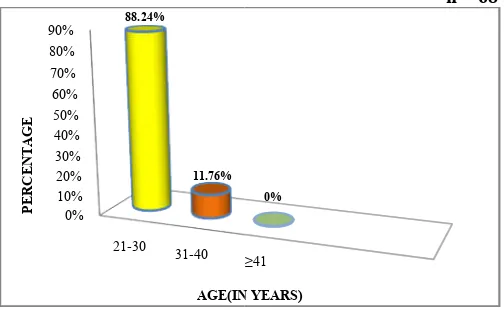
Table-I depicts that, out of 68 samples majority 60(82.24%) of the respondents were in the age groups of 21
respondents were in age group of 31
respondents were in the age group of above 41 years. The results are shown in bar diagram in figure 1.
Figure 1 Percentage distribution of the respondents according to their age
group
Table II Frequency and percentage distribution of according to gender
0%
10% 20% 30% 40% 50% 60% 70% 80% 90%
21-30 31-40
88.24%
11.76%
P
ERC
ENT
AGE
AGE(IN YEARS)
and total experience), exposure to any in-service education on
Study was conducted at two private
Staff nurses of ICU of private hospitals of
Staff nurses of ICU of selected private
Staff nurses working in ICU who fulfills the inclusion nt on the day of data collection.
Samples were selected using non probability convenience sampling technique.
The tool used for the study consisted of ofile and Structured Knowledge questionnaire. Technique used was Self report.
Tool was validated by five experts from the field of critical care and five nursing experts from the field
The reliability of the tool was done by using split half method where, the reliability (r) of the knowledge questionnaire was 0.82, so the tool was found to be
Pilot study was conductedon 7 samples. July, 2017.
Frequency and percentage distribution of the according to their age group
n=68
Frequency Percentage
82.24% 11.76% 0% 100%
I depicts that, out of 68 samples majority 60(82.24%) of the respondents were in the age groups of 21-31years, 8(11.76%) of the respondents were in age group of 31- 41 years, and none (0%) of the age group of above 41 years. The results are
n = 68
Percentage distribution of the respondents according to their age roup
Frequency and percentage distribution of respondents according to gender
n = 68 ≥41
0%
ICU In Selected Private Hospitals of Guwahati, Assam
Gender Frequency Precentage
Male 4 5.88%
Female 64 94.12%
TOTAL 68 100%
Table II depict that, out of 68 samples, 4(5.88%) of the staff nurses were male and 64(94.12%) were female. The results are shown in the Pie diagram in figure 2.
Figure 2 Percentage distribution of the respondents according to gender.
Table III Frequency and percentage distribution of the respondents according to their professional qualification
Professional
Qualification Frequency
Diploma in Nursing 32 Post Basic B. Sc. Nursing 4
Basic B.sc Nursing 32 M. Sc. Nursing 0
TOTAL 68
Table-III depicts that, out of 68 samples 32(47.06%) of the respondents were Diploma nurses, 32 (47.06%) of the respondents were Basic B.Sc. nurses, four (5.88%) were Post Basic B.Sc. Nurses and none (0%) of them were M. Sc. nursing. The data is presented in a form of bar diagram in figure 3.
Figure 3 Percentage distribution of the respondents according to their
professional qualification
Table IV Frequency and percentage distribution of the respondents according to type of ICU they are working
5.88%
94.12%
0.00% 10.00% 20.00% 30.00% 40.00% 50.00%
Diploma in nursing
Post Basic B.Sc Nursing
Basic B.sc Nursing
47.06%
5.88%
47.06%
P
ER
CEN
TAGE
PROFESSIONAL QUALIFICATION
ICU In Selected Private Hospitals of Guwahati, Assam
Precentage
Table II depict that, out of 68 samples, 4(5.88%) of the ICU were male and 64(94.12%) were female. The results are shown in the Pie diagram in figure 2.
n=68
Percentage distribution of the respondents according to gender.
Frequency and percentage distribution of the respondents according to their professional qualification
n=68
Percentage
47.06% 5.88%
47.06 0% 100%
III depicts that, out of 68 samples 32(47.06%) of the respondents were Diploma nurses, 32 (47.06%) of the were Basic B.Sc. nurses, four (5.88%) were Post Basic B.Sc. Nurses and none (0%) of them were M. Sc. nursing. The data is presented in a form of bar diagram in
n=68
Percentage distribution of the respondents according to their
Frequency and percentage distribution of the respondents according to type of ICU they are working
Type of
ICU Frequency
Neuro ICU 41 Cardiac
ICU 18
Others 9 Total 68
Table-IV depicts that, out of 68 samples majority 41(60.29%) of the respondents were from Neuro ICU, 18(26.47%) of the respondents were from Cardiac ICU, nine (13.24%) were from other ICU’s. The data is presented
in figure 4.
Figure 4Percentage distribution of the respondents according to type of ICU
they are working.
Table V Frequency and percentage distribution of the respondents according to years of experience
Years of experience
3 months -1year 1 year -5 years 5years-10years ≥10 years
TOTAL
Table-V depicts that, out of 68 samples majority 37(54.41%) of the respondents were having 1
20(29.41%) of the respondents were having 3months experience, eight (11.77%) of respondents were having 5 years, and three (4.41%) of respondent were having
experience. The results are shown in bar diagram in figure 5.
Figure 5 Percentage distribution of the respondents according to total years of
working experience Male
Female
M.Sc Nursing
0%
PROFESSIONAL QUALIFICATION
0.00% 10.00% 20.00% 30.00% 40.00% 50.00% 60.00% 70.00%
Neuro ICU Cardiac ICU
60.29%
26.47%
P
ERC
ENT
AGE
TYPE OF ICU
29.41%
54.41%
0.00% 10.00% 20.00% 30.00% 40.00% 50.00% 60.00%
3 Months-1 Year
1-5 Years
P
ERC
ENT
AGE
TOTAL EXPERIENCE OF ICU STAFF NURSES
n = 68
Frequency Percentage
41 60.29%
18 26.47%
9 13.24%
68 100%
IV depicts that, out of 68 samples majority 41(60.29%) of the respondents were from Neuro ICU, 18(26.47%) of the respondents were from Cardiac ICU, nine (13.24%) were from other ICU’s. The data is presented in the form of bar diagram
n=68
Percentage distribution of the respondents according to type of ICU they are working.
Frequency and percentage distribution of the respondents according to years of experience
n=68
Frequency Percentage
20 29.41% 37 54.41% 8 11.77%
3 4.41%
68 100%
V depicts that, out of 68 samples majority 37(54.41%) of the respondents were having 1-5 years of experience, 20(29.41%) of the respondents were having 3months-1 year of experience, eight (11.77%) of respondents were having 5-10 1%) of respondent were having >10 years of experience. The results are shown in bar diagram in figure 5.
n=68
Percentage distribution of the respondents according to total years of experience
Cardiac ICU Others
26.47%
13.24%
TYPE OF ICU
54.41%
11.77%
4.41%
5 Years 5-10 Years >10 Years
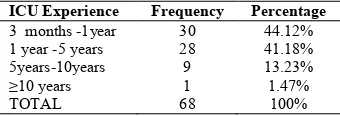
Table VI Frequency and percentage distribution of respondents according to working experience
ICU Experience Frequency Percentage
3 months -1year 30 44.12% 1 year -5 years 28 41.18% 5years-10years 9 13.23%
≥10 years 1 1.47%
TOTAL 68 100%
Table-VI depicts that, out of 68 samples majority 30(44.12%) of the respondents were having 3months-1 year experience, 28(41.18%) of the respondents were having 1
experience, nine(13.23%) of respondents were having 5 years of experience, and one (1.47%) of respondent was having >10 years of experience. The results are shown in bar diagram in figure 6.
Figure 6 Percentage distribution of the respondents according to total years of
working experience in ICU
Table VII Frequency and percentage distribution of respondents according to in-service education on arterial blood
gas analysis
In-service education on ABG Analysis
Frequency Percentage
Yes 36 52.94%
No 32 47.06%
TOTAL 68 100%
Table-VII depicts that, out of 68 samples, majority 36(52.94%) of the respondents have attended in- service class on ABG Analysis and rest 32(47.06%) of the respondents have not attended any in-service class. The results are shown in pie diagram in figure 7.
Figure 7 Percentage distribution of respondents according to exposure to in
service education on arterial blood gas analysis
44.12%
41.18%
13.23%
0.00% 5.00% 10.00% 15.00% 20.00% 25.00% 30.00% 35.00% 40.00% 45.00% 50.00%
3 Months-1 Year 1-5 Years 5-10 Years
P
ERC
ENT
AGE
TOTAL ICU EXPERIENCE OF STAFF NURSES
52.94% 47.06%
EXPOSURE TO IN-SERVICE EDUCATION ON ABG Frequency and percentage distribution of respondents according to working experience (only in ICU)
n=68
Percentage
44.12% 41.18% 13.23% 1.47%
100%
VI depicts that, out of 68 samples majority 30(44.12%) 1 year experience, 28(41.18%) of the respondents were having 1-5 years of experience, nine(13.23%) of respondents were having 5-10 one (1.47%) of respondent was 10 years of experience. The results are shown in bar
n=68
Percentage distribution of the respondents according to total years of
percentage distribution of service education on arterial blood
n=68
Percentage
52.94% 47.06% 100%
samples, majority 36(52.94%) service class on ABG Analysis and rest 32(47.06%) of the respondents have not service class. The results are shown in pie
n=68
tage distribution of respondents according to exposure to in-service education on arterial blood gas analysis
Table VIII Frequency and percentage distribution of respondents according to number of session of in
education on arterial blood gas
Number of sessions of In-service education on ABG Analysis
1 session 2 sessions >2 sessions
TOTAL
Table-VIII depicts that out of 36 samples, majority 32(88.88%) of the respondents have attended one session of in-service class on ABG Analysis, 22 (5.56%) attended two sessions and rest two (5.56%)
sessions. The result is shown in
Figure 8 Percentage distribution of respondents according to number of
sessions of in-service education on arterial blood gas analysis
Table IX Frequency and percentage distribution of staff nurses according to their level of knowledge regarding arterial blood
gas analysis before and after administration of structured teaching programme
Variable Inadequate Moderately Adequate Frequency Percentage Frequency
Pre-test
knowledge 38 55.88% 30
Post-test
knowledge 0 0% 35
Figure 9 Percentage distribution of staff nurses according to level of
knowledge regarding arterial blood gas analysis.
The data presented in Table-IX depicts that, out of 68 samples, in pre-test majority 38(55.88%) of respondents had Inadequate
13.23%
1.47%
10 Years >10 Years
TOTAL ICU EXPERIENCE OF STAFF NURSES
SERVICE EDUCATION ON ABG
YES NO
5.6% 5.6%
NO OF SESSIONS OF IN
ABG ANALYSIS
0.00% 10.00% 20.00% 30.00% 40.00% 50.00% 60.00%
Inadequate knowledge
Moderately adequate knowledge 55.88%
44.12%
0%
51.47%
P
ERC
ENT
AGE
PRE TEST AND POST TEST KNOWLEDGE SCORE Frequency and percentage distribution of respondents according to number of session of in-service
education on arterial blood gas analysis
n=36
service
education on ABG Analysis Frequency Percentage
32 88.88% 22 5.56%
2 5.56%
36 100%
VIII depicts that out of 36 samples, majority 32(88.88%) of the respondents have attended one session of service class on ABG Analysis, 22 (5.56%) attended two (5.56%) attended more than two The result is shown in pie diagram in figure 8.
n=36
Percentage distribution of respondents according to number of service education on arterial blood gas analysis
Frequency and percentage distribution of staff nurses level of knowledge regarding arterial blood gas analysis before and after administration of structured
teaching programme
n=68
Moderately Adequate Adequate Frequency Percentage Frequency Percentage
30 44.12% 0 0%
35 51.47% 33 48.53%
n=68
Percentage distribution of staff nurses according to level of knowledge regarding arterial blood gas analysis.
IX depicts that, out of 68 samples, test majority 38(55.88%) of respondents had Inadequate
88.8%
NO OF SESSIONS OF IN-SERVICE EDUCATION ON ABG ANALYSIS
1session
2session
Moderately adequate knowledge
Adequate knowledge
0% 48.53%
PRE TEST AND POST TEST KNOWLEDGE SCORE
Pre test
Post test
ICU In Selected Private Hospitals of Guwahati, Assam
knowledge and remaining 30(44.12%) had moderately adequate knowledge. After administration of STP, in post majority 35(51.47%) had moderately adequate knowledge, remaining 33 (48.53%) had adequate knowledge and none had inadequate knowledge regarding ABG analysis. Data are presented in bar diagram in figure 9.
Table X Evaluation of effectiveness of structure teaching programme on knowledge regarding Arterial blood gas
analysis among the staff nurses
The following hypothesis was formulated to test the effectiveness of structured teaching programme regarding Arterial blood gas analysis among the staff nurses.
H01: There is no significant difference between the mean
pre-test knowledge score and mean post
score regarding arterial blood gas analysis of staff nurses.
H1: The mean post-test knowledge score of staff nu
significantly higher than the mean pre score regarding arterial blood gas analysis.
Knowledge Mean SD
P-Value
Calculated
Z-Pre-test 12.87 3.71
0.01 15.87 Post-test 21.76 2.74
The Table-X depicts that, the mean knowledge score in pre test is 12.87 with standard deviation 3.71. In post
mean knowledge score is 21.76 with standard deviation 2.74. The improvement is statistically tested by Z test. The calculated value of “Z” 15.87 is higher than the tabulated value 2.33 at 0.01% of level of significant. Therefore, H
which indicates that the mean post test knowledge is significantly higher than the mean pretest knowledge. Hence, STP on Arterial blood Gas analysis is effective.
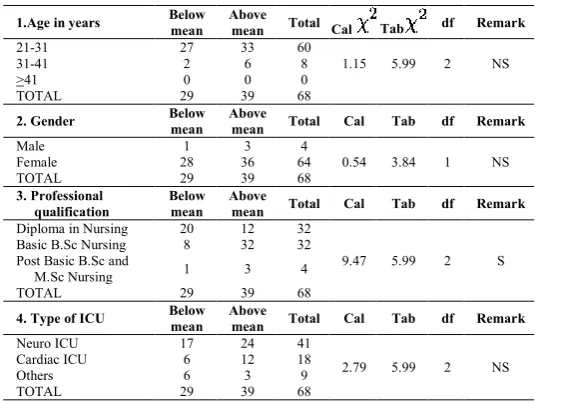
Table XI Association of pre-test knowledge with selected demographic variables
Chi square test was used to assess the association of pre knowledge with selected demographic variables
H02 -There is no significant association between pre
knowledge score and selected demographic variables.
1.Age in years Below mean
Above
mean Total Cal
21-31 27 33 60
1.15
31-41 2 6 8
>41 0 0 0
TOTAL 29 39 68
2. Gender Below
mean Above
mean Total Cal
Male 1 3 4
0.54
Female 28 36 64
TOTAL 29 39 68
3. Professional qualification
Below mean
Above
mean Total Cal
Diploma in Nursing 20 12 32
9.47
Basic B.Sc Nursing 8 32 32
Post Basic B.Sc and
M.Sc Nursing 1 3 4
TOTAL 29 39 68
4. Type of ICU Below mean
Above
mean Total Cal
Neuro ICU 17 24 41
2.79
Cardiac ICU 6 12 18
Others 6 3 9
TOTAL 29 39 68
ICU In Selected Private Hospitals of Guwahati, Assam
knowledge and remaining 30(44.12%) had moderately inistration of STP, in post-test majority 35(51.47%) had moderately adequate knowledge, remaining 33 (48.53%) had adequate knowledge and none had inadequate knowledge regarding ABG analysis. Data are
structure teaching knowledge regarding Arterial blood gas analysis among the staff nurses
The following hypothesis was formulated to test the effectiveness of structured teaching programme regarding
analysis among the staff nurses.
There is no significant difference between the mean test knowledge score and mean post-test knowledge score regarding arterial blood gas analysis of staff
test knowledge score of staff nurses is significantly higher than the mean pre-test knowledge score regarding arterial blood gas analysis.
n=68
Calculated - value
Table Z – value
15.87 2.33
depicts that, the mean knowledge score in pre-test is 12.87 with standard deviation 3.71. In post-pre-test, the mean knowledge score is 21.76 with standard deviation 2.74. The improvement is statistically tested by Z test. The higher than the tabulated value 2.33 at 0.01% of level of significant. Therefore, H1 is accepted
which indicates that the mean post test knowledge is significantly higher than the mean pretest knowledge. Hence,
ve.
test knowledge with selected
Chi square test was used to assess the association of pre-test knowledge with selected demographic variables.
There is no significant association between pre-test owledge score and selected demographic variables.
n=68
Tab df Remark
5.99 2 NS
Tab df Remark
3.84 1 NS
Tab df Remark
5.99 2 S
Tab df Remark
5.99 2 NS
5. Total working experience
Below mean
Above mean
3 months-1 year 13 7
1 year-5 years 13 24
>5 years 3 8
TOTAL 29 39
6.Total working experience in ICU
Below mean
Above mean
3 months-1 year 17 13
1 year-5 years 10 18
>5years 2 8
TOTAL 29 39
7. In-service education
Below mean
Above mean
Yes 9 27
No 20 12
TOTAL 29 39
For calculation purpose, clubbing of the scores was done and chi square formula was used.
NS=Not Significant, S=Significant, Cal
value of chi square, Tab= Table value of chi square, df= degree of freedom.
CONCLUSION
In pre-test majority of the respondents 55.88% had inadequate knowledge and 44.12% had moderately adequate knowledge but after administration of STP, majority of the respondents 51.47% had moderately adequate knowledge and 48.53% have adequate knowledge. The mean of pre
12.87. After intervention the mean of post
21.76. The calculated value of “Z” of knowledge was 15.87 which showed structured teaching programme was effective. There was significant association between pr
with the selected demographic variables like professional qualification, total years of experience and exposure to in service education.
References
1. Bare BG, Cheever KH, Hinkle JL Smeltzer SC. Brunner and Suddarth’s Textbook of Medical su
12thed. Vol 1. New Delhi: Wolter Kluwer plt.ltd; 2012. 2. Beck CT, Polit DF. Essential of nursing research:
appraising evidence for nursing practice. 7
WoltersKluwer Lippincott Williams and Wilkins Health Pvt Ltd; 2010.
3. Bersten AD, SoniN.Oh’s Intensive care manual.6 Elsevier limited; 2009.
4. Black MJ, Jacobs ME. Medical Surgical nursing clinical management nursing for continuity of care.3
Delhi: W.B.Saunders Company; 1997.
5. Burns SM, Marianne C. AACN Essentials of Criti Care Nursing. 3rded; 2009.
6. Eleanor TW, James TW. Elements of Research in Nursing. 2nd edition.CV Mosby Company Publishing, 2009.
7. Polit FD, Hungler PB. Nursing research and principles and methods. 6th ed. Philedelpphia: Lippincot Company; 1999.
8. Sharma SK. Nursing Research and Statistics.2 Delhi: Elsevier; 2014.
9. Anil GD, Gowdappa HB, Kiran HS, Murthy KA. Prospective Observational Study on Severe Metabolic Acidosis in Critically Ill Patients and Its Impact on the Outcome. IJSS[abstract].2015November.[cited 2017
Above
Total Cal Tab df Remark
20
6.04 5.99 2 S
36 11 68
Above
Total Cal Tab df Remark
30
5.05 5.99 2 NS
28 10
68
Above
Total Cal Tab df Remark
36
9.72 3.84 1 S
32 68
For calculation purpose, clubbing of the scores was done and
S=Significant, Cal-value= calculated value of chi square, Tab= Table value of chi square, df=
test majority of the respondents 55.88% had inadequate knowledge and 44.12% had moderately adequate knowledge but after administration of STP, majority of the respondents 51.47% had moderately adequate knowledge and 48.53% have he mean of pre-test knowledge was 12.87. After intervention the mean of post-test knowledge was 21.76. The calculated value of “Z” of knowledge was 15.87 which showed structured teaching programme was effective. There was significant association between pre-test knowledge with the selected demographic variables like professional qualification, total years of experience and exposure to
in-Bare BG, Cheever KH, Hinkle JL Smeltzer SC. Brunner and Suddarth’s Textbook of Medical surgical Nursing. ed. Vol 1. New Delhi: Wolter Kluwer plt.ltd; 2012. Beck CT, Polit DF. Essential of nursing research: appraising evidence for nursing practice. 7th ed. India: WoltersKluwer Lippincott Williams and Wilkins Health
, SoniN.Oh’s Intensive care manual.6th ed.
Black MJ, Jacobs ME. Medical Surgical nursing clinical management nursing for continuity of care.3rded. New Delhi: W.B.Saunders Company; 1997.
Burns SM, Marianne C. AACN Essentials of Critical ed; 2009.
Eleanor TW, James TW. Elements of Research in edition.CV Mosby Company Publishing,
Polit FD, Hungler PB. Nursing research and principles ed. Philedelpphia: Lippincot Company;
SK. Nursing Research and Statistics.2ndted.New
Dec 7];3(8):168-171. Available from: http://www.ijss-sn.com/uploads/2/0/1/5/20153321/ijss_nov_oa38.pdfdoi : 17354/ijss/2015/533.
10. Indira S, Padma K, Priya A, Subhashini N. A study to assess the knowledge regarding ABG analysis and interpretation of ABG results among staff nursein NMCH, Nellore. IJAR. 2017 Dec 3[cited 2018 Jan 19];3(1):06-08.Availabe from www.allresearchjournal. Com>partA.
11. Cadogan M. Acid base disorders: Simple method of acid base balance interpretation.-four step method of ABG analysis. Life in fastlane; 2005[updated 2014 July 15;cited 2017 Dec3]. Available from: https:// life in the fastlane.com/investigations/acid-base/
12. Danckers M. Arterial Blood Gas Sampling Technique. Medscape[ document on internet]American college of chest physician:2016 May 19 [cited 2018 Jan 12]. Available from: http://emedicine.medscape.com/ article/1902703-overview.
How to cite this article:
Reshma Begum et al (2019) 'A Study To Assess The Effectiveness of Structured Teaching Programme on Knowledge of ABG Analysis Among Staff Nurses of ICU In Selected Private Hospitals of Guwahati, Assam', International Journal of Current Advanced Research, 08(07), pp.19508-19513. DOI: http://dx.doi.org/10.24327/ijcar.2019.19513.3768