Identifying High-Impact Sub-Structures for Convolution Kernels in
Document-level Sentiment Classification
Zhaopeng Tu† Yifan He‡§ Jennifer Foster§ Josef van Genabith§ Qun Liu† Shouxun Lin†
†Key Lab. of Intelligent Info. Processing ‡Computer Science Department §School of Computing
Institute of Computing Technology, CAS New York University Dublin City University
†{tuzhaopeng,liuqun,sxlin}@ict.ac.cn,
‡[email protected],§{jfoster,josef}@computing.dcu.ie
Abstract
Convolution kernels support the modeling of complex syntactic information in machine-learning tasks. However, such models are highly sensitive to the type and size of syntac-tic structure used. It is therefore an importan-t challenge importan-to auimportan-tomaimportan-tically idenimportan-tify high im-pact sub-structures relevant to a given task. In this paper we present a systematic study inves-tigating (combinations of) sequence and con-volution kernels using different types of sub-structures in document-level sentiment classi-fication. We show that minimal sub-structures extracted from constituency and dependency trees guided by a polarity lexicon show 1.45 point absolute improvement in accuracy over a bag-of-words classifier on a widely used sen-timent corpus.
1 Introduction
An important subtask in sentiment analysis is sen-timent classification. Sentiment classification in-volves the identification of positive and negative opinions from a text segment at various levels of granularity including document-level, paragraph-level, sentence-level and phrase-level. This paper focuses on document-level sentiment classification.
There has been a substantial amount of work on document-level sentiment classification. In ear-ly pioneering work, Pang and Lee (2004) use a flat feature vector (e.g., a bag-of-words) to rep-resent the documents. A bag-of-words approach, however, cannot capture important information ob-tained from structural linguistic analysis of the
doc-uments. More recently, there have been several ap-proaches which employ features based on deep lin-guistic analysis with encouraging results including Joshi and Penstein-Rose (2009) and Liu and Senef-f (2009). However, as they select Senef-features manually, these methods would require additional labor when ported to other languages and domains.
In this paper, we study and evaluate diverse lin-guistic structures encoded as convolution kernels for the document-level sentiment classification prob-lem, in order to utilize syntactic structures without defining explicit linguistic rules. While the applica-tion of kernel methods could seem intuitive for many tasks, it is non-trivial to apply convolution kernels to document-level sentiment classification: previous work has already shown that categorically using the entire syntactic structure of a single sentence would produce too many features for a convolution ker-nel (Zhang et al., 2006; Moschitti et al., 2008). We expect the situation to be worse for our task as we work with documents that tend to comprise dozens of sentences.
It is therefore necessary to choose appropriate substructures of a sentence as opposed to using the whole structure in order to effectively use convolu-tion kernels in our task. It has been observed that not every part of a document is equally informa-tive for identifying the polarity of the whole doc-ument (Yu and Hatzivassiloglou, 2003; Pang and Lee, 2004; Koppel and Schler, 2005; Ferguson et al., 2009): a film review often uses lengthy objective paragraphs to simply describe the plot. Such objec-tive portions do not contain the author’s opinion and are irrelevant with respect to the sentiment
cation task. Indeed, separating objective sentences from subjective sentences in a document produces encouraging results (Yu and Hatzivassiloglou, 2003; Pang and Lee, 2004; Koppel and Schler, 2005; Fer-guson et al., 2009). Our research is inspired by these observations. Unlike in the previous work, however, we focus on syntacticsubstructures(rather than en-tire paragraphs or sentences) that contain subjective words.
More specifically, we use the terms in the lexi-con lexi-constructed from (Wilson et al., 2005) as the indicators to identify the substructures for the con-volution kernels, and extract different sub-structures according to these indicators for various types of parse trees (Section 3). An empirical evaluation on a widely used sentiment corpus shows an improve-ment of 1.45 point in accuracy over the baseline resulting from a combination of bag-of-words and high-impact parse features (Section 4).
2 Related Work
Our research builds on previous work in the field of sentiment classification and convolution kernel-s. For sentiment classification, the design of lexi-cal and syntactic features is an important first step. Several approaches propose feature-based learning algorithms for this problem. Pang and Lee (2004) and Dave et al. (2003) represent a document as a bag-of-words; Matsumoto et al., (2005) extract fre-quently occurring connected subtrees from depen-dency parsing; Joshi and Penstein-Rose (2009) use a transformation of dependency relation triples; Liu and Seneff (2009) extract adverb-adjective-noun re-lations from dependency parser output.
Previous research has convincingly demonstrat-ed a kernel’s ability to generate large feature set-s, which is useful to quickly model new and not well understood linguistic phenomena in machine learning, and has led to improvements in various NLP tasks, including relation extraction (Bunescu and Mooney, 2005a; Bunescu and Mooney, 2005b; Zhang et al., 2006; Nguyen et al., 2009), question answering (Moschitti and Quarteroni, 2008), seman-tic role labeling (Moschitti et al., 2008).
Convolution kernels have been used before in sen-timent analysis: Wiegand and Klakow (2010) use convolution kernels for opinion holder extraction,
Johansson and Moschitti (2010) for opinion expres-sion detection and Agarwal et al. (2011) for sen-timent analysis of Twitter data. Wiegand and K-lakow (2010) use e.g. noun phrases as possible can-didate opinion holders, in our work we extract any minimal syntactic context containing a subjective word. Johansson and Moschitti (2010) and Agarwal et al. (2011) process sentences and tweets respec-tively. However, as these are considerably shorter than documents, their feature space is less complex, and pruning is not as pertinent.
3 Kernels for Sentiment Classification
3.1 Linguistic Representations
We explore both sequence and convolution kernels to exploit information on surface and syntactic lev-els. For sequence kernels, we make use of lexical words with some syntactic information in the form of part-of-speech (POS) tags. More specifically, we define three types of sequences:
• SW, a sequence of lexical words, e.g.: A tragic waste of talent and incredible visual effects.
• SP, a sequence of POS tags, e.g.:DT JJ NN IN NN CC JJ JJ NNS.
• SWP, a sequence of words and POS tags, e.g.: A/DT tragic/JJ waste/NN of/IN talent/NN and/CC incredible/JJ visual/JJ effects/NNS.
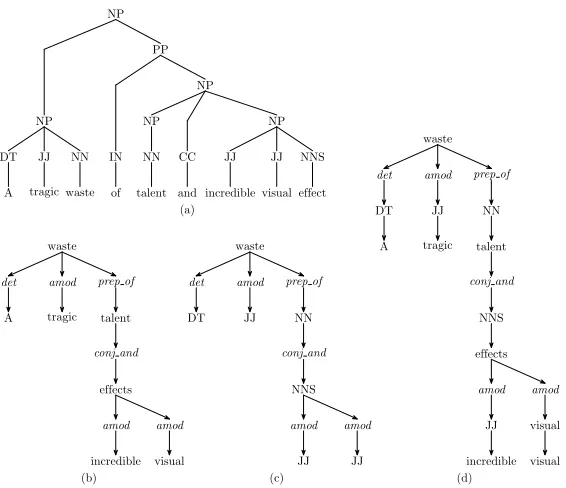
In addition, we experiment with constituency tree kernels (CON), and dependency tree kernels (D), which capture hierarchical constituency structure and labeled dependency relations between words, respectively. For dependency kernels, we test with word (DW), POS (DP), and combined word-and-POS settings (DWP), and similarly for simple se-quence kernels (SW, SP and SWP). We also use a vector kernel (VK) in a bag-of-words baseline. Fig-ure 1 shows the constituent and dependency struc-ture for the above sentence.
3.2 Settings
NP
PP
NP
DT JJ NN
A tragic waste
NP
IN
of
NP NP
NN
talent CC
and
JJ JJ NNS
incredible visual effect (a)
waste
det amod prep of
A tragic talent
conj and
effects
amod amod
incredible visual (b)
waste
det amod prep of
DT JJ NN
conj and
NNS
amod amod
JJ JJ (c)
waste
det amod prep of
DT
A JJ
tragic NN
talent
conj and
NNS
effects
amod amod
JJ
incredible visual
[image:3.612.166.449.54.298.2]visual (d)
Figure 1: Illustration of the different tree structures employed for convolution kernels. (a) Constituent parse tree (CON); (b) Dependency tree-based words integrated with grammatical relations (DW); (c) Dependency tree in (b) with words substituted by POS tags (DP); (d) Dependency tree in (b) with POS tags inserted before words (DWP).
NP
DT JJ NN
A tragic waste (a)
waste
amod
JJ
[image:3.612.325.525.364.433.2]tragic (b)
Figure 2: Illustration of the different settings on con-stituency (CON) and dependency (DWP) parse trees with
tragicas the indicator word.
Unfortunately, in our task there exist several cues indicating the polarity of the document, which are distributed in different sentences. To solve this prob-lem, we define the indicators in this task as subjec-tive words in a polarity lexicon (Wilson et al., 2005). For each polarity indicator, we define the “scope” (the minimal syntactic structure containing at least one subjective word) of each indicator for different representations as follows:
For a constituent tree, a node and its children correspond to a grammatical production. There-fore, considering the terminal nodetragicin the con-stituent structure tree in Figure 1(a), we extract the subtree rooted at the grandparent of the terminal, see Figure 2(a). We also use the corresponding sequence
Scopes Trees Size
Document 32 24
Subjective Sentences 22 27
Constituent Substructures 30 10
Dependency Substructures 40 3
Table 1: The detail of the corpus. HereTreesdenotes the average number of trees, andSizedenotes the averaged number of words in each tree.
of words in the subtree for the sequential kernel. For a dependency tree, we only consider the sub-tree containing the lexical items that are directly connected to the subjective word. For instance, giv-en the nodetragicin Figure 1(d), we will extract its direct parentwasteintegrated with dependency rela-tions and (possibly) POS, as in Figure 2(b).
We further add two background scopes, one be-ing subjective sentences (the sentences that contain subjective words), and the entire document.
4 Experiments
4.1 Setup
[image:3.612.143.230.367.435.2]1000 positive reviews and 1000 negative reviews. To obtain constituency trees, we parsed the docu-ment using the Stanford Parser (Klein and Man-ning, 2003). To obtain dependency trees, we passed the Stanford constituency trees through the Stanford constituency-to-dependency converter (de Marneffe and Manning, 2008).
We exploited Subset Tree (SST) (Collins and Duffy, 2001) and Partial Tree (PT) kernels (Mos-chitti, 2006) for constituent and dependency parse trees1, respectively. A sequential kernel is applied
for lexical sequences. Kernels were combined using plain (unweighted) summation. Corpus statistics are provided in Table 1.
We use a manually constructed polarity lexicon (Wilson et al., 2005), in which each entry is annotat-ed with its degree of subjectivity (strong, weak), as well as its sentiment polarity (positive, negative and neutral). We only take into account the subjective terms with the degree of strong subjectivity.
We consider two baselines:
• VK: bag-of-words features using avector ker-nel (Pang and Lee, 2004; Ng et al., 2006)
• Rand: a number of randomly selected sub-structures similar to the number of extracted substructures defined in Section 3.2
All experiments were carried out using the SVM-Light-TK toolkit2 with default parameter settings. All results reported are based on 10-fold cross vali-dation.
4.2 Results and Discussions
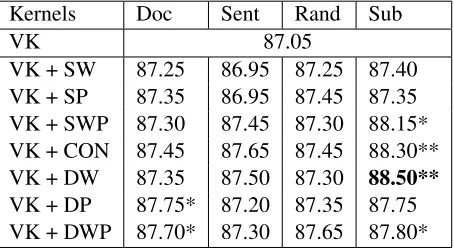
Table 2 lists the results of the different kernel type combinations. The best performance is obtained by combining VK and DW kernels, gaining a signifi-cant improvement of 1.45 point in accuracy. As far as PT kernels are concerned, we find dependency trees with simple words (DW) outperform both de-pendency trees with POS (DP) and those with both words and POS (DWP). We conjecture that in this case, as syntactic information is already captured by
1A SubSet Tree is a structure that satisfies the constraint that
grammatical rules cannot be broken, while a Partial Tree is a more general form of substructures obtained by the application of partial production rules of the grammar.
2available at http://disi.unitn.it/moschitti/
Kernels Doc Sent Rand Sub
VK 87.05
VK + SW 87.25 86.95 87.25 87.40
VK + SP 87.35 86.95 87.45 87.35
VK + SWP 87.30 87.45 87.30 88.15*
VK + CON 87.45 87.65 87.45 88.30**
VK + DW 87.35 87.50 87.30 88.50**
VK + DP 87.75* 87.20 87.35 87.75
[image:4.612.315.542.58.182.2]VK + DWP 87.70* 87.30 87.65 87.80*
Table 2: Results of kernels. HereDocdenotes the whole document of the text,Sentdenotes the sentences that con-tains subjective terms in the lexicon,Randdenotes ran-domly selected substructures, andSubdenotes the sub-structures defined in Section 3.2. We use “*” and “**” to denote a result is better than baseline VK significantly at p<0.05 and p<0.01 (sign test), respectively.
the dependency representation, POS tags can intro-duce little new information, and will add unneces-sary complexity. For example, given the substruc-ture(waste (amod (JJ (tragic)))), the PT kernel will use both(waste (amod (JJ)))and(waste (amod (JJ (tragic)))). We can see that the former is adding no value to the model, as the JJ tag could indicate ei-ther positive words (e.g. good) or negative words (e.g. tragic). In contrast, words are good indicators for sentiment polarity.
The results in Table 2 confirm two of our hy-potheses. Firstly, it clearly demonstrates the val-ue of incorporating syntactic information into the document-level sentiment classifier, as the tree k-ernels (CON and D*) generally outperforms vector and sequence kernels (VK and S*). More impor-tantly, it also shows the necessity of extracting ap-propriate substructures when using convolution ker-nels in our task: when using the dependency kernel (VK+DW), the result on lexicon guided substruc-tures (Sub) outperforms the results on document, sentence, or randomly selected substructures, with statistical significance (p<0.05).
5 Conclusion and Future Work
show that our method outperformed a bag-of-words baseline with a statistically significant gain of 1.45 absolute point in accuracy.
Our research focuses on identifying and using high-impact substructures for convolution kernels in document-level sentiment classification. We expect our method to be complementary with sophisticated methods used in state-of-the-art sentiment classifica-tion systems, which is to be explored in future work.
Acknowledgement
The authors were supported by 863 State Key Project No. 2006AA010108, the EuroMatrixPlus F-P7 EU project (grant No 231720) and Science Foun-dation Ireland (Grant No. 07/CE/I1142). Part of the research was done while Zhaopeng Tu was visiting, and Yifan He was at the Centre for Next Generation Localisation (www.cngl.ie), School of Computing, Dublin City University. We thank the anonymous reviewers for their insightful comments. We are al-so grateful to Junhui Li for his helpful feedback.
References
Apoorv Agarwal, Boyi Xie, Ilia Vovsha, Owen Rambow, and Rebecca Passonneau. 2011. Sentiment analysis of twitter data. In Proceedings of the Workshop on Languages in Social Media, pages 30–38. Association for Computational Linguistics.
Razvan Bunescu and Raymond Mooney. 2005a. A Shortest Path Dependency Kernel for Relation Extrac-tion. InProceedings of Human Language Technolo-gy Conference and Conference on Empirical Methods in Natural Language Processing, pages 724–731, Van-couver, British Columbia, Canada, oct. Association for Computational Linguistics.
Razvan Bunescu and Raymond Mooney. 2005b. Sub-sequence Kernels for Relation Extraction. In Y Weis-s, B Sch o lkopf, and J Platt, editorWeis-s,Proceedings of the 19th Conference on Neural Information Processing Systems, pages 171–178, Cambridge, MA. MIT Press. Michael Collins and Nigel Duffy. 2001. Convolution kernels for natural language. InProceedings of Neural Information Processing Systems, pages 625–632. Marie-Catherine de Marneffe and Christopher D.
Man-ning. 2008. The stanford typed dependencies repre-sentation. InProceedings of the COLING Workshop on Cross-Framework and Cross-Domain Parser Eval-uation, Manchester, August.
Paul Ferguson, Neil O’Hare, Michael Davy, Adam Bermingham, Paraic Sheridan, Cathal Gurrin, and Alan F. Smeaton. 2009. Exploring the use of paragraph-level annotations for sentiment analysis of financial blogs. In Proceedings of the Workshop on Opinion Mining and Sentiment Analysis.
Richard Johansson and Alessandro Moschitti. 2010. Syntactic and semantic structure for opinion expres-sion detection. InProceedings of the Fourteenth Con-ference on Computational Natural Language Learn-ing, pages 67–76, Uppsala, Sweden, July.
Mahesh Joshi and Carolyn Penstein-Rose. 2009. Gen-eralizing Dependency Features for Opinion Mining. InProceedings of the ACL-IJCNLP 2009 Conference Short Papers, pages 313–316, Suntec, Singapore, jul. Suntec, Singapore.
Dan Klein and Christopher D Manning. 2003. Accu-rate Unlexicalized Parsing. InProceedings of the 41st Annual Meeting of the Association for Computational Linguistics, pages 423–430, Sapporo, Japan, jul. As-sociation for Computational Linguistics.
Moshe Koppel and Jonathan Schler. 2005. Using neutral examples for learning polarity. InProceedings of In-ternational Joint Conferences on Artificial Intelligence (IJCAI) 2005, pages 1616–1616.
Steve Lawrence Kushal Dave and David Pennock. 2003. Mining the peanut gallery: Opinion extraction and se-mantic classification of product reviews. In Proceed-ings of the 12th International Conference on World Wide Web, pages 519–528, ACM. ACM.
Jingjing Liu and Stephanie Seneff. 2009. Review Sen-timent Scoring via a Parse-and-Paraphrase Paradigm. InProceedings of the 2009 Conference on Empirical Methods in Natural Language Processing, pages 161– 169, Singapore, aug. Singapore.
Shotaro Matsumoto, Hiroya Takamura, and Manabu Okumura. 2005. Sentiment classification using word sub-sequences and dependency sub-trees. Proceed-ings of PAKDD’05, the 9th Pacific-Asia Conference on Advances in Knowledge Discovery and Data Mining, 3518/2005:21–32.
Alessandro Moschitti and Silvia Quarteroni. 2008. K-ernels on Linguistic Structures for Answer Extraction. InProceedings of ACL-08: HLT, Short Papers, pages 113–116, Columbus, Ohio, jun. Association for Com-putational Linguistics.
Alessandro Moschitti, Daniele Pighin, and Roberto Basili. 2008. Tree kernels for semantic role labeling.
Computational Linguistics, 34(2):193–224.
sep. Machine Learning: ECML 2006, 17th European Conference on Machine Learning, Proceedings. Vincent Ng, Sajib Dasgupta, and S M Niaz Arifin. 2006.
Examining the Role of Linguistic Knowledge Sources in the Automatic Identification and Classification of Reviews. In Proceedings of the COLING/ACL 2006 Main Conference Poster Sessions, pages 611–618, Sydney, Australia, jul. Sydney, Australia.
Truc-Vien T Nguyen, Alessandro Moschitti, and Giuseppe Riccardi. 2009. Convolution kernels on constituent, dependency and sequential structures for relation extraction. Proceedings of the 2009 Confer-ence on Empirical Methods in Natural Language Pro-cessing, pages 1378–1387.
Bo Pang and Lillian Lee. 2004. A Sentimental Educa-tion: Sentiment Analysis Using Subjectivity Summa-rization Based on Minimum Cuts. InProceedings of the 42nd Annual Meeting of the Association for Com-putational Linguistics, pages 271–278, Barcelona, S-pain, jun. Barcelona, Spain.
Michael Wiegand and Dietrich Klakow. 2010. Convolu-tion Kernels for Opinion Holder ExtracConvolu-tion. InHuman Language Technologies: The 2010 Annual Conference of the North American Chapter of the Association for Computational Linguistics, pages 795–803, Los An-geles, California, jun. Los AnAn-geles, California. Theresa Wilson, Janyce Wiebe, and Paul Hoffmann.
2005. Recognizing Contextual Polarity in Phrase-Level Sentiment Analysis. InProceedings of Human Language Technology Conference and Conference on Empirical Methods in Natural Language Processing, pages 347–354, Vancouver, British Columbia, Cana-da, oct. Association for Computational Linguistics. Hong Yu and Vasileios Hatzivassiloglou. 2003.
Toward-s anToward-swering opinion queToward-stionToward-s: Separating factToward-s from opinions and identifying the polarity of opinion sen-tences. In Proceedings of the 2003 Conference on Empirical Methods in Natural Language Processing, pages 129–136, Association for Computational Lin-guistics. Association for Computational LinLin-guistics. Min Zhang, Jie Zhang, Jian Su, and Guodong Zhou.