R E S E A R C H
Open Access
Node importance evaluation method in
wireless sensor network based on energy
field model
Qindong Sun
1,2*, Yimin Qiao
1, Jiamin Wang
3and Si Shen
1Abstract
The stability degree of key nodes is an important indicator of wireless sensor network performance. Appropriate node importance evaluation method is a precondition for the identification of key node and the analysis on network stability. The current methods based on average length and network density are unable to make real-time evaluation on nodes in practical application. Thus, this paper puts forward a node importance evaluation method in wireless sensor network based on energy field model. Based on the data exchange at the network layer in wireless sensor network, this approach analyzes the node properties and correlation among nodes with energy field and graph theory, which shows the influence result of key nodes in wireless sensor network. Therefore, the node influence can be worked out so as to evaluate the importance of node in wireless sensor network. The experimental results show that, compared with the current node importance evaluation methods of wireless sensor network, the approach proposed in this paper not only is able to evaluate the node importance without affecting the operation of network but also shows the dynamic change in node importance.
Keywords:Energy field, Wireless sensor network, Importance evaluation of node
1 Introduction
With the feature of flexible network settings and con-venient network building, the wireless sensor network, in which the sensors communicate with each other wirelessly, is able to perceive, collect, and process the information in the network monitoring area [1]. Wireless sensor network has the capability of being self-organized, lots of single nodes formed up the multi-hop ad hoc network which is used to transmit data by initial communication and negotiation [2]. The wireless sensor network has no preexisting physical infrastructure that restricts the topology [3]. It can be applied in such fields as military, agriculture, meteorology, biology, and in-accessible areas to collect information [4]. With the ad-vent of the Internet of things, wireless sensor network is gradually pervading every aspect of people’s life, and it has significant value of scientific research and broad
application prospect [5]. With the wide application of wireless sensor network, the demands on the reliability of its communication network are also getting higher and higher. Influenced by factors such as energy, envir-onment, and network structure, some nodes of network may be damaged or may fail, etc., these unexpected situ-ations will impact the performance of the network [6]. The failure of key nodes may even cause the networks paralysis. Therefore, evaluating the importance of each node and finding out the key nodes in network contrib-ute to the maintenance of important nodes and thus im-prove the survivability of network.
Considerable studies have been carried out on the abovementioned problem. There are many methods to evaluate the mode influence in wireless sensor network. Most of the existing methods to evaluate the node im-portance are based on such indicators as the average path length, the network density, the network diameter, and the electric quantity of node. These methods are using the node-deletion method by removing the key nodes during evaluation and observing the changes (such as network disconnection) of energy consumption
* Correspondence:[email protected] 1
School of Computer Science and Engineering, Xi’an University of Technology, Xi’an 710048, China
2Shaanxi Key Laboratory of Network Computing and Security, Xi’an University of Technology, Xi’an 710048, China
Full list of author information is available at the end of the article
in network after the key node is removed or failed. How-ever, these methods are difficult to implement in prac-tical application due to restrictions of actual situation. Besides, some studies evaluate the node importance in wireless sensor network with statistical methods. How-ever, these studies have certain limitations that the data transmission process in network is not considered while evaluating the influence of nodes.
This paper proposes a node importance evaluation ap-proach in wireless sensor network based on energy field model which evaluates the node importance by analyz-ing the data transmission status among associated nodes at the network layer in the wireless sensor network. In-spired by the field theory in physics, the approach stud-ies the changes of node influence in wireless sensor network from the perspective of energy field. Besides, the network topology may change due to the added nodes for improving detection precision in practical ap-plication. That is to say, some nodes with higher import-ance may become less important after the change. Therefore, this approach gives full consideration to the dynamic change of nodes in importance evaluation. The advantage of the proposed approach is that the node im-portance is evaluated without affecting the physical structure of the network itself, which can well reflect the change of the node importance in the process of dy-namic change and reduces the workload of node import-ance evaluation process.
The rest of the paper is arranged as follows. Some research methods in relevant fields are introduced and analyzed in Section 2. Elaboration is made on the im-portance evaluation approach of node in wireless sensor network based on energy field model in Section 3. Simulation experiments are conducted in Section 4 so as to verify the approach proposed in Section 3, and comparative analysis with other two relevant methods is carried out in this section.
2 Related works
Researches on complex network theory have provided some new ideas for the study on the node importance evaluation in wireless sensor network. In [7] the authors proposed a key node identification method based on the volume of aggregated nodes. The method of node importance considered the connection characters of the nodes. In this paper, the node importance referred to the weighted sum of the self-importance of the node itself and edges that are connected with the node. In [8], the authors proposed a semi-local centrality measure which evaluated the importance of a node through a susceptible-infected-recovered (SIR) model based on the propagation velocity of a node message and the number of nodes which receive message; this effective ranking method is capable to be applied in large-scale networks.
Considering the deficiency of traditional indicators in key node positioning, in [9], the authors proposed a key node identification method which uses the communica-tion probability of a node and k-shell decomposition method to evaluate the importance of a node. By using multiple indicators to evaluate node importance al-though these methods can obtain more precise result, there are limitations in these methods with regard to characteristics of the wireless sensor network such as limited energy and operating rate. In [10], the authors proposed a method based on finite number of objects and ideal objective and evaluated the importance of each node in network through TOPSIS technique which is utilized to aggregate the multi-attribute to obtain the re-sult. In [11], the authors brought in webpage grade vec-tors in PageRank algorithm to rank the nodes and thus evaluated the node importance. In [12], the authors pro-posed an evidence-theory-based measurement which could weigh both the degree and strength of every node in a weighted network. The node influence could be rep-resented by basic probability assignment (BPA), and the measure in this paper is determined by the combination of BPAs. Inspired by the field theory in physics, in [13], the authors proposed a topological sorting algorithm in which each node in the network was seen as a material particle. The potential field around one node itself and the interaction of all nodes forms a topological field. Through the definition and calculation of potential topo-logical weight of each node, more precise ranking re-sults, which could show the importance of each node in network, were obtained. However, these methods can only rank the nodes in network with some specific indicators but fail to consider the life period of node in-fluencing on the entire network. In [14], the authors proposed a key node determining algorithm based on local information and energy factors. The algorithm pro-posed a model based on the node degree and the local information of neighboring nodes and evaluated the node importance through the surplus energy of node to-gether with the energy consumption change in network after node failure. However, this algorithm only consid-ered the energy of node and data transmission in wire-less sensor network, but the relation between nodes in node importance evaluation process is not considered.
unable to reflect the dynamic change process in wireless sensor network fully and faithfully and thus desired ef-fects cannot be achieved in later network maintenance.
3 Algorithm analysis
In physics, many physical phenomena are related to the field model which describes the interaction relationship between different objects. The interaction between two different entities is manifested by the operation of the energy. The physical properties of field can be used to depict the physical phenomenon in field space. The relationships between different variables reveal the ways of energy conversion in the field [15]. Therefore, the features of the field can be used to solve similar practical problems.
In the preliminary work, we put forward an influence calculation model of users in online social network based on field theory by using the data of Sina micro-blog. A comparative analysis was carried out on the influence calculation model through experiments. The experimental results showed that this model had a better performance in user classification [16]. This paper pro-poses a node importance evaluation method in wireless sensor network based on the energy field model, in which the influence transfer refers to the data transmis-sion between different nodes and the transmistransmis-sion process refers to the process of influence transferring along the network topology. The process is regarded as the accumulation of node influence. The relationship be-tween nodes and the node influence is analyzed with the characteristics of nodes in the process of data transmis-sion. The node influence in network generates or attenu-ates when the data transmit among nodes. In other words, when a node sends data, a certain part of energy of the node is consumed. Finally, the importance of the node is evaluated by the influence of the nodes which generated in the process of data transmission in wireless sensor network.
All the nodes in the target network which are set in indirect structure have the same functional characteris-tics. When Ni sends a data message, its related Nj will
forward the message. IfNjis not the destination node of
the message, Njwill forward the message. It means that Nihas exerted an influence onNjduring data
transmis-sion. In the forwarding process, the influence of the two nodes Ni and Nj will increase. Therefore, the influence
of Ni on Nj is larger than that of Nj on Ni. Nj receives
message from node Ni, which shows the influence of
node Niindirectly. In other words,Nj will get influence
from node Ni while forwarding the message received
fromNi. Meanwhile,Njwill feed back some influence to
node Ni. When the message forwards through nodes
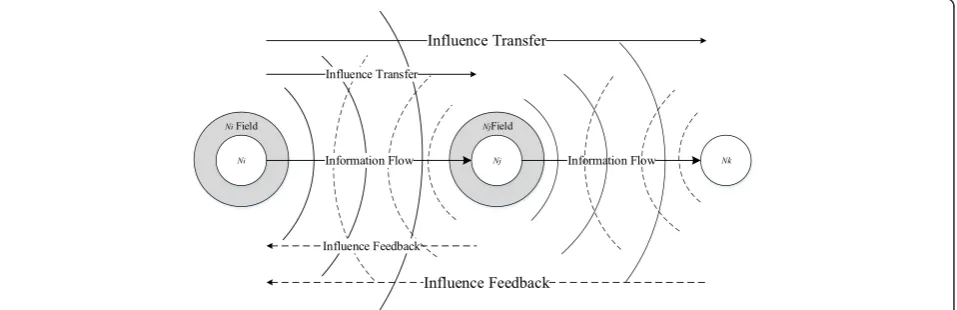
one after another, the influence will transfer and gen-erate feedback constantly between relevant nodes, as shown in Fig. 1.
In wireless senor network, the operation of the energy should be obtained when data is transferred between dif-ferent nodes. Then, the influence of the corresponding nodes is calculated by calculating the parameters in the data transmission process in the network layer. For any two nodes, Ni sends the message and Nj receives the
message. The energy consumed for transmitting k bit data is expressed through the universal wireless commu-nication energy consumption model as follows [17]:
Esendðk;dÞEeleckþεampkdij2 ð1Þ
The energy consumed for receivingkbit data is:
Ereceiveð Þ ¼k Eeleck ð2Þ
where Eelec is the transmission coefficient of radio
fre-quency, εamp is the amplification coefficient of sending
device, dij is the data transmission radius of the node.
The congestion of node can be written as follows:
J¼ Cdsend
CreceiveþCsend ð 3Þ
where Cdsend is the number of unsent messages of the
node, Creceive is the number of received messages, and
Csendis the number of sent messages.
The distance between Ni and Nj is 1; thus, the
influ-ence of Nican be expressed asIr= 1. When the distance
betweenNiandNjis larger than 1, the influence ofNiis
expressed as Ir> 1. The influence in the expressions
generates in one data acquisition period. The influence generated during message transmission is:
Ir¼1¼f1ðNi;CrÞ
where the value ofIr=1 is related to the node properties
and the number of messagesCrthatNjforward fromNi.
The value of Ir>1 depends on the distance rbetween Nj
and Ni as well as the influence of father Nfa (the node
near sink is father node).
Whenr= 1, the formula of influence derived from field theory is:
Ir¼1¼GCr
CpðEsendþEreceiveÞ ð
5Þ
whereCris the number of messagesNjforward fromNi
in one data reception period and Cp is the number of
messages received from Njin one data reception period.
The ratio ofCrtoCprefers to the correlation coefficient
ofNjtoNi.Grefers to the density of nodes aroundNiin
one data reception period. Esend refers to the energy of
Niconsumed for sendingkbit data.Ereceive refers to the
energy ofNjconsumed for receivingkbit data.Gcan be
expressed as follows:
G¼ Ki
Kmax ð
6Þ
where Ki refers to the actual sides connected with Ni
and Kmax refers to the possible maximum sides
con-nected withNi.kiis the degree ofNi. Then,Kmaxcan be
whereI(Nfa)is the influence of the father nodes andPis
the forward probability. The larger the surplus energy, the higher the probability of becoming a forwarding node. Jfa is the congestion rate of the father node.
Considering the message may impair in forwarding, the forward probability is:
P¼ PEJf a
r
ð9Þ
wherePErefers to the surplus energy ratio of the node:
r¼ eμdij ð10Þ
where μ is the weighted value of the range attenuation. The influence ofNiis:
I¼X
where n refers to the number of nodes which are away from nodeNiwith the distancerequaling 1 andmrefers
to the number of nodes causing the influence with the distancergreater than 1. The influence of nodeNicould
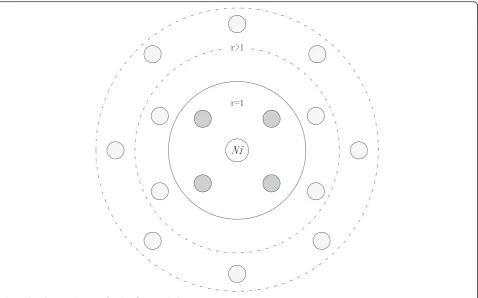
be denoted by the influence of these nodes in wireless sensor network, as shown in Fig.2.
There are four steps to evaluate node importance based on energy field model:
(1) Calculate the energy consumption in the process of data transmission in the network
(2) Choose the parameters which are related to the node in the process of data transmission (3) Under the given experimental environment
conditions, calculate theIr=1andIr>1
(4) Calculate the influence of all nodes in the whole
network by expression (11) and find out the
influential nodes according to the results
4 Experimental results analysis
4.1 The evaluation results of important nodes
In order to verify the node importance evaluation ap-proach, we have carried out some simulation experi-ments in this section. The parameters in modeling are set as follows: Eelec= 50(nJ/bit); εamp= 100(pJ/bit/m2);
the maximum transmission radius of wireless node is 200; the nodes are evenly distributed in a 100 × 100 m2. For the convenience of calculation, 100 nodes which are not on the boundary of the square are selected. The data quantity sent by node each time and the times of data sending and receiving are random. The influence of nodes which are caused by the distancer= 1 from node Ni is calculated through expression (5). The normalized
forwarding probability and distance in data transmission should be considered. It can be known from the two fig-ures that the distribution of node influence is uneven, and the nodes with bigger value are more likely having higher influence.
After working out the influence of nodes related toNi,
the influence ofNiin the entire network can be obtained
through expression (11). Considering the iteration in cal-culation, the initial influence of Ni and that of nodes in
distance 1 with Ni should be excluded. The influence
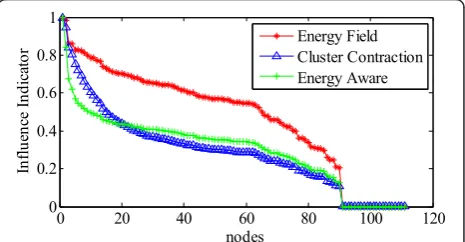
distribution of nodes in the entire network can be ob-tained after calculating the influence of nodes one after another. The normalized results are shown in Fig. 5.
The analysis results of the selected 100 nodes are shown in Fig. 6, where the cross refers to the number of messages passedNjin one data reception period, i.e.,Cp,
and the triangle refers to the number of messagesNj
for-ward from Ni, i.e.,Cr. It can be known from Fig. 5 that
the distribution of most nodes is similar to those of Cp
andCrexcept several nodes. That is, because the
deploy-ment of nodes is different in the actual network, the net-work is a self-organizing netnet-work and the attributes factors of the node (such as spatial location, signal inter-ference, the remaining energy) and the nodes with strong load capacity (such as the node communication efficiency is high, the signal interference is weak, more
Fig. 2The schematic diagram of node influence calculation
Fig. 3The influence distribution of nodes with the distancer= 1 with
Niin one data reception period
Fig. 4The influence distribution of nodes with the distancer> 1 with
remaining energy) will assume more data flow to ensure the data transmission while other nodes is able to play the role of the nodes mentioned above at any time. These nodes only serve as data channel and has strong substitutability in the network but contribute little. Therefore, the nodes with large carrying capacity may be small in influence. Through the above experimental ana-lysis, the nodes in the network can be divided into three categories and make different maintenance strategies for different type of the nodes. The first is the nodes with larger influence should be focus on the protection, the second is the nodes with large carrying capacity but small in influence need to carry out routine mainten-ance, and the third is the nodes with little influence and carrying capacity should have planned sleep and be acti-vated when needed.
4.2 Efficiency analysis of algorithm
We have carried out comparative analysis with some existing node influence evaluation methods such as cluster contraction [18], energy aware [19]. The node importance evaluation method based on the cluster con-traction principle is using certain rules to find the clus-ter structure in the network. The nodes can be divided into two categories, one is the organ nodes, and the other is the joint nodes that does not belong to any clus-ter. The joint nodes play the role of connecting organ
nodes. It is possible to cause the network paralysis when a joint node failure. The organ nodes distribution dens-ity is bigger, and there will have redundant nodes to re-place it when an organ node failed and has little damage to the network. The backbone network will be obtained by shrinking organ nodes and then evaluating the portance of the joint node in the network. The node im-portance evaluation method based on energy aware is the study of using the residual energy information as the practical basis of algorithm design. This method com-bines the node degree with the energy consumption and other related factors in the network and evaluates the node importance by calculating the residual energy of nods and the total energy consumption after corre-sponding node fails in the network. It can be known from the experimental results that the influence ob-tained through the node importance evaluation model based on energy field model is higher than that obtained through the other two models, as shown in Fig. 6.
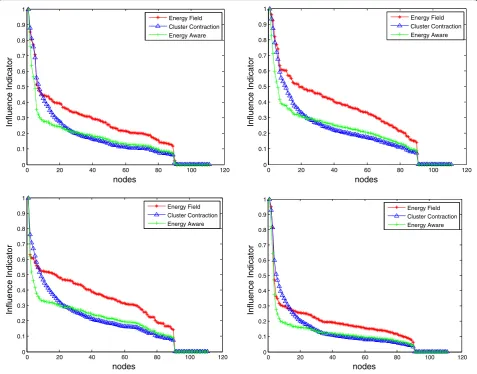
Some simulation experiments are conducted for the node influence obtained through the three methods. The influ-ence in several data reception periods calculated through the method based on energy field model shows more dra-matic change than that calculated through the methods based on cluster contraction and energy aware, as shown in Fig. 7. That is because in the current simulation experi-ments, the data quantity sent and received by nodes is usu-ally fixed. Thus, it is unable to show the influence of sensor errors, sensor noise, and error of transmission, leading to the differences in the data transmitted by nodes in the same sensor area. Considering the change in network topology caused by the variation of node amount, our method is able to show the dynamic changing process of the node influ-ence in network as well as analyze the variation trend of node importance through the change detected in data transmission. Hence, the maintenance strategy of the nodes should be changed when the influence of nodes changed, this dynamic maintenance process can greatly enhance the monitoring time of the whole network., as shown in Fig. 8.
Fig. 5The influence distribution of node
Fig. 6The data transmission distribution of node
5 Discussion
The method proposed in this paper is based on the en-ergy field model which concerns node characteristics to evaluate node importance as well as the data transmis-sion procestransmis-sion between different nodes. Different from other methods, our model can express the relationship between the node influence and data transmission and depict the dynamic change of node importance by our model in wireless sensor network. Hence, in solving some relevant problems, our model is advantageous. Be-sides, the model proposed in this paper is flexible, which can be adjusted according to different problems in prac-tical situation. Aiming at some research points in wire-less sensor network, our method has advantage in solving the following problems.
5.1 Energy management
At present, the energy management in wireless sensor network is mainly divided into three kinds of methods, which are the power-aware routing protocols, the
topology protocols, and the sleeping management. The model based on power-aware routing protocols is used to uniform the energy in whole network and effectively prolong the survival time of key nodes, but it cannot fully depict the details of data transmission process between nodes. The model based on topology protocols is used to reduce the transmission energy consumption of nodes by controlling the communication links between nodes and transmitting rage of nodes in the network in order to prolong the life cycle of the whole network and improve its network efficiency, but it lacks consideration of the role of important nodes and corresponding energy consumption in the network. The model based on sleeping management to prolong the network lifetime by keeping the redundant nodes to sleep but may cause data loss and less accuracy. Based on this model, the dynamic node importance evaluation can provide help for energy management, which makes it more accurate and more suitable for practical applications.
5.2 Network survivability
According to the characters of the network, network survivability is generally use as survivability measure-ment as the basis and establishes the survivability ana-lysis model based on the probability theory and graph theory, etc. The node importance evaluation as an important aspect in network survivability has many indi-cators such as degree, betweenness, compactness, fea-ture vector. The degree is simple, intuitive, and easy to calculate but only reflects the local characteristics. The betweenness evaluates the node importance from the point of view of flow, which can reflect the dynamic characteristics of the network, but is not suitable for practical applications because of its high computational complexity. The compactness reflects the degree of cen-trality of nodes based on the topology of network which has certain limitations on some kinds of network. The feature vector is simplistic of the actual situation by tak-ing the importance of neighbor nodes into account. Based on the energy field model, the relationship be-tween different nodes is well considered in this method which is useful for some other methods and is more ap-plicable to actual situation.
6 Conclusions
In this paper, we analyzed the node interactions based on the influence transfer effect in wireless sensor net-works and found that traditional models have limitations in describing a dynamic process in wireless sensor net-works. First, these methods do not account for data transmission mechanisms and transmission probability that can affect the node evaluation effects. Second, the node failures and other factors often cause the change of the network, and these methods cannot adapt to evalu-ate node influence in a dynamic network environment. Third, these methods have a rough classification of the nodes in wireless sensor network and cannot identify the nodes with large data flow but have limited influence in the network.
Node importance evaluation is a precondition for the identification of key nodes and the analysis on network stability. This paper has proposed a node importance evaluation approach based on energy field model. The idea is that the influence transfers and generates feed-back constantly in the process of data transmission which creates a field and interaction with related nodes forms a topological influence field over the network. By defining and computing the influence of the nodes with the distancer= 1 andr> 1 with target nodes. After a full consideration of the changes in data transmission and network topology caused by the variation of node amount, our approach can reflect and analyze the vari-ation of node influence in different data reception pe-riods. According to the influence results and contrast
analysis in simulation experiments, compared with other methods, it can be easily applied to node classification, and the approach is able to make real-time dynamic evaluation on the node importance. The model pre-sented in this paper is of flexibility which could be applied to some other research fields such as energy management and network survivability in the wireless sensor network in the future works.
Acknowledgements
The research presented in this paper is supported partly by the National Natural Science Foundation (Grant No.: 61172124, 61571360), the Shaanxi Science & Technology Co-ordination & Innovation Project (Grant No.: 2016KTZDGY05-09), and the Project of Xi’an Technology Bureau (No.: CXY1509-5).
Authors’information
Qindong Sun (corresponding author) received his Ph.D. degree at the School of Electronic and Information Engineering from the Xi’an Jiaotong University, China. He is currently the professor at the School of Computer Science and Engineering of the Xi’an University of Technology. His research interests include network information security, online social networks, and the Internet of things.
Yimin Qiao received his Master degree from the Xi’an University of Technology, China. He is currently a Ph.D. student at Xi’an University of Technology. His research interests include the Internet of things and data mining.
Jiamin Wang is currently the professor at the School of Mechanical and Precision Instrument Engineering of the Xi’an University of Technology. His research interests include product design and data mining.
Si Shen is currently a graduate student at the School of Computer Science and Engineering of the Xi’an University of Technology. Her research interests include the Internet of things and online social networks.
Competing interests
The authors declare that they have no competing interests.
Author details
1School of Computer Science and Engineering, Xi’an University of Technology, Xi’an 710048, China.2Shaanxi Key Laboratory of Network Computing and Security, Xi’an University of Technology, Xi’an 710048, China. 3School of Mechanical and Precision Instrument Engineering, Xi’an University of Technology, Xi’an 710048, China.
Received: 31 May 2016 Accepted: 9 August 2016
References
1. FL Lewis, Wireless sensor networks. Smart Environments: Technologies, Protocols, and Applications18(1), 11–46 (2005)
2. J Yick, B Mukherjee, D Ghosal, Wireless sensor network survey. Comput. Netw.52(12), 2292–2330 (2015)
3. M Kuorilehto, M Hännikäinen, TD Hämäläinen, A survey of application distribution in wireless sensor networks [J]. EURASIP J. Wirel. Commun. Netw.2005(5), 1–15 (2005)
4. Y Zhang, W Li, Modeling and energy consumption evaluation of a stochastic wireless sensor network [J]. EURASIP J. Wirel. Commun. Netw.
2012, 282 (2012)
5. L Mainetti, L Patrono, A Vilei, Evolution of wireless sensor networks towards the internet of things: a survey. Software Telecommunications and Computer Networks (SoftCOM)2011, 1–6 (2011)
6. IF Akyildiz, W Su, Y Sankarasubramaniam, Wireless sensor networks: a survey. Comput. Netw.38(4), 393–422 (2002)
7. W Jia-sheng, W Xiao-ping, Y Bo, Improved method of node importance evaluation based on node contraction in complex networks. Procedia Eng.
15(1), 1600–1604 (2011)
9. X Zhang, J Zhu, Q Wang, Identifying influential nodes in complex networks with community structure [J]. Knowl.-Based Syst.42(2), 74–84 (2013) 10. Y Du, C Gao, Y Hu, A new method of identifying influential nodes in
complex networks based on TOPSIS. Physica A.399(4), 57–69 (2014) 11. T Agryzkov, JL Oliver, L Tortosa, An algorithm for ranking the nodes of an
urban network based on the concept of PageRank vector. Appl. Math. Comput.219(4), 2186–2193 (2012)
12. D Wei, X Deng, X Zhang, Identifying influential nodes in weighted networks based on evidence theory. Physica A.392(10), 2564–2575 (2013)
13. H Nan, WY Gan, LD Yi, Evaluate nodes importance in the network using data field theory. Proceedings of the 2007 International Conference on Convergence Information Technology. IEEE Computer Society2007, 1225– 1234 (2007)
14. B Liu, YJ Sun, HR Liu, Key node decision algorithm based on local information and energy factor in wireless sensor network. J. of Commun.
36(10), 9–16 (2015)
15. E Goldfain, Complexity in quantum field theory and physics beyond the standard model. Chaos, Solitons Fractals28(4), 913–922 (2006)
16. Q Sun, N Wang, Y Zhou, Modeling for user interaction by influence transfer effect in online social networks. IEEE 39th Conference on Local Computer Networks (LCN), IEEE Computer Society, 486-489(2014)
17. WR Heinzelman, A Chandrakasan, H Balakrishnan, Energy-efficient communication protocol for wireless sensor networks. Ad Hoc Sens. Wirel. Ne.18, 8020 (2016)
18. O Younis, M Krunz, S Ramasubramanian, Node clustering in wireless sensor networks: recent developments and deployment challenges. IEEE Netw.
20(3), 20–25 (2010)
19. GV Merrett, NM White, NR Harris, Energy-aware simulation for wireless sensor networks. Sensor, Mesh and ad hoc communications and networks, 2009. SECON’09. 6th Annual IEEE Communications Society Conference on
2009, 1–8 (2009)
Submit your manuscript to a
journal and benefi t from:
7 Convenient online submission
7 Rigorous peer review
7 Immediate publication on acceptance
7 Open access: articles freely available online
7 High visibility within the fi eld
7 Retaining the copyright to your article