Load Frequency Control of Multi Area
Hybrid Power System Using Intelligent
Controller Based on Fuzzy Logic
Rahul Chaudhary1, Naresh Kumar Mehta2
M. Tech. Student, Department of Electrical and Electronics Engineering, Rajasthan Institute of Engineering and
Technology, Bhankrota, Jaipur, Rajasthan, India1, 2
ABSTRACT: Load frequency control plays significant role in power system to provide reliable and quality power all the time in Automatic generation control (AGC) system. For a multi area hybrid power system a controllercentred on the fuzzy logic approach is designed and tested in this paper. Hybrid power system consist of three area having thermal, thermal with re-heater and hydro generating units connected through tie lines. The system model will be designed in MATLAB Simulink and the comparative analysis will be done with the conventional PI controller based control scheme.
KEYWORDS: Automatic generation control, AGC, LFC, Multi area power system, Fuzzy logic controller, intelligent controller.
I. INTRODUCTION
In Electrical power system network the efficient and stable operation round the clock is extremely important. With the growing power demand the need for more power generating station arises due to which the complexity of power system increased. Large number of interconnection has been made which makes the control of multipart power system even more tedious job to accomplish. Now a days most of the world power networks has more than two interconnected generating unit of different genera for which the reactive and active power control is needed. Load frequency control is one of the key variable to have a stable and reliable operation of the interconnected system. By definition, the load frequency control is a methodology that equates the power generation and demand while maintaining the frequency fluctuation with in the stipulated level. So a very sophisticated control is needed to maintain the system frequency and tie line power under control. In past time many controller has been developed which are widely based on PID control technique. But in modern time, modern controller is needed so, many research is going on in this direction.
Big power systems have regions representing coherent generators called control areas. These different areas are interrelated through tie- lines. Inter area power exchange and abnormal condition power transfer is the main objective of these tie lines. Abnormal condition include the outage of generator, mismatch in frequency that leads to blackout. Area control error represents the error in frequency to be corrected. Conventional system uses the proportional and integral action that operate the turbine governor so that the generated power follow the load variations.
algorithm based fuzzylogic controller is also shown [7]. A takagisugeno system to deal with uncertainties in power system for LFC is designed which utilises the algorithm built on fuzzy logic [8]. Optimisation of pi controller according to the area control error using adaptive property of fuzzy controller is successfully executed [9].
The main purpose of the AGC load frequency control is to not only maintain the frequency of system constant as well as zero steady state error and tie line power flow in desired direction. This paper is aim to study the three area interconnected power system for load frequency fluctuation and developing a controller based on fuzzy logic to minimise these deviation. The interconnected system three area will have aamalgamation of hydro and thermal based power station.
II. THREE AREA SYSTEM MATHEMATICAL MODELLING
Fig. 1 Block diagram of isolated area for load frequency control.
The basic transfer function block diagram of isolated power system for LFC is shown in fig.1. It uses the governor, turbine and generating unit [10]. The speed governor is used to regulate the valve which controls the turbine action. The equation corresponding to this is
∆
( )
= [
∆
( )
-
∆
( )
] [
]. (1)
The turbine equation from the model can be written asis
∆
( )
=
∆
( )
[
] (2)
Now the output from turbine is used to rotate the generator shaft and the equationrepresenting this action is
∆
( )
= [
∆
( )
-
∆
( )
][
](3)
Governor Turbine Generator
Fig. 2. Three area interconnected power system with tie-line power flow.
In this paper the system considered is three area system with thermal power plant as one area ,second is thermal with re-heater and the third is Hydro power plant as shown in figure 2 above but for informal representation the equation is written bearing in mind the thermal power plant in all the three area.
So the equation corresponding three area system for frequency deviation considering the tie line power deviation can be written using equation (3) as
∆
( )
= [
∆
( )
-
∆
( )
-
∆
( )
] [
] (4)
∆
( )
= [
∆
( )
-
∆
( )
-
∆
( )
] [
] (5)
∆
( )
= [
∆
( )
-
∆
( )
-
∆
( )
] [
] (6)
Area control error can be deduced for area is
ACE (n) =
∆
( )
+
∆
( )
(7)
Where ACE is area control error,
∆
is tie line power, ∆ is frequency deviation.III. FUZZY LOGIC BASED CONTROLLER DESIGN
The conventional controller for LFC design widely used with thermal and hydro based area is the PI (proportional-Integral) controller. The error signal will be the proportional and integral term which help it to get faster response and no steady state error.
Equation related to PI controlleraction is
∆
( )
=
.
∆
( ) +
∫ ∆
( )
(8)
Now differentiating the equation (8) with respect to ‘t’ we get
∆ ′( )
=
.
∆ ′( ) +
∆
( )
(9)
The above equation will be input to the fuzzy logic controller
Fuzzy control ispractise to represent, operate and implement human’s experiential knowledge about how to control a system. Figure 3 shows the block illustration of a fuzzy logic controller [11]. It is used in closed loop control system. It has mainly three parts
1. Fuzzification Interface which converts the crisp data structure in the fuzzy data.
2. Rule base and decision making which is used to compare the fuzzified data with set rule base of controller.
3. Defuzzificationof data after being processed by controller converting the fuzzy data into crisp data to be fed into the system.
Fig.3 Fuzzy logic inference system block diagram
In the fuzzy logic controller the system uses the five triangular membership function each for two input and output. Rule base set is given in the table 1, where e(t) is error signal, e’(t) is differential of error signal, LN is large negative, MN is medium negative, Z is zero, MP is medium positive, LP is large positive.
e(t)e’(t) LN MN Z MP LP
LN LP LP MP MP Z
MN LP MP MP Z MN
Z MP MP Z MN MN
MP MP Z MN MN LN
LP Z MN MN LN LN
IV. SIMULATION AND RESULT
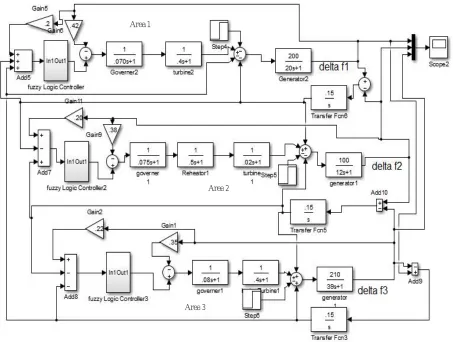
The Multi area hybrid controller is designed in MATLAB Simulink for load frequency control [12]. The model is shown in fig. 4. Area 1 has a thermal turbine, Area 2 has thermal turbine with re-heater and area three has hydro turbine. Value of physical constant is taken appropriately. The simulation is done for the 1.5% step load change. The fuzzy system has used “mamdani” inference and having 25 if-then rule set. The fuzzification and de-fuzzification method is shown in fig. 5. This is based on the equation (9) derived above [13]. All the simulation result is compared with the conventional PI control methodology. Area control error is processed through the fuzzy interface with appropriate derivative and proportional constant. Triangular membership function has a range from -0.4 to 0.4 for input and output which is deduced from the optimisation of controller [14]. The graph has been plotted for three area frequency deviation and the graph for comparing the resultant deviation with the intelligent controller and orthodox controller.Tie line power variation with the load frequency is important variable that effect the overall system efficiency is also considered.
Fig. 4. MATLAB Simulink model for load frequency control
Area 1
Area 2
Fig. 5. Fuzzy Inference system Simulink model
Simulink model for the fuzzy inference system is shown in figure 5. It has a differentiator as one of the input to fuzzy controller while the defuzzification process contain the summing of the controller output and it’s integral converting the fuzzy data into the crisp data.
Simulation results accompanied by MATLAB/Simulink are shown in Figure 6. Plot is obtained with time (seconds) on x-axis and frequency deviations (Hz) on y-axis.
Fig. 6(a) Three area frequency deviation with fuzzy controller Fig. 6(b) Frequency deviation for area 1 compared with PI controller
∆
→
∆
1
→
Fig. 6(c)Frequency deviation for area 2 compared with PI controller Fig. 6(d)Frequency deviation for area 3 compared with PI controller
Fig. 6 (e) Tie line power deviation for three area together.
Fig. 6. a, b, c and d shows the frequency deviation in all three areas individually and comparison is made with PI control.Thefrequency deviation is suppressed by the fuzzy logic controller to a great degree.Fig. 6(e) shows the tie-line power deviation between areas 1-2, 2-3 and 3-1, respectively. The tie-line power deviations in case of fuzzy control are smaller than those common controller used today.
∆
2
→ ∆
3
→
∆ →
Time (Sec)→ Time (Sec)→
V. CONCLUSION AND FUTURE SCOPE
In this paper the proposed controller is designed and examined for three area hybrid power system.All the simulation is done for 1.5% step load change. The graphical study shows that the intelligent controller designed based on the fuzzy logic has superiority over the conventional controller. Each area is been compared with the PI controller for each area separately. It is observed that the frequency fluctuation in case of fuzzy control technique has reduced also the magnitude of peak overshoot and undershoot is decreased. Also it can be seen that the transient time is reduced up to 20% and it settles faster. There is no steady state error has been observed.Fuzzy logic system has improved the all-over system performance. The study can be further extended for the increased number of interconnected area also different membership function can be tested in future.
REFERENCES
[1] Ibraheem, P. Kumar, and D. P. Kothari, “Recent philosophies of automatic generation control strategies in power systems”, IEEE Trans. PowerSyst., vol. 20, no. 1, pp. 346–357, Feb. 2005.
[2] S. VelusamiandI, A. Chidambaram, “Decentralized biased dual mode controllers for load frequency control of interconnected power system considering GD Band GRC non-linearity”, Energy Convers. Manag., vol. 48, pp. 1691–1702, 2007.
[3] L. Dong, Y. Zhang, and Z. Gao, “A robust decentralized load frequency controller for interconnected power systems”, ISA Trans., vol. 51, pp. 410–419, 2012.
[4] H. Bevrani, Y. Mitani, and K. Tsuji, “Robust decentralised load-frequency control using an iterative linear matrix inequalities algorithm”, Proc. Inst. Electr. Eng.—Genera.,Transm. Distrib., vol.151, no.3, May 2004.
[5] H. Bevrani and T. Hiyama, “Intelligent Automatic Generation Control”, Boca Raton, FL, USA: CRC press, 2011
[6] C.-F. Juang and C.-F. Lu, “Load-frequency control by hybrid evolutionary fuzzy PI controller”, Proc. Inst. Electr. Eng.—Gener.,Transm. Distrib., vol. 153, no. 2, pp. 196–204, 2006.
[7] J.TalaqandF.Al-Basri,“Adaptive fuzzy gain scheduling for load frequency control”, IEEETrans.PowerSyst.,vol.14,no.1,pp.145–150, Feb. 1999. [8] H.J. Lee, J.B. Park, and Y.H. Joo,“Robust load-frequency control for uncertain non-linear power systems: A fuzzy logic approach”, Inf. Sci.,
vol. 176, pp. 3520–3537, 2006.
[9] I. Kocaarslan and E. Cam, “Fuzzy logic controller in interconnected electrical power systems for load-frequency control”,Electr. Power Energy Syst., vol. 27, pp. 542–549, 2005.
[10] P. Kundur, “Power System Stability and Control”, New York: McGraw-Hill, 1994, pp. 581–623.
[11] Aravindan P., Sanavullah M.Y., “Fuzzy Logic Based Automatic Load Frequency Control of Two Area Power System with GRC”, International Journal of Computational Intelligence Research, Volume 5, Number 1. pp. 37–44, 2009.
[12] Nanda J., Kakkarum J.S., “Automatic Generation Control with Fuzzy logic controllers considering generation constraints”, In Proceeding of 6th IntConf on Advances in Power System Control Operation and managements, Hong Kong, 2003.
[13] O.PMalik, K.A.M. El-Mewally, “Fuzzy Logic Controller as a Power System Stabilizer”, Electric Power Applications of Fuzzy Systems, IEEE PRESS, pp. 112-120, 1998.