Abstract— The program spherical motions global stabilization problem around the center of mass of a gyrostat is investigated. A single-rotor dynamically symmetrical gyrostat with a spherical cavity, entirely filled with highly viscous fluid, is considered. The active stabilizing controls attached to the gyrostat are constructed by the principle of feedback. They solve global stabilizing program motions problem of a gyrostat with fluid. Conditions under which the desirable program motions property of asymptotic stability in large is possible are received. The task is solved on the base of a method of Lyapunov functions and a method of the limit equations and the limit systems.
Index Terms— gyrostat, cavity with fluid, Lyapunov function, feedback, stabilization in large
I. INTRODUCTION
PAtial orientation of satellites and aircraft problems about an orbit have important applied value and are widely considered by authors in many notes. Spatial motions of aircraft concerning the center of masses are modeled by spherical motions of solid bodies or bodies systems, in particular, gyrostats. Artificial satellites can contain one or more spinning rotors to provide gyroscopic stability of a desired orientation of the vehicle. Dual-spin satellites use the spin of a rotor to maintain pointing accuracy of an antenna platform or a solar sail. Some types of satellites use small but rapidly spinning momentum wheels to control the attitude of a large platform. Gyrostats and gyrostat satellite motions are investigated in a large number of papers [1-12]. The basic methods and principles of control of rotational motions of bodies and systems were studied, for example, in notes [1-3]. Paper [4] introduced the equations of a multibody gyrostat and presented analytical solutions for the free gyrostat. In note [5] authors found analytical solution for a asymmetric gyrostat in dynamical variables and solutions for Euler angles in quadratures. Modern domestic and foreign scientists actively study tasks of resonance modes and bifurcations of stationary motions of satellites [6, 7], of chaotic motions and methods of their elimination [8, 9], about stabilization of the set program motions of gyrostats of various structure [10, 11]. In note [12] authors found exact analytical solutions for the problem of the attitude dynamics of a free gyrostat.
From the middle of the previous century, various problems of dynamic motions of rigid bodies with cavities
Manuscript received April 09, 2017; revised April 15, 2017.
S. P. Bezglasnyi is with the Further Mathematics Department, Samara University, Samara, 443086 Russia (corresponding author to provide phone: 8-917-104-1316; e-mail: [email protected]).
filled with fluid were widely researched. There are two main ways of research. The first results of the theory of rigid bodies with cavities filled with liquid are represented in papers [13, 14]. The author of note [13] suggested a model, describing the motions of rigid body with a cavity entirely filled with highly viscous fluid. In the model the influence of fluid on the motion of the body is described using the kinematic characteristics of the body. This approach is widely used in papers of modern scientists [15-17].
The aim of this paper is to present new results in research studies into problem of motion’s global stabilization of gyrostat with cavity filled with viscous fluid. This note included, firstly, mathematical model of academician Chernous’ko of gyrostat with fluid. Secondly, it develops the motion equations of gyrostat in the Lagrange equations form. Thirdly, in this paper is the task formulation about the program motions global stabilization of gyrostat. And finally, this note presents the active program control and development of stability in large control constructing by the feedback principle.
II. PROBLEM DEFINITION AND MOTION EQUATIONS We research spherical motion of a gyrostat with viscous fluid. It is modeled by a system of two dynamically symmetric connected bodies with common axis of rotation. The first body is the carrier. Oxyz is related to a carrier coordinate system. Carrier has a spherical cavity filled with highly viscous fluid. The second body is the rotor. A1
B1 and C1 are main inertia moments of a carrier with fluid,2 2
A
B and C2 are main inertia moments of a rotor. HereOXYZ is fixed coordinate system. The fixed point O of a gyrostat coincides with the system’s center of mass and is located on an axis of dynamic symmetry of both bodies (Fig. 1).
The rotation of a rotor around the carrier is described with the rotation angle counted around Oz axis. Motion equations of a single-rotor gyrostat with a cavity filled with fluid are projected on axis in the related coordinate system, and they are following [17] in the form:
2 2 2
, , ,
x y z
Ap C B qr C q m Bq A C pr C p m Cr B A pq C m
(1)
Global Stabilization of Gyrostat Program
Motion with Cavity Filled with Viscous Fluid
Sergey P. Bezglasnyi
Here ω
p q r, ,
is the vector of absolute angular velocity of the carrier in the coordinate system Oxyz.1 2
A A A , BB1B2 and CC1C2 are main inertia
moments of a gyrostat calculated in the coordinate system Oxyz. Symbol
means transposition. The angular velocity ( )t of rotor rotation is a determined continuous function of time.Right parts m
m m mx, y, z
of equations (1) are projections on axes of the frame Oxyzof the force torques acting on the carrier from the cavity with fluid. According to model suggested in note [13] they are calculated in form:. p qr rq P q rp pr r pq qp
m
(2)
Here
p q r , ,
ω is the vector of angular acceleration of the carrier body, P8a7/ 525 is coefficient, that isconsidering the form (sphere with radius a) of the cavity, is density and is kinematic viscosity of fluid. We assume that the cavity is filled with highly viscous fluid: 1 1.
Following the papers [13, 17] according the mathematical model of academician Chernous’ko of gyrostat with fluid we have vector components of angular acceleration and time-derivative of the angular accelerations in the form:
1
2 1
2 1
1 1
2 1
2 1
1
, , ,
, , .
p A C B qr Сq q B A C pr С p r C B A pq
p A B C qr qr С q q q B C A pr pr С p p r C A B pq pq
(3)
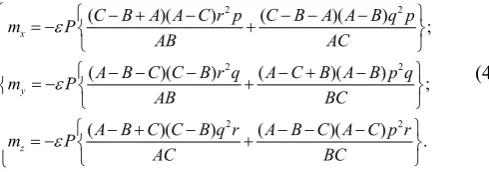
After replacing right parts (2) of (3) the force torques
acting on the carrier from the cavity with fluid are calculated according to the equals:
2 2
2 2
2 2
( )( ) ( )( ) ;
( )( ) ( )( ) ;
( )( ) ( )( )
.
x
y
z
C B A A C r p C B A A B q p
m P
AB AC
A B C C B r q A C B A B p q
m P
AB BC
A B C C B q r A B C A C p r
m P
AC BC
(4)
We constructed the gyrostat motion equations in the Lagrange equations form:
d T T
dt
q q Q. (5)
Here
, ,
q is the general coordinates vector, and q
, ,
is the general velocities vector. Values, ,
are Euler variables. The kinetic energy of the system is
2 2 2 2
2 2
2T Ap Bq Cr 2C rC . (6) We designate the general forces Q Q eQpQs. Here e
Q is the force torque acting on the carrier from the cavity with fluid. It has coordinates
sin sin sin cos cos ,
cos sin ,
.
e
x y z
e
x y e
z
Q m m m
Q m m
Q m
(7)
Torque Qp is the program control, torque Qs is the
stabilizing control.
Equations (5) are dynamic gyrostat motion equations. They are closed, for example, with Euler kinematic equations
cos sin sin ; sin sin cos ;
cos . p
q r
(8)
Let the gyrostat moves according to the law
* * *
Τ( )t ( ), ( ),t t ( )t
r . Here *( ),t *( ),t *( )t are
the determined continuous functions of time. We call the function ( )rt the program motion of the gyrostat.
We now state the task about global stabilization of program motion of gyrostat. Namely, we have to find the attached to the carrier control torques Qp and Qs making
[image:2.595.307.552.88.174.2]the program motion ( )rt asymptotically stable in large. We solve this task on the base Lyapunov method of stability theory. We construct active control using principle Fig. 1. Gyrostat.
of feedback.
The kinetic energy (6) may be presented as the following sum of the components T T 2 T T1 0. Here
2 0 0( , ) 2 ( )
T T t q C t is a scalar function. The component
1 ( , )
T B t q q
is a linear form of the general velocities q. Vector B q( , )t has the coordinates in the form
1 2 2 ( ) cos ,
b C t b2 0, b32C2( )t . Finally, the last component T2 0.5q A q q ( ) is a quadratic form of the
velocities. The matrix A q( ) is bounded and positive definite. It has the elements
2 2 2 2 2
11
12 21 33
2 2
22
13 31 23 32
sin sin sin cos cos ,
sin sin cos , ,
cos sin ,
cos , 0.
a A B C
a a A B a C
a A B
a a C a a
As a result we obtain the motion equation (5) in the form
T T
e p s
t
B B B
Aq Λ q Q Q Q q
q
. (9)
Here Λ Λ q q ( , ) is the vector with coordinates
3 3
, 1 , 1
1
, ( 1,3). 2
ij kj i k j k j
j k k j k i
a a
q q q q i
q q
(10)III. BASIC RESULTS
We calculate the program control torque according direct substitution of function r( )t in the motion equations (9):
T T ( ) ( ) ( ) ( ), ( ) ( ) / ( ), ( ) p e t t tt t t t t t
B r B r
Q A r r r
r r
Λ r r B r Q r r
(11)
The program control torque (11) realizes the program motion r( )t of the gyrostat. We mean, that the function
( )t
r is the solution of the equation (9). But in the presence of initial deviations or actions of small perturbations we construct the additional stabilizing torque Qs making the
program motion r( )t asymptotically stable in large.
Now we solve the global stabilization problem of gyrostat program motion on the base of second method of Lyapunov functions and a method of the limit equations and the limit systems. Let us introduce the new generalized coordinates (deflections) x according to equality
T* * * T
1 2 3
( ( ),t ( ),t ( ))t x x x, ,
x or
( )t
x q r .
Then we rewrite the equation (9) as
T T
( ) ( )
/ t e p s.
B B A r x Λ Λ Λ r x
x x B Q Q Q
(12)
Here program control Qp has the form (11), and
, ,
Λ Λ Λ analogously (10) are the vectors with components
3 3
, 1 , 1
1
, 2
ij kj i k j k j
j k k j k i
a a
x x x x
x x
3 3, 1 , 1
3 3
, 1 , 1
1 2 1 , 2 ij kj i k j k j
j k k j k i ij kj
k j k j j k k j k i
a a
x r x r
x x
a a
r x r x
x x
3 3, 1 , 1
1
, ( 1,3). 2
ij kj i k j k j
j k k j k i
a a
r r r r i
x x
We choose the Lyapunov function
T T
1 1
( , ) ,
2 2
V x x x Cx x Ax (13)
The function (13) is positive definite. We calculate the total time-derivative of the function (13) in the form
1 ( 2 1 ), 2
e p s
dV dt A
x r x x Cx x Λ Λ Аr Λ
x
N Q Q Q
Here N N q q ( , ) is the vector with coordinates
3 3
, 1 , 1
, 1,3
kj ij i k j k j
j k i j k k
a a
N x x x x i
x x
And we construct the stabilization control in the form
T T T 1 2 1 . 2 s e p t A Q Cx Dx Ar Λ Λ r x
x B B B
r N Q Q x x (14)
Here matrices C and D are bounded and positive definite. We calculate the total derivative of the function (13) with respect to time according the equation (12) with controls (11) and (14):
T 2
0 0 (0 0 const)
dV d d
dt x Dx x (15)
The derivative (15) of Lyapunov function (13) is negative definite determined by speeds. The set on which the derivative is equal to zero, is a set {x0}. The system limit to system (12), with (11), (14) on a set {x0} has no other decisions, except x0. Therefore on the basis of the theorem from paper [18] we receive, that program motion
* * *
Τ( )t ( ), ( ),t t ( )t
r of the gyrostat with fluid is
asymptotically stable in large.
IV. NUMERICAL SOLUTION
To illustrate the analytical results we integrate numerically the equations of control motion of the gyrostat. We use “Wolfram Mathematica 7.0”. We model the carrier and rotor by a rigid bodies with inertia moments
2
20, 30, 10
A B C C kg/m . Let the angular 2
velocity of rotor rotation about the carrier is 1 s1. The
program motion is *( ) 6cos(2 ),t t *( )t / 2 sin(2 ), t
*( ) sin(10 )t t
rad.
We assume that the initial deviations at t0 are
(0) 2, 2, 2
x rad and x(0)
1, 1, 1
rad/s. The integration was performed over the time interval
0,30
s. Let the coefficients of the matrices С and D are10
ii ii
с d , сijdij 0, i j i j, , 1, 2,3.
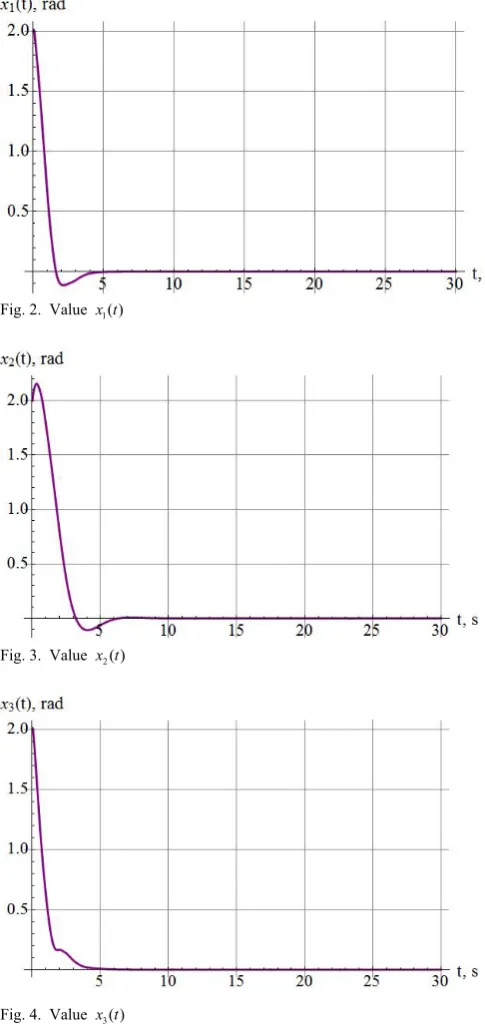
Figures 2-4 present graphs of the behavior of the components of the vector x t( ). They are the deviations of the general coordinates , , of the gyrostat for its program motion r( )t
*( ), ( ),t * t *( )t
Τ. This motionoccurs under the action of programmed torque (11) and stabilizing torque (14). The graphs illustrate the asymptotical stable of the obtained solutions.
Figures 5-7 present graphs of the behavior of the velocities x ti( ).
V. CONCLUSION
[image:4.595.310.546.52.556.2]This paper presents mathematic model of movement around the center of mass of single-rotor dynamically symmetrical gyrostat with a spherical cavity filled with viscous fluid. The problem about realization and global stabilization of gyrostat program motions is solved. The Fig. 2. Value x t1( )
Fig. 3. Value x t2( )
Fig. 4. Value x t3( )
Fig. 5. Value x t1( )
Fig 6 Value x t2( )
[image:4.595.49.292.147.665.2]active program and stabilizing controls acting to the gyrostat are constructed. The stabilizing control is obtained by the principle of feedback. The task is solved on the base of second method of Lyapunov functions and a method of the limit equations and the limit systems. The solution are asymptotical stable in large. The asymptotic convergence of the solutions is confirmed and illustrate by the results of numerical simulation of the motion of the gyrostat.
The results of this paper further develop results from notes [13, 17] and can be used for projecting control systems for objects with cavities filled with highly viscous fluids.
REFERENCES
[1] F. L. Chernous’ko, “On satellite motion relative on the center of mass under the action of gravitational moments” J. Appl. Math. Mech., vol. 27, iss. 3, 1963, pp. 708–722.
[2] A. M. Letov, Flight Dynamic and Control. Moscow: Nauka, 1969, 369 p.
[3] V. V. Rumiantsev, “On the stability of gyrostats motion” J. Appl. Math. Mech., vol. 25, iss. 1, 1961, pp. 9–19.
[4] J. Wittenburg, Dynamics of Systems of Rigid Bodies. Teubner, Stuttgart, 1977.
[5] J. E. Cochran, P. H. Shu, S. D. Rew, Attitude motion of dual-spin asymmetric spacecraft. J. Guidance Control Dynamics, no. 5, 1982, pp. 37–42.
[6] P. S. Krasilnikov, “Small plane oscillations of satellite in an weakly elliptical orbit” Nelinejnaja Dinamika, vol. 9, iss. 4, 2013, pp. 671– 696.
[7] O. E. Orel, P. E. Ryabov, “Bifurcation sets in a problem on motion of a rigid body in fluid and in the generalization of this problem”
Regular and Chaotic Dynamics, vol. 3, no. 2, 1998, pp. 82–91. [8] C. Hall, R. Rand, “Spinup dynamics of axial dual-spin spacecraft” J.
Guidance Control Dynamics, vol. 17, no. 1, 1994, pp. 30–37. [9] A. El-Gohary, “Chaos and optimal control of steady-state rotation of a
satellite-gyrostat on a circular orbit” Chaos, Solitons and Fractals, vol. 42, no. 5, 2009, pp. 2842–2851.
[10] S. P. Bezglasnyi, “Active orientation of a gyrostat with variable moments of inertia”. J. Appl. Math. Mech., vol. 78, no. 6, 2014, pp. 551-559.
[11] S. P. Bezglasnyi, “Realization of Program Motion of a Gyrostat with Variable Inertia Moments”. Lecture Notes in Engineering and Computer Science: Proceedings of The World Congress on Engineering 2015, WCE 2015, 1-3 July, 2015, London, U.K., pp. 7-9. [12] A. Elipe, V. Lanchares, Exact solution of a triaxial gyrostat with one
rotor. Celest. Mech Dyn. Astron., vol. 101, 2008, pp. 49–68.
[13] F. L. Chernous’ko, Motion of a Rigid Body with Cavities Containing a Viscous Fluid. Moscow: Nauka, 1968, 309 p.
[14] N. N. Moiseev, V. V. Rumiantsev, Dynamics of Bodies with Fluid-Filles Cavities. Moscow: Nauka, 1965, 439 p.
[15] L. D. Akulenko, D. D. Leshchenko, A. L. Rachinskaya, “Optimal deceleration of rotation of a dynamically symmetric body with a cavity filled with viscous liquid in a resistive medium”, J. of Computer and System Sciences International, vol. 49, no 2, 2010, pp. 222-226.
[16] L. D. Akulenko, Ya. S. Sinkevich, D. D. Leshchenko, A. L. Rachinskaya, “Rapid rotations of a satellite with a cavity filled with viscous fluid under the action of moments of gravity and light pressure forces”, Cosmic Research, vol. 49, no 5, 2011, pp. 440-451. [17] S. P. Bezglasnyi, “Stabilization of stationary motions of a gyrostat
with a cavity filled with viscous fluid”, Russian aeronautics, vol. 57, no. 4, 2014, pp. 333-338.