Proceedings of the 2019 Conference on Empirical Methods in Natural Language Processing
6280
A Challenge Dataset and Effective Models for Aspect-Based Sentiment
Analysis
Qingnan Jiang1, Lei Chen1, Ruifeng Xu2,3, Xiang Ao4, Min Yang1∗
1Shenzhen Institutes of Advanced Technology, Chinese Academy of Sciences 2Department of Computer Science, Harbin Institute of Technology (Shenzhen)
3Peng Cheng Laboratory
4Institute of Computing Technology, Chinese Academy of Sciences
[email protected], [email protected], [email protected] [email protected], [email protected]
Abstract
Aspect-based sentiment analysis (ABSA) has attracted increasing attention recently due to its broad applications. In existing ABSA datasets, most sentences contain only one as-pect or multiple asas-pects with the same senti-ment polarity, which makes ABSA task degen-erate to sentence-level sentiment analysis. In this paper, we present a new large-scale Multi-Aspect Multi-Sentiment (MAMS) dataset, in which each sentence contains at least two dif-ferent aspects with difdif-ferent sentiment polar-ities. The release of this dataset would push forward the research in this field. In addi-tion, we propose simple yet effective CapsNet and CapsNet-BERT models which combine the strengths of recent NLP advances. Ex-periments on our new dataset show that the proposed model significantly outperforms the state-of-the-art baseline methods1.
1 Introduction
Aspect-based sentiment analysis (ABSA) aims at identifying the sentiment polarity towards the spe-cific aspect in a sentence. An target aspect refers to a word or a phrase describing an aspect of an entity. For example, in the sentence “The decor is not special at all but their amazing food makes up for it”, there are two aspect terms “decor” and “food”, and they are associated withnegativeand positivesentiment respectively.
Recently, neural network methods have domi-nated the study of ABSA since these methods can be trained end-to-end and automatically learn im-portant features. (Wang et al.,2016) proposed to learn an embedding vector for each aspect, and these aspect embeddings were used to calculate the attention weights to capture important infor-mation with regard to the given aspects. (Tang
∗
Min Yang is corresponding author
1Data and code can be found as: https://github.com/siat-nlp/MAMS-for-ABSA
et al.,2016b) developed the deep memory network to compute the importance degree and text repre-sentation of each context word with multiple at-tention layers. (Ma et al.,2017) introduced the in-teractive attention networks (IAN) to inin-teractively learn attentions in contexts and targets, and gen-erated the representations for target and context words separately. (Xue and Li,2018) proposed to extract sentiment features with convolutional neu-ral networks and selectively output aspect related features for classification with gating mechanisms. Subsequently, Transformer (Vaswani et al.,2017) and BERT based methods (Devlin et al., 2018) have shown high potentials on ABSA task. There are also several studies attempting to simulate the process of human reading cognition to further im-prove the performance of ABSA (Lei et al.,2019;
Yang et al.,2019).
So far, several ABSA datasets have been con-structed, including SemEval-2014 Restaurant Re-view dataset, Laptop ReRe-view dataset (Pontiki et al., 2014) and Twitter dataset (Dong et al.,
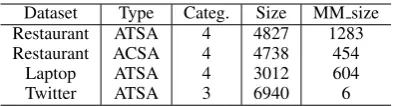
2014). Although these three datasets have since become the benchmark datasets for the ABSA task, most sentences in these datasets consist of only one aspect or multiple aspects with the same sentiment polarity (see Table 1)2, which makes aspect-based sentiment analysis degener-ate to sentence-level sentiment analysis. Based on our empirical observation, the sentence-level sen-timent classifiers without considering aspects can still achieve competitive results with many recent ABSA methods (see TextCNN and LSTM in Ta-ble3). On the other hand, even advanced ABSA methods trained on these datasets can hardly dis-tinguish the sentiment polarities towards different aspects in the sentences that contain multiple as-pects and multiple sentiments.
Dataset Type Categ. Size MM size Restaurant ATSA 4 4827 1283 Restaurant ACSA 4 4738 454
Laptop ATSA 4 3012 604
[image:2.595.83.282.61.114.2]Twitter ATSA 3 6940 6
Table 1: Statistics of existing datasets for ABSA. Size and MM size represent the total number of in-stances and multi-apsect multi-sentiment inin-stances in the dataset. Each multi-apsect multi-sentiment instance contains multiple aspects with different sentiment po-larities.
With the goal of advancing and facilitating re-search in the field of aspect-based sentiment anal-ysis, in this paper, we present a new Multi-Aspect Multi-Sentiment (MAMS) dataset. In MAMS dataset, each sentence consists of at least two aspects with different sentiment polarities, mak-ing the proposed dataset more challengmak-ing com-pared with existing ABSA datasets. Considering merely the sentence-level sentiment of the sen-tence will fail to achieve good performance on MAMS dataset. We empirically evaluate the state-of-the-art ABSA methods on MAMS dataset, the poor results demonstrate that the proposed MAMS dataset is more challenging than the SemEval-2014 Restaurant Review dataset.
We analyze the properties of recent ABSA methods, and propose new capsule networks (de-noted as CapsNet and CapsNet-BERT) to model the complicated relationship between aspects and contexts, which combine the strengths of recent NLP advances. Experimental results show that the proposed methods achieve significantly better re-sults than the state-of-the-art baseline methods on MAMS and SemEval-14 Restaurant datasets.
Our main contributions are summarized as fol-lows: (1) We manually annotate a large-scale multi-aspect multi-sentiment dataset, preventing ABSA degenerating to sentence-level sentiment analysis. The release of it would push forward the research of ABSA. (2) We propose a novel capsule network based model to learn the complicated re-lationship between aspects and contexts. (3) Ex-perimental results show that the proposed method achieves significantly better results than the state-of-the-art baseline methods.
2 Dataset Construction
Data Collection Similar to SemEval-2014 Restaurant Review dataset (Pontiki et al., 2014), we annotate sentences from the Citysearch New
Dataset Pos. Neg. Neu. Total.
ATSA
Train 3380 2764 5042 11186 Train (small) 1089 892 1627 3608
Validation 403 325 604 1332
Test 400 329 607 1336
ACSA
Train. 1929 2084 3077 7090 Train (small) 1000 1100 1613 3713 Validation 241 259 388 888
Test 245 263 393 901
Table 2: Statistics of MAMS dataset.
York dataset collected by (Ganu et al., 2009). We split each document in the corpus into a few sentences, and remove the sentences consisting more than 70 words.
Data Annotation We create two versions of MAMS dataset for two subtasks of aspect-based sentiment analysis: aspect-term sentiment analy-sis (ATSA) and aspect-category sentiment analyanaly-sis (ACSA).
For ATSA, we invited three experienced re-searchers who work on natural language process-ing (NLP) to extract aspect terms in the sentences and label the sentiment polarities with respect to the aspect terms. The sentences that consist of only one aspect term or multiple aspects with the same sentiment polarities are deleted. We also provide the start and end positions in a sentence for each aspect term.
For ACSA, we pre-defined eight coarse aspect categories: food, service, staff, price, ambience, menu, place andmiscellaneous. Five aspect cat-egories are adopted in SemEval-2014 Restaurant Review Dataset. We add three more aspect cat-egories to deal with some confusing situations. Three experienced NLP researchers were asked to identify the aspect categories described in given sentences and determine the sentiment polarities towards these aspect categories. We only keep the sentences which consist of at least two unique as-pect categories with different sentiment polarities.
[image:2.595.305.528.61.157.2]ra-… … …
BiGRU Transform & Squash
…
Transform & Squash
Context
Aspect Average Pooling
Aspect
Aspect Capsule
Concatenate Primary Capsule Category Capsule
Aspect Aware Normalization Capsule Guided
[image:3.595.76.281.60.274.2]Routing
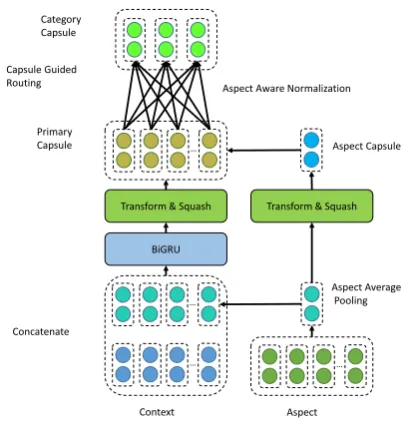
Figure 1: Model overview.
tio of multi-aspect multi-sentiment instances in Restaurant-ATSA, Restaurant-ACSA, Laptop and Twitter datasets are 26.58%, 9.58%, 20.05%, and 0.09% respectively, making the existing datasets less challenging since non-MAMS instances could be classified correctly without effectively model-ing the relationships between contexts and aspects. For fair comparison with SemEval-14 Restaurant dataset, we also provide a small version of MAMS dataset (called MAMS-small) by sampling train-ing instances from the MAMS traintrain-ing set, which has the same number of training instances with the SemEval-14 Restaurant dataset.
3 Methodology
We use D to denote the collection of sentences in the training data. Given a sentence S = {ws1, ..., wsn}, an aspect termAt = {w1a, ..., wma}
or an aspect category Ac, aspect-level sentiment classification aims to predict the sentiment polar-ityy∈ {1, ..., C}of sentenceSwith respect toAt orAc. Here,wdenotes a specific word,nandm are the lengths of the sentence and aspect term,C represents the number of sentiment categories.
As illustrated in Figure1, the proposed model consists of an embedding layer, an encoding layer, a primary capsule layer and a category capsule layer.
3.1 Embedding Layer
In the embedding layer, we convert the sentence S into word embeddings E. For ACSA task,
as-pect category embedding a are randomly initial-ized and learned during training, while for ATSA task, aspect embedding a are computed as aver-age pooling over aspect word embeddings. We get the aspect-aware sentence embeddingEsaby con-catenating the aspect embeddingawith each word embedding inS:Esai = [Ei;a]
3.2 Encoding Layer
We convert aspect-aware sentence representation
Esa into contextualized representation H = [h1, ...,hn] through bidirectional gated recurrent
unit (BiGRU) (Cho et al.,2014) and residual con-nection (He et al.,2016).
H=BiGRU(Esa) +Esa (1)
3.3 Primary Capsule Layer
In the primary capsule layer, we get primary cap-sulesP= [pi, ...pn]and aspect capsulecthrough
linear transformation and squashing activation.
pi=squash(Wphi+bp) (2)
c=squash(Waa+ba) (3)
whereWp,bp,Waandbaare learnable parame-ters. The squash function is defined as:
squash(s) = ksk
2
1 +ksk2
s
ksk (4)
Aspect Aware Normalization Due to the vari-able lengths of sentences, the number of primary capsules sent to upper layer capsules varies from sentence to sentence, leading to unstable training procedure. Extremely long sentences make the squash activation saturate and result in high confi-dence for all categories; while very short sentences in contrast will lead to low confidence for all cat-egories. To alleviate this problem, we propose the aspect aware normalization that utilizes aspect capsule to select important primary capsules, and normalize primary capsule weightsuby:
ui=
exp(piWnc)
Pn
j=1exp(pjWnc)
(5)
whereWnis a learnable parameter.
makes dynamic routing work like a self-directed process.
Instead of computing coupling coefficients be-tween primary capsules and category capsules dur-ing routdur-ing process, we design a capsule-guided routing mechanism, which leverages prior knowl-edge about the sentiment categories to guide the routing process effectively and efficiently. Specif-ically, we use a set of sentiment capsules to store prior knowledge about the sentiment categories. LetG ∈RC×dbe the sentiment matrix, which is initialized with the averaged embeddings of sen-timent words. C is the number of sentiment cat-egories, and dis the dimension of the sentiment embedding. We can get the sentiment capsules
Z = [z1, ...,zC] by applying squash activation
over sentiment matrix and compute the routing weights w by calculating the similarity between primary capsules and sentiment capsules:
zi=squash(Gi) (6)
wij =
exp(piWrzj)
Pn
k=1exp(piWrzk)
(7)
3.4 Category Capsule Layer
Based on the normalization weights and rout-ing weights, the final category capsules V = [v1, ...,vC]can be calculated as:
vj =squash(s n
X
i=1
wijuipi) (8)
wheresis a learnable scale parameter to scale the connection weights to a suitable level.
Following (Sabour et al.,2017), we use the mar-gin loss as loss function for aspect-based senti-ment classification:
L=
C
X
k=1
Tkmax(0, m+− kvkk)2
+λ(1−Tk) max(0,kvkk −m−)2 (9)
whereTk= 1if and only if a categorykis present.
m+ andm− are the margin hyper-parameters. λ control the loss for absent categories. In our ex-periments,m+, m− andλis set to 0.9, 0.1, 0.6, respectively.
3.5 CapsNet-BERT
To utilize the features learned from large-scale corpus, we design the CapsNet-BERT model
which combines the strength of BERT and capsule networks. We replace the embedding layer and en-coding layer of CapsNet with pre-trained BERT. The CapsNet-BERT model takes “[CLS] sentence [SEP] aspect [SEP]” as input, which computes the deep representations of sentences and aspects with pre-trained BERT. We then feed the sentence and aspect representations into capsule layers and pre-dict the corresponding sentiment polarities.
4 Experiments
4.1 Experimental Setup
Experimental Data In order to evaluate the ef-fectiveness of our model, we conduct experiments on the two MAMS datasets and SemEval-14 Restaurant Review (Pontiki et al., 2014) dataset. All models share the same data pre-processing procedure, and use the same pre-trained word em-beddings.
Baseline Methods We compare CapsNet with various baselines. (1) LSTM based models: TD LSTM (Tang et al.,2016a), AT LSTM (Wang et al., 2016), ATAE LSTM (Wang et al., 2016), BiLSTM enhanced with attention mechanism, IAN (Ma et al., 2017) and AOA LSTM (Huang et al.,2018); (2) CNN based model: GCAE (Xue and Li,2018); (3) Attention based models: Mem-Net (Tang et al., 2016b) and AEN (Song et al.,
2019). To verify the effectiveness of combin-ing capsule networks and BERT, we also compare the performance of CapsNet-BERT with vanilla BERT model. Vanilla BERT model adopts “[CLS] sentence [SEP] aspect [SEP]” as input and predicts the sentiment polarity of the sentence towards the given aspect.
Method ATSA ACSA
MAMS MAMS-small Restaurant MAMS MAMS-small Restaurant
TextCNN 52.694 51.736 75.928 48.856 48.814 81.418
LSTM 52.486 50.134 75.552 48.546 48.346 82.076
TD LSTM 74.596 73.582 75.630 - -
-AT LSTM 77.558 73.028 76.200 66.436 65.128 83.100
ATAE LSTM 77.054 71.708 77.200 70.634 66.814 84.000
BiLSTM+Attn 76.166 70.720 77.356 66.304 66.262 80.514
IAN 76.602 71.168 78.600 - -
-AOA LSTM 77.260 72.290 81.200 - -
-AEN 66.722 61.706 80.980 - -
-MemNet 64.568 62.694 80.950 63.288 62.818 77.862
GCAE 77.588 73.246 77.280 72.098 66.968 79.350
CapsNet 79.776 73.860 80.786 73.986 67.128 83.554
BERT 82.218 79.440 84.460 78.292 75.316 90.442
CapsNet-BERT 83.391 80.910 85.934 79.461 76.366 91.375
CapsNet-DR 79.434 71.398 77.768 69.036 65.638 81.904
CapsNet-BERT-DR 82.970 80.092 84.646 79.132 75.634 90.736
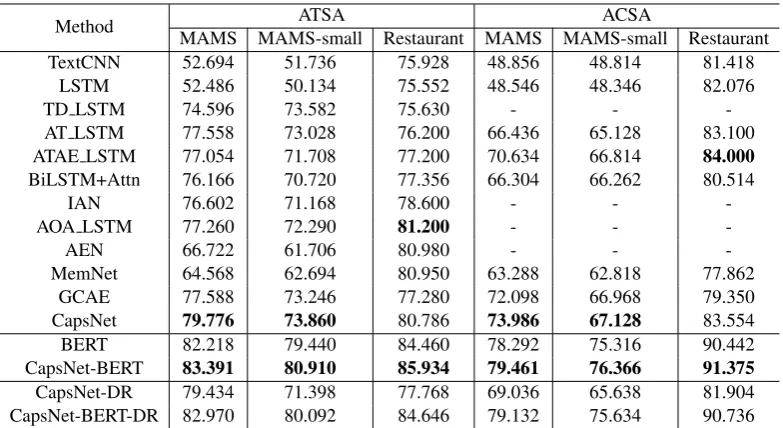
Table 3: Experimental results on two MAMS datasets and SemEval-2014 Restaurant Review dataset for both ATSA and ACSA subtasks.
4.2 Experimental Results and Analysis
Experimental results are reported in Table3. From Table3we draw the following conclusions. First, sentence-level sentiment classifiers (TextCNN and LSTM) achieve competitive results on SemEval-14 Restaurant Review dataset but perform poorly on MAMS datasets. This verifies that MAMS datasets can alleviate the task degeneration prob-lem encountered in Restaurant dataset for ABSA. Second, most advanced and complex ABAS meth-ods, which achieve impressive results on Restau-rant dataset, perform poorly on the MAMS-small dataset. This verifies that MAMS (small) is more challenging than SemEval-14 Restaurant Review dataset. Third, attention based models without effectively modeling word order (e.g., MemNet and AEN) perform worst on MAMS since they lose word order information and cannot identify which part of context describes the given aspect. Fourth, CapsNet outperforms non-BERT baselines on 4 of 6 datasets, showing the potential of ap-plying capsule networks to aspect-based sentiment analysis task. In addition, CapsNet-BERT per-forms significantly better than other models in-cluding BERT, indicating that combining capsule network and BERT can obtain additional improve-ment compared to vanilla BERT.
4.3 Ablation Study
To analyze the effectiveness of the proposed capsule-guided routing mechanism, we conduct ablation study that replace capsule-guided routing
by dynamic routing in both CapsNet and BERT, resulting in DR and CapsNet-BERT-DR. From Table 3 (last two rows) we can see that capsule-guided routing boosts the perfor-mance of CapsNet and CapsNet-BERT on all the datasets.
5 Conclusion
In this paper, we present MAMS, a challenge dataset for aspect-based sentiment analysis, in which each sentence contains multiple aspects with different sentiment polarities. The proposed MAMS dataset could prevent aspect-level senti-ment classification degenerating to sentence-level sentiment classification, which might push for-ward the researches on aspect-based sentiment analysis. In addition, we propose a simple yet ef-fective capsule networks that significantly outper-forms compared methods.
Acknowledgements
[image:5.595.105.497.61.275.2]References
Kyunghyun Cho, Bart van Merrienboer, Caglar Gul-cehre, Dzmitry Bahdanau, Fethi Bougares, Holger Schwenk, and Yoshua Bengio. 2014. Learning phrase representations using rnn encoder–decoder for statistical machine translation. InProceedings of the 2014 Conference on Empirical Methods in Nat-ural Language Processing (EMNLP), pages 1724– 1734.
Jacob Devlin, Ming-Wei Chang, Kenton Lee, and Kristina Toutanova. 2018. Bert: Pre-training of deep bidirectional transformers for language understand-ing. arXiv preprint arXiv:1810.04805.
Li Dong, Furu Wei, Chuanqi Tan, Duyu Tang, Ming Zhou, and Ke Xu. 2014. Adaptive recursive neural network for target-dependent twitter sentiment clas-sification. InProceedings of the 52nd annual meet-ing of the association for computational lmeet-inguistics (volume 2: Short papers), volume 2, pages 49–54.
Gayatree Ganu, Nomie Elhadad, and Amlie Marian. 2009. Beyond the stars: Improving rating predic-tions using review text content. InWebDB.
Kaiming He, Xiangyu Zhang, Shaoqing Ren, and Jian Sun. 2016. Deep residual learning for image recog-nition. In2016 IEEE Conference on Computer Vi-sion and Pattern Recognition (CVPR), pages 770– 778.
Binxuan Huang, Yanglan Ou, and Kathleen M Car-ley. 2018. Aspect level sentiment classification with attention-over-attention neural networks. In International Conference on Social Computing, Behavioral-Cultural Modeling and Prediction and Behavior Representation in Modeling and Simula-tion, pages 197–206. Springer.
Diederik P. Kingma and Jimmy Lei Ba. 2015. Adam: A method for stochastic optimization. international conference on learning representations.
Zeyang Lei, Yujiu Yang, Min Yang, Wei Zhao, Jun Guo, and Yi Liu. 2019. A human-like semantic cog-nition network for aspect-level sentiment classifica-tion. InProceedings of the AAAI Conference on Ar-tificial Intelligence, volume 33, pages 6650–6657.
Dehong Ma, Sujian Li, Xiaodong Zhang, and Houfeng Wang. 2017. Interactive attention networks for aspect-level sentiment classification. In IJCAI’17 Proceedings of the 26th International Joint Confer-ence on Artificial IntelligConfer-ence, pages 4068–4074.
Jeffrey Pennington, Richard Socher, and Christo-pher D. Manning. 2014. Glove: Global vectors for word representation. In Proceedings of the 2014 Conference on Empirical Methods in Natural Lan-guage Processing (EMNLP), pages 1532–1543.
Maria Pontiki, Dimitris Galanis, John Pavlopoulos, Harris Papageorgiou, Ion Androutsopoulos, and
Suresh Manandhar. 2014. Semeval-2014 task 4: As-pect based sentiment analysis. InProceedings of the 8th International Workshop on Semantic Evaluation (SemEval 2014), pages 27–35.
Sara Sabour, Nicholas Frosst, and Geoffrey E Hinton. 2017. Dynamic routing between capsules. neural information processing systems, pages 3856–3866.
Youwei Song, Jiahai Wang, Tao Jiang, Zhiyue Liu, and Yanghui Rao. 2019. Attentional encoder network for targeted sentiment classification. arXiv preprint arXiv:1902.09314.
Duyu Tang, Bing Qin, Xiaocheng Feng, and Ting Liu. 2016a. Effective lstms for target-dependent sen-timent classification. international conference on computational linguistics, pages 3298–3307.
Duyu Tang, Bing Qin, and Ting Liu. 2016b. Aspect level sentiment classification with deep memory net-work. In Proceedings of the 2016 Conference on Empirical Methods in Natural Language Process-ing, pages 214–224.
Ashish Vaswani, Noam Shazeer, Niki Parmar, Jakob Uszkoreit, Llion Jones, Aidan N. Gomez, Lukasz Kaiser, and Illia Polosukhin. 2017. Attention is all you need. neural information processing systems, pages 5998–6008.
Yequan Wang, Minlie Huang, xiaoyan zhu, and Li Zhao. 2016. Attention-based lstm for aspect-level sentiment classification. InProceedings of the 2016 Conference on Empirical Methods in Natural Lan-guage Processing, pages 606–615.
Wei Xue and Tao Li. 2018. Aspect based sentiment analysis with gated convolutional networks. meet-ing of the association for computational lmeet-inguistics, 1:2514–2523.