Page 139
THE USE OF EXPERIMENTS AMONG PALESTINIAN SCIENCE TEACHERS IN JERUSALEM AREA
Tahani Ali-Rweide
Independent Researcher and PhD Candidate at Charles University, P.O. Box 66172, E. Jerusalem
Abstract
This study is to measure the use of experiments in science teaching. There is a common belief that using experiments is crucial to the learning-teaching process. However, there is a lack of practicing experiments due to various challenges.
A questionnaire was designed and distributed to a convenience sample consists of 196 high science teachers from various schools in East Jerusalem. This is enhanced by interviews with six science teachers. It was found that teachers’ beliefs about using experiments in teaching science are positive and not affected by the independent variables of gender, scientific degree, authority, specialization and experience. In spite of that, there is a lack in using experiments.
Among the main challenging factors are the Palestinian curriculum system which restricts the use of experiments, shortage in laboratories, materials and allocated time. Other existing barriers are the lack of motivations toward using experiments among school administrations, and large number of students in the class. In addition, the Palestinian educational system discards practical aspect in the student evaluation process. There is a need to consider overcoming these challenges when reviewing the new curriculum.
Key words: Palestinian Science Teachers, Teacher’s Beliefs, Lack of Using Experiments, Barriers of Using Experiments
1.INTRODUCTION
This study measures the Palestinian science teachers’ beliefs in east Jerusalem high schools by analysing the level and barriers of using experiments. For the past two decades, studies emphasized a gap in using experiments in the Palestinian schools. Shakhshir-Sabri (1996) shows that more than 50% of schools had not have qualified labs. As a science teacher, I noted that there is a lack in using experiments in science teaching, labs scarcity and sampling materials shortage in schools. Among the most important factors that affects this is the teacher’s beliefs, since the pedagogical construction is an interaction between knowledge content and beliefs (Hashweh 2005). So this study focuses on the high school science teachers’ beliefs about using experiments and the barriers that they face.
This study aims to answer the following questions:
1. What are the main high school science teachers’ beliefs in Jerusalem area?
2. Are there statistical significant differences in the means of beliefs according to the independent variables, gender, specialization, experience, scientific degree and authority?
3. What are the levels of using experiments in teaching? 4. What are the main barriers that affect doing experiments?
2.LITERATURE REVIEW
Page 140
investigation and experiments in learning and mastering science such as physics (Keatinge 1907). Nichols and Stephen (2013) highlighted the importance of scientific method in creating major discoveries during the 19th century. They considered conducting experiments as a part of the scientific method in testing hypothesis and so as a means to develop creative learning activities. Therefore, for the past centuries, a high awareness was created at the individual and official levels to include the practical part in the curriculum. The application of this in the teaching process is influenced by several factors. Many researches highlighted the relation between beliefs and practices of school teachers.
Mansour (2009) argue that teachers’ belief is difficult to define which reflects on the teaching method and practices. He found that researchers view that the practice is influenced by teachers’ beliefs, but some noted that practice may change beliefs. For example, Morge (2005) shows that practices may be affected directly by teachers’ beliefs which by turn is influenced by their individual skills, training and education.
Chan et al (2007) a research on 313 teachers in Singapore shows that there are no statistical significant differences in teachers’ conceptions about teaching-learning process, due to gender, but there are according to qualifications.
Other researchers stressed the role of barriers facing science teachers’ which limited experiments practices. For example, Aldahmash (2014) reported that Yemeni science teachers concentrate on the theoretical part and neglect the practical aspect even after the developed curriculum made it a base for teaching science. This is due to barriers such as crowded classes, a shortage of labs and equipment, bad management of the financial resources and corruptions.
Friedrichsen & Dana (2005) adapted on high school biology teachers in order to study their beliefs about teaching science shows that teachers’ practices do not depend on teachers’ beliefs, they mostly depend on school’s environment, allocated time and students. From other point of view, their study shows that teachers’ beliefs about teaching science affected basically with the learning experience in the university, while the educational qualification does not have any effect on beliefs, neither on practices. One of the most significant results of their study is that long teaching experience disallowed changing beliefs, while those with short teaching experience have more consistency between beliefs and practices.
Pérez & Furman (2016).evaluated the development that occurred to science teachers after involving in a course which designed by Peruvian Ministry of Education and adapted on 35 high school science teachers for 10 months. In this course, teachers trained to use experimental inquiry activities. Before taking the course, 91% of them view their traditional use of lab to lack of materials and time. After involving in the training course, 38% of teachers were convinced that there is no need for sophisticated materials to do experiments. Their ideas changed to using law-cost materials in teaching.
From the aforementioned research, one can conclude the teachers’ beliefs is the major factors that can influence the classroom experiments practices. Other factors can be overcome by teachers’ creativity.
3.MATERIALS AND METHODS
Page 141
The questionnaire were collected and analysed statistically using SPSS. Means and standard deviations were analysed for the factors of beliefs and the effects of the independent variables, gender, scientific degree, authority, specialization and experience, on the dependent variable, beliefs. T-test had been used to find if beliefs are affected by gender. ANOVA tests were used to check if beliefs are affected by other independent variables, namely scientific degree, authority, specialization and experience.
In addition, the percentage uses of experiments and the main barriers of using experiments were determined. This was enhanced by interviews with six high school science teachers who are working under different authorities from different schools, gender, specialities, and with experience ranges from 4 to 30 years. Open questions had been given to them to obtain their beliefs about using experiments in teaching science, their percentage use of experiments, and any barriers they face.
4.RESULTS
4.1. Main beliefs of high school science teachers’ in Jerusalem area
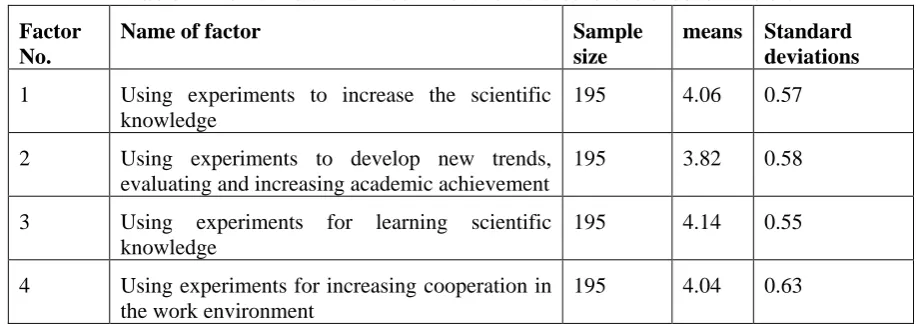
The measure of teachers beliefs of using experiments were summed up in four factors. Table 1 summarised the mean and standard deviation of each factor.
Table 1. Means and standard deviations for science teachers’ beliefs factors Factor
No.
Name of factor Sample
size
means Standard deviations 1 Using experiments to increase the scientific
knowledge
195 4.06 0.57
2 Using experiments to develop new trends, evaluating and increasing academic achievement
195 3.82 0.58
3 Using experiments for learning scientific knowledge
195 4.14 0.55
4 Using experiments for increasing cooperation in the work environment
195 4.04 0.63
* 5-point Likert Scale questions was used. , (1) strongly disagree, (5) strongly agree.
It is clear that teachers beliefs agree for all factors, although their beliefs about the importance of using experiments for learning and increasing scientific knowledge is the highest, mean = 4.14. The importance of using experiments for developing new trends and evaluating and increasing students achievement is the least, mean = 3.82.
In addition, the interviews with the six teachers shows that they all endorsed the role of experiments in teaching science. All of them state that using experiments is important to learn and increase scientific knowledge, which is also the highest stated factor in the quantitative part. Two from six said that experiments are necessary for quickly gaining new information, another two emphasised the role of experiments in discovering and deducting knowledge, while the last two think that experiments triggers thinking.
Page 142 4.2. Multi- variables effects correlation
All teachers believe in using experiments, as reflected by both the questionnaire and interviews although the independent variables are changed. ANOVA and T-Test results shows no statistical significant difference on teachers’ beliefs according to the independent variables, gender, specialization, scientific degree, experience, and authority. This result is similar to the conclusion about gender by Chan et al (2007) and contradicts with the results of Friedrichsen & Dana (2005) and Chan et al (2007) in specialisation.
4.3. Percentage of using experiments
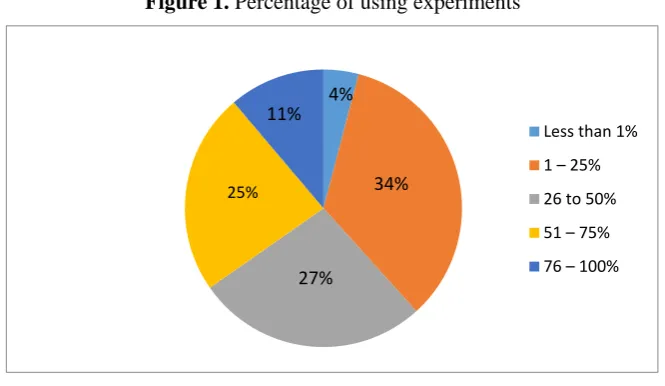
Table 2 and figure 1 show percentages of using experiments by the teachers.
Table 2. Percentages of using experiment Ratio of practicing
experiments
Number of
teachers
Percentage ratio %
Cumulative percentage ratio %
Less than 1% 8 4.1 4.1
(1 – 25)% 67 34.2 38.3
(26 - 50)% 53 27.0 65.3
(51 – 75)% 46 23.5 88.8
(76 – 100)% 22 11.2 100.0
Total 196 100.0
It can be noted that more than one third of the teachers do less than 25% of the experiments, 4.1% do not use experiments at all, and just 11.2% do more than 75% of the experiments in the curriculum. Similarly, Figure 1 shows that majority of teachers had frequent use of experiments for less than 50 %, and one out of ten from the teachers applies sufficient experiments in teaching. This indicates a shortage of using experiments in Palestinian schools.
Figure 1. Percentage of using experiments
Those who did not practice any experiments are from a school with no labs or equipment. An interview was done with a school headmaster. He stated that he is not convinced about experiments or labs, so he closed the labs and turned them to classes. However, his students have a high achievement in the general
4%
34%
27% 25%
11%
Less than 1%
1 – 25%
26 to 50%
51 – 75%
Page 143
final examination (Alinjaz) that the Ministry of Education does each year for the 12th grade. This is because the final exam in science is for the theoretical part while the practical side (the experimental part) is excluded. This agrees with Aldahmash (2014) conclusions about concentrating on the theoretical part and neglecting the practical one.
The interviews with teachers show that they differ in their percentage practicing for experiments ranging from 20% to 90%. Their practicing also depend on science subject that they learn. This is due to several barriers that will be considered in the section below.
The general results bout using experiments also agree with the study of Shakhshir-Sabri (1996) that there are shortages in using experiments. Though, the curriculum was revised several times since the time when it was using the Jordanian one. Also, the study of Mansour (2009) does not fit with the results of this research since beliefs is not related to practice.
4.4. Main barriers that affect conducting experiments
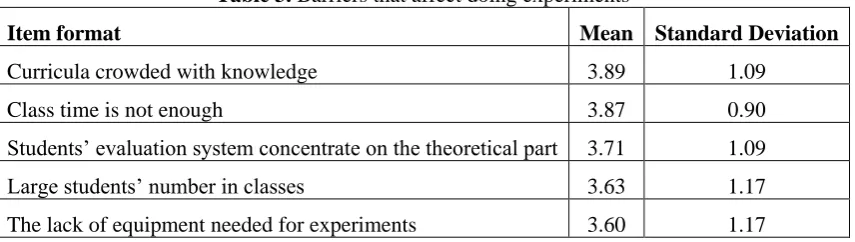
Table 3 lists 5 main factors to determine the main barriers for conducting experiments which were considered by the questionnaire. These are concerned with crowded curriculum, lack of classes’ time, students’ evaluation system, students’ number and lack of equipment.
Table 3. Barriers that affect doing experiments
Item format Mean Standard Deviation
Curricula crowded with knowledge 3.89 1.09
Class time is not enough 3.87 0.90
Students’ evaluation system concentrate on the theoretical part 3.71 1.09
Large students’ number in classes 3.63 1.17
The lack of equipment needed for experiments 3.60 1.17 * 5-point Likert Scale questions was used.
The interviews with teachers showed other similar barriers such as lack of qualified laboratory and shortage of needed materials to do experiments. Five from six of them stated that time is not enough to make experiments. Only one teacher did not complain about time, nor about students’ number, since the number of students in his classes ranges between four and nine. Four teachers mentioned that large students’ number make it difficult to do experiments, especially with small labs, lack of equipment, materials and time. While two added that students are not acting well and not cooperate with teachers during experiments time. These results harmonize with Aldahmash (2014) findings about barriers of using experiments.
Furthermore, the subject that teachers teach, mainly physics, chemistry or biology, affects the experiments execution and procedures. Three from six, who teach chemistry, mentioned the hazards from using chemical materials used during experiments, especially without qualified labs. For teachers who teach both biology and chemistry, they do experiments in biology classes much more in the chemistry classes.
Other teachers looks for creative solutions to barriers affecting experiments. Four from six stated that they use the computers, internet and social media to send films about experiments to students, or using power points in the class, especially for dangerous chemistry experiments and by those who do not have enough time or materials, large students’ number and nonqualified labs. Others do safe experiments in the classroom, like using microscopes.
Page 144
simple alternative materials. Hikmat & Khalaf (2015) study about the effect of using dry laboratory in learning chemistry between second grade class students, in girls’ high school, shows that using labs affect positively the academic achievements and it could be a supplementary method in teaching and learning.
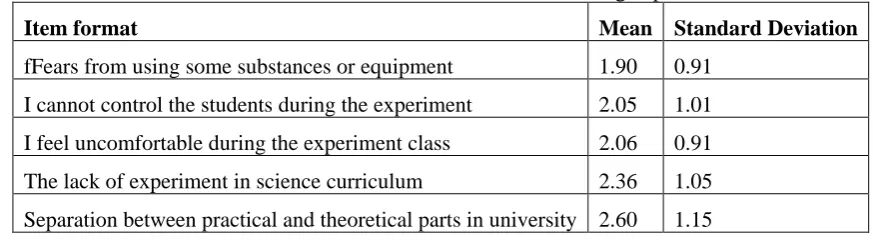
In addition, one interviewed teachers believes that the biggest barrier is headmasters who spend money in formalities, instead of spending in to qualify labs. This result is also discussed by Aldahmash (2014). There are also several other barriers that less affecting barriers. Table 4 shows means and standard deviations for some of these.
Table 4. Other less influence barriers that affect doing experiments
Item format Mean Standard Deviation
fFears from using some substances or equipment 1.90 0.91 I cannot control the students during the experiment 2.05 1.01 I feel uncomfortable during the experiment class 2.06 0.91 The lack of experiment in science curriculum 2.36 1.05 Separation between practical and theoretical parts in university 2.60 1.15
* 5-point Likert Scale questions was used.
The less important factors that do not affect teachers’ practicing experiments are mainly those concerning with teachers’ career and personality. Teachers exclude the barriers which concern with their qualifications and careers. The study of Pérez & Furman (2016) contradict with this result, since it shows that teachers become more qualified by using simple materials for experiments. In addition to that, many teachers believe that the curriculum does not lack experiments, and also the university learning does not work as barrier.
5.CONCLUSIONS
In general, science teachers’ beliefs about using experiments are positive. They believe that they have to use experiments in order to learn and increase students’ scientific knowledge. On contrast, they did not support strongly the idea of using experiments to build new trends or values. It appears that the social and emotional goals are not considered in teachers’ beliefs. Furthermore, students’ evaluation system depends on the theoretical part only.
Although teachers’ beliefs about using experiments are positive, their percentage practicing of them is low. This is due to barriers that they face from different aspects. These mainly represented by the crowded curricula, shortage of time, not enough classes, students numbers and attitudes, the lack of qualified labs or materials, and the evaluation of students which depends only on the theoretical part and neglect the practical one. Teachers’ career and qualifications are not considered as barriers as teachers believe. In all cases, there is some teachers that created alternative activities to overcome any barrier they face. It is hoped that this research will suggest a way to strengthen the use of experiments in the Palestinian schools.
REFERENCES
Page 145
Chan, K, Tan, J & Khoo, A 2007, ‘Pre-service Teachers’ Conceptions about Teaching and Learning A closer look at Singapore cultural context’, Asia-Pacific Journal of Teacher Education, vol. 35, no. 2, pp. 181-195.
Duit, R & Tesch, M 2010, ‘On the role of experiment in science teaching and learning – Visions and the reality of instructional practice’, Proceedings of the 7th International Conference on Hands-on Science, Kalogiannakis, M, Stavrou, D, & Michaelidis, P, pp. 25-31, 25-31 July.
Friedrichsen, P & Dana, T 2005, ‘Substantive-level theory of highly regarded secondary biology teachers’ science teaching orientations’, Journal of Research in Science Teaching, vol. 42, no. 2, pp. 218-244.
Hashweh, M 2005, ‘Teacher pedagogical construction: A reconfiguration of pedagogical content knowledge’, Journal of Research in Science Teaching, vol. 33, no. 1, pp. 47-63.
Hikmat, A & Khalaf, A 2016, ‘The effect of using dry laboratory in the collection of second grade students average in chemistry’, Journal of The Iraqi University, vol. 3, no. 36, pp. 481-519.
Keatinge, M (ed.) 1907, The Great Didactic, Adam and Charles Black, London.
Mansour, N 2009, ‘Science teachers’ beliefs and practices: issues, implications and research agenda’, International Journal of Environmental and Science Education, vol. 4, no. 1, pp. 25-48.
Morge, L 2005, ‘Teacher-pupil interaction: A study of hidden beliefs in conclusion phases’, International Journal of Science Education, vol. 27, no. 8, pp. 935-956.
Nichols AJ, & Stephens, A 2013, ‘The scientific method and the creative process: Implications for the K-6 classroom’, Journal for Learning through the Arts, vol. 9, no. 1, pp. 1–12, viewed May 2019, <http://escholarship.org/uc/item/0z72t75q>.
Pérez, M & Furman, M 2016, ‘What is a Scientific Experiment? The Impact of a Professional Development Course on Teachers’ Ability to Design an Inquiry-Based Science Curriculum’, International Journal of Environmental and Science Education, vol. 1, no. 6, pp. 1387-1401.