R E S E A R C H
Open Access
Frequency domain soft-constraint
multimodulus blind equalization for uplink
SC-FDMA
Kabiru Akande
1, Naveed Iqbal
1, Azzedine Zerguine
1*, Naofal Al-Dhahir
2and Abdelmalek Zidouri
1Abstract
Single-carrier frequency division multiple access (SC-FDMA) has been adopted and employed as the standard in the 3rd Generation Partnership Project (3GPP) Long-Term Evolution (LTE) uplink multiple-access scheme. It offers comparable performance and complexity to orthogonal frequency multiple access scheme (OFDMA) with a lower peak to average power ratio (PAPR) offering power-efficient transmission and longer battery life to mobile terminals. However, due to its single-carrier nature, SC-FDMA performance degrades in channels with long impulse responses and becomes prohibitive to equalize when implemented in time domain (TD). Furthermore, of the seven SC-FDMA symbols in the LTE uplink slot, one full symbol is used for channel estimation leading to about 14 % throughput degradation. In this work, a novel frequency domain soft-constraint satisfaction multimodulus blind algorithm (FDSCS-MMA) is developed and proposed. The frequency domain approach results in computational complexity reduction while blind implementation ensured improved spectral efficiency and throughput. The algorithm convergence is further improved by normalization of each of the frequency bin in the weight update. Simulation results show superior performance of the developed algorithm over other blind algorithms.
1 Introduction
The demand for high data transmission rates has been on the rise in recent years with organizations and individu-als requiring ultra high-speed data transmission scheme. Broadband wireless transmission is employed in deliver-ing this high speed data requirement to subscribers in a very hostile radio environment which offers multipath to transmitted signal. The multipath could be severe requir-ing sophisticated corrective measures at the receiver. Orthogonal frequency multiple access scheme (OFDMA) is a popular technique which uses a low symbol rate mod-ulation specially designed to cope with severe channel conditions in multipath environment [1]. However, it has high peak to average power ratio (PAPR) which imposes high-power penalty on the mobile users [2].
Single-carrier frequency division multiple access (SC-FDMA) is a variant of OFDMA with an additional dis-crete Fourier transform (DFT) processing block hence is
*Correspondence: [email protected]
1Department of Electrical Engineering, King Fahd University of Petroleum and Minerals, Dhahran, 31261, Saudi Arabia
Full list of author information is available at the end of the article
referred to as DFT-coded OFDMA [3, 4]. It has been adopted in 3rd Generation Partnership Project (3GPP) Long-Term Evolution (LTE) uplink scheme due to its lower PAPR while maintaining comparable performance and complexity to OFDMA [5, 6]. The lower PAPR fea-ture makes it suitable for uplink communication bene-fiting mobile users in terms of low-cost and improved, power-efficient transmission [5]. However, SC-FDMA is a single-carrier modulation technique whose performance degrades in a multipath environment and this gets worse with the severity of the multipath. Furthermore, frequency domain decision feedback equalization (FD-DFE) was proposed for SC-FDMA in both [7] and [8]. However, the solution assumed time-invariant and ideal channel estimate with reduction in bandwidth efficiency as pilot sequences are required for channel estimation. Both [9] and [10] equalized SC-FDMA without reference symbols but the equalizer was implemented in time domain mak-ing it unsuitable for channels with long impulse responses due to prohibitive computational complexity. An adap-tive frequency domain DFE was also proposed in [11] with added complexity of encoder and decoder. The cost
function in [12] seeks to minimize the average error for a block of received symbols which does not necessarily force/restore each of the transmitted symbols to its cor-rect point on the signal constellation while [13] is essen-tially a time domain implementation and hence has high complexity [12]. However, since SC-FDMA technique is set up in frequency domain, it is easier to implement its equalization in frequency domain as this avoids a lot of complications [10].
This paper presents a novel frequency domain imple-mentation of soft-constraint satisfaction multimodulus algorithm (FDSCS-MMA) for equalization of SC-FDMA. The proposed frequency domain implementation is based on SCS-MMA [14] which was derived by applying the principle of soft-constraint satisfaction to relax the con-straints in Lin’s cost function [15]. This implementa-tion avoids the use of reference symbols in order to improve the spectral efficiency and throughput. This is highly desired due to the fact that in the LTE uplink, a frame has 20 slots and each slot contains 7 SCFDMA symbols. Of these seven, one full training SC-FDMA symbol (preamble) is used followed by six data sym-bols (which has no training) and the channel is esti-mated (with channel-estimate-based approach, e.g., least squares) using this single preamble [16]. Hence, one out of seven SC-FDMA symbols in the LTE uplink is already des-ignated for channel estimation leading to approximately 14 % throughput degradation [3]. Therefore, blind algo-rithms provide attractive solution for SC-FDMA equal-ization. Also, the frequency domain (FD) implementa-tion greatly reduces the computaimplementa-tional complexity [17] that is associated with time domain implementation in channels with long impulse responses and has many other advantages [18]. Therefore, the frequency domain approach results in computational complexity reduction, while blind implementation ensured improved spectral efficiency and throughput [19–22]. Furthermore, FDSCS-MMA achieve lower mean square error (MSE) than both the normalized FD-modified constant modulus algorithm (NFDMMA) [23] and the popular constant modulus algorithm (CMA). Finally, FDSCS-MMA convergence is greatly improved by normalization of each of the fre-quency bin in the weight update. We have used the square root of the spectral power of the equalizer input for our normalization rather than the spectral power considered in [14] as we found that this gives better performance. Specific contributions as presented in this paper include: (1) frequency domain implementation of SCS-MMA, (2) convergence improvement of FDSCS-MMA to realize normalized FDSCS-MMA, (3) adaptation and implemen-tation of NFDSCS-MMA for the equalization of SC-FDMA, (4) reduced overhead and improved bandwidth efficiency compared to channel estimation algorithms, (5) superior phase recovery and intersymbol interference
(ISI) optimization capability compared to other popular blind algorithms such as CMA and MMA.
This paper is organized as follows: Section 2 details the mathematical description of SC-FDMA system. Section 3 provides the time domain (TD) implementation of the blind algorithms. Section 4 describes the FD imple-mentation of the proposed algorithms. Section 5 shows simulation results of the performance for the proposed equalizers. Section 6 concludes the paper.
2 Description of SC-FDMA
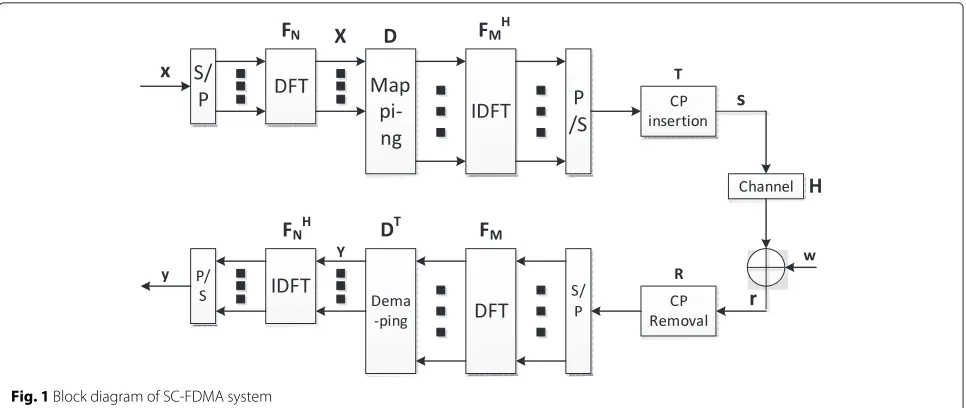
SC-FDMA is a multi-access single-carrier modulation technique with a frequency domain equalization at the receiver and allows parallel transmission of multiple users’ data. It is a variant of OFDMA with an additional DFT and IDFT processing block at the transmitter and receiver, respectively. What follows in this section is a detailed treatment of this well-known scheme. As stated in [8], it is advantageous to set up our system in terms of matri-ces as this simplifies implementation, provides a clear understanding of the system, and eases many performance analyses. Hence, our system is set up in this manner with the block diagram shown in Fig. 1.
In order to form an SC-FDMA block, sequences of data bits{an}are first modulated into symbols using any of the
modulation methods (BPSK, QPSK or M-QAM). For the qth user, whereQ represents the total number of users in the system, data block x consisting ofN symbols, is generated from the resulting modulation scheme as
x=[x0,x1,. . .,xN−1]T (1)
N-point DFT ofxis taken asX=FNxto yield frequency
coefficients which are then assigned orthogonal subcar-riers for transmission over the channel. From the DFT operation,Xrepresents DFT outputs forqthuser given as
X=[X0,X1,. . .,XN−1]T (2)
N is a normalization factor to ensure the same
Fig. 1Block diagram of SC-FDMA system
After allocating the subcarriers, M-point (M>N) inverse DFT (IDFT) is taken to convert the signal to time domain. The resulting signal is given asS = FMHXwhereSis the kth SCFDMA symbol consisting of all the users’ signal
S=[S0,S1,. . .,SM−1]T (4)
whileFMHis anM×MIDFT matrix andHis an Hermi-tian operator. The total number of users in the SC-FDMA system equals bandwidth expansion factor Q = M/N whereMis the total number of subcarriers. In order to complete an SC-FDMA block, the time domain signal is converted from parallel to serial arrangement and is cyclically extended by addition of cyclic prefix. A cyclic prefix (CP), which is typically removed at the receiving section before any major processing, is obtained by pre-fixing a symbol with its tail end to achieve mainly two purposes. If the CP length is the same or longer than the length of multipath channel delay spread, it helps prevent interblock interference (IBI) and also enable convolution between the channel impulse response and transmitted signal to be modeled as circular as opposed to normal linear convolution. This makes frequency domain equal-ization easy at the receiver. It is this second purpose that we have taken advantage of in adapting the FD blind algo-rithms to equalizing SC-FDMA symbols. The transmitted SC-FDMA block is
S=[SP,SP−1,. . .,S0,S1,. . .,SM−1]T (5)
wherePis the length of the appended CP. In matrix for-mat, both the transmitted and received signals can be written, respectively, as
S=TFMHDFNx (6)
and
Y=HS+V (7)
We define T and G which are used in adding and removing CP, respectively, as
T
IP×M
IM
,GOM×P IM
(8)
In (8),IP×Mis a matrix used in copying the lastProw of
IM,OM×Pis anM×Pzero matrix andIM is anM×M
identity matrix.H is(P+M)×(P+M)channel matrix andV is(P+M)×1 noise vector. The received signal undergoes the reverse of what it has undergone during the transmitting phase as shown in Fig. 1, hence the input to the equalizer is
Y=Hx+V (9)
where H is an N×N diagonal matrix containing the channel frequency response for theqth user andVis the effective 1×Nnoise vector. They are given as
H=FNHDTFM(GHT)FMHDFN (10)
and
V=FNHDTFMGV (11)
Equation (10) results from the fact that addition and removal of CP turns channel matrix into a circulant matrix, and the resulting circulant matrix is diagonalized by DFT processing [24].
3 Blind algorithms
3.1 CMA
[26, 27] basically reduces the error between the magni-tude of equalizer output and a circle of constant radius. However, CMA is not able to correct any phase rotation introduced by channel characteristics since its cost func-tion is independent of any phase informafunc-tion. The cost function for CMA is given as
JCMA(n)=E |z(n)|2−R
2
(12)
wherez(n)is the output of the equalizer,E[·] denotes sta-tistical expectation operator, andRis a constant defined as lengthN, the equalizer output is expressed as
z(n)=w(n)Hy(n) (14)
In order to obtain the optimum coefficients of the equal-izer, we use stochastic gradient to optimize the defined cost function with respect to the equalizer tap coefficients. Hence, we take stochastic gradient of (12) with respect to the tap weights vector to obtain
∂JCMA(n)
∂w(n) =e(n)y
∗(n) (15)
wheree(n)is the error factor and is given as
e(n)=4z(n) |z(n)|2−R (16)
and the tap weights vector are recursively updated as
w(n)=w(n−1)−μy(n)e∗(n) (17)
3.2 MMA
MMA addressed the phase ambiguity of CMA by limiting the ambiguity to within±π2 [23]. The modified form of CMA was proposed in [28] to realize a cost function that is able to perform both blind equalization and carrier phase recovery simultaneously. The cost function for MMA is given as
and both subscripts R and I denote real and imagi-nary parts, respectively. However, including both real and imaginary parts of the equalizer output in the cost func-tion and equalizing them separately sometimes results in
diagonal solutions [29]. The error sample for MMA can be derived from (18) and is given as
e(n)=2zR(n) z2R(n)−R1,R
A new blind algorithm, proposed by Lin [15], was derived by using the dispersion of real and imaginary parts of the equalizer output of MMA algorithm as constraints and minimizing the squared euclidean norm of the change in the tap weight vector to ensure that error samples approach zero. The proposed technique was based on the principle of minimum disturbance. From Lin algorithm, a new algorithm termed soft-constraint satisfaction multi-modulus algorithm (SCS-MMA) was derived by relaxing the constraints defined by Lin using principle of soft-constraint satisfaction (SCS) [14]. The cost function for SCS-MMA is given as
JSCS-MMAI(n)=E
The error term for SCS-MMA is derived from (21) and is given as
SCS-MMA achieves equalization by forcing the real and imaginary parts of equalizer output onto a four-point contour with distanceR2from the origin.
TD blind algorithms operate on a symbol-by-symbol basis processing a sample at a time. However, in order to take advantage of DFT processing, we need to for-mulate a block-by-block processing algorithm which will operate on a block of symbols at a time. This greatly improves computational cost and efficiency and is the most appropriate mode of processing for SC-FDMA FD equalization.
be avoided with the inclusion of CP [30]. Additionally, since multiplication in frequency domain for discrete data is essentially circular convolution in time domain, overlap-save and overlap-add techniques helps in imple-menting linear convolution in frequency domain for cases where transmitted symbol is much longer than the chan-nel impulse response. However, in SC-FDMA case, the received data are in blocks and these blocks of data, kept from IBI due to the appended CP, are fed into the equalizer for FD equalization.
4 Frequency domain blind algorithms
It is essential to point out the fundamental difference between the frequency domain equalization considered in this work and the frequency domain equalization (FDE) which is common in the literature. The FDE considered in works such as [23, 31] and [32] are linear convolution implemented through the use of overlap save method. In this work, cyclic-prefixed single-carrier system (CP-SCS) results in periodic transmitted symbols which trick the channel to perform circular convolution rather than lin-ear convolution. The periodicity is then removed at the receiver before carrying out frequency domain equaliza-tion. This sort of transmission format eliminates the need for overlap save method. Therefore, we simply feed the received symbol represented by (9) into the equalizer .
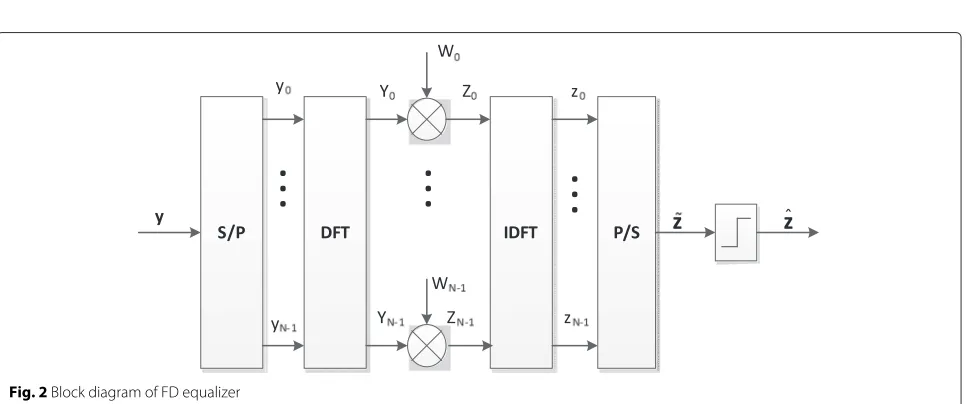
Frequency domain implementation differs from time domain implementation due to the fact that the former performs block update of the tap weight vector while the latter performs sample-by-sample update. This block update of tap weight vector greatly improves computa-tional complexity and convergence rate. The structure of FD equalizer is shown in Fig. 2 for a single user. There are two major operations involved in time domain equalization detailed in Section 3 above. They are lin-ear correlations in the update equation of (17) and linlin-ear
convolution embodied by the filtering operation in (14). In this section, we take advantage of DFT processing in implementing these two operations which lead to circu-lar correlation and circucircu-lar convolution, respectively. As mentioned earlier, the special nature of SC-FDMA which includes DFT processing and insertion of CP at the trans-mitter ensures that the received data is in blocks rather than long streams which implies that we do not require the use of overlap-save or overlap-add sectioning meth-ods. The DFT of equalizer input and tap weight vector for kth received block will, respectively, yield
Yk=FNyk (24)
and
Wk =FNwk (25)
where
yk =y(0),y(1),. . .,y(N−1)T (26)
and
wk=[w(0),w(1),. . .,w(N−1)]T (27)
Hence, the kth block of the equalizer output can be implemented with IDFT as
zk =FHN Yk(DWk)∗
(28)
where
zk =[z(0),z(1),. . .,z(N−1)]T (29)
andis the element-wise multiplication while matrixD,
and is used to implement conversion between DFT of a vector and that of its complex conjugate. Equation (28) follows from the complex conjugation property of DFT. Using equalizer output, the error factor can be computed and its DFT taken as
Ek=FNek (31)
An important observation is noted in (33) where the error factor is being computed in time domain. It is stated earlier that only correlation and convolution operations, which correspond to computation of equalizer output and weight update, respectively, are carried out in fre-quency domain. This is because error functions of blind equalizers are non-linear, and their frequency domain implementation is not equivalent to their time domain implementation. However, for non-blind equalizers like LMS whose cost function is linear in the error term, then, it is straightforward to extend its implementation to fre-quency domain. The weight update recursion of (17) is then implemented with DFT as
Wk+1=Wk−μD Y∗kEk
∗
(34)
Both (28) and (34) completely describe the equalizer operation in frequency domain.
The error functions of equalizers are derived from their cost functions, and this cost functions are different for different equalizers. Table 1 gives a synopsis of blind
algorithm cost functions and their respective error func-tions. Following the preceding discussion, both CMA and MMA can easily be fitted into the developed frame-work. We find that the convergence of SCS-MMA can be greatly improved, following the treatment in [23], by considering the square root of the spectral power as a normalization factor and we subsequently referred to the improved algorithm as normalized frequency domain SCS-MMA (NFDSCS-MMA). Therefore, each frequency bin in the weight update equation of (34) is normalized by the spectral power of its respective input data. Both the power recursive and resulting normalized weight update equation are given by the following:
Pk(i)=λPk−1(i)+(1−λ)|Yk(i)|2,i=0, 1. . .,N−1
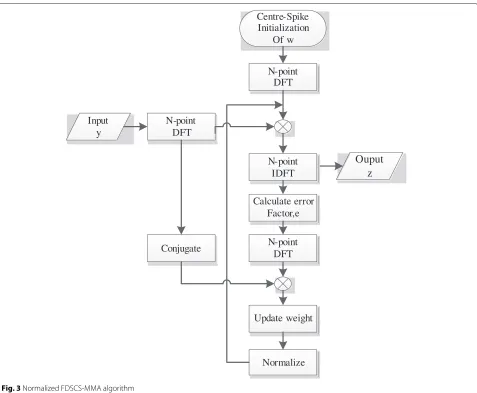
where λis a forgetting factor and is an element-wise division operator. A careful re-ordering of the normalized weight update equation reveals another insightful obser-vation into its effectiveness in improving the equalizer convergence. It is seen that the normalization is tanta-mount to using variable step size in each of the frequency bin which amounts to power control on each bin, and such technique is especially useful in applications where the input level is uncertain or vary widely across the band as noted in [18]. The procedure outlined in this section is repeated to realize normalized FDMMA and normalized FDCMA (NFDMMA) from the equations given in Table 1, and the details of the algorithm are given in Fig. 3.
5 Results and discussion
The algorithms proposed above were investigated by means of computer simulations in MATLAB environ-ment. Specifically, we have evaluated the performance of both frequency domain soft-constraint multimodulus algorithm (FDSCS-MMA) and improved FDSCS-MMA and compared their performance with the well-known
Table 1Blind algorithm equations
Algorithm Cost function Estimation error (e(n))
Fig. 3Normalized FDSCS-MMA algorithm
constant modulus algorithm CMA and its modified ver-sion MMA . In order to simulate multi-user environment, we use transmitter FFT size of 256 equivalent to the total available subcarriers in the system (M), input FFT size for a user is 64 same as the number of subcarriers avail-able for each user (N), and length of CP is 20 samples (P). This makes a total number of four users whose data were transmitted simultaneously.
The MSE convergence curve in decibels was obtained as ensemble average and is plotted as a function of the number of iterations where each iteration represent an SC-FDMA symbol consisting of all the users’ signal for that transmission time. The filter taps are of the order of Nwith center spike initialization. The modulation scheme employed for SCFDMA transmisson is 4 QAM. The local-ized carrier transmission mode is used in LTE uplink since it offers much better performance with the arrangement of pulse-shaping filter. Simulation results are averaged over 100 Monte Carlo iterations and are done for LFDMA
since DFDMA is no longer supported in three GPP LTE standards though a scenario is shown for comparison of both allocation schemes [8, 33]. The values ofR2,R,R2,I,
andλ are 1, 1, and 0.55, respectively. The step size for the equalizers are 4× 10⁻³, 3 × 10⁻³, 3× 10⁻⁴, and 1×10⁻⁴for NFDSCS-MMA, FDSCS-MMA, NFDMMA, and NFDCMA, respectively. The channel considered is frequency selective with six paths and each path fades independently, according to the Rayleigh distribution. A high speed of 360 km/h is used to account for time varia-tion in the channel [34, 35]. The additive white Gaussian noise have been chosen such that the signal to noise ratio (SNR) at the input of the equalizer is 20 dB. SNR of 10 dB is also considered for comparison of low and high SNR performance. The simulation parameters described above are implemented except stated otherwise.
0 1000 2000 3000 4000 5000 −20
−18 −16 −14 −12 −10 −8 −6 −4 −2 0
Iterations
MSE(dB)
IFDMA
LFDMA
Fig. 4MSE curves comparison between IFDMA and LFDMA
speed but LFDMA has been selected as the uplink trans-mission scheme due to its low PAPR over OFDMA in gen-eral and high rate-sum capacity over IFDMA in particular [33].
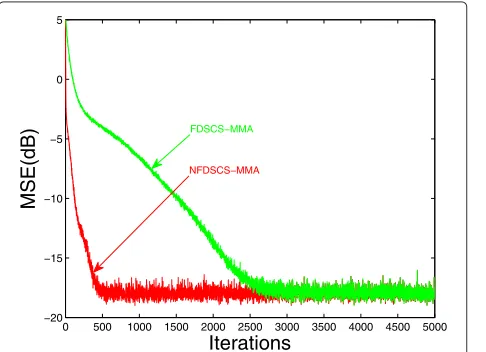
Figure 5 shows performance of NFDSCS-MMA and FDSCS-MMA. The two algorithms achieve the same residual MSE but have different convergence time. It is seen that FDSCS-MMA took a longer time to converge, about 3000 symbols. This slow adaptation is a setback in broadband wireless communication system which typ-ically requires high-speed transmission. The convergence rate was then improved greatly by considering a normal-ization factor leading to NFDSCS-MMA which converges at about 500 symbols. This corresponds to almost 83 % improvement in symbols saving over the algorithm with-out normalization for the same residual MSE. It can be
0 500 1000 1500 2000 2500 3000 3500 4000 4500 5000 −20
−15 −10 −5 0 5
Iterations
MSE(dB)
NFDSCS−MMA
FDSCS−MMA
Fig. 5MSE curves comparison between NFDSCS-MMA and FDSCS-MMA
deducted from the curves in Fig. 5 that the effect of appro-priate normalization is to provide better convergence see-ing that both algorithms achieve the same residual MSE. Based on the preceding discussion, only normalized ver-sions of the blind algorithms proposed in this work are considered in the remaining discussion.
Figures 6 and 7 show MSE convergence comparison between the proposed algorithms for both SNR of 10 and 20 dB, respectively. Normalised versions are con-sidered due to their faster convergence rate compared to unnormalized versions. Normalized FDSCS-MMA achieve fastest MSE convergence rate and lower residual error for the case of low and high SNR. NFDMMA is slightly better than NFDCMA at low SNR while both of them achieve similar MSE performance at high SNR of 20 dB.
Figures 8 shows MSE convergence comparison between the proposed algorithms for long channel impulse responses using the model C in [36] corresponding to a typical large outdoor environments with large delay spread. It is shown that NFDSCS-MMA has the best performance reflecting the robustness of the proposed algorithm while NFDMMA outperformed NFDCMA.
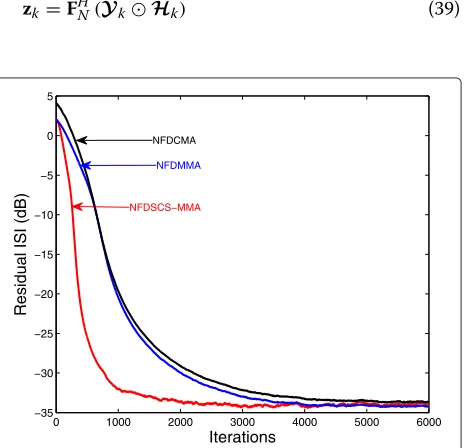
Figures 9 and 10 show the convergence behavior and residual ISI of the proposed algorithms. The residual ISI at the output of the equalizer atnth iteration is given as
ISI(n)=
|s(n)|2− |s(n)|2max |s(n)|2
max
(38)
where s(n) = h(n) ∗w∗(n), s(n) is the overall impulse response of the transmission channel,h(n), and equalizer, w(n).|s(n)|maxis the component with maximum absolute value among all the components of|s(n)|and [∗] denotes convolution.
The results show that all the algorithms are able to remove ISI but NFDSCS-MMA has better convergence
0 500 1000 1500 2000 2500 3000 −12
−10 −8 −6 −4 −2 0 2
Iterations
MSE(dB)
NFDCMA
NFDSCS−MMA
NFDMMA
0 500 1000 1500 2000 2500 3000 3500 4000 4500 5000 −20
−15 −10 −5 0 5
Iterations
MSE(dB)
NFDSCS−MMA NFDMMA
NFDCMA
Fig. 7MSE comparison curves for blind algorithms, SNR = 20 dB
performance than both NFDMMA and NFDCMA. The algorithms achieve same residual ISI but NFDSCS-MMA converges fastest for both low and high SNR scenarios and as a result, gives better performance.
Figures 11 and 12 show the phase recovery capabil-ity of the proposed algorithms for both 16 QAM and 64 QAM, respectively. All the algorithms are able to recover 16-QAM symbol constellation but only NFDMMA and NFDSCS-MMA are able to recover 64-QAM symbol con-stellation. However, NFDSCS-MMA constellation is bet-ter than that of NFDMMA. It is also seen that NFDCMA is not able to correct the phase rotation introduced by the channel characteristics and that both NFDMMA and NFDSCS-MMA do this perfectly. This is due to the fact that both equalizers achieve equalization by forcing both the real and imaginary parts of the equalizer output onto
0 1000 2000 3000 4000 5000
−12 −10 −8 −6 −4 −2 0
Iterations
MSE (dB)
NFDCMA
NFDMMA
NFDSCS−MMA
Fig. 8MSE comparison curves for blind algorithms using channel with long impulse responses, SNR = 20 dB
0 500 1000 1500 2000 2500 3000 3500 4000 −25
−20 −15 −10 −5 0 5
Iterations
Residual ISI (dB)
NFDSCS−MMA
NFDMMA
NFDCMA
Fig. 9Residual ISI convergence curves for blind algorithms, SNR = 10 dB
four-point contours which results in simultaneous blind equalization and carrier phase recovery.
Figure 13 shows the BER performance of both FDSCS-MMA with its normalized version compared to opti-mum equalizers which are miniopti-mum mean square (linear MMSE) and zero forcing equalizers. It should be noted that both linear MMSE and zero forcing equalizers are non-blind channel estimation equalizers meaning that pilot symbols are periodically transmitted to accurately estimate the channel at the receiver. The expression for the output of zero forcing equalizer for thekth received block is given as
zk =FHN(YkHk) (39)
0 1000 2000 3000 4000 5000 6000
−35 −30 −25 −20 −15 −10 −5 0 5
Iterations
Residual ISI (dB)
NFDSCS−MMA NFDCMA
NFDMMA
−400 −200 0 200 400 −400
−200 0 200 400
Real(Inphase)
Imaginary(Quadrature)
Received sequence
−5 0 5
−5 0 5
Real(Inphase)
Imaginary(Quadrature)
NFDCMA Output
−4 −2 0 2 4
−4 −2 0 2 4
Real(Inphase)
Imaginary(Quadrature)
NFDMMA Output
−4 −2 0 2 4
−4 −2 0 2 4
Real(Inphase)
Imaginary(Quadrature)
NFDSCS−MMA Output
Fig. 11Constellation without a carrier offset, 16 QAM
−1000 −500 0 500 1000
−500 0 500 1000
Real(Inphase)
Imaginary(Quadrature)
Received sequence
−10 −5 0 5 10
−10 −5 0 5 10
Real(Inphase)
Imaginary(Quadrature)
NFDCMA Output
−4 −2 0 2 4
−4 −2 0 2 4
Real(Inphase)
Imaginary(Quadrature)
NFDMMA Output
−4 −2 0 2 4
−4 −2 0 2 4
Real(Inphase)
Imaginary(Quadrature)
NFDSCS−MMA Output
0 5 10 15
Fig. 13BER comparison of NFDSCS-MMA and linear MMSE
while that of MMSE is
zk =FHN(YkCk) (40)
BothHk andNk represent the channel response and
noise component for the kth received block. We have assumed perfect knowledge of the channel in our simu-lation of the optimum equalizers. In order to assess the BER performance of NFDSCS-MMA, knowledge of the first two received symbols has also been assumed since SCS-MMA only minimizes the dispersion between real and imaginary parts of the received signal and four-point contours of distance R2. This assumption is required to correct the received signal phase [23] as “blind” in blind equalizers is with respect to the phase; hence, they are said to be blind to the “phase”. It is shown in Fig. 13 that both NFDSCS-MMA and FDSCS-MMA achieve similar BER performance which is slightly less than that of lin-ear MMSE. In situations where blind equalizers are used to open the eye of the signal constellation, a probability of symbol error of 10−2is considered acceptable [29]. From Fig. 13, it is seen that to achieve this acceptable perfor-mance, 8 dB is required for NFDSCS-MMA as compared to that of 7 dB for linear MMSE which is a small tradeoff compare to 14 % improvement in throughput.
6 Conclusions
In this paper, we have implemented a novel frequency domain soft-constraint multimodulus algorithm for single carrier. It is shown that the proposed algorithm outper-forms the popular blind algorithm, CMA and its modified version, MMA in both residual MSE and convergence rate. Phase recovery capability of the proposed algorithm is also demonstrated with acceptable BER performance. This suggests that SC-FDMA can be perfectly equalized in broadband systems using the proposed algorithm with the resultant lower MSE, faster convergence, and improved spectral efficiency.
Competing interests
The authors declare that they have no competing interests.
Acknowledgements
The authors like to thank the anonymous reviewers for their constructive suggestions which have helped improve the paper. The authors acknowledge the support provided by the Deanship of Scientific Research at KFUPM under Research Grant RG1312.
Author details
1Department of Electrical Engineering, King Fahd University of Petroleum and
Minerals, Dhahran, 31261, Saudi Arabia.2Department of Electrical Engineering, University of Texas at Dallas, Richardson, TX 75083, USA.
Received: 27 June 2015 Accepted: 1 February 2016
References
1. JAC Bingham, Multicarrier modulation for data transmission: an idea whose time has come. IEEE Commun. Mag.28(5), 5–14 (1990) 2. K Paterson, Generalized Reed-Muller codes and power control in OFDM
modulation. IEEE Transac. Inf. Theory.46(1), 104–120 (2000)
3. HG Myung, DJ Goodman,Single Carrier FDMA: A New Air Interface for Long Term Evolution. (John Wiley & Sons Inc., New York, NY, 2008)
4. FE Abd El-Samie, FS Al-kamali, AY Al-nahari, MI Dessouky,SC-FDMA for Mobile Communications. (CRC Press Inc, Boca Raton Raton, FL USA, 2013) 5. H Myung, J Lim, D Goodman, Single carrier FDMA for uplink wireless
transmission. IEEE Veh. Technol. Mag.1(3), 30–38 (2006)
6. N Benvenuto, R Dinis, D Falconer, S Tomasin, Single carrier modulation with nonlinear frequency domain equalization: an idea whose time has come again. Proc. IEEE.98(1), 69–96 (2010)
7. C Zhang, Z Wang, Z Yang, J Wang, J Song, Frequency domain decision feedback equalization for uplink SC-FDMA. IEEE Trans Broadcast.56(2), 253–257 (2010)
8. G Huang, A Nix, S Armour. Decision feedback equalization in SC-FDMA, IEEE 19th International Symposium on Personal, Indoor and Mobile Radio Communications, (2008), pp. 1–5
9. S Yameogo, P Jacques, L Cariou. A semi-blind time domain equalization of SCFDMA signal, IEEE International Symposium on Signal Processing and Information Technology (ISSPIT), (2009), pp. 360–365
10. S Yameogo, J Palicot, L Cariou. Blind time domain equalization of SCFDMA signal, IEEE Vehicular Technology Conference, VTC-Fall, (2009), pp. 1–4 11. S Yameogo, J Palicot, inInternational Conference on Consumer Electronics.
Frequency domain equalization of SC-FDMA signal without any reference symbols, (2009), pp. 1–2
12. X Wang. Blind equalization for single carrier frequency domain equalization with low complexity, China-Japan Joint Microwave Conference, (2008), pp. 748–750
13. R Martin, Fast-converging blind adaptive channel-shortening and frequency-domain equalization. IEEE Transac Signal Process.55(1), 102–110 (2007)
15. J-C Lin, Blind equalisation technique based on an improved constant modulus adaptive algorithm. IEE Proc.-Commun.149(1), 45–50 (2002) 16. HG Myung,3GPP Long Term Evolution: A Technical Overview. (John Wiley &
Sons Inc., New York, NY, 2010)
17. K Akande, N Iqbal, A Zerguine, J Chambers, Normalised frequency-domain soft constraint satisfaction multimodulus blind algorithm. Electronics Letters (2015). [Online]. Available: http://digital-library.theiet.org/content/journals/10.1049/el.2015.2845
18. N Bershad, P Feintuch, A normalized frequency domain LMS adaptive algorithm. Acoustics, Speech and Signal Process. IEEE Transact. on.34(3), 452–461 (1986)
19. T-L Kung, K Parhi, English Semiblind frequency-domain timing synchronization and channel estimation for OFDM systems. EURASIP J. Adv. Signal Process.2013(1) (2013). [Online]. Available: http://dx.doi.org/ 10.1186/1687-6180-2013-1
20. S Caekenberghe, A Bourdoux, L der Perre, J Louveaux, Preamble-based frequency-domain joint CFO and STO estimation for oqam-based filter bank multicarrier. EURASIP J. Adv. Signal Process.2014(1), 118 (2014). [Online]. Available: http://asp.eurasipjournals.com/content/2014/1/118 21. S Minhas, P Gaydecki, A hybrid algorithm for blind source separation of a
convolutive mixture of three speech sources. EURASIP J. Adv. Signal Process.2014(1) (2014). [Online]. Available: http://dx.doi.org/10.1186/ 1687-6180-2014-92
22. Y Wang, L DeBrunner, V DeBrunner, D Zhou, Blind channel equalization with colored source based on constrained optimization methods. EURASIP J. Adv. Signal Process.2008(1), 960295 (2008). [Online]. Available: http://asp.eurasipjournals.com/content/2008/1/960295
23. HH Dam, S Nordholm, H Zepernick. Frequency domain constant modulus algorithm for broadband wireless systems, IEEE Global
Telecommunications Conference, GLOBECOM, (2003), pp. 40–44 24. DH Carlson, Review: Philip j. davis, circulant matrices. Bulletin (New Series).
Am. Math. Soc.7(2), 421–422 (1982)
25. J Treichler, C Johnson, MG Larimore,Theory and Design of Adaptive Filters. (Prentice-Hall, Englewood Cliffs, NJ, 2001)
26. D Godard, Self-recovering equalization and carrier tracking in two-dimensional data communication systems. Commun. IEEE Transac. 28(11), 1867–1875 (1980)
27. J Treichler, B Agee, A new approach to multipath correction of constant modulus signals. Acoustics, Speech and Signal Process. IEEE Transac. 31(2), 459–472 (1983)
28. KN Oh, Y Chin. Modified constant modulus algorithm: blind equalization and carrier phase recovery algorithm, IEEE International Conference on Communications, (1995), pp. 498–502
29. J Yang, J-J Werner, G Dumont, The multimodulus blind equalization and its generalized algorithms. Sel. Areas Commun. IEEE J.20(5), 997–1015 (2002)
30. D Falconer, S Ariyavisitakul, A Benyamin-Seeyar, B Eidson, Frequency domain equalization for single-carrier broadband wireless systems. IEEE Commun. Magazine.40(4), 58–66 (2002)
31. C Chan, M Petraglia, J Shynk. Frequency-domain implementations of the constant modulus algorithm, Twenty-Third Asilomar Conference on Signals, Systems and Computers, vol. 2, (1989), pp. 663–669 32. MM Usman Gul, SA Sheikh, Design and implementation of a blind
adaptive equalizer using frequency domain square contour algorithm. Digit. Signal Process.20(6), 1697–1710 (2010)
33. I Ahmed, A Mohamed, I Shakeel. On the group proportional fairness of frequency domain resource allocation in L-SC-FDMA based LTE uplink, IEEE GLOBECOM Workshops (GC Wkshps), (2010), pp. 1312–1317 34. N Iqbal, A Zerguine, N Al-Dhahir, Adaptive equalisation using particle
swarm optimisation for uplink SC-FDMA, Electronics Letters.50(6), 469–471 (2014)
35. N Iqbal, A Zerguine, N Al-Dhahir, Decision feedback equalization using particle swarm optimization. Signal Process.108(C), 1–12 (2015). [Online]. Available: http://dx.doi.org/10.1016/jsigpro.2014.07.030
36. J Medbo, P Schramm, Channel models for HIPERLAN/2 in different indoor scenarios, ETSI/BRAN 3ERI085B (1998)
Submit your manuscript to a
journal and benefi t from:
7 Convenient online submission
7 Rigorous peer review
7 Immediate publication on acceptance
7 Open access: articles freely available online
7 High visibility within the fi eld
7 Retaining the copyright to your article