SuperOCR for ALTA 2017 Shared Task
Yufei Wang
Computer Science and Engineering UNSW, Sydney, Australia
Abstract
This paper describes the SuperOCR sys-tem submitted for the ALTA 2017 shared task, which aims at correcting noisy OCR output for the Trove database. We used heuristic rules and patterns in submitted system and we apply language model to further improve our system. Experiment shows that language model plays an vital role in performance. Surprisingly, a tri-gram language model outperforms LSTM language model in this task.
1 OCR Post-Correction
ALTA 2017 shared task1aims at Optical Charac-ter Recognition (OCR) post-correction for Trove database (Holley, 2010) 2. OCR extracts text from image, allowing further language analysis. However, OCR is inherently error-prone, in par-ticular for old scanned documents. High qual-ity OCR analysis result benefits downstream NLP task, including named entity recognition (NER) (Mac Kim and Cassidy,2015) and information ex-traction (Taghva et al.,2006). In this shared task, given a set of OCR raw-correction pairs, participa-tors are required to build a system to automatically and accurately correct the OCR-ed documents.
Our submitted system achieved averaged F1 score 16.82%, which is2ndbest system. Later, we
further improved our submitted system to 20.72% by using context and weighted OCR error in-formation. However, The wining system had achieved averaged F1 score 32.99%, indicating that our system still has large margin to be im-proved.
Our submitted system mainly targeted in (a) correcting word-level errors, e.g. words with
char-1http://www.alta.asn.au/events/sharedtask2017/description.html 2http://trove.nla.gov.au/
acters being dis-recognized during OCR process, and (b) delete frequent noisy text pattern. For (a), we first filtered out normal words using vocabu-lary list; then we applied correction to those error-like tokens. For (b), we extracted the frequent cor-rected patterns from the aligned documents. The experiment result shows that language model and high-quality vocabulary list are vital to boost per-formance. Surprisingly, a simple tri-gram lan-guage model outperforms a state-of-the-art LSTM language model in selecting candidate words for correction.
This paper is organized as follows: Section 2 profiles data set and OCR errors. Section 3 in-troduces submitted system and improved system. Section 4 shows the experiment result. We sum-marize our finding in Section 5.
2 OCR Documents and Errors
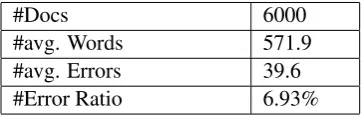
In this section, we first summarize some basic statistics of the OCR documents from this shared task in Table1.
#Docs 6000
#avg. Words 571.9
#avg. Errors 39.6
[image:1.595.326.508.532.590.2]#Error Ratio 6.93%
Table 1: Statistics of Share Task Data
We are also interested in the types of correction made by annotators in this data set. To extract the correction, we first align document pairs and un-aligned words in raw documents are the correc-tions. We characterize them largely based on the vocabulary list used in our final system. We refer words in the list to “in-vocabulary” (IV), other-wise “Out-of-Vocabulary” (OOV). We categorize these corrections into the following types:
OOVs.21.89%
• Single Word Correction: Change an OOV to an IV.18.16%
• Words Deletion: Delete words from OCRed Text.12.79%
• Multiple Words Merge: Merge multiple words into a single IV.8.05%
• Punctuation Transform: Change a punctua-tion to another punctuapunctua-tion.4.52%
• Known Word Correction: Change an IV to another IV.4.18%
• Unknown Word Modify: Change an OOV to another OOV.3.95%
• Character Case: Change the character case of a word.1.44%
• Other: Other Corrections25%
It should be noted that, the correction Single Word Split often splits valid words into two OOVs randomly, for example, randomly modifying “yes-terday” to “yes” and ““yes-terday”; modifying “Aus-tralian” to “Austra” and “lian” etc. We suspect that this is caused by a text processing errors. The correction distribution also shows the diffi-culties of this shared task as only 6.93% of words are modified while majority of words remain un-changed. Even worse, around 25% of errors are multiple words correction, which cannot be solved by checking single words.
Lastly, we analysis the length of the continuous corrected word sequence in the data set. As shown in Table2, around 75% errors are length 1. There-fore, most of OCR errors are not continuous and separated by context words.
Len. 1 2 3 4 5+
% 74.9% 13.2% 5.7% 3.9% 2.3%
Table 2: Error Length Distribution
3 System Description
There are two important factors to consider when designing system:
• Candidate FilteringIn our data, only 6.9% of words are corrected by annotators, which
means that we are facing an imbalanced situ-ation. If we apply correction to every word in document, it will generate a lot of false pos-itive examples. Our intuition is that, a valid word is unlikely to be an error in OCRed text.
• Independent Correction As shown previ-ously, most of errors are isolated by their un-changed context. Correction using sequence modeling may not be helpful as the depen-dency between errors are weak. Therefore, we correct words individually in our system.
Therefore, we design our system as shown in Alg 1. The system includes following post-correction components:
• ProcRawText: Correct frequent errors and split text into tokens.
• Word Filtering: Filtering out most of correct words in OCRed text.
• Correction: Correct an OOV word into a non-OOV word.
• ProcessKnownWord: Correct a non-OOV word to another non-OOV word.
Both of our systems follow the above frame-work and they only differ in strategies used in each component.
Algorithm 1:System Framework Data:OCRed Text
W ordList= ProcRawText(OCR T ext); CreateCorrectedList;
foreachw2W ordListdo
ifwshould be Correctedthen
w= Correction(w); else
w= ProcessKnownWord(w); AddwToCorrectedList; returnTextJoin(CorrectedList) ;
3.1 Submitted System
In our submitted system, we mainly used heuristic rules and patterns obtained from training data to correct text.
1. Deleting a set of errors patterns with format “-* ” and “- * ” where “*” stands for one of “< ⇤ > i j : ? ! 1 ; l”. These patterns are the most frequent deleted error sequences in training pairs. Interestingly, these pat-terns often result in valid words being split-ted and their character shapes are similar to each other. So these errors may be caused by similar noise in image input.
2. Splitting text based on white space and re-moving length one tokens except for “a” and “A”. These length one tokens tend to be noise in the data set. Although “I” is indeed a valid word, our experiment result shows that there are much more noisy “I” than the valid one. So, we remove it as well.
3. the leading and following non-alphabet char-acters are removed from each word except for the following punctuation “.” and “,”. We skip numbers and punctuation in this step.
InW ord F ilteringpart, we constructed a vo-cabulary list by merging the most frequent 15000 words from corrected OCR documents in training data and most frequent words 10000 from 1 Bil-lion Word Language Model Benchmark3. Given the vocabulary list, OOVs or words with most three non-alphabet characters (words with four or more non-alphabet characters are too noisy to be corrected) are selected as correction target. All other words remain unchanged.
InCorrectionpart, we extracted frequent sin-gle correction pairs in training data (e.g. “tne”) “the”). If a candidate matched one of the pairs, we would correct it. Otherwise, we exhaustively searched for words in vocabulary list that are k edit distance from the correction target. We refer these two methods as word-level correctionand exhaustive correction respectively. Finally, we will correct the character case based on the origi-nal word shape.
We skipped P rocessKnownW ord stage in our submitted system.
3.2 Language model enhanced System This system was submitted after the shared task. Following (Tursun and Cakici,2017), we used tri-gram KenLM (Heafield et al., 2013) 4 language
3http://www.statmt.org/lm-benchmark/ 4https://github.com/kpu/kenlm
model. Experiment result shows that tri-gram lan-guage model is sufficient for this task. To train the language model, we used the corrected documents in training data and lower-cased all words before the training. Intuitively, language model would capture the context information and therefore, it is helpful when we rank the correction candidate.
InP rocRawT extpart, we still used strategy 1 and 2 in submitted system. However, we changed the tokenization method to the one used in the pro-vided evaluation script. This method splits punc-tuation from words and provides better boundaries between words and punctuation, but, this could potentially lead to inappropriate punctuation split in noisy text. For example, given noisy word “-Mr.” whose ground truth of is ““-Mr.”, our method splits it into “-Mr” and “.”, making it impossible to merge the punctuation back. To tackle this issue, we collected the frequent cases from training data to correct the errors before tokenization.
In W ord F iltering part, we constructed the vocabulary list by combining non-singleton words that are no shorter than 5 in training corrected text and words that are no longer than 4 in 1 Billion Language model benchmark.
In Correction part, we additionally applied character error information to suggest correction candidates. We first extracted all Single Word Correction pairs (18.16% of all errors) and then aligned each of them in character level. We refer this as character-level correction. Besides, we corrected an OOV by merging or splitting if we can obtain IVs.
To combine both language model and word/char transformation information, we applied “Noisy Channel Model” (Mays et al.,1991) to select op-timal candidates. Formally, we tried to find the optimal wordcfor correction targetwsuch that it maximizeP(c|w), as shown in1:
arg min
c P r(w|c)⇤P r(c) (1)
whereP r(c)is the language model score
indicat-ing how likely it should be there given the context; while P r(w|c) is the error model indicating how
trans-formation have not been considered here.
Given a word, its context window and candi-dates list, (a) we calculated the language model score for all candidates and original word, with context, which is a window with size of 5, which includes itself and its previous and following two context words. Candidates words that receive higher score than original word are chosen for comparison using above model. If no candidate words get higher score than the original word, we remained original word unchanged.
InP rocessKnownW ord, our improved model applied known word transformation correction by using the frequent patterns in training data. If a known word was found in the patterns, we used the above Noisy Channel Model to decide if we should make correction.
4 Experiment Result and Discussion In this section, we show two performance mea-sure, the randomly sampled development set (Dev.) and final test set (Test.) performance for our systems. During system development, we split provided documents into 5500 documents for training and 500 documents for validation. The performance is shown in Table3.
System Dev. Test.
Sub Sys. 17.72% 16.82%
LM-Imprved Sys. 20.68% 20.72%
Table 3: Performance for both System
Table 3 shows that the language model boosts system performance by around 4%. Addition-ally, our new system no longer suffered from over-fitting as the submitted system did. This indicates that the context information provided by language model surpassed hand-crafted rules in earlier sys-tem.
4.1 Ablation Study
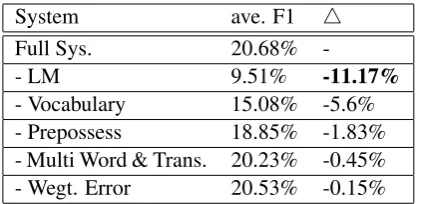
To show the effectiveness of each components, an ablation study is conducted for our final system in this section. Note that all reported performance is based on development data set.
Table4shows that language model is the most vital component in the system. This shows the importance of context modeling components for spelling correction task. In addition, the contribu-tion of the vocabulary list cannot be neglected. We manually investigated the vocabulary of corrected
System ave. F1 4
Full Sys. 20.68%
-- LM 9.51% -11.17%
- Vocabulary 15.08% -5.6% - Prepossess 18.85% -1.83% - Multi Word & Trans. 20.23% -0.45% - Wegt. Error 20.53% -0.15%
Table 4: Ablation Performance. LM: Set lan-guage model score to be 1.0; Vocabulary: Only using words in corrected training data; Prepos-sess: Disable patterns and word cleaning in begin-ning;Multi Word & Trans: No word merge split and known word trans correction; Wegt. Error: Removing the Error Model, all weights for correct candidates are 1.0.
OCR text and found that low frequent words tend to be noisy. Many of these low frequent words should have been corrected during the annotation process. This indicates that the quality of training data needs to be improved.
4.2 Optimal Language Model
In our final system, we used a tri-gram tradi-tional language model. Will higher order language model or advanced neural model continuously im-prove the performance? We conduct an experi-ment regarding the order of language model in this section.
In this experiment, we applied a language model based on LSTM (Hochreiter and Schmid-huber, 1997). Comparing with transitional lan-guage model, LSTM lanlan-guage model can be viewed as 1-order because LSTM can capture long-range dependent information using the cell and hidden information (Hochreiter and Schmid-huber,1997). In our experiment, we used the ten-sorflow implementation 5 of (Kim et al., 2016). We did not change the default parameter setting in the source code as they are optimized based on En-glish Penn Treebank (PTB)(Marcus et al.,1993). We used the corrected documents with the same text prepossess technologies as we train KenLM. We also experimented with uni-, bi-, 4-, 5-, 6-gram KenLM for comparsion. Note that, we used LSTM language model in the same way as we use KenLM.
The performance for different language models
5
[image:4.595.312.523.61.163.2]are shown in Fig. 4.2. As the result show, bi-and tri-gram language models have already pro-vided satisfying performance. Higher order lan-guage model even slightly decrease performance by 0.1%. Surprisingly, the LSTM-based language model dramatically decrease the performance by over 5%. During the LSTM model training, we monitored average perplexity over development set. The final model performance is around 80 per-plexity which is a reasonable performance com-pared with (Kim et al., 2016), showing no over-fitting in model training. We argue that two possi-ble reasons could explain this:
1. The training data for neural networks is too noisy. It has been shown that neural net-works cannot work well when training on noisy data. (Natarajan et al.,2013)
2. In the task of OCR post-correction, correct-ing errors only require nearby words, rather than long-dependency information would provide noisy information.
We can conclude that bi- and tri-gram language model are the optimal choice for OCR post-correction task.
0 1 2 3 4 5 6 1
5 10 15 20 25
Order
A
ve.
F1
Effect of Language Model’s Order
5 Conclusion
We applied heuristic rule and patterns to the task of OCR post-correction. We further apply lan-guage model to boost the performance. Our sys-tem finally achieve average F1 score 20.68%, a 2nd score in all submitted systems.
Experi-ment result suggest that 3-order language model is more capable in modeling context information than state-of-the-art LSTM-based language model when ranking correction candidates.
Acknowledgments
We would like to thank Prof. Wei Wang for discus-sion, Dr. Stephen Wan and Dr. Diego Moll-Aliod for their time in proofreading this paper. We would also like to thank the organizers of the shared task for their support.
References
Kenneth Heafield, Ivan Pouzyrevsky, Jonathan H. Clark, and Philipp Koehn. 2013. Scalable modi-fied Kneser-Ney language model estimation. In Pro-ceedings of the 51st Annual Meeting of the Associa-tion for ComputaAssocia-tional Linguistics.
Sepp Hochreiter and J¨urgen Schmidhuber. 1997. Long short-term memory. Neural computation 9(8):1735–1780.
Rose Holley. 2010. Trove: Innovation in access to in-formation in australia. Ariadne(64).
Yoon Kim, Yacine Jernite, David Sontag, and Alexan-der M Rush. 2016. Character-aware neural language models. InThirtieth AAAI Conference on Artificial Intelligence.
Sunghwan Mac Kim and Steve Cassidy. 2015. Find-ing names in trove: Named entity recognition for australian historical newspapers. InProceedings of the Australasian Language Technology Association Workshop 2015. pages 57–65.
Mitchell P Marcus, Mary Ann Marcinkiewicz, and Beatrice Santorini. 1993. Building a large annotated corpus of english: The penn treebank. Computa-tional linguistics19(2):313–330.
Eric Mays, Fred J Damerau, and Robert L Mercer. 1991. Context based spelling correction. Informa-tion Processing & Management27(5):517–522.
Nagarajan Natarajan, Inderjit S Dhillon, Pradeep K Ravikumar, and Ambuj Tewari. 2013. Learning with noisy labels. InAdvances in neural information pro-cessing systems. pages 1196–1204.
Kazem Taghva, Russell Beckley, and Jeffrey Coombs. 2006. The effects of ocr error on the extraction of private information. InDocument Analysis Systems. Springer, volume 3872, pages 348–357.