Aligning parallel texts with InterText
Pavel Vondˇriˇcka
Institute of the Czech National Corpus, Charles University in Prague Faculty of Arts, n´am. J. Palacha 2, CZ-11638 Praha 1, Czech Republic
Abstract
InterText is a flexible manager and editor for alignment of parallel texts aimed both at individual and collaborative creation of parallel corpora of any size or translational memories. It is available in two versions: as a multi-user server application with a web-based interface and as a native desktop application for personal use. Both versions are able to cooperate with each other. InterText can process plain text or custom XML documents, deploy existing automatic aligners and provide a comfortable interface for manual post-alignment correction of both the alignment and the text contents and segmentation of the documents. One language version may be aligned with several other versions (using stand-off alignment) and the application ensures consistency between them. The server version supports different user levels and privileges and it can also track changes made to the texts for easier supervision. It also allows for batch import, alignment and export and can be connected to other tools and scripts for better integration in a more complex project workflow.
Keywords:parallel corpora, alignment, editor
1.
What is InterText?
InterTextis a post-alignment editor for aligned parallel texts and a user interface to existing automatic alignersHunalign
(Varga et al., 2005) and TCA21 (Hofland, 1996; Hofland and Johansson, 1998; Vondˇriˇcka, 2010).
InterText has been developed for the project InterCorp
( ˇCerm´ak and Rosen, 2012; Rosen and Vavˇr´ın, 2012; Kˇren et al., 2011), a project of translational parallel corpora in-cluding more than 30 languages, where nearly 200 external partners cooperate on collecting and aligning thousands of texts for the main, high-quality core of the parallel corpus requiring manual verification. But the tool has been devel-oped with flexibility in mind and thus it can be used for several other purposes, including small personal projects or creation of translational databases. It has already been used in several other research projects world-wide, provid-ing useful feedback.
The name InterText today refers to two slightly different and fully independent software applications: a server based text management system with web-based editor interface, calledInterText server, and a newly developed stand-alone personal desktop application calledInterText editor. Both applications are also able to cooperate with each other, if required. They are both publicly available as open-source software and include a detailed documentation.
2.
The need for a new tool
The extraordinary extend of the InterCorpproject – both in the number of texts, languages and participators – puts extraordinary demands on its management and therefore on software tools as well. Scalability and robustness are among the most self-evident, but unfortunately not the most common qualities of existing tools. From the beginning, the workflow in the project has suffered from technical issues arising from deficiencies of the technically obsolete aligner toolParaConc(Barlow, 1992), especially when combined
1
A modified command-line version ofTCA2is required.
with limited technical skills of the collaborators, who are mostly linguists or translation scholars. Although Para-Concoffers additional value as a concordancer, it cannot treat Unicode and XML files correctly. In addition, it can-not generate stand-off alignment2and is limited to the MS Windows platform only. The need for the use of stand-off alignment became quickly evident, as well as the need for separation of the editors from the technical aspects of dealing with XML files directly. At this stage, the texts were exposed to unexpected corruptions leading to com-plications with batch-processing and automatization of the subsequent processes (tagging and conversion into the in-ternal format of the corpus search engine).
No other equivalent tool has been found, except for the
TCA2 aligner. But TCA2 did not receive much attention from theInterCorpteam, because it is an interactive aligner with relatively slow processing of texts with long sentences. The idea of manual post-alignment corrections (as known fromParaConc) seemed more user-friendly and effective. In addition, TCA2did not address another important de-ficiency ofParaConc: no possibility to fix typos or other defects in the texts, being still frequently discovered in this late phase of text processing.
Development ofInterTexthelped to solve all the mentioned problems. Now, the external collaborators only deliver proof-read texts to the project’s technical administrator, who proceeds with automatic segmentation of the text into sentences and imports it intoInterText.InterTextruns an au-tomatic aligner and makes the aligned pair of texts available to the external editor through the user interface for manual verification of the alignment and for further corrections (see
2Stand-off alignment is stored separately from the original text
figure 13).
Source text
Proofreading & cleaning
Segment & XML form
InterText
hunalign tag
Search engine External co-workers, students, users, etc.
Institute of the Czech National Corpus
Figure 1: The task ofInterText serverin the current work-flow in theInterCorpproject.
The system ensures text and alignment consistency and keeps a log of all changes made to the text, so that they can be checked and possibly reverted in case of editor’s misunderstanding of the process or project standards. In-terTextis also able to keep consistency across several in-dependent alignments of one and the same text, when the editor changes segmentation of the text (in case a wrong segmentation into sentences is discovered).
The manual alignment in projectInterCorpis limited to the level of sentences, but InterText is able to align texts on any level. However, the alignment is always limited to one level only and currently – for practical reasons4– to linear alignment.
3.
InterText server
InterTexthas been first developed as a web-based tool run-ning in PHP on top of a MySQL database on a central server. Therefore it is calledInterText (web) server, now. It was connected to a previously existing bibliographical database of texts and database of editors engaged in the project InterCorp. Because of the specificity of the bib-liographical database, it is not part of the publicInterText
distribution.
InterTextis able to make use of three levels of users: project administrators, sub-project (e.g. language) coordinators (supervisors), and editors, and it can limit their access priv-ileges in an appropriate way. But the behaviour ofInterText
can be configured beyond the specifics of the project In-terCorp in quite many aspects. For example,InterText is able to create and edit arbitrary alignments between differ-ent language versions of one text, while projectInterCorp
is currently aligning all language versions with the Czech language version, used as the “pivot language”. InterText
3The scheme does not show a separate bibliographical
database, where all metadata about the texts are stored and re-trieved again for the resulting corpus.
4
Cross-alignment (or out-of-order alignment) of elements does not pose a technical problem for the architecture ofInterText, but it would put a strain both on the usability of the user interface and the usability of the resulting alignment, which would not be acceptable for most other currently used corpus tools
also provides a special permission for disabling changes to the segmentation in pivot texts generally, while pivot texts can be defined by virtue of a regular expression matching the version name. Basic editing permissions (editing the texts generally and changing the segmentation of the pivot version specifically) can be individually set for particular alignments as needed.
InterText servercan import virtually any custom XML doc-ument in any encoding (and thus any language5), run an automatic aligner6 on the textual contents of two arbi-trarily selected language versions of one text, and make the alignable text contents7available to the selected editor and supervisor for corrections and editing. The automatic aligner can later be (re)applied again to just a part of the alignment, if necessary.8
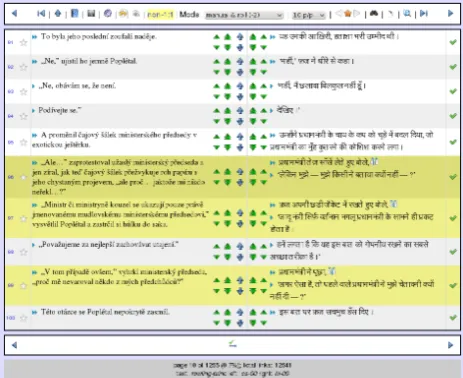
Figure 2:InterText server– editor interface showing paral-lel texts in Czech and Hindi (all control buttons shown).
The interface has a form of a table with two main columns corresponding to the two language versions (see figure 2), and each row corresponding to one segment of aligned tences. Each table cell then contains any number of sen-tences belonging to the particular segment. The editor can freely move sentences between table rows (and thus seg-ments), insert new rows or merge existing ones.
In order to help the user to focus on the most problematic places, the interface can highlight rows (segments) contain-ing another amount of sentences than in the most common
5
Web browsers still may have difficulties displaying punctua-tion correctly in right-to-left scripts.
6
CurrentlyhunalignorTCA2. Both aligners may be installed with several configurations (depending on languages aligned) which may be chosen ad-hoc by the user ofInterTextin the form of “profiles”.
7
The user can define which XML elements contain alignable text units (for each XML file separately).
8
ratio 1:1 – those are the segments containing most errors from the automatic alignment. Segments can also be visu-ally (book)marked for later revision (e.g. by the supervi-sor).
The system can automatically follow the verification pro-cess as the editor is progressively checking and fixing the alignment: when any change is done to the alignment, In-terTextcan automatically change the status of all preceding segments to “manually verified” (or “confirmed”), and so the editor can anytime stop his work and later easily find the place where his job was interrupted.
The editor may (if permitted by his supervisor or admin-istrator) open the contents of the single text elements and edit them. It is also possible to split or merge the sentences. All changes to the text contents are tracked and for each sentence a change-log is available for later revision, show-ing who and when did a change to the contents (see figure 3). This is especially important for larger projects where several editors may change a text (language) version taking part in several alignments (commonly the “pivot version”).
Figure 3:InterText server– editor interface detail showing the history of changes of one element in a Macedonian text.
InterText also cares for parent elements (“containers”) of the alignable text elements: it means that when aligning sentences in a standard text, the user can see also where paragraphs start, and the paragraphs can also be split or merged if necessary.
A basic search functionality is available as well. It can be used to search both for text, sentences by their iden-tifier, changed (edited) sentences and for special types of segments in the alignment.9 Regular expressions are also supported in the text search.
For the purpose of text and alignment management, Inter-Textalso keeps track of the status of each alignment: it can be “open” for changes or reserved by a “remote editor” (see below), it can be marked as “finished” when ready for the inclusion into the final corpus, or it can be “closed” by the administrator (or “blocked” for some other reason). Exter-nal scripts (or “triggers”) can be automatically run when the status of some alignment is changed by a user and they may also check and decide whether the text or alignment fulfils some particular formal criteria and whether its status really can be changed. The triggers may also initiate fi-nancial clearing of the finished job and eventually start fur-ther processing of the texts – export, tagging, conversion to
9Segments with missing text in one or the other version (n:0 or
0:n) or non-trivial segments (other than 1:1).
the final format or even automatic inclusion into the corpus repository.
An additional set of command-line scripts is available for external control (scripting) and especially for easy batch import and export of texts and their alignments. While the PHP scripts cannot be used as any kind of library in third-party applications, they can be easily run from command-line or from other scripts or applications in order to auto-matically trigger actions such as import or export of texts or creating initial automatic alignments between imported language versions.
InterText editoris provided with a thorough user-guide (in English and Czech) in the form of an integrated web page.
4.
InterText editor
The personal desktop applicationInterText editorhas been lately developed both as an external editor for InterText server, overcoming the limitations of an on-line, web-based editor, and as an independent, standalone alignment edi-tor for purely personal projects. It implements most of the functionality of InterText server, except for the user-level and permission system, the command line scripts and the log of changes. On the other hand, it offers more comfort-able and faster operation using both mouse and keyboard, undo and redo functionality and full search and replace ca-pability. It also allows for a more detailed customization of the interface. It uses the Qt framework and it is thus avail-able for most common platforms:10 MacOS X, Linux(and otherPOSIXsystems) andMS Windows.
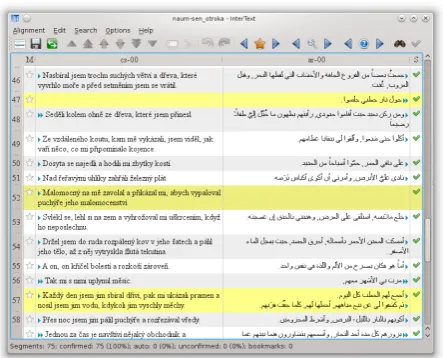
Figure 4:InterText editor– editor interface showing paral-lel texts in Czech and Arabic.
InterText editor is able to download texts and alignments from anInterText server(see figure 5).11 While the align-ment itself is locked for changes on the server12 until explicitly released from the (remote) application again,
10The latest versions of Qt open the potential to possibly
sup-port mobile platforms (AndroidandiOS) as well.
11Upload of new alignments to the server is actually also
sup-ported, if permitted by the administrator of theInterText server.
12
changes to the text contents may still be done on the server (e.g. when the same text is part of some other alignment) – such changes are tracked and may be synchronized with the local copy inInterText editor. In that way, the remote user can stay informed about possible changes in the text resulting from other people’s work, and both the text and the alignment can be worked on when off-line. The result (or its current state) may be submitted back to the server anytime when the remote user gets on-line, until the align-ment is finally released from the remote application.
Figure 5: InterText editor – dialog showing list of align-ments available on a remoteInterText serverand their dif-ferent state of synchronziation with the local repository.
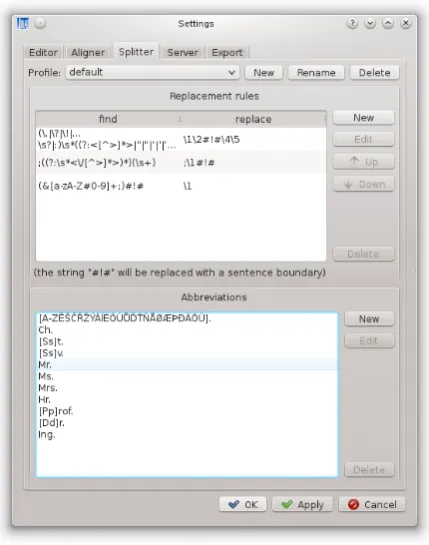
As already mentioned, InterText editor is also targeted at individual use by linguists with limited technical skills and without any need to install InterText server and to run a large centralized project with multiple users. It can thus import plain text files or unsegmented XML documents and apply a basic rule-based (fully configurable, see figure 6) sentence splitter on them. It can also import newline-aligned plain text files. Export of texts is fully customizable by the user and predefined configurations include export of new-line aligned texts, ParaConc semi-XML files and basic TMX13files.
The application can also compute direct alignment between two language versions of one text that are already indirectly aligned via a third common language version.
InterText editor is provided with a comprehensive user-guide (in English) in PDF, explaining also the most impor-tant basic principles of text alignment and common caveats for inexperienced editors.
5.
Aims of further development
Both versions ofInterTextare being continuously improved and extended within theInterCorpproject. The goal is to13TMX stands forTranslation Memory eXchange, a
standard-ized XML-based format commonly used by translational memo-ries and other CAT (Computer-Aided/Assisted Translation) appli-cations or machine translation tools.
Figure 6: Sentence splitter can have several profiles config-ured as sets of replacement rules based on regular expres-sions and exceptions (“abbreviations”).
further improve the usability, flexibility, scalability and ro-bustness (especially of the personal application InterText editor), in order to make it more and more user-friendly and useful both within the InterCorpproject and for as many other similar purposes as possible, beyond the demands of the project itself. The tool is meant to generally help lin-guists and translation scholars (or translators) with various tasks related to alignment of texts, which are otherwise dif-ficult without deeper technical skills. However, no applica-tion can offer both full flexibility and simplicity at the same time. Therefore, the user may often be in need to adapt var-ious aspects of the software by means of configuring it for his own particular purpose. Improving configurability and a detailed documentation is thus also a priority.
Of course,InterTextcannot solve all problems of complex document processing: it cannot replace fully-fledged text editors nor complex XML editors. It cannot solve e.g. the confusion based on the existence of different historical text encodings and formats used in computers for different text documents in different languages. It does not try to reinvent the automatic aligners or other existing sophisticated tools, but it wants to provide a friendlier user interface to these tools for technically unskilled users. It also wants to inte-grate the different tools related to the creation of parallel texts and corpora.