Loosely Tree-Based Alignment for Machine Translation
Daniel Gildea University of Pennsylvania
Abstract
We augment a model of translation based on re-ordering nodes in syntactic trees in order to allow alignments not conforming to the original tree structure, while keep-ing computational complexity polynomial in the sentence length. This is done by adding a new subtree cloning operation to either tree-to-string or tree-to-tree align-ment algorithms.
1 Introduction
Systems for automatic translation between lan-guages have been divided into transfer-based ap-proaches, which rely on interpreting the source string into an abstract semantic representation from which text is generated in the target lan-guage, and statistical approaches, pioneered by Brown et al. (1990), which estimate parameters for a model of word-to-word correspondences and word re-orderings directly from large corpora of par-allel bilingual text. Only recently have hybrid approaches begun to emerge, which apply prob-abilistic models to a structured representation of the source text. Wu (1997) showed that restrict-ing word-level alignments between sentence pairs to observe syntactic bracketing constraints signif-icantly reduces the complexity of the alignment problem and allows a polynomial-time solution. Alshawi et al. (2000) also induce parallel tree struc-tures from unbracketed parallel text, modeling the generation of each node’s children with a finite-state transducer. Yamada and Knight (2001) present an
algorithm for estimating probabilistic parameters for a similar model which represents translation as a se-quence of re-ordering operations over children of nodes in a syntactic tree, using automatic parser out-put for the initial tree structures. The use of explicit syntactic information for the target language in this model has led to excellent translation results (Ya-mada and Knight, 2002), and raises the prospect of training a statistical system using syntactic informa-tion for both sides of the parallel corpus.
Tree-to-tree alignment techniques such as prob-abilistic tree substitution grammars (Hajiˇc et al., 2002) can be trained on parse trees from parallel treebanks. However, real bitexts generally do not exhibit parse-tree isomorphism, whether because of systematic differences between how languages ex-press a concept syntactically (Dorr, 1994), or simply because of relatively free translations in the training material.
providing a sort of hybrid between tree-based and unstructured, IBM-style models.
We first present the tree-to-string model, followed by the tree-to-tree model, before moving on to align-ment results for a parallel syntactically annotated Korean-English corpus, measured in terms of align-ment perplexities on held-out test data, and agree-ment with human-annotated word-level alignagree-ments.
2 The Tree-to-String Model
We begin by summarizing the model of
Yamada and Knight (2001), which can be thought of as representing translation as an Alexander Calder mobile. If we follow the process of an English sentence’s transformation into French, the English sentence is first given a syntactic tree representation by a statistical parser (Collins, 1999). As the first step in the translation process, the children of each node in the tree can be re-ordered. For any node withm children,m!re-orderings are possible, each of which is assigned a probability Porder conditioned on the syntactic categories of
the parent node and its children. As the second step, French words can be inserted at each node of the parse tree. Insertions are modeled in two steps, the first predicting whether an insertion to the left, an insertion to the right, or no insertion takes place with probability Pins, conditioned on
the syntactic category of the node and that of its parent. The second step is the choice of the inserted word Pt(f|NULL), which is predicted without any conditioning information. The final step, a French translation of each original English word, at the leaves of the tree, is chosen according to a distributionPt(f|e). The French word is predicted conditioned only on the English word, and each English word can generate at most one French word, or can generate a NULL symbol, representing deletion. Given the original tree, the re-ordering, insertion, and translation probabilities at each node are independent of the choices at any other node. These independence relations are analogous to those of a stochastic context-free grammar, and allow for efficient parameter estimation by an inside-outside Expectation Maximization (EM) algorithm. The computation of inside probabilities β, outlined below, considers possible reordering of nodes in the
original tree in a bottom-up manner: for all nodesεiin input treeTdo
for allk, lsuch that1< k < l < Ndo
for all orderingsρof the childrenε1...εmofεido for all partitions of spank, lintok1, l1...km, lmdo
β(εi, k, l)+=Porder(ρ|εi)Qmj=1β(εj, kj, lj) end for
end for end for end for
This algorithm has computational complexity O(|T|Nm+2), wheremis the maximum number of children of any node in the input tree T, and N the length of the input string. By storing partially completed arcs in the chart and interleaving the in-ner two loops, complexity ofO(|T|n3m!2m)can be achieved. Thus, while the algorithm is exponential inm, the fan-out of the grammar, it is polynomial in the size of the input string. Assuming|T|=O(n), the algorithm isO(n4).
The model’s efficiency, however, comes at a cost. Not only are many independence assumptions made, but many alignments between source and target sen-tences simply cannot be represented. As a minimal example, take the tree:
A
B
X Y
Z
S
VP
NP
NNC
NNC
Kyeo-ul PAD
e
PAU
Neun
VP
NP
NNC
NNC
Su-Kap PCA
eul
VP
NP
NNU
Myeoch
NNX
NNX
Khyeol-Re XSF
Ssik
VP
NP
NNC
Ci-Keup
LV
VV
VV
Pat
EFN
Ci S
VP
VP
VP
VP
NP
NNC
Ci-Keup NULL
LV
VV
VV
Pat NULL
EFN
Ci NULL
NP
NNU
Myeoch how
NNX
XSF
Ssik many
NNX
Khyeol-Re pairs
NP
NNC
NNC
Su-Kap gloves
PCA
eul NULL
NP
VP
LV
VV
VV
Pat each
EFN
Ci you
NP
NNC
Ci-Keup issued
NNC
PAD
e in
PAU
Neun NULL
NNC
[image:3.612.81.547.185.553.2]Kyeo-ul winter
sentences may break down completely. 2.1 Tree-to-String Clone Operation
In order to provide some flexibility, we modify the model in order to allow for a copy of a (translated) subtree from the English sentences to occur, with some cost, at any point in the resulting French sen-tence. For example, in the case of the input tree
A
B
X Y
Z
a clone operation making a copy of node 3 as a new child of B would produce the tree:
A
B
X Z Y
Z
This operation, combined with the deletion of the original node Z, produces the alignment (XZY) that was disallowed by the original tree reorder-ing model. Figure 1 shows an example from our Korean-English corpus where the clone operation al-lows the model to handle a case of wh-movement in the English sentence that could not be realized by any reordering of subtrees of the Korean parse.
The probability of adding a clone of original node εi as a child of node εj is calculated in two steps: first, the choice of whether to insert a clone under εj, with probability Pins(clone|εj), and the choice
of which original node to copy, with probability
Pclone(εi|clone= 1) = PPmakeclone(εi) kPmakeclone(εk)
where Pmakeclone is the probability of an original node producing a copy. In our implementation, for simplicity,Pins(clone)is a single number, estimated
by the EM algorithm but not conditioned on the par-ent nodeεj, and Pmakecloneis a constant, meaning
that the node to be copied is chosen from all the nodes in the original tree with uniform probability.
It is important to note thatPmakeclone is not
de-pendent on whether a clone of the node in ques-tion has already been made, and thus a node may be “reused” any number of times. This indepen-dence assumption is crucial to the computational tractability of the algorithm, as the model can be
estimated using the dynamic programming method above, keeping counts for the expected number of times each node has been cloned, at no increase in computational complexity. Without such an assump-tion, the parameter estimation becomes a problem of parsing with crossing dependencies, which is ex-ponential in the length of the input string (Barton, 1985).
3 The Tree-to-Tree Model
The tree-to-tree alignment model has tree transfor-mation operations similar to those of the tree-to-string model described above. However, the trans-formed tree must not only match the surface string of the target language, but also the tree structure as-signed to the string by the treebank annotators. In or-der to provide enough flexibility to make this possi-ble, additional tree transformation operations allow a single node in the source tree to produce two nodes in the target tree, or two nodes in the source tree to be grouped together and produce a single node in the target tree. The model can be thought of as a synchronous tree substitution grammar, with proba-bilities parameterized to generate the target tree con-ditioned on the structure of the source tree.
The probability P(Tb|Ta) of transforming the source tree Ta into target tree Tb is modeled in a sequence of steps proceeding from the root of the target tree down. At each level of the tree:
1. At most one of the current node’s children is grouped with the current node in a single
ele-mentary tree, with probabilityPelem(ta|εa ⇒
children(εa)), conditioned on the current nodeεa and its children (ie the CFG produc-tion expandingεa).
2. An alignment of the children of the current elementary tree is chosen, with probability Palign(α|εa⇒children(ta)). This alignment
In the final step of the process, as in the tree-to-string model, lexical items at the leaves of the tree are translated into the target language according to a distributionPt(f|e).
Allowing non-1-to-1 correspondences between nodes in the two trees is necessary to handle the fact that the depth of corresponding words in the two trees often differs. A further consequence of allowing elementary trees of size one or two is that some reorderings not allowed when reordering the children of each individual node separately are now possible. For example, with our simple tree
A
B
X Y
Z
if nodes A and B are considered as one elementary tree, with probabilityPelem(ta|A ⇒BZ), their col-lective children will be reordered with probability Palign({(1,1)(2,3)(3,2)}|A⇒XYZ)
A
X Z Y
giving the desired word ordering XZY. However, computational complexity as well as data sparsity prevent us from considering arbitrarily large ele-mentary trees, and the number of nodes considered at once still limits the possible alignments. For ex-ample, with our maximum of two nodes, no trans-formation of the tree
A
B
W X
C
Y Z
is capable of generating the alignment WYXZ. In order to generate the complete target tree, one more step is necessary to choose the structure on the target side, specifically whether the elementary tree has one or two nodes, what labels the nodes have, and, if there are two nodes, whether each child at-taches to the first or the second. Because we are ultimately interested in predicting the correct target string, regardless of its structure, we do not assign probabilities to these steps. The nonterminals on the target side are ignored entirely, and while the align-ment algorithm considers possible pairs of nodes as elementary trees on the target side during training,
the generative probability model should be thought of as only generating single nodes on the target side. Thus, the alignment algorithm is constrained by the bracketing on the target side, but does not generate the entire target tree structure.
While the probability model for tree transforma-tion operates from the top of the tree down, prob-ability estimation for aligning two trees takes place by iterating through pairs of nodes from each tree in bottom-up order, as sketched below:
for all nodesεain source treeTain bottom-up order do
for all elementary treestarooted inεado
for all nodesεbin target treeTbin bottom-up order do
for all elementary treestbrooted inεbdo
for all alignmentsαof the children oftaandtbdo
β(εa, εb) +=
Pelem(ta|εa)Palign(α|εi)Q(i,j)∈αβ(εi, εj) end for
end for end for end for end for
The outer two loops, iterating over nodes in each tree, require O(|T|2). Because we restrict our el-ementary trees to include at most one child of the root node on either side, choosing elementary trees for a node pair isO(m2), wheremrefers to the max-imum number of children of a node. Computing the alignment between the2m children of the elemen-tary tree on either side requires choosing which sub-set of source nodes to delete,O(22m), which subset of target nodes to insert (or clone),O(22m), and how to reorder the remaining nodes from source to target tree,O((2m)!). Thus overall complexity of the algo-rithm isO(|T|2m242m(2m)!), quadratic in the size of the input sentences, but exponential in the fan-out of the grammar.
3.1 Tree-to-Tree Clone Operation
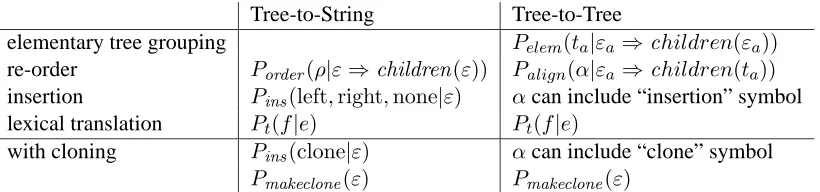
Tree-to-String Tree-to-Tree
elementary tree grouping Pelem(ta|εa⇒children(εa)) re-order Porder(ρ|ε⇒children(ε)) Palign(α|εa⇒children(ta))
insertion Pins(left,right,none|ε) αcan include “insertion” symbol
lexical translation Pt(f|e) Pt(f|e)
with cloning Pins(clone|ε) αcan include “clone” symbol
[image:6.612.105.515.71.167.2]Pmakeclone(ε) Pmakeclone(ε)
Table 1: Model parameterization
the constraints of the parallel bracketing, if it can be done in without dramatically increasing compu-tational complexity.
For this reason, we introduce a clone operation, which allows a copy of a node from the source tree to be made anywhere in the target tree. After the clone operation takes place, the transformation of source into target tree takes place using the tree decomposi-tion and subtree alignment operadecomposi-tions as before. The basic algorithm of the previous section remains un-changed, with the exception that the alignments α between children of two elementary trees can now include cloned, as well as inserted, nodes on the tar-get side. Given thatα specifies a new cloned node as a child ofεj, the choice of which node to clone is made as in the tree-to-string model:
Pclone(εi|clone∈α) = PPmakeclone(εi) kPmakeclone(εk)
Because a node from the source tree is cloned with equal probability regardless of whether it has al-ready been “used” or not, the probability of a clone operation can be computed under the same dynamic programming assumptions as the basic tree-to-tree model. As with the tree-to-string cloning operation, this independence assumption is essential to keep the complexity polynomial in the size of the input sentences.
For reference, the parameterization of all four models is summarized in Table 1.
4 Data
For our experiments, we used a parallel Korean-English corpus from the military domain (Han et al., 2001). Syntactic trees have been annotated by hand for both the Korean and English sentences; in this paper we will be using only the Korean trees, mod-eling their transformation into the English text. The
corpus contains 5083 sentences, of which we used 4982 as training data, holding out 101 sentences for evaluation. The average Korean sentence length was 13 words. Korean is an agglutinative language, and words often contain sequences of meaning-bearing suffixes. For the purposes of our model, we rep-resented the syntax trees using a fairly aggressive tokenization, breaking multimorphemic words into separate leaves of the tree. This gave an average of 21 tokens for the Korean sentences. The aver-age English sentence length was 16. The maximum number of children of a node in the Korean trees was 23 (this corresponds to a comma-separated list of items). 77% of the Korean trees had no more than four children at any node, 92% had no more than five children, and 96% no more than six chil-dren. The vocabulary size (number of unique types) was 4700 words in English, and 3279 in Korean — before splitting multi-morphemic words, the Korean vocabulary size was 10059. For reasons of compu-tation speed, trees with more than 5 children were excluded from the experiments described below.
5 Experiments
We evaluate our translation models both in terms agreement with human-annotated word-level align-ments between the sentence pairs. For scoring the viterbi alignments of each system against gold-standard annotated alignments, we use the alignment error rate (AER) of Och and Ney (2000), which measures agreement at the level of pairs of words:1
AER= 1−|2|A∩G|
A|+|G|
1
While Och and Ney (2000) differentiate between sure and
possible hand-annotated alignments, our gold standard
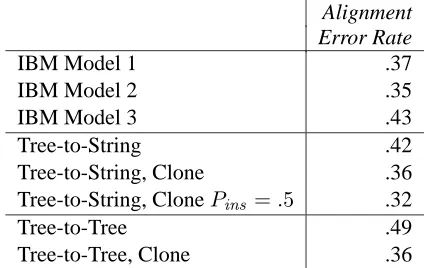
Alignment Error Rate
IBM Model 1 .37
IBM Model 2 .35
IBM Model 3 .43
Tree-to-String .42
Tree-to-String, Clone .36
Tree-to-String, ClonePins =.5 .32
Tree-to-Tree .49
[image:7.612.200.412.72.206.2]Tree-to-Tree, Clone .36
Table 2: Alignment error rate on Korean-English corpus
whereAis the set of word pairs aligned by the au-tomatic system, and G the set aligned in the gold standard. We provide a comparison of the tree-based models with the sequence of successively more com-plex models of Brown et al. (1993). Results are shown in Table 2.
The error rates shown in Table 2 represent the minimum over training iterations; training was stopped for each model when error began to in-crease. IBM Models 1, 2, and 3 refer to Brown et al. (1993). “Tree-to-String” is the model of Yamada and Knight (2001), and “Tree-to-String, Clone” allows the node cloning operation of Section 2.1. “Tree-to-Tree” indicates the model of Section 3, while “Tree-to-Tree, Clone” adds the node cloning operation of Section 3.1. Model 2 is initialized from the parameters of Model 1, and Model 3 is initialized from Model 2. The lexical translation probabilities Pt(f|e)for each of our tree-based models are initial-ized from Model 1, and the node re-ordering proba-bilities are initialized uniformly. Figure 1 shows the viterbi alignment produced by the “Tree-to-String, Clone” system on one sentence from our test set.
We found better agreement with the human align-ments when fixing Pins(left) in the Tree-to-String
model to a constant rather than letting it be deter-mined through the EM training. While the model learned by EM tends to overestimate the total num-ber of aligned word pairs, fixing a higher probability for insertions results in fewer total aligned pairs and therefore a better trade-off between precision and recall. As seen for other tasks (Carroll and Char-niak, 1992; Merialdo, 1994), the likelihood crite-rion used in EM training may not be optimal when evaluating a system against human labeling. The
approach of optimizing a small number of metapa-rameters has been applied to machine translation by Och and Ney (2002). It is likely that the IBM mod-els could similarly be optimized to minimize align-ment error – an open question is whether the opti-mization with respect to alignment error will corre-spond to optimization for translation accuracy.
Within the strict EM framework, we found roughly equivalent performance between the IBM models and the two tree-based models when making use of the cloning operation. For both the tree-to-string and tree-to-tree models, the cloning operation improved results, indicating that adding the flexibil-ity to handle structural divergence is important when using syntax-based models. The improvement was particularly significant for the tree-to-tree model, be-cause using syntactic trees on both sides of the trans-lation pair, while desirable as an additional source of information, severely constrains possible alignments unless the cloning operation is allowed.
6 Conclusion
Our loosely tree-based alignment techniques allow statistical models of machine translation to make use of syntactic information while retaining the flexibil-ity to handle cases of non-isomorphic source and tar-get trees. This is achieved with a clone operation pa-rameterized in such a way that alignment probabili-ties can be computed with no increase in asymptotic computational complexity.
We present versions of this technique both for tree-to-string models, making use of parse trees for one of the two languages, and tree-to-tree models, which make use of parallel parse trees. Results in terms of alignment error rate indicate that the clone operation results in better alignments in both cases. On our Korean-English corpus, we found roughly equivalent performance for the unstructured IBM models, and the both the string and tree-to-tree models when using cloning. To our knowl-edge these are the first results in the literature for tree-to-tree statistical alignment. While we did not see a benefit in alignment error from using syntactic trees in both languages, there is a significant practi-cal benefit in computational efficiency. We remain hopeful that two trees can provide more information than one, and feel that extensions to the “loosely” tree-based approach are likely to demonstrate this using larger corpora.
Another important question we plan to pursue is the degree to which these results will be borne out with larger corpora, and how the models may be re-fined as more training data is available. As one ex-ample, our tree representation is unlexicalized, but we expect conditioning the model on more lexical information to improve results, whether this is done by percolating lexical heads through the existing trees or by switching to a strict dependency repre-sentation.
References
Hiyan Alshawi, Srinivas Bangalore, and Shona Douglas. 2000. Learning dependency translation models as col-lections of finite state head transducers. Computa-tional Linguistics, 26(1):45–60.
G. Edward Barton, Jr. 1985. On the complexity of ID/LP parsing. Computational Linguistics, 11(4):205–218.
Peter F. Brown, John Cocke, Stephen A. Della Pietra, Vincent J. Della Pietra, Frederick Jelinek, John D. Laf-ferty, Robert L. Mercer, and Paul S. Roossin. 1990. A statistical approach to machine translation.
Computa-tional Linguistics, 16(2):79–85, June.
Peter F. Brown, Stephen A. Della Pietra, Vincent J. Della Pietra, and Robert L. Mercer. 1993. The mathematics of statistical machine translation: Parameter estima-tion. Computational Linguistics, 19(2):263–311.
Glenn Carroll and Eugene Charniak. 1992. Two experi-ments on learning probabilistic dependency grammars from corpora. In Workshop Notes for
Statistically-Based NLP Techniques, pages 1–13. AAAI.
Michael John Collins. 1999. Head-driven Statistical Models for Natural Language Parsing. Ph.D. thesis,
University of Pennsylvania, Philadelphia.
Bonnie J. Dorr. 1994. Machine translation divergences: A formal description and proposed solution.
Compu-tational Linguistics, 20(4):597–633.
Jan Hajiˇc, Martin ˇCmejrek, Bonnie Dorr, Yuan Ding, Ja-son Eisner, Daniel Gildea, Terry Koo, Kristen Parton, Gerald Penn, Dragomir Radev, and Owen Rambow. 2002. Natural language generation in the context of machine translation. Technical report, Center for Lan-guage and Speech Processing, Johns Hopkins Univer-sity, Baltimore. Summer Workshop Final Report.
Chung-hye Han, Na-Rae Han, and Eon-Suk Ko. 2001. Bracketing guidelines for Penn Korean treebank. Technical Report IRCS-01-010, IRCS, University of Pennsylvania.
Bernard Merialdo. 1994. Tagging English text with a probabilistic model. Computational Linguistics,
20(2):155–172.
Franz Josef Och and Hermann Ney. 2000. Improved statistical alignment models. In Proceedings of
ACL-00, pages 440–447, Hong Kong, October.
Franz Josef Och and Hermann Ney. 2002. Discrimina-tive training and maximum entropy models for statis-tical machine translation. In Proceedings of ACL-02, Philadelphia, PA.
Dekai Wu. 1997. Stochastic inversion transduction grammars and bilingual parsing of parallel corpora.
Computational Linguistics, 23(3):3–403.
Kenji Yamada and Kevin Knight. 2001. A syntax-based statistical translation model. In Proceedings of
ACL-01, Toulouse, France.
Kenji Yamada and Kevin Knight. 2002. A decoder for syntax-based statistical MT. In Proceedings of