c
WEAKLY-SUPERVISED TEXT CLASSIFICATION
BY YU MENG
THESIS
Submitted in partial fulfillment of the requirements for the degree of Master of Science in Computer Science
in the Graduate College of the
University of Illinois at Urbana-Champaign, 2019
Urbana, Illinois Adviser:
ABSTRACT
Deep neural networks are gaining increasing popularity for the classic text classification task, due to their strong expressive power and less requirement for feature engineering. Despite such attractiveness, neural text classification models suffer from the lack of training data in many real-world applications. Although many semi-supervised and weakly-supervised text classification models exist, they cannot be easily applied to deep neural models and meanwhile support limited supervision types. In this work, we propose a weakly-supervised framework that addresses the lack of training data in neural text classification. Our framework consists of two modules: (1) a pseudo-document generator that leverages seed information to generate pseudo-labeled documents for model pre-training, and (2) a self-training module that bootstraps on real unlabeled data for model refinement. Our framework has the flexibility to handle different types of weak supervision and can be easily integrated into existing deep neural models for text classification. Based on this framework, we propose two methods, WeSTClass and WeSHClass, for flat text classification and hierarchical text classification, respectively. We have performed extensive experiments on real-world datasets from different domains. The results demonstrate that our proposed framework achieves inspiring performance without requiring excessive training data and outperforms baselines significantly.
ACKNOWLEDGMENTS
I would like to first thank my adviser Professor Jiawei Han of the Department of Com-puter Science at University of Illinois at Urbana-Champaign. Professor Han’s continuous encouragement, inspiring guidance, and perspective advising have always steered me in the right direction towards good research topics and quality research outputs that constitute this thesis work. I would also like to thank all Data Mining Group members, especially Jiaming Shen and Chao Zhang, for the inspiring discussions that greatly polished this thesis work.
This research work is sponsored in part by U.S. Army Research Lab. under Cooperative Agreement No. W911NF-09-2-0053 (NSCTA), DARPA under Agreement No. W911NF-17-C-0099, National Science Foundation IIS 16-18481, IIS 17-04532, and IIS-17-41317, DTRA HDTRA11810026, and grant 1U54GM114838 awarded by NIGMS through funds provided by the trans-NIH Big Data to Knowledge (BD2K) initiative (www.bd2k.nih.gov).
TABLE OF CONTENTS
CHAPTER 1 INTRODUCTION . . . 1
CHAPTER 2 WEAKLY-SUPERVISED FLAT TEXT CLASSIFICATION . . . 3
2.1 Overview . . . 3
2.2 Related Work . . . 4
2.3 Preliminaries . . . 6
2.4 Pseudo Document Generation . . . 7
2.5 Neural Models with Self-Training . . . 9
2.6 Experiments . . . 13
2.7 Summary . . . 24
CHAPTER 3 WEAKLY-SUPERVISED HIERARCHICAL TEXT CLASSIFICATION 25 3.1 Overview . . . 25
3.2 Related Work . . . 27
3.3 Problem Formulation . . . 28
3.4 Pseudo Document Generation . . . 28
3.5 The Hierarchical Classification Model . . . 31
3.6 Experiments . . . 34
3.7 Summary . . . 40
CHAPTER 4 CONCLUSION AND FUTURE WORK . . . 42
CHAPTER 1: INTRODUCTION
Text classification plays a fundamental role in a wide variety of applications, ranging from sentiment analysis [37] to document categorization [42] and query intent classification [39]. Recently, deep neural models—including convolutional neural networks (CNNs) [16, 44, 15, 45] and recurrent neural networks (RNNs) [33, 32, 42]—have demonstrated superiority for text classification. The attractiveness of these neural models for text classification is mainly two-fold. First, they can largely reduce feature engineering efforts by automatically learning distributed representations that capture text semantics. Second, they enjoy strong expressive power to better learn from the data and yield better classification performance.
Despite the attractiveness and increasing popularity of neural models for text classification,
the lack of training data is still a key bottleneck that prohibits them from being adopted
in many practical scenarios. Indeed, training a deep neural model for text classification can easily consume million-scale labeled documents. Collecting such training data requires domain experts to read through millions of documents and carefully label them with domain knowledge, which is often too expensive to realize.
To address the label scarcity bottleneck, we study the problem of learning neural models for text classification under weak supervision. In many scenarios, while users cannot afford to label many documents for training neural models, they can provide a small amount of seed information for the classification task. Such seed information may arrive in various forms: either a set of representative keywords for each class, or a few (less than a dozen) labeled documents, or even only the surface names of the classes. Such a problem is called
weakly-supervised text classification.
There have been many studies related to weakly-supervised text classification. However, training neural models for text classification under weak supervision remains an open research problem. Several semi-supervised neural models have been proposed [25, 41], but they still require hundreds or even thousands of labeled training examples, which are not available in the weakly supervised setting [27]. Along another line, there are existing methods that perform weakly-supervised text classification, including latent variable models [18] and embedding-based methods [38, 19]. These models have the following limitations: (1)
supervision inflexibility: they can only handle one type of seed information, either a collection
of labeled documents or a set of class-related keywords, which restricts their applicabilities;
(2) seed sensitivity: the “seed supervision” from users completely controls the model training
process, making the learned model very sensitive to the initial seed information; (3) limited
and cannot be readily applied to learn deep neural models based on CNN or RNN.
In this thesis, we will introduce a neural approach for weakly-supervised text classification. Our framework can utilize various neural models as classifier and meanwhile support different types of weak supervisions (both word-level and document-level). We will introduce how to apply our framework to flat classification tasks in Chapter 2 and to hierarchical classification tasks in Chapter 3. Finally, we will conclude the thesis by summarizing the methods and proposing potential future work in Chapter 4.
CHAPTER 2: WEAKLY-SUPERVISED FLAT TEXT CLASSIFICATION
In this chapter, we present a method that addresses flat text classification under weak supervision. Then in the next chapter, we will extend our method to support hierarchical text classification.
2.1 OVERVIEW
Politics Sports Technology
Source 1: Label surface names
democracy republic religion liberal basketball football tennis athletes software computer drone telescope
Source 2: Class-related keywords
Source 3: Labeled documents
sports news technology news politics news User any source of supervision Politics Technology Sports Pseudo-document Generator Pseudo documents AAD BBE CCF Unlabeled documents AADA BBEB CCFC
Deep Neural Models
CNN
RNN
Deep Neural Models
CNN
RNN Shared Model Parameters
Documents with label
A B C
Generating pseudo documents
Pre-training step Self-training step
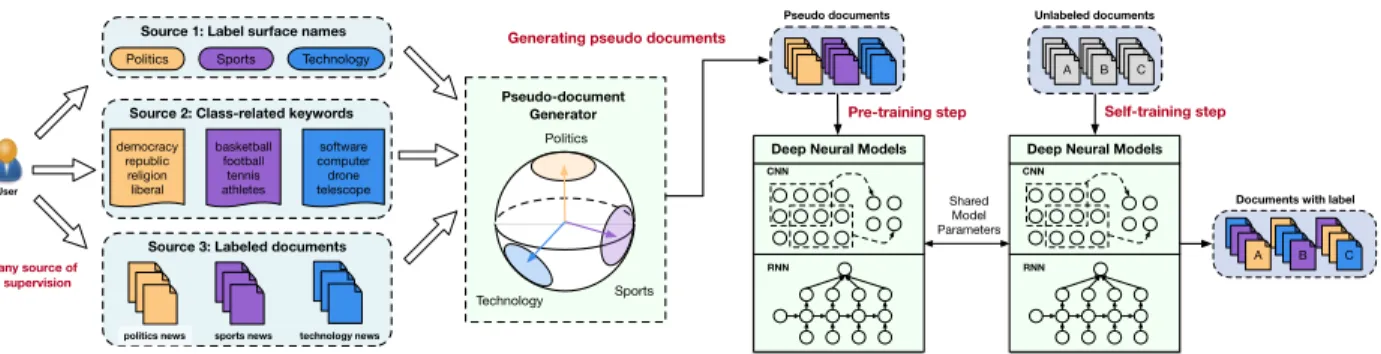
Figure 2.1: WeSTClass consists of two key modules: (1) a pseudo-document generator that leverages seed information to generate pseudo-labeled documents for model pre-training, and (2) a self-training module that bootstraps on real unlabeled data for model refinement.
In this chapter, we present a new method, namedWeSTClass [22], for Weakly-Supervised Text Classification. As shown in Figure 2.1, WeSTClass contains two modules to address the above challenges. The first module is a pseudo-document generator, which leverages seed information to generate pseudo documents as synthesized training data. By assuming word and document representations reside in the same semantic space, we generate pseudo documents for each class by modeling the semantics of each class as a high-dimensional spherical distribution [10], and further sampling keywords to form pseudo documents. The pseudo document generator can not only expand user-given seed information for better generalization, but also handle different types of seed information (e.g., label surface names, class-related keywords, or a few labeled documents) flexibly.
The second key module of our method is a self-training module that fits real unlabeled documents for model refinement. First, the self-training module uses pseudo documents to pre-train either CNN-based or RNN-based models to produce an initial model, which serves as a starting point in the subsequent model refining process. Then, it applies a self-training procedure, which iteratively makes predictions on real unlabeled documents and leverages high-confidence predictions to refine the neural model.
Below is an overview of this chapter:
1. We design the WeSTClass method for addressing the label scarcity bottleneck of neural text classification. To the best of our knowledge,WeSTClass is the first weakly-supervised text classification method that can be applied to most existing neural models and meanwhile handle different types of seed information.
2. We present a novel pseudo document generator by modeling the class semantic as a spherical distribution. The generator is able to generate pseudo documents that are highly correlated to each class, and meanwhile effectively expands user-provided seed information for better generalization.
3. We present a self-training algorithm for training deep neural models by leveraging pseudo documents. The self-training algorithm can iteratively bootstrap the unlabeled data to obtain high-quality deep neural models, and is generic enough to be integrated into either CNN-based or RNN-based models.
4. We conduct a thorough evaluation of our method on three real-world datasets from different domains. The experiment results show that our method can achieve inspiring text classification performance even without excessive training data and outperforms various baselines.
2.2 RELATED WORK
In this section, we review existing studies for weakly-supervised text classification, which can be categorized into two classes: (1) latent variable models; and (2) embedding-based models.
2.2.1 Latent Variable Models
Existing latent variable models for weakly-supervised text classification mainly extend topic models by incorporating user-provided seed information. Specifically, semi-supervised PLSA [21] extends the classic PLSA model by incorporating a conjugate prior based on expert review segments (topic keywords or phrases) to force extracted topics to be aligned with provided review segments. [12] encodes prior knowledge and indirect supervision in constraints on posteriors of latent variable probabilistic models. Descriptive LDA [8] uses an LDA model as the describing device to infer Dirichlet priors from given category labels
and descriptions. The Dirichlet priors guides LDA to induce the category-aware topics. Seed-guided topic model [18] takes a small set of seed words that are relevant to the semantic meaning of the category, and then predicts the category labels of the documents through two kinds of topic influence: category-topics and general-topics. The labels of the documents are inferred based on posterior category-topic assignment. Our method differs from these latent variable models in that it is a weakly-supervised neural model. As such, it enjoys two advantages over these latent variable models: (1) it has more flexibility to handle different types of seed information which can be a collection of labeled documents or a set of seed keywords related to each class; (2) it does not need to impose assumptions on document-topic or topic-keyword distributions, but instead directly uses massive data to learn distributed representations to capture text semantics.
2.2.2 Embedding-based Models
Embedding-based weakly supervised models use seed information to derive vectorized representations for documents and label names for the text classification task. Dataless classification [7, 34] takes category names and projects each word and document into the same semantic space of Wikipedia concepts. Each category is represented with words in the category label. The document classification is performed based on the vector similarity between a document and a category using explicit semantic analysis [11]. Unsupervised neural categorization [19] takes category names as input and applies a cascade embedding approach: First the seeded category names and other significant phrases (concepts) are embedded into vectors for capturing concept semantics. Then the concepts are embedded into a hidden category space to make the category information explicit. Predictive text embedding [38] is a semi-supervised algorithm that utilizes both labeled and unlabeled documents to learn text embedding specifically for a task. Labeled data and different levels of word co-occurrence information are first represented as a large-scale heterogeneous text network and then embedded into a low dimensional space that preserves the semantic similarity of words and documents. Classification is performed by using one-vs-rest logistic regression model as classifier and the learned embedding as input. Compared with our method, these embedding-based weakly supervised methods cannot be directly applied to deep neural models (CNN, RNN) for the text classification task. Furthermore, while they allow the seed information to directly control the model training process, we introduce a pseudo document generation paradigm which is generalized from the seed information. Hence, our model is less prone to seed information overfitting and enjoys better generalization ability.
2.3 PRELIMINARIES
In this section, we formulate the problem of weakly-supervised text classification, and give an overview of our proposed method.
2.3.1 Problem Formulation
Given a text collection D = {D1, . . . , Dn} and m target classes C = {C1, . . . , Cm}, text classification aims to assign a class label Cj ∈ C to each document Di ∈ D. To characterize each class, traditional supervised text classification methods rely on large amounts of labeled documents. In this chapter, we focus on the text classification under weakly-supervised setting where the supervision signal comes from one of the following sources: (1)label surface
names: L={Lj}|m
j=1, where Lj is the surface name for class Cj, (2) class-related keywords: S ={Sj}|m
j=1, where Sj ={wj,1, . . . , wj,k} represents a set of k keywords in class Cj, and (3)
labeled documents: DL = {DL
j}|mj=1, where DjL= {Dj,1, . . . , Dj,l} denotes a set of l (l n) labeled documents in class Cj. In many scenarios, the above weak supervision signals can be easily obtained from users. Finally, we define our problem as follows:
Definition 2.1 (Problem Formulation) Given a text collectionD ={D1, . . . , Dn}, target
classesC = {C1, . . . , Cm}, and weak supervision from eitherL, S orDL, the weakly-supervised
text classification task aims to assign a label Cj ∈ C to each Di ∈ D.
2.3.2 Method Overview
Our proposed weakly-supervised text classification method contains two key modules. The first one is a pseudo-document generator that unifies seed information and outputs pseudo documents for model training. We assume words and documents share a joint semantic space which provides flexibility for handling different types of seed information. Then, we model each class as a high-dimensional spherical distribution from which keywords are sampled to form pseudo documents as training data. The second key module of our method is a self-training module that can be easily integrated into existing deep neural models, either CNN-based or RNN-based. It first uses the generated pseudo documents to pre-train neural models, which allows the model to start with a good initialization. Then, a self-training procedure is applied to iteratively refine the neural model using unlabeled real documents based on the model’s high-confidence predictions. We show the entire process of our method in Figure 2.1.
2.4 PSEUDO DOCUMENT GENERATION
In this section, we describe the details of the pseudo-document generator, which leverages seed information to generate a bunch of pseudo documents that are correlated to each class. Below, we first introduce how to model class distributions in a joint semantic space with words and documents, and then describe the pseudo document generation process.
2.4.1 Modeling Class Distribution
To effectively leverage user-provided seed information and capture the semantic correlations between words, documents and classes, we assume words and documents share a joint semantic space, based on which we learn a generative model for each class to generate pseudo documents.
Specifically, we first use the Skip-Gram model [24] to learnp-dimensional vector represen-tations of all the words in the corpus. Furthermore, since directional similarities between vectors are more effective in capturing semantic correlations [35, 2, 17], we normalize all the
p-dimensional word embeddings so that they reside on a unit sphere inRp, which is the joint semantic space. We call it “joint” because we assume pseudo document vectors reside on the same unit sphere as well, which we will explain in Section 2.4.2. We retrieve a set of keywords in the semantic space that are correlated to each class based on the seed information. We describe how to handle different types of seed information as follows:
• Label surface names: When only label surface namesLare given as seed information, for each class j we use the embedding of its surface name Lj to retrieve top-t nearest words in the semantic space. We set t to be the largest number that does not results in shared words across different classes.
• Class-related keywords: When users provide a list of related keywords Sj for each class j, we use the embeddings of these seed keywords to find top-t keywords in the semantic space, by measuring the average similarity to the seed keywords.
• Labeled documents: When users provide a small number of documents DLj that are correlated with class j, we first extract t representative keywords in DLj using tf-idf weighting, and then consider them as class-related keywords.
After obtaining a set of keywords that are correlated with each class, we model the semantic of each class as a von Mises Fisher (vMF) distribution [2, 13], which models word embeddings on a unit sphere inRp and has been shown effective for various tasks [3, 43]. Specifically, we
define the probability distribution of a class as:
f(x;µ, κ) = cp(κ)eκµTx,
where κ≥0, kµk= 1,p≥2 and the normalization constantcp(κ)is given by
cp(κ) = κ
p/2−1
(2π)p/2Ip/ 2−1(κ)
,
where Ir(·)represents the modified Bessel function of the first kind at orderr. We justify our choice of the vMF distribution as follows: the vMF distribution has two parameters—the mean direction µ and the concentration parameter κ. The distribution of keywords on the unit sphere for a specific class concentrates around the mean direction µ, and is more concentrated if κ is large. Intuitively, the mean direction µ acts as a semantic focus on the unit sphere, and produces relevant semantic embeddings around it, where concentration degree is controlled by the parameter κ.
Now that we have leveraged the seed information to obtain a set of keywords for each class on the unit sphere, we can use these correlated keywords to fit a vMF distributionf(x;µ, κ). Specifically, letX be a set of vectors for the keywords on the unit sphere, i.e.,
X ={xi ∈Rp |xi drawn from f(x;µ, κ),1≤i≤t},
then we use the maximum likelihood estimates [2] for finding the parameters µˆ and κˆ of the vMF distribution: ˆ µ= Pt i=1xi kPt i=1xik , and Ip/2(ˆκ) Ip/2−1(ˆκ) = k Pt i=1xik t .
Obtaining an analytic solution for κˆ is infeasible because the formula involves an implicit equation which is a ratio of Bessel functions. We thus use a numerical procedure based on Newton’s method [2] to derive an approximation ofκˆ.
2.4.2 Generating Pseudo Documents To generate a pseudo document D∗
i (we use Di∗ instead of Di to denote it is a pseudo
document) of class j, we propose a generative mixture model based on class j’s distribution
document; when generating each term, the model chooses from a background distribution with probability α (0< α <1) and from the class-specific distribution with probability 1−α.
The class-specific distribution is defined based on classj’s distribution f(x;µj, κj). Par-ticularly, we first sample a document vector di from f(x;µj, κj), then build a keyword
vocabularyVdi for di that contains the top-γ words with most similar word embedding with
di. These γ words inVdi are highly semantically relevant with the topic of pseudo document
D∗
i and will appear frequently in Di∗. Each term of a pseudo document is generated according
to the following probability distribution:
p(w|di) = αpB(w) w /∈Vdi αpB(w) + (1−α) exp(dTivw) P w0∈Vd i exp(dT ivw0) w∈Vdi (2.1)
where vw is the word embedding for w and pB(w) is the background distribution for the entire corpus.
Note that we generate document vectors from f(x;µj, κj) instead of fixing them to be
µj. The reason is that some class (e.g., Sports) may cover a wide range of topics (e.g.,
athlete activities, sport competitions, etc.), but using µj as the pseudo document vector
will only attract words that are semantically similar to the centroid direction of a class. Sampling pseudo document vectors from the distribution, however, allows the generated pseudo documents to be more semantically diversified and thus cover more information about the class. Consequently, models trained on such more diversified pseudo documents are expected to have better generalization ability.
Algorithm 2.1 shows the whole process of generating a collection of β pseudo documents per class. For each class j, given the learned class distributions and the average length of pseudo documents dl1, we draw a document vector d
i from class j’s distribution f(x;µj, κj).
After that, we generate dl words sequentially based on di and add the generated document
into the pseudo document collectionDj∗ of class j. After the above process repeats β times, we finally obtain D∗j which contains β pseudo documents for class j.
2.5 NEURAL MODELS WITH SELF-TRAINING
In this section, we present the self-training module that trains deep neural models with the generated pseudo documents. The self-training module first uses the pseudo documents to pre-train a deep neural network, and then iteratively refines the trained model on the
1The length of each pseudo document can be either manually set or equal to the average document length
Algorithm 2.1: Pseudo Documents Generation.
1 Input: Class distributions {f(x;µj, κj)}|mj=1; average document lengthdl; number of
pseudo documents β to generate for each class.
2 Output: A set ofm×β pseudo documents D∗.
Initialize D∗ ← ∅
for class index j from 1 to m do Initialize D∗j ← ∅
for pseudo document index i from 1 to β do Sample document vector di fromf(x;µj, κj) D∗
i ← empty string
for word index k from1 todl do
Sample wordwi,k ∼p(w|di) based on Eq. (2.1) D∗
i =D
∗
i ⊕wi,k // concatenate wi,k after D ∗ i end for D∗.append(D∗ i) end for D∗ ← D∗ ∪ D∗ j end for Return D∗
real unlabeled documents in a bootstrapping fashion. In the following, we first present the pre-training and the self-training steps in Section 2.5.1 and 2.5.2, and then demonstrate how the framework can be instantiated with CNN and RNN models in Section 2.5.3.
2.5.1 Neural Model Pre-training
As we have obtained pseudo documents for each class, we use them to pre-train a neural network M2. A naive way of creating the label for a pseudo document D∗
i is to directly
use the associated class label that D∗
i is generated from, i.e. using one-hot encoding where
the generating class takes value 1 and all other classes are set to 0. However, this naive strategy often causes the neural model to overfit to the pseudo documents and have limited performance when classifying real documents, due to the fact that the generated pseudo documents do not contain word ordering information. To tackle this problem, we create pseudo labels for pseudo documents. In Equation (2.1), we design pseudo documents to be generated from a mixture of background and class-specific word distributions, controlled by a balancing parameterα. Such a process naturally leads to our design of the following procedure
2When the supervision source islabeled documents, these seed documents will be used to augment the
for pseudo label creation: we evenly split the fraction of the background distribution into all
m classes, and set the pseudo label li for pseudo documentD∗i as
lij =
(1−α) +α/m D∗
i is generated from class j
α/m otherwise
After creating the pseudo labels, we pre-train a neural model M by generating β pseudo documents for each class, and minimizing the KL divergence loss from the neural network outputsY to the pseudo labels L, namely
loss=KL(LkY) =X i
X
j
lijlog lij yij
We will detail how we instantiate the neural model M shortly in Section 2.5.3.
2.5.2 Neural Model Self-training
While the pre-training step produces an initial neural modelM, the performance of the M
is not the best one can hope for. The major reason is that the pre-trained model M only uses the set of pseudo documents but fails to take advantage of the information encoded in the real unlabeled documents. The self-training step is designed to tackle the above issues. Self-training [26, 30] is a common strategy used in classic semi-supervised learning scenarios. The rationale behind self-training is to first train the model with labeled data, and then bootstrap the learning model with its current highly-confident predictions.
After the pre-training step, we use the pre-trained model to classify all unlabeled documents in the corpus and then apply a self-training strategy to improve the current predictions. During self-training, we iteratively compute pseudo labels based on current predictions and refine model parameters by training the neural network with pseudo labels. Given the current outputsY, the pseudo labels are computed using the same self-training formula as in [40]:
lij = y 2 ij/fj P j0yij20/fj0 where fj =P
iyij is the soft frequency for class j.
Self-training is performed by iteratively computing pseudo labels and minimizing the KL divergence loss from the current predictionsY to the pseudo labelsL. This process terminates when less than δ%of the documents in the corpus have class assignment changes.
neural models, it is worth mentioning the difference between them: in pre-training, pseudo labels are paired with generated pseudo documents to distinguish them from given labeled documents (if provided) and prevent the neural models from overfitting to pseudo documents; in self-training, pseudo labels are paired with every unlabeled real documents from corpus and reflect current high confidence predictions.
2.5.3 Instantiating with CNNs and RNNs
As mentioned earlier, our method for text classification is generic enough to be applied to most existing deep neural models. In this section, we instantiate the framework with two mainstream deep neural network models: convolution neural networks (CNN) and recurrent neural networks (RNN), by focusing on how they are used to learn document representations and perform classification.
CNN-Based Models
CNNs have been explored for text classification [16]. When instantiating our framework with CNN, the input to a CNN is a document of length dl represented by a concatenation of word vectors, i.e.,
d=x1⊕x2⊕ · · · ⊕xdl,
where xi ∈Rp is the p dimensional word vector of the ith word in the document. We use xi:i+j to represent the concatenation of word vectors xi,xi+1, . . . ,xi+j. For window size of h, a feature ci is generated from a window of words xi:i+h−1 by the following convolution operation
ci =f(w·xi:i+h−1+b),
where b ∈ R is a bias term, w ∈ Rhp is the filter operating on h words. For each possible
size-h window of words, a feature map is generated as
c = [c1, c2, . . . , cdl−h+1].
Then a max-over-time pooling operation is performed on c to output the maximum value
ˆ
c= max(c) as the feature corresponding to this particular filter. If we use multiple filters, we will obtain multiple features that are passed through a fully connected softmax layer whose output is the probability distribution over labels.
RNN-Based Models
Besides CNNs, we also discuss how to instantiate our framework with RNNs. We choose the Hierarchical Attention Network (HAN) [42] as an exemplar RNN-based model. HAN consists of sequence encoders and attention layers for both words and sentences. In our context, the input document is represented by a sequence of sentences si, i ∈ [1, L] and each sentence is represented by a sequence of words wit, t ∈[1, T]. At time t, the GRU [1] computes the new state as
ht = (1−zt)ht−1 +zth˜t,
where the update gate vector
zt=σ(Wzxt+Uzht−1+bz),
the candidate state vector
˜
ht= tanh(Whxt+rt(Uhht−1) +bh), the reset gate vector
rt=σ(Wrxt+Urht−1+br),
andxt is the sequence vector (word embedding or sentence vector) at time t. After encoding words and sentences, we also impose the attention layers to extract important words and sentences with the attention mechanism, and derive their weighted average as document representations.
2.6 EXPERIMENTS
In this section, we evaluate the empirical performance of our method for weakly supervised text classification.
2.6.1 Datasets
We use three corpora from different domains to evaluate the performance of our proposed method: (1) The New York Times (NYT): We crawl13,081 news articles using the New York Times API3. This corpus covers 5major news topics; (2) AG’s News (AG): We use
3
the same AG’s News dataset from [45] and take its training set portion (120,000 documents evenly distributed into 4 classes) as the corpus for evaluation; (3) Yelp Review (Yelp): We use the Yelp reviews polarity dataset from [45] and take its testing set portion (38,000
documents evenly distributed into2 classes) as the corpus for evaluation.
2.6.2 Baselines
We compareWeSTClass with a wide range of baseline models, described as follows. • IR with tf-idf: this method accepts either label surface name or class-related
keywords as supervision. We treat the label name or keyword set for each class as a query, and score the relevance of document to this class using the tf-idf model. The class with highest relevance score is assigned to the document.
• Topic Model: this method accepts either label surface name or class-related keywordsas supervision. We first train the LDA model [4] on the entire corpus. Given a document, we compute the likelihood of observing label surface names or the average likelihood of observing class-related keywords. The class with maximum likelihood will be assigned to the document.
• Dataless[7, 34]: this method 4 accepts only label surface nameas supervision. It leverages Wikipedia and uses Explicit Semantic Analysis [11] to derive vector represen-tations of both labels and documents. The final document class is assigned based on the vector similarity between labels and documents.
• UNEC [19]: this method takes label surface name as its weak supervision. It categorizes documents by learning the semantics and category attribution of concepts inside the corpus. We use the authors’ original implementation of this model.
• PTE [38]: this method 5 uses labeled documents as supervision. It first utilizes both labeled and unlabeled data to learn text embedding and then applies logistic regression model as classifier for text classification.
• CNN [16]: the original CNN model is a supervised text classification model and we extend it to incorporate all three types of supervision sources. If labeled documents are given, we directly train CNN model on the given labeled documents and then apply it on all unlabeled documents. If label surface names or class-related keywords
4https://cogcomp.org/page/software_view/Descartes
are given, we first use the above “IR with tf-idf” or “Topic Modeling” method (depending on which one works better) to label all unlabeled documents. Then, we selectβ labeled documents per class to pre-train CNN. Finally, we apply the same self-training module as described in Section 2.5 to obtain the final classifier.
• HAN [42]: similar to the above CNN model, we extend the original HAN model6 to incorporate all three types of supervision sources.
• NoST-(CNN/HAN): this is a variant ofWeSTClasswithout the self-training module,
i.e., after pre-training CNN or HAN with pseudo documents, we directly apply it to classify unlabeled documents.
• WeSTClass-(CNN/HAN): this is the full version of our proposed framework, with
both pseudo-document generator and self-training module enabled.
2.6.3 Experiment Settings
We first describe our parameter settings as follows. For all datasets, we use the Skip-Gram model [24] to train 100-dimensional word embeddings on the corresponding corpus. We set the background word distribution weight α = 0.2, the number of pseudo documents per class for pre-training β = 500, the size of class-specific vocabulary γ = 50 and the self-training stopping criterion δ= 0.1.
We apply our proposed framework on two types of state-of-the-art text classification neural models: (1) CNN model, whose filter window sizes are 2,3,4,5with 20 feature maps each. (2) HAN model, which uses a forward GRU with 100dimension output for both word and
sentence encoding. Both the pre-training and the self-training steps are performed using SGD with batch size 256.
The seed information we use as weak supervision for different datasets are described as follows: (1) When the supervision source is label surface name, we directly use the label surface names of all classes; (2) When the supervision source is class-related keywords, we manually choose 3keywords which do not include the class label name for each class. The selected keywords are shown in Tables 2.1, and we evaluate how our model is sensitive to such seed keyword selection in Section 2.6.6; (3) When the supervision source is labeled documents, we randomly sample c documents of each class from the corpus (c= 10 for The New York Times and AG’s News; c= 20 for Yelp Review) and use them as the
given labeled documents. To alleviate the randomness, we repeat the document selection process 10 times and show the performances with average and standard deviation values.
Table 2.1: Seed keywords on NYT, AG, and Yelp.
Dataset Class Keyword List
NYT
Politics {democracy, religion, liberal} Arts {music, movie, dance} Business {investment, economy, industry}
Science {scientists, biological, computing} Sports {hockey, tennis, basketball}
AG
Politics {government, military, war} Sports {basketball, football, athletes} Business {stocks, markets, industries} Technology {computer, telescope, software} AG Good {terrific, great, awesome}
Bad {horrible, disappointing, subpar}
2.6.4 Experiment Results
In this subsection, we report our experimental results and our findings.
Overall Text Classification Performance
In the first set of experiments, we compare the classification performance of our method against all the baseline methods on the three datasets. Both macro-F1 and micro-F1 metrics are used to quantify the performance of different methods.
As shown in Table 2.2, our proposed framework achieves the overall best performances among all the baselines on three datasets with different weak supervision sources. Specifically, in almost every case, WeSTClass-CNN yields the best performance among all methods;
WeSTClass-HAN performs slightly worse than WeSTClass-CNNbut still outperforms other
baselines. We discuss the effectiveness of WeSTClassfrom the following aspects:
1. When labeled documentsare given as the supervision source, the standard deviation values of WeSTClass-CNN and WeSTClass-HAN are smaller than those of CNN and HAN, respectively. This shows that WeSTClass can effectively reduce the seed sensitivity and improve the robustness of CNN and HAN models.
T able 2.2: Macro-F1 scores (upp er table) and Micro-F1 score s (lo w er table) for all metho ds on three datasets. LABELS , KEYW ORDS , and DOCS means the typ e of seed sup ervision is la b el surface name, class-related k eyw ords, and lab eled do cumen ts, resp ectiv ely . Metho ds The New Y ork Times A G’s News Y elp Review LABELS KEYW ORDS DOCS LABELS KEYW ORDS DOCS LABELS KEYW ORDS DOCS IR with tf-idf 0 . 319 0 . 509 -0 . 187 0 . 258 -0 . 533 0 . 638 -T opic Mo del 0 . 301 0 . 253 -0 . 496 0 . 723 -0 . 333 0 . 333 -Dataless 0 . 484 -0 . 688 -0 . 337 -UNEC 0 . 690 -0 . 659 -0 . 602 -PTE -0 . 834 (0 . 024) -0 . 542 (0 . 029) -0 . 658 (0 . 042) HAN 0 . 348 0 . 534 0 . 740 (0 . 059) 0 . 498 0 . 621 0 . 731 (0 . 029) 0 . 519 0 . 631 0 . 686 (0 . 046) CNN 0 . 338 0 . 632 0 . 702 (0 . 059) 0 . 758 0 . 770 0 . 766 (0 . 035) 0 . 523 0 . 633 0 . 634 (0 . 096) NoST-HAN 0 . 515 0 . 213 0 . 823 (0 . 035) 0 . 590 0 . 727 0 . 745 (0 . 038) 0 . 731 0 . 338 0 . 682 (0 . 090) NoST-CNN 0 . 701 0 . 702 0 . 833 (0 . 013) 0 . 534 0 . 759 0 . 759 (0 . 032) 0 . 639 0 . 740 0 . 717 (0 . 058) W eSTClass -HAN 0 . 754 0 . 640 0 . 832 (0 . 028) 0 . 816 0 . 820 0 . 782 (0 . 028) 0 . 769 0 . 736 0 . 729 (0 . 040) W eSTClass -CNN 0 . 830 0 . 837 0 . 835 ( 0 . 010 ) 0 . 822 0 . 821 0 . 839 ( 0 . 007 ) 0 . 735 0 . 816 0 . 775 ( 0 . 037 ) Metho ds The New Y ork Times A G’s News Y elp Review LABELS KEYW ORDS DOCS LABELS KEYW ORDS DOCS LABELS KEYW ORDS DOCS IR with tf-idf 0 . 240 0 . 346 -0 . 292 0 . 333 -0 . 548 0 . 652 -T opic Mo del 0 . 666 0 . 623 -0 . 584 0 . 735 -0 . 500 0 . 500 -Dataless 0 . 710 -0 . 699 -0 . 500 -UNEC 0 . 810 -0 . 668 -0 . 603 -PTE -0 . 906 (0 . 020) -0 . 544 (0 . 031) -0 . 674 ( 0 . 029 ) HAN 0 . 251 0 . 595 0 . 849 (0 . 038) 0 . 500 0 . 619 0 . 733 (0 . 029) 0 . 530 0 . 643 0 . 690 (0 . 042) CNN 0 . 246 0 . 620 0 . 798 (0 . 085) 0 . 759 0 . 771 0 . 769 (0 . 034) 0 . 534 0 . 646 0 . 662 (0 . 062) NoST-HAN 0 . 788 0 . 676 0 . 906 (0 . 021) 0 . 619 0 . 736 0 . 747 (0 . 037) 0 . 740 0 . 502 0 . 698 (0 . 066) NoST-CNN 0 . 767 0 . 780 0 . 908 (0 . 013) 0 . 553 0 . 766 0 . 765 (0 . 031) 0 . 671 0 . 750 0 . 725 (0 . 050) W eSTClass -HAN 0 . 901 0 . 859 0 . 908 (0 . 019) 0 . 816 0 . 822 0 . 782 (0 . 028) 0 . 771 0 . 737 0 . 729 (0 . 040) W eSTClass -CNN 0 . 916 0 . 912 0 . 911 ( 0 . 007 ) 0 . 823 0 . 823 0 . 841 ( 0 . 007 ) 0 . 741 0 . 816 0 . 776 (0 . 037)
2. When the supervision source is label surface nameor class-related keywords, we can see that WeSTClass-CNN and WeSTClass-HAN outperform CNN and HAN, respectively. This demonstrates that pre-training with generated pseudo documents results in a better neural model initialization compared to pre-training with documents that are labeled using either IR with tf-idf or Topic Modeling.
3. WeSTClass-CNNandWeSTClass-HAN always outperformNoST-CNNand
NoST-HAN, respectively. Note that the only difference betweenWeSTClass-CNN/WeSTClass -HAN andNoST-CNN/NoST-HANis that the latter two do not include the self-training module. The performance gaps between them thus clearly demonstrate the effectiveness of our self-training module.
Effect of self-training module
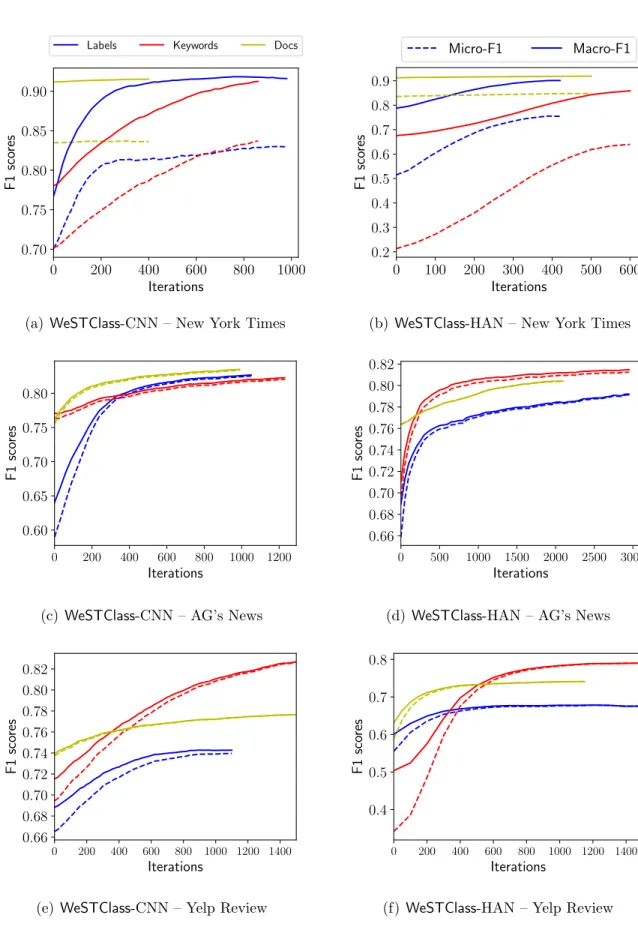
In this set of experiments, we conduct more experiments to study the effect of self-training module inWeSTClass, by investigating the performance of difference models as the number of iterations increases. The results are shown in Figure 2.2. We can see that the self-training module can effectively improve the model performance after the pre-training step. Also, we find that the self-training module generally has the least effect when supervision comes from labeled documents. One possible explanation is that when labeled documents are given, we will use both pseudo documents and provided labeled documents to pre-train the neural models. Such mixture training can often lead to better model initialization, compared to using pseudo documents only. As a result, there is less room for self-training module to make huge improvements.
0 200 400 600 800 1000 Iterations 0.70 0.75 0.80 0.85 0.90 F1 sco res
Labels Keywords Docs
(a) WeSTClass-CNN – New York Times
0 100 200 300 400 500 600 Iterations 0.2 0.3 0.4 0.5 0.6 0.7 0.8 0.9 F1 sco res Micro-F1 Macro-F1
(b) WeSTClass-HAN – New York Times
0 200 400 600 800 1000 1200 Iterations 0.60 0.65 0.70 0.75 0.80 F1 sco res
(c) WeSTClass-CNN – AG’s News
0 500 1000 1500 2000 2500 3000 Iterations 0.66 0.68 0.70 0.72 0.74 0.76 0.78 0.80 0.82 F1 sco res
(d)WeSTClass-HAN – AG’s News
0 200 400 600 800 1000 1200 1400 Iterations 0.66 0.68 0.70 0.72 0.74 0.76 0.78 0.80 0.82 F1 sco res
(e) WeSTClass-CNN – Yelp Review
0 200 400 600 800 1000 1200 1400 Iterations 0.4 0.5 0.6 0.7 0.8 F1 sco res
(f) WeSTClass-HAN – Yelp Review
Effect of the number of labeled documents
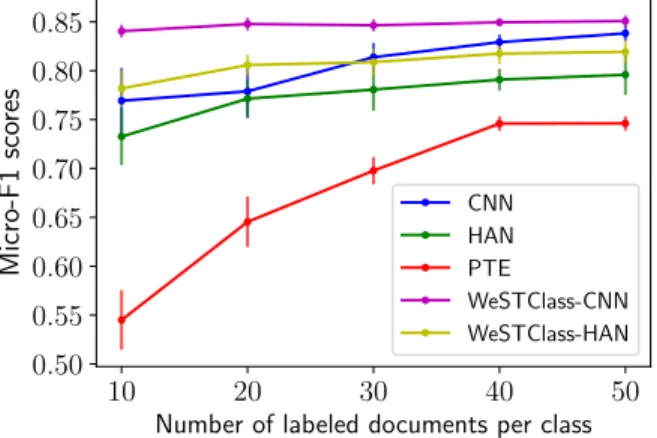
When weak supervision signal comes from labeled documents, the setting is similar to semi-supervised learning except that the amount of labeled documents is very limited. In this set of experiments, we vary the number of labeled documents per class and compare the performances of five methods on the AG’s News dataset: CNN,HAN, PTE, WeSTClass
-CNN and WeSTClass-HAN. Again, we run each method 10 times with different sets of
labeled documents, and report the average performances with standard deviation (represented as error bars) in Figure 2.3. We can see that when the amount of labeled documents is relatively large, the performances of the five methods are comparable. However, when fewer labeled documents are provided, PTE, CNN and HAN not only exhibit obvious performance drop, but also become very sensitive to the seed documents. Nevertheless,
WeSTClass-based models, especiallyWeSTClass-CNN, yield stable performance with varying
amount of labeled documents. This phenomenon shows that our method can more effectively take advantage of the limited amount of seed information to achieve better performance.
10 20 30 40 50
Number of labeled documents per class 0.50 0.55 0.60 0.65 0.70 0.75 0.80 0.85 Micro-F1 sco res CNN HAN PTE WeSTClass-CNN WeSTClass-HAN
Figure 2.3: The performances of different methods on AG’s News dataset when the number of labeled documents varies.
2.6.5 Parameter Study
In this section, we study the effects of different hyperparameter settings on the performance
of WeSTClasswith CNN and HAN models, including (1) background word distribution weight
α, (2) number of generated pseudo documents β for pre-training and (3) keyword vocabulary sizeγ used in equation (2.1) whereγ =|Vdi|. When studying the effect of one parameter, the
other parameters are set to their default values as described in Section 2.6.3 . We conduct all the parameter studies on the AG’s News dataset.
Background Word Distribution Weight
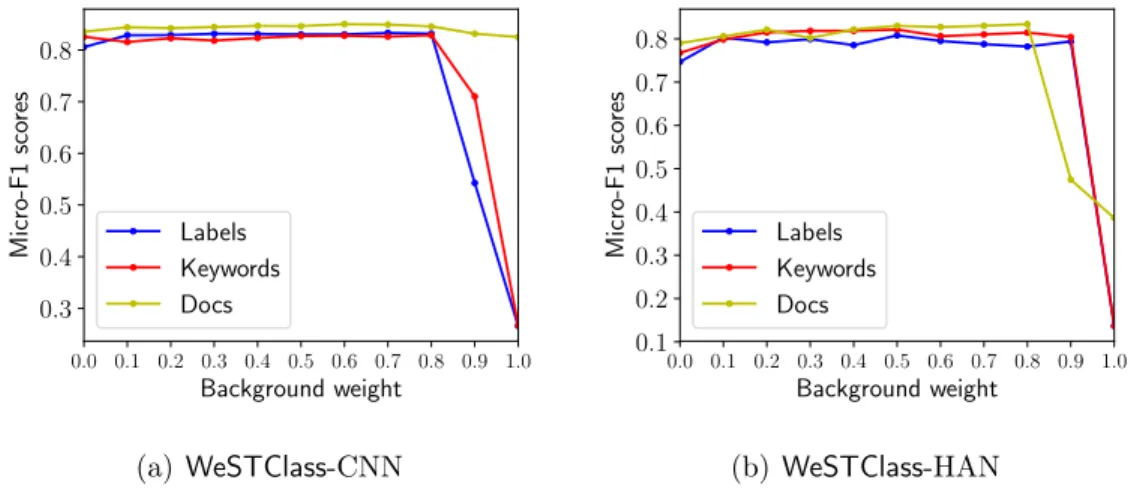
The background word distribution weight α is used in both the language model for pseudo documents generation and pseudo-labels computation. When α becomes smaller, the generated pseudo documents contain more topic-related words and fewer background words, and the pseudo-labels become similar to one-hot encodings. We vary α from 0 to
1 with interval equal to 0.1. The effect of α is shown in Figure 2.4. Overall, different α
values result in comparable performance, except when α is close to 1, pseudo documents and pseudo-labels become uninformative: pseudo documents are generated directly from background word distribution without any topic-related information, and pseudo-labels are uniform distributions. We notice that when α = 1, labeled documents as supervision source results in much better performance than label surface name and class-related keywords. This is because pre-training with labeled documents is performed using both pseudo documents and labeled documents, and the provided labeled documents are still informative. When α is close to 0, the performance is slightly worse than other settings, because pseudo documents only contain topic-related keywords and pseudo-labels are one-hot encodings, which can easily lead to model overfitting to pseudo documents and behaving worse on real documents classification.
0.0 0.1 0.2 0.3 0.4 0.5 0.6 0.7 0.8 0.9 1.0 Background weight 0.3 0.4 0.5 0.6 0.7 0.8 Micro-F1 sco res Labels Keywords Docs (a) WeSTClass-CNN 0.0 0.1 0.2 0.3 0.4 0.5 0.6 0.7 0.8 0.9 1.0 Background weight 0.1 0.2 0.3 0.4 0.5 0.6 0.7 0.8 Micro-F1 sco res Labels Keywords Docs (b) WeSTClass-HAN
Figure 2.4: Effect of background word distribution weight α.
Number of pseudo documents for pre-training
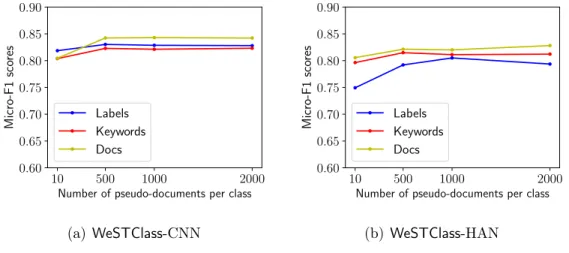
The effect of pseudo documents amount β is shown in Figure 2.5. We have the following findings from Figure 2.5: On the one hand, if the amount of generated pseudo documents is too small, the information carried in pseudo documents will be insufficient to pre-train a good model. On the other hand, generating too many pseudo documents will make the pre-training
process unnecessarily long. Generating 500 to 1000 pseudo documents of each class for pre-training will strike a good balance between pre-training time and model performance.
10 500 1000 2000
Number of pseudo-documents per class
0.60 0.65 0.70 0.75 0.80 0.85 0.90 Micro-F1 sco res Labels Keywords Docs (a) WeSTClass-CNN 10 500 1000 2000
Number of pseudo-documents per class
0.60 0.65 0.70 0.75 0.80 0.85 0.90 Micro-F1 sco res Labels Keywords Docs (b) WeSTClass-HAN
Figure 2.5: Effect of pseudo documents amount per class β for pre-training.
Size of Keyword Vocabulary
Recall the pseudo document generation process in Section 2.4.2, after sampling a document vector di, we will first construct a keyword vocabulary Vdi that contains the top-γ words
with most similar word embedding with di. The size of the keyword vocabularyγ controls
the number of unique words that appear frequently in the generated pseudo documents. If γ
is too small, only a few topical keywords will appear frequently in pseudo documents, which will reduce the generalization ability of the pre-trained model. As shown in Figure 2.6, γ can be safely set within a relatively wide range from 50 to500 in practice.
10 100 200 500
Size of keyword vocabulary
0.60 0.65 0.70 0.75 0.80 0.85 0.90 Micro-F1 sco res Labels Keywords Docs (a) WeSTClass-CNN 10 100 200 500
Size of keyword vocabulary
0.60 0.65 0.70 0.75 0.80 0.85 0.90 Micro-F1 sco res Labels Keywords Docs (b) WeSTClass-HAN
2.6.6 Case Study
In this subsection, we perform a set of case studies to further understand the properties of our proposed method.
Table 2.3: Keyword Lists at Top Percentages of Average Tf-idf.
Class 1% 5% 10%
Politics {government, president, minister} {mediators, criminals, socialist} {suspending, minor, lawsuits}
Sports {game, season, team} {judges, folks, champagne} {challenging, youngsters, stretches}
Business {profit, company, sales} {refunds, organizations, trader} {winemaker, skilling, manufactured}
Technology {internet, web, microsoft} {biologists, virtually, programme} {demos, microscopic, journals}
Choice of Seed Keywords
In the first set of case studies, we are interested in how sensitive our model is to the selection of seed keywords. In Section 2.6.3, we manually select class-related keywords, which could be subjective. Here we explore the sensitivity of WeSTClass-CNN and WeSTClass-HAN to different sets of seed keywords. For each classj of AG’s News dataset, we first collect all documents belonging to class j, and then compute the tf-idf weighting of each word in each document of class j. We sort each word’s average tf-idf weighting in these documents from high to low. Finally we form the seed keyword lists by finding words that rank at top
1% (most relevant), 5%and 10% based on the average tf-idf value. The keywords of each class at these percentages are shown in Table 2.3; the performances of WeSTClass-CNN
and WeSTClass-HAN are shown in Figure 2.7. At top 5% and 10% of the average tf-idf
weighting, although some keywords are already slightly irrelevant to their corresponding class semantic, WeSTClass-CNN andWeSTClass-HAN still perform reasonably well, which shows the robustness of our proposed framework to different sets of seed keywords.
1.0 5.0 10.0
TF-IDF Top Percentage (%)
0.0 0.2 0.4 0.6 0.8 1.0 Micro-F1 sco res WeSTClass-CNN WeSTClass-HAN
Self-training Corrects Misclassification
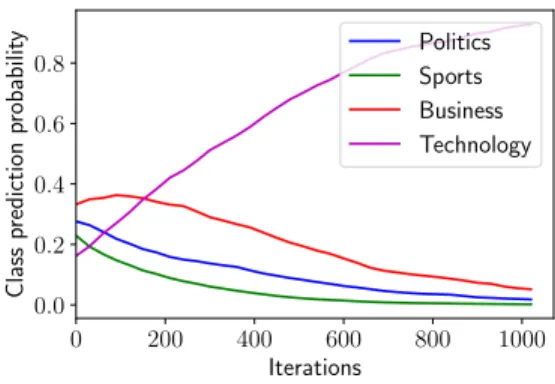
In the second set of case studies, we are interested in how the self-training module behaves to improve the performance of our model. Figure 2.8 shows WeSTClass-CNN’s prediction with label surface name as supervision source on a sample document from AG’s News dataset: The national competition regulator has elected not to oppose Telstra’s 3G radio
access network sharing arrangement with rival telco Hutchison. We notice that this document
is initially misclassified after the pre-training procedure, but it is then corrected by the subsequent self-training step. This example shows that neural models have the ability of self-correcting by learning from its high-confidence predictions with appropriate pre-training initialization. 0 200 400 600 800 1000 Iterations 0.0 0.2 0.4 0.6 0.8 Class prediction probabilit y Politics Sports Business Technology
Figure 2.8: Class prediction probability during self-training procedure for a sample document.
2.7 SUMMARY
In this chapter, we have proposed a weakly-supervised text classification method built upon neural classifiers. With (1) a pseudo document generator for generating pseudo training data and (2) a self-training module that bootstraps on real unlabled data for model refining, our method effectively addresses the key bottleneck for existing neural text classifiers—the lack of labeled training data. Our method is not only flexible in incorporating difference sources of weak supervision (class label surface names, class-related keywords, and labeled documents), but also generic enough to support different neural models (CNN and RNN). Our experimental results have shown that our method outperforms baseline methods significantly, and it is quite robust to different settings of hyperparameters and different types of user-provided seed information. An interesting finding based on the experiments in Section 2.6 is that different types of weak supervision are all highly helpful for the good performances of neural models. In the future, it is interesting to study how to integrate different types of seed information to further boost the performance of our method.
CHAPTER 3: WEAKLY-SUPERVISED HIERARCHICAL TEXT CLASSIFICATION
When the categories of a target corpus exhibit hierarchical structures, it is highly desirable to organize text documents into the class taxonomy instead of performing flat classification. In this chapter, we introduce how to extend our previous weakly-supervised text classification approach to hierarchical settings, for enabling multi-granular document classification.
3.1 OVERVIEW
Hierarchical text classification aims at classifying text documents into classes that are organized into a hierarchy. Traditional flat text classifiers (e.g., SVM, logistic regression) have been tailored in various ways for hierarchical text classification. Early attempts [6] disregard the relationships among classes and treat hierarchical classification tasks as flat ones. Later approaches [9, 20, 5] train a set of local classifiers and make predictions in a top-down manner, or design global hierarchical loss functions that regularize with the hierarchy. Most existing efforts for hierarchical text classification rely on traditional text classifiers. Recently, deep neural networks have demonstrated superior performance for flat text classification. Compared with traditional classifiers, deep neural networks [16, 42] largely reduce feature engineering efforts by learning distributed representations that capture text semantics. Meanwhile, they provide stronger expressive power over traditional classifiers, thereby yielding better performance when large amounts of training data are available.
Motivated by the enjoyable properties of deep neural networks, we explore using deep neural networks for hierarchical text classification. Despite the success of deep neural models in flat text classification and their advantages over traditional classifiers, applying them to hierarchical text classification is nontrivial because of two major challenges. The first challenge is that the training data deficiency prohibits neural models from being adopted. Neural models are data hungry and require humans to provide tons of carefully-labeled documents for good performance. In many practical scenarios, however, hand-labeling excessive documents often requires domain expertise and can be too expensive to realize. The second challenge is to
determine the most appropriate level for each document in the class hierarchy. In hierarchical
text classification, documents do not necessarily belong to leaf nodes and may be better assigned to intermediate nodes. However, there are no simple ways for existing deep neural networks to automatically determine the best granularity for a given document.
We present a neural approach namedWeSHClass [23], forWeakly-SupervisedHierarchical Text Classification and address the above two challenges. Our approach is built upon
deep neural networks, yet it requires only a small amount of weak supervision instead of excessive training data. Such weak supervision can be either a few (e.g., less than a dozen) labeled documents or class-correlated keywords, which can be easily provided by users. To leverage such weak supervision for effective classification, our approach employs a novel pretrain-and-refine paradigm. Specifically, in the pre-training step, we leverage user-provided seeds to learn a spherical distribution for each class, and then generate pseudo documents from a language model guided by the spherical distribution. In the refinement step, we iteratively bootstrap the global model on real unlabeled documents, which self-learns from its own high-confident predictions.
WeSHClassautomatically determines the most appropriate level during the classification
process by explicitly modeling the class hierarchy. Specifically, we pre-train a local classifier at each node in the class hierarchy, and aggregate the classifiers into a global one using self-training. The global classifier is used to make final predictions in a top-down recursive manner. During recursive predictions, we introduce a novel blocking mechanism, which examines the distribution of a document over internal nodes and avoids mandatorily pushing general documents down to leaf nodes.
Below is an overview of this chapter:
1. We design a method for hierarchical text classification using neural models under weak supervision. WeSHClass does not require large amounts of training documents but just easy-to-provide word-level or document-level weak supervision. In addition, it can be applied to different classification types (e.g., topics, sentiments).
2. We present a pseudo document generation module that generates high-quality training documents only based on weak supervision sources. The generated documents serve as pseudo training data which alleviate the training data bottleneck together with the subsequent self-training step.
3. We present a hierarchical neural model structure that mirrors the class taxonomy and its corresponding training method, which involves local classifier pre-training and global classifier self-training. The entire process is tailored for hierarchical text classification, which automatically determines the most appropriate level of each document with a novel blocking mechanism.
4. We conduct a thorough evaluation on three real-world datasets from different domains to demonstrate the effectiveness of WeSHClass. We also perform several case studies to understand the properties of different components in WeSHClass.
3.2 RELATED WORK
3.2.1 Weakly-Supervised Text Classification
There exist some previous studies that use either word-based supervision or limited amount of labeled documents as weak supervision sources for the text classification task. WeSTClass [22] leverages both types of supervision sources. It applies a similar procedure of pre-training the network with pseudo documents followed by self-training on unlabeled data. Descriptive LDA [8] applies an LDA model to infer Dirichlet priors from given keywords as category descriptions. The Dirichlet priors guide LDA to induce the category-aware topics from unlabeled documents for classification. [12] propose to encode prior knowledge and indirect supervision in constraints on posteriors of latent variable probabilistic models. Predictive text embedding [38] utilizes both labeled and unlabeled documents to learn text embedding specifically for a task. Labeled data and word co-occurrence information are first represented as a large-scale heterogeneous text network and then embedded into a low dimensional space. The learned embedding are fed to logistic regression classifiers for classification. None of the above methods are specifically designed for hierarchical classification.
3.2.2 Hierarchical Text Classification
There have been efforts on using SVM for hierarchical classification. [9, 20] propose to use local SVMs that are trained to distinguish the children classes of the same parent node so that the hierarchical classification task is decomposed into several flat classification tasks. [5] define hierarchical loss function and apply cost-sensitive learning to generalize SVM learning for hierarchical classification. A graph-CNN based deep learning model is proposed in [28] to convert text to graph-of-words, on which the graph convolution operations are applied for feature extraction. FastXML [29] is designed for extremely large label space. It learns a hierarchy of training instances and optimizes a ranking-based objective at each node of the hierarchy. The above methods rely heavily on the quantity and quality of training data for good performance, while WeSHClass does not require much training data but only weak supervision from users.
Hierarchical dataless classification [34] uses class-related keywords as class descriptions, and projects classes and documents into the same semantic space by retrieving Wikipedia concepts. Classification can be performed in both top-down and bottom-up manners, by measuring the vector similarity between documents and classes. Although hierarchical dataless classification does not rely on massive training data as well, its performance is highly influenced by the
text similarity between the distant supervision source (Wikipedia) and the given unlabeled corpus.
3.3 PROBLEM FORMULATION
We study hierarchical text classification that involves tree-structured class categories. Specifically, each category can belong to at most one parent category and can have arbitrary number of children categories. Following the definition in [31], we consider non-mandatory leaf prediction, wherein documents can be assigned to both internal and leaf categories in the hierarchy.
Traditional supervised text classification methods rely on large amounts of labeled docu-ments for each class. In this chapter, we focus on text classification under weak supervision. Given a class taxonomy represented as a treeT, we ask the user to provide weak supervision sources (e.g., a few class-related keywords or documents) only for each leaf class in T. Then we propagate the weak supervision sources upwards in T from leaves to root, so that the weak supervision sources of each internal class are an aggregation of weak supervision sources of all its descendant leaf classes. Specifically, given M leaf node classes, the supervision for each class comes from one of the following:
1. Word-level supervision: S = {Sj}|M
j=1, where Sj = {wj,1, . . . , wj,k} represents a set of k keywords correlated with class Cj;
2. Document-level supervision: DL = {DL
j}|Mj=1, where DLj = {Dj,1, . . . , Dj,l} denotes a small set of l (lcorpus size) labeled documents in class Cj.
Now we are ready to formulate the hierarchical text classification problem. Given a text collection D ={D1, . . . , DN}, a class category tree T, and weak supervisions of either S or DL for each leaf class in T, the weakly-supervised hierarchical text classification task aims to
assign the most likely label Cj ∈ T to each Di ∈ D, where Cj could be either an internal or a leaf class.
3.4 PSEUDO DOCUMENT GENERATION
To break the bottleneck of lacking abundant labeled data for model training, we leverage user-given weak supervision to generate pseudo documents, which serve as pseudo training data for model pre-training. In this section, we first introduce how to leverage weak supervision sources to model class distributions in a spherical space, and then explain how to generate class-specific pseudo documents based on class distributions and a language model.
3.4.1 Modeling Class Distribution
We model each class as a high-dimensional spherical probability distribution which has been shown effective for various tasks [43]. We first train Skip-Gram model mikolov2013distributed to learn d-dimensional vector representations for each word in the corpus. Since directional similarities between vectors are more effective in capturing semantic correlations [2, 17], we normalize all the d-dimensional word embeddings so that they reside on a unit sphere in Rd.
For each class Cj ∈ T, we model the semantics of class Cj as a mixture of von Mises Fisher (movMF) distributions [2, 13] in Rd: f(x|Θ) = m X h=1 αhfh(x|µh, κh) = m X h=1 αhcd(κh)eκhµThx, where Θ = {α1, . . . , αm,µ1, . . . ,µm, κ1, . . . , κm}, ∀h ∈ {1, . . . , m}, κh ≥ 0, kµhk = 1, and
the normalization constant cd(κh) is given by
cd(κh) = κ d/2−1 h (2π)d/2Id/ 2−1(κh) ,
where Ir(·)represents the modified Bessel function of the first kind at order r. We choose the number of components in movMF for leaf and internal classes differently:
• For each leaf class Cj, we set the number of vMF component m = 1, and the resulting movMF distribution is equivalent to a single vMF distribution, whose two parameters, the mean direction µ and the concentration parameter κ, act as semantic focus and concentration forCj.
• For each internal class Cj, we set the number of vMF componentm to be the number of its children classes. Recall that we only ask the user to provide weak supervision sources at the leaf classes, and the weak supervision source of Cj are aggregated from its children classes. The semantics of a parent class can thus be seen as a mixture of the semantics of its children classes.
We first retrieve a set of keywords for each class given the weak supervision sources, then fit movMF distributions using the embedding vectors of the retrieved keywords. Specifically, the set of keywords are retrieved as follows: (1) When users provide related keywords Sj for each class j, we use the average embedding of these seed keywords to find top-n closest keywords in the embedding space; (2) When users provide documentsDL
j that are correlated with class j, we extract n representative keywords from DL
above is set to be the largest number that does not result in shared words across different classes. Compared to directly using weak supervision signals, retrieving relevant keywords for modeling class distributions has a smoothing effect which makes our model less sensitive to the weak supervision sources.
LetX be the set of embeddings of then retrieved keywords on the unit sphere, i.e.,
X ={xi ∈Rd|xi drawn from f(x|Θ),1≤i≤n},
we use the Expectation Maximization (EM) framework [2] to estimate the parameters Θ of the movMF distributions:
• E-step: p(zi =h|xi,Θ(t)) = α (t) h fh(xi |µ (t) h , κ (t) h ) Pm h0=1α (t) h0fh0(xi |µ (t) h0, κ (t) h0) ,
whereZ = {z1, . . . , zn}is the set of hidden random variables that indicate the particular vMF distribution from which the points are sampled;
• M-step: α(ht+1) = 1 n n X i=1 p(zi =h|xi,Θ(t)), rh(t+1) = n X i=1 p(zi =h|xi,Θ(t))x i, µ(ht+1) = r (t+1) h krh(t+1)k, Id/2(κ (t+1) h ) Id/2−1(κ (t+1) h ) = kr (t+1) h k Pn i=1p(zi =h|xi,Θ(t)) .
where we use the approximation procedure based on Newton’s method [2] to derive an approximation of κ(ht+1) because the implicit equation makes obtaining an analytic solution infeasible.
3.4.2 Language Model Based Document Generation
After obtaining the distributions for each class, we use an LSTM-based language model [36] to generate meaningful pseudo documents. Specifically, we first train an LSTM language model on the entire corpus. To generate a pseudo document of class Cj, we sample an
embedding vector from the movMF distribution of Cj and use the closest word in embedding space as the beginning word of the sequence. Then we feed the current sequence to the LSTM language model to generate the next word and attach it to the current sequence recursively 1. Since the beginning word of the pseudo document comes directly from the class distribution, the generated document is ensured to be correlated to Cj. By virtue of the mixture distribution modeling, the semantics of every children class (if any) ofCj gets a chance to be included in the pseudo documents, so that the resulting trained neural model will have better generalization ability.
3.5 THE HIERARCHICAL CLASSIFICATION MODEL
In this section, we introduce the hierarchical neural model and its training method under weakly-supervised setting.
3.5.1 Local Classifier Pre-Training
We construct a neural classifier Mp (Mp could be any text classifier such as CNNs or RNNs) for each class Cp ∈ T if Cp has two or more children classes. Intuitively, the classifier Mp aims to classify the documents assigned to Cp into its children classes for more fine-grained predictions. For each document Di, the output of Mp can be interpreted as
p(Di ∈Cc|Di ∈Cp), the conditional probability of Di belonging to each children class Cc of
Cp, givenDi is assigned toCp.
The local classifiers perform local text classification at internal nodes in the hierarchy, and serve as building blocks that can be later ensembled into a global hierarchical classifier. We generate β pseudo documents per class and use them to pre-train local classifiers with the goal of providing each local classifier with a good initialization for the subsequent self-training step. To prevent the local classifiers from overfitting to pseudo documents and performing badly on classifying real documents, we use pseudo labels instead of one-hot encodings in pre-training. Specifically, we use a hyperparameterα that accounts for the “noises” in pseudo documents, and set the pseudo labell∗i for pseudo document D∗
i (we use D∗i instead of Di to
denote a pseudo document) as
l∗ij =
(1−α) +α/m D∗
i is generated from class j
α/m otherwise
(3.1)
1In case of long pseudo documents, we repeatedly generate several sequences and concatenate them to
where m is the total number of children classes at the corresponding local classifier. After creating pseudo labels, we pre-train each local classifier Mp of class Cp using the pseudo documents for each children class ofCp, by minimizing the KL divergence loss from outputs Y of Mp to the pseudo labels L∗, namely
loss=KL(L∗kY) =X i X j l∗ijlog l ∗ ij yij.
3.5.2 Global Classifier Self-Training
At each level k in the class taxonomy, we need the network to output a probability distribution over all classes. Therefore, we construct a global classifier Gk by ensembling all local classifiers from root to level k. The ensemble method is shown in Figure 3.1. The multiplication operation conducted between parent classifier output and children classifier output can be explained by the conditional probability formula:
p(Di ∈Cc) = p(Di ∈Cc∩Di ∈Cp)
=p(Di ∈Cc|Di ∈Cp)p(Di ∈Cp),
whereDi is a document;Ccis one of the children classes ofCp. This formula can be recursively applied so that the final prediction is the multiplication of all local classifiers’ outputs on the path from root to the destination node.
Greedy top-down classification approaches will propagate misclassifications at higher levels to lower levels, which can never be corrected. However, the way we construct the global classifier assigns documents soft probability at each level, and the final class prediction is made by jointly considering all classifiers’ outputs from root to the current level via multiplication, which gives lower-level classifiers chances to correct misclassifications made at higher levels. At each level k of the class taxonomy, we first ensemble all local classifiers from root to level k to form the global classifier Gk, and then use Gk’s prediction on all unlabeled real documents to refine itself iteratively. Specifically, for each unlabeled document Di,Gk
outputs a probability distribution yij of Di belonging to each classj at level k, and we set pseudo labels to be [40]: l∗∗ij = y 2 ij/fj P j0yij20/fj0 , (3.2) where fj =P
iyij is the soft frequency for class j.
fine-Level 0 Root) Local Classifier Level 1 (Politics) Local Classifier Level 1 (Sports) Local Classifier Level 2
(Military) (Gun Control)Level 2 (Hockey)Level 2 (Tennis)Level 2 (Basketball)Level 2
p
(
D
i2
P olitics
) = 0
.
05
p
(
D
i2
Sports
) = 0
.
95
p
(
D
i2
M ilitary
|
D
i2
P olitics
) = 0
.
34
p
(
D
i2
Basketball
|
D
i2
Sports
) = 0
.
8
0.34 0.66 0.1 0.1 0.8
p
(
D
i2
M ilitary
) = 0
.
05
⇥
0
.
34 = 0
.
017
p
(
D
i2
Basketball
) = 0
.
95
⇥
0
.
8 = 0
.
76
Figure 3.1: Ensemble of local classifiers.
tuning ofGk, by iteratively (1) computing pseudo labelsL∗∗based onGk’s current predictions Y and (2) minimizing the KL divergence loss from Y toL∗∗. This process terminates when less than δ% of the documents in the corpus have class assignment changes. Since Gk is the ensemble of local classifiers, they are fine-tuned simultaneously via back-propagation