SOFTWARE-BASED SELF-TESTING FOR A RISC PROCESSOR
TEH WEE MENG
SOFTWARE-BASED SELF-TESTING FOR A RISC PROCESSOR
TEH WEE MENG
A project submitted in partial fulfilment of the requirements for the award of the degree of
Master of Engineering (Electrical - Computer and Microelectronic System)
Faculty of Electrical Engineering Universiti Teknologi Malaysia
iii
Specially dedicated to my family, lecturers and friends who have guided, motivated
iv
ACKNOWLEDGEMENT
Firstly, I would like to thank my project supervisor Dr. Ooi Chia Yee for all her guidance and advices throughout the duration of this project. This project would not have been a successful one without her.
I also wish to express my gratitude to the authors of all technical papers listed in the references section that I have been referring to, which have provided me with all the necessary knowledge and concepts in completing this project.
v
ABSTRACT
vi
ABSTRAK
vii
TABLE OF CONTENTS
CHAPTER TITLE PAGE
DECLARATION ii
DEDICATION iii
ACKNOWLEDGEMENT iv
ABSTRACT v
ABSTRAK vi
TABLE OF CONTENTS vii
LIST OF TABLES ix
LIST OF FIGURES x
LIST OF ABBREVIATIONS xi
LIST OF APPENDICES xii
1 INTRODUCTION 1
1.1 Background 1
1.2 Objective 4
1.3 Scope 4
1.4 Problem Statement 5
1.5 Research Methodology 5
1.6 Thesis outline 6
2 LITERATURE REVIEW 7
2.1 Automatic Test Equipment (ATE) 7
2.2 Built-In Self-Test (BIST) 8
2.3 Software-Based Self-Testing (SBST) 9
viii
3 METHODOLOGY AND IMPLEMENTATION 16
3.1 RTL simulation 17
3.2 Synthesis 20
3.3 ATPG 21
3.4 Building the constrained circuit 22
3.5 Full scan design 25
4 RESULTS AND DISCUSSION 26
4.1 Results 26
5 CONCLUSION AND RECOMMENDATIONS 29
REFERENCES 31
Appendices A – D 33 - 45
ix
LIST OF TABLES
TABLE NO. TITLE PAGE
1.1 Comparison between CISC and RISC processor 2 2.1 Detailed operations of all 8 instructions 14 3.1 Testbench used and expected/output value 18
of specific registers
4.1 Results from previous work 25
x
LIST OF FIGURES
FIGURE NO. TITLE PAGE
1.1 A typical RISC processor design 3
1.2 Flow chart of research methodology 6
2.1 Software-based self-testing concept 9
2.2 Self-test concept 10
2.3 RiSC-16 5 stage pipeline 12
2.4 3 types of instruction format of RiSC-16 13
2.5 The 8 instructions of RiSC-16 14
3.1 Implementation flow chart 16
3.2 RiSC-16 without data and instruction memory 17 3.3 RTL simulation waveform of RiSC-16 on Quartus II 18 3.4 Derivation of instruction in HEX and output 19
register value
3.5 Loading up dc_shell-t 20
3.6 Loading up Tetramax 21
3.7 Extracting input constraints 23
3.8 Extracting output constraints 23
xi
LIST OF ABBREVIATIONS
SBST - Software-Based Self-Testing RISC - Reduced Instruction Set Computer CPU - Central Processing Unit
CISC - Complex Instruction Set Computer
I/O - Input/Output
ROM - Read Only Memory
ISA - Instruction Set Architecture IP - Intellectual Properties ALU - Arithmetic Logic Unit RTL - Register Transfer Language
ATPG - Automatic Test Pattern Generation
DC - Design Compiler
STIL - Standard Test Interface Language ATE - Automatic Test Equipment BIST - Built-In Self-Test
IC - Integrated Circuit
SOC - System On Chip
xii
LIST OF APPENDICES
APPENDIX TITLE PAGE
A Verilog codes for CTL1 to CTL7 32
B Verilog codes for RiSC-16 35
C A testbench file 43
CHAPTER 1
INTRODUCTION
This project is about implementing the technique of Software-Based Self-Testing (SBST) on a Reduced Instruction Set Computer (RISC) processor. Effectiveness of this testing method will be judged on the achieved test coverage, test program size and testing cycle count. Comparison with previous work that combines SBST and partial scan insertion technique would be done. This chapter gives a brief introduction of project background, objective, scope, implementation plan and problem statement, as well as the organization of this thesis.
1.1 Background
In this electronic age of 21st century, processors, also known as Central Processing Unit (CPU), are the heart of almost all smart electronics devices, especially the ubiquitous smartphones and tablets. The word “smart” stemmed from the fact that processors are continuously making all the smart decisions in terms of the controls and instruction executions in a complex system.
2
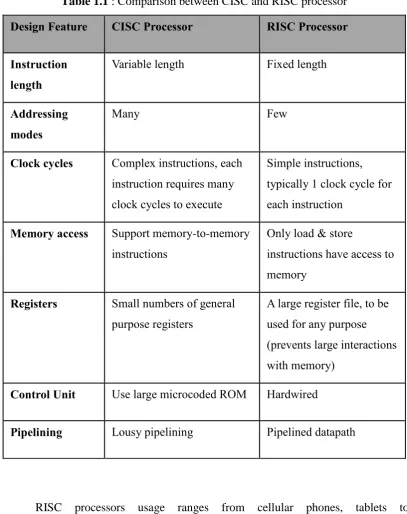
require dozens of data memory cycles in order to execute a single instruction. A quick comparison between RISC and CISC is shown in Table 1.1. In particular, RISC processors typically have separate instructions for I/O and data processing.
Table 1.1 : Comparison between CISC and RISC processor
Design Feature CISC Processor RISC Processor
Instruction length
Variable length Fixed length
Addressing modes
Many Few
Clock cycles Complex instructions, each instruction requires many clock cycles to execute
Simple instructions, typically 1 clock cycle for each instruction
Memory access Support memory-to-memory instructions
Only load & store
instructions have access to memory
Registers Small numbers of general purpose registers
A large register file, to be used for any purpose (prevents large interactions with memory)
Control Unit Use large microcoded ROM Hardwired
Pipelining Lousy pipelining Pipelined datapath
PA-3
RISC, Alpha and so on. As shown in Figure 1.1, RISC designs normally adopt Harvard architecture, whereby instruction and data memories are separate modules.
Figure 1.1 : A typical RISC processor design
Basic building blocks of a typical RISC processor include: • Instruction Set Architecture (ISA) registers. • Fundamental IPs such as:
• ALU – implementation of data processing instructions with arithmetic (add, subtract & multiply) and logical operations. • Memory access unit – manipulation of both data and instruction
memory addresses.
• Control/steering logic/pipeline registers.
• Control Unit – a module that extracts instructions from memory, decodes and executes them, calling on the ALU when necessary. • Pipeline registers – registers that store address of current executed
instruction, handles interrupt and backup return address. • Pipeline-related control logic.
4
(a) CPU control – instructions such as NOP, STOP, SET and CLR which do not generate numeric results but alter processor’s state. SET and CLR allow the set and clear operation of any status or control registers.
(b) Data transfer – instructions of MOV, LOAD and PUSH that copy the content of an internal register to another register, a memory location, or load the data from these sources to register file.
(c) Branch and subroutine – instructions like JMP and BRC that alter the value of program counter and access the call stack.
(d) Arithmetic and Logic – instructions of ADD, NEG, XOR that generate numeric results as a function of two source operands.
1.2 Objective
The main objective of this project is to understand the design of a 16-bit RISC processor from previous work, and apply SBST methodology that generates the constrained test patterns to test the processor effectively.
1.3 Scope
The scope in this project involves understanding the Verilog design of a RISC processor (reused from previous student’s project), verifying the functionality of the RISC processor through RTL simulation, synthesizing the Verilog codes into gate level netlist, generating test patterns for the processor with a set of constraints, and performing test coverage analysis.
The three main tools that are used during development of this project are summarized as below:
Quartus II (version 11.0) is used for Verilog coding
5
Design Compiler (DC) is used for synthesis of a RTL into its gate-level
netlist.
Tetramax is the Automatic Test Pattern Generation (ATPG) tool used for
test pattern generation and test coverage analysis.
1.4 Problem Statement
The previous work [1] that combines SBST technique and partial scan insertion technique has the limitations of test time generation and area overhead. This project is to eliminate area overhead incurred from the partial scan technique while retaining the reasonable test coverage.
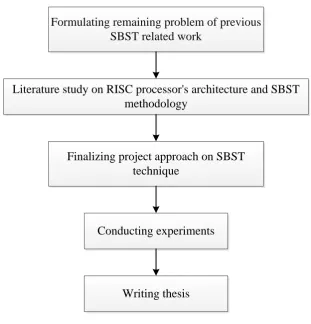
1.5 Research Methodology
6
Formulating remaining problem of previous SBST related work
Literature study on RISC processor's architecture and SBST methodology
Finalizing project approach on SBST technique
Conducting experiments
Writing thesis
Figure 1.2 : Flow chart of research methodology
1.6 Thesis Outline
31
REFERENCES
1. Ang Kim Chuan, “Software-Based Self-Test with Scan Design at Register Transfer Level for 16-bit RISC Processor”, Master Thesis of Universiti Teknologi Malaysia, Skudai, 2010.
2. Nektarios Kranitis, Antonis Paschalis, Dimitris Gizopoulos, and George Xenoulis, “Software-Based Self-Testing of Embedded Processors”, IEEE Trans. Comput., vol. 54, no. 4, pp. 461-475, Apr. 2005.
3. L. Chen and S. Dey, “Software-Based Self-Testing Methodology for Processor Cores”, IEEE Trans. Comput.-Aided Design Integr. Circuits Syst., vol. 20, no. 3, pp. 369-380, Mar. 2001.
4. A. Krstic, L. Chen, W.C. Lai, K.T. Cheng, and S. Dey, “Embedded Software-Based Self-Test for Programmable Core-Software-Based Designs”, IEEE Design and Test of Computers, pp. 18-26, July/Aug. 2002.
5. Chung-Ho Chen, Chih-Kai Wei, Tai-Hua Lu, and Hsun-Wei Gao, “Software-Based Self-Testing With Multiple-Level Abstractions for Soft Processor Cores”, IEEE Trans. VLSI Syst., vol. 15, no. 5, May 2007.
6. Prof. Bruce Jacob, “The RiSC-16 Instruction Set Architecture”, Fall 2000.
7. Psarakis, M., Gizopoulos, D., Sanchez, E., and Reorda, M.S., “Microprocessor Software-Based Self-Testing”, IEEE Design and Test of Computers, pp. 4-19, May-June 2010.
32