Fuzzy Programming Approach for a Multi-objective
Single Machine Scheduling Problem with
Stochastic Processing Time
Iraj Mahdavi*, Babak Javadi, Ali Tajdin
Abstract - This paper considers a fuzzy programming approach for a multi-objective single machine scheduling problem when processing times of jobs are normal random variables. The probabilistic problem is converted into an equivalent deterministic programming problem. Then the fuzzy programming technique has been applied to obtain a compromise solution. A numerical example demonstrates the feasibility of applying the proposed model to single machine scheduling problem.
Index Terms— Single machine scheduling, Normal random variable, Fuzzy programming
I. INTRODUCTION
Scheduling consists of planning and arranging jobs in an orderly sequence of operations in order to meet customer’s requirements [1]. The scheduling of jobs and the control of their flows through a production process are the most significant elements in any modern manufacturing systems. The single machine environment is basis for other types of scheduling problems. In a single machine scheduling, there is only one machine to process all jobs so that optimizes system performance measures such as makespan, completion time, tardiness, number of tardy jobs, idle times, sum of the maximum earliness and tardiness. In single machine scheduling, most researches are concerned with the minimization of a single criterion. However, scheduling problems often involve more than one aspect and therefore they require multiple criteria analyses [2].
Ishi and Tada [3] considered a single machine scheduling problem minimizing the maximum lateness of jobs with fuzzy precedence relations. A fuzzy precedence relation relaxes the crisp precedence relation and represents the satisfaction level with respect to the precedence between two jobs.
Iraj Mahdavi, Mazandaran University of Science & Technology, Department of Industrial Engineering, Babol, Iran, E.mail: [email protected]
Babak Javadi, Mazandaran University of Science & Technology, Department of Industrial Engineering, Babol, Iran, E.mail: [email protected]
Ali Tajdin, Mazandaran University of Science & Technology, Department of Industrial Engineering, Babol, Iran, E.mail: [email protected]
Adamopoulos and Pappis [4] presented a fuzzy-linguistic approach to multi-criteria sequencing problem. They considered a single machine, in which each job is characterized by fuzzy processing times. The objective is to determine the processing times of jobs and the common due as well as to sequence the jobs on the machine where penalty values are associated with due dates assigned, earliness, and tardiness. Another approach to solve a multi-criteria single machine scheduling problem is presented by Lee, et al. [5]. They proposed an approach using linguistic values to evaluate each criterion (e.g. very poor, poor, fair, good, and very good) and to represent its relative weights (e.g. very unimportant, unimportant, moderately important, important, and very important). Also, a tabu search method is used as a stochastic tool to find the near optimal solution for an aggregated fuzzy objective function.
Chanas and Kasperski [6] considered two single machine scheduling problems with fuzzy processing times and fuzzy due dates. They defined the fuzzy tardiness of a job in a given sequence as a fuzzy maximum of zero and the difference between the fuzzy completion time and the fuzzy due date of this job. In the first problem, they considered the minimization of the maximal expected value of a fuzzy tardiness. In the second one, they considered the minimization of the expected value of a maximal fuzzy tardiness.
Chanas and Kasperski [7] considered the single machine scheduling problem with parameters given in the form of fuzzy numbers. It is assumed that the optimal schedule in such a problem cannot be determined precisely. In their paper, it is shown how to calculate the degrees of possible and necessary optimality of a given schedule in one of the special cases of the single machine scheduling problems.
problem of minimizing the maximum earliness and number of tardy jobs.
Eren and Guner [9] considered a bi-criteria scheduling problem with sequence dependent setup times on a single machine. The objective function is to minimize the weighted sum of total completion time and total tardiness. An integer programming model is developed for the problem which belongs to an NP-Hard class. For solving problems containing a large number of jobs, a special heuristic is also used for large jobs problems. To improve the performance of the tabu search (TS) method, the result of the proposed heuristic algorithm is taken as an initial solution of the TS method.
Tavakkoli-Moghaddam, et al. [10] presented a fuzzy goal programming based approach for solving a mixed-integer model of a single machine scheduling problem minimizing the total weighted flow time and total weighted tardiness. Because of the existing conflict of these two objectives, they proposed a fuzzy goal programming model based approach to solve the extended mathematical model of a single machine scheduling problem. This approach is constructed based on desirability of the decision maker (DM) and tolerances considered on goal values. Huo et al. [11] considered bi-criteria single machine scheduling problems involving the maximum weighted tardiness and number of tardy jobs. They gave NP-hardness proofs for the scheduling problems when one of these two criteria is the primary criterion and the other one is the secondary criterion. They considered complexity relationships between the various problems and proposed polynomial algorithms for some special cases as well as fast heuristics for the general case.
It is well known that the optimal solution of single objective models can be quite different if the objective is different (e.g., for the simplest model of one machine without any additional constraint, the shortest processing time (SPT)
rule is optimal to minimize F
(i.e., mean flow time) but the earliest due date (EDD) rule is optimal to minimize the maximal tardiness (Tmax)). In fact, each particular decision maker often wants to minimize the given criterion. For example in a company, the commercial manager is interested by satisfying customers and then minimizing the tardiness. On the other hand, the production manager wishes to optimize the use of the machine by minimizing the makespan or the work in process by minimizing the maximum flow time. In addition, each of these objectives is valid from a general point of view. Since these objectives are conflicting, a solution may perform well for one objective, but giving bad results for others. For this reason, scheduling problems often have a multi-objective nature (Loukil, et al. [2]).
The chance constrained programming was first developed by Charnes and Cooper [12]. Subsequently, some researchers like Sengupta [13], Contini [14], Leclercq [15], Teghem et al. [16] and many others have established some theoretical results in the field of stochastic programming. Stancu-Minasian and Wets [17] have presented a review paper on stochastic programming with a single objective function.
The fuzziness occurs in many of the real life decision making problems. Decision making in a fuzzy environment was first developed by Bellman and Zadeh [18]. Zimmermann [19] presented an application of fuzzy linear programming to the linear vector-maximum problem and showed that the solution obtained by fuzzy linear programming is always efficient. Hanan [20], Narasimhan [21], Leberling [22] and many others have made contributions in fuzzy goal programming and fuzzy multi-objective programming.
Thus, the aim of this paper is to develop a fuzzy programming approach for solving a multi-objective single machine scheduling problem when processing times of jobs are normal random variables and the constraints follow a joint probability distribution. This probabilistic model is first converted into an equivalent deterministic model, to which fuzzy programming technique is applied to solve a multi-objective single machine scheduling problem to obtain a compromise solution.
II. PROBLEM FORMULATION
The following notation and definitions are used to describe the multi-objective single machine scheduling problem.
A. Notation Indexes:
N = number of jobs, i
p
= processing time of job i (normal random variable) (i = 1, 2…, N),Ri = release time of job i (i = 1, 2…, N),
di = due date of job i (i = 1, 2…, N),
Wi= importance factor (or weight) related to job i (i = 1, 2…,
N),
M = a large positive integer value.
Decision Variables:
1 if job is scheduled after job , 0 otherwise.
ij
j i
X = ⎨⎧ ⎩
B. Mathematical Model
In this model, the objective is to find the best (or optimal) schedule minimizing the weighted completion time (i.e., Z1) and total weighted tardiness (i.e., Z2) of a manufacturing system.
Min Z1 =
1 N
i i i
W C
=
∑
(1)Min Z2=
1 N
i i i
W T
=
∑
(2) subject toi i i
C ≥R +P ∀i (3)
1
ij ji
X +X = ∀i j i, ; ≠ j (4)
i j ij i
{
}
max 0,i i i
T = C −D (6)
{ }
0,1ij
X ∈ (7)
Constraint (3) ensures that the completion time of a job is greater than its release time plus processing time. Constraint (4) specifies the order relation between two jobs scheduled. Constraint (5) stipulates relative completion times of any two jobs. M should be large enough for constraint (5). Constraint (6) specifies the tardiness of each job.
III. MULTI-OBJECTIVE CHANCE CONSTRAINED PROGRAMMING PROBLEM
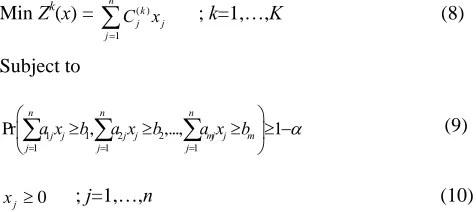
A multi-objective chance constrained programming problem with a joint probability constraint can be stated as
Min Zk(x) = ( ) 1 n
k j j j
C x
=
∑
; k=1,…,K (8)Subject to
1 1 2 2
1 1 1
Pr , ,..., 1
n n n
j j j j mj j m
j j j
a x b a x b a x b α
= = =
⎛ ⎞
≥ ≥ ≥ ≥ −
⎜ ⎟
⎝
∑
∑
∑
⎠ (9)0
j
x ≥ ; j=1,…,n (10)
Where bi's are independent normal random variables with known means and variances. Eq. (9) is a joint probabilistic constraint and 0≤ ≤α 1 is a specified probability. We assume that the decision variables xj's are deterministic. Let the mean and standard deviation of the normal independent random variable bi be given by E (bi) and σ (bi), respectively. Hence the equivalent deterministic model of probabilistic problem can be presented as (Sinha et al. [23])
Min Zk(x) = ( ) 1 n
k j j j
C x
=
∑
; k=1,…, K (11)Subject to
( )
(
)
2
2 2
3
2 1
2 3
i
i
i i
e
β
β π φ β
β
−
≥ +
− ; i=1,…,m (12)
where 1
( )
( )
n
ij j i j
i
i a x E b
b β
σ
=
−
=
∑
( )
1
1
m i i
φ β α
=
≥ −
∏
; i=1,…,m (13)( )
( )
1 n
ij j i i i j
a x β σ b E b
=
− =
∑
; i=1,…,m (14)( )
0≤φ βi ≤1 ; i=1,…,m (15)
0
j
x ≥ ; j=1,…,n (16)
We now present the methodology to solve a multi-objective stochastic programming problem using fuzzy programming approach. The algorithm includes the following steps:
C. Algorithm
Step 1: First, convert the given stochastic programming problem into an equivalent deterministic programming problem by chance constrained programming technique as discussed.
Step 2: Solve the multi-objective deterministic problem obtained from Step 1, using only one objective at a time and ignoring the others. Repeat the process K times for the K different objective functions. Let X (1); X (2); …; X (K) be the respective ideal solutions of the K objective functions.
Step 3: Using the solutions obtained in Step 2, find the corresponding value of all the objective functions at each of the solutions.
Step 4: From Step 3, obtain the upper and lower bounds (Uk
and Lk, k =1,…, K) for each of the objective functions.
Step 5: Using a linear membership function, formulate a crisp model. By introducing an augmented variable formulate single objective non-linear programming problem.
Hence, the model can be formulated as
Max λ (17)
Subject to
( )k
( ) (
)
k k k
Z x + U −L λ≤U ; k=1,…,K (18)
(
)
2
2 2
3
2 1
2 3
i
i
i i
e y
β
β π
β
−
≥ +
− ; i=1,…,m where
( )
i i
y =φ β (19)
1
1
m i i
y α
=
≥ −
∏
(20)( )
( )
1 n
ij j i i i j
a x β σ b E b
=
− =
∑
; i=1,…,m (21)0≤yi≤1 ; i=1,…,m (22)
1, 2,..., n 0
x x x ≥ (23)
0
λ≥ & β β1, 2,...,βm are unrestricted in sign
[image:3.612.47.285.243.349.2]V. NUMERICAL EXAMPLE
Table 1 summarizes the data that form the numerical example. We consider the following assumptions:
1. The processing times (Pi) is integers and is generated
from a normal distribution.
2. The due dates (di) are computed by di =μPi × N ×
(1-M) as given in [1]. N is the number of jobs and M the uniformly random number between 0 and 1.
3. The ready times (Ri ) are generated from a uniform
distribution on [1, 10],
4. The jobs’ weights (wi) are uniformly generated from
Table 1. Generated data
Job
s Pi
μ i
P
σ d
i Ri wi
1 5 2 13 7 3
2 7 3 18 5 5
3 8 5 20 4 4
4 3 6 8 4 6
5 2 4 5 9 4
A multi-objective single machine scheduling problem with stochastic processing time is presented as follows:
1 1 Z N i i i
Min w C
=
=
∑
(24)2 1 Z N i i i
Min w T
=
=
∑
(25).
.
t
s
,
Pr i i i 0.85 , ;
i j ij i
C R P
i j i j
C C MX P
− ≥
⎛ ⎞
≥ ∀ ≠
⎜ − + ≥ ⎟
⎝ ⎠ (26)
1 , ;
ij ji
X +X = ∀i j i≠ j (27)
{
}
max 0,
i i i
T = C −D ∀i (28)
{ }
0,1 i, j;i jXij∈ ∀ ≠ (29)
We obtain the equivalent deterministic programming problem for the above multi-objective stochastic programming problem by using Eqs. (11)- (16).
MinZ1=
1 N i i i W C =
∑
(30)MinZ2=
1 N i i i W T =
∑
(31) s.t.- - i i , ;
i i P i P
C R σ β =μ ∀i j i≠ j (32)
, ;
i i
i j ij P i P
C −C +MX −σ β =μ ∀i j i≠ j (33)
(
)
(
2)
21.2533141 1 2 3 3 exp
2
i
i i i
y β β ⎛ β ⎞ i
+ − ≤ ⎜− ⎟ ∀
⎝ ⎠ (34)
6 1 0.85 i i y = ≥
∏
(35)1 , ;
ij ji
X +X = ∀i j i≠ j (36)
{
}
max 0,
i i i
T = C −D ∀i (37)
{ }
0,1 , 0 , ;ij i
X ∈ y ≥ ∀i j i≠ j (38)
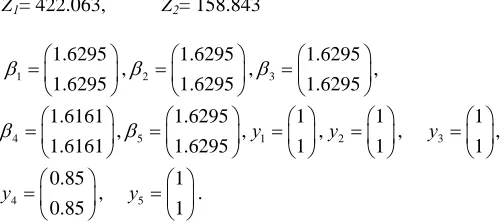
All the computational experiments are carried out with a branch-and-bound (B&B) method in the Lingo 8.0 software by an Intel® 1.61 GHz processor with 512 Mb RAM. Solving the problem for objective Z1 and Z2, The ideal solutions are as
follows:
Z1= 422.063, Z2= 158.843
1
1.6295
1.6295
β = ⎜⎛ ⎞⎟
⎝ ⎠, 2
1.6295
1.6295
β = ⎜⎛ ⎞⎟
⎝ ⎠, 3
1.6295
1.6295
β = ⎜⎛ ⎞⎟
⎝ ⎠,
4
1.6161 1.6161
β = ⎜⎛ ⎞⎟
⎝ ⎠, 5
1.6295 1.6295
β = ⎜⎛ ⎞⎟
⎝ ⎠, 1 1 1
y = ⎜ ⎟⎛ ⎞
⎝ ⎠, 2 1 1
y = ⎜ ⎟⎛ ⎞
⎝ ⎠, 3 1 1
y = ⎜ ⎟⎛ ⎞
⎝ ⎠,
4
0.85
0.85
y = ⎜⎛ ⎞⎟
⎝ ⎠, 5 1
1
y = ⎜ ⎟⎛ ⎞
⎝ ⎠.
Using the linear membership function, we formulate the following fuzzy programming problem:
( ) 1 1 1 1 1
1 422
1222-Z
422 Z 1222 1222 422
0 Z 1222
Z Z μ ≤ ⎧ ⎪⎪ =⎨ − ≤ ≤ ⎪ ≥ ⎪⎩ (39)
( )
2 2 2 2 21 158
958-Z
158 Z 958
958 158
0 Z 958
Z Z μ ≤ ⎧ ⎪⎪ =⎨ ≤ ≤ − ⎪ ≥ ⎪⎩ (40)
Max λ (41)
Subject to
1222-
(
)
1
1222 422
N i i i
W C λ
=
≥ −
∑
(42)958-
(
)
1
958 158
N i i i
W T λ
=
≥ −
∑
(43)- - , ;
i i
i i P i P
C R σ β =μ ∀i j i≠ j (44)
, ;
i i
i j ij P i P
C −C +MX −σ β =μ ∀i j i≠ j (45)
( )
(
2)
21.2533141 1 2 3 3 exp 2
i
i i i
y β β ⎛ β ⎞ i
+ − ≤ ⎜− ⎟ ∀
⎝ ⎠ (46)
6 1 0.85 i i y = ≥
∏
(47)1 , ;
ij ji
X +X = ∀i j i≠ j (48)
{
}
max 0,
i i i
T = C −D ∀i (49)
{ }
0,1 i,j;i jXij∈ ∀ ≠ (50)
Solving the above fuzzy programming problem, we get the compromise solution as
0.59
λ=
Z1= 749.2585, Z2= 480.4814
1 1.6295
β = ,β2=1.6295,β3=1.6295,
4 1.6161
β = ,β5 =1.6295,y1=1,y2=1,y3=1,y4 =0.85,
5 1
The optimal sequence of jobs is shown as follows: J1-J4-J5-J2-J3
V. CONCLUSION
We have considered a multi-objective probabilistic single machine scheduling problem to minimize the total weighted completion time and total weighted tardiness with joint constraints, where only processing time of jobs are considered as independent normal random variables. Using the stated procedures a probabilistic multi-objective single machine scheduling problem with joint constraints can be easily transformed into a deterministic multi-objective non-linear programming problem and then solved by the fuzzy programming technique to obtain the compromise solution.
REFERENCES
[1] D.R. Sule, Industrial Scheduling, PWC Publishing Company, 1997. [2] T. Loukil, J. Teghem and D. Tuyttens, Solving multi-objective
production scheduling problems using metaheuristics, European Journal of Operational Research ,Vol.161,pp. 42-61, 2005.
[3] H. Ishii and M. Tada, Single machine scheduling problem with fuzzy precedence relation, European Journal of Operational Research, Vol.87, pp.284-288, 1995.
[4] G.I. Adamopoulos and C.P. Pappis, a fuzzy-linguistic approach to a multi-criteria sequencing problem, European Journal of Operation Research ,Vol.9,pp. 628-636, 1996.
[5] H.T. Lee, S.H. Chen and H.Y. Kang, Multi-criteria scheduling using fuzzy theory and tabu search, International Journal of Production Research ,Vol.40,No.5 ,pp.1221-1234, 2002.
[6] S .Chanas, A. Kasperski, on two single machine scheduling problems with fuzzy processing times and fuzzy due dates, European Journal of Operational Research, Vol.147, pp. 281-296, 2003.
[7] S. Chanas, A.Kasperski, Possible and necessary optimality of solutions in the single machine scheduling problem with fuzzy parameters, Fuzzy Sets and Systems, Vol.142, pp.359-371, 2004.
[8] M. Azizoglu, S. Kondakci, M. Köksalan, Single machine scheduling with maximum earliness and number tardy, Computers and Industrial Engineering ,Vol.45, No. 2 ,pp.257-268,2003.
[9] T. Eren, E. Güner, A bi-criteria scheduling with sequence-dependent setup times, Applied Mathematics and Computation ,Vol.179 ,pp.378-385, 2006.
[10] R. Tavakkoli-Moghaddam, B. Javadi, N. Safaei, Solving a mixed-integer model of a single machine scheduling problem by a fuzzy goal programming approach, Wseas Transactions on Business and Economics ,Vol.3, No.2,pp. 45-52, 2006.
[11] Y. Huo, J.Y.-T. Leung, H. Zhao, Bi-criteria scheduling problems: number of tardy jobs and maximum weighted tardiness, European Journal of Operational Research ,Vol.177,No.1,pp. 116-134, 2007 . [12] Charnes, W.W. Cooper, Chance constrained programming, Management
Science ,Vol.6 ,pp. 73 – 79,1959.
[13] [13] J.K. Sengupta, Stochastic Programming: Methods and Applications, North-Holland, Amsterdam, 1972.
[14] B. Contini, A stochastic approach to goal programming, Operation Research, Vol.16, pp. 576-586, 1978.
[15] J.P. Leclercq, Stochastic programming: An interactive multi-criteria approach, European Journal of Operation Research ,Vol.10 pp.33-41, 1982.
[16] J. Jr. Teghem, D. Dufrance, M. Thauvoye, P. Kunch, Strange: an interactive method for multi-objective linear programming under uncertainty, European Journal of Operational Research, Vol.26, pp.65-82, 1986.
[17] I.M. Stancu-Minasian, M.J. Wets, A research bibliography in stochastic programming, Operation Research, Vol.24, pp.1078-1119, 1976. [18] RE. Bellman, L.A. Zadeh, Decision-making in a fuzzy environment,
Management Science, Vol.17, pp. 141–164, 1970.
[19] H.J. Zimmermann, Fuzzy programming and linear programming with several objective functions, Fuzzy Sets and Systems, Vol.1, pp.45-56, 1978.
[20] E.L. Hanan, On fuzzy goal programming, Decision Science, Vol.12, pp.522-531, 1981.
[21] R. Narsimhan, Goal programming in a fuzzy environment, Decision Sciences, Vol.11, pp.325-336, 1980.
[22] H. Leberling, On finding compromise solutions in multi-criteria problems using the fuzzy min-operator, Fuzzy Sets and Systems, Vol.6, pp.105-118, 1981.