NEW CONCEPT OF E-LEARNING AT PALACKY UNIVERSITY IN OLOMOUC – VISION AND ITS IMPLEMENTATION
Jiří Pospíšil
Department of Continuous Education and Department of Christian Education
Palacký University in Olomouc
Abstract
The paper deals with the development of e-learning at Palacký University in Olomouc – in terms of modern technology and in terms of pedagogical and didactic access. In technological point of view the paper presents a new e-learning environment within the EDIS (Education and Information System) website from the initial vision to the current state of implementation. In the pedagogical and didactic field we focus on the development of knowledge and skills of users – academic staff in the development and implementation of e-learning to support teaching.
Key words: e-learning, new concept, vision, fulfillment, learning object, aggregation, scalability, instructional design
1. INTRODUCTION
The scientific and economical prosperity of each university depends on many factors. One of the most important factors is the quality of study and the second one is number of students. As the Palacky University in Olomouc is attempting to be a research oriented university, the number of the students and quality of the educational process is very important, too. The permanent care of quality increasing and the growth of the number of students of non-present (combined) form of study are the most important reasons why we need to improve quality of the distance form of study and the quality and availability of e-learning for both students and teachers. Distance form of study that uses the comfortable and effective e-learning means (presents) the great opportunity to improve the quality of offered programs and the quality study.
Current combined form of study at Palacky University consists of the regular meetings of teachers and students. These meetings organization depends on study year schedule and takes usually from six to eight 45 minutes lessons per meeting. In the summary the range of one year in combined form takes about 100–130 hours without distance elements (e-learning). For comparison: the present form students spend more than four times more time in the school per year. The distance form (with e-learning support) allows us to compensate the difference between present and non-present form of study and enhance the quality of combined form of study. The internal screening among the teachers and students showed us that the success of massive e-learning use depends at least on two factors: by the good didactical and technical preparation of teachers for creating e-learning courses and teaching using it and the very easy to use completely online e-learning environment.
The results of the screening (previously mentioned) led the university department of distance learning to very uneasy situation. Existing learning management system (externally developed LMS Unifor) has been used for several years on five of eight faculties of the university but it surely didn’t correspond to the identified requirements, especially in the area of creation the e-learning courses. The creation of courses was very uncomfortable and needed very extensive support of ICT experts which increased massively the price of created courses. The idea of wide expansion of e-learning for thousands subjects was therefore unreal. On the other side there existed the possibility to use for example Moodle as the very common open source e-learning environment with many attractive extensions. This way was very tempting for the system stability and huge worldwide community. Against this option were actually only three objections: the course creation in Moodle was still very
complicated especially in the cases of multimedia and video streaming, the connection between Moodle and university information system required quite a lot of programming and there were no certainty that the Moodle interfaces will be unchanged in the future and, finally, the Moodle did not support well the very important property for us which was the reusability of objects. These problems connected with the fact that the implementation of Moodle will cost almost the same as the own development of new system led to the final decision to prefer the own system development. This new learning management system must be ready for our needs and fully respect the university environment and information system.
2. THE VISION
2.1 Key theoretical background and concepts
While looking for the best theoretical model of learning which could be the base of our e-framework, we founded the model presented by Wiley (2000) where the connection between instructional design theory (Reigeluth, 1999) and learning objects was presented. This theory is very based on the concept of learning object, which is understood as “any entity, digital or non-digital, that may be used learning, education or training” (IEEE, 2002). The learning object as it is defined has many properties important for the both educational and IT point of view, especially reusability, generativity, adaptability and scalability (Gibbons, Nelson, & Richards, 2000). It is notable that the learning object based approach is very close to the complex state of IEEE Learning Technology Standard Committee (LTSC) who defined more technical standards important for our conception (IEEE 2002, IEEE 2005, IEEE 2007, IEEE 2012 etc.) and potential sharing of e-learning data.
To find learning object as the base of new e-learning vision was only the first step on the way to the complex system. We founded the learning object based e-learning must have several key features and properties without which it couldn’t be successful in the university environment. The most important among these properties are:
• Simplicity in the area of creation and modification the learning objects and its parts • Availability in every day and night time.
• Simple scalability of learning objects components – the making learning object must be easy like puzzle.
• Simple learning objects aggregability to the more complex structures (we identified the optimal higher structures as themes, thematic blocks and over all the distance learning instrument which is connected and corresponds directly to the study subject); the aggregation has to be made also like folding puzzle.
• Attractive and comfortable design of the authors, teachers and students instruments.
• Easy composition of the evaluation instruments which are necessary connected to the concrete e-learning object or higher aggregated unit; the evaluation instruments (such as the test questions, tests itself, short tasks or essays) must be transferred with the object (or higher structure) in the case of reusability and inherited to the higher aggregated units in the case of aggregation to the complex structures.
• Easy and clear system of interconnections between study subjects (from university study agenda) and distance learning instruments.
• Comfortable communication instruments (like chat, discussions, messages etc.).
2.2 Learning objects
In our vision the conception of the learning object was not only defined by its content but also by its metacontent (or metadata) which defines its complex properties, for example type of content, dates of
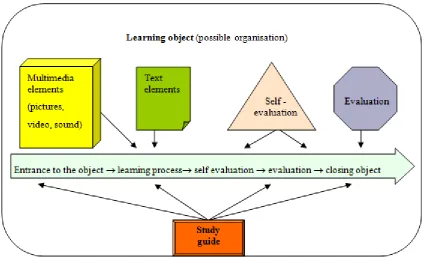
creation and modification, version etc. Against the basic definition the learning object content was also understood as the complex educational unit which has important educational properties such as introduction, instructional guide, evaluation and self-evaluation instruments, scalable internal text or multimedia contents and the closing summary. Our vision of learning object could be presented as the “box” with organized learning content, see fig. 1.
Fig. 1 Learning object model
2.3 Scalability and reusability of learning objects
Scalability is a learning object property which allows the learning object to be connected with others to the complex structures. According to scaled learning objects design we distinguished three essential types of scalability (Podškubková – Pospíšil, 2006, 39 – 42):
a) Historical – in this type of scalability the one learning object content follows some previous and forestalling some next. Objects form the timeline and are contextually dependent. Typical application of this aggregation type is in history, philosophy, literature and generally each case we want show the theme evolutionary.
Fig. 2 Historical aggregation of learning objects
b) Thematic – learning objects in this type of scalability are connected by specific general theme. Objects in this type are usually contextually independent and the main theme could be the higher level of abstraction or system. Typical application of this type is in natural sciences (mathematics, biology, physics, chemistry).
Fig. 3 Thematic aggregation of learning objects
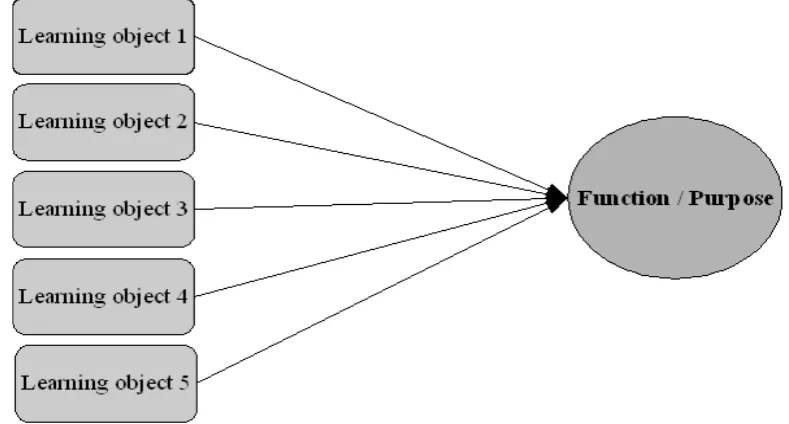
c) Functional – learning objects of this type are joined by some purpose. Individual problems are collected into blocks because for example the connected subject is special introduction for some other disciplines or themes. This kind of scalability is suitable for disciplines called like “Selected themes from …”, “Introduction into…”, “Preliminary seminary of …” etc.
Fig. 4 Functional scalability of learning objects
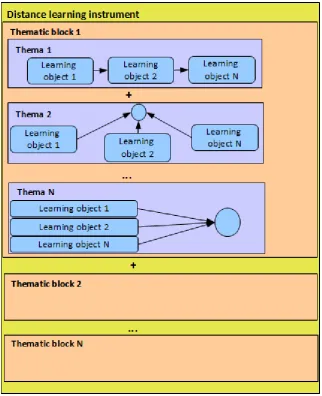
One of the most important learning object properties is reusability. Learning object is reusable, if it could be used in different educational contexts. Using objects in different context suppose the system of learning objects aggregation and levels of this aggregation. As I mentioned before we distinguished three levels of learning objects aggregation: themes, thematic blocks and the whole distance learning instruments connected directly to the educated subjects. The hierarchy (see fig. 5) is
not closed and learning objects as well as the concrete element (text, picture, video etc.) can be placed anywhere in the structure and also later can be dragged and dropped anywhere else. There are only higher hierarchy rules that don’t allow place the higher aggregated block (e. g. thematic block) under the lower one (e. g. thema). Each author can use the database of his own learning objects and elements stored in the folder organized depository. All stored objects are available under authorization and therefore if some author authorizes others to use his learning objects and elements are these components available for all authorized persons. This principle allows us to make wider author collectives and it also opens the way for wider sharing the high quality learning objects among the university.
Fig. 5 Aggregation model
3. THE REALIZATION
The vision of the new e-learning conception has been finally completed in 2011 when the university had submitted the application of grant project “Support of Interdisciplinary studies and Study Programmes Innovations at Palacký University in Olomouc” in the EFS Operational Programme Education for Competitiveness 2007 - 2013. This project has been approved and that was indeed the key moment for the realization of our new e-learning vision because we got the money for programmers, technical and methodical support and for the teachers who could make the concrete
innovations of their subjects. The project realization has started in the beginning of 2012 and the completion is planned in the end of year 2014.
As the project team began to work properly there was very hard task to prepare the basic e-learning environment for authors in the first half of the year 2012. This critical task has been successfully completed and in the second half of the year 2012 the first version of environment was deployed and the creation of new e-learning courses could begin. The new e-learning environment has been named EDIS (Education and Information System) of the Palacky University (http://edis.upol.cz) and it has been programmed with greater potential, f. e. to be the new universal information system of university. In the same time began the courses called Didactics of Distance Education (oriented on course creation) and Modern Educational Methods (oriented on educational praxis with the new courses) which are designed to teachers as the introduction to the new e-learning world of creation and practical education. The project has been started in cooperation of five faculties (Faculty of Law – 135 subjects, Sts. Cyril & Methodius Faculty of Theology – 109 subjects, Faculty of Health Sciences – 50 subjects, Faculty of Physical Culture – 31 subjects and Faculty of Science – 5 subjects). Due the realization the Faculty of Arts has joined the project aims and initiated the transfer from old to new e-learning environment.
From the year 2012 till today over seven hundred complex distance learning instruments has been created and these instruments are divided into more than 8500 learning objects. The group of teachers using the new e-learning environment grows up every day and now counts over 230 academicians of the university. The most important thing for the teachers who create the new learning objects as well as the more complex distance learning instruments is the independence from the technicians in the process of creation even in the cases of using the videos, sounds or pictures. All this elements are comfortably insertable from their homes or offices in any day/night time and doesn’t need any assistance except in special cases.
The educational praxis during the implementation of the created instruments into teaching is very different and depends on the rules of each faculty and department on which the concrete subject is educated. Many departments use the e-learning instruments only as the support of regular lectures, many other as the complex educational instrument including the students work submitting and tests making. As we knew before, this praxis is and will be increasingly dependent on the local conditions of the education and this fact was one of the most important premises of the whole project. It was not our aim to unify the educational process but to bring the unified instrument for different use.
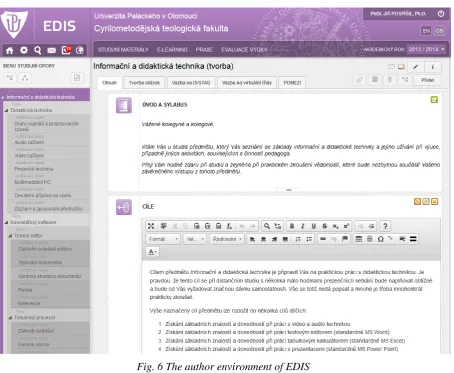
Fig. 6 The author environment of EDIS
4. STUDENT EVALUATION
It would seem that we succeeded with meeting the aims of our vision but there still remained unanswered question whether the new system is comfortable and useful for students as well as for the teachers. That was why we started wide questioning and evaluating of both the system and the prepared study instruments. The evaluation questionnaire consisted of 23 questions but the most important was the last one: “What was your overall impression of the course?” In the academic year 2013/2014 we got 12369 evaluations from students appointed to the projects. We were very pleasantly surprised that from this highly representative number of evaluations 36, 83 % of students answered the realization was excellent, 40, 46 % evaluated it as very good, 17, 75 % as good, 3, 44 % as sufficient and only 1, 52 % as insufficient. These extremely positive numbers forged us that the vision and way of changes we started was right and also that we have to continue with increasing the quality of these services for students.
5. CONCLUSION
The project of new e-learning implementation at the Palacky University now goes to the finish. We started many changes not only in the area of technology but especially in the minds of our teachers and students. We showed that the massive application of e-learning is possible, leads to the progress of the university teaching methods and increase the productivity of educational process. We also demonstrated that there is no unified way of preparation and realization of courses but when we provide the adequately, free and comfortable environment the teachers, and even those older, are
willing to create their own courses with enthusiasm. Certainly there always will be the teachers who reject the e-learning form but I believe they will be in the minority.
In addition, we confirmed the assumption the e-learning couldn’t be the only learning form in almost any subject and the combination of present form and distance e-learning is the completely possible and effective way for the future education.
REFERENCES
IEEE 2002, 1484.12.1-2002 IEEE Standard for Learning Object Metadata.
IEEE 2005, 1484.12.3-2005 IEEE Standard for Learning Technology-Extensible Markup Language (XML) Schema Definition Language Binding for Learning Object Metadata.
IEEE 2007, 1484.20.1-2007 IEEE Standard for Learning Technology - Data Model for Reusable Competency Definitions.
IEEE 2012, 1484.13.1-2012 IEEE Standard for Conceptual Model for Resource Aggregation for Learning, Education, and Training.
Gibbons, AS, Nelson, J & Richards, R 2000, ‘The nature and origin of instructional objects’ in DA Wiley (ed.), The instructional use of learning objects. Association for Educational Communications and Technology, Bloomington, IN, USA.
Podškubková, J & Pospíšil, J. (eds.) 2006, Didaktika distančního vzdělávání v prostředí vysoké školy, Univerzita Palackého, Olomouc.
Reigeluth, CM 1999, ‘The elaboration theory: Guidance for scope and sequence decisions’ in CM Reigeluth (ed.), Instructional design theories and models: A new paradigm of instructional theory, Hillsdale, NJ: Lawrence Erlbaum Associates, pp. 5-29.
Wiley, DA 2000, ‘Connecting learning objects to instructional design theory. A definition, a metaphor, and a taxonomy’. [online], viewed 16. July 2014, <http://reusability.org/read/chapters/wiley.doc>
NOTE
The publication of this paper was supported by the grant of Internal grant agency of Palacky University in Olomouc CMTF_2014_17 Values Education focused On the Target Groups of the Social Pedagogy.