R E S E A R C H
Open Access
Probabilistic distance-based quantizer
design for distributed estimation
Yoon Hak Kim
Abstract
We consider an iterative design of independently operating local quantizers at nodes that should cooperate without interaction to achieve application objectives for distributed estimation systems. We suggest as a new cost function a probabilistic distance between the posterior distribution and its quantized one expressed as the Kullback Leibler (KL) divergence. We first present the analysis that minimizing the KL divergence in the cyclic generalized Lloyd design framework is equivalent to maximizing the logarithmic quantized posterior distribution on the average which can be further computationally reduced in our iterative design. We propose an iterative design algorithm that seeks to maximize the simplified version of the posterior quantized distribution and discuss that our algorithm converges to a global optimum due to the convexity of the cost function and generates the most informative quantized
measurements. We also provide an independent encoding technique that enables minimization of the cost function and can be efficiently simplified for a practical use of power-constrained nodes. We finally demonstrate through extensive experiments an obvious advantage of improved estimation performance as compared with the typical designs and the novel design techniques previously published.
Keywords: Distributed compression, Distributed source coding (DSC), Quantizer design, Posterior distribution, KL divergence, Generalized Lloyd algorithm, Source localization, Sensor networks
Abbreviations: ARE, Asymptotic relative efficiency; DOQ, Distributed optimized quantizer; DSC, Distributed source coding; EDQ, Equally distance-divided quantizer; KL, Kullback Leibler; LE, Localization error; LSQ, Localization-specific quantizer; ML, Maximum likelihood; PDQ, Probabilistic distance-based quantizer; PDQ-R, Probabilistic distance-based quantizer-reduced; R-D, Rate-distortion; SFQ, Score-functional quantizer; SNR, Signal-to-noise ratio
1 Introduction
In distributed estimation systems where spatially sep-arated sensor nodes are battery-powered and operate under strict limitations on wireless communication band-width, the sensor nodes measure the parameter of inter-est, quantize their measurements, and send the quantized data to a fusion node which then performs estimation of the parameter. It is reported that the rate-distortion per-formance can be greatly improved by adopting efficient quantizers at nodes as compared with simple uniform quantizers.
In distributed source coding (DSC) framework where nodes at different locations collect data and transmit them
Correspondence: [email protected]
Department of Electronic Engineering, College of Electronic & information Engineering, Chosun University, 309 Pilmun-daero, Dong-gu, 61452 Gwangju, Korea
to a fusion node, practical design techniques for quantiz-ers have been reported [1–3]: to achieve the Wyner-Ziv bound, trellis codes for DSC that are computationally efficient were proposed in [1]. An iterative design for quantizer in the Lloyd algorithm framework was shown to further reduce the distortion by producing the non-regular scalar quantizers, implying that several disjoint intervals can be mapped to a single codeword [2]. In addition, since various practical design algorithms have been developed in the Lloyd algorithm framework, they can be typically affected by initialization of quantizers, leading to numerous poor local optima. Thus, to over-come this, an iterative algorithm was proposed by using a deterministic annealing technique for a robust DSC sys-tem [3]. An iterative algorithm for construction of the optimal quantization partitions was studied in distributed estimation systems [4] where computation of the estima-tor function used in encoding of such partitions may be
practically prohibitive. To avoid the encoding complexity, a suboptimal approach (i.e., linear estimator) was con-sidered for quantizer design [5]. Under the assumption of one-bit message from nodes to fusion node, univer-sal decentralized estimation schemes were investigated [6] and distributed estimators were derived for pragmatic signal models [7]. A brief investigation for quantization in distributed estimation and classification systems was presented in [8].
Since standard quantization focuses on minimization of a local metric (e.g., reconstruction error of local sensor readings), it should be modified to optimize at each step a global metric such as estimation error: more specifi-cally, the two main tasks in the Lloyd design framework (i.e., quantization partition construction and the corre-sponding codeword computation) should be dedicated to minimizing the estimation error. However, the design dif-ficulty arises since the quantization partitions constructed to minimize the estimation error are not generally inde-pendently encodable at each node: that is, encoding (or mapping) of local measurements into one of the quanti-zation partitions would be possible after computing the global metric, which is not accessible at each node where only local measurements are available.
To circumvent the difficulty, a distributional distance between the distributions under two hypotheses was sug-gested as a global metric for quantizer design to yield a manageable design procedure [9]. A distance-based metric to measure the loss due to quantization was adopted for uniform or nonuniform quantizers in the high-resolution regime [10]. A vector quantization tech-nique that minimizes the Kullback Leibler (KL) divergence was proposed for distribution matching [11]. An iterative design algorithm that maximizes the minimum asymp-totic relative efficiency (ARE) was proposed, illustrating that the score-functional quantizer (SFQ) would be opti-mal so as to maximize the minimum ARE for distributions with the monotonicity property [12]. For acoustic sen-sor networks, a distance error at nodes was proposed in the functional quantization framework to ensure con-vergence in an iterative process [13]. A weighted sum of both of the metrics was proposed as a cost function (i.e., local +λ × global) along with a search for proper weights that guarantee construction of the encodable quantization partitions while maintaining the non-increasing cost func-tion at iterafunc-tions [14], showing a significant performance gain over typical designs. To reduce design complexity, efficient algorithms that allow us to search sequentially the boundary values of the quantization intervals in scalar quantizers have been developed [15, 16].
It was also observed in [17] that multiple disjoint quan-tization bins at nodes can be merged to a single bin or a single codeword without performance loss for distributed estimation systems. The merging technique determines
the true bin transmitted from the node of interest by tak-ing into account the measurements from other nodes, hence achieving a significant rate reduction. In addition, an iterative quantizer design algorithm was proposed [18] to incorporate non-regularity into design process, imply-ing the correspondence between multiple disjoint parti-tions and a single codeword: specifically, the bins (e.g., intervals in scalar quantizers) are regarded as the elements that will be processed for mapping to their corresponding codewords (or reconstruction values), resulting in disjoint Voronoi regions (e.g., union of multiple intervals in scalar quantizers). Recently, a novel encoding scheme of assign-ing multiple codewords to each quantization partition was proposed to implement a low-weight independent encoding of the optimal partitions [19].
In this paper, we consider an iterative design of inde-pendently operating local quantizers at nodes in the Lloyd algorithm framework. Instead of directly minimizing the estimation error, we choose to use an indirect metric related to the posterior distribution. Specifically, we define quantization of the posterior distribution and focus on minimizing the probabilistic distance between the pos-terior distribution and its quantized version as a global cost function. We first express the cost function as the KL divergence which typically causes a high computa-tional cost. We develop a feasible design procedure by presenting the analysis that minimizing the KL divergence is equivalently reduced to maximizing the logarithmic quantized posterior distribution on the average which is properly further simplified as a new cost function, yielding a substantial reduction in design complexity. We discuss that the proposed algorithm converges to a global opti-mum due to the convexity of the cost function in the quantized posterior distribution [20], which is experimen-tally examined by showing that our design operates robust under various test conditions. We also show that the pro-posed quantizer generates the most informative quantized measurements, which would be efficiently used by estima-tion techniques at fusion node to improve the estimaestima-tion performance.
metric. In this work, it is assumed that the sensor nodes do not exchange data with each other; they send their mea-surements to a fusion node via reliable communication links.
This paper is organized as follows. The problem for-mulation of the quantizer design is given in Section 2. A new cost function is introduced and properly incor-porated into our iterative design algorithm in Section 3. Discussions of performance of the proposed algorithm and design complexity for our encoding technique are provided in Section 3.1 and Section 3.2. An application example for the proposed algorithm is briefly presented in Section 4. Simulation results are given in Section 5, and the conclusions are found in Section 6.
2 Problem formulation
We consider a distributed estimation system where M sensor nodes are randomly deployed at known spatial locations,xi ∈ R2,i = 1,. . .,M. Each node senses the signals generated from the unknown parameterθ ⊂ RN and sends its measurement to a fusion node for estimation of the parameter. Assuming the sensing model fi(θ,xi) employed at nodei, the measurement at nodeidenoted byzican be expressed as follows:
zi(θ) = fi(θ,xi)+ωi, i = 1,. . .,M (1)
where the measurement noiseωiis assumed to be approx-imated by normal distributionN(0,σi2), and the measure-ments are also assumed to be statistically independent of each other given the parameter; that is,p(z1,· · ·zM|θ)=
M
i=1p(zi|θ). Each node uses an Ri-bit quantizer with quantization level Li = 2Ri and the dynamic range Di =
zimin zmaxi . Note that the quantization range Dican be determined for nodes, based on their respective sensing ranges. Each node quantizes its measurement and generates the codewordzˆiforziaccording to its encoding rule (e.g., minimum Euclidean distance rule). For exam-ple, if the measurementzibelongs to thejth quantization partition Vij by using its encoding rule, the node i will transmit thejth codewordzˆjito a fusion node which pro-duces an estimate of the parameter,θˆfrom the received quantized measurements, zˆi,i = 1,. . .,M from all nodes.
Notation: A large proportion of our notation will be introduced as needed. However, a couple of basic notations will be given now: the bold characters zM1 andzˆM1 indicate a vector of measurements (z1,· · ·,zM) and a vector of codewords (zˆ1,· · ·,zˆM), respectively, and the parameter θ is treated as a vector of param-eters (θ1,· · ·,θN). In addition, zM1/i is the shortened notation for a vector of M − 1 measurements
(z1,· · ·,zi−1,zi+1,· · ·,zM), implying that the subscript iindicates the element omitted from the set of measure-ments.
2.1 Criteria for quantizer optimization
Obviously, quantizers optimized in the Lloyd framework for distributed estimation systems should seek to mini-mize the estimation error, θ − ˆθ 2 which a function of all of the codewords generated fromMnodes involved. Thus, the quantization partitions and their corresponding codewords are iteratively generated to reduce the estima-tion error at each step while such quantizaestima-tion partiestima-tions remain independently encodable at each node.
To ensure the independent encoding and minimiza-tion of the estimaminimiza-tion error which are the two crucial conditions for quantizer design algorithms in distributed estimation systems, several global metrics related to the estimation error were previously developed: the distri-butional distance [9] for distributed detection and the global distance function for distributed estimation [13]. In this perspective, we suggest quantization of the posterior distributionp(θ|zM1)and seek to design local quantizers that minimize the probabilistic distance betweenp(θ|zM1) and its quantized distribution which can be expressed as the KL divergence [20]. We show that using the dis-tance as a new cost function provides several benefits for quantizer design in distributed estimation: first, min-imizing the probabilistic distance results in quantizers that generate the codewords maximizing the logarithmic quantized posterior distribution logp(θ|ˆzM1)on the aver-age, thus improving the estimation accuracy. Second, the independent encoding can be efficiently performed since the probabilistic distance is computed based onp(θ|zM1) andMquantizers, not requiring the actual measurements at the other nodes. Third, it could allow us to estab-lish a global encoding of local measurements into their quantization partitions which would not be achieved by typical encoding rules (e.g., minimum Euclidian distance rule) used for previous novel design techniques. The ben-efits of our algorithm will be elaborated in the following sections.
3 Quantizer design algorithm
We consider for a given rate Ri,i = 1,· · ·,M the problem of designing independent local quantizers that minimize the KL divergence between the posterior distri-butionp(θ|zM1)and its quantized one denoted byq(θ|zM1) which is defined from quantization ofp(θ|zM1): formally,
qθ|zM1 = pθ|ˆzM1, Qi(zi) = ˆzi,i = 1,· · ·,M (2)
First, we simplify our metric denoted by DKL
pθ|zM1||qθ|zM1 to avoid unnecessary computa-tions for quantizer design at each node. By definition of the KL divergence, we have
DKL =
Noting that the first term is irrelevant to minimization of the metric over quantizers Qi, we can find the quantiz-ersQ∗ =[Q1,· · ·,QM] minimizing the KL divergence as
Thus, our problem is reduced to that of designing a set of quantizers that maximize the metricEθ,zM
1 logq
θ|zM1 . It should be noticed that we optimize a quantizer at each node, while quantizers for the other nodes remain unchanged. This is done successively for each sensor node and repeated over all nodes until a stopping criterion is satisfied. This notion allows us to make a further simpli-fication of the metric for faster computation by removing irrelevant terms:
where (5) follows from independence of zM1 given the parameter and (6) follows from the observation that the first and the second terms in (5) are irrelevant for quan-tizer design at node i. Note that q = p zˆji|θ when zi is assigned to the jth quantization partition or the jth codeword.
Now, we are in a position to consider the quantizer design process in the generalized Lloyd design framework. First, we construct the Voronoi region so as to maximize (6) as follows:
Second, we compute the codeword corresponding toVij in a similar manner:
It should be observed that in real situations, local quantizers should operate independent of other quantiz-ers. Hence, an independent encoding would be a crucial requirement for such quantizer designs. We present the encoding technique that assigns a local measurement zi to one of the quantizer partitions so as to maximize the metric employed in the design as follows:
Vij∗=arg max
Obviously, the encoding process in (9) is carried out by usingp(zM1|θ)andMquantizers without requiring actual measurementszM1/iat the other nodes.
3.1 Remarks on optimality and performance
Since the proposed algorithm is conducted in the general-ized Lloyd design framework, it would suffer from numer-ous poor local optima. However, the metric (3) is shown to be convex in the quantized distributionq(θ|zM1)given p(θ|zM1 )(see [20] for the proof ), implying that any local minimum must be a global minimum. In addition, the quantized distribution is uniquely determined by quan-tizers (refer to (2)) and designing quanquan-tizers that reduce the metric at each step is equivalent to finding the cor-responding quantized distributions. Thus, it is concluded that our algorithm always results in quantizers that glob-ally minimize the metric and thus provide robustness to various design factors.
It has been also shown from (4) that minimizing DKL
eachzM1 and simplifying it in the high-resolution regime as follows:
Q∗ = arg max Q1,···,QM
θ
pθ|zM1logqθ|zM1
= arg max Q1,···,QM
θ
pθ|zM1logpθ|ˆzM1 (10)
≈ arg max Q1,···,QM
θ
pθ|ˆzM1logpθ|ˆzM1 (11)
= arg min Q1,···,QM
Hθ|ˆzM1 =QM1 zM1 (12)
where (10) follows from the definition of qθ|zM1 , (11) is derived from the high-resolution assumption, and (12) is obtained from the definition of the conditional entropy Hθ|ˆzM1. Since the entropy can be minimized by choos-ing the most informative distributionspθ|ˆzM1 , our quan-tizers would generate the most informative quantized measurements, yielding a good estimation accuracy which will be investigated by conducting extensive experiments in Section 5.
3.2 Reduction of encoding complexity
It should be emphasized that one of the benefits of our algorithm is the encoding technique that operates on local measurements and at the same time optimizes our global metric whereas most of the previous designs employ the minimum Euclidean distance rule to independently assign local measurements to the predetermined quantization partitions. In our design, encoding ofzito one of the par-titions is independently executed in a system-wide sense that the metricElogqθ|zM1is maximized, although such encoding requires a high computational cost at nodes.
In this section, we consider a computational reduction in the encoding complexity for a practical use of power-constrained sensor nodes in distributed systems. Noting that givenzi, the region ofθdenoted byAθ(zi)withp(θ∈ Aθ(zi)|zi) ≈ 1 can be easily constructed, the indepen-dent encoding in (9) could be approximately conducted as follows:
Vij∗≈arg max j Eθ∈Aθ
p(zi|θ) logp zˆji|θ
−EzM
1/i∈Bθ|θlogp zˆ M
1/i,zi = ˆzji
(13)
whereBθis a set of the measurements at other nodes and can be substantially reduced again by using Aθ: that is, Bθ ≈
zM1/i(θ):θ ∈Aθ
. This further approximation will reduce the encoding complexity dramatically.
3.3 Summary of algorithm
The design algorithm at node i is summarized as fol-lows and is iteratively executed over all sensor nodes i = 1,. . .,M.
Algorithm 1Iterative quantizer design algorithm at sen-sor i
Step1: Initialize the quantizer Qi(zi). Set thresholdsand iteration indexκ=1.
Step2: Construct the quantization partition Vij,j =
1,· · ·,Liusing (7).
Step3: Compute the codeword for each partition using (8).
Step4: Compute the metric in (6) denoted by Pκ.
Step5: IfPκ−Pκ−1
Pκ < stop; otherwise continue.
Step6: Replacezˆijbyzˆij∗, Setκ =κ+1and go to Step2.
4 Application of quantizer design algorithm In this section, as an application system of our design algorithm, we briefly introduce a source localization sys-tem where M nodes equipped with acoustic amplitude sensors measure signal energy generated from a source located at an unknown locationθ ∈R2and quantize the measurements before sending them to a fusion node for localization. In expressing the signal energy measured at nodes, we adopt an energy decay model which was pro-posed and experimentally verified in [21] and employed in [22, 23]. The signal energy measured at nodeidenoted by zican be expressed as follows:
zi(θ) = gi a θ−xiα +
wi, (14)
wheregi is the gain factor at nodeiandα is the energy decay factor which is approximately equal to 2 in free space. Note that a sound source generates acoustic energy which will attenuate at a rate inversely proportional to the square of the distance in free space [24]. The signal energy awhich can be jointly estimated with the source location [25] is assumed to be known during localization process. It is also assumed that the measurement noisewican be approximated using a normal distribution,N(0,σi2).
5 Simulation results
Experiments are extensively conducted to investigate the effectiveness of different design algorithms and the sensitivity to parameter perturbation and variation of noise level. Furthermore, since typical sensor networks employ many sensor nodes in a large sensor field, we also consider a larger sensor field 20 × 20 m2 to test our algorithm over typical designs. In the experiments, performance evaluation is carried out by comparing the average localization errorEθ− ˆθ2computed from the maximum likelihood (ML) estimation technique for fast computation.
5.1 Comparison with traditional quantizers
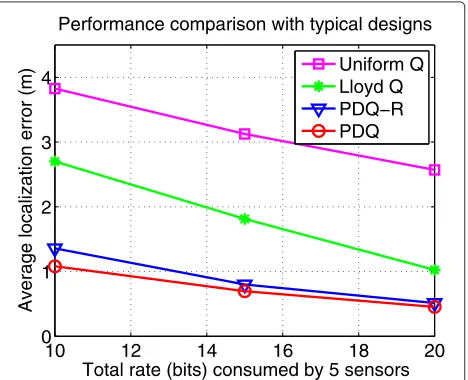
First, our quantizer is compared with typical standard designs such as uniform quantizers and Lloyd Q in Fig. 1 where the localization error (meter) is averaged over 100 node configurations for each rate Ri. For a clear comparison, the overall rate-distortion (R-D) curves are depicted for the different quantizations. As expected, PDQ provides a significant performance gain over tradi-tional quantizers since our proposed algorithm iteratively finds the probabilistic distance-based mapping that gen-erates better quantized measurements in a sense of bet-ter quantized posbet-terior distribution. It should be further noticed that PDQ-R also shows a considerable perfor-mance improvement, implying justification of the approx-imation to derive our low-complexity encoding technique in (13).
5.2 Performance evaluation: comparison with the previous novel designs
We further examine the performance of the proposed design algorithm by comparing with the previous novel
10 12 14 16 18 20
0 1 2 3 4
Performance comparison with typical designs
Total rate (bits) consumed by 5 sensors
Average localization error (m)
Uniform Q Lloyd Q PDQ−R PDQ
Fig. 1Comparison of PDQ with typical design techniques. The average localization error is plotted vs. the total rate consumed byM
nodes
design techniques such as the localization-specific tizer (LSQ) in [14] and the distributed optimized quan-tizer (DOQ) in [18]. Note that both of them have been developed as distributed source coding (DSC) techniques for distributed estimation systems and tested for source localization in acoustic amplitude sensor networks in the previous work. In designing quantizers, we initial-ize them with the equally distance-divided quantinitial-izer (EDQ) to avoid possibly poor local minima. Note that EDQ can be simply designed by uniformly dividing the sensing distance, not the dynamic range of the mea-surement. EDQ shows good localization performance so as to be used as an efficient initialization for quantizer design [14, 26].
In the experiments, we collect the two test sets from 1000 random source locations with the measurement noiseσi = 0 andσi = 0.15, respectively, for evaluation. The R-D curves for the design techniques are illustrated in Fig. 2. Surprisingly, PDQ outperforms LSQ mainly because our algorithm enables the global encoding (in our case, probabilistic distance-based encoding) whereas LSQ operates by a regular encoding (i.e., minimum Euclidean distance rule). In addition, our quantizer performs well with respect to DOQ which adopts a non-regular map-ping with a huge design complexity (see the details in [18]). Note that our algorithm focuses on minimization of the probabilistic distance caused by quantization, not directly optimizing the estimation accuracy. Nonetheless, PDQ offers a noteworthy performance improvement as compared with the previous novel designs, which can be explained from the analysis that our algorithm always produce a global optimum equipped with the powerful encoding technique whereas the others suffer from poor local optima that operate on a local distance rule.
10 15 20
0 0.5 1 1.5 2 2.5
Average localization error (m)
LSQ DOQ PDQ
10 15 20
0 0.5 1 1.5 2 2.5
Total rate (bits) consumed by 5 sensors Performance evaluation with respect to novel designs
LSQ DOQ PDQ
5.3 Sensitivity analysis of design algorithms
In this section, we first examine the proposed algorithm by making perturbation of the mode parameters from those assumed in the design stage. We further need to investigate the performance of the different design algo-rithms in the presence of the measurement noise since the quantizers are designed by using the training sets gen-erated from the assumption of noiseless measurements (σ = 0). It could be expected that our proposed algo-rithm will show a strong robustness to various design factors since it pursues a global optimum.
5.3.1 Sensitivity of PDQ to parameter perturbation
In this experiment, PDQ is tested under various types of parameter perturbation. We varied one of the model parameters (i.e., decay factorα and gain factorgi) from what was used during the training stage of quantizers for each test. It is assumed that the true parameters are avail-able at a fusion node for localization to inspect only the effect of the quantizer design on the localization perfor-mance. Note that the assumption is quite reasonable since the localization algorithms provide good robustness to the parameter perturbation (see [25]). The experimental results are given in Table 1. As expected, PDQ shows bet-ter robustness to variation of the gain factor than that of the decay factor since the latter causes more severe distor-tion in local measurements. Obviously, our design oper-ates very reliably in the presence of a small perturbation of the model parameters.
5.3.2 Sensitivity of design algorithms to noise level
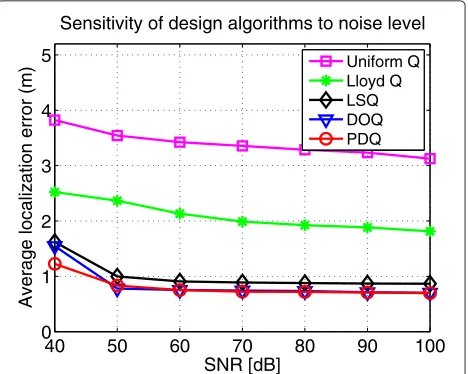
In this experiment, we study the sensitivity of various design algorithms to noise level. For each configuration, a test set of 1000 source locations with signal-to-noise ratio (SNR) in the range from 40 dB to 100 dB is generated by varyingσ. Assuming the source signal energyais known, the SNR is measured at 1 m from the source by using 10 log10σa22. For typical applications, the variance of
mea-surement noise amounts toσ2 = 0.052 (= 60 dB) and can be often much higher than 40 dB for practical vehicle targets [21, 23]. As can be seen in Fig. 3, PDQ performs quite well with respect to the other novel designs in noisy cases.
Table 1Localization error (LE) of PDQ withRi = 3 due to variations of the model parameters
Decay factorα 1.8 1.9 2 2.1 2.2
LE (PDQ) 1.5484 0.9270 0.7038 0.9535 1.5936
Gain factorgi 0.8 0.9 1 1.1 1.2
LE (PDQ) 1.2213 0.8614 0.7017 0.7841 0.9928
LE = 1 100
100
l=1El(x− ˆx2), whereElis the average localization error for thelth five-sensor configuration and is expressed in meter
40 50 60 70 80 90 100
0 1 2 3 4 5
Sensitivity of design algorithms to noise level
SNR [dB]
Average localization error (m)
Uniform Q Lloyd Q LSQ DOQ PDQ
Fig. 3Sensitivity to noise level. The average localization error is plotted vs. SNR (dB) withM = 5,Ri = 3 anda = 50
5.4 Performance analysis in a larger sensor network: comparison with traditional quantizers
In this section, we evaluate our design algorithm in larger sensor networks by comparing with typical designs. In this experiment, we generate 20 different sensor con-figurations in a larger sensor field, 20 × 20 m2 for M = 12, 16, 20. For each sensor configuration, our quan-tizers are designed with a given rate ofRi = 3 and the same dynamic range as in the experiments conducted in a 10×10m2sensor field. The localization results are pro-vided in Fig. 4. It can be seen that our design algorithm provides very good performance compared with unform quantizers and Lloyd quantizers.
12 14 16 18 20
0 1 2 3 4 5
Performance evaluation in a larger sensor network
Total number of sensor nodes, R
i=3
Average localization error (m)
Uniform Q Lloyd Q PDQ
It should be mentioned that better performance can be generally achieved with a larger number of sensors while the sensor density remains unchanged. In our exper-iments, the sensor density forM = 20 in 20×20m2is given by2020×20 = 0.05 which is equal to that for the case ofM = 5 in 10×10m2. This performance gain can be explained by taking into account the coverage of the sens-ing range of nodes which would become more efficient as the sensor field gets larger. In other words, the sen-sor nodes located around edges show their poor coverage of the sensing range, leading to performance degradation, and there are a relatively smaller number of sensor nodes near the edge in a larger sensor field as compared to a smaller field with the same sensor density.
6 Conclusions
In this paper, we have proposed an iterative quantizer design algorithm that seeks to minimize the probabilistic distance between the posterior distribution and its quan-tized one. The benefits of our algorithm are illustrated by the analysis that the independent encoding minimiz-ing the global probabilistic distance can be implemented at each node and the global minimum is always guaran-teed due to the convexity of the probabilistic distance in our quantizers. In addition, to avoid a computational bur-den at nodes for encoding process, we have suggested a low-complexity encoding technique which showed a rea-sonable performance. We demonstrated through exten-sive experiments that our proposed algorithm achieved a significant performance gain over typical designs and pro-vided a strong competitiveness in comparison with the previous novel designs in terms of performance assess-ment. In the future, we will continue to develop creative perspectives on the quantization techniques that maxi-mize application objectives for distributed systems.
Acknowledgements
This research was supported by Basic Science Research Program through the National Research Foundation of Korea (NRF) funded by the Ministry of Education (NRF-2014R1A1A2055997).
Competing interests
The authors declare that they have no competing interests.
Received: 7 December 2015 Accepted: 22 August 2016
References
1. SS Pradhan, K Ramchandran, Distributed source coding using syndromes (DISCUS): design and construction. IEEE Trans. Inf. Theory.49, 626–643 (2003)
2. N Wernersson, J Karlsson, M Skoglund, Distributed quantization over noisy channels. IEEE Trans. Commun.57, 1693–1700 (2009) 3. A Saxena, J Nayak, K Rose, Robust distributed source coder design by
deterministic annealing. IEEE Trans. Signal Process.58, 859–868 (2010) 4. W Lam, AR Reibman, Design of quantizers for decentralized estimation
systems. IEEE Trans. Commun.41(11), 1602–05 (1993)
5. JA Gubner, Distributed estimation and quantization. IEEE Trans. Inf. Theory.39(4), 1456–1459 (1993)
6. Z-Q Luo, Universal decentralized estimation in a bandwidth constrained sensor network. IEEE Trans. Inf. Theory.51(6), 2210–2219 (2005) 7. A Ribeiro, GB Giannakis, Bandwidth-constrained distributed estimation for
wireless sensor networks—part ii:unknown probability density function. IEEE Trans. Signal Process.54(7), 2784–2796 (2006)
8. RM Gray, inIEEE International Conference on Acoustic, Speech, and Signal Processing (ICASSP). Quantization in task-driven sensing and distributed processing (IEEE, Toulouse, 2006)
9. M Longo, TD Lookabaugh, RM Gray, Quantization for decentalized hypothesis testing under communication constraints. IEEE Trans. Inf. Theory.36(2), 241–255 (1990)
10. HV Poor, Fine quantization in signal detection and estimation. IEEE Trans. Inf. Theory.34(5), 960–972 (1988)
11. A Hegde, D Erdogmus, T Lehn-Schioler, YN rao, JC Principe, inIEEE International Joint Conference on Neural Networks. Vector-quantization by density matching in the minimum Kullback-Leibler divergence sense (IEEE, 2004)
12. P Venkitasubramaniam, L Tong, A Swami, Quantization for maximum are in distributed estimation. IEEE Trans. Signal Process.55(7), 3596–3605 (2007)
13. YH Kim, Functional quantizer design for source localization in sensor networks. EURASIP J. Adv. Signal Process.2013(1), 10 (2013)
14. YH Kim, A Ortega, Quantizer design for energy-based source localization in sensor networks. IEEE Trans. Signal Process.59(11), 5577–5588 (2011) 15. YH Kim, Weighted distance-based quantization for distributed estimation.
J. Inf. Commun. Convergence Eng.12(4), 215–220 (2014)
16. YH Kim, Maximum likelihood (ML)-based quantizer design for distributed estimation. J. Inf. Commun. Convergence Eng.13(3), 152–158 (2015) 17. YH Kim, A Ortega, Distributed encoding algorithms for source localization
in sensor networks. EURASIP J. Adv. Signal Process.2010, 13 (2010) 18. YH Kim, Quantizer design optimized for distributed estimation. IEICE
Trans. Inf. Systems.E97-D(6), 1639–1643 (2014)
19. YH Kim, Encoding of quantisation partitions optimised for distributed estimation. Electron. Lett.52(8), 611–613 (2016)
20. TM Cover, JA Thomas,Elements of Information Theory. (Wiley-Interscience Publication, New York, 1991)
21. D Li, YH Hu, Energy-based collaborative source localization using acoustic microsensor array. EURASIP J. Appl. Signal Process.2003, 321–337 (2003) 22. AO Hero, D Blatt, inIEEE International Conference on Acoustic, Speech, and
Signal Processing (ICASSP). Sensor network source localization via projection onto convex sets (POCS) (IEEE, Philadelphia, 2005) 23. J Liu, J Reich, F Zhao, Collaborative in-network processing for target
tracking. EURASIP J. Appl. Signal Process.2003, 378–391 (2003) 24. TS Rappaport,Wireless Communications:principles and Practice.
(Prentice-Hall Inc., New Jersey, 1996)
25. YH Kim, A Ortega, inIEEE International Conference on Acoustic, Speech, and Signal Processing (ICASSP). Maximun a posteriori (MAP)-based algorithm for distributed source localization using quantized acoustic sensor readings (IEEE, Toulouse, 2006)