by
Terry Bruce Gillette Bachelor of Science Ocean Engineering Florida Institute of Technology
1984
A thesis submitted to the College of Engineering at Florida Institute of Technology
in partial fulfillment of the requirement for the degree of
Master of Science in Computer Science
that the attached document be accepted as fulfilling in part the requirements for the degree of Master of Science of Computer Science.
“A Unique Examination of the Buffer Overflow Condition” a thesis written by Terry Bruce Gillette
James A. Whittaker, Ph.D.
Professor and Director of the Center for Software Engineering Research
Committee Chairperson
Alan A. Jorgensen, Ph.D.
Senior Research Scientist, Computer Science Committee Member
Fredric M. Ham, Ph.D.
Harris Professor, Electrical Engineering Committee Member
William D. Shoaff, Ph.D.
iii
Abstract
Title: A Unique Examination of the Buffer Overflow Condition Author: Gillette, Terry Bruce. (M. S., Computer Science) Committee Chair: James A. Whittaker, Ph.D.
Buffer overflows have been the most common form of security vulnerability for the last ten years. More over, buffer overflow vulnerabilities enable the type of exploits that dominate remote network penetration. As our reliance on commercial third party software is critical in the current computing envi-ronment one must consider the question of how these vulnerabilities are discovered in released proprietary software.
iv
Table of Contents
List of Figures ...viii
List of Tables ...ix
List of Exhibits ... x
Dedication ...xi
Acknowledgments ... xii
Chapter 1 Introduction... 1
1.1 Motivation ... 1
1.2 Problem Statement and Our Approach ... 3
1.3 Brief Summary of Results and Contributions ... 4
1.4 Organization of the Thesis ... 5
Chapter 2 A History of Buffer Overflow Vulnerabilities... 6
2.1 An Introduction to the Topic... 6
2.2 Motivation ... 8
2.2.1 Benevolent Hacking: The White Hat ... 12
2.2.2 Malicious Hacking: The Black Hat... 14
2.3 Chronology of Buffer Overflow Exploits ... 16
Chapter 3 Buffer Overflows-A Taxonomy ... 24
3.1 Introduction... 24
3.2 An Effective Taxonomy... 27
3.2.1 Characteristics of a Satisfactory Taxonomy... 28
3.3 Previous Efforts... 29
3.3.1 Protection Analysis (PA) Project ... 30
3.3.2 The Research in Secured Operating Systems (RISOS) Project ... 30
3.3.3 The Landwehr Taxonomy ... 31
3.3.4 The Marick Survey... 32
3.3.5 The Bishop Taxonomy ... 33
3.3.6 Aslam's Taxonomy... 33
3.3.7 The Lindquist Taxonomy ... 34
3.3.8 The Fisch Damage Control and Assessment Taxonomy ... 35
3.3.9 Summary of Previous Methods ... 35
3.4 A Taxonomy of Buffer Overflow Exploits ... 35
3.4.1 Offensive Access Requirements... 38
3.4.2 Intent... 39
3.4.3 Offensive Platform... 39
3.4.4 Delivery Strategy... 40
v
Table of Contents (Continued)
3.4.6 Target Software ... 42
3.5 Case Studies ... 42
3.6 Summary ... 43
Chapter 4 The Buffer Overflow Exploit-Technical Discussion ... 44
4.1 General Description ... 44
4.1.1 The Hardware/Software Interface ... 45
4.1.1.1 What defines a program? ... 45
4.1.1.2 Memory Organization ... 45
4.1.1.3 The Stack and the Heap ... 47
4.1.1.4 The Registers ... 48
4.1.2 Binary Execution at Run Time... 49
4.1.2.1 The Prolog... 50
4.1.2.2 The Call... 52
4.1.2.3 The Return ... 54
4.1.2.4 The Disassembly ... 56
4.1.3 Assessing Stack Overflow Vulnerabilities... 57
4.1.3.1 The Activation Record ... 57
4.1.3.2 The Stack Smashing Buffer Overflow Exploit... 62
4.1.3.3 Other Variants of the Buffer Overflow Exploit ... 67
4.1.3.4 Attack Code ... 68
4.2 Discussion of the C and C++ Programming Language ... 69
4.2.1 The Standard Library ... 69
4.2.2 Unsafe String Primitives ... 70
4.2.2.1 The gets() Function ... 70
4.2.2.2 The str*() Functions ... 71
4.2.2.3 The Format Family Functions... 71
4.2.2.4 Stack Behavior During a Format String Function Call... 73
4.2.2.5 The *scanf() Family... 74
4.2.2.6 Other Functions... 74
Chapter 5 Binary Reverse Engineering to Locate Security Flaws... 77
5.1 Introduction... 77
5.2 Binary Image Basics ... 77
5.2.1 Compiling, Linking and Libraries ... 78
5.2.1.1 Compiling ... 78
5.2.1.2 Linking ... 79
5.2.1.3 Libraries ... 79
5.2.2 Loading... 80
vi
Table of Contents (Continued)
5.3.1 PE File Background ... 81
5.3.2 PE File Layout... 82
5.3.2.1 PE File Header... 82
5.3.2.2 PE File Concepts... 83
5.3.2.3 Sections... 84
5.3.2.4 Offsets and Alignment ... 84
5.4 Reverse Engineering ... 85
5.4.1 Software Reverse Engineering - A Dispiriting Adventure... 86
5.4.1.1 The Human Element ... 87
5.4.2 Analysis Methods in Binary Disassembly ... 87
5.4.2.1 Analysis of Data Flow ... 88
5.4.2.2 Analysis of Control Flow... 88
5.4.2.3 Analysis of Type... 88
5.4.3 Limitations ... 89
5.5 Legal Considerations... 90
5.6 Recovery of High Level Abstractions From the Binary ... 90
Chapter 6 A Novel Approach to The Discovery of Buffer Overflows in a Binary Image ... 92
6.1 Introduction... 92
6.2 Tools... 92
6.2.1 Disassembler ... 93
6.2.1.1 IDA (Interactive Disassembler) Pro ... 93
6.2.2 Other Tools... 94
6.3 Approach ... 94
6.3.1 The gets() function ... 95
6.3.2 The strn*()... 95
6.3.3 The Format Family... 96
6.4 Search Algorithm ... 98
6.4.1 Main ... 99
6.4.2 GetAnalysis ...101
6.4.3 GetReturnValue ...103
6.4.4 GetString ...105
6.4.5 Summary ...107
6.5 Initial Testing ...107
6.5.1 sprintf_crasher.c ...108
6.5.2 First Binary Scan...110
6.5.3 Summary of Initial Test Results...113
6.6 Extended Testing...114
vii
Table of Contents (Continued)
6.6.1.1 Seattle Lab Internet Mail Server version 2.5.0.1065 ...115
6.6.1.2 CesarFTP version 0.0.9.6...116
6.6.1.3 Winamp version 2.6.0.0...116
6.6.1.4 OmniHTTPd version 1.01...118
6.6.2 Enterprise Class Server Applications ...118
6.6.2.1 fp30reg.dll version 4.0.2.3406 ...118
6.6.2.2 Microsoft ftp Client version 5.0.2134.1 ...118
6.6.2.3 Microsoft Frontpage 2000 Server Extensions ...118
Chapter 7 Conclusion ...123
7.1 Results and Contributions ...124
7.1.1 Technique Limitations...125
7.2 Research Directions ...125
7.2.1 Structure Reconstruction...126
7.2.2 Class Reconstruction...126
7.3 Final Thoughts ...126
References...128
Appendix A ...133
Appendix B ...136
Appendix C ...139
Appendix D ...159
Appendix E ...167
viii
List of Figures
Figure 1: Frequency of buffer overrun vulnerabilities ... 10
Figure 2: Frequency of buffer overrun vulnerabilities by percentage ... 11
Figure 3: The (6) major classification categories... 38
Figure 4: Hierarchy of Offensive Requirements ... 38
Figure 5: Hierarchy of Intent ... 39
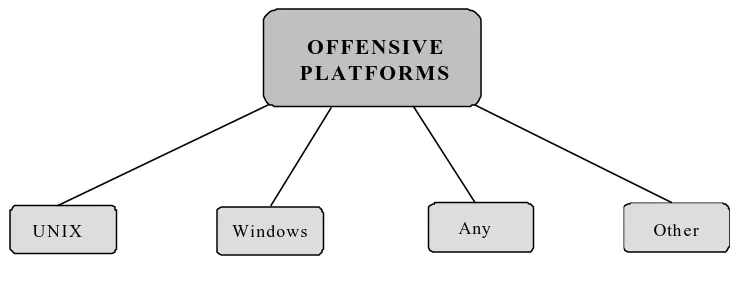
Figure 6: Offensive Platform Requirements ... 40
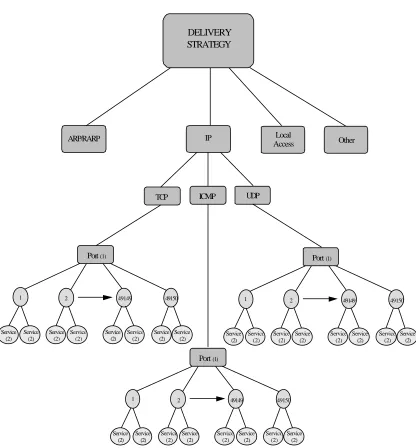
Figure 7: Delivery Strategy ... 41
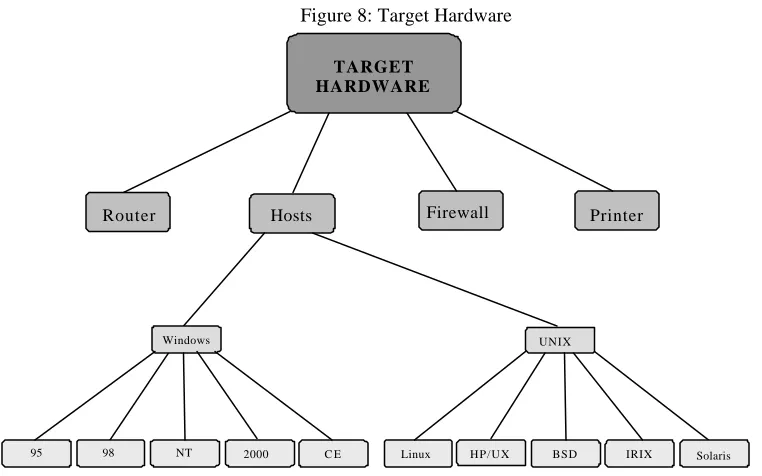
Figure 8: Target Hardware ... 42
Figure 9: Target Software... 42
Figure 10: Windows NT Memory Layout... 46
Figure 11: Elementary Stack Behavior at Run Time - The Prolog ... 51
Figure 12: Elementary Stack Behavior at Run Time - The Call ... 53
Figure 13: Elementary Stack Behavior at Run Time - The Return ... 54
Figure 14: Stack Map of Example 4.1.3... 61
Figure 15: A Stack Smashing Buffer Overflow Exploit ... 65
Figure 16: Stack Frame at a printf() Call ... 73
Figure 17: General Format of a Binary Program ... 81
Figure 18: The PE File Format... 83
Figure 19: Program Layout and Data Passing ... 99
Figure 20: Program Flow: Main() ...100
Figure 21: Program Flow: GetAnalysis() ...102
Figure 22: Program Flow: GetReturnValue() ...104
Figure 23: Program Flow: GetString() ...106
ix
List of Tables
Table 1: A Chronology of Buffer Overflow Exploits1 ... 18
Table 2: ANSI C Format Parameters ... 72
Table 3: Format String Stack Values ... 73
x
List of Exhibits
Exhibit 1: Test Program with (2) Safe Sprintf() returns ...109
Exhibit 2: Test Program Page Fault ...109
Exhibit 3: Test Program Showing String Literal ...110
Exhibit 4: Disassembly of (2) Safe Sprintf() Calls in Test Program ...111
Exhibit 5: Disassembly of Flawed Sprintf() Calls in Test Program ...111
Exhibit 6: Address Values for Sprintf() Calls in Test Program ...112
Exhibit 7: sprintf_scan.idc Input Dialogue with Address of Flawed Sprintf() Call ...112
Exhibit 8: sprintf_scan.idc Output for Flawed Sprintf() Call ...113
Exhibit 9: Test Program Stack Showing [52] Byte Target Buffer...113
Exhibit 10: sprintf_scan.idc Output: SLMail...115
Exhibit 11: sprintf_scan.idc Output: CesarFTP...116
Exhibit 12: sprintf_scan.idc Output: WinAmp ...117
Exhibit 13: sprintf_scan.idc Output: imagemap.exe ...119
Exhibit 14: Imagemap Server Error with String Literal ...120
Exhibit 15: Imagemap.exe Disassembly Showing Flawed Sprintf() Call ...120
Exhibit 16: Imagemap.exe Stack Space Showing Target Buffer ...121
Exhibit 17: Telnet Session to Port 80 Localhost with <~2700 character string> ...121
xi
Dedication
xii
Acknowledgments
When the thesis is finally written and sealed, the days of agonizing over half-baked ideas, strug-gling through writer’s block, and worrying about when (and if) all this is going to end all seem rather dis-tant. The many people who helped me in this long and sometimes frustrating process deserve special thanks, and they are many.
1
Chapter 1
Introduction
Basic research is what I’m doing when I don’t know what I am doing.
- Wernher von Braun
This thesis explores the buffer overflow vulnerability as it exists in today's modern information systems. We will then extend this knowledge by the design, implementation, and analysis of a novel approach to the discovery of potential buffer overflow vulnerabilities in closed source, proprietary soft-ware.
1.1
Motivation
Buffer overflows have been causing serious security problems for decades. In the last few years the underlying cause of the majority of computer system and network exploits and vulnerabilities have been the buffer overflow condition. As such, this represents or should represent a top security concern for all entities associated with information security. Broadly speaking the buffer overflow can affect any sys-tem where a static amount of space has been allocated for undefined dynamic input. The underlying archi-tecture of modern computer systems makes all data handling processes susceptible to this condition. In the past the buffer overflow was treated as a software bug that would, at the very worst, manifest itself as a nuisance if it were to cause a running process to crash. With the arrival of time-sharing systems, buffer overflows became an intellectual curiosity as a means to seize control of a machine in a laboratory setting. The advent of computer networks has given rise to new computational environments and compu-tational models. Remote execution, distributed computing, and code mobility are no longer constrained to the research environment. These modern computational models bring great flexibility and new promises to our everyday world of information technology. However, accompanying the expanded potential comes a set of security implications that were not present when computation was carried out largely on local, stand-alone machines. The buffer overflow represents perhaps the most insidious example of an emergent security threat that scaled directly from a stand-alone problem to one of global significance.
coun-terpart it can be used to leverage a tactical or strategic advantage across any information system in place today. In this thesis we concentrate on the possibility of buffer overflow detection at run time using the unique approach of binary disassembly.
It is a fact that buffer overflows are caused by the poor implementation of high level program-ming languages during the software development process. Today, the vast majority of software executing on both commercial and government systems is untrusted, commercial off the shelf software. Unlike cus-tom applications, which may in their specification include explicitly addressed security measures, docu-mented third party source audits and rigorous testing, commercial software walks an often indistinct line between what is secure enough and what will be profitable. When one considers security-hardened soft-ware, it is usually in the context of the expense that would be incurred if it were to fail or if it were to be exploited. The development costs of these custom applications are usually in direct proportion to the potential liability that their failure or exploitation would cost. Consequently, this class of software is well out of reach of the average consumer, available only to the deep pockets that governments or big business can bring to the table. Even this does not guarantee error free, nonexploitable code. Widely published examples of very expensive software gone wrong include the Ariane IV disaster, the failure of a 1 billion US military space mission, and loss of life caused by a software controller for medical radiological equip-ment to name a few. This class of software represents the best money can buy and illustrates in dramatic fashion the serious challenges to complex software systems.
With the development of and widespread use of high level programming languages such as C and C++, dominant PC architectures, and dominant Operating Systems, the move has been away from hetero-geneous custom software where a single customer funds development and is able to controls its destiny. Today's software is available to homogeneous, global audience and is driven by a market economy. Com-petitive market forces coupled with profitability margins serve to dictate when software is released to the masses. In addition, because of its commercial nature, this software is a proprietary product that is, in effect, secret from the very users who purchase it. The security risks inherent in using third party propri-etary software are extremely important because today’s information systems are being built from increas-ing amounts of reused and prepackaged code. A huge portion of the global information infrastructure has been scaled up on this type of software.
risky proposition. This is especially true when such systems are designed to work over a network with glo-bal extent. In fact, we have already witnessed the failure of this paradigm.
Current empirical evidence demonstrates that most external security violations are made possible by flaws in software and the buffer overflow ranks as the most significant [73]. The key suppliers of oper-ating systems, firewalls, and web-based applications invest considerable effort to find these types of flaws. It is not just good enough that they find one or a few, they must find them all which is a demon-strated impossibility with large complex programs. Once released into the real world this software is sub-jected to an assault of global proportions as hackers both good and bad rush to exploit it. They are not limited by release schedules, timelines and deadlines. Their only limitation is their ability and more signif-icantly, they do not have to find every flaw....they only have to find one.
1.2
Problem Statement and Our Approach
The central problem we study in this thesis can be stated in summary as:
We seek a technique to rapidly find an instance of a potential buffer overflow vulnerability in an executable binary. This technique will be scalable to commercial third party software systems.
Static Source Code Analysis is proposed by University of Virginia computer science researchers as one such approach and focuses on the source structure, syntax and procedural design of the code [74]. This approach encompasses the use of search algorithms to find faulty coding constructs that could lead to a potential buffer overflow. The effectiveness and accuracy of the methods associated with source code analysis can be and have been well studied and are in fact well documented. Established techniques range from line-by-line hand auditing to automated procedures. The fact is, that despite their use in today's development environment, programming errors that lead to buffer overflows remain.
Run-Time Analysis or Black-Box Testing is another approach that is related to the input/output domain of a particular program. This well described class of techniques, usually performed at run-time, is highly dependent on the actual program input. Punishing automated testing tools [75] have been devel-oped and are currently used in the software development process however buffer overflows continue to appear.
is an essential element in developing the overall testing methodology. Ongoing research associated with these techniques is moving in the direction of capturing all errors in the development cycle.
As it only takes one undiscovered exploitable buffer overflow to compromise a released program we do not care about finding them all, we only concern ourselves with finding one. Thus the central ques-tion we pose in this thesis is: “'Is there a technique that one can use to find an incidence of a buffer over-flow vulnerability, with accuracy and efficiency, when applied to a commercial third party software?” The research described here is an attempt to provide such a technique. Through a detailed examination of the buffer overflow phenomenon we develop a technique called binary scanning, and demonstrate its effec-tiveness for finding a single buffer overflow accurately and efficiently. Binary scanning is a novel method for examining a disassembled binary executable for a unique signature related to a buffer overflow vulner-ability. Our approach will investigate high-level code constructs that result in a buffer overflow. These constructs will then be compiled into a binary then disassembled and examined for signatures in the assembly code. Our ultimate goal will be to develop an algorithm that can search for and discover these signatures. We note with interest that this general binary scanning approach yields its results in a manner similar to the way released software is exploited. That is, a single vulnerability is discovered as quickly as possible.
1.3
Brief Summary of Results and Contributions
We proposed binary scanning as a novel approach to locate potential buffer overflow vulnerabil-ities in proprietary software. Here we briefly summarize the results and contributions resulting from our research:
• Several binary scanning strategies have been identified and specific schemes have been devel-oped. A substantial number of systematic empirical evaluations with the developed scanning algorithm have been performed.
• The binary scanning strategies do show a linear scalability. Our studies show that the algo-rithm that we have developed work from modest code constructs to small commercially released software. We propose then demonstrate that this scalability is linear right up through enterprise class software applications.
1.4
Organization of the Thesis
In Chapter 2 we provide a topical overview of the buffer overflow exploit. To give balance to our investigations we explore the literature for the motivation behind exploits in general. To provide a tempo-ral understanding, a chronology of the buffer overflow problem is presented.
In Chapter 3 we describe a taxonomy. The taxonomy provides a useful structure in which to gather a wide diversity of vulnerabilities into a hierarchy of categories. The strategies behind the classifi-cation scheme and conclusions resulting from the taxonomy are discussed.
To evaluate our proposed schemes and techniques, we performed a substantial review of the C and C++ programming language which is summarized in Chapter 4. Particular consideration was given to the standard library in the presentation of known dangerous functions. We extend this research by devel-oping code constructs with known buffer overflow conditions to be used to baseline our vulnerability sig-natures and act as a control during testing. The control group program and methodology used in the design is described in Chapter 6.
In Chapter 5 we present how programs behave at compile time with a discussion of binary disas-sembly and at run-time in a Win32 environment with a discussion of the PE File format. In addition, the difficulties of reverse engineering and the legal implications of commercial product disassembly are sum-marized.
Using a baseline group of potential string primitives identified in Chapter 4, we will empirically derive possible compile-time signatures for use in a technique of binary scanning. Once a signature has been identified a binary scanning algorithm can be developed. Chapter 6 leads the reader through the con-figuration of our test apparatus, algorithm development. Chapter 6 concludes with several commercial proprietary binary files that are disassembled and scanned for a potential buffer overflow vulnerability.
6
Chapter 2
A History of Buffer Overflow Vulnerabilities
All of physics is either impossible or trivial. It is impossible until you understand it, and then it becomes trivial.
- Ernest Rutherford
2.1
An Introduction to the Topic
As we enter the so-called ''information age'' of global networks, ubiquitous computing devices, and electronic commerce, many businesses, consumers, and other users are becoming increasingly con-cerned about computer security. Yet the current state of computer security is lamentably poor in practice. One survey found that nearly 2/3 of Internet hosts are vulnerable to unsophisticated, well known, easy-to-exploit attacks [1], and the number vulnerable to more clever or more recent attacks is presumably greater still. Recent FBI studies have shown that business losses are large and increasing [2]. Anecdotally, break-ins are rampant, and hackers discover new vulnerabilities almost every day. There are several causes for these trends.
First, today's systems rely heavily on applications built in an age when security did not receive the same attention it does today. The Internet, once populated almost exclusively by cooperating research-ers, and local-area networks, populated exclusively by local co-workresearch-ers, spawned many legacy applica-tions that were originally designed for use only in a friendly environment. This legacy code is unlikely to go away anytime soon, yet the threats it must defend against have changed dramatically: global networks now expose us to a much broader array of adverse interests, including hackers, vandals, competitors, crim-inals and other untrustworthy entities. Nonetheless, we need someway to protect our data from a growing number of unfriendly and potentially malicious computer users even as we continue to rely on irreplace-able legacy applications. This leaves us in an exposed position with no obvious solution.
A second contributing factor is that building secure systems is fundamentally hard, and today's programming environments do not make the task any easier; in fact, they often make the task significantly harder.
• The Unix system-call interface does not provide any simple way to atomically query a system object for permission information before performing some operation on that object, and as a result exploitable race conditions are common.
• The language almost invariably, C does not assure memory safety, and as a result it may be easy to cause memory errors and force a security-critical application to crash or worse, execute arbitrary code.
• The standard C libraries provide string buffer management primitives that are unsafe, and as a result our programs fall prey to buffer overrun vulnerabilities.
In all cases, it is in principle possible to code the desired functionality in a secure way, but the secure way is often not the easiest, best-supported, most convenient, most portable, or standard way, and it is not always feasible to fix problematic aspects of the programming environment. Of course, when the standard library functions have security pitfalls, it becomes too easy for developers to inadvertently intro-duce security holes where these functions are used. In addition, modern programming practice includes the reuse of existing libraries. A symptom of this problem may be recognized in the frequency with which programs are found to contain the same mistakes again and again.
A third common cause of insecurity is that many of our security-critical applications are large and complicated. Complexity breeds subtle interactions, subtle bugs, and thus subtle security holes [3]. Moreover, sheer size can make the source code so unwieldy that it becomes very difficult to review the application for potential security errors, or even to understand exactly what it is doing. As a result, large, complex applications often go largely unscrutinized, despite their security-critical nature. One symptom of this phenomenon can be found in the number of vulnerabilities that have lain dormant in poorly reviewed source code for years before being discovered by the security community.
In essence, then, we have a software quality assurance problem with serious implications for computer security: How do we deal with the fact that our most trusted software, even our security soft-ware itself, often contains security vulnerabilities? Re-design and reimplementation of all security-critical code of questionable quality does not appear to be a viable option at the moment; it is simply too costly to be a general solution. As a consequence, we are stuck with an overwhelming amount of legacy and other code of questionable security. As a consumer of this software with no access to the source code we have no good way to check it for even the simplest, most common classes of coding errors.
reviewer to overlook, and thus we might hope for an even higher level of assurance than manual code review can provide by itself. These comments suggest that we might do well to look for tools to help auto-mate the process, to reduce the burden on the reviewer, to raise the assurance level, and in general to reduce the cost of the security quality assurance process.
We have argued that assurance for security software is an important unsolved problem, and that simple programming errors account for a surprisingly large proportion of security failures. Critical to this entire discussion is the fact that a person looking to exploit a particular application needs to find only a single instance of a vulnerability. Perhaps the best illustration of this phenomenon may be found in the buffer overrun vulnerability, a variant of an array bounds violation error that forms one of the most prom-inent causes of insecurity in modern software systems [4]. In this chapter we discuss the buffer overflow paradigm and how it has manifested itself in the modern global software environment.
2.2
Motivation
Knowledge of the Buffer overflow condition is nothing new. In general, the theory surrounding buffer overflows has been part of computer science since the beginning of digital data processing. Our overwhelming use of the von Neumann architecture, where both data and programs are stored in the same memory space [78], makes the possibility of a buffer overflow a constant. This is especially true when using programming languages that do not perform bounds checking at compile time. In the past, on a sin-gle stand alone machine, the buffer overflow represented at worst an annoyance. With the advent of time-share systems beginning in the early 70's, the exploitation of the buffer overflow condition became a secu-rity concern [77] as it could, in theory, be used to escalate system privilege. As the time-sharing paradigm of the 1970's moved towards what we now know as computer networks the security implications of buffer overflows grew dramatically. Now we could not only comprise our own machine, we could remotely gain access on one belonging to someone else. We could use the buffer overflow condition to execute the code of our choosing. As the size and diversity of the Internet grew throughout the 1980's, speculation increased that a major security flaw would be exploited and as a result the Internet directly attacked. From 1986 to 1987 the size of the Internet grew almost 600 percent [76] and time was running out from the real-ity of a widespread exploit crashing the Internet.
overloaded the machine. A worm had invaded these systems. The worm had taken advantage of lapses in security on systems that were running 4.2 or 4.3 BSD UNIX or derivatives like the SunOS. These security flaws allowed it to connect to machines across a network, bypass their login authentication, copy itself and then proceed to attack still more machines. The massive system load was generated by multitudes of worms trying to propagate the epidemic [5]. D. Bruce, MIT EECS Professor and Vice President for Infor-mation Systems estimated that approximately 10% of 60,000 Internet hosts were exploited [6].
One of the methods used to gain access to these systems was a buffer overflow exploit of the Unix service ''finger''. This hack involved co-opting the TCP finger service as a method to gain entry into a system and it represented the first well documented, widespread buffer overflow exploit. The Finger ser-vice reports information about a user on a host, usually including things like the user's first and last name, the location of their office, the number of their phone extension and so on. The Berkeley version of the finger server has been characterized as a really trivial program. It reads a request from the originating cli-ent, stores that information in a 512 byte buffer on the host machine, runs the local finger program with the request as an argument then ships the output back to the client. Unfortunately the finger server reads the remote request with gets(), a notoriously dangerous function. This is a standard C library routine that dates from the beginning of the language. The function has no parameter in which to perform bounds checking and therefore does not check for overflow of the server's 512 byte request buffer on the stack. The exploit is some VAX machine code that asks the system to execute the command interpreter sh sup-plied by the client as a 536 byte request to the finger server. This request is crafted to be specifically 24 bytes larger than the 512 byte buffer. This is just enough data to write over the server's stack frame for the main routine. When the main routine of the finger server exits, the program counter of the calling function should be restored from the stack, but the exploit wrote over this program counter with one that points to the VAX code in the request buffer. The program then jumps to the worm's code, part of the request, and runs the command interpreter, which the worm uses as a method to enter its bootstrap; a classic case of overwriting the stack frame pointer.
Buffer overflow attacks remained relatively unheard of for many years following the Worm. One known example came in November of 1994, when one of the first commercial Web servers, running HP-UX, was successfully breached using a buffer overflow attack against the National Center for Supercom-puting Applications (NCSA) 1.3 Web server [79]. As this Web server sat on the target's internal network and could be connected to through the firewall, the attackers had unfettered access to the victim's internal network.
The event that really fueled the frequency of attacks was the November 1996 publication of a paper entitled ''Smashing the Stack for Fun and Profit'', by Aleph One, in the on-line hacker magazine Phrack [7]. Aleph One's paper (itself based on a paper written by Mudge of the L0pht, an independent computer security think tank specializing in Windows NT) explains in detail how to write a buffer over-flow exploit against a Unix system program. This moved the technical skills required from the graduate level down to anyone who could follow directions well. This heralded the birth of the script kiddie.
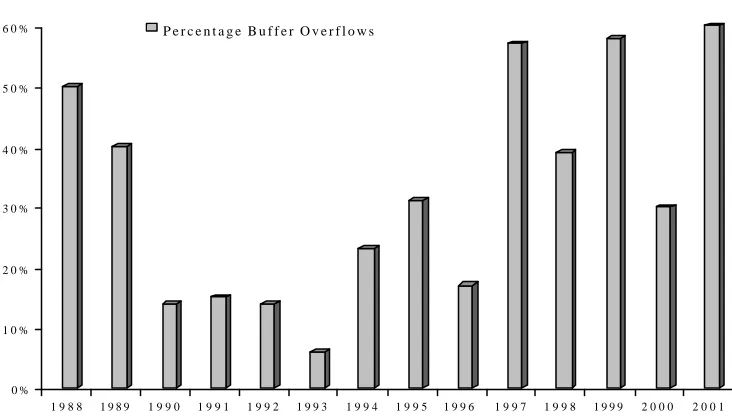
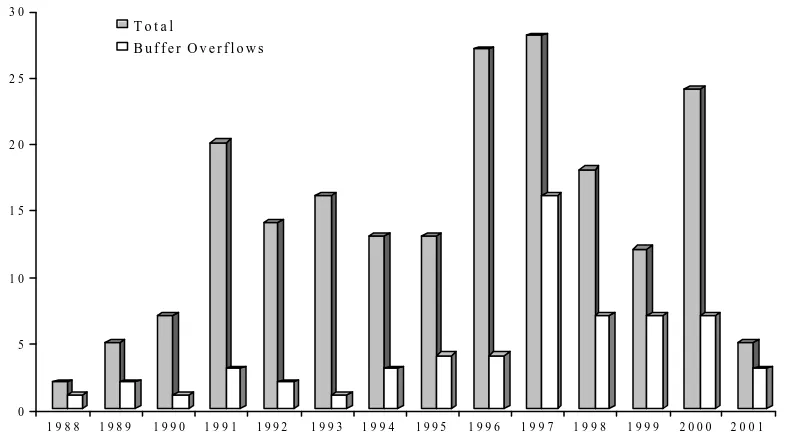
[image:22.612.136.502.496.706.2]As a result in 1997 and 1998, buffer overflow exploits became extremely common, mainly tar-geting Unix systems, in particular the Open Source versions. While the Open Source organizations, like the various Linux distributors or FreeBSD, were quick to release patches, the number of exploits was astounding. To get a feel for the scope of this problem, an exact string search for “buffer overflow exploits” on Google.com returned 6,000 matches. Buffer overflow exploits continued right into 1999, 2000, 2001, and show no signs of going away anytime soon. If anything, the incidence of buffer overrun attacks has been increasing. See Figure 1 for data extracted from CERT advisories over the last decade.
Figure 1: Frequency of buffer overrun vulnerabilities
0 % 1 0 % 2 0 % 3 0 % 4 0 % 5 0 % 6 0 %
1 9 8 8 1 9 8 9 1 9 9 0 1 9 9 1 1 9 9 2 1 9 9 3 1 9 9 4 1 9 9 5 1 9 9 6 1 9 9 7 1 9 9 8 1 9 9 9 2 0 0 0 2 0 0 1
C E R T A d v i s o r y % B u f f e r O v e r f l o w s b y Y e a r
Derived from a classification of CERT advisories. The chart shows, for each year, the total number of CERT-reported vulnerabilities and the number that can be blamed primarily on
buffer overruns
[image:23.612.123.516.317.536.2]Figure 2 shows that buffer overruns account for up to 50% of today's vulnerabilities, and this ratio seems to be increasing over time. A partial examination of other sources suggests that this estimate is probably not too far off: buffer overruns account for 27% (55 of 207) of the entries in one vulnerability database [8] and for 23% (43 of 189) in another database [9]. Finally, a detailed examination of three months of the bugtraq archives (January to March, 1998) shows that 29% (34 of 117) of the vulnerabilities reported are due to buffer overrun bugs [10].
Figure 2: Frequency of buffer overrun vulnerabilities by percentage
Derived from a classification of CERT advisories. The chart shows, for each year, percentage of CERT-reported vulnerabilities that were due to buffer overruns for each yea
The only big change in the original problem is that it now includes Microsoft products. One rea-son why Microsoft products were not initially attacked is that the techniques required are somewhat dif-ferent and more importantly the code is closed source. This represents an especially alarming situation as the majority of enterprise wide information solutions are based on Microsoft products and associated third party applications and add-ons.
Windows 2000 has already patched several buffer overflow vulnerabilities in it's enterprise class of Operating System products with a least two being reported as a major security issues. The first, a buffer
0 5 1 0 1 5 2 0 2 5 3 0
1 9 8 8 1 9 8 9 1 9 9 0 1 9 9 1 1 9 9 2 1 9 9 3 1 9 9 4 1 9 9 5 1 9 9 6 1 9 9 7 1 9 9 8 1 9 9 9 2 0 0 0 2 0 0 1 C E R T A d v i s o r y b y Y e a r
T o t a l
overflow in Windows 2000 indexing service1. The Index Server is the built-in search engine in Windows 2000 that catalogues and indexes files and properties of the hard drive. Improper bounds checking on the input buffers on the DLL file (%system32\idq.dll) allows additional characters to be forced into the pro-cess space, overflowing the buffer and providing memory space for shell code insertion. As with all buffer overflows, the shell code simply requires to launch and bind a command shell to listen on a specific port and the attacker to connect to the port using netcat or telnet. All Windows products from NT4 forward are exposed to the vulnerability. This vulnerability gained worldwide attention when the “Code Red” worm exploited it. It was estimated that 359,000 hosts were exploited within the first 14 hours of its initial release [11].
The second, a buffer overflow in a FrontPage server extension2. The FrontPage extensions ship with IIS4 and IIS5, Office 2000 and Office XP, and extend the functionality of the IIS web server to sup-port components used in the Visual Studio development suite. An optional feature of the FrontPage exten-sions is Visual Studio, Remote Application Deployment (RAD) component that contains an unchecked buffer vulnerability. The RAD feature allows developers to deploy custom COM components by allowing authenticated authors to upload COM components onto the server.
The unchecked buffer in the request processing routine allows a malformed command to insert shell code into the FrontPage process space, yielding access at either IUSR_<hostname> or system-level privileges. The buffer overflow occurs if fp30reg.dll receives a URL request that is longer than 258 bytes, exposed through a lack of length checking on the input string. By exploiting this vulnerability suc-cessfully, an attacker can execute code with the privileges of IUSR_machinename and under certain circumstances with the privileges of system. Visual Studio RAD component is not selected by default in the installation options, as is actively alerted as not suitable for production systems during installation if selected.
Clearly we have demonstrated that the buffer overflow problem is a major security issue. Despite a precise understanding for the last 15 years of the severity of the problem and of the programming prac-tices that lead to this condition, it has not gone away. Now that we have developed a feel for the scope of situation we will turn our attention to those persons who develop and use these exploitation techniques and to investigate their potential motivations.
2.2.1
Benevolent Hacking: The White Hat
In the beginning it was a core group of singular minded individuals who programmed operating systems, examined core dumps, and basically spent their entire waking moments engrossed in the
cies of digital computation. It was this original group who earned the moniker “Hackers”. These were the pioneers of modern day computing. Hacking was originally characterized to convey the sense of `an appropriate application of ingenuity'. Whether the result was a quick-and-dirty patchwork job or a care-fully crafted work of art, it was the cleverness that went into it that determined the hack. Somewhere along the lines the definition became confused and assumed the darker connotation that remains to this day. In order to distinguish those who create these clever hacks the terms “White Hat” and “Black Hat” are being used with the inference being obvious.
The white hat [80] has become the term for people who hack legitimately. These hackers devote their careers to discovering software vulnerabilities and then post these discoveries to Internet list servers or their own security related Internet homepages. Current motivation follows that by publicly posting vul-nerabilities these hackers are forcing software companies to not only address these newly found problems but to also fix them. This is the paradigm of attacking a system to secure it. Other white-hat hackers dis-cover operating system vulnerabilities, i.e. Linux, and email their results to kernel developers who then write and post software patches to mailing lists devoted to system vulnerabilities and Internet web sites like www.slashdot.org.
The White Hat's operate on the premise that so called old-fashioned security controls such as firewalls and intrusion-detection systems aren't enough. Their reasoning is that one must embrace the methods and mind-set of the enemy. In the past, the White Hats were loosely aligned in ad hoc groups or operated independently with the belief that the full disclosure of vulnerabilities was the quintessential means of securing computer systems. Their success was closely aligned with the rapid growth of the com-puter and network security industry. White-hat hackers have gone to become security consultants and are now associated with computer security consulting organizations, like Foundstone, @stake Research Labs and on-line security forums like bugtraq, www.securityfocus.com. Through their efforts, the software vendors learned that security issues were important. They also learned that they were very expensive to implement.
2.2.2
Malicious Hacking: The Black Hat
The Black Hat [81] has become the term for people who hack at the bounds of what is legal to those who are clearly breaking the law. The motivations common to those who would commit or attempt to commit computer-related crime are diverse, but hardly new. In general, criminals are driven by time-honored motivations, the most obvious of which are power, greed, revenge, lust, adventure, and even the desire to taste “forbidden fruit”. Computer crime makes no distinction to this general classification with computer criminals being no different. The ability to make an impact on large global systems from a remote location may, as an act of power, be gratifying in and of itself. The desire to inflict damage or loss on another may have roots in revenge as a motive, as when a disgruntled employee shuts down an employer's computer network, or to ideology, as when one defaces the web site of an organization or insti-tution that one regards as against their beliefs or as abhorrent. Current activity on the so called ‘electronic frontier’ entails an element of adventure, the exploration of the unknown. This is especially true for the disaffected youth raised in the age of information. The very fact that some activities in cyberspace are ille-gal or likely to elicit official condemnation is enough to attract the rebellious, defiant, or the irresistibly curious. In some cases, given the degree of technical competence and skill required to commit many com-puter-related crimes, there is a unique motivational dimension worth mentioning here. This is, of course, the intellectual challenge of mastering a system with a high level of complexity.
Unauthorized hacking is a felony crime in the United States and many other countries. Clearly there exists an ongoing information war with the Black Hat seen as the enemy. The profile of the Black Hat runs from the 12 year old script kiddie with the time and persistence to get automated well docu-mented exploit scripts to work to the government sanctioned hacker a well funded computer expert work-ing for an intelligence organization with military objectives. For the Black Hat, the buffer overflow is of critical importance as it is one of the primary means of obtaining root access on a system. As the profile of the Black Hat is so wide we will categorize the malicious hacker, by stereotype, into three groups.
The Script Kiddie: The script kiddie practices hacking using scripts and programs written by oth-ers, often without an understanding of the exploit they are using. These are the hackers with limited tech-nical expertise who, using easy-to-operate, pre-configured, and/or automated tools; conduct disruptive activities against networked systems. There are about 30,000 hacker-oriented sites on the Internet, bring-ing hackbring-ing and all the associated tools within the reach of anyone who may have an interest. As an exam-ple the Rootshell web site has a database of 690 exploit scripts [12]. Fyodor's Playhouse contains 383 attacks [13] and the Legacy hacking site has 556 exploits [14].
loosely knit ad hoc groups and often communicate using Internet Relay Chat (IRC) channels. For these practitioners their hacking is a social activity and Internet Relay Chat their communications link.
The script kiddies are not out for specific information or targeting a specific company. Their goal is to gain root the easiest way possible. This is accomplished by focusing on a small number of well-doc-umented exploits, and then using automated scanning techniques, search the entire Internet for that vulner-ability. Some of the more advanced users may use more specialized tools to leave behind sophisticated backdoors. Most have no idea what they are doing and only know how enter rudimentary input the com-mand prompt. The common strategy is to randomly search for a specific weakness, and then exploit that weakness. It is this random selection of targets along with their large numbers that make the script kiddie such a dangerous threat.
Most of the tools available to the script kiddie are easy to use, widely distributed and well-docu-mented allowing use by anyone. The script kiddie methodology is a simple one. Scan huge tracts of Inter-net address space for a specific weakness, when that weakness is found, it is exploited. The most coveted remote exploits that are in use by the script kiddie are the ones associated with the buffer overflow.
Mafia Hackers: Russian hackers first captured the world's imagination in 1994, when a young mathematician, Vladimir Levin, hacked into the computers of Citibank and transferred $12 million to the bank accounts of his friends around the world. Levin was arrested, but his case inspired other hackers, for example, Ilya Hoffman, a talented viola student at the Moscow Conservatory, who was detained in 1998 on charges of stealing $97,000 over the Internet. Another group of Russians stole more than $630,000 by hacking into Internet retailers and grabbing credit card numbers [82]. Numbers this large certainly attract the attention of organized crime and hacking associated with this element has been traditionally centered in Eastern Europe. Recently the Russian mafia has been implicated in hacks involving the theft of up to one million sets of credit card details.
The FBI, in response to an expanding number of instances in which criminals have targeted major components of information and economic infrastructure systems, has established the National Infra-structure Protection Center (NIPC). Based on FBI investigations, classified sources and other information, the NIPC has observed that there has recently been a dramatic increase in organized hacker activity specif-ically targeting U.S. systems associated with e-commerce and other Internet-hosted sites. The majority of the intrusions have occurred on networks using the Microsoft Windows NT operating system. In these cases the hackers are exploiting known buffer overflow vulnerabilities to gain unauthorized access and download propriety information [15].
1998 when it was announced that the CIA was devising a computer application that could attack the infra-structure of other countries. One can only imagine the importance of the buffer overflow as an exploit tool to gain remote access in the development of this classified program.
A series of sophisticated attempts to break into Pentagon computers has continued for more than three years according to a member of the National Security Agency's advisory board. Officials at the Pen-tagon and NSA have called the intrusions “massive” and said they caused significant disruptions. In the Middle East government supported cyber attacks are becoming more prevalent and more methodical. There is documentation that supports the existence of a coordinated campaign on the pro-Palestinian side to identify vulnerable Israeli sites and gain root access using buffer overflow exploits [16].
With our current good guy versus bad guy, exploit and patch model of computer security unpub-lished exploits are highly coveted in the hacker subculture and may be considered state secrets within gov-ernments. The power of a single remote exploit that is unknown to vendors allows a single person to potentially break into thousands of machines, often times with no recognizable trace of how it was done. Many Intrusion Detection Systems (IDS) will not recognize the fingerprints of these new exploits. The hackers with knowledge of these exploits typically do not deface web pages. This knowledge is held for high dollar gain or as a tool for true information warfare. The last thing a hacker with this type of informa-tion wants is to bring atteninforma-tion to themselves or their methods. In some cases unpublished exploits can cir-culate in the underground for up to a year before being disclosed to the masses. The damage caused by a dozen hackers have such an exploit while actively using it over a one year period is often never reported to the extent that it makes the public media.
With individuals and corporations increasingly relying on software with demonstrated security flaws and the Internet to manage everything from their finances to their personal health records, incidents of malicious hacking continue to increase. More than 7,000 computer security violations were reported in the first three months of 2001, more than in all of 1998, according to the CERT Coordination Center, a security research group at Carnegie-Mellon University in Pittsburgh [62].
Just how do these hackers find the buffer overflow vulnerabilities that lead to system exploits? As the majority of the exploited software is closed soured, third party applications, source code auditing is not an option. Are the buffer overflow conditions found simply by brute force or is there a more methodi-cal step-by-step method that can be used. It is this premise that our thesis will attempt to address as we develop a methodical approach to finding these types of vulnerabilities in closed source applications.
2.3
Chronology of Buffer Overflow Exploits
activity that we would call hacking today was occurring on the new United States phone system. Since the turn of the century, the meaning of the term hacker has evolved. A subculture has grown up around the practitioners and this has seeped into popular culture over the last two decades. As information technology continues to play an increasingly important role in our society so will the hacker continue to make his presence felt.
We present a general chronology of computer hacking and where appropriate, particular attention is paid to the buffer overflow exploit. How did hacking begin and how was it integrated into the overall development of modern digital computing?
Without the real programmers, computers, computing, networks, the Internet and the buffer over-flow would not exist. The history of digital hacking begins with John W. Mauchly and J. Presper Eckert. These two men collaborated on what was to become an icon in computer science. This was one of the first truly digital computers, the ENIAC or Electronic Numerical Integrator and Computer. ENIAC was built in 1946 and was designed with over 17,000 vacuum tubes, 30,000 resisters and covered over 1500 square feet of floor space. Despite it’s size it was only capable of 1000 calculations per second. Compare that to the computers of today that are capable of tens of millions of calculations per second. The ENIAC was the first digital machine to be able to perform an “if-then” statement or a “branch conditional statement” [83]. In 1949 Presper and Mauchly also launched the BINAC or Binary Automatic Computer, a computer that stored data using magnetic tape.
The next major milestone in the history of hacking is the UNIVAC computer. The UNIVAC was first commercial computing project commissioned for the US Census Bureau and was another of Mauchly and Presper's efforts. This was the first so-called solid state computer and could handle both alphabetic and numerical information. This development was important in that it represented a significant move toward the miniaturization of the computer. With the UNIVAC, the transistor replaced the vacuum tube and the computer shrunk down to the size of a room.
One of the first organized groups of hackers to be formed emerged from the Massachusetts Insti-tute of Technology in 1961. They were members of MIT's Tech Model Railroad and possessed an obses-sion with the PDP-1 computer. The Tech Model Railroad Club programmed the PDP-1 to control their complex model railroad track and switches. From these humble beginnings MIT would achieve critical acclaim with a world renowned Artificial Intelligence department. No chronology could be considered as complete without including a brief history of the Unix operating system. Unix has been recognized as the quintessential operating system.
users. Within this environment they identified a need for a tree structured file system and easy access to devices from within the OS plus a user level command interpreter. From these specialized needs Unix was conceived. It is important to note that Unix also gave rise to another major milestone in hacker history, the C programming language. With the advent of C, the original Unix kernel was rewritten to make it machine independent, or portable, thus making Unix the OS the choice for academic research. Particularly impor-tant from the aspect of this thesis are the function libraries within the C language. When used incorrectly, several standard C functions are directly related to the existence of the buffer overflow vulnerability. The C programming language is by far the worst offender leading to this security issue.
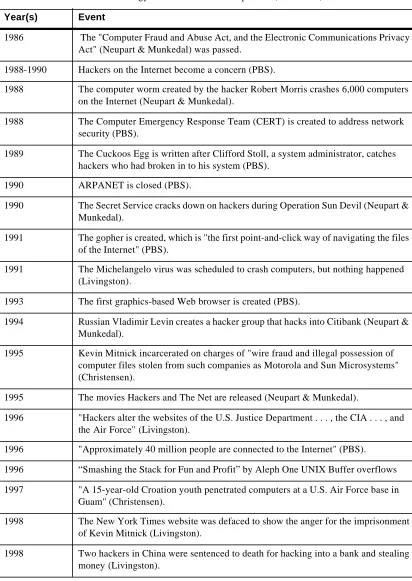
Table 1:
A Chronology of Buffer Overflow Exploits1
Year(s) Event
1940’s-1970’s The era of the huge mainframes (Catman).
1946 J. Presper Eckert and John W. Mauchly created one of the first digital, general pur-pose computers: the Electronic Numerical Integrator and Computer (ENIAC) (Wil-liams).
1949 J. Presper Eckert and John W. Mauchly created the first computer that stored its data on magnetic tape: the Binary Automatic Computer (BINAC) (Williams). 1950’s J. Presper Eckert and John W. Mauchly created the UNIVAC computer, which was
the first computer that could handle alphanumeric information. It was also smaller than the previous computers--the first step to making computers smaller (Will-iams).
Some of the first hackers of this time were Peter Deutsch, Bill Gosper, Richard Greenblatt, Tom Knight, and Jerry Sussman. (Brunvand). This was the "Golden Age" of hacking. This was when hackers made some of the largest and most impor-tant discoveries on computers. The hackers of this time are respected by the hackers of today because the computers they worked on were so cumbersome and they only had a few tools to help them learn about these machines (Brunvand).
1960’s Hacker culture spread to the general culture as the computers did. Centers of hacker culture had by now spread from MIT to Carnegie Mellon University, and Stanford University. Some of the famous hackers of this time were Ed Fredkin, Brian Reid, Jim Gosling, Brian Kernighan, Dennis Ritchie, and Richard Stallman (Brunvand). 1961 TMRC used the PDP-1, the "first commercially successful computer on the
1961 MIT began using the computer PDP-1, which were the "first commercially success-ful computer on the market" (Williams). The Tech Model Railroad Club (TMRC) at MIT, who had moved from programming the complicated wiring and switches of their model trains to programming computers, "adopted the machine as their favor-ite tech-toy and invented programming tools, slang, and an entire surrounding cul-ture that is still recognizably with us today" (Catman). This group was the first to adopt the term "hacker" (Catman).
1940’s-1970’s Era of the mainframes (Catman).
1946 J. Presper Eckert and John W. Mauchly created one of the first digital, general pur-pose computers: the Electronic Numerical Integrator and Computer (ENIAC) (Wil-liams).
1949 J. Presper Eckert and John W. Mauchly created the first computer that stored its data on magnetic tape: the Binary Automatic Computer (BINAC) (Williams). 1950’s J. Presper Eckert and John W. Mauchly created the UNIVAC computer, which was
the first computer that could handle alphanumeric information. It was also smaller than the previous computers--the first step to making computers smaller (Will-iams).
Some of the first hackers of this time were Peter Deutsch, Bill Gosper, Richard Greenblatt, Tom Knight, and Jerry Sussman. (Brunvand). This was the "Golden Age" of hacking. This was when hackers made some of the largest and most impor-tant discoveries on computers. The hackers of this time are respected by the hackers of today because the computers they worked on were so cumbersome and they only had a few tools to help them learn about these machines (Brunvand).
1960’s Hacker culture spread to the general culture as the computers did. Centers of hacker culture had by now spread from MIT to Carnegie Mellon University, and Stanford University. Some of the famous hackers of this time were Ed Fredkin, Brian Reid, Jim Gosling, Brian Kernighan, Dennis Ritchie, and Richard Stallman (Brunvand). 1961 TMRC used the PDP-1, the "first commercially successful computer on the
mar-ket," [MIT got these computers] to program their model train tracks and switches. Thus began the hackers and the AI Lab (Williams).
1961 MIT began using the computer PDP-1, which were the "first commercially success-ful computer on the market" (Williams). The Tech Model Railroad Club (TMRC) at MIT, who had moved from programming the complicated wiring and switches of their model trains to programming computers, "adopted the machine as their favor-ite tech-toy and invented programming tools, slang, and an entire surrounding cul-ture that is still recognizably with us today" (Catman). This group was the first to adopt the term "hacker" (Catman).
Table 1:
A Chronology of Buffer Overflow Exploits1 (Continued)
1962-1969 The Department of Defense's Advanced Research Project Agency (ARPA) creates the network ARPANET. They intended for researchers to use. The first universities to use the ARPANET were Stanford Research Institute, UCLA, UC Santa Barbara, and the University of Utah (PBS).
1969 The creation of the ARPANET. This was the first computer network linking "uni-versities, defense contractors, and research laboratories"Hacker Ken Thompson created the operating system UNIX. Hacker Dennis Ritchie created the program-ming language C. Both of these creations became popular across most computers, which allowed hackers to use on set of tools to hack into many different machines (Catman).
1972 The InterNetworking Working Group is founded to govern the standards of the developing network. Vinton Cerf is the chairman and is known as a "Father of the Internet" (PBS)
1973 "ARPANET goes international" (PBS).
1974-1981 ARPANET moves away from its research and military beginnings and becomes commercialized (PBS).
1974 "Bolt, Beranek, and Newman opens Telnet, the first commercial version of the ARPANET" (PBS).
1975 First portable computer was marketed (Catman).
1977 Steve Jobs and Steve Wozniak created Apple Computers (Neupart & Munkedal). 1979 The first USENET groups are created by Tom Truscott and Jim Ellis; now people
from all over can join discussion groups (PBS).
1980 USENT bulletin board began broadcasting information. USENET was a network of UNIX machines that could talk to each other (Catman).
1981 IBM creates its own personal computer (Neupart & Munkedal).
1982-1987 The ARPANET is recognized as an internet. The language of computers on the Internet, TCP/IP is created (PBS).
1982 UNIX hackers from Berkeley began Sun Microsystems; they put UNIX on less expensive workstations (Catman).
1983 The hacker film War Games was released (Catman).
1984 The hacker magazine 2600: The Hacker Quarterly was created (Neupart & Munkedal).
1984 AT&T made a version of UNIX (Catman).
[image:32.612.121.538.128.695.2]Mid-1980’s Personal computers make accessing the Internet cheap and easy (PBS). Table 1:
A Chronology of Buffer Overflow Exploits1 (Continued)
1986 The "Computer Fraud and Abuse Act, and the Electronic Communications Privacy Act" (Neupart & Munkedal) was passed.
1988-1990 Hackers on the Internet become a concern (PBS).
1988 The computer worm created by the hacker Robert Morris crashes 6,000 computers on the Internet (Neupart & Munkedal).
1988 The Computer Emergency Response Team (CERT) is created to address network security (PBS).
1989 The Cuckoos Egg is written after Clifford Stoll, a system administrator, catches hackers who had broken in to his system (PBS).
1990 ARPANET is closed (PBS).
1990 The Secret Service cracks down on hackers during Operation Sun Devil (Neupart & Munkedal).
1991 The gopher is created, which is "the first point-and-click way of navigating the files of the Internet" (PBS).
1991 The Michelangelo virus was scheduled to crash computers, but nothing happened (Livingston).
1993 The first graphics-based Web browser is created (PBS).
1994 Russian Vladimir Levin creates a hacker group that hacks into Citibank (Neupart & Munkedal).
1995 Kevin Mitnick incarcerated on charges of "wire fraud and illegal possession of computer files stolen from such companies as Motorola and Sun Microsystems" (Christensen).
1995 The movies Hackers and The Net are released (Neupart & Munkedal).
1996 "Hackers alter the websites of the U.S. Justice Department . . . , the CIA . . . , and the Air Force" (Livingston).
1996 "Approximately 40 million people are connected to the Internet" (PBS). 1996 “Smashing the Stack for Fun and Profit” by Aleph One UNIX Buffer overflows 1997 "A 15-year-old Croation youth penetrated computers at a U.S. Air Force base in
Guam" (Christensen).
1998 The New York Times website was defaced to show the anger for the imprisonment of Kevin Mitnick (Livingston).
[image:33.612.122.534.120.701.2]1998 Two hackers in China were sentenced to death for hacking into a bank and stealing money (Livingston).
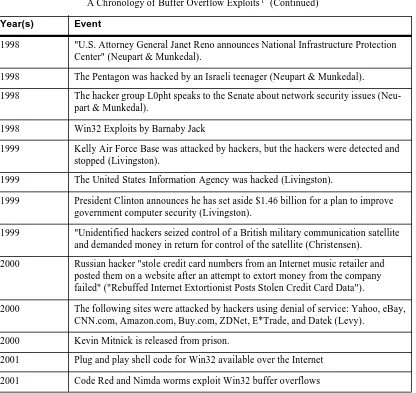
Table 1:
A Chronology of Buffer Overflow Exploits1 (Continued)
1. The following is a listing of cited works used in developing this table.
Brunvand, Erik. “The Herioc Hacker: Legends of the Computer Age” Department of Com-puter Science October 15, 1996. February 22, 2000. http://www.cs.utah.edu/~elb/folklore/afs-paper/afs-paper.htm
Catman “Hacker History.” March 11,2000. http://www.thefuturesite.com/catman/history Christensen, John. “The Trials of Kevin Mitnick.” CNN.com March 18,1999. February 9, 2000. http://www.cnn.com/SPECIALS/1999/mitnick.background
Levy, Stephen, and Brad Stone. “Hunting the Hackers” Newsweek.com February 21, 2000. March 11, 2000. http://www.newsweek.com/nw-srv/printed/us/st/a16375-2000feb13.htm Livingston, Brian. “Project Against Trojan Horses” CNN.com January 17, 2000. March 11, 2000. http://cnn.com/2000/TECH/computing/01/17/trojan.horse.idg/index.htm
1998 "U.S. Attorney General Janet Reno announces National Infrastructure Protection Center" (Neupart & Munkedal).
1998 The Pentagon was hacked by an Israeli teenager (Neupart & Munkedal).
1998 The hacker group L0pht speaks to the Senate about network security issues (Neu-part & Munkedal).
1998 Win32 Exploits by Barnaby Jack
1999 Kelly Air Force Base was attacked by hackers, but the hackers were detected and stopped (Livingston).
1999 The United States Information Agency was hacked (Livingston).
1999 President Clinton announces he has set aside $1.46 billion for a plan to improve government computer security (Livingston).
1999 "Unidentified hackers seized control of a British military communication satellite and demanded money in return for control of the satellite (Christensen).
2000 Russian hacker "stole credit card numbers from an Internet music retailer and posted them on a website after an attempt to extort money from the company failed" ("Rebuffed Internet Extortionist Posts Stolen Credit Card Data").
2000 The following sites were attacked by hackers using denial of service: Yahoo, eBay, CNN.com, Amazon.com, Buy.com, ZDNet, E*Trade, and Datek (Levy).
2000 Kevin Mitnick is released from prison.
[image:34.612.126.542.113.506.2]2001 Plug and play shell code for Win32 available over the Internet 2001 Code Red and Nimda worms exploit Win32 buffer overflows
Table 1:
A Chronology of Buffer Overflow Exploits1 (Continued)
Neupart & Munkedal. “Hacker History-Soceity and Hackers in an Historical Perspective.” March 11, 2000. http://www.n-m.com/english/security/hackhistory.htm
P.B.S. “PBS Life on the Internet.” March 11, 2000. http://www.pbs.org/internet/timeline Williams, Jim. “Hacker History-The Real Programmers” About.com April 26, 1999. February 28, 2000. http://netsecurity.about.com/compute/netsecurity/library/weekly/
24
Chapter 3
Buffer Overflows-A Taxonomy
The most exciting phrase to hear in science, the one that herolds new discoveries, is not “Eureka!” (I found it!) but “Thats funny”...
- Isaac Asimov
3.1
Introduction
We have demonstrated the omnipresent nature of Computer vulnerabilities. In every operating system fielded, in every important network application released, programming errors which result in the buffer overflow vulnerability have allowed unauthorized users to enter systems, or authorized users to take unauthorized actions. In recent years we have seen the development of sophisticated vulnerability databases and vulnerability exploitation tools by the so-called “computer underground”. Detailed descrip-tions of how to find vulnerable states have appeared in various periodicals such as PHRACK and 2600, and on the USENET [17]. A large subset of these discussions essentially show how to probe a system for clues that indicate the system is running software known to be vulnerable to a buffer overflow exploit, or that it is being administered in such a way as to allow an attacker to run a buffer overflow attack.
Some of these tools are capable of automating the exploitation of vulnerabilities that were thought to require considerable expertise, including the buffer overflow. These tools, ready-made and of considerable complexity [18], are freely and widely available, and pose a significant threat that cannot be ignored. The celebrated Kevin Mitnick is an early example of a vandal who used such tools and databases to penetrate hundreds of computers before being caught [19]. Our study clearly demonstrates that with the widespread use of computers today, and increased computer knowledge in the hands of people whose objective is to obtain access to unauthorized systems and resources, it is no longer possible or desirable to implement security through obscurity [20].
mechanism itself. A search of the literature demonstrated this with two broad categories of associated information. The first category involved numerous examples of what could be termed 'underground how to manuals' associated with a particular buffer overflow exploit [7][45][47][49][50][58]. The second con-cerned the hundreds of security advisories that alert users that a particular vulnerability exists along with details on the affected software release and the patch information. A well ordered systematic global description of the buffer overflow vulnerability does not exist.
In this research we are concerned with finding these types of vulnerabilities in released third party software and we want to find them quickly. When a product is released it is subject to potential attack from a global community. This is in effect equivalent to the exploratory testing of the software on a massive scale. As a security auditor, a single entity, we must ask how can we gain an advantage over the global community in testing the product. The testing performed by the global community can be charac-terized as a random and chaotic process, certainly with no defined plan. Each element within the commu-nity explores the product according to their own particular goals and is limited by individual expertise. One way to gain significant advantage is to leverage this haphazard testing process in our favor. We can do this by developing a methodology that consists of specific tasks, objectives and documentation, that make finding both those software systems and the individual domains within those systems, that may con-tain an exploitable buffer overflow, a systematic process. In this approach we first identify, at a top level, the potential areas of a system that enable this type of vulnerability. This allows us to identify candidate target software. Once the target has been selected we use a similar approach at a more detailed level to perform directed interactive testing or more commonly, exploratory testing.
In operational terms, exploratory testing is an interactive process of concurrent product explora-tion, test design, and test execution. The outcome of an exploratory testing session is a set of notes about the product, failures found, and a concise record of how the product was tested. When practiced in a rigor-ous methodical fashion, it yields consistently valuable and auditable results. Key to our approach is an abstraction of the buffer overflow exploit problem in terms that can be applied by the security auditor to develop the heuristic elements which define and are integrated into the actual exploratory test plan.
In this chapter we formulate a classification strategy then collect and organize1 a number of actual buffer overflow exploits that have caused failures. We will establish a framework for a database format, so that designers, programmers, analysts and auditors may do their work with a more precise knowledge of what has gone before. The buffer overflows we examinedwere able to cause conditions or circumstances that resulted in denial of service, unauthorized disclosure, unauthorized destruction of data, or unauthorized modification of data and included most modern operating systems and ancillary software. There is perhaps a legitimate concern that this kind of information could assist those who would attack computer systems. Partly for this reason, we have limited the cases described here to those that already have been publicly documented elsewhere and are relatively old. We do not suggest that we have assem-bled a representative random sample of all known buffer overflows, but we have tried to include a wide variety.
Using our collection we then classify the buffer overflow vulnerability along axiomatic lines and present our findings as a taxonomy. The unique contribution of this work is an analysis of the problem in a new way which will allow for an improvement of security in existing systems, and will provide a frame-work for exploratory software testing that highlights those areas prone to exploitable buffer overflow security flaws. This contrasts the work to [22], which argued that a preventative approach using formal methods to design secure systems is appropriate. We emphatically agree; however, as nonsecure systems continue to be used, our work is presented with the hope it will guide maintainers and software imple-menters to improve the security of these flawed systems and software. We offer the taxonomy for the use of those who are presently responsible for auditing released software and identifying exploitable flaws. We feel that buffer overflow vulnerability data, organized this way and abstracted, could be used to iden-tify the heuristic elements critical for successful interactive product testing and resultant identification of exploitable security flaws.
In addition, our taxonomy attempts to organize information about buffer overflows so that, as new vulnerabilities are reported, readers will gain a fuller understanding of which parts of systems and which parts of the system operational cycle are more susceptible to vulnerabilities than others. This infor-mation should be useful not only to those faced with the difficult task of assessing the security of a system already built, but also to software designers. To accurately assess the security of a computer system, an analyst must find its flaws. To do this, the analyst must back up and understand the system at a global level and recognize that buffer overflow vulnerabilities that threaten computer security exist in unique areas of the system. The issue of how to find the underlying vulnerabilities in the first place is of para-mount importance in any exploratory test plan.
This chapter presents a brief discussion of the characteristics that are desired in any effective tax-onomy. This is followed by a brief review of current taxonomies in the computer and network security field. These taxonomies in present use include lists of categories, lists of terms, empirical lists, results cat-egories, and matrices. As large global classifications of vulnerabilities they all suffer from a lack the focus on our particular problem. A proposed, highly specific, taxonomy for the buffer overflow exploit is then presented. Our taxonomy was developed from the criticisms of the taxonomies that have been published and from using a process or operational viewpoint of ways, means, and ends. When one uses this view-point, an attacker on computers or networks can be seen as attempting to reach or “link” to ultimate objec-tives. This link is the buffer overflow exploit and is established thro