R E S E A R C H
Open Access
The diversity of STF-coded MIMO-OFDM
systems with a general correlation model
Mang Liao
1*, Youguang Zhang
2and Zixiang Xiong
3Abstract
Owing to insufficient antenna spaces, mobile scenarios, and multipaths in practice, transmission correlations in space, time, and frequency domains are inevitable in wireless communications. This paper studies the effect of general spatial, temporal, and frequency/path correlations on the performance of space-time-frequency (STF)-coded multiple-input, multiple-output orthogonal frequency division multiplexing (MIMO-OFDM) systems over
frequency-selective block-fading channels. Specifically, we first derive an upper bound on the maximum achievable diversity by Hadamard and tensor products and analyze the effect of general spatial, temporal, and frequency/path correlations on it using rank properties of block matrices. We then address STF code designs and give two examples, one traditional STF code and another quasi-SF code, to show that our upper bound on the maximum diversity is achievable. The decoding complexity is considered in the MIMO system with arbitrary correlated fading channels using the traditional STF code. We also identify the newly developed statistical channel models for MIMO LTE and 802.11n as special cases of our STF-coded MIMO-OFDM system by showing that our theoretical diversity results match those simulated from these statistical channel models. Finally, we show that our general diversity result recovers various maximum diversity gains for different special correlation scenarios that have appeared in the literature.
Keywords: MIMO-OFDM systems, Frequency-selective block-fading channels, STF coding, Maximum achievable diversity, Hadamard/tensor product
1 Introduction
To guarantee reliable transmission, various diversity schemes have been proposed in three physical domains: space, time, and frequency. Previous works on spatial diversity assumed independent links between the trans-mitter and the receiver [1–3]. However, this assumption is not always valid due to insufficient antenna spaces or scarce scatterers during transmission. Firstly, the proba-bility of error for two-dimensional signal constellations were analyzed in [4]. Then, the effect of space-time (ST) code on the performance of input multiple-output (MIMO) systems was studied over flat-fading spa-tial correlation channels in [5, 6]. But different mobile stations or a mobile moving through different geograph-ical locations may experience channel variations in time.
*Correspondence: [email protected]
Preliminary results of this work were presented at the 2013 IEEE Wireless Communications and Networking Conference, Shanghai, China, in April 2013. 1Department of Electrical and Computer Engineering, North Carolina State University, Raleigh, USA
Full list of author information is available at the end of the article
The performance of ST-coded MIMO systems was ana-lyzed over temporal correlated Rayleigh fading channels in [7].
For the more interesting case of frequency-selective fad-ing channels, orthogonal frequency division multiplexfad-ing (OFDM) has been recognized as an attractive approach to coping with the multipath effect [8].
Recently, several papers have studied that using space-time-frequency (STF) codes across multiple OFDM blocks obtains the full diversity in frequency-selective fad-ing channels [9–11]. Others have analyzed the approaches of decoding for reducing the complexity at the receiver [12, 13]. However, limited attention has been devoted so far to the problem of the influence of correlated fading channels on diversity. The spatial correlation of the fad-ing channels is always as a Kronecker model, in which the transmitter correlation is independent of the receiver correlation. This model requires few scatterers between the transmitter and the receiver. However, the channel measurements indicate that the Kronecker structure does not describe the multipath propagation channel correctly
[14, 15]. The maximum diversity of SF-coded MIMO-OFDM systems with arbitrary spatial correlation was studied in [16]. Unfortunately, it considers no frequency correlation. However, in most practical situations, mul-tipath delay could cause the channel correlation in fre-quency domain. An arbitrary spatial and temporal corre-lation model for STF-coded MIMO-OFDM was presented in [17]. The assumption in [17] is that the multipath delays are independent and the multipaths are separated. However, in a multipath channel environment, when the scatterers are located far from the transmit antenna arrays in a narrow angular range, multipath signals that bounce from these scatterers can be correlated temporally, caus-ing path correlation among channels. Furthermore, path correlation can also be caused by using a pulse shap-ing filter at the transmitter or the receiver [18]. In fact, the frequency-selective fading channels could not avoid spatial, temporal, and frequency/path correlations.
Motivated by this problem, in our recent paper [19], considering general spatial, temporal, and frequency/path correlations in wireless communication, we studied the performance of STF-coded block-fading MIMO-OFDM systems. We went beyond the limitations of ideal assump-tions such as quasi-static or rapid fading channels, unlim-ited antenna spaces or abundant scatterers, and separable multipaths between the transmitter and the receiver. Our spatial correlation is arbitrary and affected by multipaths; hence, it is not subjected to the constraint of the Kronecker model in [9]. We derived an upper bound on the maxi-mum achievable diversity by Hadamard and tensor prod-ucts. We also addressed STF code designs with maximum diversity. In this paper, based on rank properties of block matrices, we re-derive the upper bound on the maxi-mum achievable diversity in greater details and discuss the physical meaning of each part in the expression that is conducive to analyze the influence of the individual correlation into the performance of block-fading MIMO-OFDM systems. For achieving the diversity of the sys-tem with the arbitrarily correlated channels, we give two examples of the STF codes: one traditional STF code and another quasi-SF code, which are designed for achieving maximum diversity. The decoding complexity is consid-ered in the MIMO system with arbitrary correlated fading channels using the traditional STF code. We also identify the newly developed statistical channel models for MIMO Long-Term Evolution (LTE) [20] and 802.11n [21] as spe-cial cases of our STF-coded MIMO-OFDM system by showing that our theoretical diversity results match those simulated from these statistical channel models. Finally, we show that our general diversity result recovers various maximum diversity gains for different special correlation scenarios that have appeared in the literature.
The rest of this paper is organized as follows. Section 2 describes our system model. Section 3 gives an upper
bound on the maximum diversity of block-fading MIMO-OFDM system with general spatial, temporal, and fre-quency/path correlations. Section 4 presents two STF code design criteria and two corresponding examples to show achievability of our upper bound. Section 5 pro-vides the decoding complexity. Section 6 specializes our maximum diversity to several specific channel models, including MIMO LTE and 802.11n; it also shows that our result recovers existing maximum diversity gains in the existing literature. Section 7 concludes the paper.
Notation-wise,IN denotes theN×N identity matrix, 1N×M and 0N×M, are the all-one and all-zero N × M matrices, respectively;(.)T and(.)H represent transpose and conjugate transpose, respectively; andand⊗ sig-nify Hadamard and tensor products, respectively. We use rank(R) and range(R) to denote the rank and range of matrixR, respectively, and null(R) the dimension of the null space of matrixR. In addition,h¯andhdenote symbols in the time and frequency domain, respectively. Finally, in the temporal domain,k(1 ≤ k ≤ K)is the index of OFDM blocks; in the frequency domain,n(1 ≤ n ≤ N) is the index of subcarriers; in the multipath domain,l(1≤ l ≤ L)is the index of multipaths; in the spatial domain, i(1 ≤ i ≤ Nt)andj(1 ≤ j ≤ Nr)are the indexes of the transmit and receive antennas, respectively.
2 System model
We consider MIMO-OFDM systems with arbitrarily cor-related frequency-selective block-fading channels. It is assumed that the channel is static within each OFDM block but different and correlated from one block to another. The system is provided withNttransmit anten-nas, Nr receive antennas, N subcarriers, andK OFDM blocks. There areL correlated multipaths between each pair of transmit and receive antennas. The channel impulse response between transmit antennaiand receive antennajin thekth OFDM block is given by
¯
hi,j,k(τ)= L−1
l=0
αi,j,k[l]δ (τ−τl), 1≤i≤Nt, 1≤j≤Nr, 1≤k≤K,
(1)
whereτlandαi,j,k[l]∼CN
0,σl2are the delay and com-plex amplitude of thelth path between transmit antenna i and receive antennaj, respectively. The powers of the
Lpaths are normalized such that L−1
l=0
σ2
l =1. We assume
that all path delays are located exactly at the sampling instances of the receiver. From (1), the frequency response of the channel is
hi,j,kf= L−1
l=0
αi,j,k[l]e−j2πfτl, 1≤i≤Nt, 1≤j≤Nr, 1≤k≤K,
where j = √−1 andhi,j,k
fis the Fourier transform of
¯
hi,j,k(τ)in (1).
To guarantee reliable transmission, at the transmitter, we employ STF encoding acrossNttransmit antennas,K OFDM blocks, andNsubcarriers. Each STF codeword is aKN×NtKNmatrix given by
C=diag [C1,C2,. . .,CK] (3) that satisfies the energy constraintE||C||2F =KNNt, with
||.||Fsignifying the Frobenius norm. For 1≤k≤K,Ckis anN×NtNmatrix that represents the transmitted codes in thekth OFDM block and is constructed by transmitting codes inNsubcarriers. That is,
Ck =diag [ck[1],ck[2],. . .,ck[N]], 1≤k≤K, (4) whereck[n] is a 1×Ntvector, representing an STF code in thekth OFDM block and the nth subcarrier fromNt transmit antennas, that can be written as
ck[n]=
c1,k[n],c2,k[n],. . .,cNt,k[n]
, 1≤k≤K, 1≤n≤N,
(5)
withci,k[n], 1≤i≤Nt, 1≤k≤K, 1≤n≤N, being the transmitted code from theith transmit antenna in thekth OFDM block and thenth subcarrier.
After matched filtering and fast Fourier transform (FFT), the received signal of our STF-coded MIMO-OFDM sys-tem from thejth receive antenna in thekth OFDM block and thenth subcarrier is given by
yj,k[n]=
ρ Nt
Nt
i=1
hi,j,k[n]ci,k[n]
+zj,k[n], 1≤j≤Nr, 1≤k≤K, 1≤n≤N, (6)
wherezj,k[n]∼ CN(0, 1)is the complex AGWN and the scaling factor Nρ
t ensures thatρis the average
signal-to-noise ratio (SNR) at each receive antenna. The channel frequency response hi,j,k[n] from transmit antenna i to receive antennajin thekth OFDM block and thenth sub-carrier is a uniformly sampled version of hi,j,k
fin (2) and can be expressed as
hi,j,k[n]= L−1
l=0
αi,j,k[l](W)nlN, 1≤i≤Nt, 1≤j
≤Nr, 1≤k≤K, 1≤n≤N,
(7)
where(W)N = √1Ne− j2π
N .
The received signals in (6) can be represented in matrix form as
Y =
ρ
Nt
C⊗INrH+Z, (8)
whereYandZare theNrKN×1 vectors, representing the received signals and noises, respectively.
H=H1T,H2T,. . .,HKTT (9) is anNrNtKN×1 vector, withHk, 1≤k≤K, representing the fading channels in thekth OFDM block. TheNrNtN× 1 vector
Hk =
hk[1]T,hk[2]T,. . .,hk[N]T T
, 1≤k≤K, (10)
is composed of fading channel responses inNsubcarriers, where theNrNt×1 vectorhk[n], 1≤k≤K, 1≤n≤N, representing the fading channelsHkin thenth subcarrier, can be written as
hk[n]=
h1,1,k[n],. . .,h1,Nr,k[n],. . .,hNt,1,k[n],. . .,hNt,Nr,k[n] T
.
(11)
Similarly, the complex amplitudes of the fading channel responses can be expressed in three domains: space, time, and path. For 1 ≤ k ≤ K, 1 ≤ l ≤ L, we denote the NrNt×1 vector
ak[l]=α1,1,k[l],. . .,α1,Nr,k[l],. . .,αNt,1,k[l],. . .,αNt,Nr,k[l]
T
(12)
as the complex amplitudes of the fading channels in the kth OFDM block and the lth path. We also denote the NrNtL×1 vector
Ak =
ak[1]T,ak[2]T,. . .,ak[L]T T
, 1≤k≤K, (13)
as the complex amplitudes of the fading channels in the kth OFDM block throughLpaths. Finally, theNrNtKL×1 vector
A=
AT1,AT2,. . .,ATKT (14)
represents the complex amplitudes of the frequency-selective block-fading channels in our system. Then from (7), the frequency-selective block-fading channels can be expressed as
H = IK⊗TN,L⊗INrNt
A, (15)
where
TN,L= ⎡ ⎢ ⎢ ⎢ ⎣
(W)N (W)2N . . . (W)LN (W)2N (W)4N . . . (W)2NL
..
. ... . .. ... (W)NN (W)2NN . . . (W)NLN
⎤ ⎥ ⎥ ⎥
⎦ (16)
is theN×LFFT matrix.
3 An upper bound on maximum diversity
channel state information and employ a maximum-the transmitted codeword and its corresponding detected codeword, i.e., = C −C˜. This allows us to explore the difference of two codewords in all three domains, i.e., acrossNttransmit antennas,KOFDM blocks, andN sub-carriers. Similar to the expression of an STF code in (3), we can write the difference of two STF codewords as
=diag [1,2,. . . K] , (18) wherek, 1 ≤ k ≤ K, represents the difference of two codewords in thekth OFDM block.
According to [22], the PEP between two codewords C and C˜ for a given channel realization can be upper bounded by
Since the channel coefficients are jointly Gaussian, the NrKN×1 vector⊗INrHfor a fixed code realization has
a Gaussian distribution with zero mean and NrKN × NrKNcovariance matrix
R=E
Averaging the PEP in (19) over all channel realizations, we have [23] value ofR, respectively. From (21), we see that the diversity order depends on rank(R).
The covariance matrixE{HHH}in (20) represents the correlation of frequency-selective block-fading channels in space, time, and frequency/path domains, and from (15), it can be rewritten as
EHHH=IK⊗TN,L⊗INrNt
Then, from (20) and (22), the covariance matrixRcan be expressed as
According to the property of matrix product, pre-multiplying matrixE{AAH}byϕor post-multiplying it by
ϕHdoes not increases its rank, hence from (23), the rank
of covariance matrixRsatisfies
rank(R)≤rankE{AAH}, (25) with equality holding when matrixϕhas full column rank. For the sake of simplicity, in the sequel, we only consider the influence of the channel frequency/path correlation on the channel spatial correlation and assume that the channel temporal correlation is independent of the spa-tial and frequency/path correlations. The effect of the channel temporal correlation on the channel spatial and frequency/path correlations can be studied in a similar way, and hence is omitted here.
Under the assumption that the channel temporal correlation is independent of the channel spatial and fre-quency/path correlations, we have for 1 ≤i,p≤ Nt, 1 ≤
whererLl,dandrKk,mdenote the frequency/path correlation coefficient between thelth path and thedth path, and the temporal correlation coefficient between thekth OFDM block and themth OFDM block, respectively.
RSl,d= first give the following lemma that states the relation-ship between the rank of a block matrix and those of its submatrices.
Proof.See Appendix A.
Then, according to Lemma 1, the rank of covariance matrixE{AAH}in (31) can be computed as
Thus, from (25) and (36), we have the following theorem.
Theorem 1.An upper bound on the maximum achiev-able diversity order of STF-coded MIMO-OFDM systems over frequency-selective block-fading channels with arbi-trary spatial, temporal, and path/frequency correlations is
rank(R)≤rank RK! "
Furthermore, under the assumption of N ≥NtL, equal-ity in (37)holds if the matrixϕ in (24)has full column rank, i.e.,rank(ϕ)=NrNtKL.
the performance, while theLl=1Ld=1null rlL,dRSl,d!− L
l=1null(rl)part signifies the influence of multipaths on the spatial correlation.
Theorem 1 indicates that our upper bound on the max-imum diversity of MIMO-OFDM systems depends on the correlation of fading channels, and the STF coding struc-ture does not affect the upper bound. In addition, the maximum diversity in multiple domains is the product of the maximum diversities in each separated domain. Finally, the channel correlations in each domain, the cor-relation between the spatially correlated channels, and the frequency/path correlated channels affect our upper bound.
In particular, if the effects of different paths on our sys-tem are independent, i.e., range(rl)∩range(rl) = {0}, 1≤l,l≤L,l=l, then according to Lemma 1, our upper bound on the maximum achievable diversity in Theorem 1 can be simplified as
rank(R)≤
This result implies that an upper bound on the maxi-mum diversity is the sum of the maximaxi-mum diversities in each separated path, and the maximum diversities in each path are affected by the spatial correlation of the links between the transmitter and the receiver across different paths and the channel temporal correlation.
Under the condition that the influences of differ-ent paths on the system are independdiffer-ent, if the regions where the channel spatial correlation occur in different paths are similar, i.e., range rlL,dRSl,d
according to Lemma 1, we have
rank(rl)= max 1≤d≤L
rank rlL,dRSl,d!, 1≤l≤L. (39)
Then, our upper bound on the maximum diversity of MIMO-OFDM system in Theorem 1 can be further sim-plified as
In this case, the maximum diversity of block-fading MIMO-OFDM system is the product of the time diversity and the sum of maximum space diversities in each path.
4 STF code designs with maximum diversity From (23), if matrix ϕ has full column rank, i.e., rank(ϕ) = NrNtKL, equality in (37) holds, which means that our upper bound on the maximum diversity in Theorem 1 could be achieved. This prompts us to study the STF code design criteria for maximum diversity. We start with addressing the rank of matrixϕ.
From (24), we have
rank(ϕ)=Nrrank
IK ⊗TN,L⊗INt
. (41)
Owing to the expression of in (18), we can write IK⊗TN,L⊗INtas
According to the property of matrix product, for 1 ≤ k≤K,kTN,L⊗INt can be rewritten as of the FFT matrix, respectively, then due to the property of the FFT matrix, range WlN!∩range WNl!= {0}, 1≤
Proof.According to the property of matrix product, the matrixkWlN ⊗INtin (43) can be rewritten as
kWlN⊗INt =diag WlN !
k1N×1⊗INt
, (45)
wherek1N×1⊗INt is anN ×Nt matrix, and the
ele-ments in itsith column represent the differences of two codewords from theith antenna across N subcarriers in thekth OFDM block.
If in each OFDM block, the differences of two code-words are independent from different transmit antennas acrossNsubcarriers (range(k[n])$range(k[m])=0, 1 ≤ n,m ≤ N,n = m) and are not all zeros from Nt antennas in each subcarrier (the elements in each row of matrixkare not all zero), then matrixk1N×1⊗INtwill
have full column rank, i.e., rankk1N×1⊗INt
= Nt. Hence, from (44) matrix ϕ has full column rank matrix with rank(ϕ)=NrNtKL.
Proposition 1 does not put any constraint on the dif-ference of two codewords in one OFDM block and that in another OFDM block, leaving much freedom in code designs. In particular, one can design an STF code in one OFDM block as a scaled version of an STF code in another OFDM block. We call this special STF code a quasi-SF code, which can be expressed as
CSF=D⊗CSF, (46)
whereDis aK ×K diagonal matrix, with non-zero ele-ments, satisfying the energy constraint E||D||2F = K. Similar to a traditional SF code, theN×NtNmatrix
CSF=diag
cSF[1],cSF[2],. . .,cSF[N]
(47)
denotes an STF code in one OFDM block, with theNt×1 vector
cSF[n]=
cSF1 [n],cSF2 [n],. . .,cSFNt[n]
, 1≤n≤N, (48)
denoting the transmitted codes in thenth subcarriers acrossNtantennas.
In particular, the transmitted codes can be the same for all different OFDM blocks, i.e.,D = IK, leading to a special quasi-SF code that satisfies
CSF=IK ⊗CSF. (49)
From (49), we see that the resulting STF code is con-structed by repeating an SF codeK times overKOFDM blocks.
Because of special structure of quasi-SF code in (46), we have the following proposition in terms of designing quasi-SF code with maximum diversity.
Proposition 2.Given N ≥NtL, if the differences of two quasi-SF codewords are independent from different trans-mit antennas across N subcarriers, and if the differences
are not all zeros from Nttransmit antennas in each sub-carrier, then the upper bound on the maximum diversity of quasi-SF-coded MIMO-OFDM system in Theorem 1 can be achieved.
Proof.Because of the quasi-SF coding scheme in (46), we have
rankIK ⊗TN,L⊗INt
=Krank SFTN,L⊗INt !
,
(50)
whereSF=CSF− ˜CSF.
Similar to (43) and (45), we have
rank SFTN,L⊗INt !
=
L
l=1
rank diag WlN!
× SF1
N×1⊗INt !!
. (51)
Given N ≥ NtL, if the differences of two quasi-SF codewords are independent from different transmit antennas acrossN subcarriers (rangeSF[n] $rangeSF[m] = 0, 1 ≤ n,m ≤ N,n = m) and are not all zeros from Nttransmit antennas in each subcarrier (the elements in each row of matrixk are not all zero),SF1N
×1⊗INt
has full column rank, i.e., rankSF1N
×1⊗INt
= Nt. Hence, from (44), matrixϕhas full column rank as well, i.e., rank(ϕ) = NrNtKL. Consequently, the upper bound on the matrix diversity in Theorem 1 is achieved.
We thus see that achievability of our upper bound on the maximum diversity of MIMO-OFDM system in Theorem 1 is independent of the fading channel correla-tion. By employing an appropriate STF code design, we can achieve the maximum diversity of our MIMO-OFDM systems. There are two design requirements: (1) In each OFDM block, the differences of two codewords should be independent from different transmit antennas and (2) in each subcarrier, the differences of two codewords are not all zeros. In addition, compared with a quasi-SF code satis-fying the conditions of Proposition 2, to achieve our upper bound on the maximum diversity in Theorem 1, STF code schemes in general can be different across OFDM blocks.
4.1 STF code examples
We now give two STF code examples: one STF code and another quasi-SF code that meet the conditions of our Propositions 1 and 2, respectively, to prove the achiev-ability of our upper bound on the maximum diversity of block-fading MIMO-OFDM system with arbitrary corre-lations.
is only one to guarantee N ≥ NtL. The modulation scheme is BPSK.
4.2 Example 1: a traditional STF code
In this case, an STF code scheme in one OFDM block is designed as an Alamouti code [24]. And in these two OFDM blocks, different codewords are transmitted, i.e.,
C112×1⊗I2= this STF code satisfies the conditions of Proposition 1, rank(k12×1⊗I2)=Nt=2,k=1, 2.
Thus, one STF codeword in (3) can be expressed as
C=
The corresponding matrixϕcan be rewritten as
ϕ= So using this STF code, the upper bound on maximum diversity in Theorem 1 can be achieved. In addition, the code rate in this case is 1 bits/s/Hz.
4.3 Example 2: a quasi-SF code
In this case, an STF code is constructed by repeating an SF code twice over two OFDM blocks, and the SF code again is based on the Alamouti scheme, i.e.,
CSF12×1⊗I2=
with CSF given in (49). This quasi-SF code satisfies the conditions of Proposition 2, i.e., rankSF12×1⊗I2
=
Nt=2.
Hence, a quasi-SF codeCSFin (49) can be written as
C=
and the correspondingϕmatrix is
ϕ= x2, respectively. The matrix ϕ has full column rank
with rank(ϕ) = NrNtKL = 8. Therefore, the upper bound on the maximum diversity of MIMO-OFDM sys-tem with general correlation in Theorem 1 can also be achieved by using this special quasi-SF code, whose rate is 1/2 bits/s/Hz. Compared to the STF code in Example 1, because this quasi-SF code is constructed by repeating an SF code over different OFDM blocks, it does not utilize the temporal resource, hence has lower code rate.
Note that this quasi-SF code was used to achieve an upper bound on the maximum diversity of MIMO-OFDM system with independent fading channels in the spa-tial domain in [25]. Here, we show that the same code achieves the maximum diversity for MIMO-OFDM sys-tems with general spatial, temporal, and frequency/path correlations.
5 Decoding complexity
We know that if the ML decoder at the receiver chooses K complex information symbolsxk and the modulation scheme is q-PSK, the decoding complexity cannot exceed qKmetric computations.
With quasistatic and frequency-flat i.i.d fading chan-nels, using orthogonal space-time block code (OSTBC), the decoding complexity is linear. However, on time-varying and frequency-selective channels, the STF block codes lose their reduced complexity decoding. We assume the fading channels are independent identically dis-tributed with K OFDM blocks andN subcarriers. If we use STF block codes (such as example 1), the decod-ing complexity in each group is linear and the decoddecod-ing complexity of theseKN groups isqKL, in whichLis the number of separated multipaths. If the fading channels are correlated, the decoding complexity will be further increased.
In one OFDM block and one path, the received signal could be expressed as follows:
¯
y= ¯Hx¯, (59)
where Nr × Nt matrix H¯ denotes the fading channels, Nt×1 vectorx¯denotes the transmitted signals, andNr×1 vectory¯is the received signals.
¯
H =[h¯1,. . .,h¯Nt] to obtainH¯ = ¯QR¯, where the columns
ofQ¯ =[q¯1,. . .,q¯Nt] are an orthonormal basis for the sub-space spanned byH¯, andR¯ is upper triangular with non-negative real diagonal elements. In [26], using OSTBC, the decoding complexity is qM, where M = NR+2NC
4 ,NR is
the number of off-diagonal elements ofR¯ which are equal to a real number but not zeros, andNC is the number of off-diagonal elements ofR¯ which are equal to a complex number but not zeros.
Then, in one OFDM block with frequency-selective correlated fading channels, the received signal could be expressed as follows:
Similarly, the fading channel matrix could be decom-posed toQR, i.e.,
Using STF block codes, if the L multipaths are
inde-pendent, the decoding complexity isq L
i=1Mi, whereMi = NR(i)+2NC(i)
4 ,NR(i)is the number of off-diagonal elements
ofR¯iiwhich are equal to a real number but not zeros, and NC(i)is the number of off-diagonal elements ofR¯iiwhich are equal to a complex number but not zeros. Otherwise, if there exists the path correlation, the decoding complexity
isq i,j=L
i,j=1Mij, whereqMijis the complexity through the fading
channels corresponding to one sub-matrixH¯ij.
Further, in the correlated frequency-selective fading channels with theKindependent OFDM blocks, the fad-ing channels and the transmitted codes are divided into theseKgroups and in each groups using STF block codes,
the decoding complexity isq i,j=L
i,j=1Mij. Because the codes of
different groups are not orthometric, the decoding com-plexity of the K independent OFDM blocks should be
q K
i,j=L
i,j=1Mij. If there exists temporal correlation of the
fad-ing channels, the complexity will be increased and the calculation is similar to the one of correlated paths.
6 Special cases
We simplify our general diversity result for some special correlation scenarios of practical interests. In the process, we identify the newly developed statistical channel models for MIMO LTE [20] and 802.11n [21] as special cases by showing that our theoretical diversity results match those simulated from these statistical channel models; we also recover several existing results in the literature. Note that in this section, the bit error rate (BER) performance of uncoded Raleigh channel with the diversity is depicted by the functionberfadingin Matlab. Expanding the Alamouti code to a standard STF code by tensor product, we use these STF codes in the simulation as the one in example 1 last section.
6.1 Case 1: STF-coded MIMO-OFDM system over temporal, frequency, and separable spatial correlation channels
If the scatters between the transmitter and the receiver are scarce, we can consider that the spatial correlation follows the Kronecker model [27], i.e., the transmitted correlation is independent of the received correlation. In thelth path, the spatial correlation can be expressed as
RSl,l=RNtl,l ⊗RNrl,l, (62) with transmitted correlationRNtl,l and received correlation RNrl,l. If the temporal correlation of the fading channels are independent of the spatial correlation and the multi-path correlation, according to Theorem 1, the maximum achievable diversity of MIMO-OFDM system in this case is
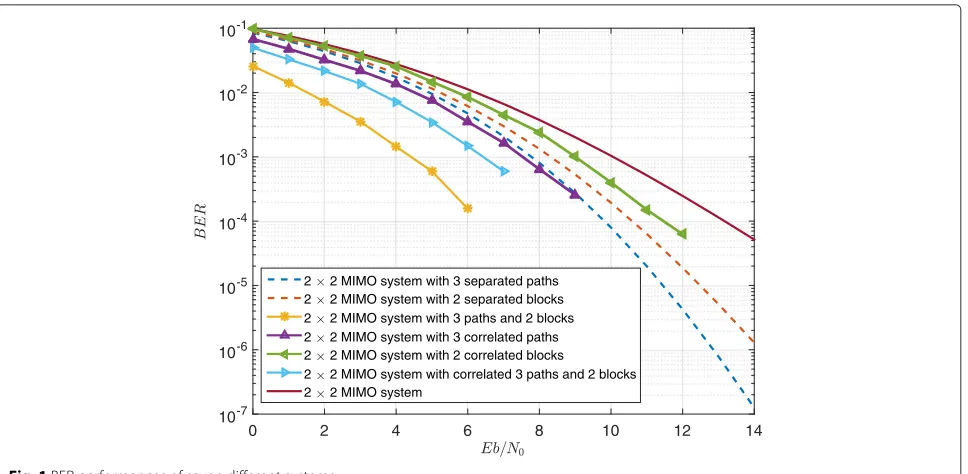
For illustrating the influence of the space, time, fre-quency dimensions, and their correlations into the system performance, Fig. 1 depicts the BER performances of seven different systems.
0 2 4 6 8 10 12 14 10-7
10-6 10-5 10-4 10-3 10-2 10-1
2 2 MIMO system with 3 separated paths 2 2 MIMO system with 2 separated blocks 2 2 MIMO system with 3 paths and 2 blocks 2 2 MIMO system with 3 correlated paths 2 2 MIMO system with 2 correlated blocks
2 2 MIMO system with correlated 3 paths and 2 blocks 2 2 MIMO system
Fig. 1BER performances of seven different systems
or with three correlated paths are decreased, respectively. That explains the effect of temporal and multipath cor-relations on the performance. In addition, the BER per-formance of 2×2 MIMO system with two blocks, three paths, and separated multipath and temporal correlations is better than the one with the completely correlated fad-ing channels. That illustrates that the correlation between two dimensions could lead to reduce the performance.
Now, we show that this model is consistent with that in MIMO LTE systems [20]. Take LTE Extended Vehicular A (EVA) model for example [20]. It is a 2×2 LTE MIMO sys-tem with nine paths. And we use high spatial correlation, i.e.,
RNrl,d=RNtl,d = %
1 0.9 0.9 1
&
. (64)
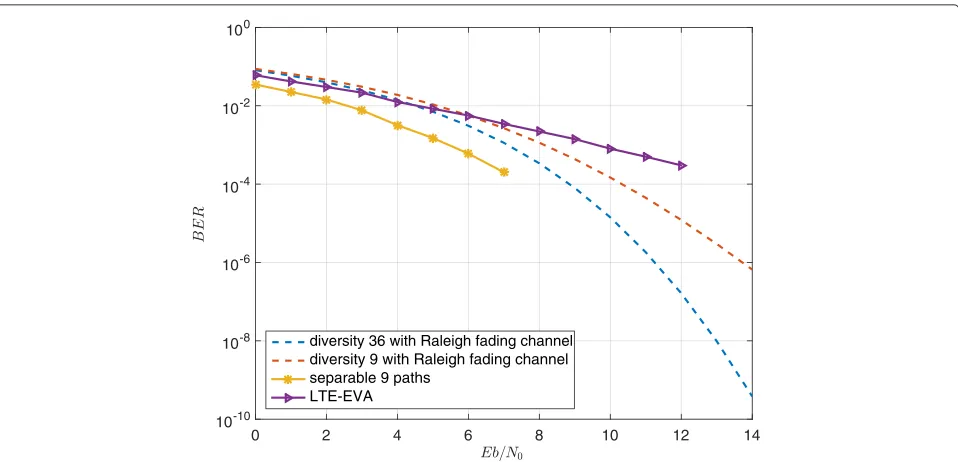
Figure 2 plots the simulated BER performance of the STF-coded 2×2 LTE-EVA system with high spatial cor-relation. In the simulation, there is one OFDM block and the modulation scheme is quadrature phase shift keying (QPSK) . Because there exists the path correlation in LTE-EVA model, though matricesRNtl,dandRNrl,dhave full ranks, from Fig. 2, the diversity of this model is less than the number of nine multipaths that is caused by the path cor-relation and the corcor-relation between the space and the path, i.e.Ll=1nullrTl−null(rl)
−nullrT1,. . .,rTL in (63).
We further let these nine multipaths be separated, and other parameters be the same with the one of LTE-EVA
model. Without multipath correlation, from (63), the achievable maximum diversity can be simplified as
rank(R)= L
l=1
rank RNtl,l !
rank RNrl,l !!
. (65)
Both covariance matricesRNtl,l andRNrl,l have rank two. From (65), the theoretical achievable maximum diversity in this case is 36. It is seen from Fig. 2 that when com-pared to the BER performance of uncoded Rayleigh fading channels with diversity order 36, the slope of the curve depicting the performance of the 2×2 LTE system with nine separable paths is the same (when SNR is larger than 8, the BER of the LTE system with nine separated multi-paths is too small to obtain by Matlab). Thus, the diversity of the 2 ×2 LTE system is also 36, which matches the theoretical result.
0 2 4 6 8 10 12 14 10-10
10-8 10-6 10-4 10-2 100
diversity 36 with Raleigh fading channel diversity 9 with Raleigh fading channel separable 9 paths
LTE-EVA
Fig. 2BER comparisons between the STF-coded 2×2 LTE-EVA system with high spatial correlation
maximum achievable diversity of MIMO-OFDM system in this case is similar to case 1,
rank(R)=rank RK! "
L
l=1 L
d=1
rank rLl,dRNt
l,d !
rank rLl,dRNr
l,d !
+null rl,dLRNt
l,d⊗R Nr
l,d !#
+ L
l=1
null rTl!−null(rl) !
−null rT1,. . .,rTL!#.
(66)
Take 802.11n channel model B for example [21]. It is a 2×2 MIMO system with nine Rayleigh-fading paths which have a bell Doppler spectrum.
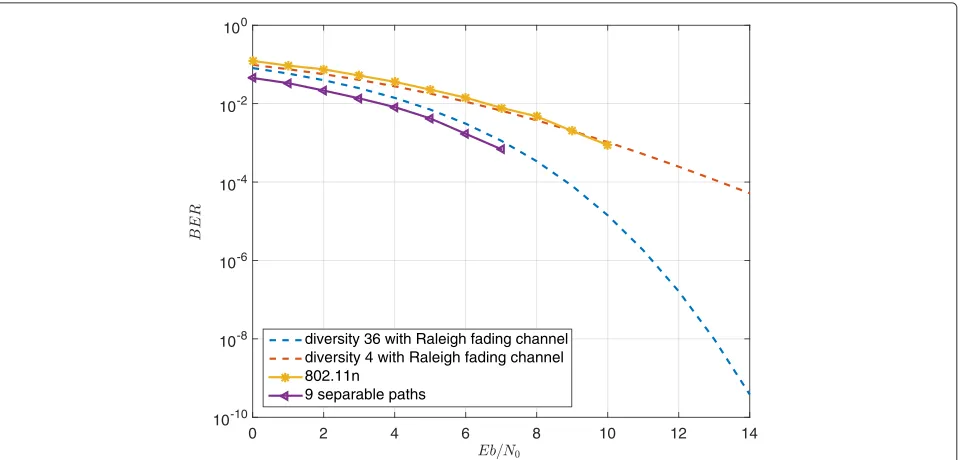
Figure 3 depicts the simulated BER performance of this model. In this simulation, there is one OFDM block and the modulation scheme is QPSK. The diversity of 802.11n with channel model B is a little larger than 4. This result is caused by the path correlation, spatial correlation, and the correlation between these two dimensions.
Further, we let these nine multipaths be separable and the transmitted correlationRNt
1,1and the received
correla-tionRNr
1,1be the same with the standard 802.11n channel
model B.
From Fig. 3, the BER performance is much better than the one of 802.11n channel model B. The reason is that under the conditions of separable multipaths, the
achievable diversity is linearly increased by the number of multipaths. That is consistent with the theoretical result.
6.2 Case 2: STF-coded MIMO-OFDM system over frequency and temporal correlation channels
If the antenna elements at both the transmitter and the receiver are well separated and scatterers are abundant, then no spatial correlation exists between the different transmit and receive antenna pairs (i.e., independent spa-tial fading channels). Hence,
rank RS[l,d]!=NrNt, 1≤l,d≤L,
nullr1T,r2T,. . .,rLT
− L
l=1 nullrlT
!
=NrNtL−rankRL,
range rLl,dRSl,d!⊆range RSl,l!, 1≤l,d≤L.
(67)
Therefore, the maximum achievable diversity of MIMO-OFDM system without the spatial correlation is
rank(R)=NrNtrank RK !
rank RL !
, (68)
which agrees with [25].
6.3 Case 3: SF-coded MIMO-OFDM system over only spatial correlation channels
0 2 4 6 8 10 12 14 10-10
10-8 10-6 10-4 10-2 100
diversity 36 with Raleigh fading channel diversity 4 with Raleigh fading channel 802.11n
9 separable paths
Fig. 3BER comparisons between the STF-coded 2×2 LTE system with four separable paths
block period. In this case, the fading channels are inde-pendent in temporal and frequency domains, leading to
RK=1,
rank rLl,dRSl,d!=0, 1≤l,d≤L,l=d,
range rlT !
∩range rlT !
= {0}, 1≤l,l≤L,l=l,
range rlL,lRSl,l !
∩range rlL,dRSl,d !
= {0}, 1≤l,d≤L,l=d. (69)
We substitute rankRK=1 into the result of case 1 and have
rank(R)= L
l=1
rank RS[l,l]!, (70)
which is consistent with the result in [16]. It indicates that the diversity order of the system is equal to the number of degrees of freedom offered by independent scatterers.
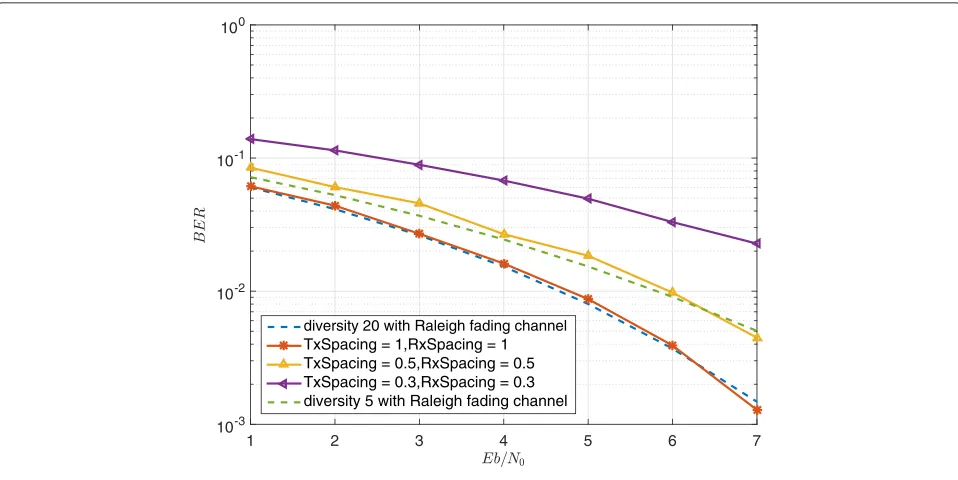
Figure 4 depicts the BER performances of 2×2 MIMO system with five separable multipaths under different spaces of transmit and receive antennas. From Fig. 4, with the space increasing, the more spatial diversities are obtained. When the spaces of transmit and receive anten-nas are one (normalized by the wavelength), the diversity is 20 which illustrates that the full space diversity 4 is achieved in each path.
6.4 Case 4: SF-coded MIMO-OFDM system over only frequency correlation channels
In this case, there is only one OFDM block period(K=1) and the fading channels in the spatial domain are indepen-dent. Hence,
RK =1,
rank RS[l,d]!=NrNt, 1≤l,d≤L,
nullr1T,r2T,. . .,rLT
− L
l=1 null rlT
! =NrNt
L−rankRL,
range rl,dLRSl,d
!
⊆range RSl,l
!
, 1≤l,d≤L.
(71)
The maximum achievable diversity of SF-coded MIMO-OFDM system over frequency correlation channels is
rank(R)=NtNrrank RL !
, (72)
which agrees with [28].
6.5 Case 5: ST-coded MIMO system over only temporal correlation channels
1 2 3 4 5 6 7 10-3
10-2 10-1 100
diversity 20 with Raleigh fading channel TxSpacing = 1,RxSpacing = 1 TxSpacing = 0.5,RxSpacing = 0.5 TxSpacing = 0.3,RxSpacing = 0.3 diversity 5 with Raleigh fading channel
Fig. 4BER performance of 2×2 system with five paths under different antenna spaces
system over temporally correlated channels. Conse-quently, we have
RL=1,
rank RS[l,d]!=NrNt,l=d=1, (73)
Because of only one path during the transmitter and the receiver, the covariance matrixE{AAH}in (27) degrades to a tensor product of a temporal channel covariance matrix RK and a spatial channel covariance matrixRS1,1.
Hence, the maximum achievable diversity for ST-coded MIMO system with temporal correlation is given by
rank(R)=NrNtrank RK !
, (74)
which was given in [7].
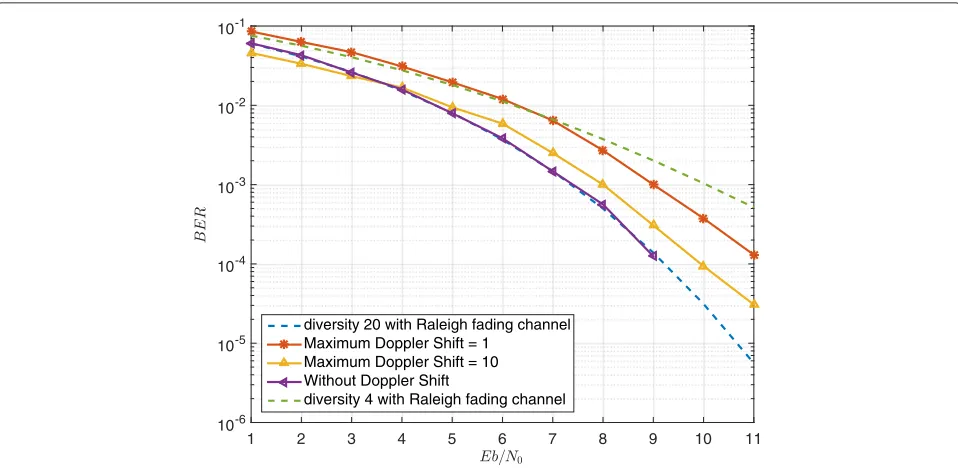
Figure 5 plots the BER performances of 2×2 MIMO system with five correlated OFDM blocks under differ-ent Doppler shifts. From Fig. 5, with the Doppler shift decreasing, the more path diversities are obtained. With-out Doppler shift, the diversity is 20 which explains that the full time diversity 5 is achieved.
6.6 Case 6: ST-coded MIMO system over spatial correlation channels with Kronecker model
In this case, the spatial correlation of flat-fading channels follows a Kronecker model [27]. Since the multipath effect and Doppler shift are not considered in this case, both the
temporal and frequency covariance matricesRK andRL degenerate, leading to
RL=1, RK =1,
EAAH=R1,1S =RNt⊗RNr. (75)
The maximum diversity of MIMO fading channels with separable spatial correlation is hence given by
rank(R)=rank RNt!rank RNr!, (76)
which is the result obtained in [27].
6.7 Case 7: independent fading channels
In this case, there is no correlation among channel fades in the space, time, and frequency/path domains. Conse-quently, we have
rank RSl,d!=NrNt, 1≤l,d≤L,
rank RK
! =K,
rank RL!=L,
rank rl,dLRSl,d!=0, 1≤l,d≤L,l=d,
range rlT !
∩range rlT !
= {0}, 1≤l,l≤L,l=l,
range rLl,lRSl,l!∩range rLl,dRSl,d!= {0}, 1≤l,d≤L,l=d.
1 2 3 4 5 6 7 8 9 10 11 10-6
10-5 10-4 10-3 10-2 10-1
diversity 20 with Raleigh fading channel Maximum Doppler Shift = 1
Maximum Doppler Shift = 10 Without Doppler Shift
diversity 4 with Raleigh fading channel
Fig. 5BER performance of 2×2 system with five OFDM blocks under different Doppler shifts
According to Theorem 1, we are able to achieve the total number of independent degrees of freedom inherent in the physical structure of the system, which is given by
rank(R)=NtNrKL, (78) which is consistent with the result in [29].
7 Conclusions
In this paper, we have studied the performance of STF-coded MIMO-OFDM system with arbitrary spatial, tem-poral, and frequency/path correlations. Our analysis is based on a general transmitted correlation model that goes beyond limitations of ideal assumptions such as quasi-static or rapid fading channels, channel indepen-dence in different antennas, and separable multipaths between the transmitter and the receiver. Our chan-nel spatial correlation covers both the Kronecker and non-Kronecker models. We derive an upper bound on the maximum achievable diversity of this system using Hadamard and tensor products. Based on rank properties of block matrices, we also analyze the effect of the general channel correlation on the performance of block-fading MIMO-OFDM systems. Furthermore, achievability of our upper bound is proved via two code design examples: one traditional STF code and another quasi-SF code. The decoding complexity is considered in the MIMO system with arbitrary correlated fading channels using the tra-ditional STF code. By identifying the newly developed statistical channel models for MIMO LTE and 802.11n as special cases of our STF-coded MIMO-OFDM system, we can directly use our theoretical diversity results without
resorting to simulations. Finally, our theoretical result for general correlation scenarios subsumes those in the exist-ing literature that only deal with different special cases.
Appendix A: proof of Lemma 1
Proof. According to the property of the rank and nullity of a matrix [30], we have
rankBp
+nullBp
=bp, 1≤p≤P, rank DTq
!
+null DTq!=dq, 1≤q≤Q,
rank [B1,B2,. . .,BP]+null [B1,B2,. . .,BP]= P
p=1 bp.
rank
DT1,DT2,. . .,DTQ
+null
DT1,DT2,. . .,DTQ
=
Q
q=1 dq.
(79)
Thus, the rank of block matrices [B1,B2,. . .,BP] and
DT1,DT2,. . .,DTQ T
can be calculated, respectively, as
rank [B1,B2,. . .,BP]
=
P
p=1
bp−null [B1,B2,. . .,BP]
=
P
p=1
rankBp
+nullBp
−null [B1,B2,. . .,BP]
and
Moreover, according to the property of the nullity of a matrix in [30], if rangeBp
then (35) follows from (83) according to the rank
proper-ties of block matrices [31].
Competing interests
The authors declare that they have no competing interests.
Acknowledgments
This work was supported by the National Science Foundation for Innovative Research Groups of China (61521091).
Author details
1Department of Electrical and Computer Engineering, North Carolina State University, Raleigh, USA.2Department of Electrical and Computer Engineering, Beihang University, Beijing, China.3Department of Electrical and Computer Engineering, Texas A&M University, College Station, USA.
Received: 8 June 2015 Accepted: 15 January 2016
References
1. JC Guey, MP Fitz, MR Bell, WY Kuo, Signal design for transmitter diversity wireless communication systems over Rayleigh fading channels. IEEE Trans. Commun.47, 527–537 (1999)
2. V Tarokh, N Seshadri, AR Calderbank, Space-time codes for high data rate wireless communication: performance criterion and code construction. IEEE Trans. Inform. Theory.44, 744–765 (1998)
3. V Tarokh, A Naguib, N Seshadri, AR Calderbank, Space-time codes for high data rate wireless communications: performance criteria in the presence of channel estimation errors, mobility, and multiple paths. IEEE Trans. Commun.47, 199–207 (1999)
4. JW Craig, inProc. IEEE Military Communications Conference, 1991. MILCOM ’91, Conference Record, Military Communications in a Changing World. A new, simple and exact result for calculating the probability of error for two-dimensional signal constellations (IEEE, McLean, VA, USA, 1991), pp. 571–575
5. V Veeravalli, On performance analysis for signaling on correlated fading channels. IEEE Trans. Commun.49, 1879–1883 (2001)
6. M Damen, A Abdi, M Kaven, inProc. IEEE VTC Fall 2001. On the effect of correlated fading on several space-time coding and detection schemes, vol. 1 (IEEE, Atlantic City, New Jersey, USA, 2001), pp. 13–16
7. W Su, Z Safar, KJR Liu, Diversity analysis of space-time modulation over time-correlated Rayleigh fading channels. IEEE Trans. Inform. Theory.50, 1832–1840 (2004)
8. H Bolcskei, M Borgmann, A Paulraj, Impact of the propagation environment on the performance of space-frequency coded MIMO-OFDM. IEEE J. Selected Areas Commun.21, 427–439 (2003) 9. F Riera-Palou, G Femenias, A unified view of diversity in
multiantenna-multicarrier systems: analysis and adaptation strategies. EURASIP. J. Wireless Commun. Netw.1, 1–14 (2012)
10. T Bao, Y Liang, inProc. IEEE International Conference on Signal Processing
Communication and Computing (ICSPCC) 2012. Improved
space-time-frequency block code for MIMO-OFDM wireless communications (IEEE, Hong Kong, China, 2012), pp. 538–541 11. G Owojaiye, F Delestre, Y Sun, Differential distributed quasi-orthogonal
space-time-frequency coding. IEEE Wireless Advanced (WiAd), 115–120 (2012)
12. M Shahabinejad, S Talebi, Full-diversity space-time-frequency coding with very low complexity for the ML decoder. IEEE Commun. Lett.16(5), 658–661 (2012)
13. C Huang, Y Guo, MH Lee, inProc. IEEE International Conference on Computer Science and Electronics Engineering (ICCSEE), 2012. High-rate full-diversity space-time-frequency codes with partial interference cancellation decoding, vol. 1 (IEEE, Hangzhou, Zhejiang, China, 2012), pp. 235–240 14. H Ozcelik, M Herdin, W Weichselberger, J Wallace, E Bonek, Deficiencies of
‘Kronecker’ MIMO radio channel model. Electron Lett.39, 1209–1210 (2003)
15. N Costa, H Simon,Multiple-Input Multiple-Output Channel Models: Theory and Practice, vol. 65. (John Wiley & Sons, 2010)
16. AK Sadek, W Su, KJ Ray Liu, inProc. IEEE Global Telecommunications
Conference (GLOBECOM) 2004. Maximum achievable diversity for
MIMO-OFDM systems with arbitrary spatial correlation, vol. 4 (IEEE, Dallas, TX, USA, 2004), pp. 2664–2668
17. A Sadek, W Su, KJR Liu, Diversity analysis for frequency-selective MIMO-OFDM system with general spatial and temporal correlation model. IEEE Trans. Commun.54, 878–888 (2006)
18. LM Davis, IB Collings, RJ Evans, inProc. IEEE Workshop on Statistical Signal and Array Processing (SSAP). Maximum likelihood delay-Doppler imaging of fading mobile communication channels (IEEE, Pocono Manor, PA, USA, 2000), pp. 151–155
19. M Liao, Y Zhang, Z Xiong, inProc. IEEE WCNC 2013. Diversity analysis for space-time-frequency (STF) coded MIMO system with a general correlation model (IEEE, Shanghai, China, 2013), pp. 2661–2666 20. 3rd Generation Partnership Project; Technical Specification Group Radio
Access Network; Evolved Universal Terrestrial Radio Access (E-UTRA); User Equipment (UE) radio transmission and reception (Release 10). 3GPP TS 36 (2010): V10
21. V Erceg, Z Wireless,et al, IEEE P802.11 Wireless LANs TGn Channel Models, doc.: IEEE 802.11-03/940r4, 1–45 (2004)
22. D Gesbert, H Bolcskei, D Gore, A Paulraj, Outdoor MIMO wireless channels: models and performance prediction. IEEE Trans. Commun.50, 1926–1934 (2002)
23. A Mathai, S Provost,Quadratic Forms in Random Variables. (Marcel Dekker, New York, 1992)
24. SM Alamouti, A simple transmit diversity technique for wireless communications. IEEE J. Select Areas Commun.16, 1451–1458 (1998) 25. W Su, Z Safar, KJR Liu, inProc. 5th Eur. Wireless Conf. Diversity analysis of
26. MO Sinnokrot,Space-time block codes with low maximum-likelihood decoding complexity. (Georgia Institute of Technology, Doctoral dissertation, 2009)
27. H Bolcskei, A Paulraj, inProc. IEEE 34th Asilomar Conf. Signals, System and Computers. Performance of space-time codes in the presence of spatial fading correlation, vol. 1 (IEEE, CA, Pacific Grove, 2000), pp. 687–693 28. W Su, Z Safar, M Olfat, KJ Ray Liu, Obtaining full-diversity space-frequency
codes from space-time codes via mapping. IEEE Trans. Signal Proc.51, 2905–2916 (2003)
29. W Zhang, X Xia, P Ching, High-rate full-diversity space-time frequency codes for broadband MIMO block fading channels. IEEE Trans. Commun.
55, 25–34 (2007)
30. CD Meyer,Matrix Analysis and Applied Linear Algebra (Society for Industrial and Applied Mathematics Philadelphia. (PA, USA, 2000)
31. G Marsaglia, GPH Styan. Equalities and inequalities for ranks of matrices.Linear Multilinear Algebra.2, 269–292 (1974)
Submit your manuscript to a
journal and benefi t from:
7Convenient online submission 7Rigorous peer review
7Immediate publication on acceptance 7Open access: articles freely available online 7High visibility within the fi eld
7Retaining the copyright to your article