Page 159
DETERMINING THE VIEWS OF GEOGRAPHY TEACHER CANDIDATES ABOUT THE CONCEPT OF LANDSLIDE
Tahsin Tapur*, Baştürk Kaya,Caner Aladağ
Necmettin Erbakan University, Ahmet Keleşoğlu Faculty of Education, 42090 Konya, Turkey
Abstract
The aim of this study is to determine the views of the geography teacher candidates about the concept of landslide. The data of the research were collected by using free word association test from 34 5th grade students who are students at the department of Geography Education of Ahmet Keleşoğlu Education Faculty in Necmettin Erbakan University in 2016-2017 academic years. This study is a qualitative research and content analysis was used in the evaluation of the data. The obtained data were coded and categories were created after similar answers were put together. The number of answer words in each category and the frequency values of all answer words were calculated and then given in tables. In each category, the words which were repeated at least two times were given. The category of "the reasons that make up the landslides" has come to the forefront within these categories in terms of its number of answer words and their frequencies. The second category in terms of the number of repetition of answer words is the category named as "The relation between landslide and ground". As a result, it has been determined that the students have correct inferences about the concept of landslide and they can think academically, but the number of answer words and frequencies is low.
Keywords:landslide, geography, cognitive structure, word association test
1. INTRODUCTION
Natural disaster; is a natural phenomenon that results in loss of life, as well as serious economic and social damage, which develops in a completely natural form without any human influence, often in an instant or in a short period of time. In addition, there are long-term natural disasters such as global warming and erosion which can cause serious effects on human and natural environment in terms of their formation mechanism (Özgen, Ünaldı and Bindak, 2011).
Disasters are also classified according to their occurrence. According to their occurrence, disasters are classified under two main groups: "sudden emergencies" (earthquake, flood, avalanche, landslide, volcanic eruptions, fires, etc.) and "insidious and persistent ones" (air pollution, drought, famine, war etc.). In general, disasters are classified into two main groups as "natural disasters" (earthquake, flood, avalanche, landslide, volcanic explosions, fires, etc.) and "unnatural human disasters" (wars, migrations, dam bursts etc.) (Yavaş, 2005).
As the name implies, natural disasters are natural origins. Their formation is based mainly on nature, natural phenomena and natural characteristics. However, human affects can be found in some of these disasters. In fact, people can play a role in triggering these events. However, the factors that prepare these events and the preparation of the events are based on the natural features or events there (Sahin and Doğanay, 2000).
Landslide, also known as earthsliding, is a phenomenon in which rocks, sediments and masses of earth are displaced along the slope under the influence of gravity. There are a variety of factors that prepare the formation of landslides. It is possible to collect these factors under two headings, natural factors and human factors (Öztürk, 2002).
Page 160
Landslides occur due to the deterioration of slope stability and it is bound to geological-geomorphological-climatological-meteorological factors, processes and various activities of people (Öztürk, 2002). The main reason for mass movements is gravity. The causes related to natural and human activities are the factors that trigger and determine the movement of mass. In addition to these, there are many factors that determine the speed of movement on the slope, decrease or increase the degree of slip of the mass and successive events chain (Öztürk, 2002).
Natural disasters in the geography of science contain very different concepts in terms of their origins, form and effects. Teaching these concepts correctly will help make meaningful learning so this way information becomes permanent. It is possible to check whether the conceptual learning is provided by determining the cognitive structures of the students in this subject. One of the techniques used for this is the word association tests.
Polat (2013) suggests that researchers use word-association tests more often to identify cognitive structures before and after instruction and to reveal changes in their cognitive structures while teaching.
Word association test is one of the oldest and most common techniques used to determine the cognitive structure of the learners and to analyse the information network between concepts in this structure and to determine whether the relations between the concepts in the long-term memory are sufficient (Özatlı and Bahar, 2010). The greatest advantage of using the word association test as both a measurement evaluation tool and a diagnostic tool is that it is easy to prepare and can be applied within a 5-minute time span (Bahar et al., 2010).
The word association test method can be applied in various forms: In Grouping Method (White and Gunstone 1992), students are asked to group the words by giving a list of words related to the topic. In Controlled Vocabulary Association (Preece 1976; Tsai and Huang 2002), students are asked to write the words on the page according to an order in which words having the closest relation to the stimuli are written at the top of each page. Free Word Association Method (Preece, 1976; Tsai and Huang 2002; White and Gunstone 1992) is the type that is introduced and used in this study. On each page, there is a stimulating word on the left side and stimulating word is repeatedly written. On the right side, the pages are presented to the students where the gaps are left for students’ writing the words related to a stimulating word (Akt: Köseoğlu and Bayır, 2011).
2. OBJECTIVE, MATERIAL AND METHOD 2.1. Objective of the Research
The aim of this study is to find out what cognitive structures related to the concept of "landslide" geography undergraduates have, whether permanent learning is provided and how they organize information about the concept of landslide in their minds by using independent word association test.
2.2. Research Model
In this study, qualitative research method was used. Qualitative research can be defined as a method in which qualitative data collection methods such as observation, interviews and document analyses are used and a qualitative process is followed for realizing the perceptions and events in a natural and realistic way. In other words, qualitative research is an approach that investigates social phenomena in an environment to which they belong with an understanding that forms theory and takes the meaning to the foreground (Yıldırım and Şimşek, 2011).
2.3. Data Collection and Data Analysis
Page 161 Landslide ---
Landslide---
.
.
.
.
.
Related sentence---
The aim in writing a key word under the other 10 times is to provide students’ returning to key concept again after writing each word. Bahar and Özatlı (2003: 77) reveal that reason of writing a key concept under the other ten times is to prevent the risk of chain-response. Because, student will write the words that came to his mind as a result of a concept which he wrote in response instead of key-concept unless he/she returns to the key-key-concept in writing the key-concept every time. And this gives harm to the objective of the test.
After the answers were written by the students, the teacher candidates were asked to write meaningful sentences between the key concepts and the answer words, and the sentences written for each word were analysed one by one during the analysis of the data. Bahar et al. (2006), the answer word associated with the key concept may also be an associative product that does not have a meaningful relationship to the key concept at the level of recall.
2.4. Data Analysis
Content analysis, which is a qualitative research method, was used in the evaluation of collected data by the free word association test.
Content analysis interprets the data that are similar to each other through integrating within the framework of certain concepts and themes (Yıldırım and Şimşek, 2006). The first stage of content analysis is called "categorical analysis". This analysis provides the classification of the meaningful items and the determination of their frequencies. Due to the use of certain measures, numbers and categories, it is a "taxonomic" method (Bilgin, 2006).
In the analysis of the data, the answer sheets of the students in the word association test applied for landslide were numbered 1 to 34. Later, in order to evaluate the results of the WAT, answer words given to the concept of landslide were grouped in alphabetical order by referring to expert opinion and it was determined how many times the words were repeated for the concept of landslide. The most frequently repeated answer words were analysed according to semantic relation technique. All the answers given to the key concepts were examined one by one and the frequency tables indicating how many times the answer words or concepts were repeated for the key concepts of landslide were created under the related categories.
2.5. Validity and Reliability Studies
Page 162
3. FINDINGS
The data obtained about the key concept of landslide are coded and categorized. A total of 6 categories were created from the answer words obtained by applying the free word association test for this concept. The answer words in each category were listed in the table under the relevant heading. If these words were repeated once, they were not written in the table but written in text under the relevant category. If the words are not relevant and meaningful, they are not included in the categories and they are also mentioned in the text. A total of 64 answer words were produced by students for the key concept of landslide. The total frequency of these words is 299. The number of answer words in 6 categories is 45 and these words were repeated 280 times. Of these 6 categories, 19 response words were repeated just once, and the frequency of them was 19. In addition, no meaningless word was found regarding the subject.
When the answer words given for the key concept of landslide are examined, the first category is named as "the reasons that make up the landslide" (Table 1). A total of 15 answer words were identified in this category and the frequency was identified as 100. The most repeated answer in this category is the word Rainfall (22). More than half of the students made a correct inference about the reasons of landslides. Water saturation (11), Soil (10), Spring (8), Land structure (7), Excessive precipitation (7) etc. are the most repeated words after the answer of “rainfall”. These words are correct but the frequencies are low. This shows that students have a certain level of knowledge about landslides but have difficulty in remembering. Because the important answer words given for the reasons of the landslide is either not remembered or the frequency is low. When the words that emerged in this category are examined, it is seen that the students have correctly correlated with the concept of Landslide, but these answers and frequencies are not sufficient. This suggests that students have lack of information in this subject. Words that repeated only once in this category are; Forest, Loose soil, Flood and Tree.
Table 1. Answer words and frequencies belong to the category of “the reasons that make up the landslides”
Category 1 Concepts Frequency
Reasons that make up the landslides Rainfall 22
Water saturation 11
Soil 10
Spring 8
Land Formation 7
Excessive precipitation 7
Climate 6
Water 6
Gravity 5
Slipperiness 5
Snowmelt 4
Vegetation Cover 3
Human 2
Roughness 2
Porosity 2
Page 163
The second category is; "Landslide and ground relations" (Table 2). In this category, there are 9 answer words that repeated 2 or more and they were repeated for 67 times. The most repeated answer word is Slope (23). More than half of the students have made an accurate association by writing the answer word of “slope”. At the second level, the word with high frequency is “clay soil” (17). These two words are the product of true thoughts and show that students correctly associate the basic concepts of landslide and ground relation in their minds. The answer words such as soil type and ground are repeated only once under this heading. When the words that emerged in this category are examined, it is seen that the students make correct associations with the key concept of landslide, but the frequencies of some answer words are not sufficient. This suggests that students have a lack of information in this subject.
Table 2. Answer words and frequencies belong to the category of “landslide and ground relations”
Category 2 Concepts Frequency
Landslide and ground relations Slope 23
Clay soil 17
Layer slope 6
Hillside 5
Rock 4
Permeable layer 4
Bedrock 3
Impermeable layer 3
Drainage 2
TOTAL 67
A third category named as "The identification of landslides" was created for the key concept of landslide using the participants' answer words (Table 3). For this category, 5 answer words were identified. The number of repetitions of these 5 answer words is 44. In this category, most associated answer words that the participants write are; Mass movement (17), Earth sliding (13). In this category 9 students used the expression of “natural disaster” (9) for landslide. The frequency of answer words is not sufficient and this indicates that students cannot construct the concept of landslides adequately in their minds because it can be understood that they cannot establish semantic relations between natural disasters and landslides.
Table 3. Answer words and frequencies belong to the category of “Identification of landslides”
Category 3 Concepts Frequency
Identification of landslides category Mass movement 17
Earth sliding 13
Natural disaster 9
Subsidence 3
Movement 2
Page 164
The fourth category is a category in which answer words related to "Landslide sensitive areas and measures to be taken for prevention" are included (Table 4). The frequency of this category is 32 and it consists of 6 answer words. Participants in this category mainly expressed the answer words of “Black Sea Region” (11) and “East Black Sea Region” (8). It is true to associate the landslide with the Black Sea Region (11).
Table 4. Answer words and frequencies belong to the category of “Landslide sensitive areas and
measures to be taken for prevention”
Category 4 Concepts Frequency
Landslide sensitive areas and Black Sea Region 11
measures to be taken for prevention East Black sea Region 8
Tortum Lake 5
Pile-driving 3
Retaining wall 3
Landslide Lake 2
TOTAL 32
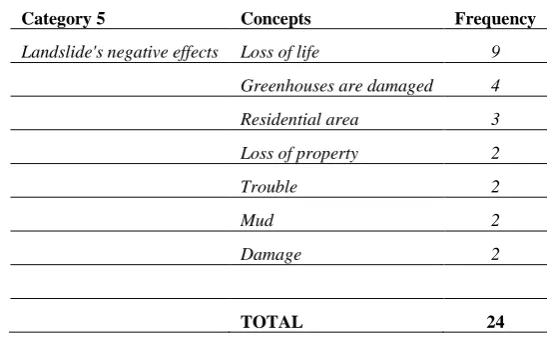
The fifth category was named as "Landslide's negative effects" and it consists of 7 answer words. The frequency of these words is 24 (Table 5). The words in this category are; loss of life (9), Greenhouses are damaged (4), Residential area (3). The students cannot produce enough answer words about the damages of the landslide and the number of repetition of the answer words they produce is also low. This suggests that students' knowledge of landslide is not sufficient and that they cannot establish relationships between concepts. In addition, words such as Structure, Demolition, Catastrophe, Field, Garden, Human factors, Materiality, Blurred water were repeated once.
Table 5. Answer words and frequencies belong to the category of “Landslide's negative effects”
Category 5 Concepts Frequency
Landslide's negative effects Loss of life 9
Greenhouses are damaged 4
Residential area 3
Loss of property 2
Trouble 2
Mud 2
Damage 2
TOTAL 24
Page 165
Table 6. Answer words and frequencies belong to the category of “Concepts related to landslide”
Category 6 Concepts Frequency
Concepts related to landslide Landslide scar 6
Landslide cone 5
Carriage 2
TOTAL 13
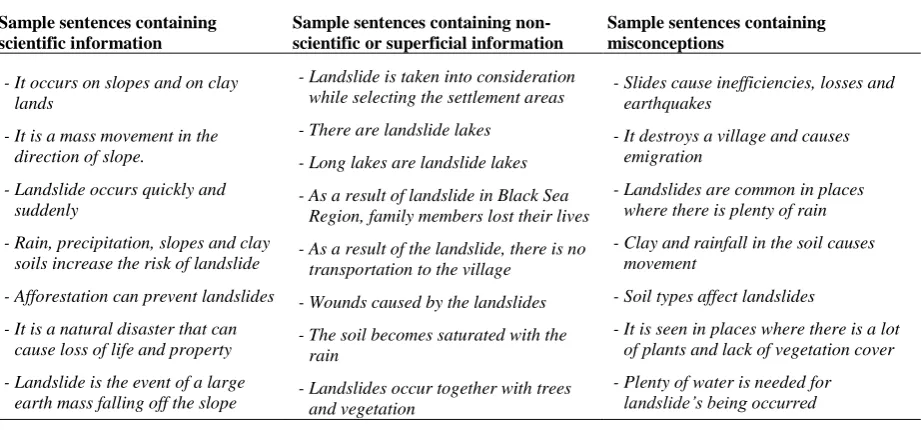
In the following table, there are some sample sentences written by geography students related to the concept of landslide. When Table 7 is examined, it is seen that geography students write correct sentences related to categories. When all these sentences are examined, it is seen that most of the sentences contains scientific information. In the second place, there is a list of sentences that are unscientific or containing superficial information related to the key concept of landslide. There are also sentences containing misconceptions in the sentences that were created with the answer words about the key concept of landslide.
Table 7. Sample Sentences That Students Create About the Key Concept of “Landslide”
Sample sentences containing scientific information
Sample sentences containing non-scientific or superficial information
Sample sentences containing misconceptions
- It occurs on slopes and on clay lands
- It is a mass movement in the direction of slope.
- Landslide occurs quickly and suddenly
- Rain, precipitation, slopes and clay soils increase the risk of landslide - Afforestation can prevent landslides - It is a natural disaster that can
cause loss of life and property - Landslide is the event of a large
earth mass falling off the slope
- Landslide is taken into consideration while selecting the settlement areas - There are landslide lakes
- Long lakes are landslide lakes - As a result of landslide in Black Sea
Region, family members lost their lives - As a result of the landslide, there is no
transportation to the village - Wounds caused by the landslides - The soil becomes saturated with the
rain
- Landslides occur together with trees and vegetation
- Slides cause inefficiencies, losses and earthquakes
- It destroys a village and causes emigration
- Landslides are common in places where there is plenty of rain - Clay and rainfall in the soil causes
movement
- Soil types affect landslides
- It is seen in places where there is a lot of plants and lack of vegetation cover - Plenty of water is needed for
landslide’s being occurred
4. RESULT
Page 166
students have correctly structured certain topics related to landslides in their minds and have information at academic level.
The frequency of the category of "Identification of Landslides" is 44. Students in this category have put forward the answer words of Mass movement (17), Land slide (13) and Natural disaster (9). The frequencies of other categories are below 50 and low. The first three categories have the highest number of answer words, while the answer words for the last three categories are fewer. It is seen that while students have included important concepts related to landslide in these categories, they have difficulty in remembering some concepts. The words in all the categories are mostly words that require academic knowledge. When the answer words given by the students for the key concept of landslide are examined, it is seen that there are no unrelated words about the landslides. All answer words are the product of correct information in students’ minds and show that students configure the key concept of landslide correctly in their minds. In short, this shows that students have correctly structured the concepts related to landslide in their minds and they have no misconceptions at the word level. It is seen that students have academic information about landslide but they have difficulty in remembering some concepts. This is a result of rote-learning based education system. Because the frequency of the most of the answer words is low and some important words were repeated only once. This result shows that the students have some imperfect information on some subjects. Some words have never been mentioned, and it means that some information about landslides has never been built up or lost in their minds.
When the sample sentences related to the key concept of landslides are examined, it can be said that most of the sentences contain scientific information. It is seen that students have created sentences containing correct information about almost every concept. This result shows the importance of conceptual learning and the conceptual learning’s having been taken place. Such sentences as; It occurs on slopes and on clay lands, It is a mass movement in the direction of slope, Landslide occurs quickly and suddenly, Rain, precipitation, slopes and clay soils increase the risk of landslide, Landslide is the event of a large earth mass falling off the slope are the examples of sentences containing scientific information.
Just a few sentences containing non-scientific or superficial information were expressed by some students. In these sentences, the students tried to explain the concept of landslide with simple and non-scientific expressions.
It is also seen that the students created sentences containing incorrect information at a certain level. Such sentences as; Slides cause inefficiencies, losses and earthquakes, It destroys a village and causes emigration, Landslides are common in places where there is plenty of rain, Clay and rainfall in the soil causes movements are the examples of sentences containing misconceptions and they are far away from scientific information.
REFERENCES
1. Bahar, M. & Özatlı, S., 2003. Kelime İletişim Testi Yöntemi İle Lise 1. Sınıf Öğrencilerinin
canlıların temel bileşenleri konusundaki bilişsel yapılarının araştırılması, Balıkesir Üniversitesi Fen Bilimleri Enstitüsü Dergisi, 5(1), 75- 85.
2. Bahar, M., Nartgün, Z., Durmuş, S. & Bıçak, B., 2006. Geleneksel ve Alternatif Ölçme Değerlendirme Öğretmen El Kitabı, Ankara: Pegem Yayıncılık.
3. Bahar, M., Nartgün, Z., Durmuş, S. & Bıçak, B., 2010. Ölçme ve Değerlendirme Teknikleri, Ankara: Pegem Yayıncılık.
4. Bilgin, N., 2006. Sosyal Bilimlerde İçerik Analizi, Siyasal Kitabevi, Ankara.
5. Köseoğlu, F. & Bayır, E., 2011. Kelime İlişkilendirme Test Yöntemiyle Kimya Öğretmen
Page 167
6. Miles, M. B. & Huberman, A. M., 1994. Qualitative Data Analysis: An Expanded Sourcebook (2nd Ed.). Thousand Oaks, California: Sage.
7. Özatlı, N.S. & Bahar, M., 2010. Öğrencilerin Boşaltım Sistemi Konusundaki Bilişsel Yapılarının
Yeni Teknikler İle Ortaya Konması, Abant İzzet Baysal Üniversitesi Dergisi, 10(2), 9-26.
8. Özgen, N., Ünaldı, Ü. E. & Bindak, R. 2011. Öğretmen Adaylarının Doğal Afetler Konusuna
Yönelik “Etkili Öğrenme Biçimlerinin Belirlenmesi, Ahi Evran Üniversitesi Kırşehir Eğitim Fakültesi Dergisi (KEFAD), 12(4), 303-323.
9. Öztürk, K., 2002. Heyelanlar ve Türkiye’ye Etkileri, Gazi Eğitim Fakültesi Dergisi, 22(2), 35-50.
10. Polat, G., 2013. 9. Sınıf Öğrencilerinin Çevreye İlişkin Bilişsel Yapılarının Kelime İlişkilendirme
Test Tekniği ile Tespiti, Necatibey Eğitim Fakültesi Elektronik Fen ve Matematik Eğitimi Dergisi (EFMED), 7(1) 97-120.
11. Preece, P. F. W., 1976. Mapping Cognitive Structure: A Comparison of Methods. Journal of Educational Psychology, 68(1), 1-8.
12. Şahin, C. & Doğanay, H., 2000. Türkiye Coğrafyası, Ankara: Gündüz Eğitim ve Yayıncılık.
13. Şahin, C. & Şipahioğlu, Ş. 2003. Doğal Afetler ve Türkiye. Ankara: Gündüz Eğitim ve Yayıncılık.
14. White, R. & Gunstone, R. 1992. Probing Understanding. New York: Falmer Press.
15. Yavaş, H., 2005. Türkiye’de Doğal Afetlerin Merkez-Yerel İlişkiler Açısından Değerlendirilmesi, Dokuz Eylül Üniversitesi, Sosyal Bilimler Enstitüsü Dergisi, 7(3), 280-301.