Analyzing the Performance of Diverse LEACH
Algorithms for Wireless Sensor Networks
Jose Anand
Research Scholar, Anna University Chennai, & Associate Professor/ECE, KCG College of Technology, Chennai. Email: [email protected]
J. Jebamalar Tamilselvi
Assistant Professor, Jaya Engineering College, Chennai, Tamil Nadu.
S. Janakiraman
Professor/CSE, Pondicherry University.
---ABSTRACT---
Sensor nodes can be used for continuous sensing, location sensing and event detection with the help of different types of sensors such as seismic, thermal, visual, infrared, magnetic, and many gaseous sensors. Sensor networks have wide range of applications including medical, military, home, etc. All these applications involve vigorous wireless communication protocol that is good in reduced energy utilization. A Low Energy Adaptive Clustering Hierarchy (LEACH) algorithm is a protocol designed to obtain energy efficient application specific data aggregation with good performance for the wireless sensor networks. LEACH is a cluster-based routing protocol in which each node has given equal probability to act as cluster head. In this paper, analysis has been done with LEACH protocol and modified LEACH protocols like LEACH-C, and DEEAC. Analyses show that with proper enhancement in the LEACH design, the transmission can enhance the energy efficiency and increase the life time of the sensor node.
Keywords - DEEAC, LEACH, LEACH-C, routing protocol, wireless sensor networks.
--- Date of Submission: September 22, 2012 Date of Acceptance: November 10, 2012 ---
I. INTRODUCTION
he progression in wireless communications and electronics has emerged the expansion of low-cost sensor networks. Wireless sensor network is a collection of sensors which are interconnected by means of wireless communication channels. A sensor node in the wireless sensor network is a small device which is capable of collecting data from the surrounding regions [18]. With the collected data, simple computations are carried out and correspond with other sensor nodes and controlling authorities in the network. Sensor networks exploit large number of wireless sensor nodes to collect information from their sensing terrain. The gathered information will undergo in-network process and is send to the remote sink. The network consists of low-cost sensor nodes with limited battery power. The sensor nodes have to use the available energy source with limited computational capabilities.
Now a day, the low cost sensor devices are capable of efficient computation and wireless communication. A network of wireless sensor nodes can be used to collect information from a variety of applications including military, environmental, medical, and scientific applications. The wireless sensor network is deployed with hundreds or thousands of wireless sensor nodes. The wireless sensor nodes are capable of self-organizing a network and the nodes will communicate with each other by the use of wireless interfaces.
Every packet transmitted in the wireless sensor networks contains useful information, which can be utilized through packet-based computation and to enhance congestion control. The wireless sensor network packet computation has small packet forwarding rate and the forwarding computation capability is limited [14]. Most of the time the sensor nodes are modeled with limited energy, as a result the sensor nodes lacks recharging issues.
Because of the inherent characteristics of wireless sensor network, the nature of routing is a challenging one. The wireless sensor network design will carry out data communication in order to prolong the node lifetime in the network. This is also used to prevent connectivity degradation by the use of employing aggressive energy management approaches. The following are the routing design issues and routing challenges that affect the routing process in wireless sensor networks.
• Deterministic node deployment
• Energy consumption without losing accuracy • Data reporting methods
• Node/Link heterogeneity • Fault tolerance
• Scalability • Network dynamics • Transmission media • Connectivity • Coverage • Data aggregation • Quality of service
The routing protocols in wireless sensor networks can be categorized into the following three types based on the network structure, named; flat-based routing protocol, hierarchical-based routing protocol, and location-based routing protocol [4]. In flat-based routing protocol, all the nodes in the wireless sensor network is assigned with equal functionalities and the sensor nodes pool resources to perform the sensing assignment. In hierarchical-based routing or cluster-based routing protocol, the nodes in the wireless sensor network will have different roles in the network with scalability and efficient communication. In location-based routing protocol, the position of the sensor nodes is exploited based on the signal strength to route data in the wireless sensor network.
Based on the route identification from the source to the destination, the routing protocols in wireless sensor networks are classified into three types, namely; proactive routing protocol, reactive routing protocol, and hybrid routing protocol. In proactive routing protocol, the routes are identified even before the route is actually needed. In reactive routing protocol, the routes are identified when needed. Hybrid routing protocol is the combination of the proactive and reactive routing protocols.
Again, based on the routing operation, the routing protocols are classified into multipath-based routing protocol, query-based routing protocol, negotiation-query-based routing protocol, QoS-based routing protocol, and coherent-based routing protocol. In multipath-based routing protocol, multiple paths are used to improve the network performance like fault tolerance, energy consumption, and reliability. In query-based routing protocol, a query for data is propagated by the destination node. In QoS-based routing protocol, both data quality and energy consumption is given more importance. In coherent-based routing protocol, data aggregation in carried out with minimum data processing before forwarding.
The rest of the paper is organized as follows. Section 2 reviews about the related literature on wireless sensor networks and section 3 describes about diverse LEACH algorithms used in the wireless sensor networks. Section 4 details the experimental setup and analysis the simulation results. Finally conclusion is given in section 5.
II. RELATED WORK
In this section, we review the prior work on the various routing algorithms implemented for the wireless sensor networks. Stephanie et al [9] proposed a near-optimal chain-based protocol for minimizing energy named Power-Efficient GAthering in Sensor Information Systems (PEGASIS). A node will communicate with its close neighbor, and turns transmitting to the base station to reduce the energy usage. The delay incurred in gathering sensed data is minimized by using Code Division Multiple Access (CDMA) capable sensor nodes, which will transmit data simultaneously with less interference. By using CDMA capable sensor nodes, a chain-based method performs well for energy x delay.
Jamal et al [4] reviewed a survey of state-of-the-art routing techniques and their design challenges in wireless sensor networks. The three routing techniques are flit-based, hierarchical-based, and location-based routing. Depending on the operation, the routing techniques can be classified into multipath-based, query-based, negotiation-based, Quality of Service (QoS)-based, and coherent-based. Also studied the design trade-offs between energy and communication overhead requirements in routing.
Sung-Hwa et al [10] proposed a gateway-selection level for a home network, in which the sensors collect various home environment data. The sensor nodes are equipped with limited power capacity batteries and are essential to make the network be energy-efficient for maximizing the life time. The technique will increase the life time of the sensor network with the integrated gateway node.
Xiaohua et al [16] proposed a cooperation protocol with low overhead and discussed its synchronization requirements among cooperating sensors. Energy effectiveness is analyzed as a tradeoff between the condensed transmission energy consumption, and with improved electronic and overhead energy utilization. Also, the efficiency of Space Time Block Code-encoded (STBC) cooperative transmission is studied using the wireless sensor network communication protocol, LEACH.
Hayoung et al [3] presented a sensor routing method to afford energy-efficient data deliverance from sensor nodes to the home base-station. The home area is separated into sectors and locates a manager node into each sector. The manager node receives the collected data from the sensor nodes and delivers the data to the base station through the shortest path in the two dimensional system.
Michele et al [6] presented an integrated MAC and routing technique for wireless sensor networks. In MAC layer, the channel is accessed by its own cost with properly defined cost-dependent access probabilities. Thus the forwarding decisions are done at the routing level and will decrease the number of in-range devices contending for the channel which in-turn reduces the interference.
Yuh-Ren Tsai [19] proposed a coverage-preserving routing protocol modified from LEACH and virtual grid routing protocol. Design of routing protocols is independent with the sensing coverage, but various routing protocols have different sensing coverage when some nodes are no longer available. The proposed scheme can substantially improve the performance of sensing coverage.
Lianshan et al [5] investigated an improved energy efficient communication protocol for wireless sensor networks in the presence of distributed optical fiber sensor links located at the center of the wireless sensor network fields. The performance of the sensor network is simulated under different scenarios and observed that cluster based protocol exhibits good energy efficiency in the sensor network.
Taewook et al [12] proposed a new method for selecting cluster heads and to evenly distribute cluster heads in cluster-based routing protocol named LEACH, which is used in wireless sensor networks. LEACH offers no guarantee about even distribution of cluster heads over the network. The method avoids creating redundant cluster heads within a small geographical range.
Ge et al [2] proposed a fuzzy logic based LEACH, which takes battery level, distance and node density into consideration. The energy of nodes is the most important consideration among the wireless sensor networks because the lifetime of wireless sensor networks is limited by the energy of the nodes. The method has a fuzzification module, an inference engine and a defuzzification module.
Abdul et al [1] analyzed the energy utilization and lifetime for cluster-based wireless sensor networks using LEACH protocol. Simulation induced unbalanced energy utilization between the sensor nodes and affects the network lifetime in the cluster-based wireless sensor networks. Moreover, suggested an adaptive and distributed clustering technique that increases the network lifetime by further balancing the energy utilization among sensor nodes.
Padmanabhan et al [7] proposed a modified algorithm for LEACH protocol called Energy Efficient Adaptive Protocol (EEAP) for clustered wireless sensor networks to prolong the lifetime of the sensor networks by balancing the energy consumption of the nodes. The protocol makes the high residual energy node to become a cluster head. The elector nodes are used to collect the energy information of the nearest sensor nodes and select the cluster heads.
XiaoHua et al [17] studied periodic query scheduling for data aggregation with minimum delay under various wireless interference models. Also, proposed an efficient and effective real-time scheduling protocol, which answer every job of each query task within a relative delay under resource constraints. This is done by addressing the tightly coupled tasks like routing, transmission plan constructions, node activity scheduling, and packet scheduling.
Peng et al [8] proposed a novel sleep scheduling method to reduce the delay of alarm broadcasting from any sensor node in the wireless sensor networks. The method has two determined traffic paths for the transmission of alarm message, and level-by-level offset based wake-up pattern according to the paths. If critical event occurs, an alarm is transmitted to the center node quickly, and is broadcasted along another path without collision.
III. DIVERSE LEACHALGORITHMS FOR WIRELESS
SENSOR NETWORKS
This section describes about three protocols, LEACH, LEACH-C and DEEAC. These protocols represent a new paradigm for collecting the data from the environment and enable a reliable monitoring of a variety of applications that include surveillance, machine failure diagnosis, biomedical patient monitoring, and chemical/biological detection.
3.1LEACH
Low Energy Adaptive Clustering Hierarchy (LEACH) protocol is an architecture for microsensor networks that combines the concepts of energy-efficient cluster-based routing and media access together with application-specific data aggregation to achieve good performance in terms of system lifetime, latency, and application-perceived quality [15]. The data aggregation technique reduces the amount of data need to be transmitted from the cluster to the base station.
The nodes in the network forms clusters by organizing themselves and one node act as a cluster head. Nodes other than the cluster head node send their data to the cluster head node. The cluster head node receives data from all the members of the respective cluster. The cluster head node performs data aggregation or process the data and transmits the information to the base station located remotely.
If the energy level of the cluster head node is reduced then the cluster head node cannot act as the cluster head and all the nodes belonging to that cluster are not able to communicate the information to the base station. LEACH avoids this problem by rotating the cluster head to a node with high energy to avoid draining the battery level of wireless sensor node in the network. In this way an energetic cluster head node is chosen as a cluster head for the cluster in the wireless sensor network.
The operation of LEACH protocol is split into two phases: set-up phase and the steady phase. In the set-up phase the entire wireless sensor node in the network chooses a random number between 0 and 1. Each wireless sensor node elects itself to be a cluster head in the beginning with a threshold value for node ‘n’, as T(n). The threshold value is chosen
such that the expected number of cluster head nodes for the current round is ‘K’. For a network with ‘N’ number of wireless sensor nodes, the expected number of cluster head is,
E[#CH] = T(n) * 1 = K (1)
The threshold value T(n) is expressed as,
T (n) = (2)
cluster head selection, the cluster head nodes will advertise their selection as cluster head to all the wireless sensor nodes by broadcasting an advertisement message (ADV) using a non-persistent Carrier-Sense Multiple Access (CSMA) MAC protocol. The advertisement message contains the node ID and a header to distinguish this message as an announcement message. All the other nodes which are not cluster head choose a nearest cluster-head when they receive advertisement message based on the received signal strength.
The wireless sensor nodes are assigned with a TDMA schedule by the cluster head node. Then the steady phase exists for a long period to reduce the overhead created in the formation of cluster head. In the steady phase, data transmission is carried out based on the TDMA schedule. For the data transmission the cluster heads perform data aggregation and fusion through local computation. The base station receives only the aggregated data from the cluster heads. This process is repeated after a certain period of time, and cluster heads are selected again through the set-up phase.
3.2. LEACH-C
The LEACH protocol never gives importance about the placement and/or number of cluster head nodes in the network. So for a round the clustering setup may be poor and may affect the performance. To overcome this, a central control algorithm is introduced to form the clusters by dispersing the cluster head nodes throughout the network, and the algorithm is called LEACH-Centralized (LEACH-C) [15]. The operation of LEACH-C protocol is split into two phases: set-up phase and the steady phase.
In the set-up phase, each node sends information about its current location using GPS and the energy level to the BS. The BS identifies the clusters and ensures that the energy load is evenly distributed among all the wireless sensor nodes. The BS calculates the mean of the wireless sensor node energy and rejects the nodes to act as cluster head which have energy value less than the mean value. From the wireless sensor nodes having energy value greater than the mean value, cluster heads are obtained using simulated annealing method.
The algorithm minimizes the amount of energy required for the non-cluster head nodes to transmit the data to the cluster head. This is done by minimizing the total sum of squared distance between all the non-cluster head nodes and the nodes which are closer to the cluster head. After the formation of cluster head, the BS broadcasts a message to the cluster head and the message contains the cluster head ID for each node. The node identifies its TDMA slot for data transmission and goes to sleep state when ever data is not transmitted. The steady-phase mechanism of the LEACH-C algorithm is similar to that of LEACH algorithm.
3.3. DEEAC
LEACH is the initial cluster based routing protocol for wireless sensor networks, which used a stochastic model for
the selection of cluster head. LEACH-C uses a central control algorithm to obtain the clusters by dispersing the cluster head nodes throughout the wireless sensor network. Both LEACH and LEACH-C never adapts to the temporal variations in the data delivery by the wireless sensor network. Distributive Energy Efficient Adaptive Clustering (DEEAC) protocol provides a hybrid approach for data collection that adapts to the changes in the data delivery rate [13].
In a wireless sensor network high data generation rate may occur in some regions. This region is considered to be hot regions. The hotness value of a wireless sensor node indicates the data generation rate in that wireless sensor node relative to the network. DEEAC optimize the energy consumption of the network by ensuring the nodes belonging to the hot regions having a high probability of becoming a cluster head node. In this way the energy consumption is balanced over the wireless sensor network.
To do this additional parameters are added with the LEACH protocol which includes the residual energy level of candidates relative to the network and the hotness value should be considered to optimize the process of cluster-head selection. The parameters under observation have different data generation rates over different periods of time. The threshold value calculation in the LEACH protocol is modified for the DEEAC protocol as given in equation 3.
T (n) =
{
m x x Hotness factor (3)where, ‘m’ is the optimal number of cluster-head nodes per round, ‘Eres’ is the residual energy of the node, and ‘Eest’ is
the estimated residual energy of the wireless sensor network. The hotness factor for a wireless sensor node is the relative data generation rate to that of the network.
During the set-up phase, each node in the wireless sensor network sends its residual energy to the cluster head along with the control message. At the end of the set-up phase the cluster head node has the aggregate energy of its cluster. In the steady phase when the cluster head node transmits data to the base station, the cluster head node also transmits the average residual energy of the cluster.
The base station aggregates the residual energy values received from various cluster head nodes to estimate the residual energy of the whole wireless sensor network. This value is periodically updated to the nodes in the wireless sensor network. This approach is more energy efficient than that of the centralized approach (LEACH-C).
IV. SIMULATION RESULTS
environment is implemented in the NS-2, a network simulator that provides support for simulating wireless networks. NS-2 is written using C++ language and uses the Object Oriented Tool Command Language (OTCL), which is an extension of the Tool Command Language (TCL).
The simulations are carried out using a sensor environment nodes roaming over a simulation area of 1000 meters x 1000 meters flat space operating for 600 seconds of simulation time. The network topology used in the simulation is a simple single-path routing model. Nodes in this simulation move according to the Random Way Point Mobility model [17], which is in random direction with speed ranges that vary from 0 m/s to 20 m/s and the buffer size is set to 100 packets. Extensive simulations were run to obtain the performance of the LEACH protocols and use four clusters for a 100 node network. The bandwidth of the channel is assumed to be 1 Mbps carrying a packet size of 500 bytes data message and 25 bytes packet header.
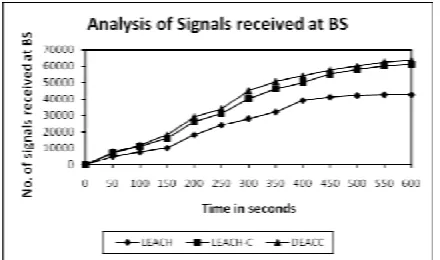
Figure 1 shows the total number of data received at the base station over simulation time. LEACH has the least amount of data received at the base station compared with the modified protocols, LEACH-C and DEEAC. Thus LEACH-C and DEEAC deliver better data per unit energy and providing better efficiency than the LEACH protocol.
Figure 1 Analysis of signals received at base station
Figure 2 shows the analysis of total number of nodes that remain alive over the simulation time. In LEACH, the delivery rate is good and has more or less same number of nodes alive compared with LEACH-C and DEEAC protocols during the simulations. Moreover, all these protocols need only one hop due to data aggregation with the cluster head providing longer lifetime.
Figure 2 Analysis of nodes alive
Table 1 shows a comparison of the above said three routing protocols for wireless sensor networks. Various LEACH protocol has been developed to overcome the drawbacks in the flat-architecture protocols that consume more energy [20]. LEACH uses a hierarchical structure, which divides the nodes into clusters.
Table 1 Comparison of LEACH, LEACH-C, and DEEAC protocols
LEACH LEACH-C DEEAC Centralized
Approach NO YES NO Distributed
Approach YES NO YES
Hotness-based NO NO YES System
Lifetime High Very High High Energy
Efficiency Medium High Medium System
Efficiency Medium High Very High Cluster
Formation
Self
Organizing Centralized Centralized
V. CONCLUSION
In this paper, analysis has been carried out for the number of nodes alive and the signals received by the base station for the cluster based wireless sensor networks. Simulations are carried out for LEACH, LEACH-C and DEEAC using NS-2 simulator with 100 nodes over a wireless environment for 600 seconds. Analysis shows that DEEAC outperforms the LEACH protocols, because the distributed protocol evenly distributes the energy usage on all the nodes in the network by efficiently taking care of the network changes and delivers more data. Analysis can also be done with some more LEACH protocols like E-LEACH, M-LEACH, V-LEACH, and O-LEACH. The work can also be contributed with new metrics for the routing protocols used in wireless sensor networks.
REFERENCES
[1]. Abdul Sattar Malik, and Suhail A. Qureshi, “Analyzing the Factors Affecting Network Lifetime for Cluster-based Wireless Sensor Networks”, Pakistan Journal of Engineering and Applied Science, Vol. 6, pp. 9-16, January 2010.
[3]. Hayoung Oh, Hyokyung Bahn, and Ki-Joon Chae, “An Energy-Efficient Sensor Routing Scheme for Home Automation Networks”, IEEE Transactions on Consumer Electronics, Vol. 51, No. 3, pp. 836-839, August 2005.
[4]. Jamal N. Al-Karaki, and Ahmed E. Kamal, “Routing Techniques in Wireless Sensor Networks: A Survey”, IEEE Wireless Communications, pp. 6-28, December 2004.
[5]. Lianshan Yan, Wei Pan, Bin Luo, Xiaoyin Li, and Jiangtao Liu, “Modified Energy-Efficient Protocol for Wireless Sensor Networks in the Presence of Distributed Optical Fiber Sensor Link”, IEEE Sensors Journal, Vol. 11, No. 9, pp. 1815-1819, September 2011.
[6]. Michele Rossi, and Michele Zorzi, “Integrated Cost-based MAC and Routing Techniques for Hop Count Forwarding in Wireless Sensor Networks”, IEEE Transactions on Mobile Computing, Vol. 6, No. 4, pp. 434-448, April 2007.
[7]. Padmanabhan K., and P. Kamalakkannan, “Energy Efficient Adaptive Protocol for Clustered Wireless Sensor Networks”, International Journal of Computer Science Issues, Vol. 8, Issue 5, No. 1, pp. 296-301, September 2011.
[8]. Peng Guo, Tao Jiang, Qian Zhang, and Kui Zhang, “Sleep Scheduling for Critical Event Monitoring in Wireless Sensor Networks”, IEEE Transactions on Parallel and Distributed Systems”, Vol. 23, No. 2, pp. 345-351, February 2012.
[9]. Stephanie Lindsey, Cauligi Raghavendra, and Krishna M. Sivalingam, “Data Gathering Algorithms in Sensor Networks using Energy Metrics”, IEEE Transactions on Parallel and Distributed Systems, Vol. 13, No. 9, pp. 924-935, September 2002.
[10]. Sung-Hwa Hong, and Byong-Kug Kim, “An Efficient Data Gathering Routing Protocol in Sensor Networks using the Integrated Gateway Node”, Proceedings of the IEEE, pp. 627-632, 2010.
[11]. Sung-Hwa Hong, Byongguk Kim, and Doo-Seop Eom, “A Base-Station Centric Data Gathering Routing Protocol in Sensor Networks Useful in Home Automation Applications”, Proceedings of the IEEE, pp. 945-951, 2007.
[12]. Taewook Kang, Jangkyu Yun, Hoseung Lee, Icksoo Lee, Hyunsook Kim, Byunghwa Lee, Byeongjik Lee, and Kijun Han, “A Clustering Method for Energy Efficient Routing in Wireless Sensor Networks”, Proceedings of the 6th WSEAS International Conference on Electronics, Hardware, Wireless and Optical Communications, Corfu Island, Greece, pp. 133-138, 16-19 February 2007.
[13]. Udit Sajjanhar, and Pabitra Mitra, “Distributive Energy Efficient Adaptive Clustering Protocol for Wireless Sensor Networks”, Proceedings of the
International Conference on Mobile Data Management (IEEE), pp. 326-330, May 2007.
[14]. Vijaya Raja V., R. Rani Hemamalini, and Jose Anand, “Multi Agent System based Upstream Congestion Control in Wireless Sensor Networks”, European Journal of Scientific Research, EuroJournals Publishing Inc., Vol. 59, No. 2, pp. 241-248, 2011.
[15]. Wendi B. Heinzelman, Anantha P. Chandrakasan, and Hari Balakrishnan, “An Application-Specific Protocol Architecture for Wireless Microsensor Networks”, IEEE Transactions on Wireless Communication, Vol. 1, No. 4, pp. 660-670, October 2002.
[16]. Xiaohua (Edward ) Li, Mo Chen, and Wenyu Liu, “Application of STBC-Encoded Cooperative Transmissions in Wireless Sensor Networks”, IEEE Signal Processing Letters, Vol. 12, No. 2, pp. 134-137, February 2005.
[17]. XiaoHua Xu, Xiang-Yang Li, Peng-Jun Wan, and ShaoJie Tang, “ Efficient Scheduling for Periodic Aggregation Queries in Multihop Sensor Networks”, IEEE/ACM Transactions on Networking, Vol. 20, No. 3, pp. 690-698, June 2012.
[18]. Yuanzhu Peter Chen, Arthur L. Liestman, and Jiangchuan Liu, “A Hierarchical Energy-Efficient Framework for Data Aggregation in Wireless Sensor Networks”, IEEE Transactions on Vehicular Technology, Vol. 55, No. 3, pp. 789-796, May 2006.
[19]. Yuh-Ren Tsai, “Coverage-Preserving Routing Protocols for Randomly Distributed Wireless Sensor Networks”, IEEE Transactions on Wireless Communications, Vol. 6, No. 4, pp. 1240-1245, April 2007.