Sentence Diagram Generation Using Dependency Parsing
Elijah Mayfield
Division of Science and Mathematics University of Minnesota, Morris [email protected]
Abstract
Dependency parsers show syntactic re-lations between words using a directed graph, but comparing dependency parsers is difficult because of differences in the-oretical models. We describe a system to convert dependency models to a struc-tural grammar used in grammar educa-tion. Doing so highlights features that are potentially overlooked in the dependency graph, as well as exposing potential weak-nesses and limitations in parsing models. Our system performs automated analysis of dependency relations and uses them to populate a data structure we designed to emulate sentence diagrams. This is done by mapping dependency relations between words to the relative positions of those words in a sentence diagram. Using an original metric for judging the accuracy of sentence diagrams, we achieve precision of 85%. Multiple causes for errors are pre-sented as potential areas for improvement in dependency parsers.
1 Dependency parsing
Dependencies are generally considered a strong metric of accuracy in parse trees, as described in (Lin, 1995). In a dependency parse, words are connected to each other through relations, with a head word (the governor) being modified by a pendent word. By converting parse trees to de-pendency representations before judging accuracy, more detailed syntactic information can be discov-ered. Recently, however, a number of dependency parsers have been developed that have very differ-ent theories of a correct model of dependencies.
Dependency parsers define syntactic relations between words in a sentence. This can be done either through spanning tree search as in
(McDon-ald et al., 2005), which is computationally expen-sive, or through analysis of another modeling sys-tem, such as a phrase structure parse tree, which can introduce errors from the long pipeline. To the best of our knowledge, the first use of de-pendency relations as an evaluation tool for parse trees was in (Lin, 1995), which described a pro-cess for determining heads in phrase structures and assigning modifiers to those heads appropri-ately. Because of different ways to describe rela-tions between negarela-tions, conjuncrela-tions, and other grammatical structures, it was immediately clear that comparing different models would be diffi-cult. Research into this area of evaluation pro-duced several new dependency parsers, each us-ing different theories of what constitutes a cor-rect parse. In addition, attempts to model multi-ple parse trees in a single dependency relation sys-tem were often stymied by problems such as dif-ferences in tokenization systems. These problems are discussed by (Lin, 1998) in greater detail. An attempt to reconcile differences between parsers was described in (Marneffe et al., 2006). In this paper, a dependency parser (from herein referred to as the Stanford parser) was developed and com-pared to two other systems: MINIPAR, described in (Lin, 1998), and the Link parser of (Sleator and Temperley, 1993), which uses a radically differ-ent approach but produces a similar, if much more fine-grained, result.
Comparing dependency parsers is difficult. The main problem is that there is no clear way to com-pare models which mark dependencies differently. For instance, when clauses are linked by a con-junction, the Link parser considers the conjunction related to the subject of a clause, while the Stan-ford parser links the conjunction to the verb of a clause. In (Marneffe et al., 2006), a simple com-parison was used to alleviate this problem, which was based only on the presence of dependencies, without semantic information. This solution loses
information and is still subject to many problems in representational differences. Another problem with this approach is that they only used ten sen-tences for comparison, randomly selected from the Brown corpus. This sparse data set is not necessar-ily congruous with the overall accuracy of these parsers.
In this paper, we propose a novel solution to the difficulty of converting between dependency models. The options that have previously been presented for comparing dependency models are either too specific to be accurate (relying on an-notation schemes that are not adequately parallel for comparison) or too coarse to be useful (such as merely checking for the existence of depen-dencies). By using a model of language which is not as fine-grained as the models used by de-pendency parsers, but still contains some semantic information beyond unlabelled relations, a com-promise can be made. We show that using linear diagramming models can do this with acceptable error rates, and hope that future work can use this to compare multiple dependency models.
Section 2 describes structural grammar, its his-tory, and its usefulness as a representation of syn-tax. Section 3 describes our algorithm for conver-sion from dependency graphs to a structural rep-resentation. Section 4 describes the process we used for developing and testing the accuracy of this algorithm, and Section 5 discusses our results and a variety of features, as well as limitations and weaknesses, that we have found in the dependency representation of (Marneffe et al., 2006) as a result of this conversion.
2 Introduction to structural grammar Structural grammar is an approach to natural lan-guage based on the understanding that the major-ity of sentences in the English language can be matched to one of ten patterns. Each of these pat-terns has a set of slots. Two slots are universal among these patterns: the subject and the predi-cate. Three additional slots may also occur: the direct object, the subject complement, and the ob-ject complement. A head word fills each of these slots. In addition, any word in a sentence may be modified by an additional word. Finally, anywhere that a word could be used, a substitution may be made, allowing the position of a word to be filled by a multiple-word phrase or an entire subclause, with its own pattern and set of slots.
To understand these relationships better, a stan-dardized system of sentence diagramming has been developed. With a relatively small number of rules, a great deal of information about the func-tion of each word in a sentence can be represented in a compact form, using orientation and other spa-tial clues. This provides a simpler and intuitive means of visualizing relationships between words, especially when compared to the complexity of di-rected dependency graphs. For the purposes of this paper, we use the system of diagramming formal-ized in (Kolln and Funk, 2002).
2.1 History
First developed in the early 20th century, structural grammar was a response to the prescriptive gram-mar approach of the time. Structural gramgram-mar de-scribes how language actually is used, rather than prescribing how grammar should be used. This approach allows an emphasis to be placed on the systematic and formulaic nature of language. A key change involved the shift to general role-based description of the usage of a word, whereas the fo-cus before had been on declaring words to fall into strict categories (such as the eight parts of speech found in Latin).
Beginning with the work of Chomsky in the 1950s on transformational grammar, sentence di-agrams, used in both structural and prescriptive approaches, slowly lost favor in educational tech-niques. This is due to the introduction of trans-formational grammar, based on generative theo-ries and intrinsic rules of natural language struc-ture. This generative approach is almost uni-versally used in natural language processing, as generative rules are well-suited to computational representation. Nevertheless, both structural and transformational grammar are taught at secondary and undergraduate levels.
Figure 1: Diagram of “The students are scholars.” and “The students studied their assignment.”
By developing an algorithm to automatically analyze a sentence using structural grammar, we hope that the advantages of structural analysis can improve the performance of natural language parsers. By assigning roles to words in a sentence, patterns or structures in natural language that can-not be easily gleaned from a data structure are made obvious, highlighting the limitations of that structure. It is also important to note that while sentence diagrams are primarily used for English, they can be adapted to any language which uses subjects, verbs, and objects (word order is not im-portant in sentence diagramming). This research can therefore be expanded into multilingual de-pendency parser systems in the future.
To test the effectiveness of these approaches, a system must be developed for structural analysis of sentences and subsequent conversion to a sen-tence diagram.
3 Sentence diagram generation algorithm
In order to generate a sentence diagram, we make use of typed dependency graphs from the Stanford dependency parser. To understand this process requires understanding both the underlying data structure representing a sentence diagram, and the conversion from a directed graph to this data struc-ture.
3.1 Data structure
In order to algorithmically convert dependency parses to a structural grammar, we developed an original model to represent features of sentence diagrams. A sentence is composed of four slots (Subject,Predicate,Object,Complement). These slots are represented1 in two sentences shown in
1All sentence diagram figures were generated by the
[image:3.595.85.274.70.170.2]al-gorithm described in this paper. Some diagrams have been
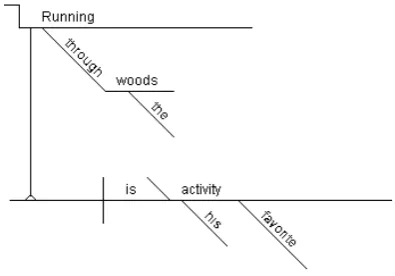
Figure 2: Diagram of “Running through the woods is his favorite activity.”
Figure 1 by the words “students,” “are,” “assign-ment,” and “scholars” respectively. Each slot con-tains three sets (Heads,Expletives,Conjunctions). With the exception of the Heads slot in Subject andPredicate, all sets may be empty. These sets are populated by words. A word is comprised of three parts: the string it represents, a set of mod-ifying words, and information about its orienta-tion in a diagram. Finally, anywhere that a word may fill a role, it can be replaced by a phrase or subclause. These phrases are represented iden-tically to clauses, but all sets are allowed to be empty. Phrases and subclauses filling the role of a word are connected to the slot they are filling by a pedestal, as in Figure 2.
3.2 Conversion from dependency graph A typed dependency representation of a sentence contains a root – that is, a dependency relation in which neither the governor nor the dependent word in the relation is dependent in any other re-lation. We use this relation to determine the predi-cate of a sentence, which is almost always the gov-ernor of the root dependency. The dependent is added to the diagram data structure based on its relation to the governor.
resenting each word in the sentence. These nodes are connected by edges in the formreln(gov, dep) representing a relation from S between a word govanddep. Our algorithm performs the following steps:
1. Determining root actions:For each relation typeR ∈S, create an ordered list of actions Root< R,A >fromAto perform if that re-lation is the root rere-lation in the graph. 2. Determining regular actions: For each
re-lation type R ∈ S, create an ordered list of actionsReln < R,A >fromAto perform if Ris found anywhere other than the root inG. 3. Determining the root: Using the root-finding process described in (Marneffe et al., 2006), find the root relationRˆ( ˆG,Dˆ)∈G. 4. Initialize a sentence diagram: Find the set
of actionsAˆfromRoot<R,ˆ A>and perform those actions.
5. Finding children:Create a setOpenand add to it each relation∈Gin whichGˆ orDˆ from step 3 is a governor.
6. Processing children: For each relation ˜
R( ˜G,D˜)inOpen,
(a) Populate the sentence diagram: Find the set of actionsA˜fromReln<R,˜ A>
and perform those actions.
(b) Finding children: Add to Open each relationR∈Gin whichG˜orD˜ is a gov-ernor.
This step continues until all relations have been found in a breadth-first order.
Our system of conversion makes the assumption that the governor of a typed dependency will al-ready have been assigned a position in a diagram. This is due to the largely tree-like structure of dependency graphs generated by the dependency parser. Dependencies in most cases “flow” down-wards to the root, and in exceptions, such as cy-cles, the governor will have been discovered by the time it is reached again. As we are searching for words breadth-first, we know that the dependent of any relation will have been discovered already so long as this tree-like structure holds. The num-ber of cases where it does not is small compared to the overall error rate of the dependency parser,
and does not have a large impact on the accuracy of the resulting diagram.
3.3 Single-relation analysis
A strength of this system for conversion is that in-formation about the overall structure of a sentence is not necessary for determining the role of each individual word as it is added to the diagram. As each word is traversed, it is assigned a role relative to its parent only. This means that overall structure will be discovered naturally by tracing dependen-cies throughout a graph.
There is one exception to this rule: when com-paring relationships of type cop (copula, a link-ing verb, usually a variant of “to be”), three words are involved: the linking verb, the subject, and the subject complement. However, instead of a tran-sitive relationship from one word to the next, the parser assigns the subject and subject complement as dependent words of the linking verb. An exam-ple is the sentence “The students are scholars” as in Figure 1. This sentence contains three relations: det(students, The)
nsubj(scholars, students) cop(scholars, are)
A special case exists in our algorithm to check the governor of a cop relation for another rela-tion (usually nsubj). This was a necessary ex-ception to make given the frequency of linking verbs in the English language. Dependency graphs from (Marneffe et al., 2006) are defined as a singly rooted directed acyclic graph with no re-entrancies; however, they sometimes share nodes in the tree, with one word being a dependent of multiple relations. An example of this exists in the sentence “I saw the man who loves you.” The word “who” in this sentence is dependent in two relations:
ref(man, who) rel(loves, who)
Term Definition Example
Input Output
GOV, DEP, RELN Elements of a relation det(‘‘woods",
‘‘the").GOV ‘‘woods"
SBJ, PRD, OBJ,
CMP Slots in a clause CLAUSE.PRD HEADS(‘‘is"),EXPL(),
CONJ() HEADS, EXPL,
CONJ Sets of words in a slot CLAUSE.PRD.HEADS() ‘‘is"
MODS Set of modifiers of a
word ‘‘activity".MODS (‘‘his",‘‘favorite") SEGMENT, CLAUSE Set or clause of word ‘‘is".SEGMENT() CLAUSE.PRD NEW[WORD, Slot] New clause constructor NEW(‘‘is", PRD) CLAUSE(SBJ(),
PRD(‘‘is"), OBJ(), CMP()) ADD(WORD[,ORIENT]) Word added to
modi-fiers ‘‘activity".ADD(‘‘his") APP(WORD[,RIGHT?]) Word appended to
phrasal head ‘‘down".APP(‘‘shut",false) SET(ORIENT) Word orientation set ‘‘his".SET(DIAGONAL)
Periods represent ownership, parentheses represent parameters passed to a method, separated by commas, and brackets repre-sent optional parameters.
[image:5.595.70.538.59.296.2]Orientations includeHORIZONTAL,DIAGONAL,VERTICAL,GERUND,BENT,DASHED, andCLAUSEas defined in (Kolln and Funk, 2002) .
Table 1: Terms and methods defined in our algorithm.
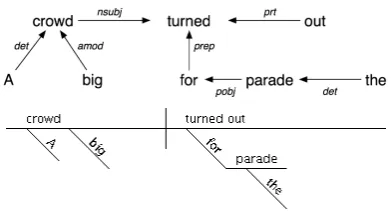
Figure 3: The sentence “A big crowd turned out for the parade.” shown as a dependency graph (top) and a sentence diagram.
to maintain the simplicity of single-relation con-version rules, though remedying this problem is an avenue for further research. For testing purposes, if duplicate copies of a word exist, the correct one is given preference over the incorrect copy, and the diagram is scored as correct if either copy is cor-rectly located.
3.4 An example diagram conversion
To illustrate the conversion process, consider the sentence “A big crowd turned out for the parade.” The dependency graph for this, as generated by the Stanford dependency parser, is shown in Figure 3. The following relations are found, with the actions taken by the conversion algorithm described:
Root: nsubj(turned, crowd)
NEW(GOV, PRD);
GOV.CLAUSE.SBJ.ADD(DEP);
Finding Children: det(crowd, A),
amod(crowd, big),prt(turned, out),
prep(turned, for)added toOpen. Relation:det(crowd, A)
GOV.ADD(DEP,DIAGONAL); Relation:amod(crowd, big) GOV.ADD(DEP,DIAGONAL);
Relation:prt(turned, out) GOV.APP(DEP,TRUE);
Relation:prep(turned, for)
Finding Children: pobj(for, parade) added toOpen.
GOV.ADD(DEP,DIAGONAL); Relation:pobj(for, parade)
Finding Children: det(parade, the) added toOpen.
GOV.ADD(DEP,HORIZONTAL); Relation:det(parade, the) GOV.ADD(DEP,DIAGONAL); 4 Experimental setup
[image:5.595.85.281.363.469.2]to ensure a wide range of structures. We decided to use an undergraduate-level English grammar text-book that uses diagramming as a teaching tool for two reasons. The first is a pragmatic matter: the sentences have already been diagrammed ac-curately for comparison to algorithm output. Sec-ond, the breadth of examples necessary to allow students a thorough understanding of the process is beneficial in assuring the completeness of the conversion system. Cases that are especially diffi-cult for students are also likely to be stressed with multiple examples, giving more opportunities to determine the problem if parsers have similar dif-ficulty.
Therefore, (Kolln and Funk, 2002) was selected to be used as the source of this testing data. This textbook contained 292 sentences, 152 from ex-amples and 140 from solutions to problem sets. 50% of the example sentences (76 in total, chosen by selecting every other example) were set aside to use for development. The remaining 216 sen-tences were used to gauge the accuracy of the con-version algorithm.
Our implementation of this algorithm was de-veloped as an extension of the Stanford depen-dency parser. We developed two metrics of pre-cision to evaluate the accuracy of a diagram. The first approach, known as the inheritance metric, scored the results of the algorithm based on the parent of each word in the output sentence dia-gram. Head words were judged on their placement in the correct slot, while modifiers were judged on whether they modified the correct parent word. The second approach, known as the orientation metric, judged each word based solely on its ori-entation. This distinction judges whether a word was correctly identified as a primary or modifying element of a sentence.
These scoring systems have various advantages. By only scoring a word based on its immediate parent, a single mistake in the diagram does not severely impact the result of the score, even if it is at a high level in the diagram. Certain mistakes are affected by one scoring system but not the other; for instance, incorrect prepositional phrase attach-ment will not have an effect on the orientation score, but will reduce the value of the inheritance score. Alternatively, a mistake such as failing to label a modifying word as a participial modifier will reduce the orientation score, but will not re-duce the value of the inheritance score. Generally,
orientation scoring is more forgiving than inheri-tance scoring.
5 Results and discussion
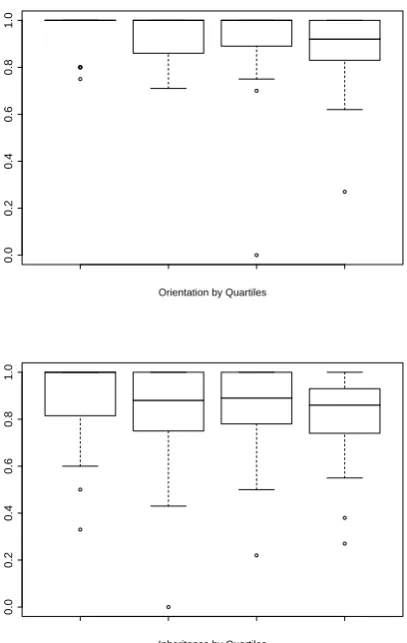
The results of testing these accuracy metrics are given in Figure 4 and Table 2. Overall inheritance precision was 85% and overall orientation preci-sion was 92%. Due to the multiple levels of analy-sis (parsing from tree to phrase structure to depen-dency graph to diagram), it is sometimes difficult to assign fault to a specific step of the algorithm.
There is clearly some loss of information when converting from a dependency graph to a sentence diagram. For example, fifteen dependency rela-tions are represented as diagonal modifiers in a sentence diagram and have identical conversion rules. Interestingly, these relations are not nec-essarily grouped together in the hierarchy given in (Marneffe et al., 2006). This suggests that the syntactic information represented by these words may not be as critical as previously thought, given enough semantic information about the words. In total, six sets of multiple dependency relations mapping to the same conversion rule were found, as shown in Table 3.
The vast majority of mistakes that were made came from one of two sources: an incorrect con-version from a correct dependency parse, or a fail-ure of the dependency parser to correctly identify a relation between words in a sentence. Both are examined below.
5.1 Incorrect conversion rules
On occasion, a flaw in a diagram was the result of an incorrect conversion from a correct interpreta-tion in a dependency parse. In some cases, these were because of simple changes due to inaccura-cies not exposed from development data. In some cases, this was a result of an overly general rela-tionship, in which one relation correctly describes two or more possible structural patterns in sen-tences. This can be improved upon by specializ-ing dependency relation descriptions in future ver-sions of the dependency parser.
Sentence Length Ori Mean Ori Std.Dev. Inh Mean Inh Std.Dev. Count
3-6 96.61 7.42 90.34 15.20 56
7-8 92.37 15.77 86.00 19.34 57
9-10 92.80 8.18 82.73 17.15 45
11-20 89.97 12.54 82.52 15.51 58
[image:7.595.103.498.63.148.2]3-20 92.91 11.84 85.51 17.05 216
Table 2: Precision of diagramming algorithm on testing data.
Relations Rule
abbrev,advmod,amod,dep,det,measure,neg,nn,
num,number,poss,predet,prep,quantmod,ref GOV.ADD(DEP,DIAGONAL)
iobj,parataxis,pobj GOV.ADD(DEP,HORIZONTAL)
appos,possessive,prt GOV.APP(DEP,TRUE)
aux,tmod GOV.APP(DEP,FALSE)
advcl,csubj,pcomp,rcmod GOV.ADD(NEW(DEP,PRD))
complm,expl,mark GOV.SEGMENT.EXPL.ADD(DEP)
Table 3: Sets of multiple dependency relations which are converted identically.
0.0
0.2
0.4
0.6
0.8
1.0
Orientation by Quartiles
0.0
0.2
0.4
0.6
0.8
1.0
Inheritance by Quartiles
Figure 4: Inheritance (top) and Orientation preci-sion results of diagramming algorithm on testing data. Results are separated by sentence length into quartiles.
interrogative sentences, e.g. the root relation of the sentence “What have you been reading?” is dobj(reading, What). This should be han-dled by treating “What” as the object of the clause. This problem can be remedied in the future by cating specialized conversion rules for any given re-lation as a root of a dependency graph.
A final issue is the effect of a non-tree struc-ture on the conversion algorithm. Because rela-tionships are evaluated individually, multiple in-heritance for words can sometimes create dupli-cate copies of a word which are then modified in parallel. An example of this is shown in Figure 5, which is caused due to the dependency graph for this sentence containing the following relations: nsubj(is-4, hope-3)
xsubj(beg-6, hope-3) xcomp(is-4, beg-6)
Because the tree structure is broken, a word (hope) is dependent on two different governing words. While the xsubj relation places the phrase “to beg for mercy” correctly in the diagram, a sec-ond copy is created because of the xcomp depen-dency. A more thorough analysis approach that checks for breaking of the tree structure may be useful in avoiding this problem in the future.
5.2 Exposed weaknesses of dependency parsers
[image:7.595.83.287.355.677.2]Figure 5: Duplication in the sentence diagram for “Our only hope is to beg for mercy.”
limitations in the theoretical model of the depen-dency parser. These differences between the ac-tual structure of the sentence and the structure the parser assigns can lead to a significant difference in semantic value of phrases. Improving the accu-racy of this model to account for these situations (either through more fine-grained separation of re-lationships or a change in the model) may improve the quality of meaning extraction from sentences.
One major shortcoming of the dependency parser is how it handles prepositional phrases. As described in (Atterer and Schutze, 2007), this problem has traditionally been framed as involv-ing four words (v, n1, p, n2) where v is the head of a verb phrase, n1 is the head of a noun phrase dom-inated by v, p is the head of a prepositional phrase, and n2 the head of a noun phrase dominated by p. Two options have generally been given for at-tachment, either to the verb v or the noun n1. This parser struggles to accurately determine which of these two possibilities should be used. However, in the structural model of grammar, there is a third option, treating the prepositional phrase as an ob-ject complement of n1. This possibility occurs fre-quently in English, such as in the sentence “We elected him as our secretary.” or with idiomatic ex-pressions such as “out of tune.” The current depen-dency parser cannot represent this at all.
5.3 Ambiguity
A final case is when multiple correct structural analyses exist for a single sentences. In some cases, this causes the parser to produce a gramati-cally and semantigramati-cally correct parse which, due to ambiguity, does not match the diagram for com-parison. An example of this can be seen in Fig-ure 6, in which the dependency parser assigns the
Figure 6: Diagram of “On Saturday night the li-brary was almost deserted.”
predicate role to “was deserted” when in fact de-serted is acting as a subject complement. How-ever, the phrase “was deserted” can accurately act as a predicate in that sentence, and produces a se-mantically valid interpretation of the phrase.
6 Conclusion
We have demonstrated a promising method for conversion from a dependency graph to a sentence diagram. However, this approach still has the op-portunity for a great deal of improvement. There are two main courses of action for future work to reap the benefits of this approach: analyzing cur-rent results, and extending this approach to other parsers for comparison. First, a more detailed analysis of current errors should be undertaken to determine areas for improvement. There are two broadly defined categories of error (errors made before a dependency graph is given to the algo-rithm for conversion, and errors made during con-version to a diagram). However, we do not know what percent of mistakes falls into those two cat-egories. We also do not know what exact gram-matical idiosyncracy caused each of those errors. With further examination of current data, this in-formation can be determined.
Second, it must be determined what level of conversion error is acceptable to begin making quantitative comparisons of dependency parsers. Once the level of noise introduced by the conver-sion process is lowered to the point that the major-ity of diagram errors are due to mistakes or short-falls in the dependency graph itself, this tool will be much more useful for evaluation. Finally, this system should be extended to other dependency parsers so that a comparison can be made between multiple systems.
References
Michaela Atterer and Hinrich Schutze. 2007.
[image:8.595.321.512.69.122.2]Com-putational Linguistics.
John Carroll, Guido Minnen, and Ted Briscoe. 1999.
Corpus annotation for parser evaluation. In
Pro-ceedings of the EACL workshop on Linguistically Interpreted Corpora.
Dan Klein and Christopher D. Manning. 2003. Ac-curate Unlexicalized Parsing. InProceedings of the 41st Meeting of the Association for Computational Linguistics.
Martha Kolln and Robert Funk. 2002. Understanding
English Grammar, Sixth Edition. Longman
Publish-ers.
Dekang Lin. 1995. A Dependency-based Method
for Evaluating Broad-Coverage Parsers. InNatural
Language Engineering.
Dekang Lin. 1998. Dependency-based evaluation of
MINIPAR. InWorkshop on the Evaluation of
Pars-ing Systems
Marie-Catherine de Marneffe, Bill MacCartney and Christopher D. Manning. 2006. Generating Typed Dependency Parses from Phrase Structure Parses. InInternational Conference on Language Resources and Evaluation.
Ryan McDonald, Fernando Pereira, Kiril Ribarov, and Jan Hajiˇc. 2005. Non-projective dependency
pars-ing uspars-ing spannpars-ing tree algorithms. InProceedings
of the conference on Human Language Technology and Empirical Methods in Natural Language Pro-cessing.