© 2015, IRJET.NET- All Rights Reserved
Page 1987
Modeling and Control of DC Chopper Fed Brushless DC Motor
Harith Mohan
1, Remya K P
21
P G Student, Electrical and Electronics, ASIET Kalady, Kerala,India
2Remya K P, Electrical and Electronics, ASIET Kalady, Kerala,India
---***---Abstract -
BLDC motors are widely used in variousindustrial and household applications due to its higher efficiency, reliability and better performance compared to Brushed motor. In this paper, various methods of speed control for Brushless DC motor has been included. The dynamic model of the BLDC motor is developed and further analysis has been conducted for the selection of controllers. A comparative study between the Performance of BLDC motor fed with P, PI and PID controllers are included. The implementation includes both direction and open loop speed control. Simulation is carried out using MATLAB / SIMULINK for 120 degree mode of operation. The results show that the
Brushless DC motors (BLDC) retains the characteristics of a dc motor but eliminates the presence of commutator and the brushes. BLDC motors are driven by dc voltage and commutation is done electronically with the help of solid state switches. They are available in wide range of different power ratings, from very small motors as used in hard disk drives to large motors in electric vehicles. The BLDC motors have many advantages over brushed DC motors. A few of these are:
Higher speed ranges
Higher efficiency
Better speed versus torque characteristics
Long operating life
Noiseless operation
Brushless DC motors are adopted in a number of applications which includes the areas like household,
industrial, aerospace, automotive, computer etc. They have lower maintenance due to the elimination of the mechanical commutator and are widely adopted for high torque to weight applications due to higher power density. BLDC motor offers low value of inertia which results in faster dynamic response to reference commands compared to induction machines. More over the losses produced across the rotor circuit is less in case of a BLDC machine and hence the efficiency is comparatively high.
The structure of BLDC motor is similar to that of a DC motor but the main difference is nothing but the absence of brushes and commutators. In BLDC motor commutation is performed electronically and during this process rotational torque is produced by changing the phase current at regular interval. The commutation process can be done wither by sensing the signals generated by a sensor associated with the sensor or by analyzing the back emf developed across the coils. Sensor based commutation is used in several applications where the variation in starting torque is large or where a high initial torque is required. They are also used in applications where position control is an important criterion. Sensor-less control is implemented in applications where the variation in torque is less and position control is not in focus.
There exist two types of permanent magnet BLDC motors based on the shape of back emf waveform developed across the rotor circuit. In case of BLDC motor the trapezoidal back-EMF waveform developed is of trapezoidal form where as the other one with sinusoidal back-EMF is called permanent magnet synchronous motor (PMSM). In BLDC motor the stator windings are wounded trapezoidally in order to generate the trapezoidal shape back-EMF waveform where as in case of PMSM windings they are sinusoidally distributed to produce the sinusoidal type back-EMF.
© 2015, IRJET.NET- All Rights Reserved
Page 1988
not be considered and in closed loop speed control ratedcondition is maintained by considering a feedback signal.
2. Construction and Principle of Operation
Normally, the stator of a BLDC motor consists of stacked steel laminations with windings placed in the slots that are axially cut along the inner periphery. Stator windings of BLDC motors are three phase star connected. Numerous coils are interconnected to form a winding. Construction of BLDC rotor poles are done using permanent magnets are used and the number of poles can vary from two to eight pairs with alternate North and South poles. Density of magnetic field required will decide the magnetic materials to be chosen for the construction of rotor poles are made with proper. Proper sequence of rotation of BLDC motor can be achieved by energizing the stator windings in a sequence. The position of rotor poles should be known to understand which winding should be energized to follow particular energizing sequence. To accomplish these, Hall Effect sensors are used to sense the rotor position and that is mounted to the stator. Normally, in most of the applications BLDC motors having three Hall sensors mounted on the stator are used and they are kept on the non-driving end of motor.
In each of the commutation sequence one of the winding is positively energized, second one is negatively energized and the third winding is kept as non-energized. The net effect produced by the interaction of permanent magnet rotor and stator causes the production of mechanical torque, and that leads to the rotation of BLDC motor. The peak torque occurs when these two fields are at 90° to each other and falls off when they overlap each other. To keep the motor running, it is necessary to keep the magnetic field produced by the windings to shift in position, when the rotor move to catch up with the stator field. BLDC motors are usually operated with three Hall Effect position sensors as it is necessary to keep the excitation in synchronization with the rotor position. While considering different factors like reliability, mechanical packaging and cost, and it is desirable to run the motor without position detecting sensors, and it is commonly known as sensorless operation. To determine the instant at which the commutation of motor drive voltage drive should occurs is decided by sensing the back-EMF voltage on an undriven motor terminal during one of the drive phases. Advantage of sensorless control is the cost and complexity of installation of Hall position
• It is possible to measure the BEMF voltage only when the motor speed is within a limited range which is sufficient for the ideal commutation rate with the applied voltage.
• Discontinuous motor response will be there when commutation occurs at rate faster than the ideal rate.
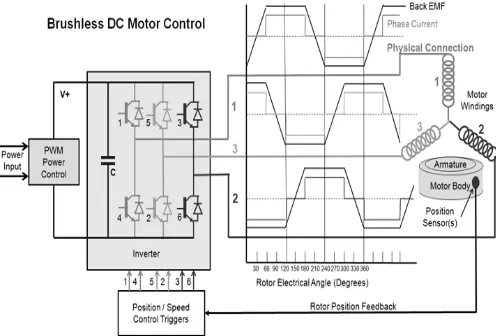
The principle of operation of sensor based Brushless DC Motor Drive using PWM is given in the Fig-1. The PWM inverter switches are triggered in a closed loop system by detecting a signal which represents the instantaneous angular position of the rotor.
Fig -1: Sensor Based BLDC Motor Drive
© 2015, IRJET.NET- All Rights Reserved
Page 1989
Corresponding stator windings. By using the high and lowduty cycles digital PWM signals are generated and Speed regulation is achieved.
Table-1: Clockwise Hall Sensor Signals and Drive Signals
Ha Hb Hc Q1 Q2 Q3 Q4 Q5 Q6
0 0 0 0 0 0 0 0 0
0 0 1 0 0 0 1 1 0
0 1 0 0 1 1 0 0 0
0 1 1 0 1 0 0 1 0
1 0 0 1 0 0 0 0 1
1 0 1 1 0 0 1 0 0
1 1 0 0 0 1 0 0 1
1 1 1 0 0 0 0 0 0
Here Ha, Hb and Hc represent the Hall sensor signals. And Q1 – Q6 are the MOSFET switches in the switching circuit.
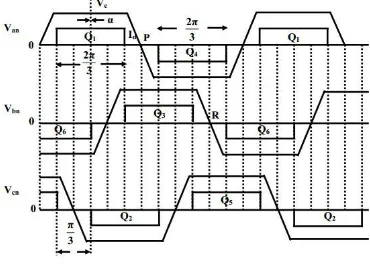
The three phase switching sequence obtained by sensing the rotor position can be illustrated using Fig.2. Here the switching instant of the individual MOSFET switches, Q1-Q6 with respect to the trapezoidal EMF waveform has been demonstrated. It can be obtained that the EMF wave is in synchronization with the rotor. Hence switching the stator phases synchronously with the back EMF wave keeps the stator and rotor mmfs to move in synchronism. With this, the inverter switches acts as an electronic commutator by receiving switching pulses from the rotor position sensor and controls the motor.
Fig.2: Three Phase Switching Sequence
2. MODEL DESCRIPTION
The modeling of Brushless DC motor can be done in the same manner as that of a three phase synchronous machine. But some of the performance characteristics are not the same as there exist a permanent magnet mounted as part of the rotor circuit. The rotor flux linkage depends upon the magnet material; hence the magnetic flux saturation is typical for this kind of motors. As in the case of any three phase motor BLDC motor is also fed by a three phase voltage source. Fig 3 shows the mathematical model of BLDC motor.
Fig. 3: Mathematical model of BLDC motor
Using KVL the voltage equation from Fig. 3 can be expressed as follows:
e
a(1)
e
a(2)
e
c(3)
Where,
L represents per phase armature self-inductance [H],
R represents per phase armature resistance [Ω],
Va , Vb, and Vc indicates per phase terminal voltage [V],
ia , ib and ic represents the motor input current [A],
ea, eb and ec indicates the motor back-EMF developed [V].
M represents the armature mutual-inductance [H].
© 2015, IRJET.NET- All Rights Reserved
Page 1990
Hence the equation for each phase of back emf can bewritten as:
ea= Kw f(θe) ω (4)
eb= Kw f(θe -2Π/3) ω (5)
ec= Kw f(θe +2Π/3) ω (6)
where,
Kw denotes per phase back EMF constant [V/rad.s-1],
θ
e represents electrical rotor angle [rad], represents rotor speed [rad.s-1 ].
The expression for electrical rotor angle cab be represented by multiplying the mechanical rotor angle with the number of pole pair’s P:
θ
e=
*θ
m (7)where,
θm denotes mechanical rotor angle[rad]
The summation of torque produced in each phase gives the total torque produced, and that is given by:
Te= (8)
Where,
Te denotes total torque output [Nm].
Mechanical part of BLDC motor is represented as follows:
Te – Tl =J * + B* (9)
Where,
Tl denotes load torque [Nm],
J denotes of rotor and coupled shaft [kgm2], and B represents the Friction constant [Nms.rad-1].
3. BLDC MOTOR SPEED CONTROL
In most of the servo systems, controlled operation can been obtained by position feedback system. With the help of this position information, velocity feedback can also be implemented and hence the need for a separate velocity transducer for the speed control loop can be eliminated. The voltage strokes generated in respect to the rotor position are used to drive a BLDC motor and that is measured using position estimators. Motor speed can be varied in accordance to the voltage developed
across the motor. If we are using PWM outputs to control the operation of inverter switches, regulation of voltge can be obtained by adjusting the duty cycle of the switches. The strength of magnetic field produced is regulated by the current flowing through the windings which in turn adjust the speed and torque generated. The adjustment made in voltage will affect the magnitude of current produced.
Proper rotation of motor can be ensured by commutation but the speed of rotation is proportional to the magnitude of voltage applied and that is adjusted using PWM technique. Conventional algorithm based controllers are used to control the speed of motor. Controller can be implemented by algorithms like proportional (P), PI or PID. Controller input is the difference between the reference speed and actual value of speed measured at a particular instant. Finally the controller generates necessary control signal to adjust the PWM duty cycle of the switching circuit to regulate the speed to desired limit based upon the error input. Speed control can be easily achieved by this method. While considering the case of closed loop control, error input has been produced by comparing the reference and actual speed of motor as shown in Fig.4.
Fig.4: Closed Loop Control of BLDC motor
© 2015, IRJET.NET- All Rights Reserved
Page 1991
3.1 Proportional (P) Controller
Output of Proportional controller is given as follows:
C(s) = Kp * e(t) (10)
Where,
Kp denotes proportional gain,
e(t) denotes the difference in actual and reference value.
3.2 Proportional- Integral (PI) Controllers
A controller which combines the operating principle of both Proportional and Integral controller is termed as PI controller. Mathematical expression for output of a PI controller can be defined as follows:
C(s) = (Kp + )*e(t) (11)
Where
Kp denotes proportional gain and Ki denotes the integral gain.
3.3 Proportional-Integral-Derivative (PID)
Controllers
A controller that combines concept of Proportional, Integral and Derivative terms by taking the sum of product of error multiplied by corresponding gains. The output of PID controller can be mathematically represented as below.
C(s) = (Kp +
+ s*K
d)*e(t) (12)Where
Kp denotes the proportional gain, Ki denotes the integral gain and Kd denotes the derivative gain
4. MODELLING AND SIMULATION REUSLTS
The Simulink model of BLDC motor developed based on the mathematical equations is shown in Fig.5 This Simulink model consists of an inverter block, hall signal generation block, main BLDC model block and controller block. The main BLDC model block, further consist of a current generator block; speed generator block and emf generator block. Here the performance analysis of different conventional controllers against an
an increase in load after duration of .2 sec has been evaluated.
Fig.5: Simulink Model of Inverter Fed BLDC Motor
Detailed SIMULINK model of BLDC motor is shown in Fig.5.
Fig.6: Detailed Simulink Model of BLDC motor
The current generation block has been modeled as shown in Fig.7. The generator block further consists of state space equations.
© 2015, IRJET.NET- All Rights Reserved
Page 1992
The Simulink model developed for speed generation blockis shown in Fig.8.
Fig.8: Speed Generation Block of BLDC motor
The back emf generation can be modelled as shown in Fig.9.
Fig.10: Back EMF generation in BLDC motor
Configuration of three phase inverter fed with DC chopper is shown in Fig.10 below.
Fig.10: DC chopper fed three phase inverter
The Simulink model of Proportional-Integral controller is shown in Fig.11.
Fig.11: Simulink Model of PI Controller
Simulink model of Proportional-Integral-Derivative controller is shown in Fig.12
Fig.12: Simulink Model of PID Controller
Here simulation is carried out for four cases. In case 1 BLDC with open loop control, Case 2 BLDC with Closed loop P Control on increase in load torque, Case 3 BLDC with Closed loop PI Control on Increasing Load, Case 4 BLDC with Closed loop PID Control on Increasing Load. The motor parameters chosen for the simulation based on the mathematical equations has been given in Table 2.
Parameters Specification
Number of Pole Pairs, P 4 Supply Voltage. Vdc 12 V Armature Resistance, R 1Ω
Self Inductance, L 20 mH Motor Inertia, J 0.005 kgm² EMF constant, Ke .763 (V/rad) Torque Constant, Kt .345 Nm/A
4.1 BLDC with Open Loop Control
© 2015, IRJET.NET- All Rights Reserved
Page 1993
Fig.13: Open loop speed response of BLDC Drive
Fig.14 shows the trapezoidal back emf wave form. Here we have considered 120 degree mode of operation
Fig.14: Back EMF of BLDC Motor
Fig.15 shows the three phase currents of motor. Earlier the value of current is high, and once the speed reaches rated value, the magnitude of current will decreases.
Fig.15: Current waveform of BLDC Motor
Fig.16 shows the closed loop speed response of BLDC motor with Proportional (P) controller. Here reference speed is taken as 2500 rpm the motor reaches the reference speed very quickly with PID control. Here load torque is increasing from 0.1 to 0.2 N-m at time t = 0.2 sec. At this time there is a small decrease in the speed of the motor and this has been corrected by P controller.
Fig.16: Closed loop control of BLDC motor with P controller
Fig.17 shows the closed loop speed response of BLDC motor with PI controller. The speed response in obtained after introducing an increase in load torque after .2 sec.
Fig.17: Closed loop control of BLDC motor with PI controller
The closed response of BLDC motor with PID controller has been shown in Fig.18.
Fig.18: Closed loop control of BLDC motor with PID controller
© 2015, IRJET.NET- All Rights Reserved
Page 1994
Stability Less Better Moderate
5. CONCLUSIONS
In this paper performance comparison between various conventional controllers has been carried out by MATLAB SIMULATION runs confirming the validity and superiority of the PID controller compared to PI and P controller. The modeling and simulation of the complete drive system is described in this project. Effectiveness of the model is established by performance prediction over a wide range of operating conditions. In conventional PID control it is not necessary to change the control parameters as the reference speed changes.
REFERENCES
[1] Krishnan R, “Permanent magnet synchronous and
brushless DC motor drives”, Boca Raton: CRC Press, 2010
[2] T. Gopalaratnam and H.A. Toliyat. 2003. “A new
topology for unipolar brushless dc motor drives”. IEEE Trans. Power Electronics. 18(6): 1397-1404, Nov. [3] Pragsen Pillay and R. Krishnan, “Modeling, simulation
and analysis of permanent-magnet motor drives. II. The
brushless DC motor drive”, IEEE Transactions on
Industrial Electronics, vol.25,no. 2, pp. 274 – 279, Mar/Apr 1989.
[4] P. Pillay, R. Krishnan, “Modelling, Simulation and
Analysis of Permanent-Magnet Motor Drives Part II: The Brushless DC Motor Drive”, IEEE Transaction on Industry Applications, pp. 274-279, September 2008.
[5] A.K.Singh and K.Kumar, Modelling and Simulation of
PID Controller Type PMBLDC Motor, Proceedings f National Seminar on Infrastructure Development Retrospect and prospects, Vol. I, pp. 137-146.
[6] Tan C.S., Baharuddin I. Study of Fuzzy and PI controller
for permanent magnet brushless dc motor drive. Proceedings of International Power Engineering and Optimization Conference, June 23-24, 2010, pp.517- 521.
[7] C. Sheeba Joice, S. R. Paranjothi, and V. Jawahar Senthil Kumar, 2014 “Digital control strategy for four quadrant operation of three phase BLDC motor with
load variations” IEEE Transaction on Industrial
Informatics, Vol.9, No. 2, pp. 974-982,
[8] [5] Marcin Baszynski and Stanislaw Pirog, 2014 “A
novel speed measurement method for a high-speed BLDC motor based on the signals m the rotor position sensor”, IEEE Transaction on Industrial Informatics, Vol.10, No. 1, pp. 84-91, February 2014
[9] Vinatha, U.; Pola, S.; Vittal, K.P. Recent Developments in Control Schemes of BLDC Motors. In Proceedings of the IEEE International Conference on Industrial Technology (ICIT 2006), Mumbai, India, December Electrical and Electronics from Adi Shankara Institute of Engineering and Technology, Cochin in 2011. He is currently pursuing Master of Technology in Power Electronics and Power System at Adi Shankara Institute of Engineering and Technology, Cochin. His current research interests include Electrical drives, Control systems and Power electronics.