New Hybrid Active Filter Topology for Harmonic Resonance Suppression
Rayudu Venugopal*1,B Ramesh2
M.Tech Student, Department of EEE, KIET-II, Kakinada, India.1 Asst. Professor, Department of EEE, KIET-II, Kakinada, India.2
Abstract-Accidental arrangement as well as parallel resonances, due to the tuned latent channel and the line inductance, may bring about extreme symphonious twisting in the mechanical power framework. This venture shows a half breed dynamic channel to stifle symphonious reverberation and to decrease consonant mutilation. The proposed crossover channel is worked as factor consonant conductance as indicated by the voltage add up to symphonious twisting; along these lines, consonant contortion can be decreased to a worthy level because of load change or parameter variety of the power framework by utilizing fuzzy controller. Since the cross breed channel is made out of a seventh-tuned uninvolved channel and a dynamic channel in arrangement association, both dc voltage and kVA rating of the dynamic channel are drastically diminished contrasted and the immaculate shunt dynamic channel. In genuine application, this component is exceptionally appealing since the dynamic power channel with completely control hardware is extremely costly. A sensible tradeoff between separating exhibitions and cost is to utilize the cross breed dynamic channel. Moreover, this venture talks about separating exhibitions on line impedance, line resistance, voltage unbalance, and capacitive channels. The outcomes confirmed through MATLAB/SIMULINK condition.
Index Terms—Harmonic reverberation, cross breed dynamic channel, mechanical power framework.
1. Introduction
Consonant contamination is winding up plainly progressively genuine because of broad utilization of nonlinear burdens, for example, flexible speed drives, uninterruptible power supply frameworks, battery charging framework, and so forth. This gear generally utilizes diode or thyristor rectifiers to acknowledge control change in light of lower part cost and less control many-sided quality.
Be that as it may, the rectifiers will contribute a lot of symphonious current streaming into the power framework, and the subsequent consonant bending may
offer ascent to glitch of delicate gear or meddling with correspondence frameworks in the region of the consonant sources. Ordinarily, tuned uninvolved channels are sent at the optional side of the circulation transformer to give low impedance to prevailing symphonious present and right power calculate for inductive burdens [1], [2]. In any case, because of parameter varieties of detached channels, accidental arrangement as well as parallel resonances may happen between the inactive channel and line inductance. The usefulness of the detached channel may disintegrate, and over the top symphonious intensification may come about [3], [4]. In this way, additional aligning work must be devoured to keep up the sifting capacity. Different dynamic sifting approaches have been displayed to address the symphonious issues in the power framework [5]–[7]. The dynamic channel expected for remunerating symphonious current of nonlinear burdens is the most prominent one, however i t may not be successful f or smothering consonant r resonances [8]. Bhattacharya and Divan proposed a half and half arrangement dynamic channel t o detach sounds between the power framework and the symphonious source [9]. A s o-called "dynamic i inductance" half breed channel was introduced to enhance the execution of the aloof channel [1]. Fujita et al. proposed a cross breed shunt dynamic channel with channel current identifying strategy to smother the fifth consonant reverberation between the power framework and a capacitor bank [8]. A half breed channel in arrangement with a capacitor bank by a coupling transformer was proposed to smother the symphonious reverberation and to repay consonant current .
In any case, this technique needs additional coordinating transformers or tuned uninvolved channels to ensure sifting usefulness. As of late, a transformer less cross breed dynamic channel was displayed to repay consonant current and additionally essential responsive current . Outline thought of the half and half channel for current pay has been widely considered. A half breed dynamic channel with damping conductance was proposed to smother consonant voltage proliferation in circulation control frameworks . In any case, this technique did not consider the reverberation between the uninvolved channel and the line inductance. The settled conductance
New Hybrid Active Filter Topology for Harmonic Resonance Suppression
Rayudu Venugopal*1,B Ramesh2
M.Tech Student, Department of EEE, KIET-II, Kakinada, India.1 Asst. Professor, Department of EEE, KIET-II, Kakinada, India.2
Abstract-Accidental arrangement as well as parallel resonances, due to the tuned latent channel and the line inductance, may bring about extreme symphonious twisting in the mechanical power framework. This venture shows a half breed dynamic channel to stifle symphonious reverberation and to decrease consonant mutilation. The proposed crossover channel is worked as factor consonant conductance as indicated by the voltage add up to symphonious twisting; along these lines, consonant contortion can be decreased to a worthy level because of load change or parameter variety of the power framework by utilizing fuzzy controller. Since the cross breed channel is made out of a seventh-tuned uninvolved channel and a dynamic channel in arrangement association, both dc voltage and kVA rating of the dynamic channel are drastically diminished contrasted and the immaculate shunt dynamic channel. In genuine application, this component is exceptionally appealing since the dynamic power channel with completely control hardware is extremely costly. A sensible tradeoff between separating exhibitions and cost is to utilize the cross breed dynamic channel. Moreover, this venture talks about separating exhibitions on line impedance, line resistance, voltage unbalance, and capacitive channels. The outcomes confirmed through MATLAB/SIMULINK condition.
Index Terms—Harmonic reverberation, cross breed dynamic channel, mechanical power framework.
1. Introduction
Consonant contamination is winding up plainly progressively genuine because of broad utilization of nonlinear burdens, for example, flexible speed drives, uninterruptible power supply frameworks, battery charging framework, and so forth. This gear generally utilizes diode or thyristor rectifiers to acknowledge control change in light of lower part cost and less control many-sided quality.
Be that as it may, the rectifiers will contribute a lot of symphonious current streaming into the power framework, and the subsequent consonant bending may
offer ascent to glitch of delicate gear or meddling with correspondence frameworks in the region of the consonant sources. Ordinarily, tuned uninvolved channels are sent at the optional side of the circulation transformer to give low impedance to prevailing symphonious present and right power calculate for inductive burdens [1], [2]. In any case, because of parameter varieties of detached channels, accidental arrangement as well as parallel resonances may happen between the inactive channel and line inductance. The usefulness of the detached channel may disintegrate, and over the top symphonious intensification may come about [3], [4]. In this way, additional aligning work must be devoured to keep up the sifting capacity. Different dynamic sifting approaches have been displayed to address the symphonious issues in the power framework [5]–[7]. The dynamic channel expected for remunerating symphonious current of nonlinear burdens is the most prominent one, however i t may not be successful f or smothering consonant r resonances [8]. Bhattacharya and Divan proposed a half and half arrangement dynamic channel t o detach sounds between the power framework and the symphonious source [9]. A s o-called "dynamic i inductance" half breed channel was introduced to enhance the execution of the aloof channel [1]. Fujita et al. proposed a cross breed shunt dynamic channel with channel current identifying strategy to smother the fifth consonant reverberation between the power framework and a capacitor bank [8]. A half breed channel in arrangement with a capacitor bank by a coupling transformer was proposed to smother the symphonious reverberation and to repay consonant current .
In any case, this technique needs additional coordinating transformers or tuned uninvolved channels to ensure sifting usefulness. As of late, a transformer less cross breed dynamic channel was displayed to repay consonant current and additionally essential responsive current . Outline thought of the half and half channel for current pay has been widely considered. A half breed dynamic channel with damping conductance was proposed to smother consonant voltage proliferation in circulation control frameworks . In any case, this technique did not consider the reverberation between the uninvolved channel and the line inductance. The settled conductance
New Hybrid Active Filter Topology for Harmonic Resonance Suppression
Rayudu Venugopal*1,B Ramesh2
M.Tech Student, Department of EEE, KIET-II, Kakinada, India.1 Asst. Professor, Department of EEE, KIET-II, Kakinada, India.2
Abstract-Accidental arrangement as well as parallel resonances, due to the tuned latent channel and the line inductance, may bring about extreme symphonious twisting in the mechanical power framework. This venture shows a half breed dynamic channel to stifle symphonious reverberation and to decrease consonant mutilation. The proposed crossover channel is worked as factor consonant conductance as indicated by the voltage add up to symphonious twisting; along these lines, consonant contortion can be decreased to a worthy level because of load change or parameter variety of the power framework by utilizing fuzzy controller. Since the cross breed channel is made out of a seventh-tuned uninvolved channel and a dynamic channel in arrangement association, both dc voltage and kVA rating of the dynamic channel are drastically diminished contrasted and the immaculate shunt dynamic channel. In genuine application, this component is exceptionally appealing since the dynamic power channel with completely control hardware is extremely costly. A sensible tradeoff between separating exhibitions and cost is to utilize the cross breed dynamic channel. Moreover, this venture talks about separating exhibitions on line impedance, line resistance, voltage unbalance, and capacitive channels. The outcomes confirmed through MATLAB/SIMULINK condition.
Index Terms—Harmonic reverberation, cross breed dynamic channel, mechanical power framework.
1. Introduction
Consonant contamination is winding up plainly progressively genuine because of broad utilization of nonlinear burdens, for example, flexible speed drives, uninterruptible power supply frameworks, battery charging framework, and so forth. This gear generally utilizes diode or thyristor rectifiers to acknowledge control change in light of lower part cost and less control many-sided quality.
Be that as it may, the rectifiers will contribute a lot of symphonious current streaming into the power framework, and the subsequent consonant bending may
offer ascent to glitch of delicate gear or meddling with correspondence frameworks in the region of the consonant sources. Ordinarily, tuned uninvolved channels are sent at the optional side of the circulation transformer to give low impedance to prevailing symphonious present and right power calculate for inductive burdens [1], [2]. In any case, because of parameter varieties of detached channels, accidental arrangement as well as parallel resonances may happen between the inactive channel and line inductance. The usefulness of the detached channel may disintegrate, and over the top symphonious intensification may come about [3], [4]. In this way, additional aligning work must be devoured to keep up the sifting capacity. Different dynamic sifting approaches have been displayed to address the symphonious issues in the power framework [5]–[7]. The dynamic channel expected for remunerating symphonious current of nonlinear burdens is the most prominent one, however i t may not be successful f or smothering consonant r resonances [8]. Bhattacharya and Divan proposed a half and half arrangement dynamic channel t o detach sounds between the power framework and the symphonious source [9]. A s o-called "dynamic i inductance" half breed channel was introduced to enhance the execution of the aloof channel [1]. Fujita et al. proposed a cross breed shunt dynamic channel with channel current identifying strategy to smother the fifth consonant reverberation between the power framework and a capacitor bank [8]. A half breed channel in arrangement with a capacitor bank by a coupling transformer was proposed to smother the symphonious reverberation and to repay consonant current .
may disintegrate the damping exhibitions. A subterranean insect reverberation crossover channel for delta-associated capacitor bank of energy component adjustment applications was displayed. This circuit was restricted to three single-stage inverters, and the separating execution was not considered. Moreover, the half breed dynamic channel was proposed for the bound together power quality (PQ) conditioner to address PQ issues in the power dispersion framework . A few contextual analyses of the cross breed dynamic channel considering ideal voltage or current twisting were led in . In past work, the creators have exhibited a transformer less half and half dynamic channel to smother consonant resonances in the mechanical power framework . The half and half channel is developed by a seventh-tuned detached channel and a dynamic channel in arrangement association. It works as a variable conductance at consonant frequencies as indicated by the voltage THD, so that symphonious bending can be lessened to a worthy level in light of load change and power framework variety. Since the arrangement capacitor is in charge of managing the essential part of the matrix voltage, the dynamic channel can work with a low dc transport voltage, contrasted and the unadulterated shunt dynamic channel . Thus, both the appraised kVA limit and the exchanging swells are lessened in like manner. Also, the proposed symphonious conductance can keep away from over current of the uninvolved channel on account of mistuning parameters. These components will profit down to earth applications. In this venture, we additionally display outlining thought of the half and half channel. A model circuit of the cross breed channel in view of 220-V/10-kVA framework has been built up to check theoretic investigation, including consistent state conduct, transient reaction, and security examination. The separating execution of the half and half channel is talked about considering X/R proportion and amplified varieties of line impedance. We additionally concentrate on sifting disintegration because of line resistance, voltage unbalance, and capacitive channels in the power framework. By and large, a dynamic power channel is intended to repay symphonious current created by a particular nonlinear load, such that it needs to gauge the heap current to be repaid . In this venture, the dynamic channel is composed as a symphonious conductance to smother both consonant reverberation and symphonious bending by utilizing inverter-side voltage and current estimations. See that it doesn't require current data of the nonlinear burdens. Therefore, this approach can be appropriate in power dispersion organizes in which the heaps might be disseminated along a feeder . What's more, remunerating major responsive power because of unequal load is conceivable, yet it is outside the extent of this venture.
BLOCK DIAGRAM:
Fig. 1. Proposed HAFU in the industrial power system and its associated control. (a) Circuit diagram of the
HAFU. (b) Control block diagram of the HAFU
II. OPERATION P RINCIPLE
Fig. 1(a) demonstrates a streamlined circuit outline considered in this venture, where Ls spoke to the line inductance in addition to the spillage inductance of the transformer. The half and half dynamic channel unit (HAFU) is built by a seventh-tuned latent channel and a three-stage voltage source inverter in arrangement association. The uninvolved channel Lf − Cf is planned
current controller, and conductance control. A point by point guideline will be exhibited as takes after.
A. Symphonious Loop
To smother symphonious resonances, the HAFU is proposed to work as factor conductance at consonant frequencies as takes after:
i_h^*=G^*.e_h (1)
where i∗ h speaks to the consonant current charge. The conductance summon G∗ is a variable pick up to give damping to all symphonious frequencies. Consonant voltage part eh is gotten by utilizing the purported SRF change , where a stage bolted circle (PLL) is acknowledged to decide the key recurrence of the power framework. In the SRF, the basic part turns into a dc esteem, and other symphonious segments are still air conditioning esteems. Subsequently, consonant voltage part eeqd,h can be extricated from eeqd by utilizing high pass channels. In the wake of exchanging back to a three-stage framework, the symphonious current charge i∗h is gotten by increasing eh and the conductance order G∗, as appeared in (1).
B. Essential Loop
In this venture, the q-pivot is adjusted to a-stage voltage. Since the latent channel is capacitive at the principal recurrence, the inactive channel draws basic driving current from the lattice, which is situated on the d-hub. The proposed inverter produces slight basic voltage on the d-pivot, which is in stage with the crucial driving current. Along these lines, the control of dc transport voltage can be refined by trading genuine power with the lattice. Subsequently, the present summon ied,f∗is gotten by a proportional–integral (PI) controller. The principal current summon i∗ f in the three-stage framework is produced subsequent to applying the converse SRF change. Condition (2) demonstrates the symphonious voltage drop on the inactive channel because of the remunerating current of the HAFU , where Ih speaks to the greatest consonant current of the dynamic channel, and the voltage drop on channel resistance Rf is dismissed. As can be seen, a huge channel capacitor brings about the decrease of the required dc voltage. Then again, the channel capacitor decides responsive power pay of the latent channel at the central recurrence. In this manner, the dc voltage v d c∗ can be resolved in view of this trade off. Take note of that the repaying current ought to be constrained to guarantee that the cross breed channel works without experiencing immersion, i.e.,
v_dc>2√2 ∑_h▒〖|1/(jω_h C_f )+jω_h L_f |.I_h〗(2)
C. Current Regulator
The present summon i∗is comprised of i∗ h and i∗f. In view of the present charge i∗and the deliberate current i, the voltage order v∗ can be inferred by utilizing a corresponding controller as takes after:
v^*=K_c.(i^*-i) (3)
where Kc is a relative pick up. As per the voltage summon v∗, space-vector beat width regulation (PWM) is utilized to incorporate the required yield voltage of the inverter. Fig. 2 demonstrates the model of the present control. The computational postponement of advanced flag handling is equivalent to one inspecting defer T, and PWM postpone approximates to half examining postpone T/2. Consequently, the corresponding addition Kc can be essentially assessed from both open-circle and shut circle picks up for reasonable strength edge and current
following capacity.
Fig. 2. Closed-loop model of the current control.
The frequency-domain analysis of current control will be given in Section IV.
D. Conductance Control
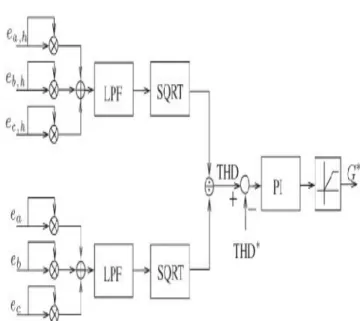
Fig. 3 demonstrates the proposed conductance control. The consonant conductance summon G∗ is resolved by the voltage THD at the HAFU establishment point. The voltage THD is roughly computed by the control appeared in Fig. 3. Here, two low-pass channels (LPFs) with cutoff recurrence fLP = 20 Hz are acknowledged to sift through swell parts . The blunder between the reasonable THD∗ and the deliberate THD is then sustained into a PI controller to get the consonant conductance summon G∗. The admissible contortion could be alluded to as far as possible in IEEE sexually transmitted disease. 519-1992 .Note that PI parameters should be tuned for required reaction and security. For instance, the relative pick up can be tuned for transient conduct, and the indispensable pick up is in charge of stifling the unfaltering state mistake. The data transfer capacity ought to be lower than one-tenth of the cutoff recurrence of the present circle to guarantee stable operation.
III. Examination OF FILTERING PERFORMANCE
The separating execution of the HAFU has been tended to in by creating proportionate circuit models, in which both symphonious impedance and consonant enhancement are considered. The recurrence normal for the uninvolved channel is changed by the proposed symphonious conductance to maintain a strategic distance from unexpected resonances. Here, we will focus on the damping execution with variety of line impedance Ls, line resistance Rs, and THD∗. Voltage unbalance and channel capacitors in the power framework are additionally considered.
IV.FUZZY LOGIC CONTROL
FLC controlled by the arrangement of etymological standards. The scientific displaying is not required in fuzzy controller because of the change of numerical variable into phonetic factors. FLC comprises of three section: a. Fuzzification, b. Impedance motor, c. Defuzzification. The fuzzy controller is portrayed as; For each information and yield there are seven fuzzy sets. For effortlessness an enrollment capacities is Triangular. Fuzzification is utilizing nonstop universe of talk. Suggestion is utilizing Mamdani's "min" administrator. Defuzzification is utilizing the "stature" technique.
V.SIMULINK DESIGN AND RESULTS
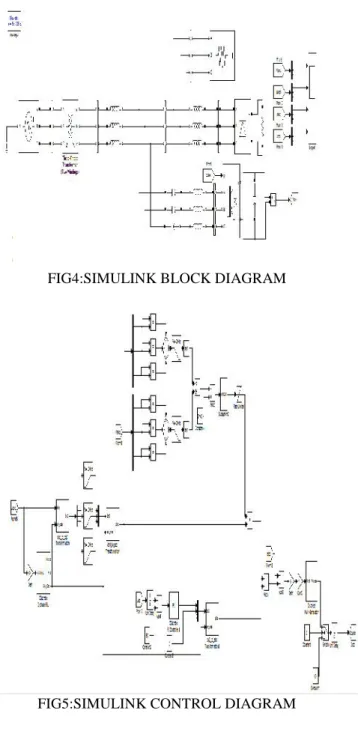
FIG4:SIMULINK BLOCK DIAGRAM
9b
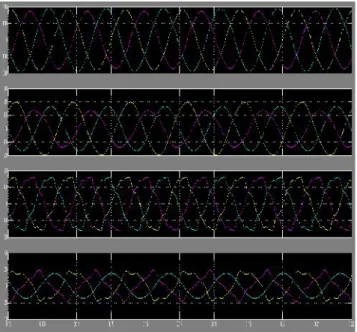
Fig. 9. Line voltage e, source current is, load current iL, and filter current i in the case of NL1 initiated. X-axis: 5 ms/div. (a) HAFU is off. (b) HAFU is on.
10a
10b
Fig. 10. Line voltage e, source current is, load current iL, and filter
current i in the case of NL2 initiated. X-axis: 5 ms/div. (a) HAFU is off.
(b) HAFU is on.
11a
11b
Fig. 11. Transient response when the nonlinear load is increased at T. (a)Waveforms of vdc, Voltage THD, G∗.
Fig. 13. HAFU is off for single-phase nonlinear load. (a) Terminal
voltage. (b) Source current. (c) Filter current. (d) Load current.
Fig. 14. HAFU is on for single-phase nonlinear load. (a) Terminal
voltage. (b) Source current. (c) Filter current. (d) Load current.
V. CONCLUSION
This project presents hybrid active filter to uppers harmonic resonances in industrial power systems. The proposed hybrid filter is composed of a seventh harmonic-tuned passive filter and an active filter in series
connection at the secondary side of the distribution transformer. With the active filter part operating as variable harmonic conductance, the filtering performances of the passive filter can be significantly improved. Accordingly, the harmonic resonances can be avoided, and the harmonic distortion can be maintained inside an acceptable level in case of load changes and variations of line impedance of the power system. Simulation results verify the effectiveness of the proposed method. Extended discussions are s summarized as follows.
Large line inductance and large nonlinear load may result in severe voltage distortion. The conductance is increased to maintain distortion to an acceptable level.
Line resistance may help reduce voltage distortion. The conductance is decreased accordingly using fuzzy controller.
For low line impedance, THD∗should be reduced to enhance filtering performances. In this situation, measuring voltage distortion becomes a challenging issue.
High-frequency resonances resulting from capacitive filters is possible t o be suppressed by the proposed method.
In case of unbalanced voltage, a band-rejected filter is needed to filter out second-order harmonics if the SRF is realized to extract voltage harmonics.
REFERENCES
[1] Tzung-Lin Lee, Member, IEEE, Yen-Ching Wang,
Student Member, “Hybrid Active Filter With Variable Conductance for Harmonic Resonance Suppression in Industrial Power Systems” IEEE, Jian-Cheng Li, and Josep M. Guerrero, Senior Member, IEEE
[2] R . H. Simpson, “Misapplication o f power capacitors
in distribute tion systems with nonlinear loads-three case
histories,”I E E E Tra n s . I n d . A p p l ., vol. 41, no. 1,
pp. 134–143, Jan./Feb.2005.
[4] T. Di ionize and V. Lorch, “Voltage distortion on an electrical distribution system,” IEEE In d . A p p l . M ag., vol. 16, no. 2, pp. 48–55, Mar./Apr. 2010.
[3] E. J. Currence, J. E. Plizga, and H. N. Nelson,
“Harmonic resonance at a medium-sized industrial
plant,”IEEE Tra n s . I n d . A p p l ., vol. 31, no. 4, pp.
682–690, Jul/Aug. 1995.
[6] H. Akagi, “Active harmonic filters,”Proc. IEEE, vol.
93, no. 12, pp. 2128–2141, Dec. 2005.
[7] A. Bhattacharya, C. Chakraborty, and S.
Bhattacharya, “Shunt compensation,” IEEE Ind. Electron. Mag., vol. 3, no. 3, pp. 38–49, Sep. 2009.
[8] F. Z. Peng, “Application issues of active power filters,” IEEE Ind. Appl. Mag., vol. 4, no. 5, pp. 21–30, Sep./Oct. 2001.