R E S E A R C H
Open Access
A rendezvous approach for correcting
accumulative errors of multiple robots
Xuefeng Dai
1*, Zheping Yan
2, Jianqi Zhao
1and Dahui Li
1Abstract
Wireless communication with no range and bandwidth limitations is desired for coordination and information sharing among multiple robots. However, the perfect communication is not available for a few of reasons. This paper proposed a simple yet effective scheme for correcting odometer errors existed in each robot of a multi-robot system. A contribution is that additional communication bandwidth is needed only if a rendezvous for two robots happened. Implementation of the error correction scheme is addressed in detail. Moreover, rendezvous is formulated by a set of predicate logic reasoning implications for each robot at upper level of soft architecture. The proposed approach was validated by computer simulations.
Keywords:Error correction, Rendezvous, Predicate logic reasoning, Multi-robot systems, Exploration
1 Introduction
Multi-robot systems not only outperform single robot sys-tems in redundancy and robustness, but also can finish tasks that the single robot systems cannot do. There are many applications for multi-robot systems in dangerous, poisonous, and radioactive operation environments. The goal for the multi-robot systems to achieve during oper-ational discourse varies according to applied scenarios. For example, the multiple robots try to scan unknown environ-ments in a minimal time for a search and rescue applica-tion. Therefore, the corresponding coordinated strategy emphasized on minimizing repeated coverage and task bal-ancing across robots. Lots of results are available to deal with the subject [1–4]. However, uncertainties which are in-trinsic in sensing and acting for all robots have not been ad-dressed in the above results. A typical uncertainty is odometer error accumulated during exploration [5]. Simul-taneous localization and mapping algorithms can overcome the uncertainty by fusing estimates provided by both sen-sory matching and dead reckoning techniques [6,7]. Unfor-tunately, if observations are not available, i.e., all environmental features are out of sensing range of the robot, then the algorithms fail to overcome the uncertainty. Markov decision process (MDP) modeling-based
approaches for multi-robot systems coordination took the uncertainty into account [8–11]. Yet, solving MDP are computational expensive. In general, there are no analytic solutions to MDP. On the other hand, the coordination de-pends on wireless communication with finite range and fi-nite bandwidth. Therefore, a practical odometer error correction scheme should not overload the bandwidth of the network. Such a novel uncertainty correction scheme which can be embedded in predicate logic reasoning-based approach (PLR-A) [12] for multi-robot systems exploring unknown environments is proposed in this paper.
It is hard to consider all variables about teammate robots and operational environment when selecting navigation goal for a specific teammate robot. So, PLR-A was proposed by the authors of this paper. The work re-alized cooperative exploration by predicate logic reason-ing in a partitioned state space instead of a joint state space for all robots and the environment. However, the uncertainties were not addressed there. This paper discusses the uncertainty correction by position informa-tion fusion through rendezvous of any two teammate robots. A contribution of this paper is odometer error that is corrected by taking advantage of rendezvous. An-other contribution is that additional communication bandwidth is needed only if a rendezvous happened. Moreover, formal expression of rendezvous at upper level is expressed by predicate logic reasoning in the adopted hierarchical architecture.
* Correspondence:[email protected]
1School of Computer and Control Engineering, Qiqihar University, Qiqihar
161006, Heilongjiang, China
Full list of author information is available at the end of the article
This paper is organized as follows. Section 2 reviews related work. Section 3 presents preliminary for explor-ation through a special kind of zigzag trajectories. Sec-tion 4 discusses error correction scheme through rendezvous and filtering of position information. Section
5 gives simulation settings for validating the proposed approach. Section 6 presents computer simulation and statistical results and discussions about the results. Fi-nally, Section7concludes the paper.
2 Related work
Coordinated algorithms take roles of task assignments to ro-bots, robots dispersion over operational environments, and cooperation across robots. They make all robots of a multi-robot system working together as a whole. Coordin-ation has been an active subject in the field of intelligent ro-botics for two decades. Study achievements about distributed multi-agent coordination since 2006 were reviewed from sys-tems and control point of view [13]. Methods for coverage path planning during the past decade of 2013 were reviewed [14]. In addition, the work also reviewed coverage under un-certainty and multi-robot coverage methods.
Recently, a few of new trends appeared, for example, energy-constrained coordination [2], joint exploration and tracking [3], and coordination under recurrent communica-tion constraints [4]. An energy-constrained spatiotemporal rendezvous problem of multi-robot systems was discussed [2]. It was formulated as an optimization problem with a global cost function and local constraints, where all robots were minimizing a same objective function, but each robot had its own constraint. Multi-robot multi-object explor-ation and tracking problem was solved simultaneously by expressing it as an optimal control problem that is to maximize objective function subject to dynamics and detec-tion probability [3]. A hierarchical formulation was pre-sented in the work, and the continuous optimal control problem for each robot was solved independently by a non-linear optimization algorithm at lower level. Finally, explor-ation strategies that allow robots to coordinate with teammates to form an ad hoc network to satisfy recurrent connectivity constraints were designed [4].
A major part of results that addressed the uncertainties are MDP and its variants modeling-based approaches. Typ-ical results included and emphasized on sequential decision-making [8] and coordination [9, 10] under uncer-tainties. The problem of sequential decision-making under uncertainties for each robot was formulated as a MDP [8]. A decentralized model learning scheme based on the Incre-mental Feature Dependency Discovery (Dec-iFDD) was pre-sented to learn uncertain state transition model in the underlying MDP. The scheme shared the most relevant fea-tures across teammates under limited communication. Moreover, a macro-action decentralized partially observable MDP (MacDec-POMDP)-based method for multi-robot
coordination was introduced in the presence of uncertain sensing and other limitations [9]. A new planning algorithm which was called MacDec-POMDP heuristic search was presented. To overcome the issue of information space scales exponentially with the number of robots, the multi-robot POMDP was decentralized by POMDP policy auctions [10]. Moreover, a problem of assigning a set of sta-tionary targets to a team of mobile robots under temporal, performance, perception, and resource constraints was ad-dressed [11]. The corresponding constrained MDP was solved in two steps. Another related work is exploration plan based on stochastic dynamic programming [15] in which uncertainties in both sensing and control were taken into account. However, it is hard to solve MDP and its variants.
Furthermore, collaborative localization [16] and active in-formation gathering [17] under uncertainty were discussed. A synthesizing method for multi-robot collaborative localization was described [16]. In the method, an odometry and a North Star positioning system were used to perform localization for each robot. Then, a distributed extended Kalman filter and relative observation combining approach were outlined. Moreover, a problem of reducing uncertainty about a physical process of interest by designing sensing trajectories for a team of robots was considered [17]. An anytime planning algorithm progressively reduced subop-timality of the information gathering plans.
therefore, the UAVs can reach rendezvous position at the same time.
Different with above results, the rendezvous is used to fuse location coordinate information in the proposed ap-proach. In addition, predicate logic reasoning is used to for-mulate the rendezvous at upper level. To the best of our knowledge, this is the first try to discuss error correction under communication constraints based on rendezvous and reasoning. Predicate logic reasoning has been used in automatic composition of semantic Web services. For ex-ample, fuzzy predicate Petri net was proposed to model Horn clauses [21]. Moreover, reasoning has been used in ontology technology which is one of the most promise methodologies to express and propagate knowledge [22].
3 Preliminary
It is assumed in this paper that a multi-robot system S = {r1,…,rn} is considered, wherenis the size of the system.
All robots are equipped with vision or sonar sensors for the purposes of scanning and recognizing each other when two robots are sufficiently close together. In addition, an in-stantaneous, infinite bandwidth communication between robots at all times are available. If each mobile robot of the system was taken as a mobile node, then all nodes consti-tute a full-connected wireless network.
For convenience of comprehension, some results re-lated to predicate logic reasoning-based coordination of multi-robot systems [12] are reviewed in brief and some results are further addressed in the following.
First, it was assumed that all robots explore an oper-ational environment through a kind of modified zigzag tra-jectories. A few of concepts about the zigzag trajectories will be reviewed. The zigzag trajectory consists of a series of shorter line segment sub-trajectories and longer line seg-ment sub-trajectories. The direction that corresponds to the shorter line segment is named as primary exploring dir-ection, and the direction that corresponds to the longer line segment is named as auxiliary exploring direction. The dis-tance between two adjacent trajectory line segments of
auxiliary exploring directions of a robot ri(i= 1, …, n) is
named as width ofri’s zigzag trajectory.
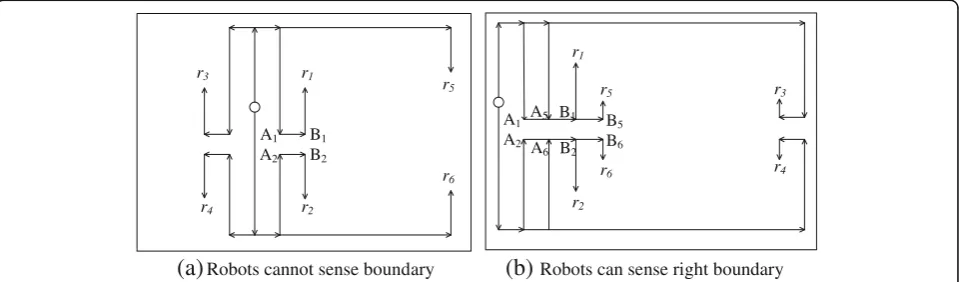
The exploration coordination consisted of partitioning the multi-robot system, initialization of exploration dis-course, and predicate logic reasoning for coordination. Be-fore exploration begins, the multi-robot system was partitioned into at most three subsets. The partitioning first aimed at making the size of each subset as an even number as possible, second aimed at making the number of subsets as small as possible and the least size of the first subset is 2, and finally aimed at making the sizes of the three subsets as equivalent as possible. Robots belonged to the same subset are named as cooperative robots. After the partitioning, exploration discourse of the multi-robot system would be initialized. Initialization strategies for a multi-robot system with n= 5 are shown in Fig.1where the partitioning isS= {{r1,r2}, {r3,r4}, {r5}}.
Figure1a, b shows the initializing processes for cases that robots cannot sense boundary and can sense right bound-ary of operational environment at initial locations, respect-ively. All robots start their exploration discourses from a common initial location where it is marked as a circle in the figures. It is assumed that auxiliary exploring directions are vertical. Then,r1,r3, andr5move upwards, andr2and
r4 move downwards in the beginning of exploration. As soon as the robots sensed upper boundary or lower bound-ary, they change to their exploring directions to their pri-mary exploring directions, as shown in the figures.
A feature of modified zigzag trajectories is that two ro-bots belonged to the same subset will have at least one ren-dezvous for the case shown in Fig. 1. Having moved a distance of their zigzag trajectory widths on their primary exploring directions, two cooperative robots began to move to each other from opposite directions on auxiliary explor-ing directions durexplor-ing the exploration discourse. As shown in Fig.1,r1andr2, andr3andr4will have a few of rendez-vous, respectively. It is not sure thatr5will not have
rendez-vous along its auxiliary or primary exploring directions since it has no cooperative robot. In addition, initialization
(a)
Robots cannot sense boundary(b)
Robots can sense right boundary r1r2
r5
r3
r4 B2
B1
A1
A2
r2
r5 r3
r4 A1
A2 B2
B1
r1
strategies for a multi-robot system withn= 6 are shown in Fig.2where the partitioning isS= {{r1,r2}, {r3,r4}, {r5,r6}}.
In the following, r1 and r2 are taken as examples to discuss rendezvous. Supposed that r1arrived at A1and
r2arrived at A2wherer1has recognizedr2, orr2has rec-ognized r1, or both robots have recognized each other, then a rendezvous happened. The time period for two robots from meeting to separating is named as rendez-vous period. The distance AiBi(i= 1, 2) traveled by the
two robots during the rendezvous period is named as rendezvous distance. The distance is equal to 2di and
4di, respectively in Fig.1a, b.
It is remarked that meeting locations have no depend-ence on the environments—every location is a potential rendezvous location.
4 Uncertainty correction scheme
If two robotsri and rj(i, j= 1, ..., n, i≠j) belonged to the
same subset Sk, and they have moved to each other along
their auxiliary exploring directions and were sufficient close to recognize each other, then the formal expression of the rendezvous at upper level by predicate logic reasoning is
Belonged rði;SkÞ∧Belonged rj;Sk
where Belonged, Moved, Be_oppst, Be_close, Rcgnz,
Coordx, and Coordy are first order predicates, and Fuse
is a second order predicate, andri,Sk, anddiri are
vari-ables, all of these predicates and corresponding variables are commentated in Table1.
During the rendezvous period, coordinate xof the two robots ri and rjare kept to be identical, Fuse(Coordx(ri),
Coordx(rj)) is conducted iteratively by
Δxijðkþ1Þ ¼
increments of ri and rj, respectively, which are derived
from dead reckonings; Δxij(k+ 1) is a fused increment;
and kr is the rendezvous period. When k= 0, xij(0)
= (xi(0) +xj(0))/2, and yi(0) = (yi(0) +yj(0))/2 +dij/2 and
yj(0) = (yi(0) +yj(0))/2−dij/2. The fusion for coordinateyi
andyjare realized by
Δyijðkþ1Þ ¼
Δyiðkþ1Þ þΔyjðkþ1Þ
2 ð4Þ
yiðkþ1Þ ¼yið Þ þk Δyijðkþ1Þ ð5Þ
yjðkþ1Þ ¼yiðkþ1Þ−dijðk¼0;…;kr−1Þ ð6Þ
where dij= |A1A2| is the distance between the two
robots when they met. During the rendezvous period,dij
will be kept as a constant. A rendezvous is over if and only if
where dr is the rendezvous distance. If ri and rj keep
current primary exploring directions, dr is equal to the
width of zigzag trajectory; otherwise, dr is equal to a
dis-tance commonly traveled by the two robots until they could sense unexplored area.
For two robots belonged to different subsets Sk∈S and
Sm∈S (k≠m), they will fuse their coordinates information
also by (2) to (6) when they met on their auxiliary exploring directions. A difference with cooperative robots is that one
(a)
Robots cannot sense boundary(b)
Robots can sense right boundary r2of the two robots should call a collision avoidance subrou-tine when a rendezvous happened and restores its auxiliary exploring direction after rounding the other robot. The cor-responding predicate logic reasoning is
Belonged rði;SkÞ∧Belonged rj;Sm
If the two robots met on their primary exploring tions, then the two robots turn to their auxiliary direc-tions, respectively, to continue their exploration discourses. If the two auxiliary exploring directions are identical, then location coordinates information fusion is conducted through revised forms of (2) to (6). The revi-sion is obtained by interchanging abscissa and ordinate in (2) to (6). Else, if the two auxiliary exploring direc-tions are different, then no fusion is needed. Upper ex-pression of the rendezvous and corresponding behavior is
The behavior for the robot when detecting an obstacle is similar to the case of detecting another robot.
Besides the correction described by (2) to (6) during rendezvous period, a further correction is necessary. The utilized trajectories featured a phenomenon that error accumulated relative to turn location for each robot. Therefore, coordinatexis updated before or after a ren-dezvous by the following scheme:
x0ið Þ ¼k X a rendezvous forri, when a rendezvous begun, ended, or
riturned its exploring direction; kis reset to zeros; and
μis a scalar, 0 <μ< 1. Correction (10)–(11) need no add-itional bandwidth of the wireless network.
5 Experiment settings
The effectiveness of the proposed approach has been validated by computer simulation experiments. The sim-ulations were conducted in Matlab 7.1 environment on a personal computer which has an Intel® Core™ i7 2.93GHz processor and 8 GB RAM. It is assumed that the sensing radius is 4 m, and the moving speed is 0.1 m/s for all robots.
Dead reckoning error models for robots were taken from [5]. If robotri (i= 1,…, 6) moved along horizontal
direction, then the errors along abscissa and ordinate are represented as Ea(k)≤ξiDi(k)(1−cosαi), and Eo(k)≤
ηiDi(k)(1−sinαi), respectively, where Di(k) is the total
distance traveled by rialong current exploring direction
so far, αi is a quite small constant, kis current time
in-stant, and ξi= [1.0 1.1 1.2 1.3 1.4 1.5]Tand ηi= [1.4 1.2
1.3 1.1 1.2 1.2]Tare coefficient vectors to represent error differences between robots. If ri moved along vertical
direction, then the two errors are represented asEa(k)≤
ηiDi(k)(1−sinαi) andEo(k)≤ξiDi(k)(1−cosαi). All robots
initially located at a common position over a 100 × 100 m2 obstacle-free environment, which was modeled as an occupied grid map of 1 × 1 m2. The initial loca-tions were randomly generated for each run. The robot team size is a variable that ranges from 2 to 6. For each team size, the simulations were conducted 100 runs.
The proposed error correction strategy was used in multi-robot systems coordinated by predicate logic-based reasoning [12] for unknown environment ex-ploration. Since the size of the individual multi-robot systems is a variable, and exploration times for different system sizes are different too, it is meaningless to com-pare the total accumulative errors. Therefore, two index functions eo¼‖P−^Po‖=nand eoc¼‖P−^Poc‖=n(n= 2, …,
6) are defined, where P is a vector representing true lo-cations of all robots and P^o and P^oc are estimates of Table 1Notations of predicate logic reasoning
Predicates Belonged A robot is belonged to a subset
Moved A robot moved along a direction
Travelled A robot has traveled a distance
Be_oppst Moving directions of two robots are opposite
Be_close Distance between two robots is close
Rcgnz A robot can recognize the other robot
Fuse Two robots fuse location information
Coordx,
Coordy
Coordinatesxoryof a robot
Avoids Avoids an object (a robot, or an obstacle)
Turns Changes current exploring direction
Variables ri Robotri(i= 1,…,n)
Sk Subsetkof the multi-robot system
diri Moving direction ofri
positions for all robots with odometer errors and cor-rected odometer errors, respectively.
6 Results and discussions 6.1 Simulation and statistical results
Figure3showed the means ofeoand eocper grid on the
trajectories during explorations. It can be seen that the proposed PLR-A with error correction (PLRec-A) re-duced accumulative errors obviously compared with PLR-A. A special phenomenon for PLRec-A errors in Fig.3is that the error for team size 5 is bigger than that for team size 4. This is due to the fact that all robots have their respective cooperative robots for the case of team size being 4, and r5 has no cooperative robot for
the case of team size being 5. The corresponding multi-robot systems were partitioned into two and three subsets in two cases, respectively. An overall trend of the errors is that errors descend versus the increasing of multi-robot system size. All robots dispersed over the environment, as discussed in the initialization strategies.
Robot trajectories for a multi-robot system coordi-nated by PLR-A and PLRec-A, withn= 2 and initial lo-cation is (41, 49), are shown in Fig.4a, b, respectively. It can be seen that dead errors increased along time, and exploration trajectories of robots coordinated by PLRec-A are closer to true trajectories than the trajec-tories of robots coordinated by PLR-A.
Wilcoxon rank-sum test under significance level α= 0.05 for the two kinds of results are shown in Table 2. The null hypothesis implies that the error means of pop-ulations from which the two samples were taken are equal. If the null hypothesis is rejected, then the error means are different. In the five tests for each system size shown in the table, all standardized values listed in the last row are bigger than 0.776; therefore, the null hy-pothesis is rejected for all tests, indicating that improve-ment resulting from PLRec-A are evident.
6.2 Discussions
The error correction scheme described in this paper was designed for coordination purpose. A precondi-tion to implement the error correcprecondi-tion scheme is that coordinated robots of the multi-robot systems could meet to each other during exploration dis-course. In addition, to get a global environment model, postprocessing is necessary [6, 7].
2 3 4 5 6
0 0.05 0.1 0.15 0.2 0.25
Number of Teammate Robots
)
m(
dir
G/
sr
orr
E
n
oiti
s
o
P
f
o
s
a
n
e
M
PLR-A PLRec-A
Fig. 3Localization errors for multi-robot systems of different sizes; in the histogram, left bar and right bar for each team size represent errors of robots coordinated by PLR-A and PLRec-A, respectively
(a)
Trajectories with odometry errors
(b)
Trajectories with corrected odometry errors
0 10 20 30 40 50 60 70 80 90 1000 10 20 30 40 50 60 70 80 90 100
X(m)
Y(
m
)
0 10 20 30 40 50 60 70 80 90 100 0
10 20 30 40 50 60 70 80 90 100
X(m)
Y(
m
)
Fig. 4Exploration trajectories of a multi-robot system composed of two robots; in the figure, blue and green trajectories correspond tor1
7 Conclusions
A novel uncertainty correction strategy for multi-robot systems in exploring unknown environments has been proposed. The approach adopted a hierarchical architec-ture to realize error correction. At upper level, the ren-dezvous was formulated by predicate logic reasoning, and at lower level coordinates, fusion was fused by
weighted summation. Although homogeneous
multi-robot systems are discussed as default, the results are suitable for heterogeneous multi-robot systems if and only if the widths of zigzag trajectories of the two cooperative robots are kept to be identical. Coordination strategy is a core for multiple robot cooperation. The re-sults proposed in this paper make robust coordination of multi-robot systems under uncertainty becoming pos-sible. Furthermore, additional bandwidth for the wireless network is needed only if rendezvous happened. How to make the proposed approach suitable for dynamic and structured environments is future work.
Abbreviations
Dec-iFDD:Decentralized model learning scheme based on the Incremental Feature Dependency Discovery; MacDec-POMDP: Macro-actions decentralized partially observable Markov decision process; MDP: Markov decision process; PLR-A: Predicate logic reasoning-based approach; PLRec-A: PLR-A with error correction; UAV: Unmanned aerial vehicle
Acknowledgements
The research presented in this paper was supported by Council of the National Natural Science Foundation of China.
Funding
The authors acknowledge the National Natural Science Foundation of China (Grant: 61672304).
Authors’contributions
XD is the main writer of this paper. He proposed the main idea, developed the predicate logic reasoning implications, and conducted the simulation. ZY designed the error correction scheme and analyzed the result. JZ took part in programming for a few of Matlab functions. DL gave some important suggestions for the predicate logic reasoning. All authors read and approved the final manuscript.
Competing interests
The authors declare that they have no competing interests.
Publisher’s Note
Springer Nature remains neutral with regard to jurisdictional claims in published maps and institutional affiliations.
Author details
1School of Computer and Control Engineering, Qiqihar University, Qiqihar
161006, Heilongjiang, China.2College of Automation, Harbin Engineering
University, Harbin 150001, Heilongjiang, China.
Received: 8 March 2018 Accepted: 30 May 2018
References
1. T Andre, C Bettstetter, Collaboration in multi-robot exploration: to meet or not to meet? J. Intell. Robot. Syst.82(2), 1–13 (2016)
2. J Banfi, LA Quattrini, I Rekleitis, F Amigoni, N Basilico, Strategies for coordinated multirobot exploration with recurrent connectivity constraints. Auton. Robot.42(4), 875–894 (2018)
3. T Setter, M M Egerstedt, Energy-constrained coordination of multi-robot teams. IEEE Trans. Control Syst. Technology25(4), 1257–1263 (2017) 4. A Ivanov, M M Campbell, Joint exploration and tracking: JET. IEEE Control
Syst. Lett.2(1), 43–48 (2018)
5. BS Ryu, HS Yang, Integration of reactive behaviors and enhanced topological map for robust mobile robot navigation. IEEE Trans. Syst. Man Cybern. A Syst. Hum.29(5), 474–485 (1999)
6. BD Gouveia, D Portugal, C Daniel, DC Silva, L Marques, Computation sharing in distributed robotic systems: a case study on SLAM. IEEE Trans. Autom. Sci. Eng.12(2), 410–422 (2015)
7. C Estrada, J Neira, TD Tardos, Hierarchical SLAM: real-time accurate mapping of large environments. IEEE Trans. Robot.21(4), 588–596 (2005)
8. NH Ure, G Chowdhary, YF Chen, JP How, J Vian, Distributed learning for planning under uncertainty problems with heterogeneous teams. J. Intell. Robot. Syst.74(1–2), 529–544 (2014)
9. C Amato, G Konidaris, A Anders, G Cruz, JP How, LP Kaelbling, Policy search for multi-robot coordination under uncertainty. Int. J. Robot. Res.35(14), 1760–1778 (2016)
10. J Capitan, MTJ Spaan, L Merino, A Ollero, Decentralized multi-robot cooperation with auctioned POMDPs. Int. J. Robot. Res.32(6), 650– 671 (2013)
11. JLS Rincon, P Tokekar, V Kumar, S Carpin, Rapid deployment of mobile robots under temporal, performance, perception, and resource constraints. IEEE Robot. Autom. Lett.2(4), 2016–2023 (2017)
12. XF Dai, LH Jiang, DH Li, Integrating predicate reasoning and reactive behaviors for coordination of multi-robot systems. Cluster Comput. (2018)
https://doi.org/10.1007/s10586-017-1676-8
13. Y Cao, WW Yu, W Wei, GR Chen, An overview of recent progress in the study of distributed multi-agent coordination. IEEE Trans. Indus. Inf9(1), 427–438 (2013)
14. E Galceran, M Carreras, A survey on coverage path planning for robotics. Robot. Auton. Syst.61(12), 1258–1276 (2013)
15. L Valentin, R Murrieta-Cid, L Munoz-Gomez, R Lopez-Padilla, M Alencastre-Miranda, Motion strategies for exploration and map building under uncertainty with multiple heterogeneous robots. Adv. Robot. 28(17), 1133–1149 (2014)
16. QR Tang, P Eberhard, Relative observation for multi-robot collaborative localisation based on multi-source signals. J. Exp. Theor. Artif. Intell.26(4), 571–591 (2014)
17. B Schlotfeldt, D Thakur, N Atanasov, V Kumar, GJ Pappas, Anytime planning for decentralized multi-robot active information gathering. IEEE Robot. Autom.3(2), 1025–1032 (2018)
18. S Keshmiri, S Payandeh, Regression analysis of multi-rendezvous recharging route in multi-robot environment. Int. J. Soc. Robot.4(1), 15–27 (2012) 19. N Roy, G Dudek, Collaborative robot exploration and rendezvous:
algorithms, performance bounds and observations. Auton. Robot.11(2), 117–136 (2001)
20. WY Jiang, DB Wang, Y Wang, ZA Ali, UAV rendezvous based on time-varying vector fields. Electronics Lett.53(10), 653–655 (2017)
21. JJ Cheng, C Liu, MC Zhou, QT Zeng, A Yla-Jaaski, Automatic composition of semantic Web services based on fuzzy predicate Petri nets. IEEE Trans. Autom. Sci. Eng.12(2), 680–690 (2015)
22. SR Fiorini, J Bermejo-Alonso, P Gonçalves, EP de Freitas, AO Alarcos, JI Olszewska, E Prestes, C Schlenoff, SV Ragavan, S Redfield, B Spencer, H Li, A suite of ontologies for robotics and automation [industrial activities]. IEEE Robot. Autom. Mag.24(1), 8–11 (2017)
Table 2Statistical results
n 2 3 4 5 6
μR1 10,050 10,050 10,050 10,050 10,050
σR1 167,500 167,500 167,500 167,500 167,500
r1 15,050 15,050 15,026 14,758 15,050