Hammerstein Model for Speech Coding
Jari Turunen
Department of Information Technology, Tampere University of Technology, Pori, Pohjoisranta 11, P.O. Box 300, FIN-28101 Pori, Finland
Email:[email protected]
Juha T. Tanttu
Department of Information Technology, Tampere University of Technology, Pori, Pohjoisranta 11, P.O. Box 300, FIN-28101 Pori, Finland
Email:[email protected]
Pekka Loula
Department of Information Technology, Tampere University of Technology, Pori, Pohjoisranta 11, P.O. Box 300, FIN-28101 Pori, Finland
Email:[email protected]
Received 7 January 2003 and in revised form 19 June 2003
A nonlinear Hammerstein model is proposed for coding speech signals. Using Tsay’s nonlinearity test, we first show that the great majority of speech frames contain nonlinearities (over 80% in our test data) when using 20-millisecond speech frames. Frame length correlates with the level of nonlinearity: the longer the frames the higher the percentage of nonlinear frames. Motivated by this result, we present a nonlinear structure using a frame-by-frame adaptive identification of the Hammerstein model parameters for speech coding. Finally, the proposed structure is compared with the LPC coding scheme for three phonemes /a/, /s/, and /k/ by calculating the Akaike information criterion of the corresponding residual signals. The tests show clearly that the residual of the nonlinear model presented in this paper contains significantly less information compared to that of the LPC scheme. The
presented method is a potential tool to shape the residual signal in an encode-efficient form in speech coding.
Keywords and phrases:nonlinear, speech coding, Hammerstein model.
1. INTRODUCTION
Due to the solid theory underlying linear systems, the most widely used methods for speech coding up to the present day have been the linear ones. Numerous modifications of those methods have been proposed. At the same time, however, the application of nonlinear methods to speech coding has gained more and more popularity. An early example of non-linear speech coding is thea-law/µ-law compression scheme in pulse code modulation (PCM) quantization. Witha-law (8 bits per sample) orµ-law (7 bits per sample) compression, the total saving of 4–5 bits per sample can be achieved com-pared to linear quantization (12 bits per sample). However, these nonlinearities do not involve modeling and are purely based on the fact that the human hearing system has loga-rithmic characteristics.
Probably, the most well-known linear model-based speech coding scheme is the linear predictive coding (LPC), where model parameters together with the information about the residual signal need to be transmitted. For exam-ple, in the ITU-T G.723.1 speech encoder, the linear
predic-tive filter coefficients can be represented using only 24 bits while the excitation signal requires either 165 bits (6.3 kbps mode) or 134 bits (5.3 kbps mode). In analysis-by-synthesis coders, such as G.723.1, the excitation signal is used for speech synthesis to excite the linear filter to produce synthe-sized speech sound similar to the original speech sound. The G.723.1 codec itself is robust and has successfully served mul-timedia communications for years. However, only 13–15% of the encoded speech frame contains information about the filter while 85–87% is spent on the excitation signal. In other words, over 80% of the transmitted data is information that the linear filter cannot model.
The residual signal in speech coding is a modeling error that is left out after filtering. The excitation signal has similar characteristics to the residual signal and it is used to excite the inverse linear filtering process in the decoder.
model the human vocal tract [2,3]. In [4], Fackrell uses a bispectral analysis in his experiments. He found that gener-ally there is no evidence of quadratic nonlinearities in speech, although, based on the Gaussian hypothesis, voiced sounds have a higher bicoherence level than expected. In some pa-pers, efforts have been made to model speech using fluid dy-namics, as in [5]. In [6,7,8] chaotic behavior has been found mainly in vowels and some nasals like /n/ and /m/. In [9], speech signal is modeled as a chaotic process. However, these types of models have not proved to be able to characterize speech in general, including consonants, and therefore they have not become widely used.
In other studies, hybrid methods, combining linear and nonlinear structures, have been applied to speech processing. For example, in [10] nonlinear artificial excitation is modu-lated with a linear filter in an analysis-synthesis system while in [11,12] Teager energy operator has been found to give good results in different speech processing contexts.
Another approach to dealing with nonlinearities in speech is to use systems that can be trained according to some training data. These systems must have the capabil-ity of learning the nonlinear characteristics of speech. In [13,14,15,16,17,18], radial basis function and multilayer perceptron neural networks were tested as short- and long-term predictors in speech coding. The results in these stud-ies are encouraging. However, the use of neural networks al-ways entails a risk that the results may be totally different if the copy of the originally reported system is built from scratch using the same number of neural nodes and so forth even when the same training data is used. The platform may be different; the way how the training is performed and the possibility of over- and undertraining will affect the train-ing result. Also, a mathematical analysis of the model struc-ture which the neural network has learned is usually not feasible.
All these studies suggest that nonlinear methods enhance speech processing when compared to the traditional linear speech processing systems. However, the form of the funda-mental nonlinearity in speech is still unknown. From a prac-tical point of view, the speech model should be easy to im-plement, and computationally efficient, and the number of transmitted parameters should be as low as possible, or at least have some benefit when compared to traditional lin-ear coding methods. It may be possible that speech contains different types of linear/nonlinear characteristics, for exam-ple, vowels have either chaotic features or types of higher-order nonlinear features, while consonants may be modeled by random processes.
Based on the ideas presented above, a parametric model consisting of a weighted combination of linear and nonlin-ear features and capable of identifying the model parameters from the speech data could be useful in speech coding. One such model is the Hammerstein model that has been used in different types of contexts, for example, in biomedical sig-nal processing and noise reduction in radio transmission, but not for speech modeling in the context of coding. Recently, the parameter identification of the Hammerstein model has turned from an iterative to a fast and accurate process in the
Input signalu(n)
Nonlinearity v(n) Linearity Additive noisew(n)
+
Output signaly(n)
Figure1: Hammerstein model.
approach presented in [19,20,21]. The proposed method is derived from system identification and control science. It has been used, for example, in biological signal processing [22] and acoustic echo cancellation [23], but it can also be used in speech processing. In this paper, we present the use of a noniterative Hammerstein model parameter identifica-tion applied to speech modeling in coding purposes.
2. MATHEMATICAL BACKGROUND
2.1. Hammerstein model
The Hammerstein model consists of a static nonlinearity fol-lowed by a linear time-invariant system as defined in [24] and presented inFigure 1. The Hammerstein model can be viewed as an extension of the conventional linear predic-tive structure in speech processing. The motivation to im-plement this model in speech processing can be traced to the exact mathematical background of the combined nonlinear and linear subsystem parameter identification. It is possible to augment static nonlinearity in front of the LPC system with fixed coefficients, but the Hammerstein model offers, in the presented form, frame-by-frame adaptive coefficient optimization for both nonlinear and linear subsystems. Tra-ditionally, the Hammerstein model is viewed as a black-box model, but in speech coding, the inverse of the Hammerstein model must also be found in order to decode the compressed signal in the destination. The coding-based aspects are dis-cussed later in this paper.
In Figure 1, the nonlinear subsystem includes a
pre-selected set of nonlinear functions. The monotonicity of the nonlinear functions, required in the decoder, is the only limi-tation that restricts the selection and the number of the non-linear functions. The non-linear subsystem consists of base func-tions whose order is not limited.
The general form of the model is as follows:
y(n)=
efficients,girepresents the set of nonlinear functions,ris the number of nonlinear functions and coefficients,Bkare finite impulse response (FIR), Laguerre, Kautz, or other base func-tions, andb=[b0, . . . , bp−1]T ∈Rpare the linear base
original speech signal has been removed and the amplitude range has been normalized between [−1,1].
As it can be seen from (1), the parameter coefficient sets (bk, ai) and (αbk, α−1ai) are equivalent. In order to obtain unique identification, either bk orai is assumed to be nor-malized.
Based on the model given by (1), the following two vec-tors can be formed: the parameter vector θ, containing the multiplied nonlinear and linear coefficient combinations, and the data vector φ, containing the input signal passed through the individual components of the set of nonlinear functionsgi.
The parameter vectorθ, parameter matrixΘab, and data vectorφcan be defined as
θ=b0a1, . . . , b0ar, . . . , bp−1a1, . . . , bp−1arT, (2a) can be written in a matrix form:
YN =ΦTNθ+WN, (5)
Estimatingθby minimizing the quadratic errorWN22
be-tween the real signal and the calculated model output in (5) (least squares estimate) can be expressed as [25]
ˆ
θ=ΦNΦTN−1ΦNYN. (7)
The ˆθvector obtained using (7) contains products of the elements of the coefficient vectorsaandbin (2a). To separate the individual coefficients vectorsaandb, the elements ofθ can be organized into a block column matrix, corresponding to the matrix defined in (2b), as
From this matrix, the model parameter estimates ˆa = [ ˆa1, . . . ,aˆr]T and ˆb = [ ˆb0, . . . ,bˆp−1]T can be solved using
economy-size singular value decomposition (SVD) [25], which yields factorization estimates are obtained as follows:
best possible parameter estimates for parameter vectors a andb. It is also proved in [21] that under rather mild condi-tions on the additive noisew(n) and input signalu(n) in (1),
ˆ
a(N)→aand ˆb(N)→b, with probability 1 asN → ∞. No-tice however that in (11) and (12) it is assumed thata2=1,
that is, the a-parameter vector is normalized. More details can be found in [19,20,21].
2.2. Nonlinearity test for speech
In order to find out nonlinearities in speech, it must be tested somehow. There are some methods available that will mea-sure the signal nonlinearity against a hypothesis and will give a statistical number as a result. Several objective tests have been developed to estimate the proportion of nonlinearities in time series. In the following, the nonlinearity of a conver-sational speech signal is analyzed using Tsay’s test [26], which is a modification of Keenan nonlinearity test [27] having sev-eral benefits over Keenan test yet maintaining the same sim-plicity. The Keenan test is originally based on Tukey’s nonad-ditivity test [28].
Tsay’s test was selected for our experiments due to its sim-plicity and usability for time series. It uses linear autoregres-sive (AR) parameter estimation, which has proven to work with speech data in several other contexts. The idea of this test is to remove the linear information and delayed regres-sion information from the data and see how much infor-mation remains in these two residuals. These two residuals are then regressed against each other and the regression er-ror is obtained. The output of the test is the information of the two residual signals normalized by the energy of the error.
A stationary time seriesy(n) can be expressed in the form
whereµis the mean level ofy(n),bi,bij, andbijkare the first-, second-, and third-order regression coefficients ofy(n), and e(n−i),e(n−j), ande(n−k) are independent and identi-cally distributed random variables. If one of the higher-order coefficients (bij), (bijk), . . .is nonzero, then y(n) is nonlin-ear. If, for example, bij is nonzero, then it will be reflected in the diagnostics of the fitted linear model if the residu-als of the linear model are correlated with y(n−i)y(n−j), a quadratic nonlinear term. Tsay’s test for nonlinearities is motivated by this observation and performed by the follow-ing way usfollow-ing only the first- and second-order regression terms.
(1) Regress y(n) on vector [1, y(n−1), . . . , y(n −M)] and obtain the residual estimate ˆe(n). The regression model is then
y(n)=KnΦ+e(n), (14)
where Kn = [1, y(n−1), . . . , y(n−M)] is the vec-tor consisting of the past values of y, and Φ = {Φ(0),Φ(1), . . . ,Φ(M)}T is the first-order autoregres-sive parameter vector, whereM presents the order of the model andn=[M+ 1, . . . ,sample size].
(2) Regress the vectorZn onKnand obtain the residual estimate vector ˆXn. The regression model is
Zn=KnH+Xn, (15)
where Zn is a vector of length (1/2)M(M+ 1). The transpose ofZnandZTn are obtained from the matrix
y(n−1), . . . , y(n−M)Ty(n−1), . . . , y(n−M) (16)
by stacking the column elements on and below the main diagonal. The second-order regression param-eter matrix is denoted by H, and n = [M + 1, . . . ,sample size].
(3) Regress ˆe(n) on ˆX(n) and obtain the error ˆε(n):
ˆ
e(n)=Xˆ(n)β+ε(n), n=[M+ 1, . . . ,sample size], (17)
where β is the regression parameter matrix of two residuals obtained from (1) and (2).
(4) Let ˆFbe theFratio of the mean square of regression to the mean square of error:
ˆ
F= Xˆ(n) ˆe(n) Xˆ(n)TXˆ(n) −1
(1/2)M(M+ 1)εˆ(n)2
× Xˆ(n)Teˆ(n)n−M−1
2M(M+ 1)−1
, (18)
which is used to represent the value of rejection of the null hypothesis of linearity. It follows approximately theF -distribution with degrees of freedomn1 = (1/2)M(M+ 1)
andn2=sample size−(1/2)M(M+ 3)−1. A more detailed
analysis of the nonlinearity test can be found in [26].
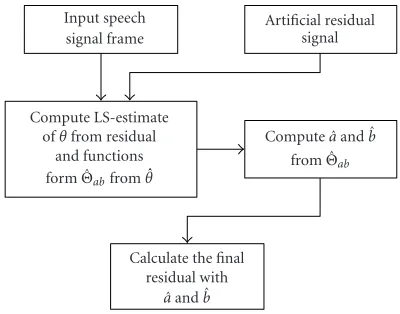
Calculate the final residual with
ˆ aand ˆb Compute LS-estimate
ofθfrom residual and functions form ˆΘabfrom ˆθ
Compute ˆaand ˆb from ˆΘab Input speech
signal frame
Artificial residual signal
Figure2: Structure of the identification system.
3. THE PROPOSED MODEL FOR SPEECH CODING
In case of the Hammerstein model, the process that alters the input signal can be viewed as a black-box model. This model has an input signal and an output signal which is the black-box process modification of the input signal. In order to identify this kind of model parameters, we need both sig-nals, model inputu(n) and outputy(n). The original speech signal can be used asu(n), buty(n) is unknown.
In the speech coding environment, the output signaly(n) is viewed as a residual. It is desirable thaty(n) be represented with as few parameters as possible. For estimating model pa-rameters in our experiments, we used three different artificial residual signals: white noise, unit impulse, and codebook-based signals. The selection and properties of these signals will be discussed later in this paper.
If the model structure is adequate, applying the model with the estimated parameters gives a true residual which re-sembles the artificial residual signal used for the estimation. Therefore, we can assume that the information contained in the true residual can also be represented using few parame-ters, a codebook or coarse quantization. The structure of the system proposed for the parameter estimation is presented in Figure 2.
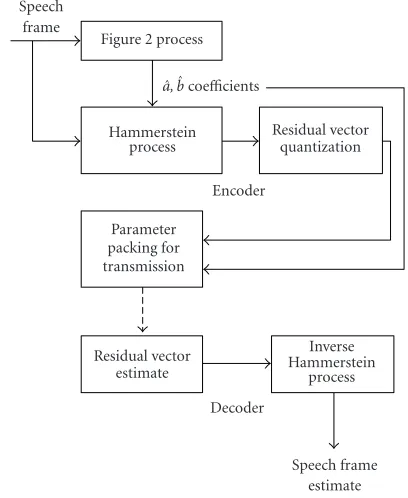
The identification algorithm is forced to find the coeffi -cients for the nonlinear and linear parts of the current model so that the final residual is very close to the artificial residual signal. The least squares estimate of the parameter vectorθ is calculated from the artificial output vector and the input which is fed through the nonlinear and linear parts of the model in question. The block column matrix ˆΘabis formed, and nonlinear and linear coefficient estimatesa,ˆ bˆare ob-tained. The proposed system attached to the speech coding framework is presented inFigure 3.
InFigure 3, the whole coding-decoding system using the
Speech frame estimate Decoder
Residual vector estimate
Inverse Hammerstein
process Parameter
packing for transmission
Encoder Hammerstein
process
Residual vector quantization ˆ
a,bˆcoefficients Figure 2 process Speech
frame
Figure3: The Hammerstein mode-based speech coder.
The aim of this paper, however, is to evaluate the capabil-ity of the Hammerstein model for speech modeling by esti-mating the amount of information contained in the residual signal.
As expressed by (1) and Figure 1, the Hammerstein model consists of two submodels, a linear and a nonlinear one. In our experiments, FIR base functions
Bk(q)=q−k (19)
were used in the linear substructure. These base functions are easy to implement. In the decoder, the inverse model has to be implemented. This is usually not a problem for the linear part of the model.
The nonlinear substructure of the Hammerstein model can be viewed as a preprocessor, turning the nonlinear task of speech modeling into a linearly solvable one. In the de-coder, finding the inverse of the nonlinear subsystem might constitute a problem. For the inverse to be unique, the func-tions must be monotonic in the amplitude range [−1,1]. The inverse can be implemented, for example, using nu-merical methods or lookup tables, depending on the type of functions used. The nonlinear subsystem is a memoryless unit and stability can be ensured by checking whether the nonlinear coefficients are below the predetermined thresh-old values. The linear subsystem must have its poles inside the unit circle. The parameter quantization also affects the encoded/decoded speech quality. However, depending on the system, the proposed Hammerstein model can be built on an analysis-by-synthesis system where the quantized parameters are part of the encoding process and thus try to maximize the quality of the encoded speech.
In the Hammerstein model, nonlinearity is a kind of pre-processing to the speech sound before linear pre-processing. In this case, the nonlinear part is assumed to reduce or modify the features of the speech signal that the linear part cannot model.
4. RESULTS
4.1. Nonlinearities in speech
We tested about 89 minutes of conversational speech sam-pled at 8000 Hz. The speech samples consisted of profes-sional speakers’ talks, interviews, and telephone conversa-tions in low-noise condiconversa-tions. Three frame lengths were used: 160, 240, and 320 samples. All the speech samples were nor-malized so that the amplitude range was between [−1,1]. Frames were nonoverlapping and for each frame length two tests were performed—one with rectangular-windowed frames and the other with Hamming windowing. Hamming windowing was selected due to its popularity in some speech-related applications and to see if the windowing itself would affect the results. In our analysis, the model orderM was M =10 and the number of samples was equal to the frame length. The frame energy was calculated as the sum of abso-lute values, and if this sum was less than the predetermined threshold 15, the frame was regarded as a silent frame and was left out. In some cases also frames containing very low-amplitude /s/ phonemes might have been left out. Of all the test data, about 45 minutes were judged as silent frames and 44 minutes had an amplitude high enough to perform the test. The test results are presented in Table 1. In the table, “p =99%” means that the null hypothesis confidence limit was 99 percent and the numbers listed in the correspond-ing column indicate the number of frames for which theF -distribution confidence limit was exceeded.
This test clearly demonstrates the existence of nonlinear-ities in speech in over 80% of the frames. This correlation may be caused by the fact that the frame length was fixed so that a single frame might have contained parts of different types of phonemes.Table 1also shows that the percentage of nonlinear frames increases significantly due to windowing. When the Hamming-windowed frames are compared with the frames with rectangular windowing, it seems that Ham-ming windowing enhances the nonlinear properties of the speech signal. This is due to the nonoverlapped Hamming windowing, where the edges of the frames may affect the re-sult.
In Table 2, the results of hand-labeled phonemes from
TIDIGITS database /a/, /s/, and /k/ are presented. The frame length was fixed, and in /s/ and /a/ the frame is taken from the middle of the phoneme. In the case of /k/, the plosive is within the frame in a way that the rest is silence or near back-ground noise level.
Table1: Tsay nonlinearity test results of conversational speech.
Frame size Window No. of all
frames
No. of nonlinear frames No. of nonlinear frames No. of nonlinear frames
p=99% p=99.9% p=99.99%
160 Rectangular 74401 69117 (92.9%) 64761 (87.0%) 59660 (80.2%)
160 Hamming 74401 73932 (99.4%) 73159 (98.3%) 71828 (96.5%)
240 Rectangular 71795 68879 (95.9%) 66956 (93.3%) 64645 (90.0%)
240 Hamming 71795 71524 (99.6%) 71066 (99.0%) 70331 (98.0%)
320 Rectangular 65613 63036 (96.1%) 61903 (94.3%) 60678 (92.5%)
320 Hamming 65613 65302 (99.5%) 64811 (98.8%) 64087 (97.7%)
Table2: Tsay nonlinearity test results for hand-labeled phonemes.
Frame size phoneme No. of all
frames
No. of nonlinear frames No. of nonlinear frames No. of nonlinear frames
p=99% p=99.9% p=99.99%
256 /a/ 670 670 (100%) 669 (99.8%) 669 (99.8%)
256 /s/ 669 175 (26.2%) 100 (15.0%) 59 (8.8%)
256 /k/ 224 194 (86.6%) 181 (80.8%) 163 (72.8%)
and thus the linear model will be appropriate to present the phoneme accurately. The phoneme /k/ is a plosive burst that has fast changes, and thus it seems to include nonlinearities.
4.2. Modeling nonlinearities of speech with Hammerstein model
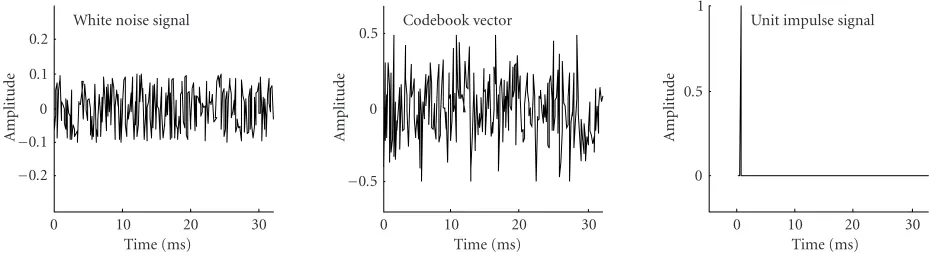
In order to estimate the model parameters, artificial residuals must be chosen. Artificial residual, in this context, means a signal with properties that are also required for the true resid-ual after the Hammerstein model process. Although ideally the residual would be zero, estimating the model parameters according to the zero residual will end up with the trivial re-sult of zero-valued coefficients. The artificial residuals chosen for our experiments are shown inFigure 4.
The white noise residual was uniformly distributed with amplitude range [−0.1,0.1]. The second residual was ob-tained by collecting a 1024-vector codebook from true resid-uals of a tenth-order LPC filter from which the periodi-cal spikes were removed. The codebook vectors were 32-sample long and the artificial residual for our experiment was formed by combining 8 randomly selected vectors from the codebook. As the third residual, a unit impulse was used. There are lots of good candidate signals available, but the ones were chosen for the following reasons: first, the random signal is very difficult to model with linear methods; second, the codebook-based signal was chosen because of the fact that it is widely used in modeling and vector quantization; and third, unit impulse was chosen due to its simple form.
The nonlinearity chosen for the experiments is
gu(n)=a1g1
u(n)+a2g2
u(n), g1
u(n)=u(n),
g2
u(n)=signu(n)u(n)3/2.
(20)
The exponent 3/2 can be changed to almost any finite num-ber, but it was selected for demonstrative purposes, in this case, based on our knowledge. The purpose was to show the behavior of the Hammerstein model using a very simple model structure.
The linear substructure constitutes a first-order FIR filter:
Lv(n)=
1
k=0
bkBk(q)=b0v(n) +b1v(n−1). (21)
The selection of the linear substructure is analyzed more in the discussion. The modeling experiment was done 670 times for hand-labeled phonemes /a/. The Hammerstein model with the three artificial residuals is shown in Figure 4. The used sampling frequency of the signals was 8000 Hz. For comparison, the coefficients of the third-order LPC model are also presented. The distribution of the estimated coeffi -cients is shown in Figure 5. The first linear parameters are normalized to one, and thus left out fromFigure 5.
Figure 5shows that in this test with variable phoneme
/a/ data, the Hammerstein model coefficient values are finite and stable. Interestingly, the deviation of the nonlinear pa-rameters is limited to a very narrow area. Also the distribu-tion of the linear component in the unit-impulse signal case is more concentrated near−0.5 when compared to the other linear parameter deviations. The coefficient parameters with phonemes /k/ and /s/ are distributed in the same manner, however the peaks are in different places (the coefficients of /k/ are deviating more than the coefficients of /a/ or /s/). This concentration property is useful especially in speech coding and possibly in speech recognition purposes.
InFigure 6, the results of two phoneme modeling
Time (ms)
Figure4: Three artificial residual signals: the leftmost is white noise, the middle signal is codebook vector, and the rightmost is unit impulse with zero padding.
the first experiment. The estimated coefficients of the Ham-merstein model for all the experimental cases are presented inTable 3for speech sections /a/ and /s/, respectively.
Figure 6shows that the Hammerstein model gives a
sig-nificantly reduced residual compared to the LPC model. This indicates the adaptation capability of the model in ampli-tude. For our experiments we selected a simple nonlinear function of (20). By optimizing the form of the nonlinearity, the performance of the Hammerstein model could be fur-ther improved. The coefficients shown inTable 3indicate the different emphasis with different artificial residual even with this small model. The results presented inTable 4in the case of phoneme /a/ are a typical case of the results presented in
Figure 5with dotted vertical line.
Figure 7shows male vowel results. The coefficients are
more oriented to the edges of the statistical data presented
in Figure 5 (dash-dotted vertical lines) when compared to
the female speech. However, both the processed female and male speech frames suggest that signal residuals processed by the Hammerstein model have smaller amplitude lev-els when compared to the linear prediction-based resid-ual. Although the Hammerstein model is formed from sim-ple linear and nonlinear substructures, the coefficient de-termination algorithm gives different weights to the linear and nonlinear coefficients, computed with different artifi-cial residuals. The true residual output from the Hammer-stein model is not the optimal one, due to the selected non-linearity, but it indicates the adaptation possibilities that will be acquired by carefully selecting the nonlinear func-tions.
The performance of the model can be evaluated by mea-suring the amount of information in the true residual sig-nal using, for example, Akaike’s information criterion (AIC). However, AIC is not directly targeted in speech processing because the purpose of AIC is to measure the amount of in-formation stored in the signal in the sense of inin-formation theory.
The AIC can be defined as
AIC(i)=NIn ˆσ2
i + 2i, (22)
whereNis the number of data samples, ˆσ is the maximum likelihood estimate of the white noise variance for an as-sumed autoregressive process, and iis the assumed autore-gressive model order. AIC estimates the information crite-rion for the signal by using estimation error from model and the model order number.
We calculated the AIC value for 670 /a/, 669 /s/, and 224 /k/ phoneme residuals for the codebook-based artificial residual (residual 2). The AIC model orderi=6 was chosen to be greater than the linear model order (LPC order= 4) used in the tests. The codebook artificial residual was cho-sen for the modeling for the reason that it is the worst signal in the sense that it may contain LPC-based information, and this information may be transferred to the true residual sig-nal. For comparison, the consequent residuals for LPC were calculated. The averaged results are shown inTable 5.
The table shows clearly that the true residual of the Ham-merstein model contains significantly less information com-pared to the LPC residual. This again indicates the ability of the Hammerstein model to capture the features of the speech signal.
5. DISCUSSION
LPC parameter 2
Hammerstein linear parameter 2 −1 −0.5 0 0.5 1
Hammerstein nonlinear parameter 1 −1 −0.5 0 0.5 1 0
20 40 60
Hammerstein nonlinear parameter 2 −1 −0.5 0 0.5 1 0
50 100
Hammerstein linear parameter 2 −1 −0.5 0 0.5 1
Hammerstein nonlinear parameter 1 −1 −0.5 0 0.5 1 0
20 40 60
Hammerstein nonlinear parameter 2 −1 −0.5 0 0.5 1 0
50 100
Hammerstein linear parameter 2 −1 −0.5 0 0.5 1
Hammerstein nonlinear parameter 1 −1 −0.5 0 0.5 1 0
20 40 60
Hammerstein nonlinear parameter 2 −1 −0.5 0 0.5 1
Figure5: The distribution of LPC and Hammerstein model parameters for phoneme /a/. The first linear parameters are normalized to 1,
and thus left out from the figure. The dotted vertical line indicates the phoneme /a/ parameter values ofTable 3and the dash-dotted line
indicates the respective parameter values ofTable 4.
when the residuals of the Hammerstein and LPC models were compared although the tests were performed with a third-order LPC filter against the Hammerstein model with a first-order linear subsystem, one nonlinearity, and linear scaling.
Usually, in speech processing, either the source or the output of the model in question is unknown. However, in the proposed model, both input and output signals are needed. In all speech coding, the purpose is to send as small a num-ber of parameters as possible to the destination while keep-ing the quality of the decoded speech as good as possible. This means that the model, intended to characterize the vo-cal tract, works so well that either there is no residual sig-nal after the filtering process or the residual can be presented with very few parameters. On the other hand, the expecta-tion of the zero residual can be dangerous when using input-output system parameter identification processes. There is a risk that the identification process will give zero-coefficients
to all nonlinear and linear filter components and there is no true filtering at all. This is why some type of residual must exist in the identification process.
Codec using the Hammerstein model requires the inver-sion of the nonlinear function in the decoder. This means that the nonlinear function must be monotonic in the se-lected amplitude range in order to reconstruct the estimate of the original speech signal. The Hammerstein model allows the usage of a very wide range of nonlinear functions, for ex-ample, polynomials, exponential series{e0.1x, e0.2x, e0.3x, . . .},
and so forth, including their mixed combinations. In speech coding, however, the amount of information to be transmit-ted must be as low as possible. Therefore, finding the suit-able combination of nonlinear components, characteristic to speech signal, is very important. This issue requires a lot of research in the future.
Time (ms)
Figure6: Comparison between the original signal, LPC-filtered residual signal, and Hammerstein residuals in the case of a random artificial residual (Hammerstein residual 1), codebook-based artificial residual (Hammerstein residual 2), and unit-impulse residual (Hammerstein residual 3). The artificial residuals are the input signals for the model, and residuals presented in the figure are the true output of the model.
preliminary tests, the selected nonlinear series function
g1
was used as nonlinearity in the Hammerstein model together with a tenth-order linear filter. The nonlinearity reduced the information too much so that after quantization in the cod-ing process the decoder oscillated and produced unwanted frequencies in the decoded speech signal. However, with carefully balanced combined nonlinear and linear structure, it is possible to quantize the final residual with very coarse quantization scheme and obtain a stable speech estimate as in [29,30]. In these studies, the stability of the inverse system
was obtained by checking the linear system stability and, if necessary, correcting it by using the minimum phase correc-tion.
Table3: The coefficient values for phonemes /a/ and /s/ inFigure 6.
Linear coefficient values for /a/ Linear coefficient values for /s/
LPC Hamm. 1 Hamm. 2 Hamm. 3 LPC Hamm. 1 Hamm. 2 Hamm. 3
1.00 1.00 1.00 1.00 1.00 1.00 1.00 1.00
−1.73 −0.12 −0.05 −0.46 −0.50 −0.05 −0.81 −0.60
Nonlinear coefficient values Nonlinear coefficient values
1.52 0.33 0.21 0.62 0.06 0.28 0.20 0.24
−0.53 −0.19 −0.11 −0.36 −0.29 −0.17 −0.11 −0.13
Time (ms)
0 5 10 15 20 25 30
Hammerstein residual 3
−0.5 0 0.5
Hammerstein residual 2
−0.5 0 0.5
Hammerstein residual 1
−0.5 0 0.5
LPC residual
−0.5 0 0.5
Original signal
−1 0 1
/a/
A
m
plitude
A
mplitude
A
m
plitude
A
mplitude
A
m
plitude
Figure7: The original speech frame /a/ taken from male speech.
moving the zeros and poles outside the unit circle to their re-ciprocal locations. The base functions utilizing pole location information need also extra calculations for defining the pole locations.
By using the rational orthonormal bases with fixed poles (OBFP) in the linear subsystem, the estimation accuracy can be improved compared to the Kautz, Laguerre, and FIR bases where the knowledge of only one pole can be incorporated [20]. The OBFP can utilize the knowledge of multiple poles in the orthonormal system and they are defined as
Bk(q)=
1− |ξk|2
q−ξk k−1
m=0
1−ξmq
q−ξm
, (24)
whereqis the unit delay,ξkis thekth pole, andξkis its
con-Table4: The coefficient values for phoneme /a/ inFigure 7.
Linear coefficient values for /a/
LPC Hamm. 1 Hamm. 2 Hamm. 3
1.00 1.00 1.00 1.00
−1.31 −0.86 −0.50 −0.87
Nonlinear coefficient values
0.30 0.92 0.80 0.74
0.14 −0.37 −0.48 −0.46
Table5: The AIC results.
Signal AIC RMS
/a/ LPC residual −5.31 0.11
/a/ Hammerstein residual −7.00 0.09
/s/ LPC residual −9.73 0.01
/s/ Hammerstein residual −14.03 <0.01
/k/ LPC residual −9.09 0.01
/k/ Hammerstein residual −12.52 <0.01
jugate. This structure is valid if the poles of the basis func-tions are real. If the poles are complex conjugate pairs, which is the case in speech analysis, the base function conversion to real pole bases maintaining orthonormality is described in [31]. Using ARMA filter with the Hammerstein model would be a fascinating idea but the calculation of the ARMA filter by adding up the base functions with their weighted coeffi -cients will increase the number of total calculations. Also, in speech processing, there is no a priori knowledge of the lo-cations of zeros and/or poles of the linear subsystem. This knowledge must be obtained using LPC or other methods before the actual model parameter identification. Naturally, this will increase the number of calculations in the speech frame analysis.
The model presented here can be used in frame-by-frame adaptive parameterization speech coding, and it provides a stable filter and function coefficient estimation method. The parameter identification is fast and the calculation over-head comes only from the nonlinear parameter identifica-tion compared to tradiidentifica-tional linear filter analysis methods. The inner structure of the nonlinear and linear blocks can be selected quite freely with only few practical limitations.
ACKNOWLEDGMENT
We would like to thank Professor Tarmo Lipping from Tallinn Technical University, Estonia, for his useful sugges-tions and improvements.
REFERENCES
[1] G. Kubin, “Nonlinear processing of speech,” inSpeech Coding
and Synthesis, W. Kleijn and K. Paliwal, Eds., pp. 557–610, El-sevier Science B.V., Amsterdam, The Netherlands, November 1995.
[2] J. Thyssen, H. Nielsen, and S. Hansen, “Non-linear short-term
prediction in speech coding,” inProc. IEEE Int. Conf.
Acous-tics, Speech, Signal Processing (ICASSP ’94), pp. 185–188, Ade-laide, Australia, April 1994.
[3] J. Schroeter and M. Sondhi, “Speech coding based on
physi-ological models of speech production,” inAdvances in Speech
Signal Processing, S. Furui and M. Sondhi, Eds., pp. 231–268, Marcel Dekker, New York, NY, USA, 1992.
[4] J. Fackrell, Bispectral analysis of speech signals, Ph.D. thesis,
Department of Electronics and Electrical Engineering, Uni-versity of Edinburgh, Edinburgh, Scotland, September 1996. [5] P. Mergell and H. Herzel, “Modelling biphonation—the role
of the vocal tract,” Speech Communication, vol. 22, pp. 141–
154, 1997.
[6] T. Miyano, A. Nagami, I. Tokuda, and K. Aihara, “Detecting nonlinear determinism in voiced sounds of Japanese vowel
/a/,” International Journal of Bifurcation and Chaos, vol. 10,
no. 8, pp. 1973–1979, 2000.
[7] M. Banbrook, S. McLaughlin, and I. Mann, “Speech
charac-terization and synthesis by nonlinear methods,” IEEE
Trans-actions on Speech and Audio Processing, vol. 7, no. 1, pp. 1–17, 1999.
[8] F. Mart´ınez, A. Guillam ´on, J. Alcaraz, and M. Alcaraz, “De-tection of chaotic behaviour in speech signals using the largest
Lyapunov exponent,” inProc. IEEE 14th International
Confer-ence on Digital Signal Processing (DSP ’02), pp. 317–320, San-torini, Greece, July 2002.
[9] B. Townshend, “Nonlinear prediction of speech,” in
Proc. IEEE Int. Conf. Acoustics, Speech, Signal Processing (ICASSP ’91), pp. 425–428, Toronto, Canada, May 1991. [10] W. Wokurek, “Time-frequency analysis of the glottal
open-ing,” inProc. IEEE Int. Conf. Acoustics, Speech, Signal
Pro-cessing (ICASSP ’97), pp. 1435–1438, Munich, Germany, April 1997.
[11] P. Maragos, T. Quatieri, and J. Kaiser, “Speech
nonlinear-ities, modulations, and energy operators,” in Proc. IEEE
Int. Conf. Acoustics, Speech, Signal Processing (ICASSP ’91), pp. 421–424, Toronto, Canada, May 1991.
[12] J. Hansen, L. Gavidia-Ceballos, and J. Kaiser, “A nonlinear operator-based speech feature analysis method with
applica-tion to vocal fold pathology assessment,” IEEE Transactions
on Biomedical Engineering, vol. 45, no. 3, pp. 300–313, 1998.
[13] N. Ma and G. Wei, “Speech coding with nonlinear local
pre-diction model,” inProc. IEEE Int. Conf. Acoustics, Speech,
Signal Processing (ICASSP ’98), pp. 1101–1104, Seattle, Wash, USA, May 1998.
[14] A. Kumar and A. Gersho, “LD-CELP speech coding with
non-linear prediction,”IEEE Signal Processing Letters, vol. 4, no. 4,
pp. 89–91, 1997.
[15] M. Fa ´undez-Zanuy, F. Vallverd ´u, and E. Monte,
“Nonlin-ear prediction with neural nets in ADPCM,” inProc. IEEE
Int. Conf. Acoustics, Speech, Signal Processing (ICASSP ’98), pp. 345–349, Seattle, Wash, USA, May 1998.
[16] F. D´ıaz-de-Maria and A. Figueiras-Vidal, “Nonlinear pre-diction for speech coding using radial basis functions,” in
Proc. IEEE Int. Conf. Acoustics, Speech, Signal Processing (ICASSP ’95), pp. 788–791, Detroit, Mich, USA, May 1995.
[17] M. Birgmeier, H.-P. Bernhard, and G. Kubin,
“Nonlin-ear long-term prediction of speech signals,” inProc. IEEE
Int. Conf. Acoustics, Speech, Signal Processing (ICASSP ’97), pp. 1283–1286, Munich, Germany, April 1997.
[18] M. Birgmeier, “A fully Kalman-trained radial basis function
network for nonlinear speech modeling,” inProc. IEEE
Inter-national Conference on Neural Networks (ICNN ’95), pp. 259– 264, Perth, Australia, November–December 1995.
[19] J. G ´omez and E. Baeyens, “Identification of multivariable Hammerstein systems using rational orthonormal bases,” in
Proc. 39th IEEE Conference on Decision and Control (CDC ’00), vol. 3, pp. 2849–2854, Sydney, Australia, December 2000. [20] J. G ´omez and E. Baeyens, “Identification of nonlinear systems
using orthonormal bases,” inProc. IASTED International
Con-ference on Intelligent Systems and Control (ISC ’01), pp. 126– 131, Tampa, Fla, USA, November 2001.
[21] E. Bai, “An optimal two-stage identification algorithm for
Hammerstein-Wiener nonlinear systems,” Automatica, vol.
34, no. 3, pp. 333–338, 1998.
[22] D. Westwick and R. Kearney, “Identification of a Hammer-stein model of the stretch reflex EMG using separable least
squares,” inProc. 22nd Annual International Conference of the
IEEE Engineering in Medicine and Biology Society (EMBS ’00), pp. 1901–1904, Chicago, Ill, USA, July 2000.
[23] L. S. H. Ngia and J. Sj¨oberg, “Nonlinear acoustic echo
cancellation using a Hammerstein model,” in Proc. IEEE
Int. Conf. Acoustics, Speech, Signal Processing (ICASSP ’98), pp. 1229–1232, Seattle, Wash, USA, May 1998.
[24] L. Ljung, System Identification: Theory for the User,
Prentice-Hall, Englewood Cliffs, NJ, USA, 1987.
[25] G. Golub and C. Van Loan, Matrix Computations, North
Oxford Academic, Oxford, UK, 1983.
[26] R. Tsay, “Nonlinearity tests for time series,” Biometrika, vol.
73, no. 2, pp. 461–466, 1986.
[27] D. Keenan, “A Tukey nonadditivity-type test for time series
nonlinearity,”Biometrika, vol. 72, no. 1, pp. 39–44, 1985.
[28] J. Tukey, “One degree of freedom for nonadditivity,”
Biomet-rics, vol. 5, pp. 232–242, 1949.
[29] J. Turunen, P. Loula, and J. Tanttu, “Effect of adaptive
non-linearity in speech coding,” inProc. 2nd WSEAS International
Conference on Signal, Speech and Image Processing (ICOSSIP
’02), pp. 3401–3406, Koukounaries, Skiathos Island, Greece,
September 2002.
[30] J. Turunen, J. Tanttu, and P. Loula, “New model for speech
residual signal shaping with static nonlinearity,” inProc. 7th
International Conference on Spoken Language Processing (IC-SLP ’02), pp. 2145–2148, Denver, Colo, USA, September 2002. [31] B. Ninness and F. Gustafsson, “A unifying construction of
or-thonormal bases for system identification,”IEEE Transactions
Jari Turunenreceived his M.S. and Licentiate of Technology de-grees in 1998 and 2000, respectively, from Tampere University of Technology. Currently he is preparing his Ph.D. dissertation in telecommunication and speech processing.
Juha T. Tanttuwas born in Tampere, Finland, on November 25, 1957. He obtained his M.S. and Ph.D. degrees in electrical engi-neering from Tampere University of Technology in 1980 and 1987, respectively. From 1984 to 1992, he held various teaching and re-search positions at the Control Engineering Laboratory of Tampere University of Technology. He currently holds professorship of in-formation technology at Tampere University of Technology, Pori.