555-230-706
Comcode 108485087
Issue 2
June 1999
Release 7
Every effort was made to ensure that the information in this book was complete and accurate at the time of printing. However, information is subject to change.
Your Responsibility for Your System’s Security
Toll fraud is the unauthorized use of your telecommunications system by an unauthorized party, for example, persons other than your com-pany’s employees, agents, subcontractors, or persons working on your company’s behalf. Note that there may be a risk of toll fraud associated with your telecommunications system and, if toll fraud occurs, it can result in substantial additional charges for your telecommunications services.
You and your system manager are responsible for the security of your system, such as programming and configuring your equipment to pre-vent unauthorized use. The system manager is also responsible for reading all installation, instruction, and system administration docu-ments provided with this product in order to fully understand the fea-tures that can introduce risk of toll fraud and the steps that can be taken to reduce that risk. Lucent Technologies does not warrant that this product is immune from or will prevent unauthorized use of com-mon-carrier telecommunication services or facilities accessed through or connected to it. Lucent Technologies will not be responsible for any charges that result from such unauthorized use.
Lucent Technologies Fraud Intervention
If you suspect that you are being victimized by toll fraud and you need technical support or assistance, call Technical Service Center Toll Fraud Intervention Hotline at 1 800 643-2353.
Federal Communications Commission Statement
Part 15: Class A Statement. This equipment has been tested and found to comply with the limits for a Class A digital device, pursuant to Part 15 of the FCC Rules. These limits are designed to provide rea-sonable protection against harmful interference when the equipment is operated in a commercial environment. This equipment generates, uses, and can radiate radio-frequency energy and, if not installed and used in accordance with the instructions, may cause harmful interfer-ence to radio communications. Operation of this equipment in a resi-dential area is likely to cause harmful interference, in which case the user will be required to correct the interference at his own expense. Part 68: Network Registration Number. This equipment is registered with the FCC in accordance with Part 68 of the FCC Rules. It is identi-fied by FCC registration number xxx.
Canadian Department of Communications (DOC) Interference Information
This digital apparatus does not exceed the Class A limits for radio noise emissions set out in the radio interference regulations of the Canadian Department of Communications.
Le Présent Appareil Nomérique n’émet pas de bruits radioélectriques dépassant les limites applicables aux appareils numériques de la class A préscrites dans le reglement sur le brouillage radioélectrique édicté par le ministére des Communications du Canada.
Trademarks
CentreVu, DEFINITY, and GuestWorks are registered trademarks of Lucent Technologies.
Prologix is a trademark of Lucent Technologies.
Write: Lucent Technologies Publications Center P.O. Box 4100
Crawfordsville, IN 47933 Order: Document No. 555-230-706
Comcode 108485087 Issue 2, June 1999
For additional documents, refer to Appendix B, ‘‘References.’’ You can be placed on a standing order list for this and other documents you may need. Standing order will enable you to automatically receive updated versions of individual documents or document sets, billed to account information that you provide. For more information on stand-ing orders, or to be put on a list to receive future issues of this docu-ment, contact the Lucent Technologies Publications Center. Product Support
To receive support on your product, call 1-800-242-2121. Outside of the continental United States, contact your local Lucent Technologies authorized representative.
European Union Declaration of Conformity
The “CE” mark affixed to the equipment described in this book indi-cates that the equipment conforms to the following European Union (EU) Directives:
• Electromagnetic Compatibility (89/336/EEC) • Low Voltage (73/23/EEC)
• Telecommunications Terminal Equipment (TTE) i-CTR3 BRI and i-CTR4 PRI
For more information on standards compliance, contact your local dis-tributor.
Comments
To comment on this document, return the comment form located at the back of this book.
Lucent Technologies Web Page
The World Wide Web home page for Lucent Technologies is http://www.lucent.com
Acknowledgment
This document was prepared jointly by the Customer Training and Information Products Organization and the Information Development Organization for Global Learning Solutions
Contents
Contents iii
About this Book ix
■ Overview ix
■ Reasons for reissue ix
Offer Category A Versus Offer Category B ix
■ Organization x
■ Conventions used in this document x
■ Where to find related documents xi
■ How to order related documents xi
■ How to comment on this document xi
1
BCMS Description 1-1■ Overview 1-1
■ BCMS Reports 1-2
■ Printing and Storing Reports 1-3
■ Acceptable Service Level 1-4
Percent within Service Level 1-4
Acceptable Service Level Administration 1-5
■ System Capacities 1-6
■ Interactions 1-7
Offer Category A Versus Offer Category B 1-7
Interactions With External CentreVu CMS 1-8
Interactions with VuStats 1-8
2
System Access 2-1■ Logging In and Logging Off 2-1
BCMS Login 2-2
Logging In 2-2
Logging In from a Local Terminal 2-2
Logging In from a Remote Terminal 2-3
Logging Off 2-4
■ How to Change the BCMS Password 2-5
Displaying Real-Time Reports 3-2
Printing Real-Time Reports 3-2
■ Displaying, Printing, and Scheduling Historical Reports 3-3
Displaying Historical Reports 3-4
Printing Historical Reports 3-8
Scheduling Historical Reports 3-11
4
BCMS Report Reference 4-1■ Overview 4-1
■ Real-Time Reports 4-3
BCMS Split Status Report 4-3
Command 4-3
Description 4-3
Sample Report 4-4
Header Definition 4-5
BCMS System Status Report 4-8
Command 4-8
Description 4-8
Sample Report 4-9
Header Definitions 4-9
BCMS VDN Status Report 4-12
Command 4-12
Description 4-12
Sample Report 4-12
Header Definition 4-13
■ Historical Reports 4-16
BCMS Agent Report 4-17
Command 4-17
Description 4-17
Sample Reports 4-18
Header Definitions 4-19
BCMS Agent Summary Report 4-22
Command 4-22
Description 4-22
Sample Reports 4-22
BCMS Split Report 4-27
Command 4-27
Description 4-27
Sample Reports 4-28
Header Definitions 4-29
BCMS Split Summary Report 4-35
Command 4-35
Description 4-35
Sample Reports 4-36
Header Definitions 4-37
BCMS Trunk Group Report 4-42
Command 4-42
Description 4-42
Sample Reports 4-43
Header Definitions 4-44
BCMS Trunk Group Summary Report 4-47
Command 4-47
Description 4-47
Sample Reports 4-48
Header Definitions 4-49
BCMS VDN Report 4-52
Command 4-52
Description 4-52
Sample Reports 4-53
Header Definition 4-54
BCMS VDN Summary Report 4-58
Command 4-58
Description 4-58
Sample Reports 4-58
Header Definitions 4-59
5
System Printer and Report Scheduler 5-1■ Overview 5-1
System Printer Data Link Operation
and Maintenance 5-3
■ Report Scheduler 5-3
Print Intervals 5-4
Adding a Report to the Report Scheduler 5-4
Summary of the Steps for Printing Reports
on the System Printer 5-6
Listing Scheduled Reports 5-7
Change Command 5-9
Remove Command 5-10
6
Use of BCMS Reports for ACD Planning 6-1■ Planning/Engineering Objectives 6-1
BCMS System Status Report 6-2
BCMS Split Status Report 6-3
BCMS VDN Status Report 6-3
BCMS Trunk Group Report 6-4
BCMS Agent Report 6-4
BCMS Split or Skill Report 6-5
BCMS VDN Report 6-5
■ Engineering ACD Applications with Data Obtained
from the BCMS Reports 6-5
Agent Engineering/Optimizing Guidelines 6-6
Trunk Engineering Guidelines 6-34
A
BCMS/CentreVu CMS ReportHeading Comparison A-1
■ Summary of Differences A-1
B
References B-1■ Basic DEFINITY ECS documents B-1
Administration B-1
Installation and maintenance B-3
Call center documents B-5
DEFINITY B-5
CentreVu CMS B-6
Application-specific documents B-7
ASAI B-7
Console operations B-8
Hospitality B-9
Non-U.S. audiences B-9
GL
Glossary and Abbreviations GL-1About this Book
Overview
This document provides a comprehensive description of the Basic Call Management System (BCMS) feature, which is available with the DEFINITY® Enterprise Communications Server (Offer Category A). This document also describes the Report Scheduler feature, which is often used with BCMS.
Although intended primarily for the BCMS administrator, this document may prove useful to the system administrator, the Automatic Call Distribution (ACD) split supervisor, the ACD administrator, and ACD agents.
Reasons for reissue
This document is being reissued to define BCMS attributes that are not used with the offer category B products, DEFINITY Business Communications System (BCS) and GuestWorks®.
Offer Category A Versus Offer Category B
Offer Category A products (DEFINITY ECS and Prologix™) supports more features and feature capacities than the Offer Category B products (DEFINITY BCS and GuestWorks). In relation to the BCMS feature, the following features are not supported with Offer Category B:
■ Expert Agent Selection (EAS) and skills
■ CentreVu® Call Management System (CMS)
■ VuStats.
Organization
This guide is divided into the following chapters and appendices:
■ Chapter , "About this Book", is an introduction to this document.
■ Chapter 1, "BCMS Description", provides a brief overview of the BCMS
feature and lists the BCMS reports.
■ Chapter 2, "System Access" ,provides procedures on how to log in and
log off BCMS. This chapter also provides the procedures for changing the BCMS password.
■ Chapter 3, "Generating BCMS Reports", describes the procedures for
displaying, printing, and scheduling BCMS reports.
■ Chapter 4, "BCMS Report Reference", gives a detailed description of
each BCMS report.
■ Chapter 5, "System Printer and Report Scheduler", describes the
optional Report Scheduler feature. This chapter also includes a description of the report scheduler commands and a display of the reports.
■ Chapter 6, "Use of BCMS Reports for ACD Planning", describes
desirable objectives and how the BCMS reports can be used to plan, engineer, and optimize ACD splits and trunk groups.
■ Appendix A, ‘‘BCMS/CentreVu CMS Report Heading Comparison’’,
compares reports and report headings between BCMS and CentreVu Call Management System (CMS).
■ Appendix B, ‘‘References’’, lists other documents that may be used for
reference.
■ ‘‘Glossary and Abbreviations’’, contains a list of frequently used terms
and their definitions as well as a list of abbreviations and acronyms.
■ ‘‘Index’’, contains a cross-referenced index.
Conventions used in this document
This document uses the following conventions:
■ The names of commands are shown in the following typeface:
change system-parameters feature
■ Information you type is shown in the following typeface: EIA
■ Information displayed on the screen is shown in the following typeface:
login:
■ Keyboard keys are shown as follows: RETURN
Where to find related documents
See Appendix B, ‘‘References’’, for a detailed list of documents related to DEFINITY ECS. Use these documents to help administer, maintain, and operate the system.
With each system that is shipped from the factory, you will receive a compact disc (CD-ROM) that contains most of the supporting documents listed in Appendix B, ‘‘References’’. These documents can be viewed and printed from a personal computer. The order number for the CD-ROM is 555-230-833.
How to order related documents
To obtain support documentation, contact:
BCS Publications Center PO Box 4100
Crawfordsville, Indiana 47933-3126 U. S. A.
In North America: Outside of North America: 1-800-457-1235 or 1-317-322-6791 +1-317-361-5353
FAX 1-800-457-1764 or 1-317-322-6849 FAX +1-317-364-5355
How to comment on this document
Lucent Technologies welcomes your feedback. Please fill out the reader comment form and return it. Your comments are of great value and help improve our documentation.
1
BCMS Description
Overview
BCMS helps you monitor the operations of your ACD application. BCMS collects data regarding the calls on the switch and organizes the data into reports that help you manage ACD facilities and personnel. The BCMS reports allow you to manage the hourly and/or daily operations of the ACD by:
■ Monitoring trunk group usage
■ Monitoring the calling volume for each split
■ Monitoring VDNs
■ Monitoring the work load of each agent
■ Comparing agents’ performances.
These reports can be displayed on a video display terminal in real time, printed immediately, scheduled to print at a later time, or scheduled to print periodically at times you specify.
NOTE:
BCMS Reports
The BCMS feature provides the following reports:
1. Real-time reports that present data on:
■ All splits, on a system basis, that are administered for internal
measurements or for both internal and external adjunct measurement
NOTE:
DEFINITY BCS and GuestWorks does not support an external adjunct (for example, CentreVu® Call Managmenet System).
■ Individual splits and the agents staffing them that have been
administered for internal or both measurements
■ VDNs that are administered for internal measurement or for both
internal and external measurement.
2. Historical reports that present historical information and can be printed immediately or scheduled for subsequent printing. These reports present data on:
■ Individual agents or a group of agents, based on the time of day
■ Individual agents or a group of agents, based on the day of the week
■ Individual splits or a group of splits, based on the time of day
■ Individual splits or a group of splits, based on the day of the week
■ Individual trunk groups or a group of trunk groups, based on the time
of day
■ Individual trunk groups or a group of trunk groups, based on the day
of the week
■ Individual Vector Directory Numbers (VDNs) based on the time of
day
■ Individual VDNs based on the day of the week.
NOTE:
Agents can be measured by their physical extension (that is, the phone extension they use), or they can be measured by their Login IDs when either EAS or BCMS/VuStats Login IDs is optioned (EAS, VuStats, and Login IDs are not supported with DEFINITY BCS and GuestWorks).
Printing and Storing Reports
The BCMS reports may be displayed on the Management Terminal or printed on its associated printer. The reports also can be scheduled to print at a later time with the Report Scheduler.
As an option, a personal computer (PC) or host computer may be used to store the reports and provide additional data manipulation capabilities.
NOTE:
The BCMS software resides completely on the switch and does not include any special software or unique communications protocol for the PC/host computer application. Although Lucent Technologies does propose the use of a PC to collect, store, and print the reports, Lucent Technologies does not recommend an applications software package for the PC. Since Lucent Technologies does not install, administer, or control the PC application, Lucent Technologies does not guarantee correct operation of this arrangement. Customers using a PC to collect report data will need the following report output information for each report:
1. Begin with one-half page of line feeds.
2. Print a four-line banner containing the following information:
■ Print job ID
■ Command
■ Time of day
■ User.
3. Provide a form feed.
4. Begin report data using 80 characters per line. Use spaces where there are no data, and a newline character at the end of each line.
5. Provide a form feed after each page of data. (The page length is defined in system parameters.)
6. Provide a form feed when the report is finished printing.
BCMS data is stored in volatile switch memory; it cannot be saved to or retrieved from tape. The switch preserves historical data if a Reset System 1, Reset System 2, or Reset System Interchange (in a duplicated system) occurs. Real-time data is preserved if a Reset System 1 or Reset System Interchange occurs.
Acceptable Service Level
Before using BCMS, you should understand the concept of Acceptable Service Level and then set the acceptable service level field on various forms.
NOTE:
Acceptable Service Level is not supported on the DEFINITY BCS and GuestWorks offers.
Acceptable Service Level is the desired time for an agent to answer a call for a given VDN or hunt group. Timing for a call begins when the call encounters a VDN or enters a hunt group queue. If the number of seconds to answer the call is equal to or less than the administered acceptable service level for the VDN or hunt group, the call is recorded as acceptable.
Percent within Service Level
A service level can be administered for each hunt group or VDN, if the
BCMS/VuStats Service Level? customer option has been set to y and if the hunt group or VDN is measured by BCMS.
To calculate the percentage of calls within the acceptable service level, BCMS divides the number of acceptable calls by the calls offered.
For hunt groups, BCMS calculates the Percent Within Service Level as follows:
where
accepted — Is the number of calls answered for which the queue time was less than or equal to the administered service level for the split.
dequeued — Is the number of calls that encountered the split’s queue, but were NOT answered, abandoned, or outflowed. This occurs with multiple split queuing.
For VDNs, BCMS calculates the Percent Within Service Level as follows:
where
accepted — Is the number of answered calls (num ans) for which the time to answer was less than or equal to the administered service level for the VDN. num ans here refers to the data item on the form of the same name.
% IN SERV LEVL accepted * 100
ACDcalls + abandons + outflows + dequeued ---=
calls offered — Is the total number of completed calls that accessed the VDN during the current interval.
Acceptable Service Level Administration
The Acceptable Service Level is administered on the System-Parameters Customer-Options, VDN, and Hunt Group forms. On the System-Parameters Customer-Options form (only changeable by a Lucent Technologies technician), verify that the field BCMS/VuStats Service Level? is set to y.
On the Hunt Group Form, set the Acceptable Service Level field to a number between 0 and 9999 seconds. Set the Measured field to either internal
or both.
On the Vector Directory Number form, set the Acceptable Service Level field to a number between 0 and 9999 seconds. Set the Measured field to either internal
or both.
NOTE:
The column % IN SERV LEVL on a report will be blank if:
■ The BCMS/VuStats Service Level? field on the Customer Options form is
set to n.
■ No service level is defined for the split or VDN (it cannot be set if BCMS
Service Level is set to n).
System Capacities
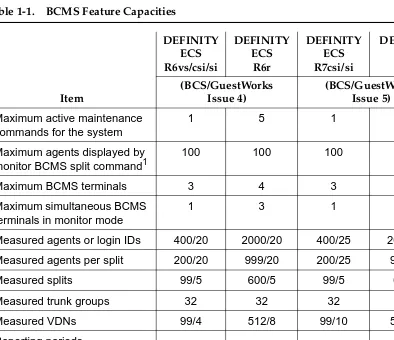
The following tables illustrates the feature capacities for BCMS and ACD based on the different switch types and different offer categories. If the capacity differs between Category A and B, the values in the table are shown as A/B. For example, the BCMS capacity for Measured splits on an R7csi Category A system is 99, but the capacity is only 5 for a Category B system.
Maintenance commands and BCMS monitoring sessions compete for the same access resources: in fact, DEFINITY counts the monitoring session as a maintenance command. So, for example, you cannot execute a maintenance command and run a monitoring session simultaneously on a G3si. (The limit for active maintenance commands is higher on the G3r because this model reserves two command slots for the Initialization and Administraiton System [INADS] and System Access Terminal [SAT] logins.)
Table 1-1. BCMS Feature Capacities
Item DEFINITY ECS R6vs/csi/si DEFINITY ECS R6r DEFINITY ECS R7csi/si DEFINITY ECS R7r (BCS/GuestWorks Issue 4) (BCS/GuestWorks Issue 5)
Maximum active maintenance commands for the system
1 5 1 5
Maximum agents displayed by monitor BCMS split command1
1. The Monitor Split command only displays status for the first 100 agents logged into the split regardless of how many additional agents log into the split.
100 100 100 100
Maximum BCMS terminals 3 4 3 4
Maximum simultaneous BCMS terminals in monitor mode
1 3 1 3
Measured agents or login IDs 400/20 2000/20 400/25 2000/25
Measured agents per split 200/20 999/20 200/25 999/25
Measured splits 99/5 600/5 99/5 600/5
Measured trunk groups 32 32 32 32
Measured VDNs 99/4 512/8 99/10 512/20
Reporting periods
Intervals 25 25 25 25
Table 1-2. ACD Feature Capacities
Interactions
Offer Category A Versus Offer Category B
Offer Category A products (DEFINITY ECS and Prologix™) supports more features and feature capacities than the Offer Category B products (DEFINITY BCS and GuestWorks). In relation to the BCMS feature, the following features are not supported with Offer Category B:
■ Expert Agent Selection (EAS) and skills
■ CentreVu® Call Management System (CMS)
■ VuStats.
When using this BCMS Operations document with an Offer Category B product, you should ignore references to these features.
Item
R6vs/csi/si R6r R7csi/si R7r BCS/GuestWorks Issue 4 BCS/GuestWorks Issue 5
Logged-in ACD agents 150 150 150 150
Logged-in splits per agent 4 4 4 4
Announcements per split 2 2 2 2
Announcements per system 128 256 128 256
Queue slots per group 200 999 200 999
Queue slots per system 1500 15000 1500 15000
Splits 99 600 99 600
ACD members per split 200 999 200 999
Split members per system 150 150 150 150
Interactions With External
CentreVu
CMS
From the administration perspective, the ACD parameters associated with trunk groups, hunt groups, and VDNs are any of the following:
■ Not measured
■ Internally measured by BCMS
■ Externally measured by CentreVu CMS
■ Measured both internally by BCMS and externally by CentreVu CMS.
Note that using BCMS in conjunction with CentreVu CMS increases the maximum number of agents and trunk groups that can be measured for a particular ACD application. In other words, the capacities for BCMS are additive to those of
CentreVu CMS.
NOTE:
If both BCMS and CentreVu CMS are used simultaneously, switch performance may be degraded.
Interactions with VuStats
2
System Access
Logging In and Logging Off
A BCMS terminal is considered to be a remote Management Terminal. You can access BCMS reports either from a Management Terminal (local) or on a dial-up (remote) basis. When dial-up access is used, the following constraints affect the number of terminals that can access BCMS data simultaneously:
■ The number of dial-up (Netcon) channels. (vs/si only)
■ The number of Terminal User IDs (TUIs). A TUI is a switch resource used
by:
— the Lucent Technologies Technical Service Center (TSC) when logged in
— the Management Terminal when powered up
— a remote Management Terminal when logged in
— a BCMS terminal when logged in
— the system printer while printing
— journal/log printer.
When the switch is configured with more than one Management Terminal, you may use one of the following terminal types to access the BCMS feature:
■ 4410
■ 4425
■ 513
■ 610
■ 615
Typically, one terminal is dedicated to the administration and/or maintenance tasks, while the others are used for the ACD/BCMS features.
BCMS Login
The switch provides several different categories of login names. The login name identifies the user and his or her permitted capabilities to the system. Generally, each category permits unique capabilities (and restrictions). You must create a login for each supervisor or other user that you want to view BCMS reports. A BCMS login can allow you to display, print, and schedule BCMS reports.
Logging In
There are two types of terminal configurations for logging into BCMS: a remote and a local. Although both configurations use the same types of terminals, the remote terminal requires a data module for dialing up the system.
!
CAUTION:
If you change your BCMS log-in, all scheduled reports must be rescheduled under the new login in order to run.
Logging In from a Local Terminal
To log into BCMS from a local terminal, perform the following steps:
1. Turn on the terminal (if required) and press BREAK (if no prompt is displayed).
— The screen displays the following prompt:
Login:
2. Enter the appropriate login and press RETURN.
— The screen displays the following prompt:
Password:
3. Enter your password and press RETURN. For security reasons, the
password is not displayed as you type it. The system verifies that the login and password you entered are valid.
— If you entered an invalid login or password, the system displays the following message and prompt:
INCORRECT LOGIN Login:
— If you entered the correct login and associated password, the screen displays the following prompt:
Terminal Type (Enter 513, 715, 4410, 4425, VT220): [513]
Proceed to Step 4.
4. Enter the appropriate terminal type:
■ If you are using a 513 terminal, just press RETURN. 513 (which is displayed in brackets on the screen) is the default.
■ If you are using a 4410 terminal, enter 4410 and press RETURN.
■ If you are using a 4425 terminal, enter 4425 and press RETURN.
■ If you are using a 610 or 615 MT terminal that has a 513 emulation
cartridge, just press RETURN.
■ If you are using a 610 or 615 MT that does not have the 513
emulation cartridge, enter 4410 and press RETURN.
■ If you are using a 715 BCT terminal, enter 715 and press RETURN.
After you enter the appropriate terminal type, the system displays the following prompt:
enter command:
The system is now ready for you to enter a command to generate a BCMS report.
Logging In from a Remote Terminal
To log into BCMS from a remote terminal, perform the following steps:
1. Turn on the terminal and press BREAK (if no prompt is displayed).
— The screen displays the following prompt:
Dial:
2. Enter the hunt group extension number for the Netcon channels and press
RETURN.
— The screen displays the following prompt:
Login:
3. Enter the appropriate login and press RETURN.
— The screen displays the following prompt:
4. Enter your password and press RETURN.
For security reasons, the password is not displayed as you type it. The system verifies that the login and password you entered are valid.
— If you entered an invalid login or password, the system displays the following message and prompt:
INCORRECT LOGIN "Login:
Repeat Steps 3 and 4.
— If you entered the correct login and associated password, the screen displays the following prompt:
Terminal Type (Enter 513, 715, 4410, 4425, VT220): [513]
Proceed to Step 5.
5. Enter the appropriate terminal type:
■ If you are using a 513 terminal, just press RETURN. 513 (which is displayed in brackets on the screen) is the default.
■ If you are using a 4410 terminal, enter 4410 and press RETURN.
■ If you are using a 4425 terminal, enter 4425 and press RETURN.
■ If you are using a 610 or 615 MT terminal that has a 513 emulation
cartridge, just press RETURN.
■ If you are using a 610 or 615 MT that does not have the 513
emulation cartridge, enter 4410 and press RETURN.
■ If you are using a 715 BCT, enter 715 and press RETURN.
After you enter the appropriate terminal type, the system displays the following prompt:
enter command:
The system is now ready for you to enter a command to generate a BCMS report.
Logging Off
Whenever you are not using the terminal, log off the system. To log off the system, perform the following steps:
1. Type logoff.
2. Press RETURN.
How to Change the BCMS Password
Any user can change the password for the login they have been assigned to view BCMS reports. The System Manager (or any user with special privileges) can change the password for other users.
The password should be changed at regular intervals and:
■ Each time a new person takes over a login name
■ If an unauthorized person has discovered the password
Once a password is assigned or changed, keep the following in mind:
■ Do not give the password to anyone
■ Keep the written password in a locked place
To change a password, perform the following steps:
1. At the enter command: prompt, enter change password <login name> and press RETURN.
— The system displays the Password Administration screen (Screen 2-1). The cursor is positioned on the Password of Login Making Change: field.
Screen 2-1. Password Change Screen
2. Enter your current password and press RETURN.
— The cursor is positioned on the Login’s Password: field.
change password bcms Page 1 of 1
LOGIN ADMINISTRATION
Password of Login Making Change:
LOGIN BEING ADMINISTERED
Login’s Name: Login Type: Service Level:
LOGIN’S PASSWORD INFORMATION
Login’s Password: Reenter Login’s Password: Password Aging Cycle Length (Days): 120
LOGOFF NOTIFICATION
3. Enter your new password and press RETURN.
NOTE:
Valid passwords contain four to seven alphabetic or numeric characters, or a combination of alphabetic and numeric characters.
— The cursor is positioned on the Reenter Login’s Password:
field.
4. Re-enter your new password and press ENTER.
— The system displays the following prompt:
3
Generating BCMS Reports
Overview
This chapter describes the procedures for displaying and printing real-time reports and for displaying, printing, and scheduling historical reports. It is assumed that a system printer has been connected and administered before attempting to print these reports.
Displaying and Printing Real-Time
Reports
The monitor command is used to display and print real-time status reports. These reports display data accrued since the last interval boundary. Data is based on hourly or half-hourly intervals as administered in the “BCMS/VuStats
Measurement Interval” field on the Feature-Related System Parameters screen.
There are three monitor commands, one to display or print each real-time report:
■ bcms split
■ bcms system
■ bcms vdn.
Whenever a status report is displayed on the Management Terminal, it updates automatically approximately every 30 seconds. You can immediately update the on-screen status report by pressing UPDATE. To cancel the monitor command and return to the command prompt, press CANCEL. If the status report consists of more than one page, press NEXTPAGE to display any subsequent pages and PREVPAGE
If you incorrectly enter the command, or if the qualifier is not applicable or is not measured, an error message appears on the message line, located on the bottom of the screen. If you require more information about the error message, press
HELP.
Complete the steps in the following sections to display or print real-time reports.
Displaying Real-Time Reports
To display a real-time report, complete the following procedures.
1. Type the monitor command that will display the report you want to view. See Table 3-1.
2. Press RETURN. The report appears on your screen.
3. Press the NEXTPAGE key to display subsequent pages and the PREVPAGE
key to display previous pages if appropriate.
4. To immediately update the report data, press UPDATE.
5. To exit the report, press CANCEL.
:
Printing Real-Time Reports
To print a real-time report, complete the following procedures.
1. Type the monitor command that will print the report. See Table 3-2.
2. Press RETURN. The report prints on the printer that is attached to your terminal.
Table 3-1. Commands for Displaying Real-Time Reports To View the Type Where
Split Status Report monitor bcms split ## ## is an administered split measured by BCMS.
System Status Report monitor bcms system ## ## is an administered split or range of splits measured by BCMS. ## is optional. If not included, the report shows all splits.
Displaying, Printing, and Scheduling
Historical Reports
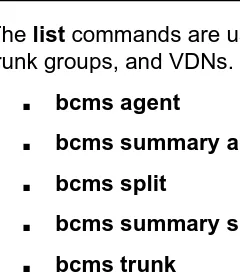
The list commands are used to display historical information for agents, splits, trunk groups, and VDNs. There are eight secondary list commands:
■ bcms agent
■ bcms summary agent
■ bcms split
■ bcms summary split
■ bcms trunk
■ bcms summary trunk
■ bcms vdn
■ bcms summary vdn.
With these commands, you can specify:
■ Whether you want data that is collected during a specified range of dates
or during a specified period of time. Data collected during a specified period of time is based on hourly or half-hourly intervals as administered in the “BCMS/VuStats Measurement Interval” field on the Feature-Related System Parameters screen.
!
CAUTION:
The switch stores time interval data in a time database that holds a maximum of 25 intervals. Data for the 26th interval overwrites the first
Table 3-2. Commands for Printing Real-Time Reports
To View the Type Where
Split Status Report monitor bcms split ## print ## is an administered split measured by BCMS.
System Status Report monitor bcms system ## print
## is an administered split or range of splits measured by BCMS. ## is optional. If not included, the report shows all splits.
interval reports are run while the data for the desired interval is still available in the time database. For example, if you select the half-hour option, print the report twice daily to ensure that you do not lose information.
■ The times or days for which you wish to see data.
■ The system to immediately display the report on your terminal.
■ The system to print the report. If you include print at the end of the
command, the system will immediately print the report to the printer attached to the management terminal. If you include schedule at the end of the command, the system will allow you to schedule the report to print to the system printer immediately (immediate), at a later time (deferred), or routinely at specified times (scheduled).
Complete the steps in the following sections to display, print, or schedule historical reports.
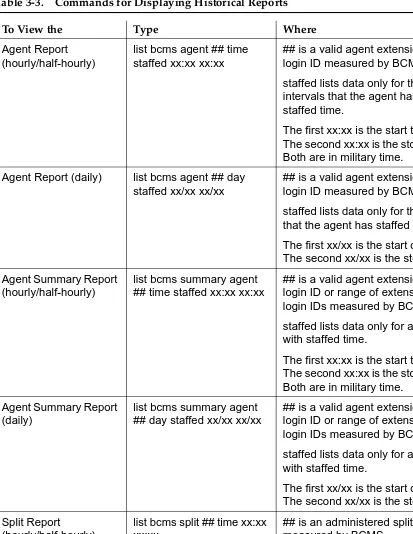
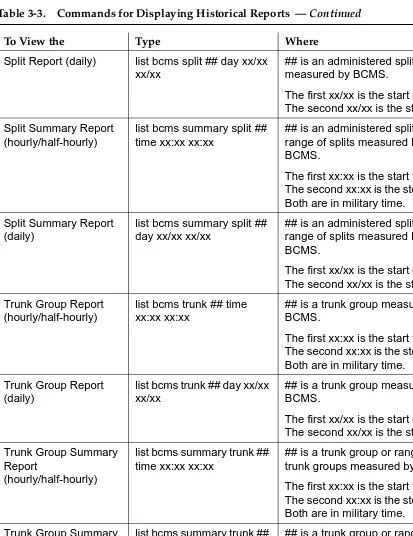
Displaying Historical Reports
To display an historical report, complete the following procedures.
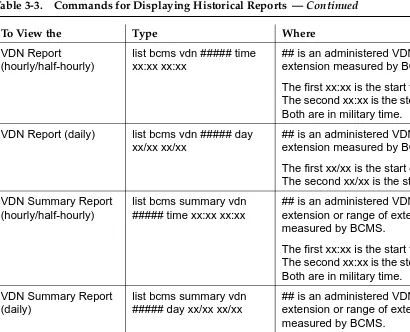
1. Type the list command that will display the report you want to view. See Table 3-3.
2. Press RETURN. The report appears on your screen.
3. Press the NEXTPAGE key to display subsequent pages and the PREVPAGE
Table 3-3. Commands for Displaying Historical Reports To View the Type Where
Agent Report (hourly/half-hourly)
list bcms agent ## time staffed xx:xx xx:xx
## is a valid agent extension or login ID measured by BCMS.
staffed lists data only for the intervals that the agent has staffed time.
The first xx:xx is the start time. The second xx:xx is the stop time. Both are in military time.
Agent Report (daily) list bcms agent ## day staffed xx/xx xx/xx
## is a valid agent extension or login ID measured by BCMS.
staffed lists data only for the days that the agent has staffed time.
The first xx/xx is the start day. The second xx/xx is the stop day.
Agent Summary Report (hourly/half-hourly)
list bcms summary agent ## time staffed xx:xx xx:xx
## is a valid agent extension or login ID or range of extensions/ login IDs measured by BCMS.
staffed lists data only for agents with staffed time.
The first xx:xx is the start time. The second xx:xx is the stop time. Both are in military time.
Agent Summary Report (daily)
list bcms summary agent ## day staffed xx/xx xx/xx
## is a valid agent extension or login ID or range of extensions/ login IDs measured by BCMS.
staffed lists data only for agents with staffed time.
The first xx/xx is the start day. The second xx/xx is the stop day.
Split Report (hourly/half-hourly)
list bcms split ## time xx:xx xx:xx
## is an administered split measured by BCMS.
The first xx:xx is the start time. The second xx:xx is the stop time. Both are in military time.
Split Report (daily) list bcms split ## day xx/xx xx/xx
## is an administered split measured by BCMS.
The first xx/xx is the start day. The second xx/xx is the stop day.
Split Summary Report (hourly/half-hourly)
list bcms summary split ## time xx:xx xx:xx
## is an administered split or range of splits measured by BCMS.
The first xx:xx is the start time. The second xx:xx is the stop time. Both are in military time.
Split Summary Report (daily)
list bcms summary split ## day xx/xx xx/xx
## is an administered split or range of splits measured by BCMS.
The first xx/xx is the start day. The second xx/xx is the stop day.
Trunk Group Report (hourly/half-hourly)
list bcms trunk ## time xx:xx xx:xx
## is a trunk group measured by BCMS.
The first xx:xx is the start time. The second xx:xx is the stop time. Both are in military time.
Trunk Group Report (daily)
list bcms trunk ## day xx/xx xx/xx
## is a trunk group measured by BCMS.
The first xx/xx is the start day. The second xx/xx is the stop day.
Trunk Group Summary Report
(hourly/half-hourly)
list bcms summary trunk ## time xx:xx xx:xx
## is a trunk group or range of trunk groups measured by BCMS.
The first xx:xx is the start time. The second xx:xx is the stop time. Both are in military time.
Trunk Group Summary Report (daily)
list bcms summary trunk ## day xx/xx xx/xx
## is a trunk group or range of trunk groups measured by BCMS.
The first xx/xx is the start day. The second xx/xx is the stop day.
Table 3-3. Commands for Displaying Historical Reports — Continued
To View the Type Where
VDN Report (hourly/half-hourly)
list bcms vdn ##### time xx:xx xx:xx
## is an administered VDN extension measured by BCMS.
The first xx:xx is the start time. The second xx:xx is the stop time. Both are in military time.
VDN Report (daily) list bcms vdn ##### day xx/xx xx/xx
## is an administered VDN extension measured by BCMS.
The first xx/xx is the start day. The second xx/xx is the stop day.
VDN Summary Report (hourly/half-hourly)
list bcms summary vdn ##### time xx:xx xx:xx
## is an administered VDN extension or range of extensions measured by BCMS.
The first xx:xx is the start time. The second xx:xx is the stop time. Both are in military time.
VDN Summary Report (daily)
list bcms summary vdn ##### day xx/xx xx/xx
## is an administered VDN extension or range of extensions measured by BCMS.
The first xx/xx is the start day. The second xx/xx is the stop day.
Table 3-3. Commands for Displaying Historical Reports — Continued
To View the Type Where
Printing Historical Reports
If you do not have a printer directly connected to your terminal, see ‘‘Scheduling Historical Reports’’ on page 3-11.
To print an historical report, complete the following procedures.
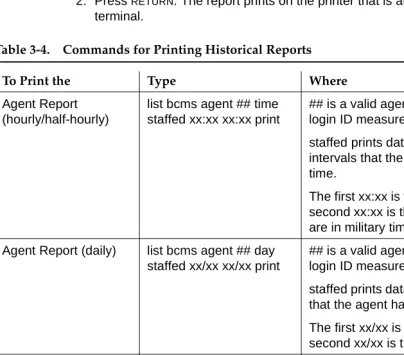
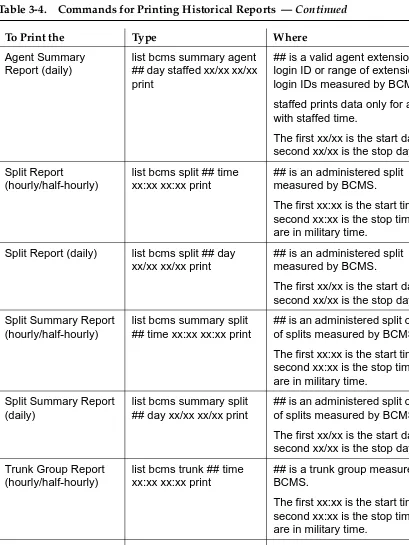
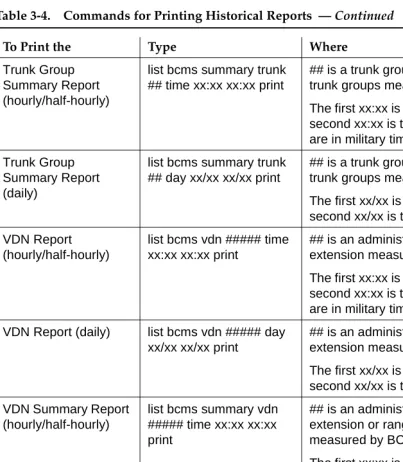
1. Type the list command for the report that you want to print. See Table 3-4.
2. Press RETURN. The report prints on the printer that is attached to your terminal.
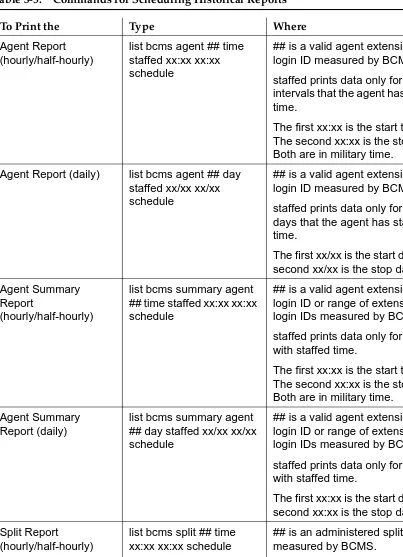
Table 3-4. Commands for Printing Historical Reports To Print the Type Where
Agent Report (hourly/half-hourly)
list bcms agent ## time staffed xx:xx xx:xx print
## is a valid agent extension or login ID measured by BCMS.
staffed prints data only for the intervals that the agent has staffed time.
The first xx:xx is the start time. The second xx:xx is the stop time. Both are in military time.
Agent Report (daily) list bcms agent ## day staffed xx/xx xx/xx print
## is a valid agent extension or login ID measured by BCMS.
staffed prints data only for the days that the agent has staffed time.
The first xx/xx is the start day. The second xx/xx is the stop day.
Agent Summary Report
(hourly/half-hourly)
list bcms summary agent ## time staffed xx:xx xx:xx print
## is a valid agent extension or login ID or range of extensions/ login IDs measured by BCMS.
staffed prints data only for agents with staffed time.
The first xx:xx is the start time. The second xx:xx is the stop time. Both are in military time.
Agent Summary Report (daily)
list bcms summary agent ## day staffed xx/xx xx/xx print
## is a valid agent extension or login ID or range of extensions/ login IDs measured by BCMS.
staffed prints data only for agents with staffed time.
The first xx/xx is the start day. The second xx/xx is the stop day.
Split Report (hourly/half-hourly)
list bcms split ## time xx:xx xx:xx print
## is an administered split measured by BCMS.
The first xx:xx is the start time. The second xx:xx is the stop time. Both are in military time.
Split Report (daily) list bcms split ## day xx/xx xx/xx print
## is an administered split measured by BCMS.
The first xx/xx is the start day. The second xx/xx is the stop day.
Split Summary Report (hourly/half-hourly)
list bcms summary split ## time xx:xx xx:xx print
## is an administered split or range of splits measured by BCMS.
The first xx:xx is the start time. The second xx:xx is the stop time. Both are in military time.
Split Summary Report (daily)
list bcms summary split ## day xx/xx xx/xx print
## is an administered split or range of splits measured by BCMS.
The first xx/xx is the start day. The second xx/xx is the stop day.
Trunk Group Report (hourly/half-hourly)
list bcms trunk ## time xx:xx xx:xx print
## is a trunk group measured by BCMS.
The first xx:xx is the start time. The second xx:xx is the stop time. Both are in military time.
Trunk Group Report (daily)
list bcms trunk ## day xx/xx xx/xx print
## is a trunk group measured by BCMS.
The first xx/xx is the start day. The second xx/xx is the stop day.
Table 3-4. Commands for Printing Historical Reports — Continued
Trunk Group Summary Report (hourly/half-hourly)
list bcms summary trunk ## time xx:xx xx:xx print
## is a trunk group or range of trunk groups measured by BCMS.
The first xx:xx is the start time. The second xx:xx is the stop time. Both are in military time.
Trunk Group Summary Report (daily)
list bcms summary trunk ## day xx/xx xx/xx print
## is a trunk group or range of trunk groups measured by BCMS.
The first xx/xx is the start day. The second xx/xx is the stop day.
VDN Report (hourly/half-hourly)
list bcms vdn ##### time xx:xx xx:xx print
## is an administered VDN extension measured by BCMS.
The first xx:xx is the start time. The second xx:xx is the stop time. Both are in military time.
VDN Report (daily) list bcms vdn ##### day xx/xx xx/xx print
## is an administered VDN extension measured by BCMS.
The first xx/xx is the start day. The second xx/xx is the stop day.
VDN Summary Report (hourly/half-hourly)
list bcms summary vdn ##### time xx:xx xx:xx print
## is an administered VDN extension or range of extensions measured by BCMS.
The first xx:xx is the start time. The second xx:xx is the stop time. Both are in military time.
VDN Summary Report (daily)
list bcms summary vdn ##### day xx/xx xx/xx print
## is an administered VDN extension or range of extensions measured by BCMS.
The first xx/xx is the start day. The second xx/xx is the stop day.
Table 3-4. Commands for Printing Historical Reports — Continued
To Print the Type Where
Scheduling Historical Reports
The Report Scheduler allows you to schedule the day or days for the system to print the report. If you do not have a printer directly connected to your terminal, you can use the Report Scheduler feature to print the report immediately to the system printer. For more detailed information about the Report Scheduler, see Chapter 5, ‘‘System Printer and Report Scheduler’’.
To schedule an historical report, complete the following procedures.
1. Type the list command that will schedule the report. See Table 3-5.
2. Press RETURN.
— The Report Scheduler form appears on your screen. The cursor is located in the Print Interval: field.
Screen 3-1. Report Scheduler Form
NOTE:
If you do not have a printer directly connected to your terminal, you can immediately print the report to the system printer by pressing
ENTER.
3. Enter schedule and press RETURN.
— The Print Time: field appears beneath the Print
Interval: field, and fields for each day of the week appear at the bottom of the form. The cursor is located in the Print Time:
field.
list bcms agent ## time xx:xx xx:xx
Page 1 REPORT SCHEDULER
Date: 11:00 pm MON APR 23, 1990 Job Id: 1 Job Status: none
Screen 3-2. Report Scheduler Form with the Print Interval Set to scheduled
4. Enter the time you want the report printed and press RETURN.
— The cursor moves to the Sun: field.
5. Enter y for the day(s) you want the report printed. Use RETURN to move the cursor to the next field.
6. When you are finished, press ENTER.
— The report has been scheduled, and the system presents the enter command: prompt.
!
CAUTION:
If you change your BCMS log-in, all scheduled reports must be rescheduled under the new login in order to run.
NOTE:
The commands for scheduling historical reports also can be used to defer printing of a report to a later time. See ‘‘Report Scheduler’’ on page 5-3 for more information.
list bcms agent ## time xx:xx xx:xx Page 1
REPORT SCHEDULER
Date: 11:00 pm MON APR 23, 1990
Job Id: 1 Job Status: none Command: list bcms agent ## time xx:xx xx:xx Print Interval: scheduled
Print Time: xx:xx
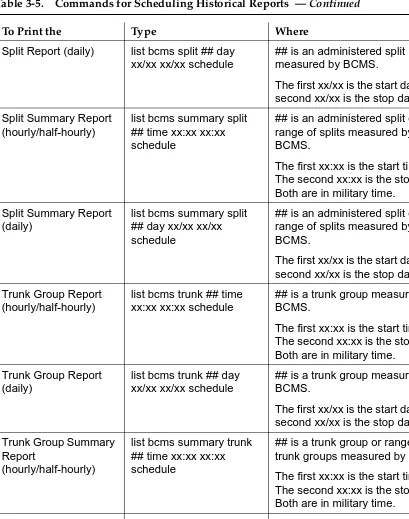
Table 3-5. Commands for Scheduling Historical Reports To Print the Type Where
Agent Report (hourly/half-hourly)
list bcms agent ## time staffed xx:xx xx:xx schedule
## is a valid agent extension or login ID measured by BCMS.
staffed prints data only for the intervals that the agent has staffed time.
The first xx:xx is the start time. The second xx:xx is the stop time. Both are in military time.
Agent Report (daily) list bcms agent ## day staffed xx/xx xx/xx schedule
## is a valid agent extension or login ID measured by BCMS.
staffed prints data only for the days that the agent has staffed time.
The first xx/xx is the start day. The second xx/xx is the stop day.
Agent Summary Report
(hourly/half-hourly)
list bcms summary agent ## time staffed xx:xx xx:xx schedule
## is a valid agent extension or login ID or range of extensions/ login IDs measured by BCMS.
staffed prints data only for agents with staffed time.
The first xx:xx is the start time. The second xx:xx is the stop time. Both are in military time.
Agent Summary Report (daily)
list bcms summary agent ## day staffed xx/xx xx/xx schedule
## is a valid agent extension or login ID or range of extensions/ login IDs measured by BCMS.
staffed prints data only for agents with staffed time.
The first xx:xx is the start day. The second xx:xx is the stop day.
Split Report (hourly/half-hourly)
list bcms split ## time xx:xx xx:xx schedule
## is an administered split measured by BCMS.
Split Report (daily) list bcms split ## day xx/xx xx/xx schedule
## is an administered split measured by BCMS.
The first xx/xx is the start day. The second xx/xx is the stop day.
Split Summary Report (hourly/half-hourly)
list bcms summary split ## time xx:xx xx:xx schedule
## is an administered split or range of splits measured by BCMS.
The first xx:xx is the start time. The second xx:xx is the stop time. Both are in military time.
Split Summary Report (daily)
list bcms summary split ## day xx/xx xx/xx schedule
## is an administered split or range of splits measured by BCMS.
The first xx/xx is the start day. The second xx/xx is the stop day.
Trunk Group Report (hourly/half-hourly)
list bcms trunk ## time xx:xx xx:xx schedule
## is a trunk group measured by BCMS.
The first xx:xx is the start time. The second xx:xx is the stop time. Both are in military time.
Trunk Group Report (daily)
list bcms trunk ## day xx/xx xx/xx schedule
## is a trunk group measured by BCMS.
The first xx/xx is the start day. The second xx/xx is the stop day.
Trunk Group Summary Report
(hourly/half-hourly)
list bcms summary trunk ## time xx:xx xx:xx schedule
## is a trunk group or range of trunk groups measured by BCMS.
The first xx:xx is the start time. The second xx:xx is the stop time. Both are in military time.
Trunk Group Summary Report (daily)
list bcms summary trunk ## day xx/xx xx/xx schedule
## is a trunk group or range of trunk groups measured by BCMS.
The first xx/xx is the start day. The second xx/xx is the stop day.
Table 3-5. Commands for Scheduling Historical Reports — Continued
To Print the Type Where
VDN Report (hourly/half-hourly)
list bcms vdn ##### time xx:xx xx:xx schedule
## is an administered VDN extension measured by BCMS.
The first xx:xx is the start time. The second xx:xx is the stop time. Both are in military time.
VDN Report (daily) list bcms vdn ##### day xx/xx xx/xx schedule
## is an administered VDN extension measured by BCMS.
The first xx/xx is the start day. The second xx/xx is the stop day.
VDN Summary Report (hourly/half-hourly)
list bcms summary vdn ##### time xx:xx xx:xx schedule
## is an administered VDN extension or range of extensions measured by BCMS.
The first xx:xx is the start time. The second xx:xx is the stop time. Both are in military time.
VDN Summary Report (daily)
list bcms summary vdn ##### day xx/xx xx/xx schedule
## is an administered VDN extension or range of extensions measured by BCMS.
The first xx/xx is the start day. The second xx/xx is the stop day.
Table 3-5. Commands for Scheduling Historical Reports — Continued
To Print the Type Where
4
BCMS Report Reference
Overview
Table 4-1 is a quick reference to the commands that you can use to display, print, and schedule BCMS reports. See Chapter 3, ‘‘Generating BCMS Reports’’ for more detailed instructions for displaying, printing, and scheduling reports.
The remainder of this chapter describes each report in detail, providing a brief description of each report, sample reports, and a description of the information contained in each report.
NOTE:
.
Table 4-1. BCMS Administration Commands
BCMS Administration Commands1
1. Items depicted within brackets, such as [print], are optional.
Action Object Qualifiers
monitor bcms split split number [print]
bcms system [split number]2 [print]
2. Whenever the command line qualifier [schedule] is initially executed, the system defaults the report for immediate printing (unless a day/time of day is scheduled) and generates a Job Id. The Job Id is required by the Report Scheduler feature for updating and deleting the schedule of reports.
bcms vdn extension2 [print]
list bcms agent ext.|loginID3 [time] [staffed] [start time] [stop time] [print|schedule]2
3. If “BCMS/VuStats Login IDs” is enabled on the System-Parameters Customer-Options form, then you must enter an agent’s login ID or a range of login IDs in place of the physical extension or range of extensions. (VuStats is not supported with DEFINITY BCS and GuestWorks; however, BCMS Login IDs are supported.)
bcms agent ext.|loginID3 [day] [staffed] [start day] [stop day] [print|schedule]
bcms summary agent ext.|loginID23 [time] [staffed] [start time] [stop time] [print|schedule]
bcms summary agent ext.|loginID23 [day] [staffed] [start day] [stop day] [print|schedule]
bcms split split number [time] [start time] [stop time] [print|schedule]
bcms split split number [day] [start day] [stop day] [print|schedule]
bcms summary split split number2 [time] [start time] [stop time] [print|schedule]
bcms summary split split number2 [day] [start day] [stop day] [print|schedule]
bcms trunk group number [time] [start time] [stop time] [print|schedule]
bcms trunk group number [day] [start day] [stop day] [print|schedule]
bcms summary trunk group number2 [time] [start time] [stop time] [print|schedule]
bcms summary trunk group number2 [day] [start day] [stop day] [print|schedule]
bcms vdn extension [time] [start time] [stop time] [print|schedule]
bcms vdn extension [day] [start day] [stop day] [print|schedule]
bcms summary vdn extension2 [time] [start time] [stop time] [print|schedule]
Real-Time Reports
BCMS provides three real-time reports:
■ BCMS Split Status
■ BCMS System Status
■ BCMS VDN Status.
The BCMS Split Status report provides the current (real-time) status and
cumulative measurement data for those agents assigned to the split you specify. The BCMS System Status report provides current (real-time) status information for either all BCMS splits or selected splits. The BCMS VDN Status report provides the current (real-time) status and cumulative measurement data for VDNs monitored by BCMS.
BCMS Split Status Report
Command
Use the following command to generate the BCMS Split Status report:
monitor bcms split (split number) [print]
Description
The BCMS Split Status report provides the current (real-time) status and
Sample Report
Screen 4-1. BCMS Split Status Report Screen
*
An asterisk precedes the Calls Waiting field if any of the calls are Direct Agent calls.& The LOGIN ID column is empty if the BCMS login system parameter is set to no.
$ If name is not administered, this column is blank for the agent.
Split is displayed as “Skill” when EAS is optioned (EAS and skills are not supported with DEFINITY BCS and GuestWorks).
monitor bcms split 30
BCMS SPLIT (AGENT) STATUS
Split: 30 Date: 12:13 pm MON MAY 15, 1995 Split Name: headquarters
Calls Waiting: 5 Acceptable Service Level: xxx Oldest Call: 1:39 % Within Service Level: xxx Staffed: 7 Avail: 1 ACD: 1 ACW: 2 AUX: 2 Extn Calls: 2 Other: 1
Header Definition
Table 4-2. Split Status Report Header Definitions Header Definition
Split The split number specified with the command line.
Split Name The administered name of the split. This name usually describes the purpose or service of the split (for example, sales, service, or help line). If no name exists, BCMS displays the split extension (for example,
EXT 65222).
The split name is limited to a maximum of 11 characters. If you enter more than 11 characters, the additional characters are not printed on the System Printer.
Calls Waiting The number of calls currently queued and calls ringing at an agent’s phone. If any of the calls in the queue are Direct Agent calls, an asterisk appears before the value in this field.
Oldest Call The number of minutes and seconds that the oldest call in queue has been waiting to be answered. This includes calls ringing at an agent’s phone.
Acceptable Service Level
The desired time for an agent to answer a call for a given hunt group or VDN. Timing for a call begins when the call enters the hunt group queue.
% Within Service Level
The percentage of calls answered within the administered service level. This field is blank if no calls have been recorded for this time interval or if there is no Acceptable Service Level administered on the Hunt Group form.
NOTE:
Not available with DEFINTY BCS and Guestworks.
Staffed The number of agents currently logged into the split. Staffed equals available agents, agents on ACD calls and agents in ACW, AUX, and Other.
Avail The number of agents in this split currently available to receive an ACD call. In order to be counted as being available, agents must either be in the Auto-In (AI) or Manual-In (MI) work mode. Refer to the Glossary for a description of work modes. If the agent is on another split’s call or is performing After Call Work for another split, the agent is not considered available and is not recorded here. If a call is ringing at the agent’s phone or a call is on hold, the agent is not considered available unless Multiple Call Handling is active and the agent selects AI/MI with a call on hold.
ACD The number of agents who are currently on an ACD call for this split. This value also includes Direct Agent calls and those agents who are currently on ACD calls that flowed in from another split.
ACW The number of agents in this split who are currently in ACW mode for this split. Refer to the Glossary for a description of After Call Work (ACW) mode. If an agent is in ACW mode for another split, the agent is included in the Other state count for this split. ACW includes agents who are on extension-in and extension-out calls while in ACW.
AUX The number of agents in this split who are currently in the AUX work mode for this split. If an agent is answering a call from another split or is in ACW work mode for another split, that agent is not considered in AUX work mode for this split and is not included in this number. The agent is included in the Other state count. AUX includes agents who are on extension-in and extension-out calls while in AUX, Auto-In and Manual-In.
Extn The number of agents in this split who are currently on non-ACD calls. These non-ACD calls may be either incoming (direct to the extension) or outgoing (direct from the extension). Those agents receiving or making extension calls while available, or while in the ACW or AUX work mode are recorded as being on extension calls.
Other The number of agents in this split who:
■ Are on a call from another split
■ Are in ACW work mode for another split
■ Have placed a call on HOLD and made no other state selections
■ Have a call ringing at their telephones
■ Are dialing a number (to place a call or activate a feature)
All of the agents in the Other state are unavailable for ACD calls.
AGENT NAME The name of the agent. Generally, this is the agent’s first or last name. However, if no name is administered on the station form, this field is left blank. When the field is blank, the data can be identified by the extension.
LOGIN ID The BCMS login ID(s) (taken from the BCMS/VuStatus Login ID form or EAS Login form) for which you requested the report. This column is empty if BCMS logins are not optioned. (VuStats are not supported on DEFINITY BCS and GuestWorks: however, BCMS Login IDs are supported.)
EXT The 1-, 2-, 3-, 4-, or 5-digit extension number for the agent.
Table 4-2. Split Status Report Header Definitions — Continued
Header Definition
STATE The current work state for the agent. Possible work states are Avail, ACD, ACW, AUX, Extn, and Other. Unstaffed agents do not appear on the report. When the system time is changed, agents are in the INIT state. Each agent remains in the INIT state until he or she takes a call or pushes a work mode button.
TIME The 24-hour clock time at which the agent entered this work state.
ACD CALLS The number of ACD calls that the agent has completed since the beginning of the current interval. This value includes any calls that flowed in from other splits. (Calls in process are not counted until they are completed.)
EXT IN CALLS The number of non-ACD calls that the agent has received (incoming) since the beginning of the current interval. (Calls in process are not counted until they are completed.) The maximum value is 255.
If an extension-in call is active for less than the time set for the Abandon Call Timer, the call will not be counted in this field. The duration of such calls is counted as AUX/OTHER time.
EXT OUT CALLS
The number of non-ACD calls that the agent has made (outgoing) since the beginning of the current interval. (Calls in process are not counted until they are completed.) The maximum value is 255.
Table 4-2. Split Status Report Header Definitions — Continued
Header Definition
BCMS System Status Report
Command
Use the following command to generate the BCMS System Status report:
monitor bcms system [split number] [print]
Description
The BCMS System Status report provides current (real-time) status information for either all BCMS splits or selected BCMS splits. This report displays data accrued since the last interval boundary. For example, if the interval is set to hour, and you issue the command to display the BCMS System Status report at 11:10 a.m., the report displays the data accrued since 11:00 a.m. Although this report is updated approximately every 30 seconds, you can immediately update the information on the screen by pressing UPDATE. This report is reset at the beginning of the time interval (for example, hour or half-hour).
NOTE:
When analyzing this report, keep the following things in mind:
■ All averages are for completed calls only.
■ A completed call may span more than one time interval. ACD calls that are
in process (have not terminated) are counted in the time interval in which they terminate. For example, if an ACD call begins in the 10:00 to 11:00 time interval, but terminates in the 11:00 to 12:00 time interval, the data for this call is counted in the 11:00 to 12:00 time interval.
■ Asterisks indicate that the maximum for the associated field has been
Sample Report
Screen 4-2. BCMS System Status Report Screen
Header Definitions
& Split name is not administered — default is EXT xxxx, where xxxx is the extension administered for the split.
Split is displayed as “Skill” when EAS is optioned (EAS and skills are not supported with DEFINITY BCS and GuestWorks).
Table 4-3. System Status Report Header Definitions Header Definition
SPLIT NAME The name of the split (for example, sales, service, or help line). If no name exists, the split extension (for example, EXT 12345) is
displayed.
CALLS WAIT The number of calls in the split’s queue that are currently waiting to be answered and calls ringing at an agent’s phone. If any of the calls in the queue are Direct Agent calls, an asterisk appears before this field. Consult the Glossary for a description of the Direct Agent feature.
OLDEST CALL The number of minutes and seconds the oldest call in queue has been waiting to be answered. This includes calls ringing at an agent’s phone.
Continued on next page
monitor bcms system
BCMS SYSTEM STATUS
AVG SPEED ANS
The average amount of time it takes before the calls are answered by agents. This value includes time waiting in the queue and time ringing at the agent’s telephone. The calculation is:
Keep the following things in mind:
■ Calls that flow in from other split(s) do not include time in queue
from the other splits in this calculation. Also, the AVG SPEED ANS does not include time spent listening to a forced first announcement.
■ A completed call may span more than one time period. ACD
calls that are in process (have not terminated) are counted in the time period in which they terminate. For example, if an ACD call begins in the 10:00 to 11:00 time period, but terminates in the 11:00 to 12:00 time period, the data for this call is counted in the 11:00 to 12:00 time period.
■ Asterisks indicate that the maximum for the associated field has
been exceeded.
AVAIL AGENT The number of agents in this split who are currently available to receive an ACD call directed to this split.
ABAND CALLS The total number of ACD calls that have hung up while waiting to be answered. This includes those calls that have abandoned while in queue or while ringing. Calls that are not queued (for example, because the queue is full, the caller receives a forced first
announcement and abandons during the announcement, or no agents are staffed) are not counted as abandoned for the hunt group.
AVG ABAND TIME
The average time before an ACD call abandons. This does not include any time spent in another split’s queue before intraflowing to this split. The calculation is:
This value does not include time spent listening to a forced first announcement or calls that abandon while listening to a forced first announcement.
Table 4-3. System Status Report Header Definitions — Continued
Header Definition
Continued on next page AVG SPEED ANS =
Sum of Each Completed Call’s Time In Queue + Time Ringing Total Number of ACD Calls Answered
ACD CALLS The number of ACD calls completed during the current interval. This number also includes those calls that flow in from other splits.
AVG TALK TIME
The average duration of ACD calls for each split. This calculation includes the time each agent spent talking but does not include ring time at an agent’s telephone. The calculation is:
AVG AFTER CALL
The average ACW time for call-related ACW time completed by agents in this split during this time interval. Call-related ACW is the time that occurs immediately after an ACD call (that is, when an agent was in Manual mode and an ACD call ended, or when the agent presses the ACW button during an ACD call). AVG AFTER CALL does not include time spent on direct incoming or outgoing calls while in ACW or time that immediately follows an EXTN call. The calculation is:
The average is for ACW sessions, which may not correspond to the number of ACD calls either because some ACD calls did not have ACW time or because the call was recorded in another interval.
% IN SERV LEVL
The percentage of calls answered within the administered service level for this split. Calculation is based on the following
where
accepted is calls answered whose queue time was less than or equal to the administered service level for the split.
dequeued is a call that encountered the split’s queue, but which was NOT answered, abandoned, or outflowed. This occurs with multiple split queuing.
NOTE:
Not available with DEFINTY BCS and Guestworks.
Table 4-3. System Status Report Header Definitions — Continued
Header Definition
Continued on next page AVG TALK TIME Total ACD Talk Time
Total Number of ACD Calls Answered ---=
AVG AFTER CALL Total Call-Related ACW Time Number of Call-Related ACW