Image Quality Assessment by Dual Tree
Complex Wavelet Transform In Fractal
Dimension
P.Sabareeswari1,. Dr,T.Menakadevi 2
PG Scholar, Department of ECE, Adhiyamaan College of Engineering, Hosur, Tamilnadu, India1
Asst. Professor, Department of ECE, Adhiyamaan College of Engineering, Hosur, Tamilnadu, India2
ABSTRACT: Reduced-reference image quality assessment (RRIQA) provides a practical solution for automatic image quality evaluations in various applications where only partial information about the original reference image is accessible. In this paper, multifractal analysis is personalized to reduced-reference image quality assessment (RR-IQA). A novel RR-QA approach is proposed, which measures the difference of spatial arrangement between the reference image and the distorted image in terms of spatial regularity measured by fractal dimension. An image is first expressed in wavelet domain using duel tree complex wavelet transform. Then, fractal dimensions are computed on each wavelet subband and concatenated as a feature vector. Finally, the extracted features are pooled as the quality score of the distorted image using ℓ1 distance. Compared with existing approaches, the proposed method measures image quality from the perspective of the spatial distribution of image patterns. The proposed method was evaluated on seven public benchmark data sets. Experimental results have demonstrated the excellent performance of the proposed method in comparison with state-of-the-art approaches.
KEYWORDS: RR-IQA , multifractal, spatial arrangement , wavelet, subband,DTCWT
I. INTRODUCTION
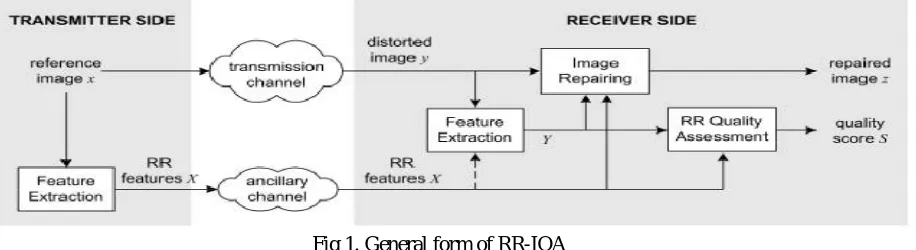
Reduced-reference (RR) image quality metrics provide a solution that lies between FR and NR models. They are designed to predict the perceptual quality of distorted images with only partial information about the reference images. Recently, the video quality experts group has included RR image/video quality assessment as one of its directions for future development. RR methods are useful in a number of applications. For example, in real-time visual communication systems, they can be used to track image quality degradations and control the streaming resources. The system includes a feature extraction process at the sender side and a feature extraction/quality analysis process at the receiver side. The extracted RR features usually have a much lower data rate than the image data and are typically transmitted to the receiver through an ancillary channel. Although it is often assumed that the ancillary channel is error-free, this is not an absolutely necessary requirement since even partly decoded RR features may still be helpful in evaluating the quality of the distorted image, though the accuracy may be severely affected.
Fig 1. General form of RR-IQA
The basic assumption behind natural image statistics-based approaches is that most real-world image distortions disturb image statistics and make the distorted image “unnatural”. The unnaturalness measured based on models of natural image statistics can then be used to quantify image quality degradation. In particular, here we observe that the marginal distribution of the wavelet coefficients within a given subband changes in different ways for different types of image distortions. We then use an information distance measure between probability distributions to quantify such changes and examine if this provides a useful quality measurement of images through comparisons with subjective image quality evaluations. Since no specific distortion model is assumed, the proposed method is potentially useful for a wide range of distortion types..
components of the signal are suppressed and approximate shift invariance is achieved. The DWT suffers from the following two problems.
Lack of shift invariance - this results from the down sampling operation at each level.When the input signal is shifted slightly, the amplitude of the wavelet coefficients variesso much.
Lack of directional selectivity - as the DWT filters are real and separable the DWT cannotdistinguish between the opposing diagonal directions.
These problems hinder the use of wavelets in other areas of image processing. The first problemcan be avoided if the filter outputs from each level are not down sampled but this increases thecomputational costs significantly and the resulting undecimated wavelet transform still cannotdistinguish between opposing diagonals since the transform is still separable. To distinguishopposing diagonals with separable filters the filter frequency responses are required to beasymmetric for positive and negative frequencies. A good way to achieve this is to use complexwavelet filters which can be made to suppress negative frequency components. The CDWT hasimproved shift-invariance and directional selectivity than the separable DWT.
II.PRELIMINARIES
Before presenting the detailed description of our approach,we first give an introduction to the two mathematical toolsupon which our approach is built.
1. DUAL TREE COMPLEX WAVELET TRANFORM :
The transform is 2-times expansive because for an N-point signal it gives 2N DWT coefficients. If the filters in the upper and lower DWTs are the same, then no advantage is gained. However, if the filters are designed is a specific way, then the subband signals of the upper DWT can be interpreted as the real part of a complex wavelet transform, and subband signals of the lower DWT can be interpreted as the imaginary part. Equivalently, for specially designed sets of filters, the wavelet associated with the upper DWT can be an approximate Hilbert transform of the wavelet associated with the lower DWT. When designed in this way, the dual-tree complex DWT is nearly shift-invariant, in contrast with the critically-sampled DWT. Moreover, the dual-tree complex DWT can be used to implement 2D wavelet transforms where each wavelet is oriented, which is especially useful for image processing. (For the separable 2D DWT, recall that one of the three wavelets does not have a dominant orientation.) The dual-tree complex DWT outperforms the critically-sampled DWT for applications like image denoising and enhancement.
II. LOG GABOR REPRESENTATION
The Log-Gabor filters defined in frequency domain are as Follows
where(ρ, θ) are the polar coordinates in frequency domain,(ρ0, θ0) and (σρ, σθ ) denote the shift and the bandwidthrespectively in the polar coordinates of frequency domain.The term σρ/ρ0 should be held constant to obtain filterswith constant shape ratios and its value determines the filterbandwidth. In our implementation, the parameters for generatingthe Log-Gabor filters are set as: ρ0 = 1/5, θ0 = 0,σρ/ρ0 = 0.75, and σθ= 0.6. An example of a 2D Log-Gaborfilter in the frequency domain.
III. FRACTAL ANALYSIS
Fractal analysis first developed by Mandelbrot provides a powerful mathematical framework to study the irregular, complex and similar objects in nature. Fractalscan be viewed as the objects with statistical self-similarities.Most of the intensity surfaces of natural images can bemodeled by isotropic fractals. One fundamental conceptin fractal analysis is the so-called fractal dimension, denotedby d, which summarizes the irregularity and statisticalself-similarity of a given point set E in some measurementspace m(·) by measuring its power-law behavior according tothe scale δ:
.
IV. PROPOSED METHOD
A general framework for the use of RR-IQA in visual communications. An image x is transmitted to the receiver via a transmission channel, which introduces distortions in the received image y. Meanwhile, RR features X extracted at the transmitter side are sent to the receiver through an ancillary channel. The feature extraction unit at the receiver side calculates the features Y from the received image y in a similar fashion as in the transmitter side. X and Y are compared at the quality assessment unit, which creates a quality score S of the distorted image y. A good RR-IQA approach should achieve a good trade-off between rate and accuracy. In general, the larger the rate of the RR features, the more accurate the RR-IQA measure.
Our proposed method is to extract the feature of the image using the duel tree complex wavelet transform (DTCWT). The Dual-tree complex wavelet transform (DTCWT) calculates the complex transform of a signal using two separate DWT decompositions (tree a and tree b). It also provides approximate shift-invariance (unlike the DWT) yet still allows perfect reconstruction of the signal.The design of the filters is particularly important for the transform to occur correctly and the necessary characteristics are:
The low-pass filters in the two trees must differ by half a sample period
Reconstruction filters are the reverse of analysis
All filters from the same orthonormal set
Tree a filters are the reverse of tree b filters
Block diagram
2D DT-CWT
The 2D DT-CWT also more selectively discriminates features of various orientations. Whereas the critically decimated 2D DWT outputs three orientation selective sub-bands per level conveying image features oriented at the angles of 90o , ± 45o , and 0o , the 2D DT-CWT produces six directional sub bands per level to reveal the details of an image in ±15o ,± 45o and ± 75o directions with 4:1 redundancy.
The six wavelets defined by oriented shown above have the sum/difference operation is orthonormal, which constitutes a perfect reconstruction wavelet transform. The imaginary part of 2D DT-CWT has similar basis function as the real part [8]. The 2D DT-CWT structure has an extension of conjugate filtering in 2D case. The filter bank structure of 2D dual-tree is shown in figure
IV .EXPERIMENTAL RESULTS
In order to simulate the perception of human to image viathe V1 cortex of primates, the Log-Gabor filters {H(ρ, θ)}ρ,θare run on the feature image M to localize the image structuresof different orientations and frequencies. This procedureresults in multiple response images {Gρ,θ}ρ,θfrom the feature
image:
whereF(·, H) denotes filtering with the Log-Gabor filter H.By using Log-Gabor filtering, we convert the extracted imagefeatures from image space into visual perceptive space. Then,parallel to characterizing the spatial distribution of the visualresponses in the V1 area of HVS, we extract features from theLog-Gabor response images via fractal analysis.
a. Image with distortion b. Restored image
a. Image with poor contrast b. Image enhancement by contrast stretching
Log gabor:
Thus by the fractal analysis , it is give as in SSRM curves with the respective distortions ,
V.CONCLUSION AND FUTURE ENHANCEMENT
Conclusion:
In this paper, the design of RR objective perceptual image quality metrics for wireless imaging has been presented. Instead of focusing only on artifacts due to source encoding, the design follows an end-to-end quality approach that accounts for the complex nature of artifacts that may be induced by a wireless communication system. Image quality assessment can assist several image-related tasks including image processing and image recognition. However, image quality assessment is a challenging task, especially when only part information of the reference image is known. We extracted the low level feature and use duel tree complex wavelet transform for decomposition of the image. This extracts the spatial frequency components of the imageIn future the spectrum of spatial regularity can be obtained by various decomposition methods are used and their performance is analysed.
REFERENCES
[1] Yong Xu, Delei Liu, YuhuiQuan, and Patrick Le Callet , Fractal Analysis for Reduced Reference Image Quality Assessment IEEE TRANSACTIONS ON IMAGE PROCESSING, VOL. 24, NO. 7, JULY 2015
[2] A. Rehman and Z. Wang, “Reduced-reference image quality assessmentby structural similarity estimation,” IEEE Trans. Image Process., vol. 21,no. 8, pp. 3378–3389, Aug. 2012.
[3] H. R. Sheikh and A. C. Bovik, “Image information and visual quality,”IEEE Trans. Image Process., vol. 15, no. 2, pp. 430–444, Feb. 2006.
[4] N. Damera-Venkata, T. D. Kite, W. S. Geisler, B. L. Evans, andA. C. Bovik, “Image quality assessment based on a degradation model,” IEEE Trans. Image Process., vol. 9, no. 4, pp. 636–650, Apr. 2000.