Abstract— Tiger grouper (Epinephelus fuscoguttatus) is much
in demand by consumers because of their meat texture and stiffness. The quality of fish is strongly influenced by the condition of the water in which the fish lives. One of the parameters that determine the stiffness of fish flesh is the flow of water, so the research to determine the relationship between the velocities of water flow to the water quality, which in turn determines the quality of the fish, needs to be done. S ome 60 fish (Epinephelus fuscoguttatus) were used in the experiments and kept in four 24-L tanks with population of 10 fish per tank. The four tanks were treated with different water flow rates.
Our study employed completely randomized design (CRD) experiments. The muscle histology as a function of velocity of water flow was analyzed descriptively. The correlations between the muscle stiffness and survival rates with water flow velocity were analyzed using an analysis of variance (ANOVA). If the results show significant effects, the Tukey test was then used. Our study revealed that skeletal muscle histology of fish exposed to flowing water showed no different with the group without water flow (control). The structure of muscle tissue of treated groups also showed no different with the control group. Treatment of water flow had a significant effect (p <0.05) on meat firmness of the tiger grouper as well as on the survival rate.
Index Term— Tiger grouper, Epinephelus fuscoguttatus, water
flow velocity, muscle firmness, survival rate.
I. INT RODUCT ION
THE grouper fish, especially the tiger grouper (Epinephelus fuscoguttatus), is one of the important species and has been
M. Dj. R. Oedjoe is a PhD candidate at the Faculty of Fishery and Marine Science, Brawijaya University, Malang 65145, East Java, Indonesia and a Lecturer at the Faculty of Agriculture, University of Nusa Cendana, Kupang, East Nusa T enggara, Indonesia (corresponding
author, mobile phone: +62-81339425182; e-mail: [email protected]).
E. Suprayitno and E. Y. Herawati are with the Faculty of Fishery and Marine Science, Brawijaya University, Malang 65145, East Java,
Indonesia.
Aulanni’am is with Dept. of Chemistry, Faculty of Mathematics and Natural Sciences, Brawijaya University, Jl. Veteran 2, Malang 6545, East
Java, Indonesia.
cultivated in Southeast Asia because of their quality tasty meat and high price in Asian, American and European markets. Groupers are a major source of food in China and other Asian countries [1]. To capture export markets there must be continuation of production, therefore the supply of grouper hatchlings must not be uninterrupted year long [2]. Yet in reality the limited hatchlings stock is a major con straint in groupers farming [3]. The main obstacle in grouper farming is a high mortality in the farming cycle from hatchling to harvesting and lack of availability of good quality hatchlings [4]. The quality of the fish is the most concern of the consumers, such as meat texture and stiffness and savory and delicious taste. More active fish are likely to have more stiff meat than those less active. Water flow will provide stimuli to the fish to move where the motion will continually stimulate fish muscles to grow [5, 6]. In contrast, the fish that are not stimulated to move the muscle will grow much slower [7]. Muscles contract under the coordination of the brain when there are stimuli from its surrounding such as water flow changes, electricity, wind, and light [8]. Physical activity of fish is associated with muscle tissue in the body [9].
Improving the quality of tiger grouper hatchlings such as survival rates and growth can be done through artificial stream system [6], in which the movement and growth of fish are much dependent on the availability of energy sources, digestibility of protein and the content of oxygen in water (dissolved oxygen/DO). The flow of water may increase the DO and reduce organic matter sediments as a source of the pathogens for cultured organisms [1]. Therefore, an artificial stream system could be employed to get quality tiger grouper hatchlings.
The export market prefers fish with stiffer meat [10]. Flesh firmness is closely related to the amount and type of muscle fibers, freshness, species, age and treatment. Firmer meat found in wild fis h is due to their active movements [11]. Therefore, water current is believed to improve the quality of fish hatchlings in increasing flesh stiffness. This paper discusses our study the effect of water current on muscle functions and survival rate of tiger grouper hatchlings.
Effects of Water Flow Speed on Muscle
Histology and Survival Rate in Improving Tiger
Grouper Hatchlings Quality
II. MAT ERIALS AND MET HODS
A. Review Stage
Our experiments were conducted at the Center for Mariculture in Lampung, the Institute of Veterinary Investigation and Testing in Lampung, Microbio logy Laboratory in Brawijaya University, and Brawijaya University Central Laboratory of Life Sciences from September 2011 to January 2012.
12 24-L (diameter 34 cm, height 34 cm) tanks were prepared. Prior to use the tanks were washed with fresh water and sterilized with 10 ppm chlorine to remove dirt, bacteria and fungi on the tank wall. The tanks were then flushed using fresh water to clean. The tanks were left to dry for 24 hours to remove chlorine smell. Once completed, the tanks were filled with 20 liters of sea water. During experiments the water were replaced at least 10% every two days by siphoning method.
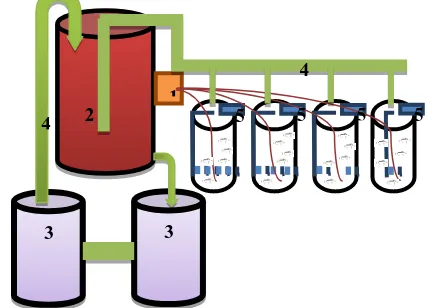
We used a complete random design (CRD) in our experiment with three variations of water flow speed. A set of blowers was used to regulate the water flow speed in the tanks. Water current speed in tank A was set to 1.25 cm/sec (treatment A), tank B was set to 1.00 cm/sec (treatment B), tank C was set to 0.75 cm/sec (treatment C) and tank K had no speed treatment (treatment control). The data were taken in triplicate. The experiment set up is provided in Fig. 1.
Tiger grouper (E. fuscogutattus) hatchlings measuring ±7 cm in length and ±12 g in weight were obtained from the Institute of Maricuture Development Hanura in Bandar Lampung and adapted for 3 days. After that the hatchlings were invested in the tanks at a density of 10 fish/tank.
The fish were fed with Survirgo grouper formula with a composition of min 45% protein, min 13% fat, max 4% fiber, min 3.6 cal/g, and max 12% moisture content. Feeding d ose was 3-5% of the total weight of the fish and given twice daily ad libitum at 06.00 and at 18.00.
The parameters tested were skeletal muscle histology, levels of amino acids using high performance liquid chromatography (HPLC) method, flesh firmness using organoleptic and tensile strength machine (Imada ZP-200 N).
Fig. 1. Schematic diagram of experiment set up. Remarks: 1: Flow generator & aerator (oxygen suply), 2: Main tank, 3: Circulation tank,
4: Plumbing, 5: Filter.
Animal survival rate is expressed as a ratio of the number of survived animals at the end of experiment by the initial number of the animals at the beginning of the experiment. It is mathematically expressed as (SR) (%) = (number of fish at end of the study/initial number of fish) × 100% [12, 13]. Analysis on the tissue parameters was descriptive one. Variations in muscle fiber diameter and survival rate were variance analyzed (ANOVA) based on the completely randomized design. Should there is a difference between the treatments, the Tukey test is used [14].
III. RESULT S AND DISCUSSION A. Histological Overview of Sk eletal Muscle of Tiger Grouper (E. fuscoguttatus)
The results of histological examination of skeletal muscle after flow treatments did not show significant changes in each treatment as shown in Fig. 2.
Fig. 2. T he histology of muscle cross-sectional sections from experiment tanks at 400× magnification. Number 1 indicates the muscle
fibers and the number 2 points to endomysium.
Fig. 2 shows that the muscle fiber (myofibril), which plays an important role in the process of muscle contraction, had no significant changes between the control and treatment groups. Yet, inspecting the treatment groups we found enlargement and elongation of muscle fibers that was supposed due to swimming activities against the current. The contracted muscle will be shorter and bigger than the relaxed ones, but the thin filaments do not change [15].
B. Changes in Sk eletal Muscle Fibers due to Exposures to Water Flow Speed
The measurement results on changes in muscle fibers exposed to water flow rate are enlisted in Table I. It shows that the size of the muscle fibers of tiger grouper hatchlings increased with the increase of water flow speed. It is because the speed of the water flow stimulates the muscle fibers to contract and relax in swimming movement. The higher the flow velocity, the greater the muscle fibers are [15]. Continuous physical activity will stimulate the development of muscle fibers [16]. Our findings are in agreement with the study by Lesson et al., (1997) who stated that the muscle fibers increase
3 3
2
1
1 4
4
5
4
5
4
5
4
in size is due to exercise (hypertrophy), not due to increased number of muscle fibers.
TABLEI
THE SIZE OF TIGER GROUP ER (E. FUSCOGUTATTUS) MUSCLE FIBER IN DIFFERENT FLOW SP EED.
T reatment Size of muscle fiber (µm)
Small Medium Large
Control 28.9 ± 1.7a 94.4± 1.8b 181±2c C 29.8± 1.6 a 101.1±1.8 b 188.3±1.8c
B 42.2± 1.5 a 105.6±1.7b 247.1±1.7c
A 46.7± 1.4ba 118.9±1. b 281.1±1.7ec
Remark: Different superscript letters behind the numbers in the same column indicate significant different (p < 0.05).
The variance analysis gave values Fcount (9.4) > Ftable (4.1), so to conclude that the four treatments influence the muscle cell diameter differently. While the Tukey test showed that treatments A and C have a significant effect on the diameter of skeletal muscle fiber. Similar result was found in treatment A and control groups. Meanwhile, treatments A and B, A and C, B and C, B and Control, and C and Control did not show significant influence on the muscle fiber diameter.
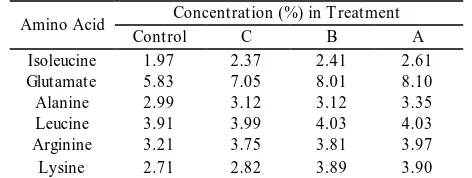
The results of amino acid analysis of hatchlings tiger grouper are presented in Table II.
TABLEII
AMINO ACIDS CONCENTRATION IN TIGER GROUP ER (E. FUSCOGUTATTUS)
NEEDED FOR JUVENILE GROWTH. Amino Acid Concentration (%) in T reatment
Control C B A
Isoleucine 1.97 2.37 2.41 2.61
Glutamate 5.83 7.05 8.01 8.10
Alanine 2.99 3.12 3.12 3.35
Leucine 3.91 3.99 4.03 4.03
Arginine 3.21 3.75 3.81 3.97
Lysine 2.71 2.82 3.89 3.90
Table II shows that the isoleucine, glutamate, alanine and leucine amino acids increased with increasing water flow rate. Our findings on amino acids content are consistent with Shapawi et al. [17] who reported the glutamate content was in the range of 4.0 to 11.5%, isoleucine (2.0 to 2.5%), leucine (3.0 to 6.4%), and alanine (2.8 to 4.0%). Glutamate is a non essential amino acid found in most muscles and function to increase the volume of muscle. Glutamate also strengthens the muscles caused by exercise, while alanine helps the muscles in getting energy [18]. Glutamate and alanine are useful in preventing muscle fatigue and help in increasing muscle cell volume and restoring stamina and generate power after activity [19].
C. Effect of Water Flow Rate on Flesh Firmness of Tiger Grouper
Observations on elasticity of tiger grouper meat is conducted in the conventional way (organoleptic) and tensile strength test and the results are presented in Table III.
TABLEIII
FLESH FIRMNESS IN TIGER GROUP ER (E. FUSCOGUTATTUS) AS A FUNCTION OF WATER FLOW SP EED VARIATIONS.
T reatment Flesh Firmness
Organoleptik Measure of Firmness (N)
Control 2.0 ±0.8a 10.5±1.7b
C 3.0±0.7a 12.5±1.5b
B 4.0±0.4b 13.3±1.4c
A 4.0±0.2c 15.5±1.3d
Remark: Different superscript letters behind the numbers in the same column indicate significant different (p < 0.05).
Table III shows that tiger grouper flesh firmness increased with increasing flow speed as a result of burning proteins during muscle contractions. Protein makes muscles more firmer, flexible, elastic and slender [20]. These results are consistent with previous study by David [8]. Tenderness of the muscles is due to release of calcium ions (Ca2+) into ATP (Adenosine triphosphate) causing proteins actin and myosin cross [21]. Actin and myosin intensive and rapid crosses make the sarcomere to shorten and tender [22].
The analysis of variance on the meat tenderness of fish after 90 days of experiment gave Fcount (10.0) > Ftable (4.7) to conclude that the water flow speed did effect on meat tenderness (p < 0.05). The Tukey test showed that the speed of the water in treatments B and A significantly affected the meat tenderness, but meat of treatment A was more tender and more homogeny than that of treatment B.
Meat tenderness of treatment A was measured at 15.5 N, followed by treatments B (13.3 N), C (12.5 N), and control (10.5 N). The processes of glycolysis, Krebs cycle, and oxidative phosphorylation produce ATP to be used for muscle contraction [23].
D. Survival Rate
TABLEIV
SURVIVAL RATE AND DISSOLVED OXYGEN VALUES IN THE EXP ERIMENT TANKS.
T reatment Average Value
Survival rate (%) Dissolved Oxygen (mg/L)
Control 67.8±1.6c 3.1±0.9a
C 96.7±1.4c 5.2±0.7a
B 100.0±0.0d 5.5±0.6b
A 100.0±0.0e 5.5±0.6c
Remark: Different superscript letters behind the numbers in the same column indicate significant different (p < 0.05).
Table IV shows that survival rate and value of dissolved oxygen (DO) increase by the increase of water flow. The current supplies oxygen and increase fish survival rate to 96.67 to 100%. Our results are in agreement with the results of Nana et al. [6] who reported the survival rate of groupers in artificial current stimulation elevated up to 100%. But Andayani [24] reported a survival rate of only 15%, while Salosso [25] reported a survival rate of 44.4%.
and dissolved oxygen determines the biological activity o f aerobic and anaerobic organisms [27]. The content of dissolved oxygen in the water in the treatment tanks ranged from 5.18 to 5.53 mg/L. Meanwhile, according to Indonesian government the dissolved oxygen for marine life must be greater than 5 mg/L.
It can be seen from the results of the analysis of variance that treatments with water flow velocity significantly affect the survival rate (p <0.05), where Fcount (24.6)> Ftable (4.7). The Tukey test showed treatments A and B had a significant effect on the survival rate, but treatment A was better than treatment B (seen from the value of the standard deviation of treatment A was smaller than treatment B). At the speed of the water flow of about 1 cm/sec – 1.50 cm/sec the system is able to work properly without the emergence of resonance, and could improve the survival of farmed fish [28].
Apart from that, some amino acids are required in juvenile growth, such arginine and lysine. Table II shows the arginine and lysine amino acids in tiger grouper increase when water flow rate increases. The results are consistent with reports of Luo et al. [29] and Shapawi et al. [17] who obtained arginine in a range of 3.10 to 6.79% and lysine approximately 2.3 to 4.43%. Arginine is needed for growth especially by juveniles and young fish [29, 30]. Lysine deficiency can interfere with the growth of the fish, which if sustained will lead to death [17]. The use rate of lysine is influenced by the level of arginine [31].
IV. CONCLUSION
Experiments on investigating the effects of water flow rate on the fish flesh firmness and survival rate had been carried out. The results showed that the speed of water flow did not affect the histological function of skeletal muscle tissue. We found that the water flow rate increase muscle fiber size and firmness of meat. This makes fish are stronger and improve survival rate to 100%. Therefore, water flow speed could enhance the quality of tiger grouper hatchlings .
ACKNOWLEDGMENT
The research was supported by MDF 4Fish NUFFIC, a project at Nusa Cendana University in Kupang year 2009-2013. The authors are very grateful to the Institute of Mariculture Development (BBL) Hanura Bandar Lampung and the Center for Veterinary Disease Investigation Regional Three, Bandar Lampung, Sumatra. The authors would like to thank Dr Eko, Dr Joko Siswanto and the team, Bpk. Pudjianto (BBL Hatchling Division) for their assistance during the course of the research. Thanks also should go to Bpk. Alie, Bpk. Prapto and Ibu Retno (BBL Seahorse Laboratory) for facilitating the research.
REFERENCES
[1] C. X. Ye, Y. J. Liu, K. S. Mai, L. X. T ian, H. J. Yang, J. Niu, and J. W. Huang, "Effect of dietary iron supplement on growth, haematology and microelements of juvenile grouper,
Epinephelus coioides," Aquacult. Nutr., vol. 13, pp. 471-477, 2007.
[2] F. Sukardi, Aquaculture Profile. Jakarta: Ministry of Marine Affairs and Fisheries. Directorate General of Aquacultute, 2007 (in Indonesian).
[3] Ihsan, "Karps breeding technology," in National Sem inar on Marine Finfish Culture, Jakarta 2003, pp. 51-56 (in Indonesian).
[4] S. Darwisito, "Reproduction Strategy for Karps," Makalah Pengantar Falsafah Sains (PPS702) Program Pasca Sarjana/S2 Institut Pertanian Bogor, 2002 (in Indonesian). [5] J. R. Brett, "T he respiratory metabolism and swimming
performance of young sockeye salmon," J. Fish Res. Board Can., vol. 21, pp. 1183-226, 1964.
[6] S. S. Nana, U. Putra, M. Syaichudin, Fauzia, Suarni, Hasmawati, and M. Syahrir, "Upaya Peningkatan Kualitas Ikan Kerapu Macan (Epinephelus fuscoguttatus) Pada Pendederan Berdensitas T inggi Melalui Pemanfaatan Stimulasi Arus Buatan," Jurnal Penelitian Balai Budidaya Air Payau Takalar, vol. 9 pp. 30 - 37, 2007 (in Indonesian).
[7] J. Altringham and D. J. Ellerby, "Fish Swimming Patterns in Muscle Function," J. Exp. Biol., vol. 20, pp. 3397 - 3403, 2006.
[8] D. J. Coughlin, "Aerobic Muscle Function during Steady Swimming in Fish," J. Fish Fisher. Sci., vol. 3, pp. 63-78, 2004.
[9] Fauzia, Suarni, S. S. Nana, Hamka, and M. Syaichudin, "Pemanfaatan Arus dalam Meningkatkan Kualitas Ikan Kerapu Macan (Epinephelus fuscoguttatus)," Jurnal Penelitian Perikanan Balai Budidaya Air Payau Takalar, vol. 13 pp. 14-24, 2004
[10] J. Hutabarat, "Program Peningkatan Ekspor Perikanan 2005 ," Jakarta: UPT Ditjen Perikanan. Direktorat Bina Program, 2006 (in Indonesian).
[11] R. T hompson and J. L. Munro, "Aspects of the biology and ecology of Caribbean reef fishes: Serranidae (hinds and groupers)," J. Fish Biol., vol. 12, pp. 115-146, 1978. [12] C. Schulz, M. Huber, J. Ogunji, and B. Rennert, "Effects of
varying dietary protein to lipid ratios on growth performance and body composition of juvenile pike perch (Sander lucioperca)," Aquacult.Nutr., vol. 14, pp. 166-173, 2008. [13] C. Schulz, U. Knaus, M. Wirth, and B. Rennert, "Effects of
varying dietary fatty acid profile on growth performance, fatty acid, body and tissue composition of juvenile pike perch (Sander lucioperca)," Aquacult. Nutr., vol. 11, pp. 403-413, 2005.
[14] J. Fowler, L. Cohen, and P. Jarvis, Practical Statistics For Field Biology, 2nd ed. New York: John Wiley & Sons, 2000. [15] A. Gunawan, "Mechanism and the Mechanics of Muscular
Motion," Intergral vol. 2 pp. 67-78, 2001 (in Indonesian). [16] A. M. Sänger, "Quantitative fine structural diversification of
red and white muscle fibres in cyprinids," Environ. Biol. Fish, vol. 33, pp. 97-104, 1992.
[17] R. Shapawi, S. Mustafa, and W. K. Ng, "A Comparison of the Growth Performance and Body Composition of the Humpback Grouper, Cromileptes altivelis Fed on Farm-made Feeds, Commercial Feeds or T rash Fish," J. Fish Aquat. Sci., vol. 6, pp. 523-534, 2011.
[18] H. Y. Chen and J. C. T sai, "Optimal dietary protein level for the growth of juvenile grouper, Epinephelus m alabaricus, fed semipurifiel diets," J. Aquacult. Nutrit., vol. 11 pp. 265-271, 2004
cobia (Rachycentron canadum)," J. Aquacult., vol. 271, pp. 401-410, 2007.
[20] S. Watabe, "T emperature Plasticity of Contractile Protein in Fish Muscle," J. Exp. Biol., vol. 18 pp. 79-85, 2002. [21] R. D. Keynes and D. J. Aidley, Nerve and Muscle, Muscle
Structure Exercise Physiology. Cambridge: Cambridge University Press, 2001.
[22] B. P. Priosoeryanto, I. M. Erza, R. T iuria, and S. U. Handayani, "Gambaran histologi insang, usus dan otot ikan mujair (Oreochrom is m ossam bicus) yang berasal dari daerah Ciampea, Bogor," Jurnal of Veterinary Science and Medicine, vol. 2, pp. 25-33, 2010 (in ndonesian).
[23] I. A. Johnston, "Muscle development and growth: potential implications for flesh quality in fish," Aquacult., vol. 177 pp. 99-115, 1999.
[24] S. Andayani, Pengaruh bioaktif alkaloid ubur-ubur (Bouganvellia sp) sebagai im m unostim ulan terhadap aktifitas bakterisida , respon im un non spesifik serta kelulushidupan ikan kerapu m acan (Epinephelus fuscogutattus). PhD T hesis. Program Pascasarjana, Universitas Brawijaya. Malang 2007 (in Indonesian).
[25] Y. Salosso, Senyawa bioaktif m akroalga coklat Padina australis sebagai antibakteri alam i dalam pengendalian Vibrio alginolyticus pada budadaya ikan kerapu tikus (Crom ileptes altivelis). PhD T hesis. Graduate School of Fishery and Marine Science, Universitas Brawijaya. Malang. 2011 (in Indonesian).
[26] Salmin, "Kadar oksigen terlarut di perairan Muara Karang dan T eluk Banten," Indonesian Institute of Science, T angerang. 2000 (in Indonesian).
[27] Kumarudin, "Manajemen Kualitas Air," Jurnal Penelitian Balai Besar Pengem bangan Air Payau Jepara, vol. 6, pp. 12 - 20, 2004 (in Indonesian).
[28] A. W. Husodo, I. M. Ariana, I. K. Utama, and R. Hartono, "Respon Getaran Model Vertical Axis T urbine (VAT ) Akibat Pengaruh Kecepatan Aliran Arus Laut," Jurnal Penelitian ITS, vol. 4, pp. 1-8, 2009 (in Indonesian).
[29] Z. Luo, Y. J. Liu, K. S. Mai, L. X. T ian, H. J. Yang, X. Y. T an, and D. H. Liu, "Dietary L-methionine requirement of juvenile grouper Epinephelus coiodes at a constan dietary cystine level," J. Aquacult., vol. 24, pp. 409-418, 2005. [30] A. J. Buentello, M. R. Becerril, M. deJesus, and F. A. Valle,
"Effects of dietary arginine on hematological parameters and innate immune function of channel catfish," J. Aquatic Anim . Health, vol. 19, pp. 195-203, 2011.