
R E S E A R C H
Open Access
Realified L1-PCA for direction-of-arrival
estimation: theory and algorithms
Panos P. Markopoulos
1, Nicholas Tsagkarakis
2, Dimitris A. Pados
3*and George N. Karystinos
4Abstract
Subspace-based direction-of-arrival (DoA) estimation commonly relies on the Principal-Component Analysis (PCA) of the sensor-array recorded snapshots. Therefore, it naturally inherits the sensitivity of PCA against outliers that may exist among the collected snapshots (e.g., due to unexpected directional jamming). In this work, we present DoA-estimation based on outlier-resistant L1-norm principal component analysis (L1-PCA) of the realified snapshots and a complete algorithmic/theoretical framework for L1-PCA of complex data through realification. Our numerical studies illustrate that the proposed DoA estimation method exhibits (i) similar performance to the conventional L2-PCA-based method, when the processed snapshots are nominal/clean, and (ii) significantly superior performance when the snapshots are faulty/corrupted.
Keywords: Data contamination, Direction-of-arrival estimation, Faulty measurements, L1 norm, L2 norm, Multiple signal classification, Principal-component analysis, Outlier resistance, Singular-value decomposition, Subspace data processing
1 Introduction
Direction-of-arrival (DoA) estimation is a fundamental problem in signal processing theory with important appli-cations in localization, navigation, and wireless commu-nications [1–6]. Existing DoA-estimation methods can be broadly categorized as (i) likelihood maximization meth-ods [7–13], (ii) spectral estimation methods, as in the early works of [14,15], and (iii) subspace-based methods [16–19]. Subspace-based methods have enjoyed great popularity in applications, mostly due to their favorable trade-off between angle estimation quality and computa-tional simplicity in implementation.
In their most common form, subspace-based DoA esti-mation methods rely on the L2-norm principal compo-nents (L2-PCs) of the recorded snapshots, which can be simply obtained by means of singular-value decom-position (SVD) of the sensor-array data matrix, or by eigenvalue decomposition (EVD) of the received-signal autocorrelation matrix [20]. Importantly, under nominal system operation (i.e., no faulty measurements or unex-pected jamming/interfering sources), in additive white
*Correspondence:[email protected]
3I-SENSE and Department of Computer and Electrical Engineering and
Computer Science, Florida Atlantic University, Boca Raton, FL, 33431 USA Full list of author information is available at the end of the article
Gaussian noise (AWGN) environment, such methods are known to offer unbiased, asymptotically consistent DoA estimates [21–23] and exhibit high target-angle resolution (“super-resolution” methods).
However, in many real-world applications, the col-lected snapshot record may be unexpectedly corrupted by faulty measurements, impulsive additive noise [24–26], and/or intermittent directional interference. Such inter-ference may appear either as an endogenous characteristic of the underlying communication system, as for exam-ple in frequency-hopped spread-spectrum systems [27], or as an exogenous factor (e.g., jamming). In cases of such snapshot corruption, L2-PC-based methods are well known to suffer from significant performance degradation [28–30]. The reason is that, as squared error-fitting min-imizers, L2-PCs respond strongly to corrupted snapshots that appear in the processed data matrix as points that lie far from the nominal signal subspace [29]. Accordingly, DoA estimators that rely upon the L2-PCs are inevitably misled.
At the same time, research in signal processing and data analysis has shown that absolute error-fitting minimizers place much less emphasis on individual data points that diverge from the nominal signal subspace than square-fitting-error minimizers. Based on this observation, in
the past few years, there have been extended docu-mented research efforts toward defining and calculating L1-norm principal components (L1-PCs) of data under various forms of L1-norm optimality, including absolute-error minimization and projection maximization [31–46]. Recently, Markopoulos et al. [47,48] calculated optimally the maximum-projection L1-PCs of real-valued data, for which up to that point only suboptimal approximations were known [36–38]. Experimental studies in [47–53] demonstrated the sturdy resistance of optimal L1-norm principal-component analysis (L1-PCA) against out-liers, in various signal processing applications. Recently, [43,45] introduced a heuristic algorithm for L1-PCA that was shown to attain state-of-the-art performance/cost trade-off. Another popular approach for outlier-resistant PCA is “Robust PCA” (RPCA), as introduced in [29] and further developed in [54,55].
In this work, we consider system operation in the presence of unexpected, intermittent directional inter-ference and propose a new method for DoA-estimation that relies on the L1-PCA of the recorded complex snapshots. Importantly, this work introduces a com-plete paradigm on how L1-PCA, defined and solved over the real field [47, 48], can be used for processing complex data, through a simple “realification" step. An alternative approach for L1-PCA of complex-valued data was presented in [46], where the authors reformulated complex L1-PCA into unimodular nuclear-norm maxi-mization (UNM) and estimated its solution through a sequence of converging iterations. It is noteworthy that for the UNM introduced in [46], no general exact solver exists to date.
Our numerical studies show that the proposed L1-PCA-based DoA-estimation method attains performance similar to the conventional L2-PCA-based one (i.e., MUSIC [16]) in the absence of jamming sources, while it offers significantly superior performance in the case of unexpected, sporadic contamination of the snapshot record.
Preliminary results were presented in [56]. The present paper is significantly expanded to include (i) anAppendix section with all necessary technical proofs, (ii) important new theoretical findings (Proposition 3 on page 7), (iii) new algorithmic solutions (Section3.5), and (iv) extensive numerical studies (Section4).
The rest of the paper is organized as follows. In Section2, we present the system model and offer a pre-liminary discussion on subspace-based DoA estimation. In Section 3, we describe in detail the proposed L1-PCA-based DoA-estimation method and present three algorithms for L1-PCA of the snapshot record. Section4 presents our numerical studies on the performance of the proposed DoA estimation method. Finally, Section5holds some concluding remarks.
1.1 Notation
We denote by R and C the set of real and complex numbers, respectively, and by j the imaginary unit (i.e.,
j2 = −1). {(·)},{(·)},(·)∗,(·), and (·)H denote the real part, imaginary part, complex conjugate, transpose, and conjugate transpose (Hermitian) of the argument, respectively. Bold lowercase letters represent vectors and bold uppercase letters represent matrices.diag(·)is the diagonal matrix formed by the entries of the vector argu-ment. For anyA∈Cm×n, [A]i,qdenotes its(i,q)th entry,
is the pth entry-wise norm of A,A∗ is the nuclear norm of A(sum of singular val-ues), span(A)represents the vector subspace spanned by the columns of A, rank(A) is the dimension of span(A), and null(A)is the kernel of span(A)(i.e., the nullspace ofA). For any square matrixA∈Cm×m, det(A)denotes its determinant, equal to the product of its eigenvalues.
⊗andare the Kronecker and entry-wise (Hadamard) product operators [57], respectively.0m×n,1m×n, andIm
are the m×nall-zero,m×nall-one, and size-m
iden-tity matrices, respectively. Also,Em =
2 System model and preliminaries
We consider a uniform linear antenna array (ULA) ofD
elements. The length-Dresponse vector to a far-field sig-nal that impinges on the array with angle of arrival θ ∈
(−π
where fc is the carrier frequency, c is the signal
propagation speed, anddis the fixed inter-element spac-ing of the array. We consider that the uniform inter-element spacingdis no greater than half the carrier wave-length, adhering to the Nyquist spatial sampling theorem; i.e.,d ≤ 2cfc. Accordingly, for any two distinct angles of arrivalθ,θ ∈(−π2,π2], the corresponding array response vectorss(θ)ands(θ)are linearly independent.
The ULA collects N narrowband snapshots from K
sources of interest (targets) arriving from distinct DoAs
θ1,θ2,. . .,θK ∈ −π2,π2
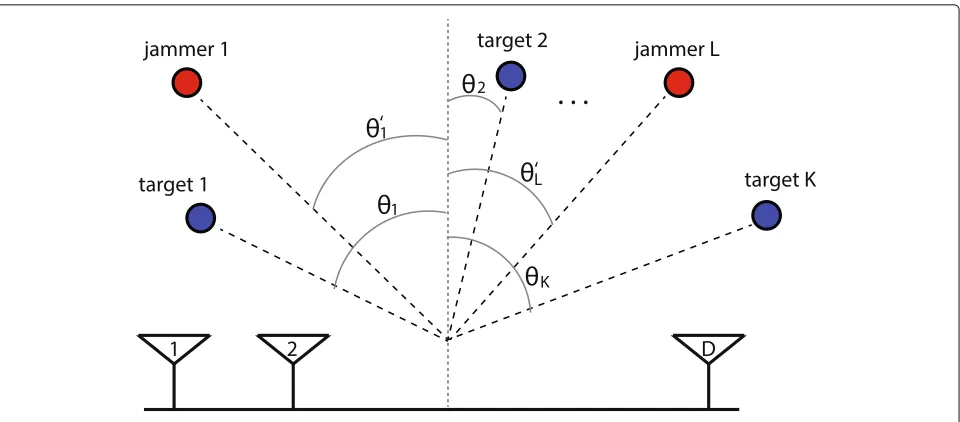
,K <D≤N. We assume that the system may also experience intermittent directional inter-ference fromLindependent sources (jammers), at angles
θ
1,θ2,. . .,θL ∈ −π2,π2
. A schematic illustration of the targets and jammers is given in Fig. 1. We assume that
θi =θq, for anyi∈ {1, 2,. . .,K}andq ∈ {1, 2,. . .,L}. For
Fig. 1Schematic representation of theKtarget sources and theLdirectional jammers
to the receiver probabilitypl. Accordingly, then-th
down-converted received data vector is of the form
yn= K
k=1
xn,ks(θk)+ L
l=1
γn,lxn,ls θl
+nn∈CD×1,
n=1, 2,. . .,N,
(2)
where, xn,k and xn,l ∈ C denote the statistically
inde-pendent signal values of targetk and jammer l, respec-tively, comprising power-scaled information symbols and flat-fading channel coefficients, and γn,l is the activity
indicator for jammerl, modeled as a{0, 1}-Bernoulli ran-dom variable with activation probabilitypl. nn ∈ CD×1
accounts for additive white Gaussian noise (AWGN) with mean equal to zero and per-element varianceσ2; i.e.,nn∼ CN 0D,σ2ID
. Henceforth, we refer to the case of target-only presence in the collected snapshots (i.e.,γn,l = 0 for
everyn=1, 2,. . .,Nand everyl =1, 2,. . .,L) asnormal system operation.
Definingxn=[xn,1,xn,2,. . .,xn,K],xn
=[xn,1,xn,2,. . .,
xn,L],n = diag [γn,1,γn,2,. . .,γn,L]
, and S = [s(φ1),s(φ2),. . .,s(φm)] ∈ CD×m for any size-m set of
angles = { φ1,φ2,. . .,φm} ∈ −π2,π2
m
,1 (2) can be rewritten as
yn=S xn+S nxn+nn∈CD×1, n=1, 2,. . .,N, (3)
for = { θ1,θ2,. . .,θK} and =
θ
1,θ2,. . .,θL
. The goal of a DoA estimator is to identify correctly all angles
in the DoA set . Importantly, by the Vandermonde structure ofS , it holds that
s(φ)⊆span(S )⇔φ∈ , (4)
for anyφ ∈ −π2,π2[16]. That is, givenS = span(S ), the receiver can decide accurately for any candidate angle
φ∈ −π 2,π2
whether it is a DoA in , or not.
2.1 DoA estimation under normal system operation. Considering for a moment pl = 0 for every l ∈
{1, 2,. . .,L}, (2) becomes
yn=S xn+nn∈CD×1, n=1, 2,. . .,N (5)
with autocorrelation matrixR=EynyHn
=S ExnxHn
SH+σ2ID. Certainly,S = span(S )coincides with the
K-dimensional principal subspace of R, spanned by its
K highest-eigenvalue eigenvectors [5]. Therefore, being aware of R, the receiver could obtain S through stan-dard EVD and then conduct accurate DoA estimation by means of (4). However, in practice, the nominal received-signal autocorrelation matrixRis unknown to the receiver and sample-average estimated as Rˆ = N1 Nn=1ynyHn [5,
16]. Accordingly, S is estimated by the span of the K
highest-eigenvalue eigenvectors ofRˆ, which coincide with theK highest-singular-value left singular-vectors ofY= [y1,y2,. . .,yN]. The eigenvectors ofRˆ, or left
singular-vectors ofY, are also commonly referred to as the L2-PCs of Y, since they constitute a solution to the L2-PCA problem
QL2= argmax Q∈CD×K,QHQ=IK
In accordance to (4), the DoA set is estimated by the arguments that yield theK local maxima (peaks) of the familiar MUSIC [16] spectrum
P(φ)= ID−QL2QHL2
which clarifies why MUSIC is, in fact, an L2-PCA-based DoA estimation method. Certainly, asN increases asymptotically, Rˆ tends to R,QL2tends to spanS , and
P(φ) goes to infinity for every φ ∈ and finding its peaks becomes a criterion equivalent to (4). There-fore, for sufficient N, L2-PCA-based MUSIC is well-known to attain high performance in normal system operation.
2.2 Complications in the presence of unexpected jamming
In this work, we focus on the case wherepl > 0 for all
l, so that some snapshots in Y are corrupted by unex-pected, unknown, directional interference, as modeled in (2). In this case, the K eigenvectors of R = EynyHn
do not span S any more. Thus, the K eigenvectors of
ˆ
R or singular-vectors of Y would be of no use, even for very high sample-support N. In fact, interference-corrupted snapshots in Y may constitute outliers with respect to S. Accordingly, due to the well documented high responsiveness of L2-PCA in (6) to outlying data, QL2may diverge significantly fromS[29,48], rendering DoA estimation by means of (7) highly inaccurate. Below, we introduce a novel method that exploits the outlier-resistance of L1-PCA [36,47,48] to offer improved DoA estimates.
3 Proposed DoA estimation method
3.1 Operation on realified snapshots
In order to employ L1-PCA algorithms that are defined for the processing of real-valued data, the proposed DoA esti-mation method operates on real-valued representations of the recorded complex snapshots in (2), similar to a num-ber of previous works in the field [58–60]. In particular, we define the real-valued representation of any complex-valued matrix A ∈ Cm×n, by concatenating its real and
In Lie algebras and representation theory, this transi-tion from Cm×n to R2m×2n is commonly referred to as complex-number realification [61, 62] and is a method that allows for any complex system of equations to be con-verted into (and solved through) a corresponding real sys-tem [63]. Lemmas1,2, and3presented in theAppendix provide three important properties of realification. By (8)
and Lemma 1, thenth complex snapshotynin (3) can be
is a 2K-dimensional subspace wherein theKrealified signal components of interest with angles of arrival in lie. The following Proposition, deriv-ing straightforwardly from (4) by means of Lemma1and Lemma 2, highlights the utility ofSRfor estimating the
target DoAs.
Proposition 1 For anyφ∈ −π2,π2, it holds that span(s(φ))⊆SR ⇔ φ∈ . (10)
Set equality may hold only if K =1.
By Proposition 1, given an orthonormal basis QR ∈
R2D×2K that spansS
R, the receiver can decide accurately
whether someφ ∈ −π2,π2is a target DoA, or not, by
Similar to the complex-data case presented above, in normal system operation,SR coincides with the span of
the K dominant eigenvectors ofRR = E
ynyn. When the receiver, instead of RR, possesses only the realified
snapshot recordY,SRcan be estimated as the span of
QR,L2= argmax Q∈R2D×2K,QQ=I2K
QY2
2. (12)
Then, in accordance with (11), the target DoAs can be estimated as the arguments that yield theKhighest peaks of the spectrum by singular-value decomposition (SVD) of Y. Interest-ingly, the L2-PCA-based DoA estimator of (13) is equiv-alent to the complex-field MUSIC estimator presented in Section2. In fact, as we prove in theAppendix,
PR(φ;QR,L2)=P(φ) ∀φ∈
Hence, exhibiting performance identical to that of MUSIC, (12) can offer highly accurate estimates of the target DoAs under normal system operation. However, when Y contains corrupted snapshots, the L2-PCA-calculated span QR,L2
is a poor approximation to SR
an alternative, L1-PCA-based method for obtaining an outlier-resistant estimate of .
3.2 DoA estimation by realified L1-PCA
Over the past few years, L1-PCA has been shown to be far more resistant than L2-PCA against outliers in the data matrix [31–40,47,48]. In this work, we propose the use of a DoA-estimation spectrum analogous to that in (13) that is formed by the L1-PCs ofY. Specifically, the proposed method has two steps. First, we obtain the L1-PCs ofY, solving the L1-PCA problem
That is, (15) searches for the subspace that maximizes data presence, quantified as the aggregate L1-norm of the projected points.
Then, similarly to MUSIC, we estimate the target angles in by the K highest peaks of the L1-PCA-based spectrum
In accordance to standard practice, to find the
K highest peaks of (16), we examine every angle in small scanning stepφ >0. Next, we place our focus on solving the L1-PCA in (15).
3.3 Principles of realified L1-PCA
Although L1-PCA is not a new problem in the litera-ture (see, e.g., [36–38]), its exact optimal solution was unknown until the recent work in [48], where the authors proved that (15) is formally NP-hard and offered the first two exact algorithms for solving it. Proposition2below, originally presented in [48] for real-valued data matri-ces of general structure (i.e., not having nematri-cessarily the realified structure of Y) translates L1-PCA in (15) to a nuclear-norm maximization problem over the binary field.
Proposition 2IfBoptis a solution to
maximize L1-PCA is in practice equivalent to a combinatorial opti-mization problem over the 4NKbinary variables inB. The authors in [48] presented two algorithms for exact solu-tion of (17), defined upon real-valued data matrices of general structure.
In this work, for the first time, we simplify the solu-tions of [48] in view of the special, realified structure of Y. Specifically, in the following Proposition 3, we show that forK = 1 we can exploit the special structure ofY and reduce (17) to a binary quadratic-form maximization problem over half the number of binary variables (i.e., 2N
instead of 4N). A proof for Proposition3is provided in the Appendix.
Proposition 3Ifboptis a solution to
maximize
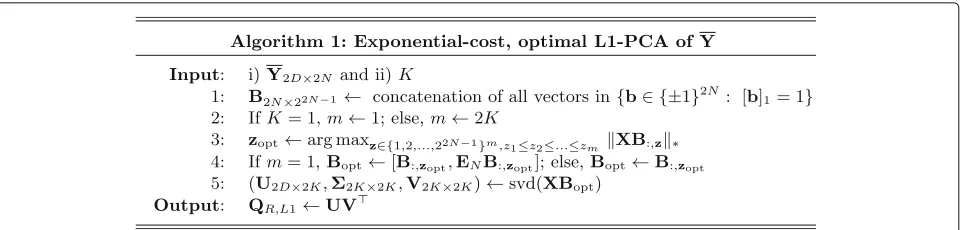
Since (21) is a combinatorial problem, the conceptually simplest approach for solving it is an exhaustive search (possibly in parallel fashion) over all elements of its feasi-bility set{±1}2N×m. By means of this method, one should conduct 22Nmnuclear norm evaluations (e.g., by means of SVD ofYB) to identify the optimum argument in the fea-sibility set; thus, the asymptotic complexity of this method is O 22Nm. Exploiting the well-known nuclear-norm properties of column-permutation and column-negation invariance, we can expedite practically the exhaustive pro-cedure by searching for a solution to (21) in the set of all binary matrices that are column-wise built by the elements of a size-mmultiset2of{b∈ {±1}2N : [b]
1=1}. By this modification, the exact number of binary matri-ces examined (thus, the number of nuclear-norm evalu-ations) decreases from 22Nm to 22N−1m+2K−1. Of course, exhaustive-search approaches, being of exponential com-plexity inN, become impractical as the number of snap-shots increases. For completeness, in Fig. 2, we provide a pseudocode for the exhaustive-search algorithm pre-sented above.
For the case of engineering interest whereN>DandD
Fig. 2Algorithm for optimal computation of the 2KL1-PCs of rank-2Ddata matrixY2D×2Nwith exponential (w.r.t.N) asymptotic complexity
O 22Nm(m=1, forK=1;m=2K, forK>1)
In the following subsection, we exploit further the struc-ture ofYand reduce significantly the computational cost of this algorithm.
3.4 Polynomial-cost realified L1-PCA
The authors in [48] showed that, according to Proposition2, a solution to (21) can be found among the binary matrices that draw columns from
B=sgnYa
: a∈2D
⊆ {±1}2N×1 (22)
where 2D =
a∈R2D×1: a2=1, [a]2D>0
–with the positivity constraint in the last entry ofaderiving from the invariance of the nuclear norm to column negations of its matrix argument. That is, a solution to (21) belongs to themth Cartesian power ofB,Bm⊆ {±1}2N×m.
In addition, [48] pointed out that, since the nuclear-norm maximization is also invariant to column permutations of the argument, we can maintain problem equivalence while further narrowing down our search to the elements of a set
˜
B, subset ofBm, that contains the |B|+mm−1binary matri-ces that are built by the elements of all size-mmultisets ofB. That is, we can obtain a solution to (21) by solving instead
maximize B∈ ˜B
YB2∗. (23)
Importantly, | ˜B| = |B|+mm−1 < |B|m = |Bm|. The exact multiset-extraction procedure for obtainingB˜from Bfollows.
Calculation of B˜ from B [48]. For every i ∈
1, 2,. . ., |B|+mm−1, we define a distinct indicator func-tionfi : B → {0, 1,. . .,m} that assigns to everyb ∈ B
a natural numberfi(b) ≤ m, such thatb∈Bfi(b) = m.
Then, for every i ∈
1, 2,. . ., |B|+mm−1, we define a unique binary matrix Bi ∈ {±1}2N×m such that every
b ∈ B appears exactlyfi(b) times among the columns
of Bi. Finally, we define the sought-after set as B˜ =
B1,B2,. . .,B(|B|+m−1
m )
.
Evidently, the cost to solve (23), and thus (21), amounts to the cost of constructing the feasibility set B˜ added to the cost of conducting nuclear-norm evaluations (through SVD) over all its elements. Therefore, the cost to solve (23) depends on the construction cost and car-dinality of B˜. As seen above, | ˜B| = |B|+mm−1 and
˜
B can be constructed online, by multiset selection on B, with negligible computational cost. Therefore, for determining the cardinality and construction cost of
˜
B, we have to find the cardinality and construction cost ofB.
Next, we present a novel method to construct B, dif-ferent than the one in [48], that exploits the realified structure ofYto achieve lower computational cost.
Construction ofB, in view of the structure of Y. Considering that any group of m ≤ 2D columns of Y spans a m-dimensional subspace, for each index set X ⊆ {1, 2,. . ., 2N}–elements in ascending order (e.a.o.)– of cardinality |X| = 2D− 1, we denote by z(X) the unique left-singular vector ofY:,X that corresponds to zero singular value. Calculation ofz(X)can be achieved either by means of SVD or by simple Gram-Schmidt Orthonormalization (GMO) of Y:,X –both SVD and GMO are of constant cost with respect toN. Accordingly, we define
c(X)=sgn([z(X)]2D)z(X)∈2D. (24)
Being a scaled version of z(X),c(X) also belongs to nullY:,X
, satisfying Y:,Xc(X) = 02D−1. Next, we define the set of binary vectors
B(X)=b∈ {±1}2N×1: [b]Xc=sgn
[Y]:,Xcc(X)
(25)
of cardinality |B(X)| = 22D−1, where Xc =
B=
elements. In fact, in view of [64], the exact cardinality ofBis
Next, we show for the first time how we can reduce the cost of calculatingB, exploiting the realified structure ofY. 2D− 1, by the Chu-Vandermonde binomial-coefficient property [65],{X1,X2}can take
values. Therefore, exploiting the structure ofY, the pro-posed algorithm constructs Bby (32), avoiding half the
nullspace calculations needed in the generic method of [48], presented in (26).
elements. Thus, O(N2Dm−m) nuclear-norm evaluations
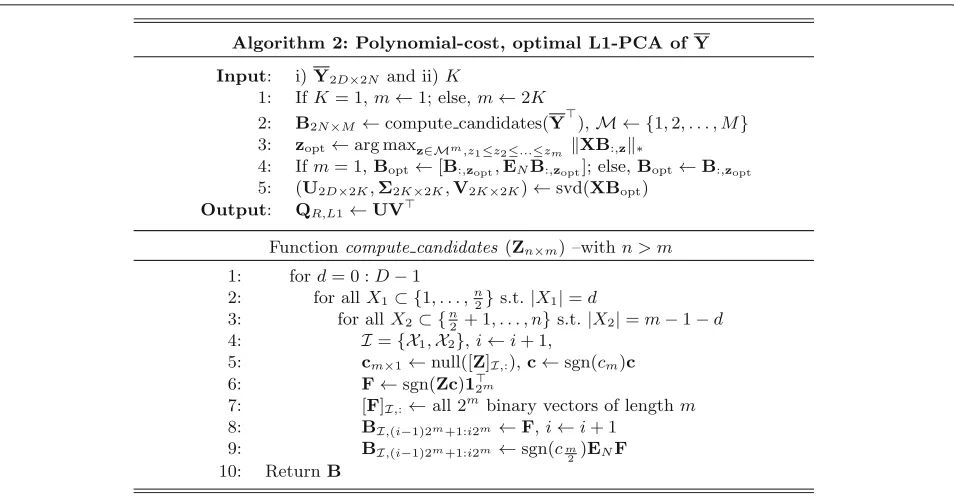
suffice to obtain a solution to (17). The asymptotic com-plexity for solving (15) by the presented algorithm is then O N2Dm−m. The described polynomial-time algorithm is presented in detail in Fig. 3, including element-by-element construction ofB.
3.5 Iterative realified L1-PCA
For large problem instances (largeN,D), the above pre-sented optimal L1-PCA calculators could be computa-tionally impractical. Therefore, at this point we present and employ the bit-flipping-based iterative L1-PCA cal-culator, originally introduced in [43] for processing gen-eral real-valued data matrices. Given Y ∈ R2D×2N, and some m < 2 min(D,N), the algorithm presented below attempts to solve (21), by conducting a converging sequence of optimal single-bit flips.
Specifically, the algorithm is initializes at a 2N × m
binary matrix B(1) and conducts optimal single-bit flip-ping iterations. Specifically, at thetth iteration step (t >
1), the algorithm generates the new matrix B(t) so that (i) B(t) differs fromB(t−1) in exactly one entry (bit
Fig. 3Algorithm for optimal computation of the 2KL1-PCs of the rank-2Ddata matrixY2D×2Nwith polynomial (w.r.t.N) asymptotic complexity
O N4DK−m+1(m=1 forK=1;m=2K, forK>1)
and updatesL(t+1)toL(t)\ {(k−1)2N+n}. If, otherwise,
YB(t−1)−2B(t−1)n,k[Y]:,nek,m
∗ ≤ YB
(t−1) ∗, the algorithm obtains a new solution(n,k)to (36) after reset-tingL(t)to{1, 2,. . ., 2Nm}. If this new(n,k)is such that
YB(t−1)−2B(t−1)n,k[Y]:,nek,m
∗ > YB (t−1)
∗, then the algorithm setsB(t) = B(t−1)−2[B(t−1)]n,ken,2Nek,m
and updatesL(t+1) =L(t)\ {(k−1)2N+n}. Otherwise, the iterations terminate and the algorithm returns B(t) as a heuristic solution to (21). Notice that since at each iteration, the optimization metric increases. At the same time, the metric is certainly upper-bounded byYBopt∗. Therefore, the iterations are guaranteed to terminate in a finite number of steps, for any initialization B(1). Our studies have shown that, in fact, the iterations terminate for t < 2Nm, with very high frequency of occurrence.
For solving (36), one has to calculate YB(t−1)−2
B(t−1)j,l[Y]:,jel,m
∗, for all (j,l) ∈ {1, 2,. . ., 2N} ×
{1, 2,. . .,m}such that(l−1)2N+j ∈ L. At worst case, L= {1, 2,. . ., 2Nm}and this demands 2Nmindependent singular-value/nuclear-norm calculations. Therefore, the total cost for solving (36) is O N2m3. If we limit the number of iterations to 2Nm, for the sake of practical-ity, then the total cost for obtaining a heuristic solu-tion to (21) is O N3m4 –significantly lower than the cost of the polynomial-time optimal algorithm presented
above,O N2Dm−m. When the iterations terminate, the algorithm returns the bit-flipping-derived L1-PC matrix QR,BF=UV, whereU2K×2KVsvd= YBopt. Formal
per-formance guarantees for the presented bit-flipping proce-dure were offered in [43], for general real-valued matrices andK =1.
A pseudocode of the presented algorithm for the calcu-lation of the 2KL1-PCsY2D×2N is presented in Fig.4.
4 Numerical results and discussion
We present numerical studies to evaluate the DoA estimation performance of realified L1-PCA, compared to other PCA calculation counterparts. Our focus lies on cases where a nominal source (the DoA of which we are looking for) operates in the intermittent presence of a jammer located at a different angle. Ideally, we would like the DoA estimator to be able to identify successfully the DoA of the source of interest, despite the unexpected directional interference.
Fig. 4Algorithm for estimation of the 2KL1-PCs of rank-2Ddata matrixY2D×2Nwith cubic (w.r.t.N) asymptotic complexityO N3m4(m=1 for
K=1;m=2K, forK>1)
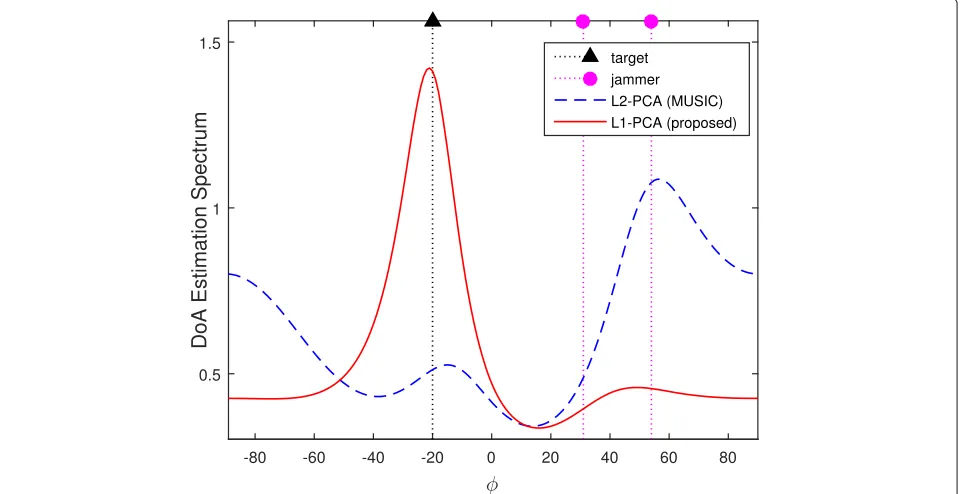
by two jamming sources with DoAs 31◦ and 54◦. The signal-to-noise ratio (SNR) is set to 2 dB for the target source and to 5 dB for each of the jammers. We observe that standard MUSIC (L2-PCA) is clearly misled by the two jammer-corrupted measurement. Interestingly, the
proposed L1-PCA-based method manages to identify the target location successfully.
Next, we generalize our study to include probabilistic presence of an jammer. Specifically, we keepD = 3 and
N = 8 and considerK = 1 target at θ = −41◦with
Fig. 5DoA-estimation spectraPR(φ;QR,L2)(MUSIC) andPR(φ;QR,L2)(proposed); one target and two jamming signals with angles of arrival marked
SNR 2 dB, andL= 1 jammer atθ = 24◦with activation probabilityptaking values in{0, .1, .2, .3, .4, .5}.
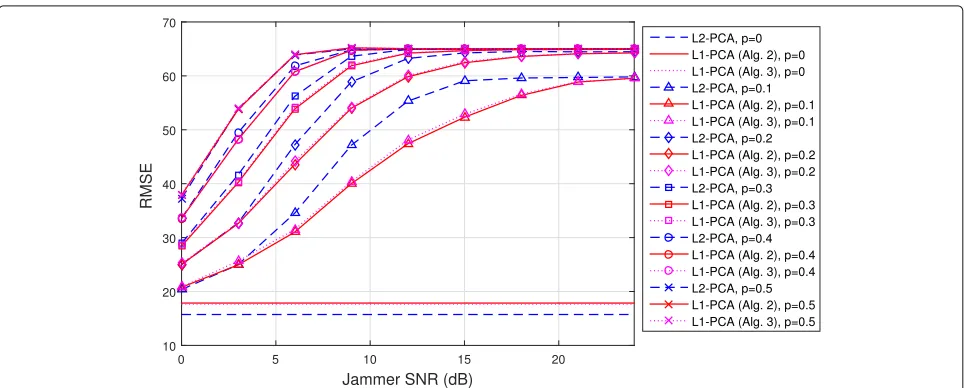
In Fig.6, we plot the root-mean-square-error (RMSE)4, calculated over 5000 independent realizations, vs. jam-mer SNR, for three DoA estimators: (a) the standard L2-PCA-based one (MUSIC), (b) the proposed L1-PCA DoA estimator with the L1-PCs calculated optimally by means of the polynomial-cost algorithm of Fig.3, and (c) the proposed L1-PCA estimator with the L1-PCs found by means of the algorithm of Fig. 4. For all three meth-ods, we plot the performance attained for each value of p ∈ {0, .1, .2, .3, .4, .5}. Our first observation is that the two L1-PCA-based estimators exhibit almost identi-cal performance for every value of pand jammer SNR. Then, we notice that, in normal system operation (p=0) the RMSEs of the L2-PCA-based and L1-PCA-based esti-mators are extremely close to each other and low, with slight (almost negligible) superiority of the L2-PCA-based method. Quite interestingly, for any non-zero jammer activation probabilitypand over the entire range of jam-mer SNR values, the RMSE attained by the proposed L1-PCA-based methods is lower than that attained by the L2-PCA-based one. For instance, for jammer SNR 12 dB andp=.1, the proposed methods offer 8◦smaller RMSE than MUSIC. Of course, at high jammer SNR values and
p = .5 the RMSE of both methods approaches 65◦, which is the angular distance of the target and the jammer; i.e. both methods tend to peak the significantly (18 dB) stronger jammer present in half the snapshots.
In Fig. 7, we change the metric and study the more general Subspace Representation Ratio (SRR), attained by L2-PCA and L1-PCA. For any orthonormal basis Q ∈ R2D×2K, SRR is defined as
SRR(Q)= Q s(θ)2
2
Qs(θ)22+Qs(θ)22. (37)
In Fig. 7, we plot SRR(QR,L2) (L2-PCA), SRR(QR,L1) (optimal L1-PCA), and SRR(QR,BF) averaged over 5000
realizations, for multiple values ofp, versus the jammer SNR. We observe that, again, the performance of the opti-mal and heuristic L1-PCA calculators almost coincides for every value of p and jammer SNR. Also, we notice that under normal system operation (p= 0) the spans of QR,L2,QR,L1, andQR,BF are equally good approximations
to SRand their respective SRR curves lie close (as close
as the target SNR and the number of snapshots allow) to the benchmark of SRR(U), whereU is an orthonormal basis for the exactSR. On the other hand, when half the
snapshots are jammer corrupted (p = .5) both methods capture more of the interference. Similar to Fig.6, for any jammer activation probability and over the entire range of jammer SNR values, the SRR attained by L1-PCA (both algorithms) is superior to that attained by conventional L2-PCA.
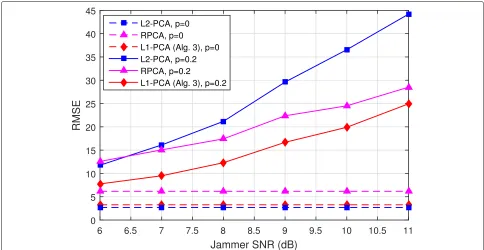
Next, we set D = 4,N = 10,θ = − 20◦ andθ = 50◦. The source SNR is set to 5 dB. In Fig. 8, we plot the RMSE vs. jamming SNR performance attained by L2-PCA, RPCA5(algorithm of [29]), and L1-PCA (proposed –computed by efficient Algorithm 3), all computed on the realified snapshots. We observe that forp = 0 (i.e., no jamming corruption) all methods perform well; in partic-ular, L2-PCA and L1-PCA demonstrate almost identical performance of about 3◦ RMSE. For jammer operation probabilityp>0, we observe that the proposed L1-PCA method outperforms clearly all counterparts, exhibiting
Fig. 7Average SRR vs. jammer SNR, for: L2-PCA (MUSIC), optimal L1-PCA, calculated by means of Algorithm 2 in Fig.3, and L1-PCA by means of Algorithm 3 in Fig.4. For each estimator, we present the RMSE curves forp=0, .1, .2, .3, .4, .5.N=8,D=3,θ= −41◦,θ=24◦, source SNR 2 dB
from 5◦(for jammer SNR 6 dB) to 20◦(for jammer SNR 11 dB) lower RMSE.
In Fig. 9. we plot the RMSE attained by the three counterparts, this time fixing jamming SNR to 10 dB and varying the snapshot corruption probability p ∈ {0, .1, .2, .3, .4, .5, .6}. Once again, we observe that, forp=
0 (no jamming activity), all methods perform well. For
p>0, L1-PCA outperforms both counterparts across the board.
Finally, in the study of Fig.9, we measure the computa-tion time expended by the three PCA methods, forp=0 andp=0.5. We observe that standard PCA, implemented by SVD, is the fastest method, with average computation time about 4·10−5s, for both values ofp. The computa-tion time of RPCA is 1.5·10−2s forp = 0 and 1.9·10−2s forp=0.5. L1-PCA (Algorithm 3) computation takes, on average, 4.3·10−2 s for both values ofp, comparable to RPCA.6
Fig. 9RMSE vs. jammer operation probabilityp, for: L2-PCA (MUSIC), RPCA [29], and L1-PCA by means of Algorithm 3 in Fig.4. N=10,D=4,θ= −20◦,θ=50◦, source SNR 5dB, jammer SNR 10 dB
5 Conclusions
We considered the problem of DoA estimation in the possible presence of unexpected, intermittent directional interference and presented a new method that relies on the L1-PCA of the recorded snapshots. Accordingly, we presented three algorithms (two optimal ones and one iterative/heuristic) for realified L1-PCA; i.e., L1-PCA of realified complex data matrices. Our numerical studies showed that the proposed method attains performance similar to conventional L2-PCA-based DoA estimation (MUSIC) in normal system operation (absence of jam-mers), while it attains significantly superior performance in the case of unexpected, sporadic corruption of the snapshots.
Endnotes 1S
∈CD×mis a transposed Vandermonde matrix [66] and has rankmif|| =m<D.
2For any underlying set of elementsAof cardinalityn,
a sizemmultiset may be defined as a pair A,fwhere
f : A → N≥1 is a function from A to N≥1 such that a∈Af(a) = m; the number of all distinct sizem
multisets defined uponAis n+mm−1[67].
3The(n,k)th bit of the binary matrix argument in (21) has the corresponding single-integer index(k−1)2N+n∈ {1, 2,. . ., 2Nm}.
4Denoting byθthe DoA andθˆthe DoA estimate, RMSE is defined as the square root of the average value of
| ˆθ −θ|2.
5GivenY, RPCA minimizesL
∗+λO1, overLand O, subject to Y = L+ O andλ = √max{2D, 2N}−1
[29]. Then, it returns the 2K L2-PCs of L (computed by SVD).
6Reported computation times are measured in
MAT-LAB R2017a, run on a computer equipped with Intel(R) core(TM) i7-6700 processor 3.40 GHz and 32 GB RAM. The MATLAB code of L1-PCA (Algorithm 3) can be found at [68]. The MATLAB code for RPCA was provided at [69].
Appendix
Useful properties of realification
Lemma1below follows straightforwardly from the defini-tion in (8).
Lemma 1 For anyA,B∈Cm×n, it holds that(A+B)= A+B. For anyA ∈ Cm×n andB ∈ Cn×q, it holds that
(AB)=A Band AH=A. Lemma2 below was discussed in [70] and [20], in the form of problem 8.6.4. Here, we also provide a proof, for the sake of completeness.
Lemma 2For any A ∈ Cm×n,rank(A) = 2 rank(A). In particular, each singular value ofAwill appear twice among the singular values ofA.
Proof Consider a complex matrixA ∈ Cm×n of rank
k≤min{m,n}and its singular value decompositionASVD= Um×mm×nVHn×n, where
=
diag(σ) 0k×(n−k)
0(m−k)×k 0(m−k)×(n−k)
andσ =[σ1,σ2,. . .,σk]∈Rk+is the lengthkvector con-taining (in descending order) the positive singular values ofA. By Lemma1, tutes the standard (sorted singular values) SVD ofAand rank(A)=2k.
Lemma3below follows from Lemmas1and2.
Lemma 3For anyA∈Cm×n,A22= 12A22.
Proof of (14)
We commence our proof with the following auxiliary Lemma4.
ProofOrthonormal basis [Uˇ]:,1:2l, defined in the proof
of Lemma 2above, contains the 2lhighest-singular-value
left-singular vectors ofA, and, thus, solves (43) [20]. Since the objective value in (43) is invariant to column permu-tations of the argument Q, any column permutation of [Uˇ]:,1:2lis still a solution to (43). Next, we define the
per-singular-value left-singular vectors ofA and solves (44) [20]. By the above, we conclude that a realification per (8)
XB(e.a.o.) Then, we notice that
[I2N]:,XB=EN[I2N]:,XAP, (45)
where b1 and b2 are the first and second columns of B, respectively. Evidently, the maximum value attained at (17) is upper bounded as
Considering now a solution bopt to maximizeb∈{±1}2N×1 Yb22, and definingbopt = ENbopt,
AWGN: Additive white Gaussian noise; DoA: Direction-of-arrival; EVD: Eigenvalue decomposition; PCA: norm principal-component analysis; L1-PCs: L1-norm principal components; L2-L1-PCs: L2-norm principal components; MUSIC: Multiple signal classification; PCA: Principal-component analysis; RMSE: Root-mean-squared-error; RPCA: Robust PCA; SNR: Signal-to-noise ratio; SRR: Subspace-representation ratio; SVD: Singular-value decomposition; ULA: Uniform linear array; UNM: Unimodular nuclear-norm maximization
Acknowledgements
The authors would like to thank the U.S. NSF, the U.S. AFOSR, and the Ministry of Education, Research, and Religious Affairs of Greece for their support in this research work.
Authors’ contributions
All the authors have contributed to the presented theoretical, algorithmic, and numerical results, as well as the drafting of the manuscript. All the authors read and approved the final manuscript.
Authors’ information
Panos P. Markopoulos ([email protected]) is an Assistant Professor with the Dept. of Electrical and Microelectronic Engineering, Rochester Institute of Technology, Rochester, NY, USA. Nicholas Tsagkarakis
([email protected]) is a System Engineer with Ericsson, Gothenburg, Sweden. Dimitris A. Pados ([email protected]) is an I-SENSE Fellow and Professor with the Dept. of Computer and Electrical Engineering and Computer Science, Florida Atlantic University, Boca Raton, FL, USA. George N. Karystinos ([email protected]) is an Professor with the School of Electrical and Computer Engineering, Technical University of Crete, Chania, Greece.
Funding
This work was supported in part by the U.S. National Science Foundation (NSF) under grants CNS-1117121, ECCS-1462341, and OAC-1808582, the U.S. Air Force Office of Scientific Research (AFOSR) under the Dynamic Data Driven Applications Systems (DDDAS) program, and the Ministry of Education, Research, and Religious Affairs of Greece under Thales Program Grant MIS-379418-DISCO.
Availability of data and materials
MATLAB scripts for L1-PCA of real data can be found here [68]. All numerical studies in this paper involve synthetic data, generated in MATLAB exactly as presented in Section4; thus, no other datasets are made available.
Ethics approval and consent to participate
Not applicable. The manuscript does report any studies involving human participants, human data, or human tissue.
Consent for publication
Not applicable. The manuscript does not contain any individual person’s data.
Competing interests
The authors declare that they have no competing interests.
Author details
1Department of Electrical and Microelectronic Engineering, Rochester Institute
of Technology, 14623 Rochester, NY, USA.2Ericsson AB, 417 56 Göteborg,
Sweden.3I-SENSE and Department of Computer and Electrical Engineering
and Computer Science, Florida Atlantic University, Boca Raton, FL, 33431 USA.
4School of Electrical and Computer Engineering, Technical University of Crete,
73100 Chania, Crete, Greece.
Received: 19 September 2018 Accepted: 31 May 2019
References
1. S. A. Zekavat, M. Buehrer,Handbook of Position Location: Theory, Practice and Advances. (Wiley-IEEE Press, New York, 2011)
2. W.-J. Zeng, X.-L. Li, High-resolution multiple wideband and non-stationary source localization with unknown number of sources. IEEE Trans. Signal Process.58, 3125–3136 (2010)
3. M. G. Amin, W. Sun, A novel interference suppression scheme for global navigation satellite systems using antenna array. IEEE J. Select Areas Commun.23, 999–1012 (2005)
4. S. Gezici, Z. Tian, G. B. Giannakis, H. Kobayashi, A. F. Molisch, H. V. Poor, Z. Sahinoglu, Localization via ultra-wideband radios. IEEE Signal Process. Mag.22, 70–84 (2005)
5. L. C. Godara, Application of antenna arrays to mobile communications, part ii: Beam-forming and direction-of-arrival considerations. Proc. IEEE. 85, 1195–1245 (1997)
6. H. Krim, M. Viberg, Two decades of array signal processing research. IEEE Signal Process. Mag., 67–94 (1996)
7. J. M. Kantor, C. D. Richmond, D. W. Bliss, B. C. Jr., Mean-squared-error prediction for bayesian direction-of-arrival estimation. IEEE Trans. Signal Process.61, 4729–4739 (2013)
8. P. Stoica, A. B. Gershman, Maximum-likelihood doa estimation by data-supported grid search. IEEE Signal Process. Lett.6, 273–275 (1999) 9. P. Stoica, K. C. Sharman, Maximum likelihood method for direction of
10. J. Sheinvald, M. Wax, A. J. Weiss, On maximum-likelihood localization of coherent signals. IEEE Trans. Signal Process.44, 2475–2482 (1996) 11. B. Ottersten, M. Viberg, P. Stoica, A. Nehorai, inRadar Array Processing, ed.
by S. Haykin, J. Litva, and T. J. Shepherd. Exact and large sample maximum likelihood techniques for parameter estimation and detection in array processing (Springer, Berlin, 1993), pp. 99–151
12. M. I. Miller, D. R. Fuhrmann, Maximum likelihood narrow-band direction finding and the em algorithm. IEEE Trans. Acoust., Speech, Signal Process. 38, 1560–1577 (1990)
13. F. C. Schweppe, Sensor array data processing for multiple-signal sources. IEEE Trans. Inf. Theory.14, 294–305 (1968)
14. D. H. Johnson, The application of spectral estimation methods to bearing estimation problems. Proc. IEEE.70, 1018–1028 (1982)
15. R. T. Lacoss, Data adaptive spectral analysis method. Geophysics.36, 661–675 (1971)
16. R. O. Schmidt, Multiple emitter location and signal parameter estimation. IEEE Trans. Antennas Propag.34, 276–280 (1986)
17. S. Haykin,Advances in Spectrum Analysis and Array Processing. (Prentice-Hall, Englewood Cliffs, 1995)
18. H. L. V. Trees,Optimum Array Processing, Part IV of Detection, Estimation, and Modulation Theory. (Wiley, New York, 2002)
19. R. Grover, D. A. Pados, M. J. Medley, Subspace direction finding with an auxiliary-vector basis. IEEE Trans. Signal Process.55, 758–763 (2007) 20. G. H. Golub, C. F. V. Loan,Matrix Computations, 4th edn. (The Johns
Hopkins Univ. Press, Baltimore, 2012)
21. P. Stoica, A. Nehorai, Music, maximum likelihood, and cramer-rao bound. IEEE Trans. Acoust. Speech Signal Process.37, 720–741 (1989) 22. P. Stoica, A. Nehorai, Music, maximum likelihood, and cramer-rao bound:
further results and comparisons. IEEE Trans. Acoust. Speech Signal Process.38, 2140–2150 (1990)
23. H. Abeida, J.-P. Delmas, Efficiency of subspace-based doa estimators. Signal Process. (Elsevier).87, 2075–2084 (2007)
24. K. L. Blackard, T. S. Rappaport, C. W. Bostian, Measurements and models of radio frequency impulsive noise for indoor wireless communications. IEEE J. Select Areas Commun.11, 991–1001 (1993)
25. J. B. Billingsley, Ground clutter measurements for surface-sited radar. Massachusetts Inst. Technol. Cambridge, MA, Tech. Rep. 780 (1993). https://apps.dtic.mil/docs/citations/ADA262472
26. F. Pascal, P. Forster, J. P. Ovarlez, P. Larzabal, Performance analysis of covariance matrix estimates in impulsive noise. IEEE Trans. Signal Process. 56, 2206–2217 (2008)
27. R. L. Peterson, R. E. Ziemer, D. E. Borth,Introduction to Spread Spectrum Communications. (Prentice Hall, Englewood Cliffs, 1995)
28. O. Besson, P. Stoica, Y. Kamiya, Direction finding in the presence of an intermittent interference. IEEE Trans. Signal Process.50, 1554–1564 (2002) 29. E. J. Candes, X. Li, Y. Ma, J. Wright, Robust principal component analysis?. J.
ACM.58(11), 1–37 (2011)
30. F. De la Torre, M. J. Black, inProc. Int. Conf. Computer Vision (ICCV). Robust principal component analysis for computer vision, (Vancouver, 2001), pp. 1–8
31. Q. Ke, T. Kanade, Robust subspace computation using L1 norm, . Internal Technical Report, Computer Science Department, Carnegie Mellon University, CMU-CS-03–172 (2003).http://www-2.cs.cmu.edu/~ke/ publications/CMU-CS-03-172.pdf
32. Q. Ke, T. Kanade, inProc. IEEE Conf. Comput. Vision Pattern Recog. (CVPR). Robustl1norm factorization in the presence of outliers and missing data by alternative convex programming (SPIE, San Diego, 2005), pp. 739–746 33. L. Yu, M. Zhang, C. Ding, inProc. IEEE Int. Conf. Acoust., Speech, Signal
Process. (ICASSP). An efficient algorithm forl1-norm principal component analysis (IEEE, Kyoto, 2012), pp. 1377–1380
34. J. P. Brooks, J. H. Dulá, Thel1-norm best-fit hyperplane problem. Appl. Math. Lett.26, 51–55 (2013)
35. J. P. Brooks, J. H. Dulá, E. L. Boone, A purel1-norm principal component analysis. J. Comput. Stat. Data Anal.61, 83–98 (2013)
36. N. Kwak, Principal component analysis based onl1-norm maximization. IEEE Trans. Pattern Anal. Mach. Intell.30, 1672–1680 (2008)
37. F. Nie, H. Huang, C. Ding, D. Luo, H. Wang, inProc. Int. Joint Conf. Artif. Intell. (IJCAI). Robust principal component analysis with non-greedyl1-norm maximization (IJCAI, 2011), pp. 1433–1438
38. M. McCoy, J. A. Tropp, Electron JS. Two proposals for robust PCA using semidefinite programming.5, 1123–1160 (2011)
39. C. Ding, D. Zhou, X. He, H. Zha, inProc. Int. Conf. Mach. Learn. (ICML).
r1-PCA: Rotational invariantl1-norm principal component analysis for robust subspace factorization (Proc. ICML, Pittsburgh, 2006), pp. 281–288 40. X. Li, Y. Pang, Y. Yuan,l1-norm-based 2DPCA. IEEE Trans. Syst. Man.
Cybern. B. Cybern.40, 1170–1175 (2009)
41. Y. Liu, D. A. Pados, Compress-sensed-domain L1-PCA video surveillance. IEEE Trans. Mult.18, 351–363 (2016)
42. P. P. Markopoulos, D. A. Pados, G. N. Karystinos, M. Langberg, inProc. SPIE Compressive Sensing Conference, Defense and Commercial Sensing (SPIE DCS 2017). L1-norm principal-component analysis in l2-norm-reduced-rank data subspaces, (Anaheim, 2017), pp. 1021104–1102110410 43. P. P. Markopoulos, S. Kundu, S. Chamadia, D. A. Pados, Efficient L1-norm
principal-component analysis via bit flipping. IEEE Trans. Signal Process. 62, 4252–4264 (2017)
44. N. Tsagkarakis, P. P. Markopoulos, D. A. Pados, inProc. IEEE International Conference on Machine Learning and Applications (IEEE ICMLA 2016). On the L1-norm approximation of a matrix by another of lower rank (IEEE, Anaheim, 2016), pp. 768–773
45. P. P. Markopoulos, S. Kundu, S. Chamadia, D. A. Pados, inProc. IEEE International Conference on Machine Learning and Applications (IEEE ICMLA 2016). L1-norm principal-component analysis via bit flipping (IEEE, Anaheim, 2016), pp. 326–332
46. N. Tsagkarakis, P. P. Markopoulos, G. Sklivanitis, D. A. Pados, L1-norm principal-component analysis of complex data. IEEE Trans. Signal Process. 66, 3256–3267 (2018)
47. P. P. Markopoulos, G. N. Karystinos, D. A. Pados, inProc. 10th Int. Symp. on Wireless Commun. Syst. (ISWCS). Some options forl1-subspace signal processing (IEEE, Ilmenau, 2013), pp. 622–626
48. P. P. Markopoulos, G. N. Karystinos, D. A. Pados, Optimal algorithms for
l1-subspace signal processing. IEEE Trans. Signal Process.62, 5046–5058 (2014)
49. P. P. Markopoulos, S. Kundu, D. A. Pados, inProc. IEEE Int. Conf. Image Process. (ICIP). L1-fusion: Robust linear-time image recovery from few severely corrupted copies (IEEE, Quebec City, 2015), pp. 1225–1229 50. P. P. Markopoulos, F. Ahmad, inProc. IEEE Radar Conference (IEEE Radarcon
2017). Indoor human motion classification by L1-norm subspaces of micro-doppler signatures (IEEE, Seattle, 2017)
51. D. G. Chachlakis, P. P. Markopoulos, R. J. Muchhala, A. Savakis, inProc. SPIE Compressive Sensing Conference, Defense and Commercial Sensing (SPIE DCS 2017). Visual tracking with L1-grassmann manifold modeling (SPIE, Anaheim, 2017), pp. 1021102–1102110210
52. P. P. Markopoulos, F. Ahmad, inInt. Microwave Biomed. Conf. (IEEE IMBioC 2018), IEEE. Robust radar-based human motion recognition with L1-norm linear discriminant analysis (IEEE, Philadelphia, 2018), pp. 145–147 53. A. Gannon, G. Sklivanitis, P. P. Markopoulos, D. A. Pados, S. N. Batalama,
Semi-blind signal recovery in impulsive noise with L1-norm PCA(IEEE, Pacific Grove, 2018). to appear
54. X. Ding, L. He, L. Carin, Bayesian robust principal component analysis. IEEE Trans. Image Process.20(12), 3419–3430 (2011)
55. J. Wright, A. Ganesh, S. Rao, Y. Peng, Y. Ma, inAdv. Neural Info. Process. Syst. (NIPS). Robust principal component analysis: Exact recovery of corrupted low-rank matrices via convex optimization, (2009), pp. 2080–2088 56. P. P. Markopoulos, N. Tsagkarakis, D. A. Pados, G. N. Karystinos, inProc. IEEE
Phased Array Systems and Technology (PAST 2016). Direction-of-arrival estimation by L1-norm principal components, (Waltham, 2016), pp. 1–6 57. A. Graham,Kronecker Products and Matrix Calculus with Applications. (Ellis
Horwood, Chichester, 1981)
58. M. Haardt, J. Nossek, Unitary esprit: How to obtain increased estimation accuracy with a reduced computational burden. IEEE Trans. Signal Process.43, 1232–1242 (1995)
59. M. Pesavento, A. B. Gershman, M. Haardt, Unitary root-music with a real-valued eigendecomposition: A theoretical and experimental performance study. IEEE Trans. Signal Process.48, 1306–1314 (2000) 60. S. A. Vorobyov, A. B. Gershman, Z.-Q. Luo, Robust adaptive beamforming
using worst-case performance optimization. IEEE Trans. Signal Process. 51, 313–324 (2003)
62. A. W. Knapp,Lie Groups Beyond an Introduction vol. 140. (Birkhauser, Boston, 2002)
63. L. W. Ehrlich, Complex matrix inversion versus real. Commun. ACM.13, 561–562 (1970)
64. G. N. Karystinos, A. P. Liavas, Efficient computation of the binary vector that maximizes a rank-deficient quadratic form. IEEE Trans. Inf. Theory.56, 3581–3593 (2010)
65. E. S. Andersen, Two summation formulae for product sums of binomial coefficients. Math. Scand.1, 261–262 (1953)
66. C. D. Meyer,Matrix Analysis and Applied Linear Algebra. (SIAM, Philadelphia, 2001)
67. R. P. Stanley,Enumerative Combinatorics vol. 1, 2nd edn. (Cambridge University Press, New York, 2012)
68. P. P. Markopoulos, L1-PCA Toolbox.https://www.mathworks.com/ matlabcentral/fileexchange/64855-l1-PCA-toolbox. Accessed 18 July 2019
69. D. Laptev, RobustPCA.https://github.com/dlaptev. Accessed 18 July 2019 70. D. Day, M. A. Heroux, Solving complex-valued linear systems via
equivalent real formulations. SIAM J. Sci. Comput.23(2), 480–498 (2001)
Publisher’s Note
![Fig. 9 RMSE vs. jammer operation probabilityN p, for: L2-PCA (MUSIC), RPCA [29], and L1-PCA by means of Algorithm 3 in Fig](https://thumb-us.123doks.com/thumbv2/123dok_us/879729.1105713/12.595.56.541.86.298/rmse-jammer-operation-probabilityn-music-rpca-means-algorithm.webp)
