Abstract —This article studies the evolution process of newly forming robotic enterprises from the abstract concept of perspective production system to science-driven product. Prerequisites of creation of the system under development in connection with occurrence of transitive manufactures are considered. Appearance of such kind of enterprises is connected with primary introduction of technological solutions of the 4th industrial revolution, in particular, robotization, and with the existence of basic and specialized enterprises that is a common case in the Russian manufacturing industry. The results of the previous work are briefly outlined: the concept of perspective flexible manufacturing system was created and detailed, the analysis of existing manufacturing systems was performed. In this article the concept of perspective flexible manufacturing system was developed to product representation as a science-driven. A set of tools was formed for the effective evolution of the system, taking into account its specifics based on the lean start-up strategy modification. The general issues of the basic elements of the product life cycle within the framework of roadmap compiling of the science-driven product were highlighted. The intermediate result is the compilation of functional requirements for the system and its subsystems, as applied to the topical technical case for the creation of a collaborative robotic technological cell. Conclusions have been drawn about the development perspective of the studies in this direction to set future objectives.
Index Terms— manufacturing system, multiagent system, identification, robotic manufacturing, robotic enterprise, product management, functional requirements, product framework
I. INTRODUCTION
T the moment, the basic directions of the 4th industrial revolution are rapidly evolving. One of the key trends is manufacturing robotization. At the same time, there are many scenarios of the robotization integration process for each specific enterprise. Two common cases can be emphasized: creation enterprise "from scratch" and modernization of the traditional production. In both cases, there are many complexities and challenges of different nature and origins [1].
Manuscript received July 29, 2019; revised July 30, 2019.
Ph. D. V. V. Serebrenny is with the Bauman Moscow State Technical University, Moscow, 105005 Russia (e-mail: [email protected]).
D. V. Lapin is with the Bauman Moscow State Technical University, Moscow, 105005 Russia (corresponding author phone +79150556452; e-mail: [email protected]).
A. A. Mokaeva is with the Bauman Moscow State Technical University, Moscow, 105005 Russia (e-mail: [email protected]).
Flexible manufacturing systems (FMS) are designed to solve a whole number of such issues.
The particular case for such a system was presented in the previous work connected to this area of research. The analysis of existing FMS has been conducted, the concept of the Perspective FMS (PFMS) has been developed and the primary detailed elaboration of core subsystems and the system as a whole has been carried out. However, this is not enough to create a starting point for further development due to the practical orientation of the system and its focus on business and operational processes in the interdisciplinary areas of research. In this case, it is impossible to create a system based solely on the abstract cybernetic representation. As a solution to this problem it is proposed to develop an approach based on the presentation of the concept – system as a science-driven product. In our research we represent problem in science terms, so why we called it science-driven product. It also allows to implement a number of advantages when supporting the life cycle of the system, especially with instruments of lean startup methodology.
The main goal is the concept development in a science-driven product for perspective manufacturing system for a newly forming robotic enterprises. Following tasks have to be done:
-- precondition for creation of a PFMS for newly forming robotic enterprise and the concept itself were considered;
-- to form concept representation as science-driven product and set of tools for work with it;
-- to develop on the basis of the received tools functional requirements to software and its elements concerning a particular task;
-- to apply the obtained approach for designing system for partial automation of drilling and riveting of the airframe.
-- to analyze the results and make conclusions.
II. BASIS OF CONCEPT
For the beginning consider the basics of the concept, in particular, analyze in detail the processes that form the preconditions for the development and research of the idea of this study.
A. Newly forming Robotics Enterprises
The newly forming robotic enterprises are part of the technological business development [2-3]. There are two
The Perspective Flexible Manufacturing System
for a Newly Forming Robotic Enterprises:
Transition Framework from the Concept to
Science-Driven Product
Vladimir Serebrenny, Member, IAENG, Dmitry Lapin, Member, IAENG,
Alisa Mokaeva, Member, IAENG
scenarios of their elaboration: starting with initial production and with traditional production. Consider these scenarios in more detail. They will define the key technological solutions and form requirements for effective manufacturing system.
1) Initial production vs traditional production
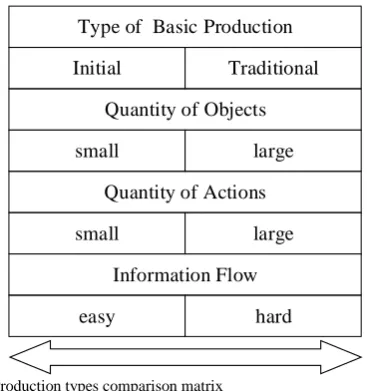
The first case means the production deployment by small innovative enterprises [4]. The second case means partial or full production deployment on the base of medium-sized innovative enterprises and large production centers [5]. It is necessary to carry out structuring of the features of newly forming robotic enterprises in order to make a fuzzy comparison of the presented scenarios. For this purpose, we will combine the operating parameters similar in value and behavior. Fig. 1 shows the matrix of comparison of these scenarios by main parameters.
Assuming these it is possible to conclude the following: -- risks are related to the absence of observation because of space and resource economy – for initial production;
-- risks are related to the absence of organization because of difficulties of integration in existing system.
As can be seen from the basic metrics of both cases, they are opposite in their advantages and disadvantages.
2) Technical and economic factors
In both cases, minimizing risks and achieving high efficiency can be reached by implementing lean principles. Proven principles of lean – such as reducing waste in the form of machine break downs or non-value-adding activities – will remain fundamental. At the same time, advancements in data collection, sensors, robotics and automation, new technologies and increased computing power will enable advanced analytics and give established methods a new edge [6].
In this, the most critical is to establish the concept aimed at solving the main problems of the above-described extremes scenario of enterprises: formation of the flexible manufacturing organizing system, introduction of universal scalable observation system and as the result of their interaction - control system, based on reconfigurable manufacturing systems approach [7] with the development perspectives to adaptive manufacturing system [8].
B. Concept description
The PFMS under development is based on dynamic organization and observation subsystems [7]. Subsystems implementation and their mechanisms are shown on fig. 2.
This effect is achieved due to the implementation features of the organizing and monitoring subsystems.
Organizing subsystem is based on the multiagent system with dynamic mechanism of coalition formation approach [8 -10], observing subsystem – end-to-end structural and parametric wavelet identification tool [11, 12].
C. Structure and Mechanism
The general structure of the proposed production system is based on two subsystems, which carry out both independent functioning and mutual influence. The overall effect of adaptive management is due to the effective decomposition of the global task, as well as the constant exchange of information at all levels of control - in Fig. 3.
Subsystems exchange mechanism is based on complex behavioral model of the enterprise. The main object in the behavioral setting is the “behavior” – the set of all signals compatible with the system. An important feature of this approach is that it does not distinguish a priority between input and output variables. Apart from putting system theory and control on a rigorous basis, the behavioral approach unified the existing approaches and brought new results on controllability for nD systems, control via interconnection, and system identification [13].
III. FROM CONCEPT TO PRODUCT
Let us consider the evolution from an abstract representation of the system from the concept to the driven product. To begin with, let's analyze the term science-driven product, after which we will turn to the basic methodology of the lean startup [14].
easy hard
small large
Quantity of Actions Quantity of Objects
small large
Information Flow Initial Traditional
[image:2.595.307.544.109.260.2]Type of Basic Production
Fig. 1. Production types comparison matrix
Organization Observation
Work Environment
Global Product Task/Solution
Complex State Information
Global Model Task/Solution Enterprise
[image:2.595.86.270.253.449.2]Behavioral Model Reorganization
Fig. 2. Subsystems implementation and their interaction mechanisms
O
bs
er
vi
ng s
ubs
ys
te
m
Organizing subsystem
[image:2.595.307.548.452.564.2]A. Science-driven product
In contrast with “project”– any undertaking, carried out individually or collaboratively and possibly involving research or design, that is carefully planned to achieve a particular ai [15], “product” is an item that serves as a solution to a specific consumer problem. In our research we represent problem in science terms, so why we called it science-driven product.
B. The lean startup
Lean startup is a methodology for developing products, which aims to shorten product development cycles and rapidly discover if a proposed business model is viable; this is achieved by adopting a combination of business-hypothesis-driven experimentation, iterative product releases, and validated learning [14, 17].
Central to the lean startup methodology is the Build-Measure-Learn, that we transformed for our objectives, taking into account the focus on the scientific way of development of the system. The functional requirements for the system are then reviewed based on its external and internal presentation. The functional requirements for the system are then reviewed based on its external and internal presentation. Within the functional requirements, the approach to minimal viable product (MVP) is formed as independently valuable elements of the system.
[image:3.595.311.559.78.178.2]C. Build-Measure-Learn loop
Fig. 4 shows the basic type of development cycle according to the lean startup methodology [14].
The Build-Measuring-Learn loop emphasizes that speed is an essential component of product development. The effectiveness of a team or company is determined by its ability to idealize, quickly create a MVP of the idea, measure its effectiveness in the marketplace, and learn from this experience. In other words, it is a learning cycle in which ideas are turned into products, the reaction and behavior of customers to the created products is measured, and then a decision is made whether to continue or reverse the idea; this process is repeated as many times as necessary. The phase of the cycle is: Ideas → Build → Product → Measurement → Data → Learn [14, 18].
For science-driven product we build the phases starting from Data and Learn: Data → Learn → Ideas → Build → Product → Measure. The reason for this is that in case of operating a knowledge-intensive product, it is necessary to collect preliminary information on the corresponding research areas. Since globally the concept concerns, first of all, the system representation of both the system itself and
systems above and below the level: supersystem and subsystems. A schematic description is presented in Fig. 5.
Introduction of system inputs and outputs when designing the system as a science-based product is extremely important in the future to establish global functional requirements.
D. Functional Requirements
The basic elements of functional requirements are presented in the following consecutive nested list:
1) Product description - main ideas about the form and content of the system;
2) Product creation goal – S.M.A.R.T. objectives for the system [16];
3) Module i=1..n - synergistic independent set of functions as an element of the system:
a) Module description - main ideas about the form and content of the system element;
b) Users/roles - a list of end-users and their roles in the system;
c) User Story j=1..m - presentation of the idea of a system element of the kind "I, as a performer of the role, will use this module, because I have specific SMART objectives;
(d) Function f=1..k - properties of the system element to solve the purposes;
i) Description - the main ideas about the form and content of the system element;
(ii) Scheme - a conceptual description of the interaction of the property with the environment;
(iii) Input/output data - ranking of data to determine properties range;
(iv) Usage scenario - case study on property applications;
(v) Algorithms and methods - selection of scientific tools for the most comprehensive implementation of the property.
This view provides the most comprehensive coverage of the necessary information for the next steps in research and development of the system as a science-driven product.
E. Minimal viable product
The MVP has a sufficient number of basic functions for the effective deployment of the product. The MVP is the version of the new product used by the team to collect the maximum amount of verified customer knowledge with the least effort. The use of maximum and minimum words means that it is not a formula. This requires judgment to understand, in any given context, what makes sense to MVP. Due to this uncertainty, the term MVP is widely used to refer to a much broader concept, from a fairly prototype product to a fully-fledged and in demand product. This is very important when we are trying to create a testing methodology for a new product
Build
Measure
Learn
Data
Code
Ideas
Fig. 4. Basic Build-Measure-Learn loop
Subsystem 1
System
Supersystem
Subsystem 2 Subsystem 3
[image:3.595.59.249.398.536.2]based on scientific advances.
Viability for MVP of science-driven product is expressed in the systemic adequacy of the representation of system elements under the condition of modeling their interaction with the supersystem and subsystems.
This is the main feature in the iterative process of idea generation, prototyping, presentation, data collection, analysis and training. One of them aims to minimize the total time spent on iteration. The process is iterated until the desired product/market does not meet the requirements, or until the product is considered unviable.
F. Primary pivots
A pivot is a structured course correction designed to test a new fundamental hypothesis about a product, strategy and growth engine [14, 17]. For the science-driven product methodology the following basic pivots were chosen and modified.
Zoom-in pivot. This pivot can be useful when one feature of a product under development gets far more traction and interest than the other features of it. It’s also helps get to market more quickly and build an MVP more efficiently.
Zoom-out pivot. This is the above pivot in reverse. The product can be broadened to include more features. Now what was considered the whole product becomes one or several features of a larger product.
Platform pivot. This talks about a change from an application to a platform or vice versa.
Engine of growth pivot. Nowadays, most startups use one of the three main growth models: viral, sticky and paid. Viral growth is when current users recommend other users. Paid growth is when new customers are attracted in result of marketing. Sticky growth is when the developer manages to retain most of users and churn rate is low.
Technology pivot. This pivot is when a new technology can be used to achieve the same outcome. This can be beneficial if the new solution has lower cost and/or better performance.
G. Summary framework
Combining the above modifications of lean startup tools into a single framework allows you to get a boost-methodology for effective development of the system under study. This methodology has been successfully applied to the solution of the private case described below.
IV. CASE-ORIENTED SOLUTION
In this paragraph the solution for industrial automation based of the modified methodology of lean startup for science-driven project is described.
A. Case problem
The supporting case for FPMS study and development is the partially automation of drilling and riveting of the airframe in a traditional production environment.
Modern fully automated equipment, regardless of its purpose, is created for the implementation of specially developed technological processes, which, in accordance with the principle of variation, can significantly differ even in relation to a single product [19-23]. Therefore, the
automation of assembly processes for aircraft components should begin with a rethinking of the existing theoretical positions and practical experience oriented towards manual production. Today there are following methods of assembly are actively used in manual production: on the base part, on the assembly holes, and on the marking. It should be noted that work on the automation of the above assembly methods is carried out quite intensively, but so far, a unified concept of flexible riveting and assembly systems has not been developed.
To automate the assembly process, it is necessary to develop a robotic system able to implement the whole process in one workplace, since the transportation of parts with low rigidity is difficult. The system should include the following:
-- riveting machine; -- locate-and-clamp fixture; -- parts feeder;
-- self-unloading mechanism; -- rivet feeder;
-- movements control system; -- installer readjustment mechanism.
It is quite obvious that the economic efficiency of such a system can be achieved only by its high performance and flexibility, allowing to produce aerospace product regardless of their belonging to the product in development or re-launched one
The approach proposed by the authors is aimed, first of all, at robotization of the drilling and riveting works with minimal equipment costs. The system will consist of one collaborative robot equipped with a special tool. This configuration allows the simultaneous work of human and robot in a shared technological environment
There are the following critical technological solutions for this case:
-- collaborative robotics [24];
-- data gathering by set of sensors [25]; -- digital interface for operators [26].
The high intelligence level of the modern tools also impacts on the concept in the questions of effective use of intelligent elements of these solutions at all levels of management
B. Product solution
In this case collaborative production cell is represented as an element of PFMS system level. This is possible due to the use of the developed transition method from concept to science-driven product. The use of modified Build-Measure-Learn loop described above allowed to formulate functional requirements for MVP for drilling and riveting collaborative production cell.
C. Technical composition
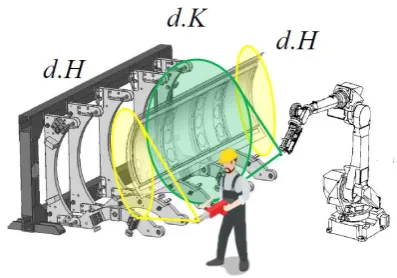
[image:5.595.67.266.51.190.2]Consider the basic technical solutions on the example of drilling and riveting tool module. The proposed technical implementation of the system is presented on Fig. 7.
Fig. 7. The structure of the robotic system for drilling and riveting
The equipment can be divided into the following groups according to its properties:
A – base manipulator - the basis of the collaborative robot, which is an n-link industrial manipulator.
B – modified tool - end-of-arm tool for drilling and riveting, the essence of the technical requirements for which is formed on the basis of the manipulator ergonomics. It is also notable, that due to human-like ergonomics of the modern collaborative robots, the development of tool modification is a part of the future work [27, 28].
C - sensing system - one of the keys of the concept implementation is the modification of the existing robot, tool and tooling for drilling and riveting into collaborative to be similarly safe for human. The approach is based on a special sensing system for the robot, tool and tooling and developing of a simplified lashing diagram [29, 30].
D – control unit - hardware unit for implementing a part of a hybrid control system of a collaborative multiagent robotic system [9]. It can be integrated into the united information field, along with being able to decentralized control with the operator assistance.
Within the framework of the proposed concept robot performs a significant part of drilling and riveting works. The human not only acts as an observer but also has the ability to perform the same operations as the robot, for example, in areas inaccessible to the robot. The robot, tool, and tooling have to be equipped by sensors due to meet strict safety requirements for work in cooperation with human [31]. However, these technical solutions will lead to the robotic system total cost increase due to the design complexity and additional requirements for the control algorithms.
V. CONCLUSION
Assuming the results of this study it is possible to conclude the following:
-- precondition for creation of a PFMS for newly forming robotic enterprise and the concept itself were considered;
-- PFMS concept was represented as the science-driven product;
-- set of tools for work with modified concept were designed;
-- designed approach was applied at forming functional requirements for minimal viable product for collaborative drilling and riveting production cell.
The future work will consist of system specification for further software and hardware implementation.
REFERENCES
[1] Lee, J., Bagheri, B., & Kao, H. A. (2015). A cyber-physical systems architecture for industry 4.0-based manufacturing systems.
Manufacturing letters, 3, 18-23.
[2] Tarassov, V. B. (2018). Enterprise Total Agentification as a Way to Industry 4.0: Forming Artificial Societies via Goal-Resource Networks. In International Conference on Intelligent Information Technologies for Industry, (pp. 26-40). Springer, Cham.
[3] Akberdina V., Kalinina A., Vlasov A. (2019) Transformation stages of the Russian industrial complex in the context of economy digitization.
Problems and Perspectives in Management, 201-211.
[4] Hedelind, M., & Jackson, M. (2011). How to improve the use of industrial robots in lean manufacturing systems. Journal of Manufacturing Technology Management, 22(7), 891-905.
[5] Vysocky, A., & Novak, P. (2016). Human-Robot collaboration in industry. MM Science Journal, 9(2), 903-906.
[6] Behrendt, A., Müller, N., Odenwälder, P., & Schmitz, C. (2017). Industry 4.0 demystified–lean’s next level. Retrieved March, 3. [7] Serebrenny V., Lapin D., Mokaeva A. (2019) The Concept of Flexible
Manufacturing System for a Newly Forming Robotic Enterprises. In
Lecture Notes in Engineering and Computer Science: Proceedings of The World Congress on Engineering 2019, 3-5 July, 2019, London, U.K., (pp. 267-271).
[8] Vorotnikov, S., Ermishin, K., Nazarova, A., & Yuschenko, A. (2018, September). Multi-agent Robotic Systems in Collaborative Robotics. In International Conference on Interactive Collaborative Robotics (pp. 270-279). Springer, Cham.
[9] Pechoucek, M., Marik, V., & Stepankova, O. (2000). Coalition formation in manufacturing multi-agent systems. In Proceedings 11th International Workshop on Database and Expert Systems Applications
(pp. 241-246). IEEE.
[10] Nazarova, A. V., & Zhai, M. (2019). Distributed Solution of Problems in Multi Agent Robotic Systems. In Smart Electromechanical Systems
(pp. 107-124). Springer, Cham.
[11] Bakhtadze, N., & Sakrutina, E. (2016, May). Wavelet-based identification and control of variable structure systems. In 2016 International Siberian Conference on Control and Communications (SIBCON) (pp. 1-6). IEEE.
[12] Bakhtadze, N., & Sakrutina, E. (2016). Applying the Multi-Scale Wavelet-Transform to the Identification of Non-linear Time-varying Plants. IFAC-PapersOnLine, 49(12), 1927-1932.
[13] Markovsky, I., Willems, J. C., Van Huffel, S., & De Moor, B. (2006).
[image:5.595.57.278.384.505.2]Exact and approximate modeling of linear systems: A behavioral approach (Vol. 11). SIAM.
Fig. 6. Example of human and robot collaboration
А
B
C
[14] Ries, E. (2011). The lean startup: How today's entrepreneurs use continuous innovation to create radically successful businesses. Crown Books.
[15] Kerzner, H. (2017). Project management: a systems approach to planning, scheduling, and controlling. John Wiley & Sons.
[16] Eisenmann, T. R., Ries, E., & Dillard, S. (2012). Hypothesis-driven entrepreneurship: The lean startup. Harvard Business School Entrepreneurial Management Case, (812-095).
[17] Maurya, A. (2012). Running lean: iterate from plan A to a plan that works. " O'Reilly Media, Inc.".
[18] Doran, G. T. (1981). There’s a SMART way to write management’s goals and objectives. Management review, 70(11), 35-36.
[19] Lysenko Ju. (2007) Mehanizacija i avtomatizacija sborochno-klepal'nyh rabot na baze mashin impul'snogo dejstvija: ucheb. posobie [Mechanization and automation of assembly and riveting works based on pulsed machines: a tutorial]. Samara: Publishing house of Samar State Aerospace University (In Russ.).
[20] Automation in the aerospace industry. Retrieved from https://www.kuka.com/en-de/industries/other-industries/aerospace [21] Mechanic and Machine: Boeing’s Advanced Manufacturing Improves
777 Assembly. Retrieved from https://www.boeing.com/features/2017/02/faub-777-assembly-02-17.page
[22] Broetje-Automation. Retrieved from https://www.broetje-automation.de/en/equipment/automatische-montage
/bohren-nieten/#bohren-nieten
[23] Fedorov V. (2003) Tehnologija sborki izdelij aviacionnoj tehniki: Tekst lekcij [Technology of assembly of aviation equipment: Text of lectures]. Chelyabinsk: SUSU publishing house (In Russ.).
[24] Khalid, A., Kirisci, P., Ghrairi, Z., Thoben, K. D., & Pannek, J. (2016). A methodology to develop collaborative robotic cyber physical systems for production environments. Logistics Research, 9(1), 23. [25] Lindsey, S., & Raghavendra, C. S. (2002, March). PEGASIS:
Power-efficient gathering in sensor information systems. In Proceedings, IEEE aerospace conference (Vol. 3, pp. 3-3). IEEE.
[26] Fernandez, M. G., Rosen, D. W., Allen, J. K., & Mistree, F. (2002, January). Digital interfaces: the key to effective decision-making in distributed collaborative design and manufacturing. In ASME 2002 International Design Engineering Technical Conferences and Computers and Information in Engineering Conference (pp. 467-479). American Society of Mechanical Engineers.
[27] Sarh, B. (1990). U.S. Patent No. 4,967,947. Washington, DC: U.S. Patent and Trademark Office.
[28] Shi, Z., Yuan, P., Wang, Q., Chen, D., & Wang, T. (2016). New design of a compact aero-robotic drilling end effector: An experimental analysis. Chinese Journal of Aeronautics, 29(4), 1132-1141. [29] Pang, G., Deng, J., Wang, F., Zhang, J., Pang, Z., & Yang, G. (2018).
Development of flexible robot skin for safe and natural human–robot collaboration. Micromachines, 9(11), 576.
[30] Mazzocchi, T., Diodato, A., Ciuti, G., De Micheli, D. M., & Menciassi, A. (2015, September). Smart sensorized polymeric skin for safe robot collision and environmental interaction. In 2015 IEEE/RSJ International Conference on Intelligent Robots and Systems (IROS) (pp. 837-843). IEEE.
![Fig. 4 shows the basic type of development cycle according to the lean startup methodology [14]](https://thumb-us.123doks.com/thumbv2/123dok_us/393219.536864/3.595.59.249.398.536/fig-shows-basic-development-cycle-according-startup-methodology.webp)