IJIRT 101466
INTERNATIONAL JOURNAL OF INNOVATIVE RESEARCH IN TECHNOLOGY90
Analysis of pH process using Model Reference Adaptive
Controller
S.Gomathy
1, Ms.T.Anitha
21
PG Scholar, Department of Control and Instrumentation Engineering,
2Assistant Professor, Department of Control and Instrumentation Engineering,
Sri Ramakrishna Engineering College, Coimbatore, India
Abstract- pH control plays an important role in many applications. pH value must be maintained within the allowable range so that the products produced within the safety limit. There is no particular acceptable solution to control the varying pH value. Due to high non-linearity of the process, controlling of the acid-base parameters becomes difficult. Conventional controller designed for controlling parameters does not obtain good performance. To overcome the disadvantage of conventional controller, advanced controllers like IMC based PID, adaptive techniques like Model Reference Adaptive Controller(MRAC) and Intelligent controllers like Fuzzy Logic Controller(FLC) are designed to obtain better performance. A comparative study of these controllers was done in this work.
Index Terms- PID controller, IMC based PID controller,Model Reference Adaptive
controller(MRAC),Fuzzy Logic Controller(FLC).
I. INTRODUCTION
Control of the pH neutralization process plays an important role in different chemical plants, such as chemical and biological reaction, waste water treatment, electrochemistry and precipitation plants, production of pharmaceuticals, fermentation, and food production such as in vegetable oil refining. However, it is difficult to control a pH process with
adequate performance point due to its nonlinearities,
time-varying properties and sensitivity to small disturbances when working near the equivalence point. The pH was defined earlier as the measure of the acidity or the basic of a solution, and an acid was defined as the solution of pH less than 7, and the base as that solution of pH larger than 7.Titration curves provide information about acids and bases in addition
to analyzing the quantity that is present [8]. They can provide information about the strength of the acid or base, the number of ionizable groups,ionization and hydrolysis constants, and molecular weight.
By manipulating control parameters, the pH level within the system can be kept within a certain range. To determine the proper control mechanism adaptive controlling schemes are used. The pH number is a measure of concentration or more precisely the activity of hydrogen ion in a solution.
]
log[
H
pH
(1)More specifically, the pH was controlled in a continuously stirred tank reactor (CSTR) in this experiment. The reaction being controlled was the acid-base reaction of sodium hydroxide (NaOH) and hydrochloric acid (HCL).If the pH of the process solution is maintained constantly by adding HCL to the process tank is said to be acid control and if the pH of the process solution is maintained constantly by adding NaOH to the process tank is said to be base control.
Using process reaction curve the open loop test is done and the transfer function is obtained for both acid and base separately. Conventional controller, advanced controller and intelligent controllers are designed. Comparative study is done between PID,IMC based PID,MRAC then Fuzzy Controller. In this paper Fuzzy Controller is used to tune the PID.
A.PREPARARION OF SOLUTIONS Fluid taken for pH process:
IJIRT 101466
INTERNATIONAL JOURNAL OF INNOVATIVE RESEARCH IN TECHNOLOGY91
Process solution-distilled wáter
Preparation of 1pH of acid:
pH = - log [(Amount of HCl/lt)/Molecular Weight] pH= -log[3.65/36.5]
pH=1
Preparation of 13 pH of base:
pOH= - log[(Amount of NaOH/lt)/Molecular Weight] pH = 14 – pOH
pH=14-[-log(4.0/40)] pH=13
The Hardware setup of the pH control trainer is shown in fig1.
Fig 1: Hardware setup of pH
II.PROCESS REACTION CURVE METHOD
The process reaction curve methods works by generating a process reaction curve (below) in response to a disturbance. Controller gain, integral time and derivative time can be calculated using this curve.
Fig 2: Process reaction curve
Transfer function for acid:
1
100
07114
.
0
)
(
20
s
e
s
Gp
s
(2)
Transfer function for base:
)
(
s
Gp
=1
320
04912
.
0
20
s
e
s(3)
III. DESIGN OF PID CONTROLLER
PID controller is used when dealing with higher order capacitive processes (processes with more than one energy storage) when their dynamic is not similar to the dynamics of an integrator (like in many thermal processes). PID controller is often used in industries.
A.PID FOR ACID
Kp=97.22379
i
=0.001460d
=6.77966B.PID FOR BASE
Kp=439.29303
i
=0.02107d
=7.2644IV. DESIGN OF IMC BASED PID CONTROLLER
IJIRT 101466
INTERNATIONAL JOURNAL OF INNOVATIVE RESEARCH IN TECHNOLOGY92
controller design that emphasizes disturbance rejection rather than set point tracking is an important design problem that has to be taken into consideration.
A.IMC BASED PID FOR ACID
Kp=56.25879 Ki=0.56259 Kd=6.6666
B.IMC BASED PID FOR BASE
Kp=260.69246 Ki=0.81466 Kd=7.78564
V. DESIGN OF MODEL REFERENCE ADAPTIVE CONTROLLER
In MRAC technique Adjustment mechanism automatically adjusts the controller parameters so that the plant output(y) closely follows that of reference model. The adjustment mechanism constructs by adaptive control (MIT rule)[4] .
Fig 3: General block diagram of MRAC
The Adaptive Controller has two loops. The inner loop consists of the process and an ordinary feedback controller. The outer loop adjusts the controller parameters in such a way that the error, which is the difference between the process output y and model output ym is small[6].
A.MIT RULE
The MIT rule was originally approach to model reference adaptive control[5]. Let the desired close loop response be specified by a model whose output
m
y and let e be the error between the output y of the
close loop system and the output
y
m of the model. one possibility is to adjust the parameter in such a way that the loss function,2
2
1
)
(
e
J
(4)is minimized[5]. To make J small, it is reasonable to change the parameters in the direction of negative gradients of J (i,e)
j
dt
d
(5)B.MODELLING OF MRAC
Consider a first order system:
bu
ay
dt
dy
(6) The controller can be written as,y
u
u
1
c
2
(7) The model can be considered as,
c m m m m
m
a
y
b
u
dt
dy
(8)
M.I.T rule is introduced to minimize the loss function,
Error=
y
y
m(9)
Loss function 2
2
1
)
(
e
J
(10) The controller parameters are chosen as,
b
a
a
b
b
m m
2
1
(11) Thus the parameter adjustment is given by,e
a
u
a
dt
d
m c m.
1
(12)e
a
y
a
dt
d
m m.
2
(13)VI. DESIGN OF FUZZY LOGIC CONTROLLER
IJIRT 101466
INTERNATIONAL JOURNAL OF INNOVATIVE RESEARCH IN TECHNOLOGY93
control rules (e.g., IF-THEN rules) involving linguistic variables rather than a complicated dynamic model. The fuzzy rule base stores the empirical knowledge of the operation of the process of the domain experts. The inference engine is the kernel of a FLC, and it has the capability of simulating human decision making by performing approximate reasoning to achieve a desired control strategy[1].
An FLC consists of three components; the fuzzification process, inference,and the defuzzification process.
Fig 4: General block diagram of FLC
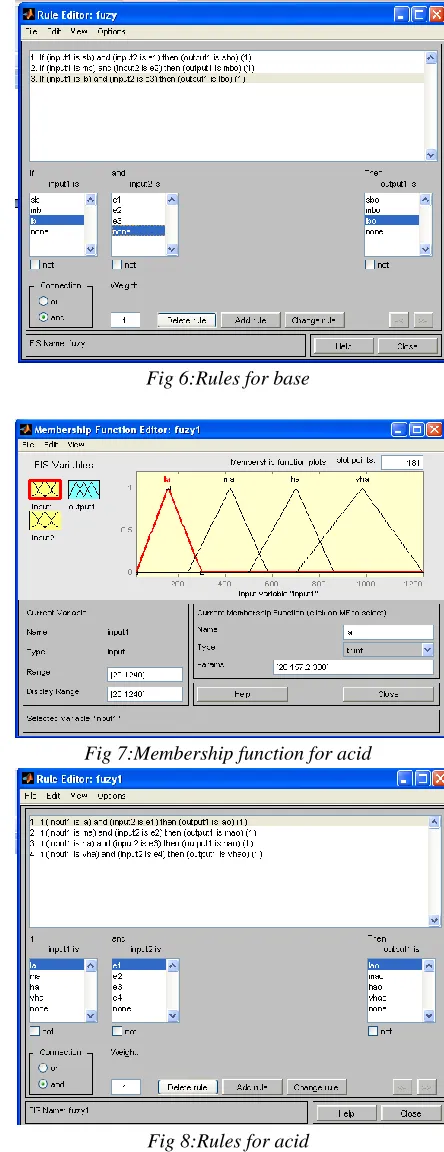
The fuzzification process interprets the inputs as linguistic values. Inference uses a knowledge base of rules to determine the output sets for the input linguistic values. Finally, the defuzzification process uses the output of the inference to derive a single crisp" output value. Fuzzification transforms a set of crisp inputs to the corresponding fuzzy sets.In this paper fuzzy controller is used to tune the PID parameters to get the better response.
Fig 5:Membership function for base
Fig 6:Rules for base
Fig 7:Membership function for acid
Fig 8:Rules for acid
IJIRT 101466
INTERNATIONAL JOURNAL OF INNOVATIVE RESEARCH IN TECHNOLOGY94
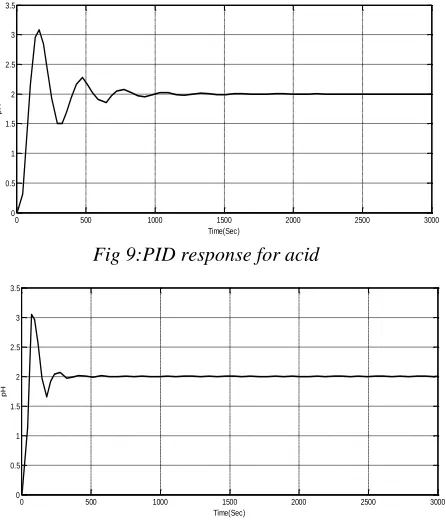
VII. SIMULATION RESULTS
Fig 9:PID response for acid
Fig 10: IMC based PID response for acid
Fig 11: MRAC response for acid
Fig 12: Response of PID tuning using FLC for acid
Fig 13: PID response for base
Fig 14: IMC based PID response for base
Fig 15: MRAC response for base
Fig 16: Response of PID tuning using FLC 0 500 1000 1500 2000 2500 3000
0 0.5 1 1.5 2 2.5 3 3.5
Time(Sec)
pH
0 500 1000 1500 2000 2500 3000 0
0.5 1 1.5 2 2.5 3 3.5
Time(Sec)
pH
0 100 200 300 400 500 600 700 800 900 1000 -0.5
0 0.5 1 1.5 2 2.5
Time(Sec)
pH
0 5 10 15 20 25 30 35 40 45 50 0
1 2 3 4 5 6 7
Time(Sec)
pH
0 500 1000 1500 2000 2500 3000 0
2 4 6 8 10 12 14 16 18 20
Time(Sec)
pH
0 500 1000 1500 2000 2500 3000 0
2 4 6 8 10 12 14
Time(Sec)
pH
0 100 200 300 400 500 600 700 800 900 1000 -2
0 2 4 6 8 10 12 14
Time(Sec)
pH
0 5 10 15 20 25 30 35 40 45 50 0
5 10 15 20 25
Time(Sec)
IJIRT 101466
INTERNATIONAL JOURNAL OF INNOVATIVE RESEARCH IN TECHNOLOGY95
Table1:Comparison table for acid
Controllers PID IMC based PID
MRAC PFLC
Settling time(sec)
1500 800 600 30
Peak overshoot
3 1.5 0 4
Table2: Comparison table for base
IX. CONCLUSION
The above simulation and the results from the above tabulation shows that the designed intelligent controller and advanced controllers performed better than the conventional controller. Thus for maintain the pH level of a process the acid and the base levels are maintained and controlled using the controllers. It is inferred that intelligent controllers serves better in settling time and the advanced controller serves better in peak overshoot.
REFERENCES
[1] Teenu Jose, Rahul Antony, Samson Isaac, “pH neutralization in CSTR using Model Reference Neural Network and Fuzzy Logic Adaptive controlling schemes”, International Journal of Advancements in Research & Technology, Volume 2, Issue1, January-2013.
[2] R. Prakash, R. Anita, “Design of Intelligent Adaptive Control using Neural Network and Fuzzy Logic Controller,” European Journal of Scientific Research 2011, pp.156-172
[3] Nejati, Ali, Shahrokhi, Mohammad, Mehrabani, Arjomand, “Adaptive Input-Output Linearization Control of pH Processes”
Iran.J.Chem.Eng, Vol. 27, No.3, 2008.
[4] Nayeem N. Karnachi and Geoff Waterworth, “ Non-linear Model Reference control of pH process” Proceedings 15th European Simulation Symposium, 2003 ISBN 3-936150-28-1 (book) / 3-936150-29-X (CD).
[5] Nguyen Tan Tien, “Adaptive Control,” IEEE transaction-Vol.6,2002.
[6] Karl Johan Astrom, Bjorn Wittenmark, “Adaptive Control,” Second edition,Pearson education Asia,1995.
[7] Kulkarni, B. D,S. Tambe, N. V. Shukla and P. B. Deshpande. “Non-linear pH Control.” Chem. Eng. Sci., 46, 995,1991.
[8] Robert H Perry, Don W Green, “Perry’s chemical engineering hand book,” Seventh edition McGra-Hill San Fransisco Washington D C. Controllers PID IMC
based PID
MRAC PFLC
Settling time(sec)
2000 1400 550 20
Peak overshoot