2019; 7(2): 51-58
http://www.sciencepublishinggroup.com/j/net doi: 10.11648/j.net.20190702.16
ISSN: 2326-9766 (Print); ISSN: 2326-9782 (Online)
GA Technique to Solve the Load Frequency and Tie-Line
Power Problem of Thermal Generating Unit
Ashish Dhamanda, Gajendra Singh Rawat
Electrical Engineering Department, Gurukula Kangri University, Haridwar, India
Email address:
To cite this article:
Ashish Dhamanda, Gajendra Singh Rawat. GA Technique to Solve the Load Frequency and Tie-Line Power Problem of Thermal Generating Unit. Advances in Networks. Vol. 7, No. 2, 2019, pp. 51-58. doi: 10.11648/j.net.20190702.16
Received: October 19, 2019; Accepted: November 20, 2019; Published: December 2, 2019
Abstract:
For a wide role of a electric power system, Automatic Generation Control (AGC) is responsible to area loadchanges and abnormal imprecise system operating parameters essentially means very fast minimization of area frequency changes and mutual tie line power flow changes of the areas for satisfactory and stable operation of the system. Some technique gives the good results in normal operation but in abnormal condition, it take large time to settle down the load disturbance, which is harmful for the system. Genetic Algorithm (GA) Technique) provides better control performance over frequency deviations and tie line power flow deviations due to a normal and abnormal operating condition of sudden load changes. In this paper six area model of thermal generating units has been developed and simulated in MATLAB Simulink software. Response of the developed model has been obtained by GA technique and compared with the other technique like; fuzzy, PID. Tabulated result shows that the GA technique give the better performance over the other technique due to settling down the frequency and tie line power flow changing in less time and maintenance the system constancy with the litmits.
Keywords:
Imprecise System, Frequency Deviations, Tie Line Power Flow, Automatic Generation Control,Genetic Algorithm
1. Introduction
Electrical energy is broadly used all over the world because it is a most flexible form of energy. The problem of electrical power system is to randomly change of load due to heavy demand arise from the consumer.
A control strategy has been made which can generate and deliver the power as economically and reliable as possible with limitation of frequency and voltage. Change in real power dependent on the frequency and independent of voltage while voltage dependent on the reactive power and independent of frequency. Thus, real power with frequency and reactive power with voltage are controlled separately.
The AGC of a large interconnected electric system has aspects to maintain the frequency and power changes over tie lines on scheduled value in general operating condition and even when there is a small amount of load changing continuously. In steady state condition, the output of the generators at any instant will exactly equal to load on the system and all the generating units operate synchronously with the same operating frequency. [1-9, 12-20].
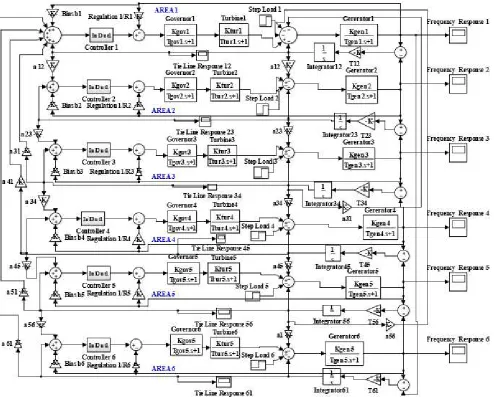
Figure 1. Six Area Thermal Generating Unit (TGU).
2. Mathematical Equation of AGC
For such a large and complex systems, the mathematical equations for six area thermal units are given below; [2, 4-5, 10-11]
Load frequency deviation ( ) and tie-line power for step load ( ) changes are given in equation 1 and 2,
= - 1 − (1)
Power flow out of control area-1 can be expressed as
PTL1 = | | | | sin (δ1- δ2) (2)
Where|!"| and |!&| are voltage magnitude of area 1 and area 2, respectively, δ1 and δ2 are the power angles of
equivalent machines of their respective area, and '() is the tie line reactance.
The above equations is used to determine the settling time response of the load changes system corresponding to tie-line power for all areas of thermal generating system.
The increase in load demand ( ) is met under steady state conditions partly by the increased generation *) due to the opening of the steam valve and partly by the decreased load demand due to droop in frequency.
Increase in generation ( *) can be expressed by the equation 3,
* = - " − +," = -" ˟+ ," . (3)
Where is increase in demand, R is speed governor regulation, generally B is much less than (i.e., B « "). Power in p.u. for single area case is
ΔP1" s − ΔP3" s =&567 s89 8 ΔF" s +B1∆F1(s)+∆PTL1(s)
(4)
In single area system, Area Control Error (ACE) is the change in frequency but for two area power system, ACE is the linear combination of the change in frequency and change in tie-line power. Thus, for control area-1 we have
Where b1 = constant area frequency bias. Taking Laplace
transform on both sides of equation (5), we get equation 6
ACE1(s) = ∆PTL1 (s) + b1∆F1(s) (6)
Similarly, ACE for all the six area thermal generating system can be obtained. [15-19]
3. Genetic Algorithm (GA)
This algorithm inspired by the mechanism of natural selection, a biological process in which stronger individual is likely to be the winners in a competing environment. GA uses a direct analogy of such natural evolution to do global optimization in order to solve highly complex problems. It presumes that the potential solution of a problem is an individual and can be represented by a set of parameters. These parameters are regarded as genes of a chromosome and can be structured by a string of concatenated values. The form of variables representation is defined by the encoding scheme. The variables can be represented by binary, real numbers or other forms, depending on the application data.
GA parameters for six area thermal generating system has
been found with fitness function, population size, selection, mutation, cross over, bound limit etc. listed on Table 1.
Table 1. GA Parameters for System.
Parameters Six Area Thermal Generating System
Fitness Function @ash_dha
Variables 18
Population Size 20
Selection Stochastic Uniform
Mutation Constraint Dependent
Cross Over Scattered
Bound Limit Upper [0] and Lower [-5]
4. Result
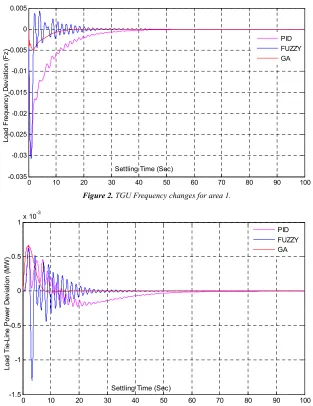
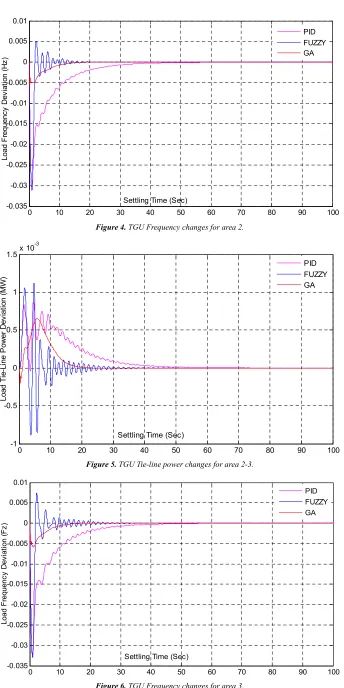
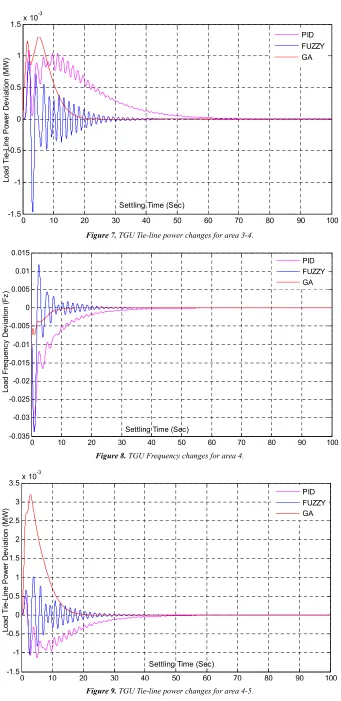
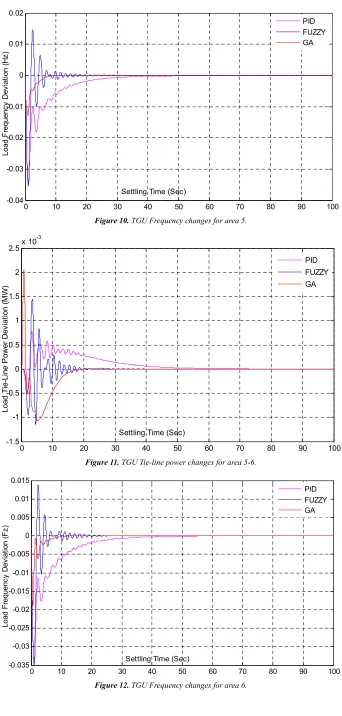
In this paper PID, Fuzzy and new approach (GA technique) has been used combinedly to obtained the settling time response of load frequency and tie-line power deviation of thermal generating system of six area system with step load 0.01 p.u is applied. The comparative response obtained for load frequency and tie-line power changes of thermal generating system is given below and results are tabulated in Table 2.
Figure 2. TGU Frequency changes for area 1.
Figure 3. TGU Tie-line power changes for area 1-2.
0 10 20 30 40 50 60 70 80 90 100
-0.035 -0.03 -0.025 -0.02 -0.015 -0.01 -0.005 0 0.005
Settling Time (Sec)
L
o
a
d
F
re
q
u
e
n
c
y
D
e
v
ia
ti
o
n
(
F
z
)
PID FUZZY GA
0 10 20 30 40 50 60 70 80 90 100
-1.5 -1 -0.5 0 0.5
1x 10 -3
Settling Time (Sec)
L
o
a
d
T
ie
-L
in
e
P
o
w
e
r
D
e
v
ia
ti
o
n
(
M
W
)
Figure 4. TGU Frequency changes for area 2.
Figure 5. TGU Tie-line power changes for area 2-3.
Figure 6. TGU Frequency changes for area 3.
0 10 20 30 40 50 60 70 80 90 100
-0.035 -0.03 -0.025 -0.02 -0.015 -0.01 -0.005 0 0.005 0.01
Settling Time (Sec)
L
o
a
d
F
re
q
u
e
n
c
y
D
e
v
ia
ti
o
n
(
H
z
)
PID FUZZY GA
0 10 20 30 40 50 60 70 80 90 100
-1 -0.5 0 0.5 1 1.5x 10
-3
Settling Time (Sec)
L
o
a
d
T
ie
-L
in
e
P
o
w
e
r
D
e
v
ia
ti
o
n
(
M
W
)
PID FUZZY GA
0 10 20 30 40 50 60 70 80 90 100
-0.035 -0.03 -0.025 -0.02 -0.015 -0.01 -0.005 0 0.005 0.01
Settling Time (Sec)
L
o
a
d
F
re
q
u
e
n
c
y
D
e
v
ia
ti
o
n
(
F
z
)
Figure 7. TGU Tie-line power changes for area 3-4.
Figure 8. TGU Frequency changes for area 4.
Figure 9. TGU Tie-line power changes for area 4-5.
0 10 20 30 40 50 60 70 80 90 100
-1.5 -1 -0.5 0 0.5 1 1.5x 10
-3
Settling Time (Sec)
L
o
a
d
T
ie
-L
in
e
P
o
w
e
r
D
e
v
ia
ti
o
n
(
M
W
)
PID FUZZY GA
0 10 20 30 40 50 60 70 80 90 100
-0.035 -0.03 -0.025 -0.02 -0.015 -0.01 -0.005 0 0.005 0.01 0.015
Settling Time (Sec)
L
o
a
d
F
re
q
u
e
n
c
y
D
e
v
ia
ti
o
n
(
F
z
)
PID FUZZY GA
0 10 20 30 40 50 60 70 80 90 100
-1.5 -1 -0.5 0 0.5 1 1.5 2 2.5 3 3.5x 10
-3
Settling Time (Sec)
L
o
a
d
T
ie
-L
in
e
P
o
w
e
r
D
e
v
ia
ti
o
n
(
M
W
)
Figure 10. TGU Frequency changes for area 5.
Figure 11. TGU Tie-line power changes for area 5-6.
Figure 12. TGU Frequency changes for area 6.
0 10 20 30 40 50 60 70 80 90 100
-0.04 -0.03 -0.02 -0.01 0 0.01 0.02
Settling Time (Sec)
L
o
a
d
F
re
q
u
e
n
c
y
D
e
v
ia
ti
o
n
(
H
z
)
PID FUZZY GA
0 10 20 30 40 50 60 70 80 90 100
-1.5 -1 -0.5 0 0.5 1 1.5 2 2.5x 10
-3
Settling Time (Sec)
L
o
a
d
T
ie
-L
in
e
P
o
w
e
r
D
e
v
ia
ti
o
n
(
M
W
)
PID FUZZY GA
0 10 20 30 40 50 60 70 80 90 100
-0.035 -0.03 -0.025 -0.02 -0.015 -0.01 -0.005 0 0.005 0.01 0.015
Settling Time (Sec)
L
o
a
d
F
re
q
u
e
n
c
y
D
e
v
ia
ti
o
n
(
F
z
)
Figure 13. TGU Tie-line power changes for area 6-1.
The results of combined response obtained from figure 2 to figure 13, settling time of load frequency and tie-line changes are tabulated in below Table 2.
Table 2. Comparative Results of Load Frequency and Tie-Line change of TGU.
Controllers
Settling Time (Sec)
Load Frequency Change Load Tie-Line Change
Area 1 Area 2 Area 3 Area 4 Area 5 Area 6 Area 1 Area 2
Area 2 Area 3
Area 3 Area 4
Area 4 Area 5
Area 5 Area 6
Area 6 Area 1
PID 55 53 54 54 54 54 75 74 88 68 72 78
Fuzzy 40 35 40 40 30 30 57 55 60 50 40 45
GA 21 23 22 19 19 15 19 24 25 24 24 28
Table 2 shows that the settling time of load frequency and tie-line power changes for six area thermal generating unit (TGU) obtained by different technique like PID, Fuzzy and GA. For all the six areas result obtained by PID and Fuzzy technique taking large time to settle down the deviation in load frequency and corresponding tie-line power if 0.01 p.u step load is applied. Whenever GA technique take less time with respect to other technique to settle down the same deviation problem. So, it can say that the GA Technique gives the better result with reducing the settling time with respect to the other technique.
5. Conclusion
In a power system there is a continuous variation of load increasing the difficulty to maintenance the load frequency and tie-line power change. To solve these problems a six-area thermal generating unit (TGU) has been taking into consideration and solve by using PID, Fuzzy and GA Technique. The result obtained from these techniques has been illustrated in Table 2, which shows that the settle down time of frequency and tie-line power changes found by GA Technique improve the performance of the system by taking less time to settle down the variation and maintain the system operation. So, it can be concluded that the proposed GA
technique gives better dynamic result.
Appendix
Six Area TGU System Parameters are given below: F = 60Hz; R1 = R2 = R3 = R4 = R5 = R6 = 2.4Hz/p.uMW;
Tgov1 = Tgov2 = Tgov3 = Tgov4 = Tgov5 = Tgov6 = 0.08Sec; Tgen1 =
Tgen2 = Tgen3 = Tgen4 = Tgen5 = Tgen6 = 20Sec; Ttur1 = Ttur2 =
Ttur3 = Ttur4 = Ttur5 = Ttur6 = 0.3Sec; A12 = A23 = A34 = A45
= A56 = A61 = 1; h1 = h2 = h3 = h4 = h5 = h6 = 5MW-S/MVA; pr1 =
pr2 = pr3 = pr4 = pr5 = pr6 = 2000MW; Kgen1 = Kgen2 = Kgen3 =
Kgen4 = Kgen5 = Kgen6 = 120Hz/puMW; Kgov1 = Kgov2 = Kgov3 =
Kgov4 = Kgov5 = Kgov6 = 1; Ktur1 = Ktur2 = Ktur3 = Ktur4 = Ktur5 =
Ktur6 = 1; d1234 = 8.33*10p.uMW/hz.; b123456 =
0.425p.uMW/Hz; ∆PD123456 = 0.01p.u; T12 = T23 = T34 = T45 =
T56 = T61 = 0.0 867MW/Rad; Ptie max = 200MW.
Acknowledgements
This work is supported & done in electrical engineering department, Sam Higginbottom Institute of Agriculture Technology & Sciences. Allahabad, UP, India and also Faculty of Engineering & Technology, Gurukula Kangri University Haridwar UK India.
0 10 20 30 40 50 60 70 80 90 100
-6 -5 -4 -3 -2 -1 0 1 2 3x 10
-3
Settling Time (Sec)
L
o
a
d
T
ie
-L
in
e
P
o
w
e
r
D
e
v
ia
ti
o
n
(
M
W
)
References
[1] Box ZOU and Wei-hong XU (2006), ‘A New Evaluation Method for AGC Units Performance’. 0-7803-9114-4/05/$20.00©2005 IEEE D. P. Kothari, Nagrath, 2003. Modern Power System Analysis, Tata McGraw Hill, Third Edition. [2] Chaturvedi Ratnesh and Dwivedi Bharti (2014), ‘Fuzzy and PI
Controller Based Load Frequency Control of Thermal-Hydro Power System’. International Journal of Innovative Science, Engineering & Technology, Vol. 1 Issue 3, May 2014. [3] Gabano J. D., Poinot T. and Kanoun H., (2010), ‘Identification
of a Thermal System Using Continuous Linear Parameter Varying Fractional Modelling’. IET Control Theory Appl, 2011, Vol. 5, issue 7.
[4] Hassen S. Z. Sayed and Jahmeerbacus M. I., (2013), ‘Optimal Frequency Regulation of a Two-area Power System’. 978-1-4673-4569-9/13/$31.00©2013 IEEE.
[5] Kadam D. P., Wagh S. S. and Patil P. M., (2007), ‘Thermal Unit Commitment Problem by Using Genetic Algorithm, Fuzzy Logic and Priority List Method’. International Conference on Comput-ational Intelligence and Multimedia Applications 2007, 0-7695-3050-8/07$25.00© 2007 IEEE. [6] Pan C. T. and Liaw C. M., (1989), ‘An Adaptive Controller for
Power System Load Frequency Control’. IEEE Transactions on Power Systems, Vol. 4, No. 1, February 1989.
[7] Park Min-Su and Chun Yeong-Han (2009), ‘Tuning of Generating Unit Controller for the Generators with Governor’. IEEE T&D Asia 2009.
[8] Ping Li, Kang, Hengjun Zhu and Yuyun Li (2002), ‘Genetic Algorithm Optimization for AGC of Multi-Area Power Systems’. 0-7803-7490-8/02/$17.00@2002 IEEE.
[9] Prakash Surya and Sinha Sunil Kumar (2013), ‘Performance Evaluation of Hybr -id Intelligent Controllers in Load Frequency Control of Multi Area Interconnected Power Systems’. World Academy of Science, Engineering and Technology, Vol. 7 2013-05-26.
[10] Qi H., Zhang K. F. and Dai X. Z., (2010), ‘Coordinated Control of Thermal Genera –ting Unit Aiming at Multi-Machine Power Systems’. 978-1-4244-6551-4/10 /$26.00 ©2010 IEEE.
[11] Rakhshani E. and Sadeh J., (2008), ‘Load Frequency Control of Multi-Area Restrutured Power System’. IEEE Power India Conference & Power on 2008, New Delhi, India, 12-15 October, 978-1-4244-1762-9/08/$25.00@2008 IEEE.
[12] Sinha S. K., Prasad R. and Patel R. N., (2009), ‘PSO Tuned Combined Optimal Fuzzy Controller for AGC of Two Area Interconnected Power System’. 978-1-4244-5612-3-09/$26.00 @2009 IEEE.
[13] Trivedi Anupam (2011), ‘Improved Multi-objective Evolutionary Algorithm for Day Ahead Thermal Generation Scheduling’. 978-1-4244-7835-4/11/$26.00©2011 IEEE. [14] Xiuxia Du and Pingkang Li (2006), ‘Fuzzy Logic Control
Optimal Realization using GA for Multi Area AGC Systems’. IJIT Vol. 12 No. 7 2006.
[15] D. P. Kothari, Nagrath, 2003. Modern Power System Analysis, Tata McGraw Hill, Third Edition.
[16] Elgerd O. I, 1971. Electric Energy System Theory; an Introduction, McGraw Hill.
[17] S. Sivanagaraju, G. Sreenivasan, 2011. Power System Operation and Control, PEARSON.
[18] S. Hasan Saeed, 2006. Automatic Control System, S. K. Kataria and Sons.
[19] Surya Prakash, S K Sinha, 2012. Four Area Load Frequency Control of Interconnected Hydro-Thermal Power System by Intelligent PID Control Controller, IEEE 978-1-4673-0455-9/12.