USF Scholarship: a digital repository @ Gleeson Library | Geschke
USF Scholarship: a digital repository @ Gleeson Library | Geschke
Center
Center
Doctoral Dissertations Theses, Dissertations, Capstones and Projects
2019
EFFECTS OF THINK-ALOUD PROTOCOL ON THE MATHEMATICAL
EFFECTS OF THINK-ALOUD PROTOCOL ON THE MATHEMATICAL
PROBLEM-SOLVING SKILLS OF SEVENTH- AND EIGHTH- GRADE
PROBLEM-SOLVING SKILLS OF SEVENTH- AND EIGHTH- GRADE
STUDENTS WITH LEARNING DISABILITIES
STUDENTS WITH LEARNING DISABILITIES
Nasa Lesley Cole
THE UNIVERSITY OF SAN FRANCISCO
EFFECTS OF THINK-ALOUD PROTOCOL ON THE MATHEMATICAL
PROBLEM-SOLVING SKILLS OF SEVENTH- AND EIGHTH-
GRADE STUDENTS WITH LEARNING DISABILITIES
A Dissertation Presented to
The Faculty of the School of Education
Learning and Instruction Department
In Partial Fulfillment
of the Requirements for the Degree
Doctor of Education
by
Nasa Lesley Amajor-Cole
San Francisco, California
ii
iii Dissertation Abstract
Effects of Think-Aloud Protocol on the Mathematical Problem-Solving Skills of Seventh- and Eighth-Grade Students with Learning Disabilities
The purpose of this study was to examine the effect of a cognitive- and
metacognitive-strategy instruction on the mathematical problem-solving performance and
metacognitive experience of 22 seventh- and eighth-grade students with learning
disabilities. When solving mathematical word problems, students with learning
disabilities typically lack self-regulation processes (Larson & Gerber, 2002) tend to
respond impulsively, to use trial and error, and fail to evaluate or verify their solutions
(Bryant, Bryant, & Hammermill, 2000).
This study used the Metacognitive Experience Survey (MES), two sets of three
mathematical-word-problem probes of varying complexity levels, and think-aloud
protocols to measure intervention effect. The first research question probed the effect of
the intervention on the mathematical-problem-solving performance of the participants as
measured by their metacognitive verbalizations collected through think-aloud protocols.
Qualitative analysis of the transcripts revealed four emerging themes: students with high
metacognition were more successful in performing tasks correctly even when their
nonproductive metacognitive verbalizations were above 25.0%; students in the high- and
average-metacognition categories successfully solved the 3-step probe, whereas students
in the low-metacognition category were not successful in solving the 3-step probe;
students in the low-metacognition category used less productive metacognitive
iv with preintervention observations.
The second research question probed the intervention effect on the mathematical-
problem-solving performance of the participants as measured by the change from pre- to
postintervention scores on two sets of three mathematical probes. A dependent-samples t
test revealed no strong statistically significant relationships. One weak but statistically
significant relationship was found for students’ performance on the 1-step probe. There
was an increase in the means for the 1-step and 3-step probes from pre- to
postintervention. For the 2- and 3-stepstep probes, however, the change from pre- to
postintervention was not statistically significant.
The third research question probed the effect of the strategy instruction on the
metacognitive experience of the participants as measured by the MES. A
dependent-samples t test results indicated an increase in the participants’ metacognitive experience
means from pre- to postintervention but the postintervention mean was not statistically
significantly different than the preintervention mean.
Notwithstanding that statistically significant changes were not realized across the
MES and the mathematical-word-problem probes, important insights were obtained from
v Signatures
This dissertation, written under the direction of the candidate’s dissertation
committee and approved by the members of the committee, has been presented to and
accepted by the Faculty of the School of Education in partial fulfillment of the
requirements for the degree of Doctor of Education. The content and research
methodologies presented in this work represent the work of the candidate alone.
Nasa L. Cole May 16, 2019
Dissertation Committee
Dr. Patricia Busk May 16, 2019
Dr. Mathew T. Mitchell May 16, 2019
vi
Page
Dissertation Abstract ... iii
Signatures ...v
LIST OF TABLES ... viii
LIST OF FIGURES ... ix
CHAPTER I INTRODUCTION TO THE STUDY ...1
Purpose of the Study ... 4
Background and Need ... 5
Theoretical Rationale ... 13
Flavell’s Theory of Metacognition (1979) ... 15
Montague’s Model of Effective Problem Solving in Mathematics ... 17
Educational Significance ... 19
Research Questions ... 21
Definition of Terms... 21
Summary ... 26
CHAPTER II LITERATURE REVIEW ...27
Metacognition ... 31
Metacognition and Cognition ... 32
Metacognition and Learning ... 37
Metacognition and Learning Disabilities ... 44
Metacognition and Pedagogy ... 47
Metacognition and Measurement ... 54
Think-Aloud Protocols... 59
Summary ... 67
CHAPTER III METHODOLOGY ...71
Research Design... 71
Settings and Participants ... 74
Protection of Human Subjects ... 76
Instrumentation ... 78
Metacognitive Experience Survey (MES) ... 79
Six Mathematical-Problem-Solving Probes ... 81
Think-Aloud Protocols... 81
Transcription and Coding ... 84
Procedure ... 85
vii
CHAPTER Page
Subjectivity ... 93
Data Analysis ... 94
Summary ... 96
CHAPTER IV RESULTS ...97
Research Question 1 ... 98
Research Question 2 ... 109
Research Question 3 ... 112
Summary ... 114
CHAPTER V SUMMARY OF FINDINGS, LIMITATIONS, AND IMPLICATIONS ...116
Summary of Findings ... 119
Limitations ... 120
Discussion of Findings ... 124
Research Question 1 ... 125
Research Question 2 ... 131
Research Question 3 ... 134
Ancillary Analysis ... 136
Implications for Educational Practice ... 137
Implications for Educational Research ... 142
Recommendations for Future Research ... 146
Conclusion ... 147
REFERENCES ...148
APPENDICES ...162
APPENDIX A ... 162
THREE WORD-PROBLEM PROBES (SET 1 & 2) ... 162
APPENDIX B Metacognitive Experience Survey (MES) ... 165
APPENDIX C SCRIPTED LESSON ... 167
APPENDIX D Think-Aloud Protocol Coding/Scoring Sheet ... 170
APPENDIX E Six Coded Think-Aloud Protocols of Students with Learning Disabilities ... 174
APPENDIX F Aggregated Participants’ Preintervention Scores on the Metacognitive Experience Survey and on the Mathematical-Problem-Solving Probes ... 179
APPENDIX G Aggregated Participants’ Postintervention Scores on the Metacognitive Experience Survey and Mathematical-Problem-Solving Probes ... 181
viii
Table Page
Table 1: Common Core Standards for Mathematical Practice……….12
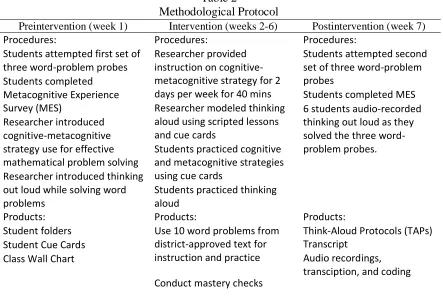
Table 2: Methodological Protocol………67
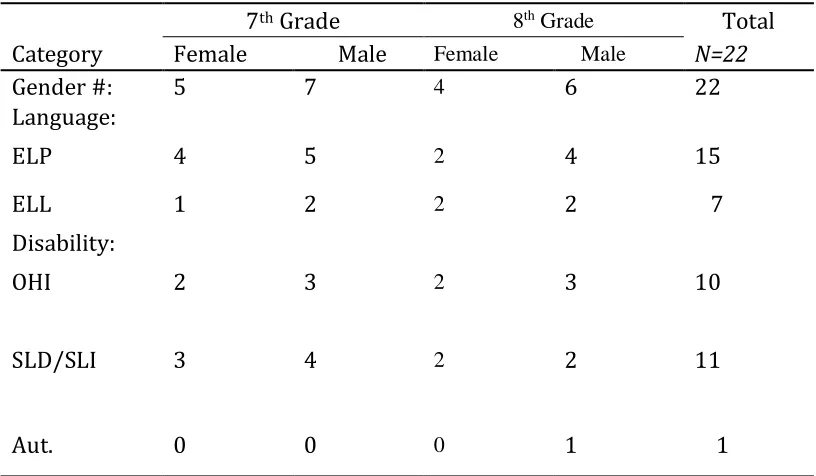
Table 3: Demographical Characteristics of Participants………..70
Table 4: Timeline for the Cognitive-Metacognitive Strategy Instruction………80
Table 5: Operational Definition and Coding of the Cognitive Processes………93
Table 6: Think-Aloud protocols for the 1-Step Probe (Participant #4)………95
Table 7: Think-Aloud protocols for the 1-Step Probe (Participant #13)………..95
Table 8: Think-Aloud protocols for the 1-Step Probe (Participant #2)………96
Table 9: Think-Aloud protocols for the 1-Step Probe (Participant #5)………96
Table 10: Think-Aloud protocols for the 1-Step Probe (Participant #3)………..96
Table 11: Think-Aloud protocols for the 1-Step Probe (Participant #12)………96
Table 12: Productive Metacognitive Verbalizations Used by Participants to Solve Probes……….102
Table 13: Means and Standard Deviations on the Pre- and Postintervention Measures……….103
Table 14: Pre- and Postintervention Performance on Mathematical Probes…………..104
Table 15: Means, Standard Deviations, and Paired-Samples t Test for the Metacognitive Experience Survey (MES) and the Mathematical Probes ……….106
Table 16: Categories for MES Assessing Mathematical Probes………106
ix
Figure 1: Flavell’s (1979) Theory of Metacognition………..13
CHAPTER I
INTRODUCTION TO THE STUDY
Progressively, being adept at mathematical problem solving is vital to success in
mathematics curriculum (Krawec, Huang, Montague, Kressler, & de Alba, 2012) as well
as to a student’s achievement in school and career (Hudson & Miller, 2006). Solving
mathematical word problems entails that students possess declarative and procedural
knowledge (Montague & Applegate, 2001). The declarative or conceptual knowledge in
mathematics relates to a student’s ability to recognize and apply mathematical operations
and algorithms in various situations, and the procedural knowledge entails the ability to
apply declarative knowledge effectively as well as to coordinate multiple cognitive and
metacognitive processes associated with proficient problem solving (Mayer, 1985;
Zawaiza & Gerber, 1993). Montague (2001) maintained that students need conditional
knowledge (conceptual and procedural) to enable them to select and implement
appropriate strategies and to adjust their behaviors to changing mathematical
problem-solving demands. Both knowledge bases, however, are impaired in students’ with
learning disabilities who demonstrate a lack in strategy knowledge and use (Bornert &
Wilbert, 2015; Kraai, 2011; Krawec et al., 2012), who apply strategies inconsistently and
ineffectively (Kraai, 2011; Rosenzweig, Krawec, & Montague, 2011), who manifest a
lack in self-efficacy processes (Larson & Gerber, 2002) as they tend to respond
impulsively, who use trial and error, who fail to evaluate their answers or verify their
solutions (Bryant, Bryant, Hammil, 2000; Kraai, 2011), and who display an inability to
disabilities (Bornert & Wilbert, 2015; Fuchs et al., 2003; Hessels, Hessels-Schlatter,
Bosson, & Balli, 2009).
Students with learning disabilities are poor problem solvers who also exhibit
deficits in working memory, processing speed, and executive function (Geary, 2004;
Johnson, Humphrey, Mellard,Woods, & Swanson, 2010). The situation is exacerbated
when students’ instruction in mathematical problem solving is restricted to textbook
models and composed of sequenced list of activities for solving problems (e.g., read,
decide what to do, solve, and check the problem) as is evident in most mathematics
classrooms (Jitendra & Star, 2011). Consistently, these cognitive activities are
inadequate for students with LD who possess limited knowledge of appropriate
problem-solving strategies (Montague & Applegate, 2001), immature ways to identify the type of
problem (Garcia, Jimenez, & Hess, 2006), and constrained ability to represent the
problem visually (Booth & Thomas, 2000).
Mathematical problem solving, which correlates highly with success in
mathematics, presents a challenge for students with LD (Geary, 2003). Metacognition,
defined as reflective abstraction (Paiget, 1985), as well as one’s thinking about own
thinking (Flavell, 1976), was identified as crucial to mathematics success, to problem
solving, and to overall academic achievement (Trainin & Swanson, 2005).
Metacognition, further, was identified as a better index of learning performance than
intelligence (Vennman & Spans, 2005). Luit and Kroesbergen (2006) contended that,
although intelligence contributes about 25% of the explained variance in performance,
metacognition contributes approximately 75% of the explained variance in performance.
metacognition entails higher-order-thinking skills that enable students to monitor and
control cognitive processes employed during metacognitive activities (Langeli & Cabrele,
2006). One form of metacognitive processing is the think-aloud protocol (TAP). TAP is
used in a variety of disciplines to facilitate meaningful learning. TAP entails a conscious
unveiling of the thought processes used by students during problem-solving activities.
TAP provides rich verbal data useful for instructional and assessment purposes in the
scientific and quantitative reasoning of typically-developing students (Thelk & Hoole,
2006), in the nursing arena (Offredy & Meerabeau, 2005), in the cognitive processes of
graduate engineering students (Litzinger, Van Meter, Firetto, Passmore, & Masters,
2010), as well as in the cognitive processes of students with learning disabilities
(Desoete, Roeyers, & Buysse, 2001; Rosenzweig et al., 2011).
A review of literature suggested that previous research on using think alouds
focused primarily on a cognitive or a metacognitive strategy when investigating the
achievement of students with learning disabilities in mathematical problem solving.
Further, other studies that used the think-aloud protocol indicated positive effect in the
interaction of cognitive, metacognitive, or affective variables (Rosenzweig et al., 2011;
Shuell, 1990) on the mathematical problem-solving skills of students with learning
disabilities. To date, scant investigation focused on the effect of instruction in cognitive
skills and metacognitive strategies on the mathematical problem-solving skills of
seventh- and eighth-grade students with learning disabilities in an intact resource class.
This study filled a gap in the thinking-aloud self-efficacy learning-strategies research and
offered an instructional approach that can remediate the mathematical problem-solving
Purpose of the Study
The purpose of this study was to investigate the effect of implementing a
cognitive- and metacognitive-strategy instruction on the word-problem-solving
performance and self-efficacy perception of seventh- and eighth-grade students with
learning disabilities in relation to their mathematical word-problem-solving skills
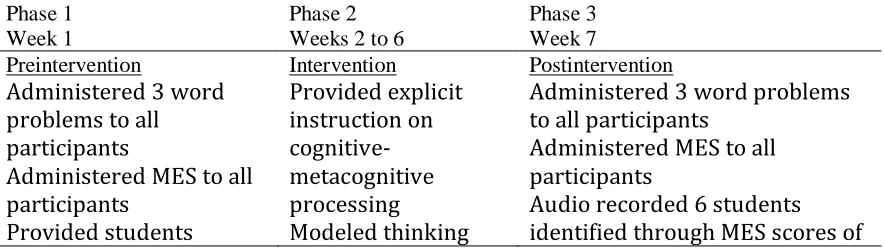
(perception and performance). This study was conducted over a 7-week period (2 weeks
of assessment, 5 weeks of intervention) in the students’ resource classroom. During the
study, students learned how to apply the think-aloud protocol as they attempted
mathematical word problems. Students used Montague’s (1992) model comprised of the
seven cognitive skills and the three metacognitive processes to solve word problems.
To examine the efficacy of the intervention, this study used a pre- and
postintervention design. Learning was measured using quantitative and qualitative
methods. The qualitative data served to confirm and augment data gathered through
quantitative measures. The quantitative instruments included the Metacognitive
Experience Survey (MES) and two sets of three word-problem probes. The
Metacognitive Experience Survey assessed students’ self-efficacy beliefs about their
ability to solve mathematical word problems. The first set of three word-problem probes
and the MES were used as pre- and postintervention items. The verbalizations of six
students were audio-recorded as they solved the second set of three word problems.
Transcription and coding of the verbalizations were analyzed to assess students’
perception of mathematical performance, attitude toward mathematics, and attitude
toward mathematical word problems. The descriptive information generated by
word problems served as the qualitative component of this study. The analyses of the data
obtained in this study provided empirical information on the effect of cognitive- and
metacognitive-strategy instruction on the mathematical-word-problem-solving
performance of students with learning disabilities. The analyses of the
think-aloud-protocol data enabled exploration of the role of students' verbalization during
mathematical-problem-solving event.
Background and Need
Swanson and Sachs-Lee (2001) argued that problem solving encompassed a
complex behavior in relation to the cognitive development of adolescents. Problem
solving was defined as the ability to employ cognitive processes to tackle and resolve
intricate cross-disciplinary tasks (U.S. Department of Education National mathematics
Advisory Panel, 2008). Expert problem solvers, further, executed problem-solving tasks
by employing and integrating cognitive, metacognitive, and motivational elements
(Schoenfeld, 1983). The three components termed skill, metaskill, and will (Mayer, 1998)
referred to possessing domain-specific knowledge, possessing strategy on how to apply
and monitor the knowledge, and possessing the intrinsic motivation and task-related
interest respectively. Embedded in the definition of an expert problem solver was the
presumption that the individual obtained extensive training in a specific domain and,
therefore, was considered highly knowledgeable in that specific area. Given that students
with learning disabilities receive instruction in the general-education setting where
models and composed of sequenced list of activities for solving word problems (e.g.,
read, decide what to do, solve, and check the problem), it is imperative that students with
learning disabilities receive extensive cognitive and metacognitive strategy instruction in
the domain of mathematical problem solving.
An international measure used to assess the performance of participating students
worldwide is the Trends in International Mathematics and Science Study (TIMSS).
Established in 1985, TIMSS provides a comparative perspective of student achievement
in mathematics and science curricula for fourth and eighth graders every 4 years. TIMSS
was designed to align broadly with mathematics and science curricula in the participating
countries and education systems (TIMSS, 1995, 1999, 2003, 2007, 2011) thereby
producing results that indicated the degree to which students acquired the mathematics
and science concepts and skills taught in school. Over the 16-year period of
implementation, TIMSS has provided an unexcelled data resource for trends in
mathematics and science achievement (Foy, Arora, & Stanco, 2013). At both fourth- and
eighth-grade levels, the mathematics framework was organized around a content
dimension that indicated the mathematics subject matter to be assessed and a cognitive
dimension that specified the thinking processes to be assessed (Mullis, Martin, Ruddock,
O’Sullivan, & Preuschoff, 2009). TIMSS’ three cognitive domain processes include
knowing facts, procedures, and concepts; applying knowledge and understanding; and
reasoning. Mullis and associates (2012) suggested that knowing pertained to the
student’s knowledge base of mathematics facts, concepts, tools, and procedures.
Applying emphasized the student’s ability to apply knowledge and conceptual
solution of typical problems to unfamiliar situations, complex contexts, and multistep
problems (p. 140). For the TIMSS, the cognitive domains assessed were the same for
fourth and eighth grades and comprised the scope of cognitive processes used in solving
mathematical problems in the primary- and middle-school years.
In the 2011 study, participants in TIMSS comprised internationally representative
samples of students in 63 countries. The TIMSS 2011 International Results in
Mathematics illustrated data on the trend of student performance in mathematics over the
five assessments since 1995, on student performance in the mathematics content domains
(algebra, geometry, etc.), and on student proficiency in handling the problem-solving
tasks in these mathematical contexts (Gonzales et al., 2011; TIMSS). A comparative
synopsis of the eighth-grade students’ performance in 2011 indicated that the U.S.
average mathematics score (509) was higher than the international TIMSS scale average
(500) for that same year and 17 score points higher than the U.S. average mathematics
score in 1995 (509 vs. 492). In regard to the fourth-grade students, the US average score
in mathematics (541) was higher than the international TIMSS scale average (500), and
when compared with the 1995 and 2007 scores, the U.S. 2011 fourth-grade average
mathematics score (541) was 23- and 12-score points higher, respectively. Across the
fourth and eighth grades, however, the U.S. students demonstrated higher proficiency in
knowing mathematics (i.e., recalling, recognizing, and computing) than in applying
mathematical knowledge, and reasoning (problem solving). In fact, a comparison
between the US and select countries (Singapore, Korea, Hong Kong, Chinese Taipei,
Japan, Northern Ireland, and Belgium) across the cognitive domains indicated that,
lagged behind in mathematics cognitive and metacognitive domains (Kastberg, Ferraro,
Lemanski, Roey, & Jenkins, 2013).
Over a period of 2 decades (1980-2000), members of the National Council of
Teachers of Mathematics (NCTM), the largest organization concerned with mathematics
education, initiated mathematics reforms that were structural, curricular, or instructional
in nature. The Council maintained that problem solving was at the core of any
substantive mathematics curriculum (NCTM, 1980). Council members stressed the need
to replace the emphasis on computational fluency with a proficiency in higher-order
conceptual skills because the latter constituted a better measure of mathematical
competence (NCTM, 1980). Another area the Council advocated for was reasoning.
Council members argued that a student who was imparted with the reasoning (logic)
associated with a mathematical procedure was more likely to learn and apply the
procedure appropriately than a student who attempted to apply rules without regard to
their reasonableness (NCTM, 2003). Similarly, Council members highlighted
communication as an important assessment tool that students use to explain, write, draw,
or otherwise demonstrate what they have learned. Accordingly, they recommended that
teachers formulated alternate means of assessing the communication of students with
learning disabilities or students with limited-English abilities who encountered academic
challenges as a result of their identified language and processing impairments. As stated
previously, students with learning disabilities struggled in the identified areas
(problem-solving, reasoning, communication) and, therefore, required intervention that addressed
Predictably, students with learning disabilities were more affected, comparatively,
by the US lag in achievement in the mathematics cognitive and metacognitive domains.
Ample research confirmed that cognitive and metacognitive domains were difficult for
students with learning disabilities (Fuchs & Fuchs, 2002; Geary, 2003; Hanich, Jordan,
Kaplan, & Dick, 2001; Montague & Applegate, 1993). Researchers agreed that when
solving mathematical word problems, students with learning disabilities responded
impulsively, used trial and error, and failed to verify solution path more than their
typically-achieving peers (Bryant, Bryant, & Hammermill, 2000; Fuchs & Fuchs, 2002;
Gonzalez & Espinel, 2002; Geary, 2004; Johnson et al., 2010). Yet, students with LD
characteristically overestimated their ability compared with their peers (Garette,
Mazzocco, & Baker, 2006; Montague, 1997). Mayer (1985) noted that to solve
mathematical word problems, students needed to be able to represent the problem,
develop a solution path, and execute the solution. Mayer (1985) further stated that
cognitive processing and metacognitive strategies (e.g., visualizations, estimations,
self-questioning) were integral to representing the problem. In other words, mathematical
problem solving entailed a proper synthesis and execution of metacognitive strategies and
cognitive processes. These processes, however, were challenging for students with
learning disabilities who typically experienced processing deficits as a manifestation of
their disability (Montague, 2004, 2008). As a result, students with learning disabilities
were less likely to use task-appropriate metacognitive strategies when solving
mathematical word problems (Stone & May, 2002), although metacognition enhanced the
implementation of the cognitive strategy as well as student learning (Azevedo &
In 2010, California joined 45 other states across the nation to adopt the Common
Core State Standards (CCSS) in Mathematics and English Language Arts (ELA). The
CCSS provided consistent, clear, and challenging standards for what students were
expected to learn and be able to do in mathematics from kindergarten (K) through Grade
12. The California Assessment of Student Performance and Progress (CAASPP) system,
the assessment arm of the CCSS, replaced California’s Standardized Testing and
Reporting (STAR) program in July 2013. The STAR program had measured the
achievement of California Content Standards for grades 2 through 11 using five
benchmarks to indicate a student's proficiency in English Language Arts and
Mathematics. The students took part annually in statewide testing, and schools were
assigned an Academic Performance Index based on results from STAR testing. Under the
No Child Left Behind (NCLB, 2001) mandate, the Academic Performance Index also
was used to evaluate schools for Adequate Yearly Progress toward the growth in
curricula instruction and assessment of all students, including students with learning
disabilities. The No Child Left Behind Act (NCLB, 2001) and the Individuals with
Disability Education Act (IDEA, 2004) were standards-based reforms that mandated the
accountability of and access to the general curriculum for all students, including students
with learning disabilities. Nolet and McLaughin (2000) contended that the purpose of
standards-based reform was to align special-education programs and policies with the
larger national school-improvement efforts. Nolet et al. (2000) argued that the reforms
linked academic achievement and accountability for all students and increased the
A school district in Northern California administered the Smarter Balanced
Assessments Consortium (SBAC) to students in April 2015. The SBAC is part of the
California Assessment of Student Performance and Progress (CAASPP). This was the
first year that all California students in grades 3 through 8 and 11 were administered the
test. As a result, students’ scores were considered baseline performance against future
test scores. Students with learning disabilities at this middle school historically lagged in
the domain of mathematics problem solving. For instance, the results from the STAR
2012-13 indicated that of the 94 students with disabilities assessed on the mathematics
domain, 15% scored within the Proficient or Above range compared with 52% of the 566
students with no identified disabilities. In the 2015 CAASPP, 181 seventh- and 172
eighth-grade students with no identified disabilities were tested on the Problem Solving &
Modeling/Data Analysis domain. Thirty-six percent of the seventh graders and 49% of
the eighth graders scored in the Standard Exceeded and At or NearStandard range.
Twenty-three seventh- and 21 eighth-grade students with identified learning disabilities
were tested on Problem Solving & Modeling/Data Analysis domain. Only 13% of the
seventh graders and 15% of the eighth graders scored in the Standard Exceeded and At or
Near Standard range.
The CCSS was designed as a blueprint for mathematics instruction in the general-
education classroom (National Governors Association Center for Best Practices, 2010),
and considering that many students with learning disabilities receive their mathematics
instruction in the general- education classroom, concerns arose relating to effective
strategies to use for instruction on mathematics problem-solving tasks for students with
(Fuchs & Fuchs, 2013). Teachers nationwide claimed that, although the benefits of the
rigorous CCSS reached their districts, the positive effect was not evidenced in their
classrooms (Gates Foundation, 2012). Foundation informed that even in states that had
begun to provide professional development and support, teachers still struggled with the
progression of the complex mathematics skills across grade level and across disabilities
(Gates Foundation, 2012). Teachers stressed that only a few teaching strategies were
available to teach students with disabilities content that linked to the CCSS or other state
standards in mathematics (Browder, Jimenez, et al., 2012). As a result, the achievement
of students with learning disabilities continued to lag behind the achievement of their
peers without learning disabilities. There was a need, therefore, to develop more
empirical interventions for students with learning disabilities as scant studies addressed
the effect of cognitive and metacognitive skills on the achievement of students with
learning disabilities especially bearing the rigorous CCSS framework in mind.
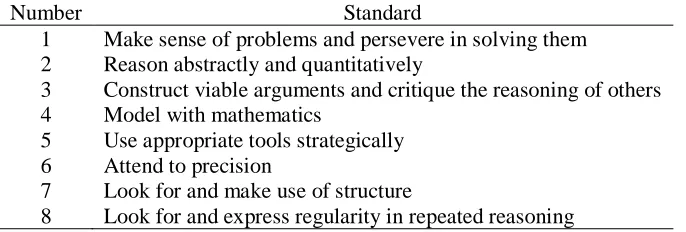
The framework of the CCSS in mathematics delineated eight (see Table 1)
instructional practices (i.e., practice standards) for teachers to implement during
instruction. Teachers were encouraged to provide opportunities to apply the practice
standards throughout as they taught the mathematical content standards (Russell, 2012).
Research on the use of cognitive strategies in solving mathematical word problems
indicated that students with learning disabilities typically experience processing deficits
as a manifestation of their disability (Montague, 2004, 2008; Sweeney, 2010). Students
with learning disabilities were consequently less likely to use task-appropriate
Azevedo et al. (2004) noted that metacognitive processing equally enhanced the
implementation of a cognitive strategy and student learning. It was vital, therefore, that
teachers employed instructional practices that incorporated metacognitive processing
coupled with cognitive strategy to deliver instructions on the new CCSS mathematics
standards. In this way,
Table 1
Common Core Standards for Mathematical Practice
Number Standard
1 Make sense of problems and persevere in solving them 2 Reason abstractly and quantitatively
3 Construct viable arguments and critique the reasoning of others 4 Model with mathematics
5 Use appropriate tools strategically 6 Attend to precision
7 Look for and make use of structure
8 Look for and express regularity in repeated reasoning
students with learning disabilities would learn how to employ metacognitive strategies
(i.e., self-questioning) to monitor cognitive processing during mathematical problem
solving. For this reason, this study examined the effect of a metacognitive strategy (TAP)
with eighth-grade students with learning disabilities on their mathematical
problem-solving skills.
Theoretical Rationale
This study used think-aloud protocols to investigate the effect of the cognitive and
metacognitive processes on the mathematical problem-solving skills of seventh- and
eighth-grade students with learning disabilities. To examine the
mathematical-problem-solving performance and perception of students with learning disabilities, the current
Flavell’s 1979 theory of metacognition. This section presented the two theories related to
the foci of this study: metacognition and model of mathematical problem solving.
In a meta-analysis, Lester (1994) identified two implications that correlated
metacognition and mathematical problem solving. The first was that effective
metacognitive activity during mathematical problem solving entailed knowing what and
when to monitor as well as how to monitor, and the second specified that teaching
students to become aware of their cognition, including the ability to monitor their
mathematical-problem-solving actions, should take place in the context of learning
specific mathematics concepts and strategies. Lester (1994) further posited that
delivering a general metacognitive instruction, in isolation, was likely to be less effective.
As a result, this investigation was conducted within the theoretical framework of
Flavell’s (1976) theory of metacognition (Figure 1) and Montague’s (1992) model of
effective mathematics problem solving (Figure 2). Students with learning disabilities
were chosen as the
Metacognitive Knowledge
Declarative, procedural and conditional
knowledge stored in one’s long-term memory
Metacognitive Skills
Authentic procedures and
strategies performed during task
execution in order to monitor and
control one’s cognition
Metacognitive Experience
Conscious reactions and
self-judgments regarding personal
performance before, during or after task
Figure 1. Flavell’s (1979) Theory of Metacognition illustrating how the three elements of metacognition relate
population for this investigation because of the unique deficits in processing,
organization, and persistence that characterized their disabilities in the area of
mathematical problem solving.
Flavell’s Theory of Metacognition (1979)
John Flavell (1971), a cognitive developmental psychologist, developed the
concept of metamemory (now known as metacognition). Flavell (1971) described
metamemory as an individual’s ability to manage and monitor the endeavor of inputting,
storing, searching, and retrieving information from one’s own memory. Flavell (1971)
theorized that the process of metamemory was deliberate, conscious, and strategic and
was aimed at achieving a goal or outcome. In a later article, Flavell (1976) extrapolated
that monitoring and regulation were two aspects of metacognition, which he defined as
follows:
In any kind of cognitive transaction with the human or nonhuman environment, a
variety of information processing activities may go on. Metacognition refers, among
other things, to the active monitoring and consequent regulation and orchestration of
these processes in relation to the cognitive objects or data on which they bear, usually in
service of some concrete goal or objective (Flavell, 1976).
Flavell’s (1979) model of metacognition highlighted the interaction between four
components of metacognition namely (a) metacognitive knowledge, (b) metacognitive
experiences, (c) tasks or goals, and (d) strategies or skills. The last two components have
Roeyers, 2002; Lucangeli & Cabrele, 2006) as will be used henceforth in this proposal
(Figure 1).
Metacognitive knowledge relates to one's knowledge or beliefs about the factors
that effect cognitive activities. Flavell (1979) argued that metacognitive activity typically
preceded and tracked cognitive activity; both were closely and mutually dependent.
An example of metacognitive knowledge would be when a student determined
through prior knowledge that using the order Parenthesis, Exponent, Multiplication,
Division, Addition, and Subtraction to solve a computation problem entailed multiplying
prior to dividing terms. Metacognitive knowledge also apply to a person’s awareness or
perception that he or she was a visual rather than an auditory learner. Flavell (1979)
concluded that one's beliefs about himself or herself as a learner helped or hindered his or
her performance in learning situations.
Metacognitive experience pertains to an individual’s internal response to or
monitoring of his or her own knowledge or strategies. Metacognitive experience serves
as an internal feedback mechanism to the individual about his or her current progress,
future expectations of progress or completion, degree of comprehension, connecting new
information to old, and many other events (Flavell, 2009). In this way, a metacognitive
experience would cover the affective response that an individual demonstrates when
encountering a task. For instance, a person’s willingness or interest to undertake a future
tasks may be determined by his or her perceived success or failure, task difficulty,
frustration or satisfaction, and confidence with prior similar tasks.
Metacognitive skills refer to the strategies and procedures (e.g., self-observation,
monitoring and controlling one’s cognition (Efklides, Kiorpelidou, & Kiosseoglou,
2006). Some of these strategies are valuable in assessing how individuals demonstrate
their knowledge when tackling novel as well as complex tasks (Lucangeli et al., 2006).
In summary, using the three components of metacognition (i.e., knowledge,
experience, and skill) as a framework for this study enabled persuasive and robust
assessment of the metacognitive knowledge, experience, and skills that students with LD
employed as they performed mathematics word problems. Metacognitive knowledge,
experience, and skill highlighted what students knew about their own knowledge, who
they were in terms of self-regulating their task performance, why they persevered through
or relinquished from a task, and the basics of how they performed the task at hand.
Montague’s Model of Effective Problem Solving in Mathematics
Montague’s (1992) model of effective problem solving was developed from
robustresearch conducted in the area of self-regulation, general and mathematical
problem solving, as well as in other affective variables that facilitate successful
problem-solving endeavor (Montague, 1992, 1997; Montague & Applegate, 1993, 2000;
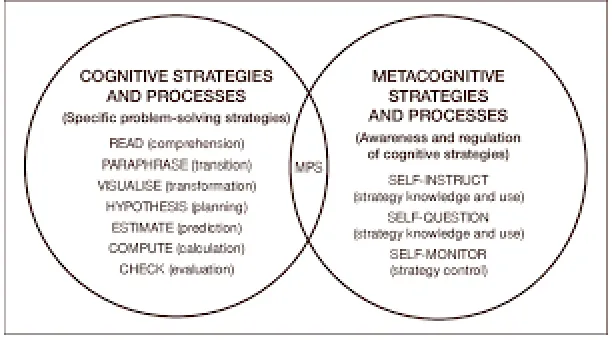
Montague & Bos, 1986). This model (Figure 2) holds that to employ self-regulation
techniques in solving mathematical problems, expert problem solvers purposefully and
actively monitor their performance (metacognitive) as they select from a collection of
applicable strategies (cognitive). Montague’s (1992) seven cognitive strategies and three
metacognitive processes illustrate best practices for successful mathematical problem
solving.
The seven cognitive processes enhance solving mathematics word problems and
(draw a picture or diagram), Hypothesize (a plan to solve the problem), Estimate (make a
prediction), Compute (do the arithmetic), and Check (make sure everything is right). The
metacognitive
processes guide and monitor the application of the cognitive strategies. They include
self-instruction, self-questioning, and self-monitoring.
Figure 2. Montague’s (1992) Model of Mathematical Problem Solving
To facilitate acquisition of the cognitive skill, students were instructed explicitly
through teacher modeling during the intervention phase of this study. Montague’s (1992)
framework for the protocol analysis of problem solving in mathematics differentiates
explicitly between cognitive and metacognitive problem-solving behaviors observed
within the different events of problem solving. Montague’s (1992) framework indicates a
synthesis of the cognitive and metacognitive levels of problem-solving behaviors studied
within cognitive psychology by Flavell (1981). Flavell’s (1979) theory of metacognition
and Montague’s (1992) model of effective problem solving provided the grounding for
this study. Synthesizing what students knew (metacognitive knowledge), how they
related and reflected the knowledge (metacognitive skills), and to what they attributed the
in mathematics yielded a theoretical basis used to evaluate the effect of a cognitive- and
metacognitive-strategy instruction on the problem-solving performance and perception of
students with learning disabilities.
Educational Significance
This investigation addressed two main gaps in the research. A review of literature
suggested that previous research on think alouds were focused primarily on using a
cognitive (Krawec, Montague, Kressler, & de Alba, 2012) or a metacognitive strategy
(Rosenzweig et al., 2011) when investigating the achievement of students with learning
disabilities on mathematics word problems. Further, other studies that used think-aloud
protocol indicated positive effect in the interaction of cognitive, metacognitive, and
affective variables (Rosenzweig et al., 2011; Shuell, 1990) on the mathematical
problem-solving skills of students with learning disabilities. Specifically, the current study
investigated how using both cognitive and metacognitive strategies on the mathematical
problem-solving skills effected the performance and perception of seventh- and
eighth-grade students with learning disabilities.
Students with learning disabilities often over- or underestimate their mathematics
abilities (Garrett et al., 2006), and this deficiency in self-regulation hinders how
educators can assist them to acquire critical self-help skills. When practitioners
understand the connections between what a student says he or she knows (metacognitive
knowledge), how he or she applies that knowledge (metacognitive skill), and what
motivates him or her toward their performance (metacognitive experience), they are
equipped to provide students with the remediation that is germane to the specific area(s)
access to students’ thought processes through the students’ verbalizations when they
encounter difficult tasks, novel tasks, or both. Using the think-aloud approach to solve
mathematical problems, therefore, enables students to become aware of their own thought
processes and enables teachers concurrently to gain access into their students thought
processes and patterns. Furthermore, problem solving is critical to navigating higher
education and employment. Research has shown that problem solving is difficult for
students who are low achieving or have learning disabilities (Fuchs & Fuchs, 2002;
Geary, 2003; Hanich et al., 2001; Montague & Applegate, 1993). Swanson and Saez
(2003) argued that even with available federal funding and educator efforts, students with
learning disabilities tend to experience more problems in transitioning to higher
education or to workforce placement. The low proficiency of students with learning
disabilities in regulating cognition, metacognition, and motivations in learning activities
may be a critical factor in explaining their unsatisfactory school performance and
challenges in transitioning to higher education or to workforce placement (Wagner,
2005). Therefore, facilitating the cognitive and metacognitive processes needed to
understand and solve mathematical word problems would help students with learning
disabilities to compete in the global economy in pursuit of educational opportunities and
worthwhile careers.
Similarly, analyzing the metacognitive strategies that student use during
problem-solving activities may enable practitioners to teach students to acquire, internalize, and
apply metacognitive skills effectively. This study attempted to further the research on
how students with learning disabilities utilized cognitive processes and metacognitive
this study would support the need for educators to foster both cognitive and
metacognitive strategies when teaching students with learning disabilities how to solve
mathematics word problems.
Research Questions
This pre- and postintervention experimental study examined the effect of
cognitive- and metacognitive-strategy instruction, using think-aloud protocols as the
instrument, on the problem-solving performance of seventh- and eighth-grade students
with learning disabilities in an intact resource room. The following research questions
guided the study:
1. To what extent are the seventh- and eighth-grade students with learning disabilities using
the cognitive and metacognitive strategies solving mathematical word problems?
2. To what extent does using cognitive and metacognitive strategies improve the
mathematical problem-solving performance of seventh- and eighth-grade students with
learning disabilities as measured by the change from pre- to postintervention scores on
two sets of word-problem-solving probes?
3. To what extent does cognitive and metacognitive strategies improve the metacognitive
experience of seventh- and eighth-grade students with learning disabilities as measured
by the Metacognitive Experience Survey (MES)?
Definition of Terms
This section contains the definition of main terms and concepts that were used in
this investigation. The definitions provided are specific to this study as there may be
Cognition entails the mental processes and abilities that learners engage on a daily
basis (Montague, 2008). Examples of the cognitive processes engaged are memory,
learning, problem-solving, evaluation, reasoning, and decision making (Montague et
al.,1991, 2009, 2011, 2014). For a learner, cognition helps to generate new knowledge
through mental processes and also helps in the utility of knowledge in daily activities.
Cognitive strategies refer to a learner’s interaction with the material to be learned;
how the learner manipulates the information mentally (as in making mental images or
relating new information to previously acquired concepts or skills) or physically (as in
grouping items to be learned in meaningful categories or making summaries of important
information to be remembered; O’Malley & Chamot, 1987).
Conceptual knowledge is a grasp of the mathematical concept and ideas that are
not problem-specific and consequently can be applied to any problem-solving situation
(Jayanthi, Gersten, & Baker, 2008).
Conditional knowledge is the ability to discern under what circumstance it is
appropriate to use a specific strategy (Schraw et al., 2006).
Declarative knowledge is symbolic knowledge (Broadbent, 1989) that enables
individuals to retrieve stored information using associations (Squire & Knowlton, 1995).
The creation of new memories can alter declarative knowledge although declarative
knowledge is not substantive until it is retrieved by cues and prompts (e.g., questioning).
Accessing or retrieving declarative knowledge is not intentionally as the individuals can
only perceive the products of this process.
Higher-order thinking skills pertain to learning experiences that are focused
used in this study, entail developing problem-solving skills such as inferring, estimating,
predicting, generalizing, and reflecting (Dillon, 2002; Zohar & Dori, 2003; Zoller, Dori,
& Lubezky, 2002).
Learning Strategies are thoughts, behaviors, beliefs, or emotions that facilitate the
acquisition, understanding, or later transfer of new knowledge and skills (Weinstein et al.,
2000).
Mathematical problem solving is a complex cognitive activity involving a number
of processes and strategies. Montague (1996) informed that problem solving comprises
problem representation and problem execution. Obtaining a solution to the mathematical
problem is grounded on appropriately representing the problem. Montague (1996)
hypothesized that students who struggle with correctly representing the problem will
have challenges with solving the problem because problem representation underlies
understanding the problem and devising a plan to solve the problem.
Mathematical problem-solving performance is the dependent variable.
Mathematical problem-solving performance entails: (a) organizing the mathematical
operations, (b) choosing the most effective method, (c) monitoring and controlling
operations carried out, and (d) evaluating the reasonableness of the solution obtained
(Montague, Warger, & Morgan, 2000; Victor, 2004). In this study, mathematical
problem-solving performance incorporated interpretation and analysis (Passolunghi,
Mazocchi, & Fiorillo, 2005), problems that required single and multiple steps to solve
(Fuchs, Fuchs, & Prentice, 2004; Montague & Applegate, 1993), and word problems set
up in contextually simple as well as complex formats that included irrelevant information
identical sets of three mathematical-word-problem probes pre- and postintervention to
assess the effect of the cognitive- and metacognitive-strategy instruction on their
performance. The three word-problem probes were of varying difficulty levels (1-step, 2-
step, and 3-step). The resulting preintervention and postintervention scores ranged from 0
to 6 points, respectively with the latter indicating the effect of the treatment.
Mathematical-problem-solving performance was analyzed using descriptive
narratives. The second set of three mathematical word problems were administered
individually postintervention to six students based on their Metacognitive Experience
Survey scores. Selection criterion was two students each who score high (50 to 60
points), average (40 to 49 points), and low (Below 40 points) on the Metacognitive
Experience Survey. Descriptive analyses of student verbalization and performance
yielded cognitive profiles that informed on students’ knowledge of mathematical
problem-solving, and knowledge, use, and control of the seven problem-solving
processes (Daniel, 2003; Montague, Bos, & Doucette, 1991).
Metacognition refers to higher-order thinking that involves active control over the
cognitive processes engaged in learning (Brown, 1978; Flavell, 1979). Activities such as
planning how to approach a given learning task, monitoring comprehension, and
evaluating progress towards the completion of a task are metacognitive in nature (Flavell,
1979).
Metacognitive strategies pertain to the executive processes in planning for
learning, monitoring one’s comprehension and production, and evaluating how well one
Procedural knowledge involves knowing how to use a particular learning
strategy. Procedural knowledge pertains to awareness and management of cognition,
including knowledge about strategies (Kuhn & Dean, 2004; Schraw et al., 2006).
Procedural knowledge enables students to execute the necessary action sequences to
solve problems (Rittle-Johnson & Star, 2007).
Self-efficacy deals with an individual’s beliefs that he or she is capable of
successfully performing a given task (Zimmerman et al., 1996). In this study,
self-efficacy was assessed using the Metacognitive Experience Survey. The Metacognitive
Experience Survey comprised a 5-item Likert-style questionnaire with four response
scores ranging from Not at all True (1 point); Hardly True (2 points); Mostly True (3
points); and Absolutely True (4 points), and three mathematical problem-solving probes
differentiated by difficulty types (one step, two step, and three step). Questions on the
Metacognitive Experience Survey included, I have seen this type of question before; I
understand what the problem asks me to do; The problem is going to be difficult to solve;
I will need to use a lot of effort to solve the problem; and I am confident that I will solve
this problem correctly. The Metacognitive Experience Survey provided a measure of
students’ self-efficacy beliefs and the effectiveness of cognitive- and
metacognitive-strategy instruction on students’ perception in their ability to solve the three word
problems. The Metacognitive Experience Survey was administered individually to all
students pre- and postintervention by the researcher and assistant during the student’s
resource session. Each student received one question-type on a sheet of paper. After
perusing each question type, the student responded to the 5-item survey. Each student,
on three separate sheets delivered one after the other. Each student, therefore, read and
responded to the survey questions three times each for the pretest and the posttest
data-collection processes. Metacognitive Experience Survey scores, consequently, ranged
from 15 to 60 possible points for the survey. This study, therefore, examined the effect of
a metacognitive strategy instruction on students’ rating of self-efficacy using the
Metacognitive Experience Survey.
Think-Aloud Protocol (TAP) is a method to garner insight into metacognition by
asking students to verbalize their thoughts while working on a mathematics
word-problem. The verbalizations subsequently are recorded, transcribed, and systematically
assessed (Veenman et al., 2005). In this study, the researcher trained the participants by
modeling thinking out loud. Six students comprised of two students each with high,
average, and low scores on the MES were audiotaped solving three mathematics word
problems while thinking aloud. Montague’s (2003) model of seven cognitive and three
metacognitive processes were the instruments used to measure students’ verbalization as
they solved three word problems with varying difficulty level. The qualitative data
gathered was analyzed in narrative format in this study.
Summary
This chapter outlined the purpose of the study, the research problem and its
significance, and the two conceptual theories that framed this study. Metacognitive
theory and the Model of Effective Mathematical Problem Solving were described and
presented as channels to capture the challenges that students with disabilities face as they
of terms were summarized in this chapter. In chapter II, the review of literature examined
the recent relevant research findings in the area of metacognition and think-aloud
protocols. In chapter III, the methodology for this study was explained and included a
description of the research design, the treatment, procedures for data collection, and the
data analysis. Chapter IV reported the results of the data analysis for the research
questions that guided this mixed-method study. Chapter V presented a discussion of the
study findings, limitations, and recommendations for future research.
CHAPTER II
LITERATURE REVIEW
According to Flavell (1979) and colleagues (Lucangeli & Cabrele, 2006),
metacognition comprises metacognitive knowledge, metacognitive experience, and
cognitive- and metacognitive-strategy instruction on the mathematical problem-solving
performance and perception of middle-school students with learning disabilities. The
three components of Flavell’s (1979) model of metacognition and Montague’s (1992)
seven cognitive and three metacognitive processes (see Figure 2) provided the framework
for this study. This review of literature presented research that examined metacognition,
and the cognitive- and metacognitive-functioning of students with learning disabilities
during mathematical problem-solving task performance. Metacognition ranks high
among the cognitive processes extolled and recommended in mathematics education.
Anderson, Corbett, Koedinger, and Pelletier (1995) stressed that understanding and
controlling cognitive processes, a function of metacognition, are fundamental skills that
classroom teachers can help learners develop. Metacognition is described as the ability to
develop one's self-knowledge as well as the ability to learn how to learn (Desoete, 2007;
2008; Desoete & Roeyers, 2006; Desoete & Veenman, 2006).
Mathematical problem solving is an increasingly critical skill in the 21st century
mathematics curriculum because success in mathematical problem solving is correlated
with overall mathematics achievement (Bryant, Bryant, & Hammermill, 2000).
Similarly, the need to develop proficiency in the mathematics domain is relevant to
students’ success in school and beyond. Problem-solving skills span the five curricular
content standards and are a means and a goal of learning mathematics (National Council
of Teachers of Mathematics, 2000); furthermore, mathematical problem solving
comprises a skill set that has become central to success in 21st century workplaces
(Hudson & Miller, 2006). A prevalent goal in mathematics education is for students to
Kindergarten through 12th (K through 12) grades require grounding in mathematics
ability as a symbol of progression in learning, and the workforce equally requires
problem-solving skills as a symbol of creativity and success (Hudson & Miller, 2006).
Due to the influence of cognitive psychology, mathematical proficiency has
become paramount in policy-level recommendations such as Common Core State
Standards (CCSS, 2012) and the National Council of Teachers of Mathematics (NTCM)
standards (NCTM, 1989, 2000). Both the CCSS and the NCTM stressed a focus on
conceptual understanding and a problem-solving approach to teaching mathematics.
NTCM advised mathematics teachers to engage students in meaningful discussions about
mathematics in order to develop students’ ability to understand and make connections
across mathematics concepts. Developing students’ ability to conceptualize and problem
solve during a mathematical episode encapsulates the microcosm of mathematical culture
(Schoenfeld, 1987): critical-thinking skills that enable students to relate classroom
mathematics to everyday life. Schoenfeld (1980) further argued that metacognition is the
process that students employ to achieve a linkage between mathematical education and
everyday mathematical implications. Other researchers agree that mathematical problem
solving is one of the domains for which metacognition consistently predicts the learning
performance (Desoete, 2009; Desoete & Veenman, 2006; Fuchs et al., 2010; Harksamp &
Suhre, 2007). Schoenfeld (1992) also informed that metacognition monitors the solution
processes and regulates the problem-solving events. Schoenfeld (1992) elucidated further
that the problem-solving events include analyzing and exploring a task, making a solution
Competent problem solvers integrate and implement cognitive and metacognitive
components (Brown, 1978; Mayer, 1985, 1998; Montague, 2001; Montague &
Applegate, 1993) because proficiency in either component or in isolation is insufficient to
successful problem solving. The researchers maintained that students need declarative
knowledge of mathematical concepts, procedural knowledge to apply declarative
knowledge and to coordinate cognitive and metacognitive processes, and conditional
knowledge to discern and adapt their attitudes to the changing demands of the tasks. As a
result of the intricate interaction among cognitive, metacognitive, and attitudinal factors,
average-achieving students and students with learning disabilities, in particular, continue
to struggle with mathematical problem solving (Gonzalez & Espinel, 2002; Montague &
Applegate, 1993; Morris & Mather, 2008). A critical aspect of learning that benefits
students with learning disabilities is the adoption of self-regulatory practices (Butler,
2003). Because students with learning disabilities typically use strategies inefficiently
(Butler, 2003), instruction that incorporates learning strategies, therefore, enhances the
efficiency of strategy awareness and implementation for students with learning
disabilities (Montague, 2003).
The purpose of this study was to investigate the effect of the cognitive and
metacognitive strategies on the mathematical problem-solving skills of seventh- and
eighth-grade students with learning disabilities. This literature review, therefore,
examined the literature and research that dealt with the effect of cognitive, metacognitive,
and affective processes on the mathematical word-problem-solving of students with LD.
self-efficacy), in relation to remediating the problem-solving skills of students with learning
disabilities, were presented.
Metacognition
Notwithstanding its enduring stance in educational psychology, the term
metacognition is interpreted in multiple ways in the literature (Livingston, 1997). Flavell
(1976) described metacognition as thinking about thinking, and later (Brown, 1978;
Flavell, 1979) as knowledge about and regulation of an individual’s cognitive activities in
the learning processes. Flavell (1971) introduced the concept within the framework of
developmental psychology and research on metamemory (Simons, 1996), defining
metacognition as “one’s own cognitive processes and products or anything related to
them” (Flavell, 1976, p. 232). Piaget (1985) referred to the act of thinking about thinking
as “reflective abstraction” that develops in children through an awareness of different
viewpoints and an experience of self-conflict when challenged conceptually (Fisher,
1998). Lesh Livingston (1997) further described metacognition as higher-order thinking
that entails active control over the cognitive processes engaged in learning. More
recently, Ormrod (2006) described metacognition as an individual’s knowledge and
beliefs about his or her cognitive processes and the resulting attempts to regulate those
cognitive processes in order to maximize learning and memory.
Other researchers, additionally, have stressed the importance of metacognition on
the mathematics-learning process and performance (Desoete & Veenman, 2006; Ozsoy &
Ataman, 2009; Stel, Veenman, Deelen, & Haenen, 2010), on enabling learners to be
flexible and intentional in accordance to the problem-solving tasks, demands, and
at all phases of mathematical problem solving (Fuchs & Fuchs, 2005; Krawec, Huang,
Montague, Kressler, & de Alba, 2012). Roberts and Erdos (1993) defined metacognition
as an individual’s knowledge and awareness of his or her own cognitive process. In all,
although diverse definitions of metacognition exist in the literature, the recurring theme
on metacognition is that metacognition pertains to individuals having information about
their cognitive structure and processes and being able to organize this structure (Aktürk
& Şahin, 2011; Dunlosky & Hertzog, 2000; Georghiades, 2004; Steinbach, 2008;
Veenman, Van Hout-Wolters, & Afflerbach, 2006). In theory, metacognition entails
planning of the information on cognitive processes before fulfilling a task,
comprehending the reasoning and learning that facilitates task implementation, regulating
actions and decisions that pertain to the task, and evaluating task completion (Scott,
2008). In a meta-analysis, Lester (1994) contended that during mathematical problem
solving, effective metacognitive activity comprises knowing what to monitor, when to
monitor, and how to monitor task execution. In addition, Lester (1994) recommended that
instruction in cognitive and metacognitive strategies occur within the context of learning
specific mathematics concepts and techniques.
Metacognition and Cognition
This subsection differentiates between cognition and metacognition to highlight
the levels of cognitive behaviors students demonstrate during
mathematical-problem-solving events. John Flavell (1976), credited with founding the concept of metacognition
through research, initially theorized that metacognition is the individual’s knowledge
about his or her cognitive processes and products, and later Flavell (1979) conceptualized
posited that students require cognition to carry out a task, and metacognition to
understand how a task will be performed. Cognition, therefore, involves an awareness
and understanding of a situation, whereas metacognition involves being aware and
knowledgeable about how one learns as well as being aware and understanding of a
situation (Senemoglu, 2005). Expatiating on cognition and metacognition, Gourgey
(1998) informed that cognition is necessary to form and apply the learning process and
information whereas metacognition enables the individual to develop, apply, check, and
evaluate current processes, knowledge, and experience about a task. Metacognition,
therefore, is fundamental for cognitive effectiveness, occurring before cognitive activities
(planning), during activities (monitoring) or after activities (evaluating and checking;
Akturk & Sahin, 2011). Flavell (1979) acknowledged that cognitive knowledge and
metacognitive knowledge are similar and only differ in the way that the information is
used. He argued that cognitive strategies are procedures implemented to help attain a
particular goal whereas metacognitive strategies are used to plan, monitor, control, and
evaluate the cognitive processes to ensure that the desired goal is attained.
Two studies have examined the isolated and combined effects of cognitive and
metacognitive processes in the mathematical-problem-solving performance of
freshman-college students (Bayata & Tamizi, 2010) and in the problem-solving of elementary- and
middle-school students (Forster, 2014). Bayata and colleague (2010) used a descriptive
correlational design to investigate the cognitive and metacognitive processes used by 86
randomly selected college-students with a Mathematics major in a Malaysian university
while they solved Algebra problems. Algebra problem-solving performance was
comprised of seven algebra questions: four questions were routine problems and three
questions were nonroutine problems. The researchers operationally-defined nonroutine
algebra problems as problems that require critical thinking because the problems are
unfamiliar to the students, whereas routine problems were operationally-defined as
algebra problems used in the class on a regular basis. Additionally, mathematical
achievement in algebra was measured and based on the cumulative final score of the
MTH 3200 course taken by the students during the semester. Cognitive strategy and
metacognitive strategy were assessed using self-report instruments. The cognitive
strategy instrument, consisting of 18 items, assessed two types of cognitive strategies:
shallow cognitive strategy (e.g., highlighting, underlining, copying, repeating items in a
list) and deep cognitive strategy (e.g., paraphrasing, summarizing, creating analogies, and
note-taking). The study used a 5-point Likert scale ranging from “1-never” to “5 = very
often” to elicit students response to each statement in relation to how they learned algebra
and how they solved algebraic problems. The 52-item Metacognitive Awareness
Inventory (MAI) was used to measure students’ opinions about their metacognitive
processes (e.g., self-instruction, self-questioning, and self-monitoring) as they solved
algebraic problems in the MTH 3200 course. The students were required to give a “true”
or “false” response to each item.
The results indicated no statistically significant correlation between Algebra
problem-solving performance and shallow cognition strategy (r = -.13). Likewise, there
was no statistically significant relationship between the students’ performance and deep
cognitive strategy (r = .12). Results showed, however, that there was statistically