Approximate Data Analytics Systems
byDo Le Quoc
A dissertation submitted for the degree of Doktoringenieur (Dr.-Ing.)
in
Technische Universität Dresden
Faculty of Computer Science Institute of Systems ArchitectureChair of Systems Engineering
Supervisors:
Prof. Dr. Christof Fetzer Prof. Dr. Pramod Bhatotia
Abstract
Today, most modern online services make use of big data analytics systems to extract useful information from the raw digital data. The data normally arrives as a continuous data stream at a high speed and in huge volumes. The cost of handling this massive data can be significant. Providing interactive latency in processing the data is often impractical due to the fact that the data is growing exponentially and even faster than Moore’s law predictions. To overcome this problem, approximate computing has recently emerged as a promising solution. Approximate computing is based on the observation that many modern applications are amenable to an approximate, rather than the exact output. Unlike traditional computing, approximate computing tolerates lower accuracy to achieve lower latency by computing over a partial subset instead of the entire input data. Unfortunately, the advancements in approximate computing are primarily geared towards batch analytics and cannot provide low-latency guarantees in the context of stream processing, where new data continuously arrives as an unbounded stream. In this thesis, we design and implement approximate computing techniques for processing and interacting with high-speed and large-scale stream data to achieve low latency and efficient utilization of resources. To achieve these goals, we have designed and built the following approximate data analytics systems:
• StreamApprox—a data stream analytics system for approximate computing. This system supports approximate computing for low-latency stream analytics in a transparent way and has an ability to adapt to rapid fluctuations of input data streams. In this system, we designed an online adaptive stratified reservoir sampling algorithm to produce approximate output with bounded error.
• IncApprox—a data analytics system for incremental approximate computing. This system adopts approximate and incremental computing in stream processing to achieve high-throughput and low-latency with efficient resource utilization. In this system, we designed an online stratified sampling algorithm that uses self-adjusting computation to produce an incrementally updated approximate output with bounded error.
• PrivApprox—a data stream analytics system for privacy-preserving and approximate computing. This system supports high utility and low-latency data analytics and pre-serves user’s privacy at the same time. The system is based on the combination of privacy-preserving data analytics and approximate computing.
• ApproxJoin—an approximate distributed joins system. This system improves the perfor-mance of joins — critical but expensive operations in big data systems. In this system, we employed a sketching technique (Bloom filter) to avoid shuffling non-joinable data items through the network as well as proposed a novel sampling mechanism that executes during the join to obtain an unbiased representative sample of the join output.
Our evaluation based on micro-benchmarks and real world case studies shows that these systems can achieve significant performance speedup compared to state-of-the-art systems by tolerating negligible accuracy loss of the analytics output. In addition, our systems allow users to systematically make a trade-off between accuracy and throughput/latency and require no/minor modifications to the existing applications.
Acknowledgements
First of all, I would like to thank my advisor Prof. Christof Fetzer for providing an opportunity to join Systems Engineering chair at TU Dresden to pursue doctoral study. He gave me freedom to choose my research topics and motivated me to take challenges in doing research. Of course, the road was not always smooth and had its ups and downs. Fortunately, it works out at the end. Second, I would like to thank my co-advisor Prof. Pramod Bhatotia for taking me out of my comfort zone and guiding me to go through difficulties of my PhD life. He spent a tremendous amount of time helping me improving research skills. I have learned a lot from him. Third, I would like to thank Prof. Thorsten Strufe for providing me the deep knowledge in privacy research, supporting me at the final stage of my PhD, and being my “Fachreferent”. In addition, I would like to thank Prof. Jan S. Rellermeyer for serving as an external reviewer of my thesis.
Next, I would like to thank my collaborators at Bell Labs (Ruichuan Chen, Dr. Istemi Ekin Akkus, and Dr. Volker Hilt), at TU Dresden (Martin Beck and Dhanya R Krishnan), and at the Ohio State University (Prof. Spyros Blanas). Without their support and technical contribution, I would not be able to publish papers in top-tier conferences. The collaboration with them was amazing.
Further, I would like to thank the members of the Systems Engineering Group at TU Dresden (Dmitry, Sergey, Franz, Rasha, Oleksii, and Bohdan). They commented on and discussed all my early paper drafts and encouraged me when I felt stuck. It was great having them around during my PhD.
Next, I would especially like to thank my amazing mom for her love, support, and constant encouragement. My mom has sacrificed her life to raise me and my sister. She once told me that studying is the only way out of poverty. Thus, she was willing to sell everything in our house for her children to go to school to have a better life.
Finally, I would especially like to thank Trang for cooking Vietnamese food for me and being with me during the time I was in Germany for my PhD.
Publications
The content of this thesis is based on the following publications.
• StreamApprox: Approximate Computing for Stream Analytics. Do Le Quoc, Ruichuan Chen, Pramod Bhatotia, Christof Fetzer, Volker Hilt, and Thorsten Strufe. Inproceedings of the annual ACM/IFIP/USENIX Middleware conference (Middleware), 2017.
• IncApprox: A Data Analytics System for Incremental Approximate Computing. Dhanya R Krishnan , Do Le Quoc, Pramod Bhatotia, Christof Fetzer, and Rodrigo Rodrigues. In proceedings of the 25th International World Wide Web Conference (WWW), 2016. • PrivApprox: Privacy-Preserving Stream Analytics. Do Le Quoc, Martin Beck, Pramod
Bhatotia, Ruichuan Chen, Christof Fetzer, and Thorsten Strufe. Inproceedings of the USENIX Annual Technical Conference (USENIX ATC), 2017.
• ApproxJoin: Approximate Distributed Joins. Do Le Quoc, Istemi Ekin Akkus, Pramod Bhatotia, Spyros Blanas, Ruichuan Chen, Christof Fetzer, and Thorsten Strufe. Submitted to the International Conference on Very Large Data Bases (VLDB), 2018.
Contents
List of Figures XI
List of Tables XIII
1 Introduction 1
1.1 Brief History of Big Data Systems . . . 1
1.2 The Need for Approximation . . . 3
1.3 The Promise of Approximate Computation . . . 4
1.4 Thesis Research: Approximate Data Analytics Systems . . . 5
1.5 Thesis Contributions . . . 6
1.5.1 StreamApprox— A Data Analytics System for Approximate Computing. . 6
1.5.2 IncApprox— A Data Analytics System for Approximate and Incremental Computing . . . 7
1.5.3 PrivApprox— A Data Analytics System for Approximate and Privacy-Preserving Computing . . . 7
1.5.4 ApproxJoin— A Data Analytics System for Approximate Distributed Joins 7 1.6 Organization . . . 8
2 Background 9 2.1 Approximate computing. . . 9
2.1.1 Sampling. . . 10
2.1.2 Sketches . . . 12
2.2 Big data analytics frameworks . . . 14
2.2.1 Apache Spark . . . 14
2.2.2 Apache Flink . . . 15
3 StreamApprox: Approximate Stream Analytics 17 3.1 Motivation . . . 17 3.2 Contribution . . . 18 3.3 Overview . . . 20 3.3.1 System Overview. . . 20 3.3.2 Computational Model . . . 20 3.3.3 Design Assumptions . . . 21
3.3.4 Background: Technical Building Blocks . . . 21
3.4 Design . . . 23
3.4.1 System Workflow . . . 23
3.4.3 Error Estimation . . . 25
3.5 Implementation . . . 27
3.5.1 Background . . . 27
3.5.2 StreamApprox Implementation Details . . . 29
3.6 Evaluation . . . 30
3.6.1 Experimental Setup . . . 30
3.6.2 Varying Sample Sizes . . . 30
3.6.3 Varying Batch Intervals . . . 32
3.6.4 Varying Arrival Rates for Sub-Streams . . . 32
3.6.5 Varying Window Sizes . . . 33
3.6.6 Scalability . . . 33
3.6.7 Skew in the Data Stream . . . 34
3.7 Case Studies . . . 35
3.7.1 Experimental Setup . . . 35
3.7.2 Network Traffic Analytics. . . 36
3.7.3 New York Taxi Ride Analytics . . . 37
3.8 Discussion . . . 38
3.9 Related Work . . . 39
3.10 Conclusion. . . 40
4 IncApprox: Approximate and Incremental Stream Analytics 43 4.1 Motivation . . . 43 4.2 Contribution . . . 45 4.3 Overview . . . 46 4.3.1 System Overview . . . 46 4.3.2 Design Goals . . . 46 4.3.3 System Model. . . 47 4.3.4 Building Blocks . . . 48 4.4 Design . . . 49 4.4.1 Algorithm Overview . . . 49
4.4.2 Stratified Reservoir Sampling . . . 49
4.4.3 Biased Sampling . . . 53
4.4.4 Run Job Incrementally. . . 54
4.4.5 Estimation of Error Bounds . . . 55
4.5 Implementation . . . 56
4.6 Evaluation . . . 58
4.6.1 Varying Sample Sizes . . . 58
4.6.2 Varying Slide Intervals. . . 58
4.6.3 Varying Window Sizes . . . 59
4.6.4 Varying Arrival Rates for Sub-Streams . . . 59
4.7 Case Studies . . . 60
4.7.1 Experimental Setup . . . 60
Contents
4.7.3 Twitter Analytics . . . 62
4.8 Discussion . . . 63
4.9 Related Work . . . 64
4.10 Conclusion. . . 65
5 PrivApprox: Approximate and Privacy-Preserving Stream Analytics 67 5.1 Motivation . . . 67 5.2 Contribution . . . 68 5.3 Overview . . . 69 5.3.1 System Architecture. . . 70 5.3.2 System Model. . . 70 5.4 Design . . . 72 5.4.1 Submitting Queries . . . 72 5.4.2 Answering Queries. . . 73 5.4.3 Algorithms . . . 77 5.4.4 Practical Considerations . . . 78 5.5 Implementation . . . 81 5.6 Evaluation . . . 82
5.6.1 Varying Sampling and Randomization Parameters . . . 82
5.6.2 Error Estimation . . . 83
5.6.3 Varying Number of Clients . . . 83
5.6.4 Varying Fraction of Truthful Answers. . . 84
5.6.5 Varying Answer’s Bit-vector Sizes. . . 85
5.6.6 Effect of stratified sampling . . . 85
5.6.7 Computational Overhead of Crypto Operations . . . 85
5.6.8 Throughput at Clients . . . 85
5.6.9 Comparison with Related Work . . . 86
5.7 Case Studies . . . 87
5.7.1 Experimental Setup . . . 88
5.7.2 Scalability . . . 89
5.7.3 Network Bandwidth and Latency . . . 89
5.7.4 Utility and Privacy . . . 89
5.7.5 Historical Analytics . . . 90
5.8 Discussion . . . 91
5.9 Related Work . . . 92
5.10 Conclusion. . . 93
6 ApproxJoin: Approximate Distributed Joins 95 6.1 Motivation . . . 95
6.2 Contribution . . . 96
6.3 Overview . . . 97
6.3.1 Distributed Joins in Big Data Systems . . . 97
6.3.2 Problem Statement . . . 99
6.4 Design . . . 102
6.4.1 Filtering Redundant Items . . . 102
6.4.2 Approximation: Cost Function . . . 105
6.4.3 Approximation: Sampling and Execution. . . 107
6.4.4 Approximation: Error Estimation . . . 109
6.4.5 Analysis of ApproxJoin. . . 111 6.5 Implementation . . . 114 6.6 Evaluation . . . 116 6.6.1 Experimental Setup . . . 116 6.6.2 Benefits of Filtering . . . 117 6.6.3 Benefits of Sampling . . . 118
6.6.4 Effectiveness of Cost Function. . . 119
6.6.5 Comparison with SnappyData using TPC-H . . . 120
6.7 Case Studies . . . 121
6.7.1 Network Traffic Analytics. . . 121
6.7.2 Netflix Prize Analytics . . . 122
6.8 Discussion . . . 123
6.9 Related Work . . . 124
6.10 Conclusion. . . 125
7 Conclusion and Future Work 127 7.1 Summary of Results . . . 127
7.2 Future Work . . . 128
A Appendix i A.1 Privacy Analysis and Proofs . . . i
List of Figures
1.1 Timeline of the big data analytics systems development. . . 2
1.2 Throughput/latency, resource utilization, and accuracy triangle. . . 5
1.3 Systems Overview. . . 6
3.1 System overview. . . 19
3.2 Stratified sampling with the sampling fraction of50%.. . . 22
3.3 OASRS with the reservoirs of size three. . . 24
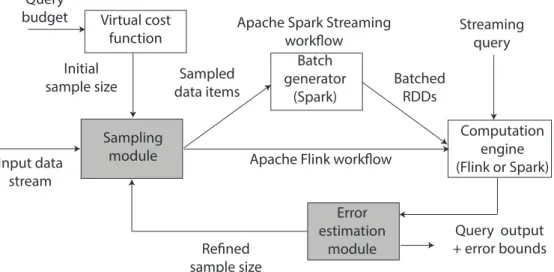
3.4 Architecture of StreamApprox prototypes (shaded boxes depict the imple-mented modules). We have impleimple-mented our system based on Apache Spark Streaming and Apache Flink. . . 28
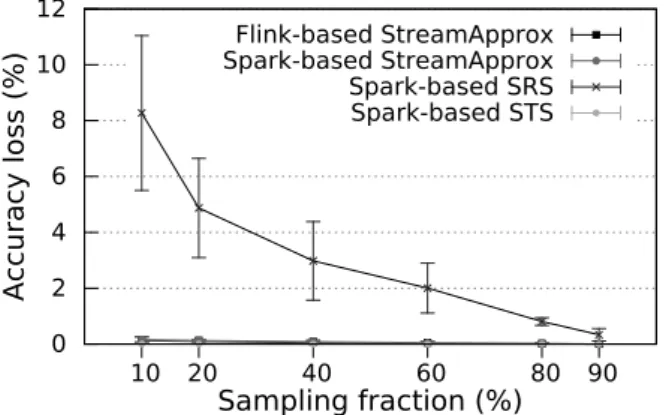
3.5 Comparison between StreamApprox, Spark-based SRS, Spark-based STS, as well as native Spark and Flink systems. (a) Peak throughput with varying sampling fractions. (b) Accuracy loss with varying sampling fractions. . . 31
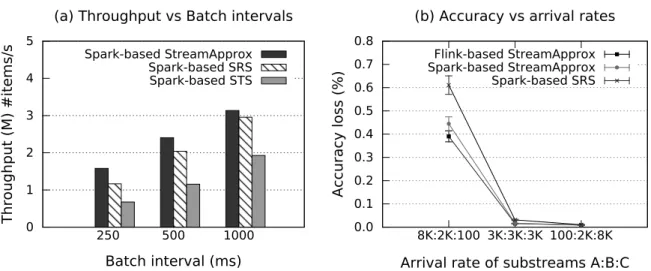
3.6 Comparison between StreamApprox, Spark-based SRS, Spark-based STS. (a) Peak throughput with varying batch intervals. (b) Accuracy loss with varying arrival rates. The sliding window size is 10 seconds, and each sliding step is 5 seconds. . . 32
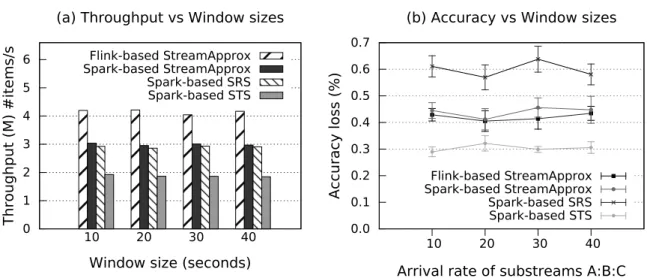
3.7 Comparison between StreamApprox, Spark-based SRS, and Spark-based STS. (a) Peak throughput with varying window sizes. (b) Accuracy loss with varying window sizes. The sampling fraction is set to60%. . . 33
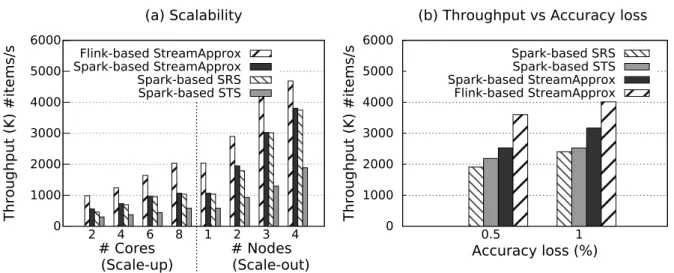
3.8 Comparison between StreamApprox, Spark-based SRS, and Spark-based STS. (a) Peak throughput with different numbers of CPU cores and nodes. (b) Peak throughput with accuracy loss. . . 34
3.9 The accuracy loss comparison between StreamApprox, Spark-based SRS, and Spark-based STS with varying sampling fractions. . . 35
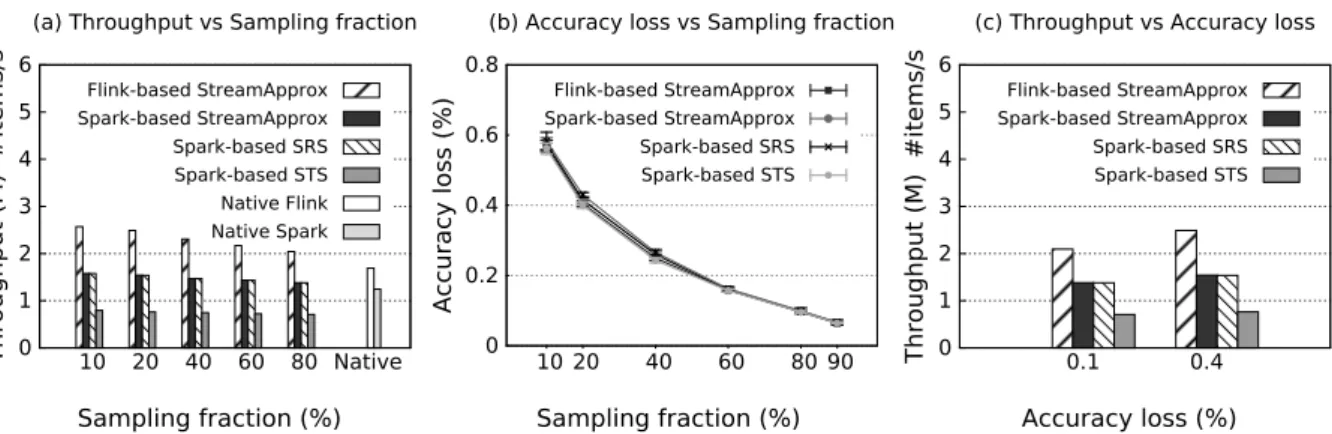
3.10 The case study of network traffic analytics with a comparison between StreamAp-prox, Spark-based SRS, Spark-based STS, as well as the native Spark and Flink systems. (a) Peak throughput with varying sampling fractions. (b) Accuracy loss with varying sampling fractions. (c) Peak throughput with different accuracy losses. . . 35
3.11 The case study of New York taxi ride analytics with a comparison between StreamApprox, Spark-based SRS, Spark-based STS, as well as the native Spark and Flink systems. (a) Peak throughput with varying sampling fractions. (b) Ac-curacy loss with varying sampling fractions. (c) Peak throughput with different accuracy losses. . . 37
3.12 The latency comparison between StreamApprox, based SRS, and
Spark-based STS with the real-world datasets. The sampling fraction is set to 60%. . . 38
4.1 System overview. . . 46
4.2 Batch-based stream processing. . . 47
4.3 Sliding window computation over data stream. . . 48
4.4 Run data-parallel job incrementally. . . 55
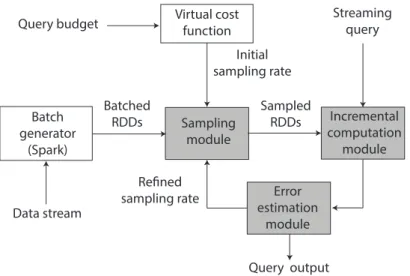
4.5 Architecture of IncApprox prototype (shaded boxes depict the implemented modules).. . . 57
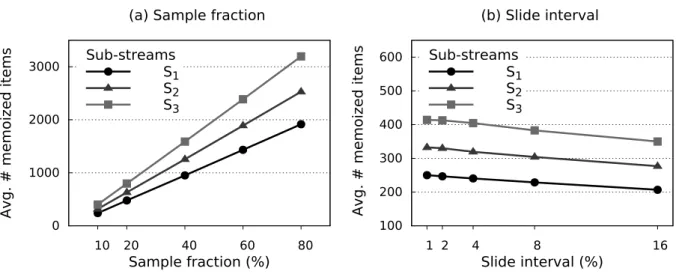
4.6 The effect of various sample fractions and slide intervals on the memoization. . 59
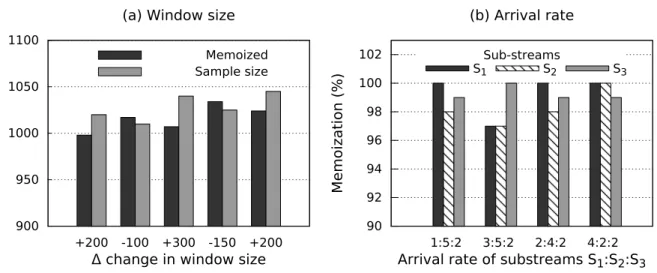
4.7 The effect of various window sizes and arrival rates on the memoization. . . 60
4.8 The ratio of peak throughput of Inc, Approx, and IncApprox to the peak through-put of native Spark Streaming with the sampling fraction is set to 60% and with end-to-end latency350ms. . . 61
4.9 The effect of varying sampling fractions on:(a)The ratio of the peak throughput of Approx and IncApprox to the peak throughput of native Spark Streaming, and (b)The accuracy loss of Approx and IncApprox with end-to-end latency350ms. 62 5.1 System overview. . . 70
5.2 XOR-based encryption with two proxies. . . 75
5.3 Architecture of PrivApprox prototype. . . 81
5.4 (a) Accuracy loss with varying sampling and randomization parameters. (b) Error estimation during the randomized response process and sampling process, combined and individually. . . 83
5.5 (a) Accuracy loss with varying # of clients. (b) Accuracy loss for the native and inverse query results with different fractions of truthful “Yes” answers. . . 84
5.6 (a) Throughput of proxies with different bit-vector sizes for the query answer. (b) Average number of sampled data items after stratified sampling with different sampling fractions. . . 86
5.7 (a) Latency comparison b/w SplitX (batch analytics) and PrivApprox (stream analytics). (b) Differential privacy level comparison b/w RAPPOR and PrivApprox. 87 5.8 Throughput at proxies and the aggregator with different numbers of CPU cores and nodes. . . 88
5.9 Total network traffic and latency at proxies with different sampling fractions at clients. . . 90
5.10 Results from the NYC taxi case-study with varying sampling and randomization parameters: (a) Utility, (b) Privacy level, (c) Comparison between utility and privacy. . . 90
5.11 Historical analytics results with varying sampling fractions: (a) Latency, (b) Throughput, and (c) Utility. . . 91
6.1 The comparison between sampling over joins mechanisms with different sam-pling fractions. (a)Latency;(b)Accuracy loss. . . 98
List of Figures
6.3 Bloom filter building.. . . 102 6.4 (a) The shuffled data size comparison between join mechanisms. The
over-lap fraction between input datasets is set to1%;(b)The shuffled data size of repartition join and Bloom filter based join with different overlap fractions. The number of input datasets is3(Simulation with100nodes cluster).. . . 105 6.5 The latency of cross-product operation with varying input sizes. . . 106 6.6 The cross-product operation graph of join data items having overlap keyC0. . . 108
6.7 The data shuffle size comparison between broadcast join, repartition join, op-timal ApproxJoin, and ApproxJoin with different desired false positive values. Optimal ApproxJoin is the case that there is no false positive happen during the join operation in ApproxJoin. . . 113 6.8 System implementation: the figure shows distributed dataflow graph execution
(on y-axis) for different stages (on x-axis) in ApproxJoin. . . 114 6.9 The latency breakdown of:(a)ApproxJoin without sampling;(b)Spark repartition
join;(c)Native Spark join. . . 116 6.10 Comparison between ApproxJoin and Spark join systems: (a) Latency with
varying overlap fractions;(b)Shuffled data size with varying overlap fractions;
(c)Latency and shuffled data size with varying # input datasets. . . 117 6.11 Comparison between ApproxJoin and Spark join systems: (a) Scalability; (b)
Latency; (c) Accuracy loss with varying sampling fraction. Note that Spark repartition join performs sampling after the join operation in this experiment. . 119 6.12 Comparison between ApproxJoin and Spark repartition join with sampling after
the join operation: (a)Latency;(b)Accuracy loss with varying latency budgets. . 119 6.13 Comparison between ApproxJoin and SnappyData:(a)Latency with with TPC-H
queries;(b)Latency;(c)Accuracy loss with varying sampling fractions. . . 121 6.14 Comparison between ApproxJoin and Spark join systems in network traffic case
study: (a)Latency and shuffle data;(b)Latency with various sampling fractions;
(c)Accuracy loss with various sampling fraction. . . 121 6.15 Comparison between ApproxJoin and Spark join systems in Netflix case study:
(a)Latency and shuffle data;(b)Latency with various sampling fractions. . . 122 6.16 Comparison of size of different Bloom filters with varying false positive rate. . . 124 A.1 Ratio of zk
List of Tables
5.1 Utility and privacy of query results with different randomization parametersp andq. . . 82 5.2 Comparison of crypto overheads (# operations/sec). The public-key crypto
schemes use a1024-bit key.. . . 84 5.3 Throughput (# operations/sec) at clients . . . 85
1 Introduction
Over the last ten years, the growth of digital data has accelerated exponentially. In 2017, Twitter users generated456,000tweets, Instagram users uploaded46,740photos, and Google conducted3,607,080searches every minute1. The volume of digital data is projected to reach 40zettabytes2or more by 2020 [126,185]. In modern online services, which are mostly
data-driven services, the need for real-time data analytics will continue to increase with high rate since it is crucial for their business. To exploit and mine rich and valuable information, data analytics systems are required to scale and adapt in order to handle vast amounts of data, high acquisition velocities, and a great variety of data sources and types. These challenges are associated with a hot topic in industry and academia called “big data”. These challenges also are described with “3Vs” [138], namely,Volumewhich reflects the massive data volumes, Velocitywhich implies the rapid growth of digital data, andVarietywhich refers to the diversity of data from various sources (e.g., sensors, web clickstreams, and social media) and also the types of data such as structured data (e.g., relational data), semi-structured data (e.g., XML and JSON), and unstructured data (e.g., video, audio, and plain text).
1.1 Brief History of Big Data Systems
Traditional technologies for analyzing data using SQL-based RDBMS and data warehousing became impractical for handling such vast amounts of data [30,53]. Thus, cluster comput-ing with a shared-nothcomput-ing architecture naturally has become a design choice for buildcomput-ing big data analytics systems. In these systems, data is partitioned and distributed on clus-ters of commodity machines, and computations are performed on the same machines with data locality-aware scheduling, fault tolerance, and scalability. Figure1.1shows briefly the history of big data systems development. Google pioneered this trend by introducing MapRe-duce [75] programming model, followed shortly by its open-source implementation, Apache Hadoop [222]. MapReduce is a simple and general programming model for parallel data ana-lytics. One of fundamental principles of it is to move computations to the data for processing rather than moving data to avoid network bottlenecks. In addition, it allows users to focus on computation on the data and the details of distributed execution and fault tolerance are transparently handled by the framework itself.
MapReduce works well for several workloads such as Web log analysis and text processing. However, it has been shown to be ineffective for other types of workloads: (i) iterative processing [89,229] such as machine learning [153] and graph processing [153,154],(ii)data stream processing [227].
For iterative programs, the classical MapReduce framework issues a MapReduce job for each
1https://www.domo.com/learn/data-never-sleeps-5 2
A zettabyte corresponds to one thousand exabytes, that is1021 bytes.
MapReduce 2004 2006 Hadoop 2007 Dryad 2010 Graphlab Pregel HaLoop Spark 2013 MillWheel Naiad Spark/GraphX 2014 Flink 2015 SparkSQL Spark/MLlib Spark Streaming Google Dataflow 2016 TensorFlow Time
Figure 1.1– Timeline of the big data analytics systems development.
iteration and handles the intermediate output of each iteration via a driver program. This incurs significant latency since, although the major data remains unchanged from one iteration to the next, the data needs to be loaded and processed repeatedly at each iteration, thus wasting not only computing resources but also network bandwidth. As a result, several variants of MapReduce have been developed to overcome this limitation. For example, HaLoop [48] caches the unchanged data in the first iteration and reuses them in the next iterations whereas iMapReduce [231] pipelines the intermediate data between tasks and between jobs to support iterative computations.
In addition, many complex computations such as graph processing and machine learning are not naturally suitable for only two phases of map and reduce. Dryad [127] overcomes this problem by using not only the two map-reduce phases, but arbitrary Directed Acyclic Graphs (DAGs) to describe computations. In a DAG, vertices represent operations and directed edges represent the communication between the operations. The operations are user-defined and the communication can be established through a variety of channels including files, shared memory FIFO, and TCP pipes. Inspired by the DAG-based dataflow concept, Apache Spark [21,22,229], introduces a flexible data-sharing abstraction called Resilient Distributed Datasets (RDDs) allowing to implement in-memory operations. With this abstraction, Spark can support multiple computing workloads including graph processing, machine learning, and SQL in a unified computation engine. Recently, Tensorflow [2] has been designed specifically for deep learning workloads.
Much of digital data is produced and generated as a continuous data stream and in huge volumes (e.g., video streaming, data streams from IoT sensors, and Twitter’s stream data). Real-time analytics of this stream data is hard. In principle, the fundamental design of MapReduce requires the map phase to be completedbeforethe reduce phase starts. All intermediate data is persisted to hard disks before sending to reducers. Thus, it introduces significant latency and makes this computing model unfit for stream processing. As a result, a wide range of dataflow-based stream processing systems has been proposed both in academia and industry such as Google MillWheel [210], Naiad [168], Spark Streaming [23,227], and Google Dataflow [9], Apache Flink [17], IBM Streams, Microsoft StreamInsight, and Amazon Kinesis. These distributed stream processing systems can be classified into two prominent cate-gories: (i)batched stream processing model, and(ii)pipelined stream processing model. In batched stream processing systems such as Spark Streaming [23,227] and FlumeJava [54], an input data stream is considered as a sequence of micro-batches and each micro-batch is processed by a distributed data-parallel job. This model introduces high latency since it requires forming micro-batches. However, it allows the fault tolerant mechanism in these
1.2 The Need for Approximation
systems to use partial results for recovery. In addition, the recovery process can be performed in a parallel and distributed manner. On the other hand, in pipelined stream systems such as Apache Flink and Naiad, each arriving data item is forwarded to the next operator in DAG as soon as it is ready to be processed without forming the whole batch. Thus, this processing model achieves lower latency. However, the recovery from failures is more expensive since it requires the state of operators to be recovered from the last checkpoint.
Recently, the Databricks team introduced a new computing model for processing high-speed data streams in Apache Spark, namelyStructured Streaming. Instead of treating the input data stream as a sequence of micro-batches as Spark Streaming, Structured Streaming treats the data stream as an append-only input table [202]. A new data item of the stream is considered as a row appended to the table. This design enables real-time stream processing with high throughput and low latency. In addition, it allows users to analyze the input stream by incrementally executing SQL queries on the table.
1.2 The Need for Approximation
Analyzing data to extract valuable information quickly is critical in terms of business of most online services. These data-driven services are typically user-interactive applications (e.g., search engines, recommendation systems, and social networks) which require strict latency constraints. With the rapid growth of data, meeting strict latency requirements in the process becomes really difficult.
Typically, the performance (throughput and latency) constraints can be met by employing more computing resources. As mentioned above, almost all data analytics systems in modern online services are based on the data-parallel programming model [17,21,75], thus they are able to achieve almost linear scalability by increasing computing resources, i.e., adding more CPU cores (scale-up) and worker nodes (scale-out). However, this comes at a significantly higher computing cost, which is not always acceptable in practice because of resource budget limits. For example, to speed up the data analytics10×by horizontal scaling, we need to pay10×more for the computing resources we added. This economic problem needs to be carefully considered in modern online services. In addition, in large-scale services such as social media, video streaming, and stock market analysis, the growth of data over time will quickly overwhelm available resources. Briefly, data analytics systems of modern online services have two desirable, but contradictory design requirements [168,227]:(i)achieving high-throughput/low-latency and(ii)efficient resource utilization.
To address this dilemma, we need to reduce the amount of data that needs to be processed. A promising solution for this approach isapproximate computingwhich is based on the obser-vation that many modern online services do not always require exact data analytics results (e.g., recommendation services, sentiment analysis, and stock market trend prediction). For these services, the trends extracted from the data are more important than exact statistical results. In addition, in some cases, it is impossible to get exact results since the input data often contains noise (e.g, the data from IoT devices may contain inherent measurement errors). Thus, for these services, we can applyapproximate computingto strike a balance between throughput/latency and resource constraints. Since approximate computing paradigm per-forms analytics over a subset of data items instead of the entire datasets, it requires less time and resources, and thus allows to achieve desirable latency and efficient resource utilization.
1.3 The Promise of Approximate Computation
Approximate computing has recently emerged as a promising solution to reduce the com-puting resources usage, processing time, and even energy consumption of data analytics systems [7,8,103]. As mentioned above, the computing paradigm is based on the observation that for many modern online services it is acceptable to approximate rather than produce ex-act output results. Such services include search engines (Google, Microsoft Bing, Yandex, and Yahoo search), recommendation systems (Youtube, Facebook, Amazon, and Netflix), speech recognition (Apple Siri and Google voice search), and computer vision (online games). The “correctness” or quality of output of these services is defined as providing good enough or sufficient quality of results for users satisfaction. In addition, several applications have to accept approximate results since their input data contains noise. Thus, even if a data analytics system processes the whole input data, it cannot produce an exact result.
As a result, for these services and applications, it is possible to make a trade-off between accuracy, high-throughput/low-latency and efficient resource utilization by computing over a partial subset instead of the entire large-scale input data. This trade-off domain can be depicted as a “throughput/latency – resource utilization – accuracy” triangle (see Figure1.2). The domain can be further extended with energy efficiency or even privacy-preserving analytics objectives.
The idea behind approximate computing is to build synopses of the original massive data to quickly answer analytics queries by executing them over the synopses instead of the original data. In general, approximate computing techniques provide mechanisms to summarize the massive data in such a way that this summary (synopsis) of the data effectively captures all features and attributes that we are interested in. Ideally, the synopsis first should be small compared to the original massive data, such as it can be kept and processed in our system. Thus, it allows providing approximate analytical results with a significantly lower latency. Second, it should be able to incrementally update with new arriving data. Finally, it should be able to be processed to get the insights.
Over the last decade, approximate computing has been applied to various levels of the com-puting stack for both hardware and software [91,224,225]. In detail, applications of approxi-mate computing have been explored in various domains such as programming languages [29, 194], hardware design [193], query processing [7,59,200], and distributed systems [70,121, 171]. Various approximation techniques have been proposed including sampling [11, 100], sketches [73], and online aggregation [121,171] to build the synopses. These techniques make different trade-offs with respect to the output quality, supported query interface, and work-load. However, the early work in approximate computing mainly targeted the centralized database architecture, and it was unclear whether these techniques could be extended in the context of big data analytics.
Among these approximation techniques, sampling has been widely applied for approximate computing since this approach has the ability to provide probabilistic error bounds for approx-imate results; it also fits well with a wide range of applications including graph processing [197] and machine learning [49,139]. Recently, sampling-based approaches have been successfully adopted for distributed data analytics [7,8,103,204]. Unfortunately, these “big data” systems are mainly targeted towards batch processing, where the input data remains unchanged during the course of sampling. Therefore, these systems cannot be used for stream analytics, which requires real-time continuous processing of input data streams. One of challenges
1.4 Thesis Research: Approximate Data Analytics Systems Accuracy Throughput/ Latency Resource Utilization
Figure 1.2– Throughput/latency, resource utilization, and accuracy triangle.
in building approximate data anatlytics systems is to solve high-speed large-volume data streams in distributed environments and producing approximate results for various queries with resonable latencies.
1.4 Thesis Research: Approximate Data Analytics Systems
Thesis Statement. The aim of our work is to design and implement approximation techniques to build scalable resilient systems for processing and interacting with high-speed large-volume datasets with low latency and efficient utilization of resources. In other words, in this thesis, we design systems to process big data with high-throughput low latency and efficient resource utilization using approximate computing.
Scope. There exist many approximation techniques including sampling, sketches, wavelets, histograms, and on-line aggregation. The main purpose of these techniques is to efficiently summarize the input data using synopses and thereafter process the summary data instead of the original input data. In this thesis, we focus on sampling-based approaches which can be used to approximately answer a wide range of statistical queries on data streams. Sampling-based approaches build a representative subset of the input data obtained using stochastic mechanisms, then process this subset to provide an approximate output result. Goals. In this thesis, we design and build approximate data analytics systems with three goals in mind:
• TransparencyExisting applications are able to get the benefit from our systems without any modifications or with a minor change in their code base. To ensure that, we build our systems on top of state-of-the-art big data analytics platforms such as Apache Spark and Apache Flink without changing or with slightly changing the existing interfaces of these systems.
• PracticalityWe offer a simple and convenient interface for approximate computation which allows users systematically make a trade-off between the output quality, through-put/latency or computing resources for data analytics.
• EfficiencyWe aim to handle very large-scale and high-speed data in an efficient and cost-effective manner. To achieve this goal, we design and propose sampling based techniques for approximate computing.
Approximate Data Analytics
Input data Approximate result
± Error bound Query Query budget
Figure 1.3– Systems Overview.
1.5 Thesis Contributions
In this thesis, we describe the design and implementation of big data analytics systems that employ approximate computing. Figure1.3depicts the high-level architecture of our approximate computing data analytics systems for processing large-scale input datasets. The input data can be in form of batches (data-in-rest) or streams (data-in-motion). We offer the convenience of querying on this input data by supporting a user interface that consists of a query and a query budget for executing the query. A user submits the query as well as specifies a query budget to the system. The query budget can either be in the form of latency/throughput guarantees, desired processing, computing resources available or energy consumption for query processing. Our systems make sure that the computation done over the data remains within the specified budget and the query result is emitted along with a confidence interval or error bounds.
In this thesis, we present the following approximate data analytics systems.
1.5.1 StreamApprox— A Data Analytics System for Approximate Computing
We start this thesis with building a stream processing system called StreamApprox. The aim of this work is to build a system that supports approximate computing for low-latency stream analytics in a transparent manner. Furthermore, the system has the ability to adapt to rapid fluctuations in input data streams. To realize this, we design an online adaptive stratified reservoir sampling algorithm to produce approximate output with bounded error that requires no modifications to the existing applications. Importantly, our proposed algorithm is generic and can be applied to two prominent types of stream processing systems: (i)batched stream processing such as Apache Spark Streaming, and(ii)pipelined stream processing such as Apache Flink. To showcase the effectiveness of our algorithm, we implemented StreamApprox as a fully functional prototype based on Apache Spark Streaming and Apache Flink. We evaluated StreamApprox using a set of micro-benchmarks and real-world case studies. Our evaluation shows that StreamApprox has the ability to handle high throughput input stream data with fluctuated arriving rates and at the same time provide high accuracy in data analytics.
1.5.2 IncApprox— A Data Analytics System for Approximate and Incremental Computing
After building StreamApprox, we reviewed the design to see whether we can improve the performance of StreamApprox further. We recognized that it is possible to improve the
per-1.5 Thesis Contributions
formance by using an additional computing paradigm called incremental computing besides approximate computing. Incremental computing relies on the memoization of intermediate results from previous computations and reuses them in subsequent computations. Since com-puting over a subset of the input requires less time and resources, this comcom-puting paradigm also achieves low-latency and efficient resource utilization as approximate computing. We combine the two computing paradigms by designing an online stratified sampling algorithm that uses self-adjusting computation to produce an incrementally updated approximate out-put with bounded error. We implemented our algorithm in a system called IncApprox based on Apache Spark Streaming. Our evaluation shows that the two computing paradigms, in-cremental and approximate computing, are complementary and the combination allows our system to leverage the benefits of both.
1.5.3 PrivApprox— A Data Analytics System for Approximate and Privacy-Preserving Computing
After designing StreamApprox and IncApprox, the systems that allow users to systematically make a trade-off between throughput/latency and accuracy in stream analytics, we wondered whether it is possible to expand the trade-off domain to more than just throughput/latency and accuracy? This question motivated us to build the third system called PrivApprox by expanding the trade-off domain with a new and interesting dimension — privacy. Our objective in this work is to develop a system that supports high-utility and low-latency data analytics while preserving users privacy at the same time. To achieve this goal, we combined privacy-preserving data analytics and approximate computing to build PrivApprox. Privacy-privacy-preserving analytics adds explicit noise to the final query output to protect users privacy. In particular, we make use of randomized response mechanisms to preserve the privacy of users and sampling techniques to achieve low-latency in data analytics. Interestingly, by applying these sampling techniques for approximate computing, our system actually strengthens users privacy.
1.5.4 ApproxJoin— A Data Analytics System for Approximate Distributed Joins
In PrivApprox, the system needs to perform a join operation between two input data streams to decrypt the user input stream data. Unfortunately, this join operation is a bottleneck of the system. This motivated us to build the forth system called ApproxJoin to improve the performance of join operations in data analytics using approximate computing. To realize this idea, we designed a novel join sampling algorithm that combines two approximate techniques (i)Bloom filters - a sketch technique and(ii)stratified sampling. Bloom filters remove unneces-sary data items which do not participate in the join operation (non-join items), thus reducing the shuffled data size during the join operation. Meanwhile, stratified sampling allows users to take samples over the join operation to make a trade-off between accuracy and latency. The combination of the two techniques allows users to obtain unbiased random samples over joins. We implemented ApproxJoin in Apache Spark and evaluated it with micro-benchmarks and real-world case-studies. Our evaluation shows that the system not only improves the performance of join operation regarding latency but also significantly reduces total shuffled data size through the network during the join processing.
1.6 Organization
The remainder of the thesis is organized as follows.
In Chapter2, we present the background about approximate computing techniques and big data analytics frameworks used in this thesis.
In Chapter3, we present the design and implementation of StreamApprox. In Chapter4, we present the design and implementation of IncApprox. In Chapter5, we present the design and implementation of PrivApprox. In Chapter6, we present the design and implementation of ApproxJoin. Finally, in Chapter7, we give the conclusion of our works.
2 Background
In this chapter, we first introduce approximate computing, and then briefly review approxi-mation techniques for data analytics systems including sampling techniques and sketches. Next, we present big data analytics platforms used to implement our systems in this thesis.
2.1 Approximate computing
Approximate computing is a computing paradigm making a trade-off between accuracy and efficiency. Approximate computing is based on the observation that approximate results are sufficient for many applications such as machine learning, social media, and search engines. For example, in machine learning, it is impossible to compute exact models for classification and prediction problems. In video streaming applications, dropping few frames will not affect the quality of output since human perception is limited. In search engines, there is no exact answer for a certain search query, but a list of approximate answers.
Approximate computing has been applied across the whole computing stack including hardware [193], compilers [192], programming languages [29,194] (refer to [191] for a detailed survey) and data analytics systems [7,103,137,204] to trade accuracy of computations for higher throughput, lower latency, and efficient resource utilization or efficient energy con-sumption. For example, in K-means clustering computation, sacrificing only5%classification accuracy loss can save up to50×energy [164].
Our work mainly builds on the advancements in the databases community. In this section, we survey the approximation techniques in this context. The databases community has pro-posed various approximation techniques based on sampling [11,100], online aggregation [121], and sketches [73]. However, these early works in approximate computing were mainly de-signed for the centralized database architecture. In the context of big data analytics, it was still not clear whether these techniques could be applied or not.
In the last five years, sampling-based approaches have been successfully adopted for dis-tributed data analytics [7, 103, 204]. For example, BlinkDB [7] proposed an approximate distributed query processing engine that uses stratified sampling [11] to support ad-hoc queries with error and response time constraints. First, BlinkDB creates and maintains a collection of multi-dimensional stratified samples using off-line stratified sampling. Second, based on accuracy or response time requirements of users input query, it selects a rele-vant sample to execute the query. Later, the systems SnappyData [186] and SparkSQL [27] adopted the approximation techniques from BlinkDB to support approximate queries. Ap-proxHadoop [103] uses multi-stage sampling [152] for approximate MapReduce job execution. These systems show that it is possible to make a trade-off between the output accuracy and performance gains (also efficient resource utilization) by employing sampling-based approaches to compute over a subset of data items. However, these “big data” systems target
batch processing and cannot cater required low-latency guarantees for stream analytics. Like BlinkDB, Quickr [204] also supports complex ad-hoc queries in big-data clusters. Quickr deploys distributed sampling operators to reduce execution costs of parallelized queries. In particular, Quickr first injects sampling operators into the query plan; thereafter, it searches for an optimal query plan among sampled query plans to execute input queries. However, Quickr is also designed for static databases, and it does not account for stream analytics.
As mentioned before (see §1.3), the key idea behind approximate computing is to execute computations over synopses, which captures the vital characteristics of the original big data, instead of the original data to approximate results with a significantly lower latency. To build the approximate synopses (i.e., compressed representations or summaries) of the big data, there are two major approximate techniques that can be employed: (i)sampling and(ii) sketches (for other approximate techniques, a detailed survey is provided in [73,164]).
2.1.1 Sampling
Sampling techniques have become the norm in approximate data analytics. They provide an efficient and cost-effective way to reduce the size of big data meanwhile maintaining vital properties of the original data.
The main objective of sampling mechanisms is to make use of stochastic techniques to take samples representative of the original data. These samples can be used to quickly provide approximate answers for a wide range of queries. The sampling mechanisms allow us to make trade-offs between accuracy and throughput/latency by tuning the sample size of the samples. In fact, online aggregation mechanisms make use of sampling mechanisms with the observation that the accuracy of approximate results can be incrementally improved simply by repeatedly adding more samples.
Random sampling mechanisms are perhaps the most widely used for approximate data ana-lytics including approximate query processing (AQP) [7,8,103,186,204], graph processing [197], and machine learning [49,139]. An abundance of methods of building and maintaining samples of big data has been proposed along with multiple mechanisms to provide an estimator for a given query to calculate error-bounds for approximate results. For aggregation queries such as sum, average, and count, unbiased estimators based on Central Limit Theorem [205] can straightforwardly provide error-bounds for approximate results.
For approximate data analytics, there are several key sampling schemes including Bernoulli sampling, simple random sampling, stratified sampling and reservoir sampling.
Bernoulli sampling. Bernoulli sampling is an equal-probability, without-replacement sam-pling scheme where all data items in the original data have an equal chance of being included in the sample. Since each data item in the original data is considered independently for the sample, the sample size of the sample is not fixed. Implementing Bernoulli sampling is quite straightforward [114]. To perform Bernoulli sampling with sampling fraction ofq, we can implement a mechanism as follows. For each data item, we generate a random number in the range [0, 1] (flipping a biased coin), and if the random number is less thanq, we add the data item into the sample, otherwise, we just skip it. We can further improve this algorithm by simulating the gaps between subsequent selected items. This is based on the observation that the number of data items that are ignored between successive selections has a geometric
2.1 Approximate computing
distribution. By simulating the gaps we can save CPU cycles for generating the random number for non-selected data items [114]. The Bernoulli sampling mechanism can be applied easily to take a sample of an input data stream within one pass in distributed environments. However, the problem of Bernoulli is that the sample size is random and not fixed. Thus, it is difficult to estimate the processing latency over the samples.Simple random samplingis a sampling sheme overcoming this limitation of Bernoulli sampling.
Simple random sampling. Simple random sampling is a sampling scheme that allows us to takekdistinct data items (kis the sample size) fromndata items of the original data in such a way that every possible combination of k items is equally likely to be the sample selected (see the definition in [161,205]). In simple random sampling, each data item has an equal chance to be included in the selected sample. It is considered as the most common sampling scheme for taking a sample of the original data.
In this sampling scheme, simple random samplingwith replacementallows each data item to appear multiple times in the sample, meanwhile simple random samplingwithout replacement allows each data item appear at most one time in the sample. Given the same sample size, simple random sampling without replacement can capture more vital properties of the original data. This is due to the fact that in simple random sampling with replacement, although the sample may contain duplicated data items, the sample size is still the same. In the case the sample size is very small compared to the population size of the original data, simple random sampling with and without replacement are almost the same since the probability of selecting a given data item into the sample more than once is negligible.
Although simple random sampling is widely used for approximate computing, it may po-tentially compromise the statistical quality of the sample in the case where the original data contains multiple homogeneous groups (e.g., an input data stream may contain several sub-streams) with different distributions. This is due to the fact that simple random sampling may overlook some groups having only a few but important data items. Simple random sampling does not ensure that each group in the original data is considered fairly to contribute its data items for the sample. Stratified sampling [11,205] was proposed to overcome this limitation of simple random sampling.
Stratified sampling. Stratified sampling is a sampling scheme in which the original data is divided into a homogeneous disjoint set of groups (strata); from each group (stratum) a random sample is drawn and these are combined together to build the sample of the original data [205]. Stratified sampling ensures that data items from each group are considered fairly to be present in the sample and no group will be overlooked.
Compared to simple random sampling, stratified sampling provides higher statistical preci-sion and reduces sampling error of the sample. It also means that it requires a smaller sample size to achieve the same accuracy as simple random sampling, thus further improving perfor-mance and utilizing less computing resources. Therefore, stratified sampling is considered as a building block for our approximate data analytics systems in this thesis.
There are two types of stratified sampling: (i)proportionate stratified sampling and(ii) disproportionate stratified sampling. In proportionate stratified sampling, the same sampling fraction is applied for each stratum, i.e., the sample size of each stratum is proportionate to the size of the stratum, whereas in disproportionate stratified sampling, different sampling fractions are applied for different strata. In this thesis, we only consider the proportionate stratified sampling as a building block to design our systems.
Note that, in the case we apply simple random sampling for each stratum, the stratified sampling requires to know the size of the stratum in advance. Hence, it may become im-practical in sampling data streams since the population size of a data stream is typically unknown in advance, and thus, sampling fraction cannot be defined beforehand. In addition, the data stream may contain a large number of data items which could not be stored in the system, then the stratified sampling also does not work.Reservoir samplingwas proposed to overcome these issues.
Reservoir sampling. Reservoir sampling is a sampling scheme that allows us to take and maintain a sample of sizekfrom an input data stream. Reservoir sampling receives data items from the input data stream and maintains a sample in a buffer calledreservoir. Specifically, to take a sample with sizekfrom the input data stream, Reservoir sampling first fills up the reservoir with the firstkdata items of the input stream, thereafter it selects a new arriving data item with probabilityk
i whereiis the index of the item in the input stream, then randomly replaces one existing item in the reservoir by the selected item [114]. Reservoir sampling does not require to know the size of the input data stream in advance. In addition, this sampling scheme makes sure that each data item in the input stream is included in the reservoir with equal probability.
Although reservoir sampling is resource-efficient, similar to simple random sampling, it may potentially mutilate the statistical quality of the sampled data items in the reservoir, especially when the input data stream combines multiple sub-streams with different distributions. The data items received from an infrequent substream could easily get overlooked in reservoir sampling. In addition, the scheme is difficult to implement to work in distributed environments since it is required to maintain a global view of the probability k
i.
There have been several variants of reservoir sampling scheme proposed. Brown et al. [47] extend the scheme to sample multiple streams in parallel. Al-Kateb et al. [11] combine stratified sampling and reservoir sampling to take samples of a heterogeneous input data stream. However, these mechanisms are not able to neither ensure the statistitical quality of samples nor be implemented in distributed environments.
2.1.2 Sketches
Sketches are techniques to build synopses of big data including batch and stream data. Typically, this technique is suitable to handle high-speed and large-volume data streams [73]. A sketch is a compressed synopsis or a compacted data structure that captures all interesting features and attributes of an input stream. One of the advantages of sketch techniques is that sketches are much smaller compared to the input data stream, thus executing queries on sketches instead of the original data significantly improves the latencies and achieves more efficiency in resource utilization. In general, sketches are built specifically to serve a certain type of query in mind [73], e.g., membership query [41], finding Heavy Hitters in data streams [72] and finding Top-k data items in data streams [156]. The similarity between sketches is that they make use of underlying hashing schemes to summarize the original data [125]. Next, we review several sketches which are widely adopted as technical building blocks for approximate data analytics systems.
proba-2.1 Approximate computing
bilistic sketch for supporting membership queries. A Bloom filter is a space-efficient data structure designed to query whether an element is present in a dataset rapidly and memory-efficiently [41]. The Bloom filter data structure is basically anm-bit vector. Each cell in the vector is represented by a bit. Initially, all cells are set to0. To add a data item to the Bloom filter, we simply hash ithtimes usinghhash functions to obtain bit indices and set the corresponding bits to1. To check for membership of a data item, we also hash ithtimes using the same hash functions, and if all bits of itshhash indices are1, then the data item is in the dataset. For Bloom filters, false positives are possible but false negatives are not. There is a trade-off between the size of a bit vectormand the probability of a false positive. A largermhas less false positives but consumes more memory, whenever a smallermrequires less memory at the risk of more false positives. The false positive rate can be computed as follows [41]:
p≈(1−ehnm)h (2.1)
In this thesis, we also consider Bloom filter as a technical building block to design our approximate data analytics systems since it provides three main advantages: (i)querying the membership of data items is efficient (O(h) complexity);(ii)the size of a Bloom filter is linearly correlated with the size of the input data, but requires a significantly smaller storage compared to the original data;(iii)building a Bloom filter requires only a single pass over the input data.
Count-Min Sketch. Count-Min sketch is a probabilistic data structure that is used to estimate the frequencies of data items in an input data stream. It extends the design of Bloom filter with a bit array structure into a table counter (a two-dimensional array) in order to maintain approximate frequency counts of input data stream items [71]. Count-Min sketch uses a set of hash functions to map input data items into the table. The table is organized as a sequence of rows, each data item is mapped into the first row using the first hash function, into the second row using the second hash function, and so on. Each row maintains a counter that is incremented on every occurrence of the data item. This counter could also potentially be incremented by other items mapped to the same location as collisions are expected to happen. To estimate the frequencies of a data item, Count-Min sketch simply takes the smallest counter among rows of the item since the counters contain the desired count plus noise due to collisions [71,73].
HyperLogLog. HypperLogLog is a probabilistic data structure that is used to estimate the number of distinct data items in a dataset or an input data stream. HyperLogLog uses a hash function to map each data item in the original data to a hash value and assumes that the hash function produces uniform hash values. If the binary representation of hash values hasl maximum number of leading zeros at the beginning (00..0 1* -lzeros), then the number of distinct data items in the original data is estimated to2l[92,122]. This algorithm is based on the observation that the number of distinct data items (cardinality) of a list ofuniformly distributed random numberscan be estimated by measuring the maximum number of leading zeros in the bit-string representation of each number in that list. If the maximum number of zeros obtained among bit-strings isl, the number of distinct items in the list can be estimated as2l[92,122]. Refer to [122] for deep discussion on how to use HyperLogLog in practice.
In general, sketches can be used to build synopses or summaries of data streams to capture interesting features for answering queries. One of the limitations of sketching techniques
compared to sampling techniques is that each sketch is designed to support a specific type of query. For example, Bloom Filter is designed for membership queries, Count-Min sketch for frequency queries, HyperLogLog for count distinct queries, and MinHash sketch [67] for measuring the similarity between two sets. Meanwhile, sampling techniques can support more general queries. Thus, in this thesis, we focus on using sampling techniques to design approximate analytics systems. However, we also try to combine sampling techniques and sketching techniques to support a wide-range of queries and provide better approximations for those queries.
2.2 Big data analytics frameworks
In this section, we provide a brief description of big data frameworks which we used to implement our approximate data analytics systems including Apache Spark [21] and Apache Flink [17]. These two frameworks have been widely used in both academia and industry for big data analytics.
2.2.1 Apache Spark
Apache Spark [21] is an open-source large-scale data processing framework. Comparing to Hadoop MapReduce, Spark is much faster in processing large-scale datasets since instead of using the disk-based cluster computing, Spark applies the in-memory computing concept where intermediate data is cached in memory to reduce latency [133].
Spark introduces the core abstraction – Resilient Distributed Datasets (RDDs) [229] for distributed data-parallel computing. An RDD is an immutable and fault-tolerant collection of elements (objects) that is distributed or partitioned across a set of nodes in a cluster [21]. To achieve fault tolerance, Spark provides thelineagemechanism in which each RDD maintains meta-datahow it was created from other RDDs. Themeta-datais used to recover the RDD in the case of failure [133,229].
RDDs support two types of operations: transformations andactions. Transformations return a new RDD, such asmap()andfilter(), and actions are operations performed on RDDs that return the output to the driver program or store it in a persistent storage system (e.g reduce(), count(),collect(),saveAsTextFile(), etc). Transformations are performed lazily, i.e., they are computed whenever an action operation is invoked [133].
Spark platform contains multiple integrated components including MLlib [22] for machine learning, GraphX [105] for graph-based analytics, Spark SQL [27] for working with structured data, and Spark Streaming [23] for processing data streams. Spark Streaming extends the RDD abstraction by introducing the DStreams APIs [227], which is a sequence of RDDs arrived during a time window. Spark Streaming splits the input data stream into micro-batches, and for each micro-batch, a distributed data-parallel job (Spark job) is launched to process the micro-batch.
Spark supports RDD based sampling functions, which in turn can be used to support approximate computing [229]. In particular, Spark’s sampling functions can be classified into the following two categories: 1) Simple Random Sampling (SRS) usingsample(), and 2) Stratified Sampling (STS) usingsampleByKey()andsampleByKeyExact(). Spark implements
2.2 Big data analytics frameworks
these sampling functions in a “batch” fashion, where all data items are first accumulated in a batch, and then the actual sampling is carried out.
2.2.2 Apache Flink
Apache Flink [17] is an open-source framework for both distributed batch and stream data analytics. Apache Flink and Spark Streaming both are DAG-based distributed stream process-ing engines. At a high level, both frameworks provide similar dataflow operators (e.g., map, flatmap, reduce, and filter). However, Spark Streaming is a batched stream processing engine, whereas Flink is a pipelined stream processing engine. In particular, Apache Flink adopts a pipelined architecture in which whenever an operator in the DAG dataflow emits an item, this item isimmediatelyforwarded to the next operator without waiting for a whole data batch. This mechanism allows Apache Flink to support truely stream processing. In addition, Flink considers batches as a special case of streaming, whereas Spark considers streaming as a special case of batches.
Similar to Spark, Apache Flink also provides a fault-tolerance scheme to consistently recover the state of data stream processing jobs in the case of failures. This scheme takes consistent snapshots of the input data stream and state of operators. In the case of failures, the snapshots are used for recovery. Apache Flink supports both stream and batch processing by offering two main abstractions:(i) DataStreamfor stream processing and(ii) DataSetfor batch processing.
In addition, Flink also contains multiple integrated components including Flink Gelly [93] for graph processing, FlinkML [95] for machine learning, and Flink SQL [94] for supporting SQL queries for both stream and batch data analytics.
3 StreamApprox: Approximate Stream Analytics
In this chapter, we present the design, implementation, and evaluation of StreamApprox, an ap-proximate computing system for stream analytics. StreamApprox supports high-throughput and low-latency stream analytics by adopting approximate computing in a transparent manner. In StreamApprox, we designed an online stratified reservoir sampling algorithm to produce approximate output with rigorous error bounds.
This chapter is organized as follows. We first motivate the design of StreamApprox in Section§3.1. We next briefly highlight the contributions of StreamApprox in Section§3.2. Thereafter, we present the overview of StreamApprox in Section§3.3. Next, we describe the detailed design of StreamApprox in Section§3.4. Then, we present the implementation of StreamApprox based on the design in Section§3.5. Next, we present an experimental evaluation of StreamApprox using micro-benchmarks in Section§3.6 and two real world case-studies in Section§3.7. Thereafter, we present the limitations in Section§3.8. Finally, the related work and conclusion are discussed in Section§3.9and Section§3.10, respectively. The content of this chapter is based on our conference paper [184] and technical report [181]. This work is based on a joint collaboration with Ruichuan Chen, Pramod Bhatotia, Christof Fetzer, Volker Hilt, and Thorsten Strufe.
3.1 Motivation
Stream analytics systems are extensively used in the context of modern online services to transform continuously arriving raw data streams into useful insights [17,168,227]. These systems target low-latency execution environments with strict service-level agreements (SLAs) for processing the input data streams.
In the current deployments, the low-latency requirement is usually achieved by employ-ing more computemploy-ing resources and parallelizemploy-ing the application logic over the distributed infrastructure. Since most stream processing systems adopt a data-parallel programming model [75], almost linear scalability can be achieved with increased computing resources.
However, this scalability comes at the cost of ineffective utilization of computing resources and reduced throughput of the system. Moreover, in some cases, processing the entire input data stream would require more than the available computing resources to meet the desired latency/throughput guarantees.
To strike a balance between the two desirable, but contradictory design requirements — low latency and efficient utilization of computing resources — there is a surge ofapproximate computingparadigm that explores a novel design point to resolve this tension. In particular, approximate computing is based on the observation that many data analytics jobs are amenable to an approximate rather than the exact output [80,170]. For such workflows, it is possible to trade the output accuracy by computing over a subset instead of the entire data stream. Since
computing over a subset of input requires less time and computing resources, approximate computing can achieve desirable latency and computing resource utilization.
To design an approximate computing system for stream analytics, we need to address the following three important design challenges: Firstly, we need an online sampling algorithm that can perform “on-the-fly” sampling on the input data stream. Secondly, since the input data stream usually consists of sub-streams carrying data items with disparate population dis-tributions, we need the online sampling algorithm to have a “stratification” support to ensure that all sub-streams (strata) are considered fairly, i.e., the final sample has a representative sub-sample from each distinct sub-stream (stratum). Finally, we need an error-estimation mechanism to interpret the output (in)accuracy using an error bound or confidence interval.
Unfortunately, the advancements in approximate computing are primarily geared towards batch analytics [7,103, 204], where the input data remains unchanged during the course of sampling (see§3.9for details). In particular, these systems rely on pre-computing a set of samples on the static database, and take an appropriate sample for the query execution based on the user’s requirements (aka query execution budget). Therefore, the state-of-the-art systems cannot be deployed in the context of stream processing, where the new data continuously arrives as an unbounded stream.
As an alternative, we could in principlerepurposethe available sampling mechanisms in Apache Spark (primarily available for machine learning in the MLib library [22]) to build an approximate computing system for stream analytics. In fact, as a starting point, we designed and implemented an approximate computing system for stream processing in Apache Spark based on the available sampling mechanisms.
Unfortunately, as we will show later, Spark’s stratified sampling algorithm suffers from three key limitations for approximate computing, which we address in our work (see§3.5 for details). First, Spark’s stratified sampling algorithm operates in a “batch” fashion, i.e., all data items are first collected in a batch as Resilient Distributed Datasets (RDDs) [229], and thereafter, the actual sampling is carried out on the RDDs. Second, it does not handle the case where the arrival rate of sub-streams changes over time because it requires a pre-defined sampling fraction for each stratum. Lastly, the stratified sampling algorithm implemented in Spark requires synchronization among workers for the expensive join operation, which imposes a significant latency overhead.
3.2 Contribution
In this chapter, we present the design and implementation of StreamApprox, an approximate computing system for stream analytics. In this system, we designed anonline stratified reservoir sampling algorithmfor stream analytics. Unlike existing Spark-based systems, we perform the sampling process “on-the-fly” to reduce the latency as well as the overheads associated with the process of forming RDDs. Importantly, our algorithm generalizes to two prominent types of stream processing models: (1) batched stream processing employed by Apache Spark Streaming [23], and (2) pipelined stream processing employed by Apache Flink [17].
More specifically, our sampling algorithm makes use of two techniques: reservoir sampling and stratified sampling. We perform reservoir sampling for each sub-stream by creating a
3.2 Contribution StreamApprox Data stream Stream aggregator (E.g. Kafka) Sub-streams S1 S2 Sn . . Query output Streaming query Query budget
Figure 3.1– System overview.
fixed-size reservoir per stratum. Thereafter, we assign weights to all strata respecting their respective arrival rates to preserve the statistical quality of the original data stream. The proposed sampling algorithm naturally adapts to varying arrival rates of sub-streams, and requires no synchronization among workers (see §3.4).
We implemented StreamApprox based on Apache Spark Streaming [23] and Apache Flink [17], and evaluate its effectiveness via various micro-benchmarks. Furthermore, we also report our experiences on applying StreamApprox to two real-world case studies. Our evaluation shows that Spark- and Flink-based StreamApprox achieves a significant speedup of1.15×to 3×over the native Spark Streaming and Flink executions, with varying sampling fraction of 80%to10%, respectively.
In addition, for a fair comparison, we have also implemented an approximate computing system leveraging the sampling modules already available in Apache Spark’s MLib library (in addition to the native execution comparison).