R E S E A R C H
Open Access
Performance analysis of transmit antenna
selection for cognitive radio systems with
imperfect channel estimation
Peng Lan
1†, Lizhen Chen
1, Guowei Zhang
2and Fenggang Sun
1*†Abstract
In this article, we consider a spectrum sharing cognitive radio network with a transmit antenna selection scheme, subject to the peak interference constraint of primary user (PU) and the maximum transmit power limit of secondary user (SU). Due to time-varying properties or feedback latency, the channel estimation of the link from secondary transmitter to primary receiver may be imperfect, which will result in the violation of the interference constraint at PU. Under the condition of imperfect channel state information (CSI), we derive the cumulative distribution function (CDF) and probability density function (PDF) of the SU’s signal to noise ratio (SNR). Then, we obtain the closed-form expressions of average symbol error rate (SER) and capacity for the secondary system, respectively. Extensive simulations are performed with various system parameters to validate the correctness of our theoretical analysis.
Keywords: Cognitive radio, Transmit antenna selection, Imperfect channel state information, Capacity, Symbol error rate
1 Introduction
Cognitive radio (CR) has been considered as a promis-ing solution to tackle the spectrum scarcity problem by allowing spectrum sharing [1]. The spectrum sharing approaches are generally classified as underlay and over-lay [2]. In the spectrum underover-lay approach, the secondary user (SU) coexists with primary user (PU) in the licensed band by keeping its induced interference under a certain threshold to avoid interrupting the primary transmission. In the overlay approach, the SU detects the PU’s idle spec-trum for its transmission and hence no interference is induced on the PU.
Equipped with multiple antennas, SU can acquire signif-icant performance enhancement while control the inter-ference to PU successfully [3]. However, the benefits come at the increased hardware cost with multiple radio frequency (RF) chains. To reduce the hardware cost, the antenna selection technique has triggered significant interest for CR systems recently [4, 5]. With negligible
*Correspondence: [email protected] †Equal Contributors
1College of Information Science and Engineering, Shandong Agricultural University, Daizong Road No.61, 271018 Tai’an, Shandong, China Full list of author information is available at the end of the article
hardware cost, the antenna selection based CR system can obtain the most advantages of multiple antennas and the interference caused to PU can also be well-controlled.
For the traditional multi-input multi-output (MIMO) systems, various antenna selection schemes have been proposed and analyzed in terms of the average symbol error rate (SER) or capacity performance [6, 7], which are also suitable to the overlay CR systems as SU does not interfere with the PU. However, such results cannot be directly applied to the underlay CR systems because the additional primary interference constraint may further affect the antenna selection criterion on the secondary transmitter. The performance analysis of the underlay CR system with transmit antenna selection (TAS) has been recently studied [8–11]. The work of [8] analyzed the SU’s capacity performance with TAS under the primary interference constraint. In [9], the closed-form expression for the average capacity of the secondary link with TAS and receive maximal ratio combining (MRC) was derived under the primary interference constraint. Further in [10], the authors analyzed the performance of a MIMO cogni-tive system employing TAS/MRC with the peak transmit power at SU and the peak interference power constraint at PU, and the closed form expressions are obtained via the
moment generating function, in terms of the SER and the ergodic capacity, respectively. The work of [11] considered TAS scheme in spectrum sharing MIMO CR system that the antenna with the maximal ratio of the secondary chan-nel gain to the secondary-primary interference chanchan-nel gain is selected, and the thorough performance of the sec-ondary system is analyzed in terms of outage probability, symbol error rate and ergodic capacity.
References [8–11] have all assumed that SU has full channel state information (CSI) knowledge between its transmitter and the PU receiver to protect the PU by the peak interference power constraint. However, in practice, SU may not acquire the perfect CSI of the interference link, because of several factors such as channel estima-tion errors and/or feedback delay, the obtained CSI may be imperfect and hence may differ from its actual value. When the imperfect CSI is used to control the interfer-ence to the PU, the interferinterfer-ence constraint to the PU can be violated and the performance of the PU can be affected consequently. Therefore, it is important to inves-tigate the impact of the imperfect CSI in spectrum sharing CR systems [12–15].
For underlay CR systems, the effect of imperfect CSI of the interference link between SU and PU was consid-ered in [12], where a closed-form expression for the SU’s average capacity was derived under the joint constraints of the peak interference power constraint for PU and the maximum transmit power limit for SU. The authors in [13] analyzed the cognitive underlay multihop networks with imperfect CSI and developed closed-form expres-sions for the secondary outage probability, bit error rate, and ergodic capacity. For cooperative cognitive MIMO networks, the authors in [14] analyzed its performance under the perfect and imperfect CSI of the secondary link condition, where the approximate expressions for outage probability and average SER is derived with primary peak interference constraint. In [15], the authors proposed to perform power control following an probabilistic interfer-ence constraint, which is derived from the point of long term statistics of the interference power.
However, to the best of our knowledge, most existing works about TAS in the underlay CR systems only focus on the performance analysis with perfect CSI of the SU-PU link (e.g., See [8–11]). The imperfect CSI of the inter-ference link is rarely investigated. Only in [16], the effect of the imperfect CSI between the secondary transmitter and the primary receiver of cognitive systems with arbitrary TAS was analyzed. However, the aforementioned work [16] focused on the achievement of the closed-expression of the capacity performance and the performance analysis for the SER performance was not involved. Besides, expect for the primary interference constraint, the SU’s peak transmit power constraint is also an important parameter as all the RF power amplifiers have the maximum output
power capacity [17] in the practical application. It will be shown later in our results that the neglection of the SU’s maximum transmit power constraint will induce an obvi-ous performance measurement error especially when the peak interference power constraint of the PU is in a large region or the interference channel from the secondary transmitter to the primary receiver is in a deep fading. In this article, a CR system employing TAS scheme at the secondary transmitter is considered. The performance of this system is analyzed for a more realistic scenario: (1) because of channel estimation errors and/or feedback delay, the channel between the secondary transmitter and the primary receiver is assumed to be imperfect, and (2) both the maximum transmit power limit at SU and the interference constraint at PU are taken into consideration. In this article, based on the derivation of the cumulative distribution function (CDF) and probability density func-tion (PDF) of the SU’s signal to noise ratio (SNR), the exact closed-form expressions of the average SER and capacity are obtained and validated by simulations. We can observe from the simulation results that the overestimated capac-ity performance caused by unlimited transmit power of SU can be corrected by our work with more reasonable performance.
To be more specific, the main contributions of this article are listed as follows.
• We characterize the effects of the imperfect CSI, the interference power constraint for SU, and the peak transmit power limit for PU, and derive the
closed-form expressions of PDF and CDF of SU’s SNR with transmit antenna selection for CR networks. • We use the back-off power control scheme to
overcome the violation of interference constraint due to the imperfect CSI.
• We show that the SU’s performance is greatly affected by the peak transmit power limit for PU. Therefore, the considered environment is more practical. • We analyze the performance for secondary network
in terms of the average SER and capacity and derive the closed-form expressions for CR networks, while considering all these factors, i.e., the imperfect CSI, the interference power constraint for SU, and the peak transmit power limit for PU.
The rest of this article is organized as follows. System model and problem definition is described in Section 2. Then the performance analysis in terms of the aver-age SER and capacity different models is provided in Section 3. Simulation results are given in Section 4, and Section 5 concludes the article.
2 System model and problem definition
licensed spectrum belongs to the primary link, while the secondary link can implicitly access the spectrum without violating the interference constraint of the primary link. The secondary transmitter (ST) is equipped with NT transmit antennas and only one RF chain. Therefore, only one antenna is selected to communicate with the one-antenna secondary destination (SD). We assume that all the links follow independent Rayleigh flat fading distribution. Lethi,SD andhi,P (i = 1, 2,. . .,NT) denote the channel coefficients from theith antenna of ST to SD and PD, respectively. The corresponding channel power gains hi,SD2 and hi,P2 are exponentially distributed random variables with the mean values 1/λD and 1/λP, respectively. The thermal noise at SD is modeled as addi-tive white Gaussian noise (AWGN) with zero mean and varianceσ2. To select a transmit antenna for SU, different selection criteria can be applied. To protect PU, a simple way is to select the antenna with the minimum interfer-ence channel gain between SU and PU, which is denoted as the interference channel gain minimum (ITEM)-based method. To enhance the secondary transmission, it is feasible to select the antenna with the maximum trans-mission channel gain between ST and SR [18], which is denoted as transmission channel gain maximum (TRAM)-based method. However, both the ITEM and TRAM methods only consider the interference channel or the transmission channel separately. In this article, we consider the two channels jointly and adopt the received SNR maximization as the selection criterion, since the received SNR involves the two items and determines the QoS of the secondary transmission directly.
From a practical point of view, the perfect CSI within the secondary link (i.e.,hi,SD) is assumed to be available at ST; however, only the partial CSI of the interference link (i.e.,
hi,P) can be estimated. In other words, the estimated CSI ofhi,Pmay differ from its actual value. The imperfect CSI of the interference link can be obtained by the SU through channel reciprocal [15] or pilot aided channel estimation [19]. In order to investigate the impact of imperfect CSI on the overall performance, we have an estimate of the channel of the form [20]
hi,P=ρhi,P+
1−ρ2h
i,P, (1)
wherehi,Pis the channel estimate available at ST, andhi,P is a complex Gaussian variable with zero mean and vari-ance 1/λP, which is uncorrelated withhi,P. The correlation coefficientρ(0≤ρ≤1) is a constant that determines the average quality of the channel estimate over all channel states ofhi,P.
In order to guarantee the quality of service (QoS) of the primary link, the transmit power of ST must be approx-imately controlled. A straightforward way is to maintain the interference caused by SU at PD below the peak inter-ference threshold Ic. Besides, the transmit power at SU
is also limited by the maximum transmission powerPm. The ST with the perfect CSI can suppress its power to satisfy both the constraints threshold stringently. Thus, the available power for theith transmit antenna of ST is min
. However, when the imperfect CSI is available at the ST, as a result, the transmit power turns
out to be min Pm, Ic
hi,p
2
. Due to its uncertainty
of the interference channelhi,P, the obtained transmit power will possibly lead to the violation of the interference threshold at the PU. As the violation is unavoidable since the perfect CSI is not available, we use the primary inter-ference outage probability [13] to scale the violation level, which is defined as the probability that the received inter-ference power at the PD is higher thanIc. Accordingly, the primary interference probabilityPoutPri,Iccan be denoted
as
value, which means that less violation occurs. Otherwise, the primary transmission has a high probability to be disturbed by secondary link, which is not allowable in practice. To guarantee the interference probability at an acceptable level, back-off transmit power control mecha-nism is considered. The transmit power of theith antenna at ST can be adjusted as
Pi,bf =min Pm, εiIc
hi,p
2
, (3)
where εi denotes back-off power control coefficient for the ith antenna. The back-off power control coefficient
εineeds to satisfy the predetermined interference outage probabilityPIwhich is derived as [21]
PI=e−β−e−βQ1 2ρ
function [22]. However, the coefficient εi can not be derived as a closed form to satisfy (4), hence, the coeffi-cientεi can be numerically derived [21], with which ST can adjust its transmit power to satisfy the primary inter-ference outage constraint. It is notable that the back-off power control coefficientεifor each antenna is equal, i.e.,
Through back off power control, the transmit power for all theNT antennas can be obtained. Then according to the received SNR maximization criterion, letSdenote the best transmit antenna selected from the transmit antennas setT, and the received SNR at SD can be given as
follow exponential distribution with parameters 1 /λD and 1 /λP, respectively. Therefore, the CDFFγS(x)can be written as
expansion, (8) can be expressed as
FγS(x)=
3 Performance analysis
In this section, we investigate the performance of the TAS-based underlay CR system in terms of the average SER and capacity with imperfect CSI of the link from ST to PD.
3.1 Average symbol error rate
The average SER is one of the most commonly used per-formance criterion for digital communication systems.
The straightforward expression of the average SER is given by
Pe=
+∞
0
PS(x)fγS(x)dx, (11)
where PS(x) is the instantaneous error probability in AWGN channel with SNRxfor the particular modulation used. Meanwhile, the SER can also be expressed as [23]
Pe=
dx denotes the derivative of the instantaneous error probabilityPS(x).
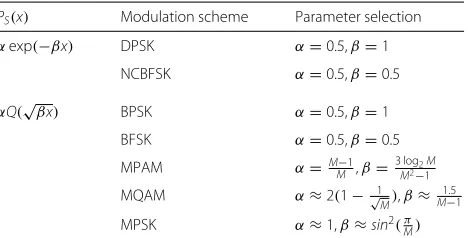
For different modulation schemes employed in practi-cal systems, the instantaneous error probabilityPS(x)is of different forms that we summarized in Table 1 [24].
For the casePS(x)=αexp(−βx), we use the expression of the average SER in (11). By substituting (10) into (11), the average SER can be calculated as:
Pe=
Carrying out the integral in (13), the closed form expres-sion of the average SER for SU is obtained as:
Pe=
Table 1Instantaneous error probability for different modulation schemes
PS(x) Modulation scheme Parameter selection
whereEn(m)is the exponential integral [25], defined by
En(m)= +∞
m z−nexp(−z)dzform>0.
For the casePS(x)= αQ(√βx), we use expression (12) to obtain the average SER, i.e.,
Pe=α
Then, by substituting (9) into (15), the average SER can be evaluated as
Pe=
whereφ(x;y;z)is the confluent hypergeometric function of the second kind, defined by the integral (9.211.4), [25]
φ(x;y;z)= 1 (x)
+∞
0
exp(−zt)tx−1(1+t)y−x−1dt. (17)
3.2 Average capacity
The average capacity is also an important performance metric as it provides insight on the maximum achievable transmission rate under which the errors are recoverable. For the TAS CR system, the received SNR at SD follows a distribution with PDF given by (10). According to the def-inition of the instantaneous capacityCγS =log2(1+γS), the average capacity of SU can be expressed as
RS=
+∞
0
log2(1+x)fγS(x)dx, (18)
wherex denotes the instantaneous received SNR at SD. Substituting (10) into (18) and after some necessary but tedious manipulations, we can get a closed form expres-sions of the average capacityRSas
2 4 6 8 10 12 14 16
10−3 10−2 10−1
NT
Average Symbol Error Rate of SU
Proposed,DPSK
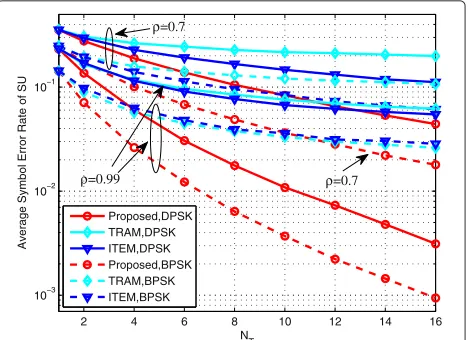
Fig. 1The average symbol error rate vs. number of transmit antennas of SU:NT, whenPm=0 dBW,Ic= −10 dBW, andPI=0.1
4 Numerical and simulation results
In this section, we firstly compare the proposed method with TRAM and ITEM via Monte Carlo simulations to verify its effectiveness. Then, we confirm the analyti-cal results derived in Section 3 in terms of the average SER and capacity performance, respectively, for the TAS-based CR system with imperfect CSI. We consider the BPSK and DPSK modulation schemes for the performance evaluation. Throughout this section, the following system parameters are used:λP = λD = 1 andσ2 = −10 dBW. From Figs. 1 and 2, the proposed method provides supe-rior performance in terms of average SER and capacity, as compared to TRAM and ITEM. As shown in Figs. 3, 4, 5, 6, 7, 8, 9, and 10, the analytical results and the simula-tion results always match exactly, which indicates that our theoretical analysis is valid and accurate.
Figures 1 and 2 depict the average SER and ergodic capacity of SU for different methods vs. the number of SU’s transmit antennas NT when Pm = 0 dBW, Ic =
−10 dBW, andPI = 0.1. As is shown, with the increase of transmit antenna number, the performance of both the average SER and ergodic capacity is enhanced. As
2 4 6 8 10 12 14 16 0.5
1 1.5 2 2.5 3 3.5 4
NT
Ergodic capacity of SU: (bit/s/Hz)
Proposed TRAM ITEM
ρ=0.7 ρ=0.99
Fig. 2The ergodic capacity vs. number of transmit antennas of SU: NT, whenPm=0 dBW,Ic= −10 dBW, andPI=0.1
compared to TRAM and ITEM, the proposed method provides better performance. This is because the pro-posed method jointly considers the interference channel between SU and PU and the transmission channel for SU. Therefore, the proposed method is superior to the other two methods.
Figures 3 and 4 show the average SER and ergodic capac-ity of SU with respect to different channel coefficientρ forNT = 1, 4 andIc = −10,−8 dBW. As can be clearly seen, the average SER and ergodic capacity performance of SU will be improved with the increase of channel coef-ficientρ, i.e., channel estimation quality increases. Note that the SU’s performance is more sensitive to the value ofρthat is close to 1, since we observe a higher dynamic range for such values. Figures 3 and 4 also show that the
0 0.2 0.4 0.6 0.8 1
10−2 10−1 100
ρ
Average Symbol Error Rate of SU
Theory,DPSK,I
c=−10
Simulation,DPSK,I
c=−10
Theory,DPSK,Ic=−8 Simulation,DPSK,I
c=−8
Theory,BPSK,I
c=−10
Simulation,BPSK,I
c=−10
Theory,BPSK,Ic=−8 Simulation,BPSK,I
c=−8 N
T=1
N T=4
Fig. 3The average symbol error Rate vs. channel correlation coefficientρ, whenPm=0 dBW andPI=0.1
0 0.2 0.4 0.6 0.8 1
0 0.5 1 1.5 2 2.5
ρ
Ergodic capacity of SU: (bit/s/Hz)
Theory,I
c=−10
Simulation,Ic=−10 Theory,I
c=−8
Simulation,I
c=−8
N T=1 N
T=4
Fig. 4The ergodic capacity vs. channel correlation coefficientρ, whenPm=0 dBW andPI=0.1
increase of NT andIcwill improve the average SER and ergodic capacity of SU. This is becasue higher transmit diversity can be achieved with the increase of NT and more transmit power is enabled with largerIcaccording to (3).
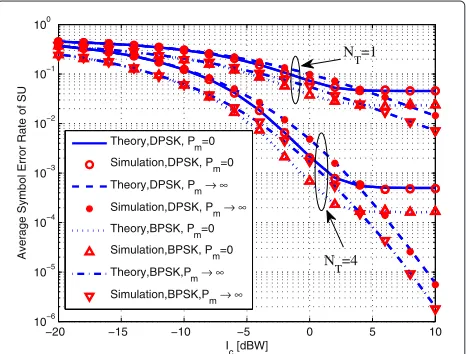
Figures 5 and 6 show the average SER and ergodic capacity of SU with different levels of allowed inter-ference power Ic at PU for NT = 1, 4. In particu-lar, to investigate the impact of the maximum transmit power limit Pm at SU, the cases of Pm = 0 dBW and Pm → ∞are compared. As is shown, the perfor-mance difference between the cases with and without the maximum transmit power limit is negligible whenIc is in the low region. With the increase of Ic, the per-formance of the cases without the maximum transmit power limit improves continuously. However, with the
−20 −15 −10 −5 0 5 10
10−6 10−5 10−4 10−3 10−2 10−1 100
I c [dBW]
Average Symbol Error Rate of SU
Theory,DPSK, Pm=0 Simulation,DPSK, Pm=0 Theory,DPSK, Pm→∞
Simulation,DPSK, P m→∞ Theory,BPSK, P
m=0 Simulation,BPSK, P
m=0 Theory,BPSK,P
m→∞ Simulation,BPSK,Pm→∞
N T=4
N T=1
−80 −6 −4 −2 0 2 4 6 8 10 1
2 3 4 5 6 7 8
I c [dBW]
Ergodic capacity of SU: (bit/s/Hz)
Theory,P m=0 Simulation,P
m=0 Theory,P
m→∞ Simulation, P
m→∞
N T=1 N
T=4
Fig. 6The ergodic capacity vs. interference constraint:Ic(dBW), when
ρ=0, 9 andPI=0.1
maximum transmit power limit, the average SER and capacity of SU will firstly improve and finally achieve a performance ceiling. This phenomenon can be explained as follows: when Ic is in the low region, the transmit power of SU is dominantly decided by the primary inter-ference constraint, and when Ic is in the high regions, the transmit power of SU is dominated by the maxi-mum transmit power limit of SU. Obviously, neglecting the maximum transmit power limit will result in inaccu-racy for the performance analysis of SU whenIcis in high region.
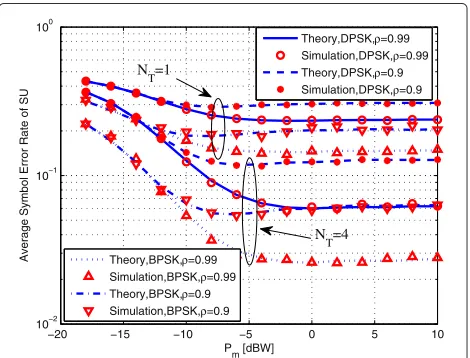
In Figs. 7 and 8, we plot the average SER and ergodic capacity performance vs. the SU maximum transmit power limitPmforNT =1, 4 andρ=0.9, 0.99. As can be seen, the system performance improves with the increase
−20 −15 −10 −5 0 5 10
10−2 10−1 100
Pm [dBW]
Average Symbol Error Rate of SU
Theory,DPSK,ρ=0.99 Simulation,DPSK,ρ=0.99 Theory,DPSK,ρ=0.9 Simulation,DPSK,ρ=0.9
Theory,BPSK,ρ=0.99 Simulation,BPSK,ρ=0.99 Theory,BPSK,ρ=0.9 Simulation,BPSK,ρ=0.9
N T=1
N T=4
Fig. 7The average symbol error rate vs. SU maximum transmit power limit:Pm(dBW), whenIc= −10 dBw andPI=0.1
−10 −5 0 5 10
0.8 1 1.2 1.4 1.6 1.8 2 2.2 2.4 2.6
P
m [dBW]
Ergodic capacity of SU: (bit/s/Hz)
Theory,ρ=0.99 Simulation,ρ=0.99 Theory,ρ=0.9 Simulation,ρ=0.9
NT=1 N
T=4
Fig. 8The ergodic capacity vs. SU maximum transmit power limit:Pm (dBW), whenIc= −10 dBW andPI=0.1
of Pm. The performance ceiling achieves when Pm is in the high regions, which is due to the SU’s interference level constraint Ic. Moreover, the system performance improves with the increase of antenna number NT and channel coefficientρ. The reasons are as follows: more transmit antennas can provide higher diversity gain and the transmit power increases as channel estimation qual-ityρincreases.
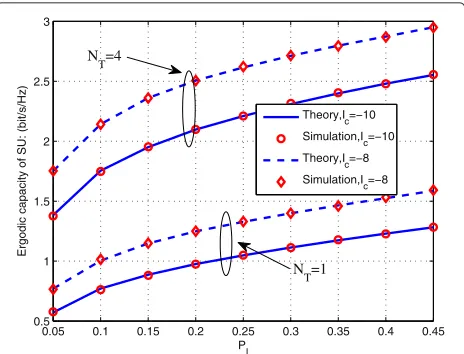
Figures 9 and 10 show that the average SER and ergodic capacity performance versus the interference outage probability PI of SU for NT = 1, 4 and Ic =
−10,−8 dBW. As can be seen, with the increase ofPI, the average SER and ergodic capacity performance improves for the reason that more transmit power is allowed for the secondary transmission.
0.05 0.1 0.15 0.2 0.25 0.3 0.35 0.4 0.45 0.5 10−3
10−2 10−1 100
PI
Average Symbol Error Rate of SU
Theory,DPSK, Ic=−10 Simulation,DPSK, Ic=−10 Theory,DPSK, Ic=−8 Simulation,DPSK, Ic=−8 Theory,BPSK,Ic=−10
Simulation,BPSK,Ic=−10 Theory,BPSK,Ic=−8 Simulation,BPSK, Ic=−8
N T=1
N T=4
0.05 0.1 0.15 0.2 0.25 0.3 0.35 0.4 0.45 0.5
1 1.5 2 2.5 3
PI
Ergodic capacity of SU: (bit/s/Hz)
Theory,Ic=−10 Simulation,Ic=−10 Theory,I
c=−8
Simulation,I
c=−8 N
T=4
N T=1
Fig. 10The ergodic capacity vs. interference outage probability of SU:PI, whenρ=0.9 andPm=0 dBW
5 Conclusions
This article studies the performance of a TAS CR system in the presence of imperfect channel knowledge of the primary-secondary links under the peak interference con-straint at PU and the maximum transmit power limit at SU. To protect the primary transmission, we apply a back-off control technique to restrict SU’s power so that the interference probability of the primary transmis-sion is satisfied. Utilizing the derived cumulative distri-bution function and probability density function of the SU’s SNR, the closed form expressions of the secondary system performance are derived in terms of the average SER and capacity. Our theoretical analysis can serve as an efficient means to investigate the impacts of imper-fect channel knowledge, the maximum transmit power limit, the interference power constraint, and the number of transmit antennas on the performance of secondary system. The theoretical analysis is validated by simulation results. Recent advances in CR networks have drawn the significance of security communications [26, 27]. In our future works, we will research on performance analysis for security-based CR TAS networks.
Competing interests
The authors declare that they have no competing interests.
Authors’ contributions
PL contributed to the conception and design of the study and writing of the manuscript. FS carried out the simulation and revised the manuscript. LC participated in the design of the study. GZ helped perform the analysis with constructive discussions and helped to draft the manuscript. All authors read and approved the final manuscript.
Acknowledgements
This work was supported in part by Shandong Province High School Science and Technology Fund Planning Project (J12LN02) and Research Fund for the Doctoral Program of Higher Education of China (20123702120016).
Author details
1College of Information Science and Engineering, Shandong Agricultural
University, Daizong Road No.61, 271018 Tai’an, Shandong, China.
2Administration Center of Shandong Academy of Information and Communication Technology, Xinluo Street No. 1768 High-tech Zone, 250101 Jinan, China.
Received: 5 June 2015 Accepted: 6 June 2016
References
1. J Mitola, GQ Maguire, Cognitive radio: making software radios more personal. IEEE Pers. Commun.6(4), 13–18 (1999)
2. Q Zhao, BM Sadler, A survey of dynamic spectrum access. IEEE Signal Process. Mag.24(3), 79–89 (2007)
3. G Scutari, D Palomar, S Barbarossa, Cognitive MIMO radio. IEEE Signal Process. Mag.25(6), 46–59 (2008)
4. Y Wang, J Coon, Difference antenna selection and power allocation for wireless cognitive systems. IEEE Trans. Commun.59(12), 3494–3503 (2011) 5. MF Hanif, PJ Smith, DP Taylor, PA Martin, MIMO cognitive radios with
antenna selection. IEEE Trans. Wireless Commun.10(11), 3688–3699 (2011)
6. Z Chen, J Yuan, B Vucetic, Analysis of transmit antenna
selection/maximal-ratio combining in Rayleigh fading channels. IEEE Trans. Veh. Technol.54(4), 1312–1321 (2005)
7. L Yang, J Qin, Performance of Alamouti scheme with transmit antenna selection for M-ary signals. IEEE Trans. Wireless Commun.5(12), 3365–3369 (2006)
8. H Wang, J Lee, S Kim, D Hong, Capacity enhancement of secondary links through spatial diversity in spectrum sharing. IEEE Trans. Wireless Commun.9(2), 494–499 (2010)
9. V Blagojevic, P Ivanis, Ergodic capacity for TAS/MRC spectrum sharing cognitive radio. IEEE Commun. Lett.16(3), 321–323 (2012)
10. FA Khan, K Tourki, MS Alouini, KA Qaraqe, Performance analysis of a power limited spectrum sharing system with TAS/MRC. IEEE Trans. Sign. Process.62(4), 954–967 (2014)
11. K Tourki, FA Khan, KA Qaraqe, HC Yang, MS Alouini, Exact performance analysis of MIMO cognitive radio systems using transmit antenna selection. IEEE J. Sel. Areas Commun.32(3), 425–438 (2014)
12. HA Suraweera, PJ Smith, M Shafi, Capacity limits and performance analysis of cognitive radio with imperfect channel knowledge. IEEE Trans. Veh. Technol.59(4), 1811–1822 (2010)
13. VNQ Bao, TQ Duong, C Tellambura, On the performance of cognitive underlay multihop networks with imperfect channel state information. IEEE Trans. Commun.61(12), 4864–4873 (2013)
14. X Jia, D Wang, X Dang, L Yang, H Zhu, Performance analysis of cooperative cognitive MIMO multiuser downlink transmission with perfect and imperfect CSI over Rayleigh fading channels. EURASIP J. Wireless Commun. Netw.2015, 1–21 (2015)
15. S Tiiro, K Umebayashi, J Lehtomaki, Y Suzuki, Spectrum sharing in MIMO cognitive radio systems with imperfect channel state information. IEICE Trans. Commun.E97-B(4), 867–874 (2014)
16. D Li, Effect of channel estiamtion errors on arbitrary transmit antenna selection for cognitive MISO systems. IEEE Commun. Lett.15(6), 656–658 (2011)
17. TQ Duong, PL Yeoh, VNQ Bao, M Elkashlan, N Yang, Cognitive relay networks with multiple primary transceivers under spectrum-sharing. IEEE Sign. Process. Lett.19(11), 741–744 (2012)
18. J Lee, H Wang, JH Andrews, D Hong, Outage probability of cognitive relay networks with interference constraints. IEEE Trans. Wireless Commun. 10(2), 390–395 (2011)
19. TW Ban, W Choi, BC Jung, DK Sung, Multi-user diversity in a spectrum sharing system. IEEE Trans. Wireless Commun.8(1), 102–106 (2009) 20. Q Wu, Y Huang, J Wang, Y Cheng, Effective capacity of cogntive radio
systems with GSC diversity under imperfect channel knowledge. IEEE Commun. Lett.16(11), 1792–1795 (2012)
21. H Kim, H Wang, S Lim, D Hong, On the impact of outdated channel information on the capacity of secondary user in spectrum sharing environments. IEEE Trans. Wireless Commun.11(1), 284–293 (2012) 22. AH Nuttall,Some integrals involving the Q-function. (Naval Underwater
Syst. Cent, New London, CT, Tech. Rep. 4297, 1971)
24. JG Proakis,Digital Communications, 5th edition. (Mc Graw-Hill, New York, 2008)
25. IS Gradshteyn, IM Ryzhik,Table of Integrals, Series and Products, 7th edition. (Academic Press, New York, 2007)
26. Y Zou, J Zhu, L Yang, YC Liang, YD Yao, Securing physical-layer communications for cognitive radio networks. IEEE Commun. Maganize. 53(9), 48–54 (2015)
27. Y Zou, B Champagne, WP Zhu, L Hanzo, Relay-selection improves the security-reliability trade-off in cognitive radio systems. IEEE Trans. Commun.63(1), 215–228 (2015)
Submit your manuscript to a
journal and benefi t from:
7Convenient online submission
7Rigorous peer review
7Immediate publication on acceptance
7Open access: articles freely available online
7High visibility within the fi eld
7Retaining the copyright to your article