The Modelling and Analysis
of Security Protocols:
the CSP Approach
P.Y.A. Ryan, S.A. Schneider,
M.H. Goldsmith, G. Lowe and A.W. Roscoe
First published 2000.
The original version is in print December 2010 with Pearson Education.
This version is made available for personal reference only. This version is copyright c
Pearson Education Ltd, and is made available with the permission of the publisher and the authors.
Contents
Preface vii 0 Introduction 1 0.1 Security protocols . . . 1 0.2 Security properties . . . 6 0.3 Cryptography . . . 140.4 Public-key certificates and infrastructures . . . 21
0.5 Encryption modes . . . 22
0.6 Cryptographic hash functions . . . 22
0.7 Digital signatures . . . 23
0.8 Security protocol vulnerabilities . . . 26
0.9 The CSP approach . . . 32
0.10 Casper: the user-friendly interface of FDR . . . 36
0.11 Limits of formal analysis . . . 36
0.12 Summary . . . 37
1 An introduction to CSP 39 1.1 Basic building blocks . . . 40
1.2 Parallel operators . . . 47
1.3 Hiding and renaming . . . 53
1.4 Further operators . . . 57
1.5 Process behaviour . . . 59
1.6 Discrete time . . . 72
2 Modelling security protocols in CSP 75 2.1 Trustworthy processes . . . 75
2.2 Data types for protocol models . . . 80
2.3 Modelling an intruder . . . 82
2.4 Putting the network together . . . 85
3 Expressing protocol goals 91 3.1 The Yahalom protocol . . . 94
3.2 Secrecy . . . 95
3.3 Authentication . . . 99 iii
iv CONTENTS 3.4 Non-repudiation . . . 108 3.5 Anonymity . . . 114 3.6 Summary . . . 120 4 Overview of FDR 123 4.1 Comparing processes . . . 124
4.2 Labelled Transition Systems . . . 127
4.3 Exploiting compositional structure . . . 133
4.4 Counterexamples . . . 136
5 Casper 141 5.1 An example input file . . . 141
5.2 The %-notation . . . 149
5.3 Case study: the Wide-Mouthed-Frog protocol . . . 151
5.4 Protocol specifications . . . 157
5.5 Hash functions and Vernam encryption . . . 158
5.6 Summary . . . 159
6 Encoding protocols and intruders for FDR 161 6.1 CSP from Casper . . . 161
6.2 Modelling the intruder: the perfect spy . . . 164
6.3 Wiring the network together . . . 167
6.4 Example deduction system . . . 169
6.5 Algebraic equivalences . . . 171
6.6 Specifying desired properties . . . 171
7 Theorem proving 175 7.1 Rank functions . . . 177
7.2 Secrecy of the shared key: a rank function . . . 181
7.3 Secrecy onnB . . . 187
7.4 Authentication . . . 192
7.5 Machine assistance . . . 198
7.6 Summary . . . 199
8 Simplifying transformations 203 8.1 Simplifying transformations for protocols . . . 203
8.2 Transformations on protocols . . . 207
8.3 Examples of safe simplifying transformations . . . 210
8.4 Structural transformations . . . 213
8.5 Case study: The CyberCash Main Sequence protocol . . . 215
8.6 Summary . . . 221
9 Other approaches 225 9.1 Introduction . . . 225
9.2 The Dolev-Yao model . . . 226
9.3 BAN logic and derivatives . . . 226
9.5 NRL Analyser . . . 231
9.6 The B-method approach . . . 232
9.7 The non-interference approach . . . 232
9.8 Strand spaces . . . 233
9.9 The inductive approach . . . 236
9.10 Spi calculus . . . 237
9.11 Provable security . . . 238
10 Prospects and wider issues 241 10.1 Introduction . . . 241
10.2 Abstraction of cryptographic primitives . . . 241
10.3 The refinement problem . . . 242
10.4 Combining formal and cryptographic styles of analysis . . . 242
10.5 Dependence on infrastructure assumptions . . . 244
10.6 Conference and group keying . . . 244
10.7 Quantum cryptography . . . 245
10.8 Data independence . . . 245
A Background cryptography 249 A.1 The RSA algorithm . . . 251
A.2 The ElGamal public key system . . . 252
A.3 Complexity theory . . . 254
B The Yahalom protocol in Casper 257 B.1 The Casper input file . . . 257
B.2 Casper output . . . 258
C CyberCash rank function analysis 273 C.1 Secrecy . . . 273
C.2 Authentication . . . 278
Preface
The value of information and the power that it can convey has long been recognized. Now, more than ever, information is a driver of society and its integrity, confidentiality and authenticity must be ensured.
Security protocols are a critical element of the infrastructures needed for the secure communication and processing of information. They are, of course, not the only components needed to ensure such security properties: for example, good cryptographic algorithms and systems security measures to protect key material are also needed. Protocols can however be thought of as the keystones of a secure architecture: they allow agents to authenticate each other, to establish fresh session keys to communicate confidentially, to ensure the authenticity of data and services, and so on.
Aims of the book
This book is about the role of security protocols, how they work, the security properties they are designed to ensure and how to design and analyze them.
It was recognized very early on, almost as soon as they were conceived, that the design and analysis of security protocols was going to be a very delicate and error-prone process. Security protocols are deceptively simple-looking objects that harbour surprising subtleties and flaws. Attempts to develop frameworks and tools to reason about their properties goes back over 20 years, but the topic remains a highly active and fruitful one in the security research community. An overview of the historical background can be found in Chapter 9.
In this book we present the particular approach to security protocol verification that has been developed by the authors. It was the first to apply process algebra and model-checking to the problem. The process algebra in question is CSP (Communicating Sequential Processes).
There is a widespread misconception that pouring liberal libations of cryptographic algorithms over an architecture will render it secure. Certainly, good cryptographic algorithms are important but, as we will see, it is quite possible to have an architecture employing high grade algorithms that is still wide open to exploitation due to poor protocol design.
We hope that our readers will come away with a good understanding of the role of security protocols, how they work and the kinds of vulnerabilities to which they are
viii Preface prey. In particular we hope that they will better appreciate the subtleties in making precise the security goals that such protocols are intended to ensure and the importance of making these goals – as well as the assumptions about the underlying mechanisms and environment – precise.
Ideally we hope that the reader will gain sufficient understanding (and enthusiasm!) to apply the tools and techniques presented here to their own protocols, real or imaginary. Perhaps also some readers will be sufficiently intrigued to go on to pursue research into some of the open problems that remain in this challenging and fascinating area.
Structure of the book
This book is concerned with the particular approach to analysis and verification of security protocols based around the process algebra CSP. There are a number of facets to this approach, and the book uses a running example, the Yahalom protocol, to link the material.
The Introduction introduces the general topic of security protocols. It covers the issues that arise in their design, the cryptographic mechanisms that are used in their construction, the properties that they are expected to have, and the kinds of attacks that can be mounted to subvert them. It also discusses the CSP approach and the tool support. The chapter introduces the Yahalom protocol and several other protocol examples.
Chapter 1 provides a general introduction to the main aspects of CSP relevant to the approach. CSP consists of a language and underlying theory for modelling systems consisting of interacting components, and for supporting a formal analysis of such models. This chapter introduces the building blocks of the language which enable individual components to be described, and discusses how components are combined into systems. Specification and verification through refinement, and with respect to property-oriented specifications, is also covered. The chapter finishes with a brief discussion of how discrete time can be modelled.
Chapter 2 shows how to use CSP to construct models of security protocols, which consist of a number of communicating components and are thus well suited to analysis in CSP. The variety of possible attacks on protocols must also be built into the model, and the chapter shows how to incorporate the Dolev-Yao approach to modelling a hostile environment and produce a system description which is suitable for analysis.
Chapter 3 covers the kinds of properties that security protocols are expected to provide, and how they can be expressed formally within the CSP framework. Secrecy and authentication are the main concern of the approaches in this book, and various forms are covered. The properties of non-repudiation and anonymity are also discussed.
Chapter 4 introduces the model-checking tool support available for CSP, the Failures-Divergences Refinement checker (FDR). It discusses how this tool works, and the nature of refinement checking.
Chapter 5 is concerned with the Casper tool. This is a compiler for security protocols, which transforms a high-level description of a security protocol, and the
properties required of it, into a CSP model of the protocol as described in Chapter 2, and a number of assertions to be checked. This model can then be analyzed using the model-checker FDR discussed in Chapter 4.
Chapter 6 discusses in more detail some of the CSP modelling that is carried out by Casper, particularly how the hostile environment is modelled to allow efficient analysis by the model-checker.
Chapter 7 is concerned with direct verification of CSP models of protocols. It introduces the ‘rank function’ approach to proving protocols correct. This allows proofs to be constructed that verify protocol descriptions of arbitrary size against their requirements. The theorem-proving and bespoke tool support available for this approach is also discussed.
Chapter 8 addresses the problem of scale. Real-world protocols are very large and their analysis is difficult because of the volume of detail contained in their description. This chapter is concerned with ‘simplifying transformations’, which allow extraneous detail to be abstracted away when checking a protocol against a particular property in such a way that verification of the abstract protocol implies correctness of the full protocol. The approach is illustrated with the CyberCash main sequence protocol.
Chapter 9 discusses the literature on security protocol verification and its historical context. There are a number of different approaches to the problems addressed in this book, and this chapter covers many of those that have been most influential in the field. Chapter 10 discusses the broader issues, open problems and areas of ongoing research, and gives indications of areas for possible further developments and research. One area of current research discussed in this chapter, of particular importance to the model-checking approach of this book, is the development of techniques based on ‘data independence’, which allow the results of model-checking to be lifted to protocol models of arbitrary size.
There are three appendices. The first covers some background mathematics and cryptography, introducing the RSA and the ElGamal schemes; the second is an example of Casper applied to the Yahalom protocol, containing the input file and the CSP model produced by Casper; and the third contains a verification using rank functions of the simplified CyberCash protocol descriptions produced in Chapter 8.
The book has an associated website: www.cs.rhbnc.ac.uk/books /secprot/ This website provides access to all of the tools discussed in this book, and to the protocol examples that are used throughout (as well as others). Readers are recommended to download the tools and experiment with protocol analysis while reading the book. The website also provides exercises (and answers!), as well as a variety of other related material.
Acknowledgements
The authors would like to thank DERA (the Defence and Evaluation Research Agency, UK) and the MoD for funding the Strategic Research Project (SRP) ‘Modelling and Analysis of Security Protocols’ under which the foundations of the approach were laid down, and the EPRSC (UK Engineering and Physical Sciences Research Council) and ONR (US Office of Naval Research) for funding subsequent developments of
x Preface the approach. Thanks are also due to Inmos, ONR, DERA and ESPRIT, for funding developments to FDR over the years.
Peter Ryan would also like to thank the Department of Computer Science, Royal Holloway, and Microsoft Research, Cambridge, for hospitality during the writing of this book.
This work has benefited from collaboration with Philippa Broadfoot, Neil Evans, James Heather, Mei Lin Hui, Ranko Lazi´c and the staff at Formal Systems. It has also been influenced by discussions with and comments from Giampaolo Bella, Steve Brackin, Dieter Gollmann, Andy Gordon, Roberto Gorrieri, Joshua Guttman, Richard Kemmerer, John McLean, Cathy Meadows, Larry Paulson, Matthias Schunter, Paul Syverson and Paulo Verissimo.
Thanks also to Giampaulo Bella, Neil Evans, Dieter Gollmann, Mei Lin Hui, Matthias Schunter and Paulo Verissimo for their careful reading of various parts of this book, and for their suggestions for improvement.
Finally, special thanks are due to Coby, Helen, and Liz, Kate, and Eleanor for moral support.
Chapter 0
Introduction
0.1
Security protocols
As with any protocol, a security protocol comprises a prescribed sequence of interactions between entities designed to achieve a certain end. Adiplomaticprotocol typically involves some exchange of memoranda of understanding and so on, intended to establish agreement between parties with potentially conflicting interests. A communicationsprotocol is designed to establish communication between agents, i.e. set up a link, agree syntax, and so on. Even such mundane, everyday activities as withdrawing money from an ATM or negotiating a roundabout involve protocols.
The goals ofsecurity protocols, also known as cryptographic protocols, are to provide various security services across a distributed system. These goals include: the authentication of agents or nodes, establishing session keys between nodes, ensuring secrecy, integrity, anonymity, non-repudiation and so on. They involve the exchange of messages between nodes, often requiring the participation of a trusted third party or session server. Typically they make liberal use of various cryptographic mechanisms, such as symmetric and asymmetric encryption, hash functions, and digital signatures. In some cases further devices like timestamps are also used. We will explain these terms more fully shortly.
The difficulty of designing and analyzing security protocols has long been recognized. This difficulty stems from a number of considerations:
• The properties they are supposed to ensure are extremely subtle. Even the apparently rather simple notion of authentication turns out to harbour a number of subtleties and comes in various flavours. The precise meaning, or rather meanings, of this concept remain hotly debated.
• These protocols inhabit a complex, hostile environment. To evaluate them properly we need to be able accurately to describe and model this environment and this will have to include the capabilities of agents deliberately trying to undermine the protocol. In this book we will refer to such a hostile agent as
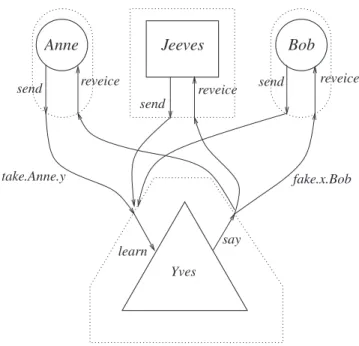
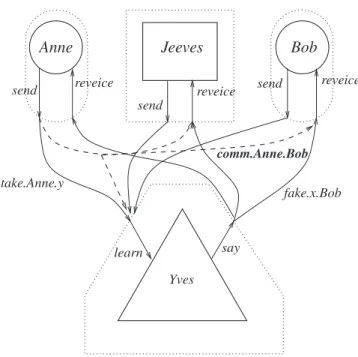
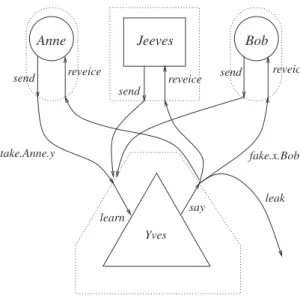
Figure 1: Setting up a secure channel
an intruder; in the literature other terms such as ‘spy’, ‘enemy’, ‘attacker’, ‘eavesdropper’ and ‘penetrator’ are also used.
• Capturing the capabilities of ‘intruders’ is inevitably extremely difficult. Arguably it is impossible, but at least we may hope to make good approximations that can be progressively enhanced as new styles of attack come to light. Besides manipulating messages passing across the network, they could include cryptanalytic techniques, monitoring tempest emanations, timing, power fluctuations, probabilistic observations and other nefarious activities as ‘rubber hose-pipe cryptanalysis’ (non-mathematical techniques for extracting cryptographic variables).
• By their very nature security protocols involve a high degree of concurrency, which invariably makes analysis more challenging.
Security protocols are, in fact, excellent candidates for rigorous analysis techniques: they are critical components of any distributed security architecture, they are very easy to express, and they are very difficult to evaluate by hand. They are deceptively simple looking: the literature is full of protocols that appear to be secure but have subsequently been found to fall prey to some subtle attack, sometimes years later. In Roger Needham’s remark ‘they are three line programs that people still manage to get wrong’.
Security protocols have taken on a role for the formal-methods community analogous to that of fruit flies to the genetic research community. They are compact and easy to manipulate whilst embodying many of the issues and challenges to the tools and techniques for the analysis and evaluation of security critical systems.
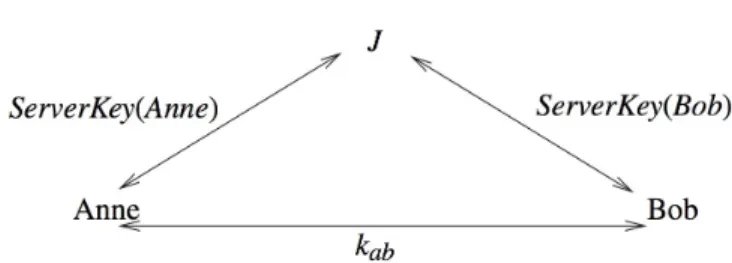
To make things rather more concrete let us consider an example: the Needham-Schroeder Secret-Key (NSSK) protocol. This is one of the earliest such protocols and has, aside from a rather subtle vulnerability that we will discuss later, stood the test of time. It forms the basis of the well-known Kerberos authentication and authorization system [65]. It uses purely symmetric encryption algorithms and is designed to enable two agents, Anne and Bob say, to set up a secure channel of communication with the help of a trusted server, Jeeves. This situation is illustrated in Figure 1.
To start with, all the registered agents, including Anne and Bob, share private, long-term keys with Jeeves. These are pair-wise distinct so although each can communicate
0.1. SECURITY PROTOCOLS 3 securely with Jeeves they are not able to communicate directly with each other. Now suppose that Anne wants to start talking privately with Bob. One obvious possibility is for them to communicate via Jeeves: she sends an encrypted message to Jeeves using the key she shares with him; he decrypts this and then encrypts the plaintext using the key he shares with Bob. This works but rapidly gets very cumbersome: it involves a lot of computation and means that Jeeves becomes a bottleneck and single point of failure. The trick then is just to use Jeeves as and when necessary to establish a new key between Anne and Bob so that they can then communicate directly without further recourse to Jeeves. An obvious question is: why not just supply each pair of agents with a key at the outset? Again this works up to a point but requires roughly N2 distinct keys to be distributed from the start, whereN is the number of agents. IfN is large this rapidly becomes impractical, especially as it is likely that most of these keys will never be used. It is even worse as we may not know at the outset what the set of users is going to be. Typically, registered users will come and go. Another important point is that it is desirable to change keys frequently to make the task of cryptanalysts harder and contain the effect of any compromises. Having a mechanism like the Needham-Schroeder Secret-Key protocol to set up new keys as required makes this easier. The long-term keys,ServerKey(a),ServerKey(b)etc., can be stronger and should less susceptible to cryptanalysis as they tend to carry only a small volume of traffic.
Returning then to the protocol we see that if we start withNusers onlyNkeys need be set up initially and it will be fairly straightforward to supply each new user with a new private key as and when they register.
Suppose that Anne shares the keyServerKey(Anne)with Jeeves, whilst Bob shares ServerKey(Bob)with him.
The protocol proceeds as follows: Message1 a→J : a.b.na
Message2 J→a : {na.b.kab.{kab.a}ServerKey(b)}ServerKey(a)
Message3 a→b : {kab.a}ServerKey(b)
Message4 b→a : {nb}kab Message5 a→b : {nb−1}kab
This requires some explanation. First let us explain the notation. Each step of the protocol is represented by a line in the description. Thus
Messagen a→b : data
indicates that in thenth step of the protocol agenta dispatches a messagedatatob. The message in general consists of a number of parts concatenated together. In practice it is of course possible that this message will not reachbor might reach someone else. For the moment however we are only concerned with presenting the intended progress of the protocol.
Terms of the form na denote so-called nonces: freshly generated, unique and
(usually) unpredictable numbers. The subscript indicates who generated it, but notice that this is just a notational convenience; in the real protocol there will typically be
nothing in the actual value to indicate that it was created bya. We will discuss the role of nonces more fully shortly.
Compound terms can take the forms:
• {data}k, which denotes the valuedataencrypted under the keyk;
• m.n, which denotes the textmfollowed by (concatenated with) the textn. Now we are in a position to walk through this protocol step by step. In the first step Anne tells Jeeves that she would like to talk to Bob and she supplies the nonce na. Jeeves now creates a new keykaband returns the message with nested encryption
indicated in step 2 to Anne. The outer encryption is performed usingServerKey(a)
which Anne can strip off. Inside Anne finds the following: na.b.kab.{kab.a}ServerKey(b)
The first term is just the value of the nonce she sent to Jeeves in message 1. She is expected to check that this value agrees with the value she originally sent out. We will return to the significance of this a little later. The second term should be Bob’s name. Again she should check that this agrees with the name in her request of message 1. The third term is the new keykab. The last term is encrypted using the key that Bob
shares with Jeeves. Anne can’t read this last term but in accordance with the protocol, and assuming that all the other checks have succeeded, she simply forwards it to Bob in the third step. When Bob receives this he is able to strip off the encryption to reveal: kab.a.
So he now knows the value of the new keykab and knows that it is intended for
communication with Anne. He now dreams up a new nonce of his ownnband sends it
back to Anne encrypted underkabin message 4. Anne decrypts this to extractnb. She
modifies this in some standard way – the convention is to subtract 1 – and sends this modified value back to Bob, again encrypted underkab. Finally Bob decrypts this and
checks that the resulting value agrees with what he expects fornb−1.
So, what has all this frantic activity achieved? In informal terms, and assuming that all has gone smoothly, Anne and Bob end up with shared knowledge ofkab. In
fact they share this knowledge after message 3 has been received by Bob. So why a further two messages and yet another of these nonces? Messages 4 and 5 are really just acknowledgement messages to assure each other that the other also knowskab. We see
that by the time Bob receives message 3 he knows that Anne knowskab. Once Anne
gets message 4 she knows that Bob knowskab and, further, she knows that he knows
that she knowskab. And so on. We can see that we could go on constructing an infinite
chain of acknowledgement messages leading to a tower of states of knowledge about knowledge.
We should stress though that the conclusions reached by Anne and Bob above are based on very informal reasoning. On receiving message 3 Bob is reasoning something along the following lines:
Apart from me only Jeeves knowsServerKey(b)so only he could have generated these terms. Assuming that Jeeves is being honest he would only have generated them in response to a request from Anne and so they
0.1. SECURITY PROTOCOLS 5 must have been included in a message to Anne encrypted with her long-term key. Hence it could only have reached me if it was forwarded to me by Anne. So Anne received the appropriate message from Jeeves with kab. . .
Such chains of reasoning are extremely error prone as we will see in, for example, the analysis of the Needham-Schroeder Public-Key (NSPK) protocol. We will see in this book how one can reason about protocols in a fully formal and indeed largely automated way.
The goal of this protocol is authenticated key distribution. In particular it should fulfil Anne’s request to provide the means for her to have a private, authenticated conversation with Bob. What she wants at the end of the protocol run is to be sure that Jeeves has supplied her and Bob, and only her and Bob, with a freshly generated session keyKthat they can now use in further exchanges. As long as this key is only known to her and Bob she can be confident that messages she sends out encrypted with K can only be read by Bob, and furthermore that messages she gets back encrypted withKmust have come from Bob and will also be safe from prying eyes.
This protocol illustrates a number of interesting issues that will crop up repeatedly throughout this book. Ensuring that Anne and Bob are really justified in having confidence in the services provided by this protocol is no easy task. First, we need to be sure that intruders can’t undermine this goal by manipulating the messages in various (non-cryptographic) ways. This depends on the correctness of the protocol design, and is the principal concern of this book. It is also possible that poorly designed or unsuitable cryptographic primitives might lead to vulnerabilities that can be exploited. By and large we will not deal with such problems except to discuss to some extent how features of the crypto algorithms might interact with the protocol itself to give rise to vulnerabilities. We should also note that, from Anne’s point of view say, she needs to place confidence in certain, remote parts of the system. She has to trust Jeeves to act according to the protocol description and to employ a ‘good’ key generation scheme. She also needs to trust Bob. If Bob is going to compromise his key, either deliberately or simply through carelessness (insecure storage of the key material), then all hope of secrecy or authentication is lost. On the other hand she should not need to place any great faith in the communications medium. Quite the contrary: she should typically assume that the medium is entirely open to malicious agents trying everything in their power to undermine the security goals.
Notice that the first message from the initiator, Anne, goes out in the clear. There is thus nothing to ensure the secrecy or integrity of this message. We are assuming that the intruder learning that Anne wants to talk to Bob is not a problem. We will also see later that there is no use to the intruder of learning the value ofna. Thus lack of secrecy
of these values is not a problem unless we are worried about traffic analysis. As to the integrity, it is certainly the case that there is nothing to prevent the intruder altering these values. However the only effect will be for Anne to back out when she finds that the values in the reply from Jeeves do not agree with her records. A denial of service attack can be launched in this way, but secrecy and authentication are not breached.
Another point is that we are assuming that the protocol is using a form of block cipher (which operates on fixed length blocks of plaintext and ciphertext) rather than
say a stream cipher (which converts plaintext to and from ciphertext one character at a time). We will discuss the distinctions in more detail in Section 0.3 but this is important for Bob’s nonce challenge to work. If a stream cipher were used the intruder would most likely be able to fake{nb−1}kab, without even knowing eithernborkab, by simply flipping an appropriate bit of the ciphertext of message 5.
We are further assuming that encrypting a number of terms together has the effect of binding them together, that is, it is not possible to cut and paste a chunk of the ciphertext in order to replace one of the terms without garbling the whole encipherment. Where the length of the terms exceeds the length of the block cipher, a suitable encryption mode will be needed to achieve this and we will discuss this in more detail a little later. Without such a mechanism the intruder, Yves, might be able to cut and paste a chunk of ciphertext that he knows will decrypt to his identity rather than Anne’s, so as to fool Bob into thinking that he has a secure channel with Yves rather than with Anne.
This example served to give the flavour of the role of security protocols and how they are typically implemented. This particular protocol enables principals to authenticate each other and, if required, communicate in secrecy. Other security goals are of course possible and we will see several more in the next section. A number of cryptographic primitives have made an appearance here serving a number of roles: encryption to achieve secrecy, bind terms and ensure authenticity; nonces to foil replays; and so on. Such primitives will recur throughout the book and we will give an overview of the cryptographic background required to understand how these primitives are implemented in Section 0.3.
0.2
Security properties
Here we give an intuitive description of a number of important properties or services that security protocols may be required to provide. Typically, of course, a protocol will only be expected to provide a subset of these, depending on the application.
The meanings of these terms are frequently taken as obvious and widely understood. One typically finds that when pressed people find it remarkable difficult to make precise their understanding. Furthermore it often turns out that these supposedly widely understood terms are given different interpretations, sometimes within a single document or design. It is for these reasons that it is so essential to give precise, formal meanings. It is not sufficient, for example, to assert that a particular protocol is ‘secure’, or worse ‘correct’. A protocol can only be claimed to be correct with respect to a given, precisely defined property and even then only against certain classes of threat and subject to various assumptions.
In the following sections we outline possible formalizations of these properties. These should be regarded as indicative rather than definitive. More detailed descriptions, along with formalizations in CSP, can be found in Chapters 2 and 3.
Secrecy
Secrecy, or confidentiality, has a number of different possible meanings and which is appropriate will depend on the application. We might have a very strict interpretation
0.2. SECURITY PROPERTIES 7 in which the intruder should not be able to deduce anything about the legitimate users’ activity. In effect he should not even be able to perform any traffic analysis, let alone be able to derive the content of any messages. For this a non-interference style characterization is required that asserts that a high-level user’s activity should not result in any observable effect on low-level users or outside observers of the system. See for example [82] for a detailed discussion. This is a very strict interpretation and requires correspondingly elaborate implementations. In the case of a communications network it would require, for example, hot-line style dummy traffic, or anonymized routeing.
This tends to be an overly strong characterization for most applications, and typically simpler, safety-style formalizations are sufficient. Such properties are both simpler to understand and to check and also seem more appropriate to most applications, so we will confine ourselves to these in the bulk of this book.
In most cases it is sufficient to prevent the intruder from being able to derive the plaintext of messages passing between the honest nodes. That is, Yves may be able to tell that Anne has sent a message to Bob and maybe even have a good idea of how long it was, but he is unable to read its contents. A property of this kind can be formulated as a safety or trace property. Such properties can be stated as predicates over the behaviours of the system. They state which behaviours are acceptable and which are not. Such properties are generally easier to understand and analyze than say liveness and non-interference, both of which must be formulated as properties over the ensemble of system behaviours and cannot be reduced to a predicate on individual traces.
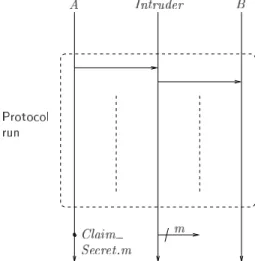
We can capture a simple notion of secrecy as follows. Suppose that there is some set M of data items that we regard as sensitive and that the users will be encouraged to transmit to each other encrypted under-session keys established using a key-establishment protocol. We want to ensure that no message from this set can be obtained by the intruder in unencrypted form. We will see later how this is formalized in CSP. For the moment we can think of it as follows: if there is any behaviour of the system that reaches a state in which an item from the setMshows up in plaintext form in the intruder’s set of knowledge this is deemed to represent a breach of the secrecy property. We of course suppose that the intruder does not have any elements ofMin his original knowledge set so if he does learn a value it must be through observation of messages between the legitimate nodes. We are not concerned that the intruder may be able to get hold of encrypted version of sensitive data items, indeed we fully expect this to happen, as long as he doesn’t also get hold of the corresponding decryption key.
Authentication of origin
Intuitively authentication of origin is taken to mean that we can be sure that a message that purports to be from a certain party was indeed originated by that party. Furthermore we will typically also require that we can be sure that the message has not been tampered with between times.
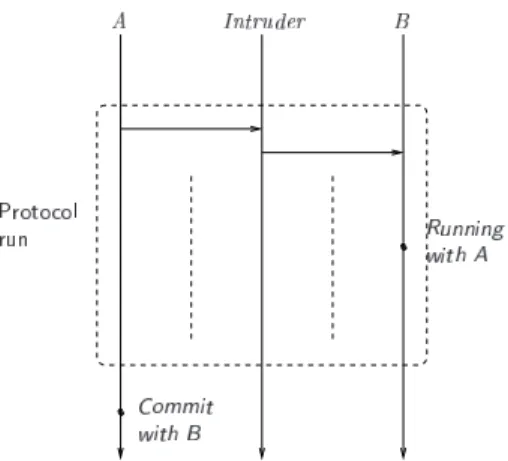
We can turn this around and phrase it as follows: a protocol maintains authentication of origin if it is always the case that if Bob’s node accepts a message as being from Anne then it must indeed be the case that earlier Anne sent exactly this
message. A stronger property is to further require that Anne actually intended the message for Bob. These can be formulated as predicates on system behaviours.
Notice that here we have made no mention of time so there is no measure of the time that might have elapsed between Anne sending her message and Bob receiving it. We tend to assume, for example, that if an agent is still prepared to accept a response to a nonce challenge then the challenge itself was sent out only ‘recently’. To take more detailed account of the freshness of the message when it reaches Bob, and to express timed requirements, we typically need a timed model (seeChapters 1 and 5).
Another point to note is that there is nothing in this formulation to prevent Bob receiving the message several times even if Anne only sent it once. For many applications this may not be a concern so this formulation is adequate. Sometimes it may be an issue. For example, if the messages represent money transfers then clearly we don’t want to allow one deposit to lead to multiple increments to Anne’s account. For such applications the predicate can be strengthened in a straightforward fashion, as discussed in Chapter 3.
Entity authentication
The term ‘entity authentication’ crops up frequently in the literature and its meaning is often unclear. In particular the distinction between entity authentication and authentication of origin is not obvious. Intuitively the notion is that you can be confident that the claimed identity of an agent with whom you are interacting is correct. To a large extent this is already captured in the notion of authentication of origin: you are able to verify the origin of each message you receive from an agent during the course of an interaction.
Entity authentication carries with it a notion of timeliness that is absent in the simple formulation of authentication of origin given above. There also seems to be an implication that it is a one-off process: you establish the identity of your interlocutor and proceed with your interaction. For some forms of communications media this might make sense, if for example once a link is established it is difficult for a third party to tap into it and start masquerading. Terms like ‘trusted channel’ are sometimes employed to indicate such a link. Such links can be implemented, but great care needs to be taken if you are incorporating the assumption of such links in your analysis. Even if you do have such a link set up, there remains the possibility, for example, that your interlocutor gets overpowered by an intruder and again authentication is undermined.
It is actually rather difficult to capture the notion of entity authentication in a precise mathematical way and for most purposes it seems enough to regard it as a repeated form of origin authentication at each step of the interaction between agents. This is the approach that we will adopt in this book. Gollmann has studied the notion of authentication in great detail in, for example [36]. Much of the confusion surrounding the notion of entity authentication seems to arise from differing models of communication: some people think in connection-oriented terms, others in connectionless terms. The way that we model communications in this book corresponds to the connectionless approach: each message is separately consigned to the medium and the fate of every message is independent.
0.2. SECURITY PROPERTIES 9
Integrity
Integrity is usually taken to mean that data cannot be corrupted, or at least that any such corruption will always be detected. In this sense integrity is seen as a corollary of our authentication property above. This follows from the fact that in this formulation we required that the contents of the output message match that of the input message. Notice that we are thinking of the occurrence of an event such asreceive.Anne.Bob.m as indicating that the node has not detected any corruption of the message and has output it to Bob. If it were possible for a corrupted message to be accepted then this would show up as a violation of the property above and we would have to deem the protocol to be flawed. We could relax the condition in our definition of origin authentication that the data values match. This would give us something akin to entity authentication: it would establish that the other party is alive and responding, but would not guarantee the authenticity of any contents we might receive. This may be useful in some circumstances, for example if you want to check that an alarm is active.
This captures the notion of integrity of communicated messages. Integrity can also be taken to encompass the immunity from corruption of stored data. We will not explore this further as it is really a systems security issue rather than a security protocols problem.
Authenticated key-exchange
One of the major roles of security protocols is to enable authenticated, confidential communication across networks by setting up key material between the various players. To some extent this can be viewed as a special case of secrecy as described earlier, where the sensitive data items are the keys. However, it is a bit more subtle as we have to be precise about who should get knowledge of the keys and who must not. It is also often the case that further properties besides secrecy of the keys are called for. Slightly different terminology is used to reflect the differing requirements.
Secrecy alone is not enough, or at least we have to be far more precise about what secrecy means. Pure Diffie-Hellman key establishment (seepage 20) does provide a form of secrecy in that only the two interlocutors know the session key at the end of the protocol. The problem is that it is all very well knowing that you share a secret with another person but not much use if you do not know for sure who this other person is.
Thus the essential properties to be upheld by a key-establishment protocol are the secrecy and authenticity of the resulting session keys. More precisely: suppose that Anne starts up a protocol to agree a key to talk to Bob. We need to be confident that whenever Anne reaches a commit state in which she thinks that she shared a keyKwith Bob, thenKshould indeed be known at most to Anne and Bob. Similarly for Bob. Thus key establishment and authentication must be inextricably bound up in the protocol to avoid any danger of one of the players being fooled into associating the key with the wrong agent. We will refer to such requirements as authenticated key establishment.
Many authenticated key-establishment protocols are based on a cryptographic primitive like Diffie-Hellman to provide the secrecy of the session key with additional features to ensure the authentication. A prime example of this is the Station-To-Station (STS) protocol due to Diffie, Van Oorschot and Wiener [24]. The reference is in fact
Anne
Bob
a
xa
y·
{
Sign
Bob(
a
y· a
x)}
k{
Sign
Anne(
a
x· a
y)}
kFigure 2: Station-To-Station protocol
an excellent summary of authentication and authenticated key-exchange protocols and recommended reading for anyone interested in the subject.
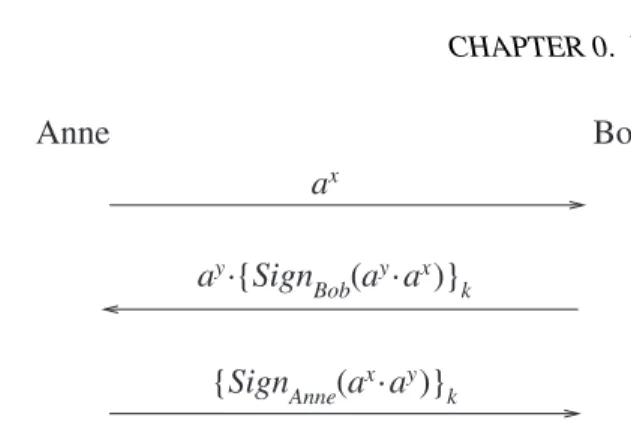
One of STS’s key features is the intertwining of the authentication with key exchange, which would seem vital in order to assure that authentication is maintained. Assume first (as in Diffie-Hellman, page 20) that a cyclic group along with a primitive element a are publicly known. Assume further that public keys of users are available (for example via certificates issued by a certifying authority). With this in place we proceed as follows:
Anne chooses a random number xand sends ax to Bob. All calculations are of
course performed modulop. Bob now chooses a random number yand calculates k=axy. He then sends Anne a message of the form:
ay.{SignBob(ay.ax)}k
whereSignBob(X)denotes the application of Bob’s signature toX.
Anne can now computek=ayxand thence decrypt the token and then finally check Bob’s signature from her knowledge of his public key. Anne now sends Bob:
{SignAnne(ax.ay)}k
Finally Bob can decrypt and check Anne’s signature. Figure 2 summarizes the exchanges involved. The outcome of all this is that Anne and Bob should be confident of each other’s identities and that they share a key k that can now be used for subsequent communication using a symmetric encryption scheme.
The security of the scheme can be enhanced by allowing each user to use a distinct field. The most powerful attacks against these Diffie-Hellman style schemes involve the pre-calculation of a large look-up table to speed up the calculation of logarithms. If a single field is used over a network then clearly such attacks become more attractive. If this proposal is adopted then of course a minor modification to the protocol is needed to ensure that both parties use the same field and primitive element. Thus the first message must include a statement ofpanda. So Anne starts the protocol by sending: ax.p.a. Other variants of the protocol are also suggested, such as an authentication-only version. A version in which certificates are shipped across with the messages is also proposed for a situation in which the public keys are not already distributed.
0.2. SECURITY PROPERTIES 11 The term ‘key-agreement’ often also carries an additional connotation: that both players contribute to the final value of the session key, ideally in a symmetrical fashion. In particular, in the absence of some form of collusion, neither can determine the final value. Protocols based on the Diffie-Hellman scheme are a prime example. When Anne supplies heraxterm she cannot predict whatyvalue Bob will use. Arguably if
Bob could compute discrete logs he could choose ayto give a particular value forK but we are in any case supposing that this is intractable.
Sometimes Anne, say, may want to know not only that the key is at most known only to her and to Bob but further to be sure that Bob does indeed know it and associates it with communication with her. This kind of requirement is often referred to as key-confirmation. What typically happens is that the agents’ knowledge grows as the protocol unfolds. Consider the following toy protocol:
Message1 Anne→Bob : SignAnne(Bob.ax)
Message2 Bob →Anne : SignBob(Anne.ax.ay)
Message3 Anne→Bob : {data}K
whereK=axy.
After receiving the first message Bob knows that Anne wants to talk to him and that she has supplied the Diffie-Hellman term ax. He responds with the second message and can already infer that if Anne gets this message uncorrupted she should be able to calculate the session keyK. Arguably, he could already try sending some data to her along with this message encrypted with K. In fact this would be rather dangerous as, at this stage, he has no assurance of the freshness of the first message from Anne. However, when she receives this second message from Bob she knows that he has acquired heraxterm and has provided hisayand so he presumably knows
Kand associates it with her. Furthermore, she has assurances of freshness of message 2 because her Diffie-Hellman term in effect doubles as a nonce. She could now transmit some data to Bob encrypted withK. On receiving this Bob can now infer that Anne did indeed receive his message and so has constructedKand associates it with him. It may be preferable, of course, just to have some innocent data value here.
Note how the Diffie-Hellman terms double as nonces, so providing assurances of freshness. Note further that we can perform an authentication analysis on this protocol to check that if Bob accepts ax as originating from Anne then it really was created
by Anne and vice versa. We can then invoke the Diffie-Hellman problem to infer the secrecy of the termKbetween Anne and Bob.
The terms ‘key distribution’ and ‘key transport’ are sometimes used to denote schemes in which the keys are generated in one place and shipped out as requested. Here we are thinking more of some central server creating keys as required. There is no notion of the various participants all contributing to the resulting keys, as with the Diffie-Hellman scheme, for example. The Needham-Schroeder Secret-Key or Yahalom (see p. 33) protocols provide examples of key distribution protocols in which the key is generated solely by the server with no input from the principals.
Non-repudiation
For most security goals we are making assumptions that the legitimate participants are honest, i.e. behave according to the protocol rules. Usually it will be in their interests to do so. If, for example, Anne and Bob want to have a private conversation then it is in their interests not to disclose their keys or stray from the protocol rules.
Non-repudiation is rather different however. Here we are concerned with protecting one participant against possible cheating by another. Consequently we cannot assume that the ‘legitimate’ participants will not cheat. In essence the idea is to provide the parties with evidence that certain steps of the protocol have occurred. For example, non-repudiation of transmission should provide the recipient with proof that the message was indeed sent by the claimed sender, even if the sender subsequently tries to deny it. Furthermore, this proof must be convincing to a third party, not just to the recipient himself. It is essential therefore that the evidence should not be forgeable by the recipient.
As such we see that non-repudiation appears to be very similar to authentication. This suggests that we may be able to capture this property as a variant of authentication, but ensure that our model endows the principals with intruder-like capabilities. That is, the participants are given capabilities to fake messages up to the usual cryptographic constraints. If we can then show that Bob could only have come into possession of a message of a certain form if Anne had actually sent an appropriately related message to him then we will have shown that the non-repudiation property holds. This will usually call for some signature-type mechanism to ensure that Bob can only come into possession of such a message if Anne really had previously signed and sent it to him. Alternatively, a trusted notary can be used, but this adds communication overheads and so on.
Fairness
Occasionally protocols are required to enforce certain fairness properties. In electronic contract signing, for example, we will want to avoid one of the participants being able to gain some advantage over another by halting the protocol part-way through. Bob could, for example, refuse to continue after Anne has signed up, but before he has signed. Various protocols have been proposed to address this, some involving Trusted Third Parties (notaries). Others avoid this but use instead some form of incremental commitment mechanism. See for example [102]. There tends to be a trade-off here between, on the one hand, the need to involve a third party and, on the other, the need for rather a lot of communication. The former calls for an extra entity to be trusted and to be available. The latter tends to require a large number of messages to pass back and forth. More recent protocols seek to provide fairness efficiently by only resorting to a third party in the event of dispute as discussed in [6].
Anonymity
Anonymity is a property that seems to have been explored comparatively little from a formal point of view. Intuitively a system that is anonymous over some set of events
0.2. SECURITY PROPERTIES 13 Eshould have the property that when an event fromEoccurs then an observer, though he may be able to deduce that an event fromEhas occurred, will be unable to identify which. Of course this will in general depend on the status of the observer so we must be clear about the observer viewpoint in formalizing such a property. Typically the set Ewill be an indexing set of users, so we are asserting that although an observer may be able to tell that a certain class of action has occurred, he is not able to identify which of the agents was associated with it.
An elegant formalization of this property can be given in CSP. The key idea is to use the renaming operator of CSP to shuffle the events of the setE. We then assert that if the observer’s view of the system is unchanged after an arbitrary shuffling of the set Ethen the system provides anonymity with respect to the setEand that observer.
A number of examples of systems displaying various degrees of anonymity, such as Chaum’s ‘dining cryptographers’, have been analysed using FDR (seeChapter 3).
The CSP approach is essentially ‘possibilistic’ in style, that is to say it abstracts away from issues of probability and considers only whether or not certain events are possible. Other approaches have taken a probabilistic style, for example Pfitzmann and Waidner [72]. Here the idea is to show that the a posterioriprobability distribution over some event set that some observer can assign after an observation is equal to the a prioridistribution before the observations.
Up to now we have assumed that anonymity should apply to each occurrence of the events in question, in effect that the events from the anonymity set could be freshly shuffled on each occurrence. In some situations we might not expect the occurrence of events from the set to be wholly independent. Voting provides a good example: we do not want a particular vote to be associated with an individual, but on the other hand we want to prevent double voting. The events are thus not independent but are subject to the constraint that for a given run each event should occur at most once.
This and other similar conditional forms of anonymity are most elegantly formalized as constrained forms of the strong anonymity outlined above. Here we construct a process that embodies the constraint and compose it in parallel with the system and again impose the anonymity condition on this. Any behaviours that violate the constraint will fall outside the condition. This allows for the possibility that if an agent violates the constraint then his anonymity will be broken and his identity revealed.
Alternatively we may want to design the system so that such behaviours are not possible. In this case we simply do a refinement check of the system against the constraint.
Availability
Thus far we have discussed the rather negative properties of protocols: establishing that they do not allow certain undesirable behaviours. It is clearly also important to be able to establish that, under appropriate assumptions, the protocol will achieve some desired goal. Thus, for example, for a key-exchange protocol, we would like to be confident that a session will indeed be established. We need to use the more sophisticated semantic models of CSP that deal with such liveness issues. Thus we might have a specification along the lines of: if Anne requests the server to set up a
session key between her and Bob then the system must subsequently reach a state in which Anne and Bob both have knowledge of the fresh session key.
Of course, for a system to be able to guarantee such a property we will need to curtail the intruder capabilities to some extent, in particular we cannot allow him unlimited ability to kill messages. It is fairly straightforward to construct models of intruders with curtailed capabilities, e.g. able to kill only a finite number of messages or only over some finite period.
0.3
Cryptography
For the purposes of this book we will treat cryptographic algorithms in a very abstract way. We will be concerned with what properties such algorithms provide and not with the details of how they are implemented. In particular, details of their cryptographic strength will not really concern us; we will typically assume that the algorithms are secure (though in some of the more elaborate analyses we can take account of possible compromises).
In recent decades the science of cryptography has moved from being the exclusive preserve of governments and security agencies into the open world. This has been prompted partly by the increase in the importance of secure communications, but also in large part by the discovery of public-key cryptography (PKC) [23]. It is now widely studied and taught in academia and industry and as a result there is now a substantial open literature on cryptography.
For the most part the two topics of protocol analysis and cryptanalysis have developed quite separately, that is the two styles of analysis are typically conducted quite independently. This is partly to keep the analysis tractable: a model that encompasses aspects relevant to both is likely to be virtually intractable. It can also be attributed in part to the fact that the two communities – the formal analysts and the cryptologists – are largely disjoint and attend separate conferences etc. This is starting to change gradually, with some collaboration and interchange of ideas and techniques taking place between these communities.
For most of this book we will be making this separation, in common with virtually all work in this field. It should be noted though that potentially there can be subtle interactions between protocols and cryptographic algorithms, leading to flaws that would not show up in either style of analysis conducted separately. We will return to this issue in Chapter 10.
Here we will outline the features of cryptographic primitives that we will need later. Our outline is necessarily rather shallow and will not cover all aspects of the subject. We are seeking only to give the reader sufficient feel for the nature and role of these primitives in security protocols. Anyone wanting to delve deeper into the fascinating subject is referred to [89], [100] or [97], for example. An excellent reference book that gives a very rigorous treatment of the whole subject is the Handbook of Applied Cryptography [63]. Less mathematical and technical expositions, but excellent introductions with plenty of historical background, can be found in [45] and [94], for example.
0.3. CRYPTOGRAPHY 15
Symmetric cryptography
Until the advent of public-key cryptography all cryptography was what we now class as symmetric or secret-key. In effect this means that for two parties to communicate securely they need to share some secret: the cryptographic key. The process of encryption is essentially the same as that of decryption; in particular if you can do one you can necessarily do the other. To take a simple example: in the Caesar cipher you encrypt by shifting each plaintext letter three forward in the alphabet. Clearly, to decrypt you shift back three in the alphabet.
This is rather like the situation with ordinary locks and keys: locking and unlocking can be done with a single key, you just twist in opposite directions. It is not usual to have locks that require one key to lock and a different one to unlock, though in principle such a lock could be constructed. It is of course common to have locks that do not require a key to lock but do to unlock, and indeed this does have some analogy with the notion of public cryptography. We will return to this in the next section.
A distinction is often drawn between the notion of a code, in which the syntactic objects that are manipulated may be letters, syllables, words or phrases, and a cipher, in which (blocks of) letters, alphanumerics, bits etc. are manipulated. Codes in this sense will not be relevant to us.
Ciphers can be classified into substitution and transposition. In the former the letters of the plaintext are replaced by ciphertext equivalents according to some algorithm. In the latter the letters are unchanged but their position is shuffled. Transposition ciphers will not concern us, but it should be noted that modern block ciphers typically involve substitution and transposition to achieve appropriate levels of confusion and diffusion.
Substitution ciphers are further divided up into stream and block ciphers. The distinction is only important to us in as much as it affects integrity issues: the extent to which attempts to manipulate the ciphertext and hence the decrypted plaintext can be detected.
In a stream cipher each symbol is encrypted individually in turn. The Caesar cipher is a simple example in which the same transformation is applied to each symbol of the plaintext. Such ciphers are usually referred to as monographic. A more sophisticated stream cipher would involve applying a varying transformation as you move through the plaintext, for example the Vigen`ere cipher in which the substitution is determined by a cyclic key. Another example, with a vastly longer, mechanically generated key cycle, is the German Second World War Enigma machine. This is referred to as polyalphabetic. A one-time-pad in which the numerical representation of the plaintext letters are added modulo 26 to a random, letter key stream is another. Such ciphers can provide very high-grade secrecy, indeed a genuine one-time pad system is known to provide perfect security when properly used [92]. However, the key stream has to be truly random, at least as long as the plaintext, and never reused.
What precisely we mean by ‘random’ here is itself a deep topic that we will not delve into. Crudely speaking, it can be taken to mean that the stream cannot be compressed without loss of information. Thus a pseudo-random stream is not truly random, in that an arbitrarily long sequence can be generated once you know the appropriate algorithm and key. Nor is a cyclic key for which it suffices to know the
cycle pattern.
Although stream ciphers can provide a very high level of secrecy they tend to be very weak in providing integrity. As a stream cipher encrypts each element of the plaintext separately it may be possible for the ciphertext to be altered in a way that is not detectable by, for example, changing letters of the ciphertext or cutting out, inserting or reordering chunks. This may not be easy, as most such manipulation will lead to obvious garbling of the resulting plaintext, but there are scenarios in which this is a real danger. Subverting Bob’s nonce challenge in the Needham-Schroeder Secret-Key protocol is an excellent example. Another concerns financial transactions involving messages of fixed format in which certain fields represent amounts of money. These fields could easily be altered in a way that would not be readily detectable. Clearly, redundancy in the message space helps, but the point is that the encipherment does not of itself provide any integrity assurances.
In a block cipher, encryption is performed on blocks of plaintext rather than on each letter or bit individually. A well-known, classical example is the Playfair cipher in which the encryption is performed on pairs of letters. The alphabet (minus J) is written into a five by five table. The order of the letters in this table constitutes the key. Suppose that we choose the table (scrambled using the keyword ‘dyslexia’):
D Y S L E
X I A B C
F G H K M
N O P Q R
T U V W Z
To encipher a pair of letters, PL say, we first situate them in the table. Typically a pair of letters will occupy different rows and columns, as is the case here, and so form opposite corners of a rectangle. The ciphertext letters are taken to be the other corners of the rectangle ordered according to some suitable convention. Thus PL enciphers to QS in this case. Different rules apply when the letters fall on the same row or column. Double letters in pairs can be eliminated by inserting nulls.
The Playfair cipher is thus a simple substitution cipher acting on pairs of letters, digraphs, rather than single letters. It is simple in the sense that the mapping A× A →A×Aremains constant. It of course considerably more complex than a simple monographic cipher, which is a constant mappingA→A. The complexity and security can be made greater by working with larger blocks.
Computers allow us to construct ciphers that work with far bigger blocks than would be practical with pen and paper. Ciphers that work with 64 or 128-bit blocks are typical. The Data Encryption Standard (DES) system is a well-known example. Here the ciphertext is first translated into binary streams using, for example, the ASCII standard. Encryption is now performed on strings of 64 bits at a time and involves an iterated sequence of complex transformations designed to ensure a high degree of confusion and diffusion. In particular, altering a single bit in the plaintext string influences the value of all the ciphertext bits of the block. It is thus extremely difficult to manipulate the ciphertext to produce a given change in the corresponding plaintext.
0.3. CRYPTOGRAPHY 17 With the rapid growth in computing power DES is now widely thought to be vulnerable to current cryptanalytic techniques and tools and to have reached the end of its useful life. Another symmetric, block algorithm that is widely thought to be very strong is the IDEA algorithm [50] that works with 128-bit blocks. At the time of writing a competition is being staged by the US National Institute for Standards and Technology to establish a new encryption standard AES (Advanced Encryption Standard) [67].
Asymmetric or public-key cryptography
Prior to 1976 it was taken as an unwritten axiom that all cryptography had to be symmetric: to communicate securely the participants would have to share a common secret. So ingrained was this assumption that it was not even recognized as such.
In 1976 a paper was published by Diffie and Hellman [23] that was to take cryptography into entirely new realms. Here, for the first time in the open literature, the possibility of forms of secret communication without a prior shared secret was aired.
The idea of public-key cryptographic systems had in fact been invented slightly earlier at GCHQ, but was not made public. Indeed this fact was not publicly announced until 1998. Details can be found in [94].
Public-key systems open up possibilities that would previously have been regarded as absurd. For example, it is possible for two complete strangers who do not have any prior shared secrets to establish a shared secret using only open lines of communication. Superficially, this sounds manifestly impossible: any information available to them will equally be available to anyone who can monitor the traffic. Any knowledge they can derive can also be derived by the intruder. However, this ignores the issue of the complexity of deriving information from given information.
First we describe how the concept can be used. Later we will outline some of the mathematical concepts that are used to actually realize the idea. Finding workable, secure implementations of the concept was non-trivial and indeed refinements and new approaches are still being developed.
In public-key cryptography keys come in pairs, one that we will refer to as the private keySKiand the other the public key,PKi. The subscriptiis drawn from some
indexing set that will typically correspond to the set of names of users. Decryption using the private key undoes the effect of encryption with the public key:
{{X}PKi}SKi =X
However, knowledge ofPKi, say, does not entail knowledge ofSKiand vice versa. This
gives us a possibility that was not available with shared-key cryptography: we can make PKipublicly known whilst keepingSKiprivate. Anyone who knows Anne’s public key
PKacan send her a secret message by simply encrypting it underPKa. Assuming that
Anne has keptSKaprivate and only she knows it then only she can undo the encryption
and so read the contents. Some asymmetric schemes such as the RSA scheme, devised by Rivest, Shamir and Adleman [74], have the additional property that:
but this is not true of all public-key schemes.
In fact, using public-key techniques to exchange secret information in this way tends to be very inefficient due to the effort required to perform the necessary computations. Public-key techniques are far more effective when used for authentication and for establishing session keys that can then be used with a symmetric algorithm to do the actual exchanges of secret information. Many of the protocols we will be seeing through this book are designed to achieve various flavours of this.
Coming up with the notion of public-key cryptography is one thing, coming up with a mathematical scheme to actually realize it is yet another. James Ellis of GCHQ, one of the co-inventors of public-key ciphers, gives an account that is interesting here. Having conceived of the possibility, he was stumped as to how to realize it in an effective way. He did come up with an existence theorem, however, by noting that one possibility is simply to have a pair of vast code books, one the inverse of the other. The decryption book can be thought of as the private key, the encryption book as the public key. The former will be organized in lexical order according to the ciphertext, the latter according to plaintext. We assume that these books embody random permutations, one being the inverse of the other. Now we note that with the encryption book it is easy to encrypt a message. However to decrypt a message will be extremely difficult because you do not have the appropriate lexical ordering. In effect you have to search the entire book to decrypt each element. With the decryption book decryption is easy of course – you have the right lexical ordering.
This is fine in theory, but to provide a good degree of security these books will have to be astronomically large to ensure that searching is infeasible. The required size means that it is not practical actually to construct them so this remains a proof of existence rather than a practical possibility. What is really needed is a mathematical procedure to generate the elements of the books as and when they are required. Given that this procedure must also be infeasible to run in reverse it is still not clear that this can ever be realized in a practical way.
The mathematical trickery that enables us to realize the PKC idea in a workable way is the notion of way functions and in particular trap-door functions. A one-way function is one that is easy to compute in one direction but intractable in the other. A trap-door function has the added feature that it can be reversed quite easily if you possess a suitable secret, the trap-door, but of course this trap-door has to be extremely difficult to discover. Of course, whoever constructs the function can incorporate the trap-door quite easily. Devising mathematical functions that are one-way and for which a trap-door can be incorporated and effectively concealed is really the key breakthrough here. First let us describe two mathematical operations that were identified early on as having the one-way property:
• calculating the product of a pair of numbers is easy whilst the inverse process of factorizing a number into prime factors is, in general, thought to be intractable; • taking an exponent in a finite field is easy whilst computing the log of an element
of such a field is thought to be intractable.
SeeAppendix A for further details of these operations, in particular what exactly is meant by intractable.
0.3. CRYPTOGRAPHY 19 Just having a one-way function does not advance you very far in the quest for a way of realizing public-key encryption: the legitimate recipient of the message is not going to be any better off than the intruder when it comes to decrypting. An extra ingredient is needed: the notion of a trap-door, a secret that enables the reverse of the one-way function to be calculated easily. Of course, the trap-door has to be hard to discover just from knowledge of the encryption algorithm. We describe two ways to achieve this.
The best known is the RSA algorithm. Here we sketch how it works (the details of the number theory that lies behind it can be found in Appendix A):
1 Two ‘large’ distinct primes p and q are chosen and their product n = pq computed.
2 An integereis chosen that is relatively prime to(p−1)(q−1).
3 An integerd is found such thated = 1mod (p−1)(q−1). Using Fermat’s Little Theorem it can be shown that, for allm:
med=m(mod n) (1)
4 nandeare publicized whilstp,qanddare kept secret.
Encryption of a messagem(modulon) can now be performed by anyone knowing the public valuesnandeby computing:
c=me(mod n)
If the message does not encode to a number less thannthen it must be chopped into a suitable number of blocks such that each can be so encoded and each block is enciphered separately.
Decryption is effected by taking thedth power modulonof the ciphertext (number) which, thanks to equation 3 above equals the original message:
cd =med=m(mod n)
If you know the factorization ofnit is comparatively easy to find adthat is ‘inverse to’e, in effect to construct the decryption algorithm corresponding to the encryption withe. The details are in Appendix A. Without the knowledge of the factorization it is thought to be intractable to find a suitable d. In turn, the factorization of the product of a pair of large, suitably chosen primes is thought to be intractable. In effect the factorization ofnconstitutes the trap-door for this algorithm and its concealment depends on the difficulty of factorization. The description of another trap-door one-way algorithm for encryption, the ElGamal algorithm based on the difficulty of taking discrete logarithms in a finite field, is also given in Appendix A.
It must of course be stressed that the belief that problems like factorization and taking discrete logs are intractable remain unproven conjectures, albeit supported by strong circumstantial evidence. As yet nobody has come up with an effective algorithm for their solution, but equally no proof exists that no efficient algorithm could exist. Indeed any such proof would presumably have to be relative to some model of