Proceedings of the 10th International Workshop on Health Text Mining and Information Analysis (LOUHI 2019), pages 18–27 18
On the Effectiveness of the Pooling Methods
for Biomedical Relation Extraction with Deep Learning
Tuan Ngo Nguyen†, Franck Dernoncourt‡and Thien Huu Nguyen† †Department of Computer and Information Science, University of Oregon
‡Adobe Research
{tnguyen, thien}@cs.uoregon.edu, [email protected]
Abstract
Deep learning models have achieved state-of-the-art performances on many relation extrac-tion datasets. A common element in these deep learning models involves the pooling mechanisms where a sequence of hidden vec-tors is aggregated to generate a single rep-resentation vector, serving as the features to perform prediction for RE. Unfortunately, the models in the literature tend to employ differ-ent strategies to perform pooling for RE, lead-ing to the challenge to determine the best pool-ing mechanism for this problem, especially in the biomedical domain. In order to an-swer this question, in this work, we conduct a comprehensive study to evaluate the effective-ness of different pooling mechanisms for the deep learning models in biomedical RE. The experimental results suggest that dependency-based pooling is the best pooling strategy for RE in the biomedical domain, yielding the state-of-the-art performance on two bench-mark datasets for this problem.
1 Introduction
In order to analyze the entities in text, it is crucial to understand how the entities are related to each other in the documents. In the literature, this prob-lem is formalized as relation extraction (RE), an important task in information extraction. RE aims to identify the semantic relationships between two entity mentions within the same sentences in text. Due to its important applications on many areas of natural language processing (e.g., question an-swering, knowledge base construction), RE has been actively studied in the last decade, featuring a variety of feature-based or kernel-based models for this problem (Zelenko et al.,2002;Zhou et al.,
2005; Bunescu and Mooney, 2005; Sun et al.,
2011;Chan and Roth,2010;Nguyen et al.,2009). Recently, the introduction of deep learning has produced a new generation of models for RE with
the state-of-the-art performance on many different benchmark datasets (Zeng et al., 2014; dos San-tos et al., 2015;Xu et al.,2015;Liu et al.,2015;
Zhou et al.,2016;Wang et al.,2016;Zhang et al.,
2017, 2018b). The advantage of deep learning over the previous approaches for RE is the abil-ity to automatically learn effective features for the sentences from data via various network architec-tures. The same trend has also been observed for RE in the biomedical domain where deep learning is gaining more and more attention from the re-search community (Mehryary et al.,2016;Bj¨orne and Salakoski,2018;Nguyen and Verspoor,2018;
Verga et al.,2018).
The typical deep learning models for RE have involved Convolutional Neural Networks (CNN) (Zeng et al.,2014;Nguyen and Grishman,2015b;
Zeng et al., 2015; Lin et al., 2016; Zeng et al.,
2017), Recurrent Neural Networks (RNN), (Miwa and Bansal, 2016; Zhang et al., 2017), Trans-former (self-attention) networks (Verga et al.,
2018), and Graph Convolutional Neural Networks (GCNN) (Zhang et al., 2018b). There are two major common components in such deep learn-ing models for RE, i.e., the representation com-ponent and the pooling comcom-ponent. First, in the representation component, some deep learning ar-chitectures are employed to compute a sequence of vectors to represent an input sentence for RE for which each vector tends to capture the spe-cific context information for a word in that sen-tence. Such word-specific representation sequence is then fed into the second pooling component (e.g., max pooling) that aggregates the represen-tation vectors to obtain an overall vector to repre-sent the whole input repre-sentence for the classification problem in RE.
pos-sible methods for the pooling component of the deep learning models have not been systemati-cally benchmarked for RE in general and for the biomedical domain in particular. Specifically, the prior work on relation extraction with deep learn-ing has only assumed one form of poollearn-ing in the model without considering the possible alterna-tives for this component. In this work, we argue that the pooling mechanisms also have significant impact on the performance of the deep learning models for RE and it is important to understand how well different pooling methods perform in this case. Consequently, in this work, we conduct a comprehensive investigation on the effectiveness of different max pooling methods for the deep learning models of RE, focusing on the biomed-ical domain as the case study. Our goal is to deter-mine the best pooling methods for the deep learn-ing models in biomedical RE. We also want to em-phasize the experiments where the pooling meth-ods are compared in a compatible manner with the same representation components and resources for the biomedical RE models in this work. Such compatible comparison is unfortunately very rare in the current literature about deep learning for RE as new models are being intensively proposed, em-ploying a diversity of options and resources (i.e., pre-trained word embeddings, optimizers, etc.). Therefore, this is actually the first work to com-pare different pooling methods for deep relation extraction on the same setting.
In the experiments, we find that syntactic in-formation (i.e., dependency parsing) can be ex-ploited to provide the best pooling strategies for biomedical RE. In fact, our experiments also sug-gest that it is more beneficial to apply the syntac-tic information in the pooling component of the deep learning models for biomedical RE than that in the representation component. This is different from most of the prior work on relation extraction that has only employed the syntactic information in the representation component of the deep learn-ing models (Xu et al., 2016; Miwa and Bansal,
2016). Based on the syntax-based pooling mecha-nism, we achieve the state-of-the-art performance on two benchmark datasets for biomedical RE.
2 Model
Relation Extraction can be seen as a multi-class classification problem that takes a sentence and two entity mentions of interest in that sentence as
the input. The goal is to predict the semantic re-lation between these two entity mentions accord-ing to some predefined set of relations. Formally, let W = [w1, w2, . . . , wn]be the input sentence wherenis the number of tokens and wi is thei -th word/token inW. As entity mentions can span multiple consecutive words/tokens, let [s1, e1]be
the span of the first entity mention M1 where s1
ande1 are the indexes for the first and last token
ofM1 respectively. Similarly, we define [s2, e2]
as the span for the second entity mentionM2. For
convenience, we assume that the entity mentions are not nested, i.e.,1≤s1≤e1 < s2 ≤e2 ≤n.
2.1 Input Vector Representation
In order to encode the positions and the entity types of the two entity mentions in the input sen-tence, following (Zhang et al.,2018b), we first re-place the tokens in the entity mentionsM1andM2
with the special tokens of format M1-Type1 and
M2-Type2respectively (Type1andType2represent
the entity types ofM1andM2respectively). The
purpose of this replacement is to help the models to abstract from the specific tokens/words of the entity mentions and only focus on their positions and entity types, the two most important pieces of information of the entity mentions for RE.
Given the enriched input sentence, the first step in the deep learning models for RE is to convert each word in the input sentence into a vector to fa-cilitate the real-valued computation of the models. In this work, the vectorvi for wi is obtained by concatenating the following two vectors:
1. The word embeddings of wi: The embed-dings for the special tokens are initialized ran-domly while the embeddings for the other words are retrieved from the pre-trained word embedding table provided by the Word2Vec toolkit with 300 dimensions (Mikolov et al.,2013).
2. The embeddings for the part-of-speech (POS) tag of wi inW: We assign a POS tag for each word in the input sentence using the Stanford CoreNLP toolkit. The embedding for each POS tag is also randomly initialized in this case.
Note that both the word embeddings and the POS embeddings are updated during the training time of the models in this work. The word-to-vector conversion transforms the input sentence
W = [w1, w2, . . . , wn]into a sequence of vectors
mod-els considered in this work to ensure a compati-ble comparison. As mentioned in the introduction, the deep learning models for RE involves two ma-jor components, i.e., the representation component and the pooling component. We describe the op-tions for such components in the following sec-tions.
2.2 The Representation Component for RE
Given the input sequence of vectors V = [v1, v2, . . . , vn], the next step in the deep learn-ing models for RE is to transform this vector se-quence into a more abstract vector sese-quenceA = [a1, a2, . . . , an]soai would capture the underly-ing representation for the context information spe-cific to thei-th word in the sentence. In this work, we examine the following typical architectures to obtain such an abstract sequenceAforV:
1. CNN (Zeng et al., 2014; Nguyen and Gr-ishman, 2015b;dos Santos et al., 2015): CNNis one of the early deep learning models for RE. It involves an 1D convolution layer over the input vector sequenceV with multiple window sizes for the filters. CNNproduces a sequence of vectors in which each vector capture somen-grams specific to a word in the sentence. This sequence of vectors is used asAfor our purpose.
2. BiLSTM(Nguyen and Grishman,2015a): In
BiLSTM, two Long-short Term Memory Networks (LSTM) are run over the input vector sequenceV
in the forward and backward direction. The hid-den vectors generated at the positioniby the two networks are then concatenated to constitute the abstract vector ai for this position. Due to the recurrent nature,ai involves the context informa-tion over the whole input sentenceW although a greater focus is put on the context of the current word.
3. BiLSTM-CNN: This models resembles the MASS model presented in (Le et al.,2018). It first applies a bidirectional LSTM layer over the input sequenceV whose results are further processed by a Convolutional Neural Network (CNN) layer as inCNN. We also use the output of the CNN layer as the abstract vector sequenceAfor this model.
4. BiLSTM-GCNN(Zhang et al.,2018b): Simi-lar toBiLSTM-CNN,BiLSTM-GCNNalso first em-ploys a bidirectional LSTM network to abstract the input vector sequenceV. However, in the sec-ond step, different fromBiLSTM-CNN, BiLSTM-GCNNintroduces a Graph Convolutional Neural
Network (GCNN) layer that consumes the LSTM hidden vectors and augments the representation for a word with the representation vectors of the surrounding words in the dependency trees. The output of the GCNN layer is also a sequence of vectors to represent the contexts for the words in the sentence and functions as the abstract se-quence A in our case. BiLSTM-GCNN (Zhang et al.,2018b) is one of the current state-of-the-art models for RE in the literature.
Note that there are many other variants of such models for RE in the literature (Xu et al., 2016;
Zhang et al.,2017;Verga et al.,2018). However, as our goal in this paper is to evaluate different pooling mechanisms for RE, we focus on these standard representation learning methods to avoid the confounding effect of the complicated models, thus better revealing the effectiveness of the pool-ing methods.
2.3 The Pooling Component for RE
The goal of the pooling component is to aggregate the representation vectors in the abstract sequence
A to constitute an overall vector F to represent the whole input sentence W and the two entity mentions of interest (i.e., F = aggregate(A)). The overall representation vector should be able to capture the most important features induced in
A. The typical method to achieve such aggrega-tion in the RE models is to apply the element-wise max-pooling operation over subsets of vectors in
Awhose results are combined to obtain the over-all representation vector. While there are differ-ent methods to select the vector subsets for the max-pooling operation, the prior work for RE has only employed one particular selection method in their deep learning models (Nguyen and Grish-man,2015a;Zhang et al.,2018b;Le et al.,2018). This raises the question about the impact of the other subset selection methods for such prior RE models. Can these methods benefit from differ-ent pooling mechanisms? What are the best pool-ing methods for the deep learnpool-ing models in RE? In order to answer these questions, besides the ar-chitectures for the representation component in the previous section, we investigate the following sub-set selection methods for the pooling component of the RE models in this work:
A for the max-pooling operations (i.e., M1 with
the words in the range [s1, e1] and M2 with the
words in the range[s2, e2]). This is motivated by
the utmost importance of the two entity mentions of interest for RE and employed in some prior work (Nguyen and Grishman,2015a;Zhang et al.,
2018b):
FM1 = max-pool (as1, as1+1, . . . , ae1)
FM2 = max-pool (as2, as2+1, . . . , ae2)
FEN T−ON LY = [FM1, FM2]
2. ENT-SENT: Besides the entity mentions, the other context words in the sentence might also involve important information for the rela-tion predicrela-tion in RE. For instance, in the sentence “Acetazolamide can elevate cyclosporine levels.”, the context word “elevate” is crucial to deter-mine the semantic relations between the two en-tity mentions of interest “Acetazolamide and “ cy-closporine”. In order to capture such important contexts for pooling, the typical approach in the prior work for RE is to perform the max-pooling operation over the abstract vectors for every word in the sentence (i.e., the whole setA) (Zeng et al.,
2014;dos Santos et al.,2015;Le et al.,2018). The rationale is to select the features of the abstract vectors in A with the highest values in each di-mension to reveal the most important context for RE. The max-pooled vector over the whole setA
is combined with theFEN T−ON LY vector in this method:
FSEN T = max-pool (a1, a2, . . . , an)
FEN T−SEN T = [FEN T−ON LY, FSEN T]
3. ENT-DYM: Similar to ENT-SENT, this method also seeks the important context informa-tion beyond the two entity meninforma-tions of interest. However, instead of taking the whole vector se-quence A for the pooling, ENT-DYM divides A
into three separate vector subsequences based on the start and end indexes of the first and second entity mentions (i.e.,s1ande2) respectively. The
max-pooling operation is then applied over these three subsequences and the resulting vectors are combined to form an overall vector (i.e., dynamic
pooling) (Zeng et al.,2015):
FLEF T = max-pool (a1, a2, . . . , as1−1)
FM IDDLE = max-pool (as1, as1+1, . . . , ae2)
FRIGHT = max-pool (ae2+1, ae2+2, . . . , an)
FEN T−DY M = [FLEF T, FM IDDLE, FRIGHT,
FEN T−ON LY]
4. ENT-DEP0: The previous pooling methods have only relied on the sequential structures of the sentence where the chosen subsets of A for pooling always contain vectors for the consecu-tive words in the sentence. Unfortunately, such se-quential pooling might introduce irrelevant words into the selected subsets of A, potentially caus-ing noise in the poolcaus-ing features and impedcaus-ing the performance of the RE models. For instance, in the previous sentence example “Acetazolamide can elevate cyclosporine levels.”, theENT-SENT
and ENT-DYM methods woulds also include the word “levels” in the pooling subsets that is not very important for the relation prediction in this case. Consequently, inENT-DEP0, we explore the possibility to use the dependency parse tree of the input sentenceW to filter out the irrelevant words for the pooling operation. In particular, instead of considering every word in the input sentence,
ENT-DEP0only pools over the abstract vectors in
A that correspond to the words along the short-est dependency path (SDP) between the two entity mentionsM1 andM2 in the dependency tree for
W (calledSDP0(M1, M2)). Note that the
short-est dependency paths have been shown to be able to select the important context words for RE in many previous work (Zhou et al.,2005;Chan and Roth,2010;Xu et al.,2016). Similar toENT-SENT
andENT-DYM, we also include FEN T−ON LY in this method:
FDEP0 = max-poolai∈SDP0(M1,M2)(ai)
FEN T−DEP0 = [FDEP0, FEN T−ON LY]
5. ENT-DEP1: This method is similar to
ENT-DEP0. However, instead of directly pool-ing over the words in the shortest dependency path
SDP0(M1, M2),ENT-DEP1extends this path to
also include every word that is connected to some word in SDP0(M1, M2) via an edge in the
de-pendency tree forW (i.e., one edge distance from
SDP0(M1, M2)). We denote this extended word
set bySDP1(M1, M2)for which the
the max-pooling operation. The motivation for
SDP1(M1, M2)is that the representations of the
words close to the shortest dependency path be-tweenM1andM2might also provide useful
infor-mation to improve the performance for RE. In our experiments, we find that one edge is the optimal distance to enlarge the shortest dependency paths. Using larger distance for the pooling mechanism would hurt the performance of the deep learning models for RE:
FDEP1 = max-poolai∈SDP1(M1,M2)(ai)
FEN T−DEP1 = [FDEP1, FEN T−ON LY]
Once the overall representation vector F for the input sentence W and the two entity men-tions of interest has been produced, we feed it into a feed-forward neural network with a softmax layer in the end to obtain the probability distribu-tion P(y|W, M1, M2) = feed-forward(F) over
the possible relation types for our RE problem. This probability distribution would then be used for both making prediction (i.e., by taking the re-lation type with the highest probability) and train-ing models (i.e., by optimiztrain-ing the negative log-likelihood function).
3 Experiments
3.1 Datasets
In order to evaluate the performance of the models in this work, we employ the following biomedical datasets for RE in the experiments:
DDI-2013 (Herrero-Zazo et al., 2013): This dataset contains 730 documents from the Drug-bank database, involving about 25,000 examples for the training and test sets (each example con-sists of a sentence and two entity mentions of in-terest for classification). There are 4 entity types (i.e.,drug,brand,groupandbrand n) and 5 rela-tion types (i.e.,mechanism,advise,effect,int, and
no relation) in this dataset. The no relation is to indicate any example that does not belong to any relation types of interest. This dataset is severely imbalanced, containing 85% negative examples in the training dataset. In order to deal with such im-balanced data, we employ weighted sampling that equally distributes the selection probability for the positive and negative examples.
BB3 (Del´eger et al., 2016). This dataset con-tains 95 documents; each of them involves a title and abstract from a document from the PubMed
database. There are 800 examples in this dataset divided into two separate sets (i.e., the training set and the validation set). BB3 also include a test set; however, the relation types for the examples in this test set are not provided. In order to obtain the performance of the models on the test set, the performers need to submit their system outputs to an official API that would evaluate the output and return the model performance. We train the mod-els in this work on the training data and employ the official API to obtain their test set performance to be reported in the experiments for this dataset.
Following the prior work on these datasets (Chowdhury and Lavelli,2013;Lever and Jones,
2016;Zhou et al.,2018;Le et al.,2018), we use the micro-averaged F1 scores as the performance measure in the experiments to ensure a compatible comparison.
3.2 Parameters and Resources
As the DDI-2013 dataset does not involve a de-velopment set, we tune the parameters for the models in this work based on the validation data of the BB3 dataset and use the selected param-eters for both datasets in the experiments. The best parameters from this tuning process include the learning rate of 0.5 and momentum of 0.8 for the stochastic gradient descent (SGD) optimizer with nesterov’s momentum to optimize the mod-els. In order to regularize the models, we ap-ply dropout between layers with the drop rate for word embeddings set to 0.7 and other drop rates set to 0.5. We also employ the weight dropout
sec-ond layer is determined by the number of relation types in the datasets.
3.3 Evaluating the Pooling Methods for RE
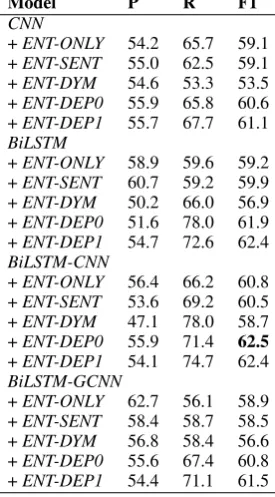
This section evaluates the performance of different pooling methods when they are applied to the deep learning models for RE on the two datasets DDI-2013 and BB3. In particular, we integrate each of the pooling methods in Section2.3 (i.e., ENT-ONLY, ENT-SENT, ENT-DYM, END-DEP0, and
END-DEP1) into each of the deep learning models in Section2.2(i.e.,CNN,BiLSTM,BiLSTM-CNN, and BiLSTM-GCN), resulting 20 different model combinations to be investigated in this section. For each model combination, we train five versions of the model with different random seeds for param-eter initialization over the training datasets. The performance of such versions over the test sets is averaged to serve as the overall model perfor-mance on the corresponding dataset. Tables1and
2 report the performance of the models on the DDI-2013 dataset and BB3 dataset respectively.
Model P R F1
CNN
+ENT-ONLY 52.7 43.1 47.4 +ENT-SENT 75.8 60.7 67.3 +ENT-DYM 66.5 70.6 68.5 +ENT-DEP0 59.8 61.5 60.6 +ENT-DEP1 67.6 65.1 66.3 BiLSTM
+ENT-ONLY 74.0 69.4 71.6 +ENT-SENT 74.8 71.7 73.1 +ENT-DYM 71.5 73.4 72.4 +ENT-DEP0 72.8 69.4 71.1 +ENT-DEP1 71.6 76.4 73.9
BiLSTM-CNN
+ENT-ONLY 69.6 72.3 70.9 +ENT-SENT 69.4 74.9 72.0 +ENT-DYM 71.0 69.7 71.8 +ENT-DEP0 72.2 69.5 70.8 +ENT-DEP1 71.0 74.3 72.6 BiLSTM-GCNN
[image:6.595.347.485.66.315.2]+ENT-ONLY 69.3 71.4 70.4 +ENT-SENT 72.2 71.9 72.0 +ENT-DYM 69.7 73.9 71.7 +ENT-DEP0 70.1 71.1 70.6 +ENT-DEP1 72.7 72.9 72.8
Table 1: Results on DDI 2013
From the tables, we have the following observa-tions about the effectiveness of the pooling meth-ods for RE with deep learning:
1. ComparingENT-SENT,ENT-DYMand ENT-ONLY, we see that the pooling methods over the whole sentence (i.e., ENT-SENT and ENT-DYM) are significantly better thanENT-ONLYthat only focuses on the two entity mentions of interest in
Model P R F1
CNN
+ENT-ONLY 54.2 65.7 59.1 +ENT-SENT 55.0 62.5 59.1 +ENT-DYM 54.6 53.3 53.5 +ENT-DEP0 55.9 65.8 60.6 +ENT-DEP1 55.7 67.7 61.1 BiLSTM
+ENT-ONLY 58.9 59.6 59.2 +ENT-SENT 60.7 59.2 59.9 +ENT-DYM 50.2 66.0 56.9 +ENT-DEP0 51.6 78.0 61.9 +ENT-DEP1 54.7 72.6 62.4 BiLSTM-CNN
+ENT-ONLY 56.4 66.2 60.8 +ENT-SENT 53.6 69.2 60.5 +ENT-DYM 47.1 78.0 58.7 +ENT-DEP0 55.9 71.4 62.5
+ENT-DEP1 54.1 74.7 62.4 BiLSTM-GCNN
+ENT-ONLY 62.7 56.1 58.9 +ENT-SENT 58.4 58.7 58.5 +ENT-DYM 56.8 58.4 56.6 +ENT-DEP0 55.6 67.4 60.8 +ENT-DEP1 54.4 71.1 61.5
Table 2: Results on BioNLP BB3
the DDI-2013 dataset. This is true across differ-ent deep learning models in this work. However, this comparison is reversed for the BB3 dataset where ENT-ONLYis in general better or compa-rable toENT-SENT and ENT-DYMover different deep learning models. We attribute such phenom-ena to the fact that the BB3 dataset often contains many entity mentions and relations within a single sentence (i.e., overlapping contexts) while the sen-tences in DDI-2013 tend to involve only a single relation with few entity mentions. This make ENT-SENT andENT-DYM) ineffective for BB3 as the pooling mechanisms over the whole sentence are likely to involve the contexts for the other entity mentions and relations in the sentences, causing the low quality of the resulting representations and the confusion of the model for the relation predic-tion. This problem is less severe in DDI-2013 as the context of the whole sentence (with a single re-lation) is more aligned with the important context for the relation prediction. We call the many entity mentions and relations in a single single sentence of BB3 as the multiple relation effect for conve-nient discussion in this paper.
[image:6.595.113.249.375.625.2]ef-fect in BB3 due toENT-DYMwhere the separation of the sentence context for pooling encourages the emergence of context information for multiple re-lations in the final representation vector and in-creases the confusion of the models.
3. Comparing the syntax-based pooling meth-ods and the non-syntax pooling methmeth-ods, the pooling based on dependency paths (i.e., ENT-DEP0) is worse than the non-syntax pooling meth-ods (i.e.,ENT-SENTandENT-DYM) and perform comparably with ENT-ONLY in the DDI-2013 dataset over all the models (except for the CNN
model where ENT-ONLYis much worse). These evidences suggest that the dependency paths them-selves are not able to capture effective contexts for the pooling operation beyond the entity mentions for biomedical RE in DDI-2013. However, when we switch to the BB3 dataset, it turns out that
ENT-DEP0is significantly better than all the non-syntax pooling methods (i.e., ENT-ONLY, ENT-SENTandENT-DYM) for all the comparing mod-els. This can be explained by the multiple relation effect in BB3 for which the dependency paths help to identify the most related context words for the two given entity mentions and filter out the con-fusing context words for the other relations in the sentences. The models would thus become less confused with different contexts for multiple re-lations as those inENT-SENT and ENT-DYMfor better performance in this case.
4. Finally, among all the pooling methods, we find thatENT-DEP1significantly outperforms the other pooling methods across different models and datasets (except theCNNmodel on DDI-2013 and BiLSTMon BB3). In particular, the perfor-mance improvement is substantial over the non-syntax pooling methods in BB3 whereENT-DEP1
is up to 2% better than ENT-SENT, ENT-DYM
and ENT-ONLYon the absolute F1 scores. This helps to demonstrate the benefits of ENT-DEP1
for biomedical RE to both recognize the impor-tant context words for pooling in DDI-2013 and reduce the confusion effect of the multiple rela-tions in single sentences for the models in BB3.
3.4 Comparing the Deep Learning Models for RE
Regarding the comparison among different deep learning models, the major observations from from Tables1and2include:
1. The performance of CNN is in general
worse that the other models with the bidirectional LSTM components (i.e., BiLSTM, BiLSTM-CNN
and BiLSTM-GCN) over different pooling meth-ods and datasets. This illustrates the importance of bidirectional LSTMs to capture the effective fea-ture representations for biomedical RE.
2. Comparing BiLSTMandBiLSTM-CNN, we find that BiLSTM is better in DDI-2013 while
BiLSTM-CNNachieves better performance in BB3 (over different pooling methods). In other words, the CNN layer is only helpful for the BiLSTM
model in the BB3 dataset. This can also be at-tributed to the multiple relation effect in BB3 where the CNN layer helps to further abstract the representations from BiLSTMto better reveal the underlying structures in such confusing and com-plicated contexts in the sentences of BB3 for RE.
3. Graph convolutions over the dependency trees are not effective for biomedical RE as in-corporating it into the BiLSTM model hurts the performance significantly. In particular, BiLSTM-GCNNis significantly worse thanBiLSTMno mat-ter which pooling methods are applied and which datasets are used for evaluation.
4. Interestingly, comparing theBiLSTMmodel with the ENT-DEP1 pooling method (i.e., BiL-STM + ENT-DEP1) and theBiLSTM-GCNmodel with the non-syntax pooling methods (i.e., ENT-ONLY, ENT-SENT and ENT-DYM), we see that
BiLSTM + ENT-DEP1is significantly better with large performance gaps over both datasets DDI-2013 and BB3. For example, BiLSTM + ENT-DEP1is 1.9% better thanBiLSTM-GCNN + ENT-SENT in the DDI-2013 dataset and 3.5% better than BiLSTM-GCNN + ENT-ONLY in BB3 with respect to the absolute F1 scores. In fact, BiL-STM + ENT-DEP1also achieves the best perfor-mance among the compared models in this sec-tion for both datasets. The major difference be-tween BiLSTM + ENT-DEP1 and BiLSTM-GCN
than in the representation learning component of the deep learning models for biomedical RE. This is an interesting and unique observation given that the prior work for RE has only focused on us-ing the syntactic information in the representation component and never explicitly investigated the effectiveness of the syntactic information for the pooling component of the deep learning models.
3.5 Comparing to the State-of-the-art Models
In order to further demonstrate the advantage of the syntactic information for the pooling com-ponent for biomedical RE, this section compares
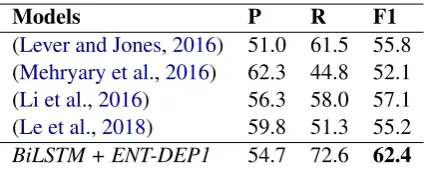
BiLSTM + ENT-DEP1 (i.e., the best model with theENT-DEP1pooling in this work) with the best reported models on the two datasets DDI-2013 and BB3. For a fair comparison between models, we select the previous single (non-ensemble) models for the comparison in this section. Tables3and4
presents the model performance.
Models P R F1
(Raihani and Laachfoubi,2017) 73.6 70.1 71.8 (Zhang et al.,2018a) 74.1 71.8 72.9 (Zhou et al.,2018) 75.8 70.3 73.0 (Bj¨orne and Salakoski,2018) 75.3 66.3 70.5
[image:8.595.75.289.472.557.2]BiLSTM + ENT-DEP1 71.6 76.4 73.9
Table 3: Comparison with the state-of-the-art systems on the DDI-2013 test set
Models P R F1
(Lever and Jones,2016) 51.0 61.5 55.8 (Mehryary et al.,2016) 62.3 44.8 52.1 (Li et al.,2016) 56.3 58.0 57.1 (Le et al.,2018) 59.8 51.3 55.2
BiLSTM + ENT-DEP1 54.7 72.6 62.4
Table 4: Comparison with the state-of-the-art systems on the BB3 test set
The most important observation from the tables is that theBiLSTMmodel, once combined with the
ENT-DEP1 pooling method, significantly outper-forms the previous models on DDI-2013 and BB3, establishing new state-of-the-art performance for these datasets. In particular, in the DDI-2013 dataset,BiLSTM + ENT-DEP1is 0.9% better than the current state-of-the-art model in (Zhou et al.,
2018) while the performance improvement over the best reported model for BB3 in (Li et al.,2016) is 5.3% (over the absolute F1 scores). Such sub-stantial improvement clearly demonstrates the
ad-vantages of the syntactic information and its de-layed application in the pooling component of the deep learning models for biomedical RE.
4 Related Work
Traditional work on RE has mostly used feature engineering with syntactical information for sta-tistical or kernel based classifiers (Zelenko et al.,
2002; Zhou et al., 2005; Bunescu and Mooney,
2005;Sun et al.,2011;Chan and Roth,2010). Re-cently, deep learning has been shown to advance many benchmark datasets for this RE problem due to its representation learning capacity. The typical architectures for such deep learning mod-els involve CNN, LSTM, the attention mechanism and their variants (Zeng et al., 2014; dos Santos et al.,2015;Zhou et al.,2016;Wang et al.,2016;
Nguyen and Grishman,2015a;Miwa and Bansal,
2016; Zhang et al., 2017, 2018b). Deep learn-ing has also been applied to biomedical RE in the last couple of years and started to demonstrate much potentials for this area (Mehryary et al.,
2016; Bj¨orne and Salakoski, 2018; Nguyen and Verspoor,2018;Verga et al.,2018).
Pooling is a common and crucial component in most of the deep learning models for RE. (Nguyen and Grishman,2015b;dos Santos et al.,2015) ap-ply the pooling operation over the whole sentence for RE whileZeng et al.(2015) proposes the dy-namic pooling mechanism in the CNN models. However, none of these prior work systematically examines different pooling mechanisms for deep learning in RE as we do in this work.
5 Conclusion
References
Jari Bj¨orne and Tapio Salakoski. 2018. Biomedical Event Extraction Using Convolutional Neural Net-works and Dependency Parsing. InProceedings of the BioNLP 2018 Workshop, pages 98–108.
Razvan Bunescu and Raymond Mooney. 2005. A Shortest Path Dependency Kernel for Relation Ex-traction. InProceedings of the EMNLP-HLT 2005, pages 724–731.
Yee S. Chan and Dan Roth. 2010. Exploiting back-ground knowledge for relation extraction. In COL-ING.
Md Faisal Mahbub Chowdhury and Alberto Lavelli. 2013. FBK-irst : A Multi-Phase Kernel Based Approach for Drug-Drug Interaction Detection and Classification that Exploits Linguistic Information. In Proceedings of the Seventh International Work-shop on Semantic Evaluation, pages 351–355.
Louise Del´eger, Robert Bossy, Estelle Chaix, Mouhamadou Ba, Arnaud Ferr´e, Philippe Bessi`eres, and Claire N´edellec. 2016. Overview of the Bacte-ria Biotope Task at BioNLP Shared Task 2016. In Proceedings of the BioNLP 2016 Workshop, pages 12–22.
Cicero dos Santos, Bing Xiang, and Bowen Zhou. 2015. Classifying Relations by Ranking with Con-volutional Neural Networks. InProceedings of the IJCNLP 2015, pages 626–634.
Mar´ıa Herrero-Zazo, Isabel Segura-Bedmar, Paloma Mart´ınez, and Thierry Declerck. 2013. The DDI corpus: An annotated corpus with pharmacological substances and drug–drug interactions. Journal of Biomedical Informatics, 46(5):914–920.
Hoang-Quynh Le, Duy-Cat Can, Sinh T. Vu, Thanh Hai Dang, Mohammad Taher Pilehvar, and Nigel Col-lier. 2018. Large-scale Exploration of Neural Rela-tion ClassificaRela-tion Architectures. InProceedings of the EMNLP 2018, pages 2266–2277.
Jake Lever and Steven JM Jones. 2016. VERSE: Event and Relation Extraction in the BioNLP 2016 Shared Task. In Proceedings of the BioNLP 2016 Work-shop, pages 42–49.
L. Li, and, and D. Huang and. 2016. Biomedical event extraction via Long Short Term Memory networks along dynamic extended tree. InProceedings of the IEEE-BIBM 2016, pages 739–742.
Yankai Lin, Shiqi Shen, Zhiyuan Liu, Huanbo Luan, and Maosong Sun. 2016. Neural Relation Extrac-tion with Selective AttenExtrac-tion over Instances. In Pro-ceedings of the ACL 2016, pages 2124–2133.
Yang Liu, Furu Wei, Sujian Li, Heng Ji, Ming Zhou, and Houfeng Wang. 2015. A dependency-based neural network for relation classification. arXiv preprint arXiv:1507.04646.
Farrokh Mehryary, Jari Bj¨orne, Sampo Pyysalo, Tapio Salakoski, and Filip Ginter. 2016. Deep Learning with Minimal Training Data: TurkuNLP Entry in the BioNLP Shared Task 2016. In Proceedings of the BioNLP 2016 Workshop, pages 73–81.
Stephen Merity, Nitish Shirish Keskar, and Richard Socher. 2017. Regularizing and Optimizing LSTM Language Models. In Proceedings of the ICLR 2018.
Tomas Mikolov, Kai Chen, Greg Corrado, and Jeffrey Dean. 2013. Efficient Estimation of Word Represen-tations in Vector Space.arXiv:1301.3781 [cs].
Makoto Miwa and Mohit Bansal. 2016. End-to-End Relation Extraction using LSTMs on Sequences and Tree Structures. InProceedings of the ACL 2016, pages 1105–1116.
Dat Quoc Nguyen and Karin Verspoor. 2018. Convolu-tional neural networks for chemical-disease relation extraction are improved with character-based word embeddings. In Proceedings of the BioNLP 2018 Workshop, pages 129–136.
Thien Huu Nguyen and Ralph Grishman. 2015a. Combining neural networks and log-linear mod-els to improve relation extraction. arXiv preprint arXiv:1511.05926.
Thien Huu Nguyen and Ralph Grishman. 2015b. Re-lation Extraction: Perspective from Convolutional Neural Networks. InProceedings of the 1st Work-shop on Vector Space Modeling for Natural Lan-guage Processing, pages 39–48.
Truc-Vien T. Nguyen, Alessandro Moschitti, and Giuseppe Riccardi. 2009. Convolution kernels on constituent, dependency and sequential structures for relation extraction. InEMNLP.
Anass Raihani and Nabil Laachfoubi. 2017. A Rich Feature-based Kernel Approach for Drug- Drug In-teraction Extraction. In In Proceedings of the IJACSA 2017, volume 8.
Ang Sun, Ralph Grishman, and Satoshi Sekine. 2011. Semi-supervised relation extraction with large-scale word clustering. InACL.
Patrick Verga, Emma Strubell, and Andrew McCal-lum. 2018. Simultaneously Self-Attending to All Mentions for Full-Abstract Biological Relation Ex-traction. InProceedings of the NAACL-HLT 2018, pages 872–884.
Li Wan, Matthew Zeiler, Sixin Zhang, Yann Le Cun, and Rob Fergus. 2013. Regularization of Neural Networks using DropConnect. InProceedings of the ICML 2013, pages 1058–1066.
Yan Xu, Ran Jia, Lili Mou, Ge Li, Yunchuan Chen, Yangyang Lu, and Zhi Jin. 2016. Improved relation classification by deep recurrent neural networks with data augmentation. InProceedings of the COLING 2016, pages 1461–1470.
Yan Xu, Lili Mou, Ge Li, Yunchuan Chen, Hao Peng, and Zhi Jin. 2015. Classifying Relations via Long Short Term Memory Networks along Shortest De-pendency Paths. In Proceedings of the EMNLP 2015, pages 1785–1794.
Dmitry Zelenko, Chinatsu Aone, and Anthony Richardella. 2002.Kernel Methods for Relation Ex-traction. InProceedings of the EMNLP 2002, pages 71–78.
Daojian Zeng, Kang Liu, Yubo Chen, and Jun Zhao. 2015. Distant Supervision for Relation Extraction via Piecewise Convolutional Neural Networks. In Proceedings of the EMNLP 2015, pages 1753–1762.
Daojian Zeng, Kang Liu, Siwei Lai, Guangyou Zhou, and Jun Zhao. 2014. Relation Classification via Convolutional Deep Neural Network. In Proceed-ings of the COLING 2014, pages 2335–2344.
Wenyuan Zeng, Yankai Lin, Zhiyuan Liu, and Maosong Sun. 2017. Incorporating Relation Paths in Neural Relation Extraction. InProceedings of the EMNLP 2017, pages 1768–1777.
Yijia Zhang, Wei Zheng, Hongfei Lin, Jian Wang, Zhi-hao Yang, and Michel Dumontier. 2018a. Drug-Drug Interaction Extraction Via Hierarchical Rnns on Sequence and Shortest Dependency Paths. Bioin-formatics, 34(5):828–835.
Yuhao Zhang, Peng Qi, and Christopher D. Manning. 2018b. Graph Convolution over Pruned Depen-dency Trees Improves Relation Extraction. In Pro-ceedings of the EMNLP 2018, pages 2205–2215.
Yuhao Zhang, Victor Zhong, Danqi Chen, Gabor An-geli, and Christopher D. Manning. 2017. Position-aware Attention and Supervised Data Improve Slot Filling. InProceedings of the EMNLP 2017, pages 35–45.
Deyu Zhou, Lei Miao, and Yulan He. 2018. Position-Aware Deep Multi-Task Learning for Drug–Drug In-teraction Extraction. Journal of Artificial Intelli-gence in Medicine, 87:1–8.
Guodong Zhou, Jian Su, Jie Zhang, and Min Zhang. 2005. Exploring Various Knowledge in Relation Extraction. InProceedings of the ACL 2005, pages 427–434.