Entity Extraction via Ensemble Semantics
Marco Pennacchiotti Yahoo! Labs Sunnyvale, CA, 94089 [email protected]
Patrick Pantel Yahoo! Labs Sunnyvale, CA, 94089 [email protected]
Abstract
Combining information extraction sys-tems yields significantly higher quality re-sources than each system in isolation. In this paper, we generalize such a mixing of sources and features in a framework called
Ensemble Semantics. We show very large gains in entity extraction by combining state-of-the-art distributional and pattern-based systems with a large set of fea-tures from a webcrawl, query logs, and Wikipedia. Experimental results on a web-scale extraction of actors, athletes and mu-sicians show significantly higher mean av-erage precision scores (29% gain) com-pared with the current state of the art.
1 Introduction
Mounting evidence shows that combining infor-mation sources and inforinfor-mation extraction algo-rithms leads to improvements in several tasks such as fact extraction (Pas¸ca et al., 2006), open-domain IE (Talukdar et al., 2008), and entailment rule acquisition (Mirkin et al., 2006). In this paper, we show large gains in entity extraction by com-bining state-of-the-art distributional and pattern-based systems with a large set of features from a 600 million document webcrawl, one year of query logs, and a snapshot of Wikipedia. Further, we generalize such a mixing of sources and fea-tures in a framework calledEnsemble Semantics.
Distributional and pattern-based extraction al-gorithms capture aspects of paradigmatic and syn-tagmatic dimensions of semantics, respectively, and are believed to be quite complementary. Pas¸ca et al. (2006) showed that filtering facts, extracted by a pattern-based system, according to their ar-guments’ distributional similarity with seed facts yielded large precision gains. Mirkin et al. (2006) showed similar gains on the task of acquiring lex-ical entailment rules by exploring a supervised
combination of distributional and pattern-based al-gorithms using an ML-based SVM classifier.
This paper builds on the above work, by study-ing the impact of various sources of features exter-nal to distributioexter-nal and pattern-based algorithms, on the task of entity extraction. Mirkin et al.’s re-sults are corroborated on this task and large and significant gains over this baseline are obtained by incorporating 402 features from a webcrawl, query logs and Wikipedia. We extracted candidate entities for the classes Actors, Athletes and Mu-sicians from a webcrawl using a variant of Pas¸ca et al.’s (2006) pattern-based engine and Pantel et al.’s (2009) distributional extraction system. A gradient boosted decision tree is used to learn a re-gression function over the feature space for rank-ing the candidate entities. Experimental results show 29% gains (19% nominal) in mean average precision over Mirkin et al.’s method and 34% gains (22% nominal) in mean average precision over an unsupervised baseline similar to Pas¸ca et al.’s method. Below we summarize the contribu-tions of this paper:
• We explore the hypothesis that although dis-tributional and pattern-based algorithms are complementary, they do not exhaust the se-mantic space; other sources of evidence can be leveraged to better combine them;
• We model the mixing of knowledge sources and features in a novel and general informa-tion extracinforma-tion framework called Ensemble Semantics; and
• Experiments over an entity extraction task show that our model achieves large and sig-nificant gains over state-of-the-art extractors. A detailed analysis of feature correlations and interactions shows that query log and we-bcrawl features yield the highest gains, but easily accessible Wikipedia features also im-prove over current state-of-the-art systems.
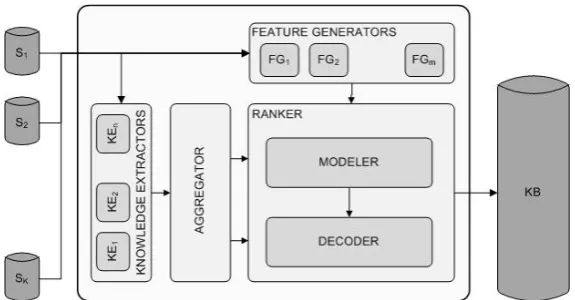
Figure 1: TheEnsemble Semanticsframework for information extraction.
The remainder of this paper is organized as fol-lows. In the next section, we present our Ensemble Semantics framework and outline how various in-formation extraction systems can be cast into the framework. Section 3 then presents our entity ex-traction system as an instance of Ensemble Se-mantics, comparing and contrasting it with previ-ous information extraction systems. Our experi-mental methodology and analysis is described in Section 4 and shows empirical evidence that our extractor significantly outperforms prior art. Fi-nally, Section 5 concludes with a discussion and future work.
2 Ensemble Semantics
Ensemble Semantics (ES) is a general framework for modeling information extraction algorithms that combine multiple sources of information and multiple extractors. The ES framework allows to:
• Represent multiple sources of knowledge and multiple extractors of that knowledge;
• Represent multiple sources of features;
• Integrate both rule-based and ML-based knowledge ranking algorithms; and
• Model previous information extraction sys-tems (i.e., backwards compatibility).
2.1 ES Framework
ES can be instantiated to extract various types of knowledge such as entities, facts, and lexical en-tailment rules. It can also be used to better under-stand the commonalities and differences between existing information extraction systems.
After presenting the framework in the next sec-tion, Section 2.2 shows how previous information extraction algorithms can be cast into ES. In Sec-tion 3 we describe our novel entity extracSec-tion al-gorithm based on ES.
The ES framework is illustrated in Figure 1. It decomposes the process of information extraction into the following components:
Sources (S): textual repositories of information, either structured (e.g., a database such as DBpe-dia), semi-structured (e.g., Wikipedia Infoboxes or HTML tables) or unstructured (e.g., news articles or a webcrawl).
Knowledge Extractors (KE): algorithms re-sponsible for extracting candidate instances such as entities or facts. Examples include fact extrac-tion systems such as (Cafarella et al., 2005) and entity extraction systems such as (Pas¸ca, 2007). Feature Generators (FG): methods that extract evidence (features) of knowledge in order to de-cide which candidate instances extracted from KEs are correct. Examples include capitalization features for named entity extractors, and the dis-tributional similarity matrix used in (Pas¸ca et al., 2006) for filtering facts.
Aggregator (A). A module collecting and as-sembling the instances coming from the different extractors. This module keeps the footprint of each instance, i.e. the number and the type of the KEs that extracted the instance. This information can be used by the Ranker module to build a rank-ing strategy, as described below.
The Ranker is composed of two sub-modules: the Modeler and the Decoder. TheModeler is re-sponsible for creating the model which ranks the candidate instances. TheDecodercollects the can-didate instances from the Aggregator, and applies the model to produce the final ranking.
In rule-based systems, the Modeler corresponds to a set of manually crafted or automatically in-duced rules operating on the features (e.g. a com-bination of thresholds). In ML-based systems, it is an actual machine learning algorithm, that takes as input a set of labeled training instances, and builds the model according to their features. Training in-stances can be obtained as a subset of those col-lected by the Aggregator, or from some exter-nal resource. In many cases, training instances are manually labeled by human experts, through a long and costly editorial process.
Information sources (S) serve as inputs to the system. Some sources will serve as sources for knowledge extractors to generate candidate in-stances, some will serve as sources for feature gen-erators to generate features or evidence of knowl-edge, and some will serve as both.
2.2 Related Work
To date, most information extraction systems rely on a model composed of a single sourceS, a single extractorKE and a single feature generatorF G. For example, many classic relation extraction sys-tems (Hearst, 1992; Riloff and Jones, 1999; Pan-tel and Pennacchiotti, 2006; Pas¸ca et al., 2006) are based on a single pattern-based extractorKE, which is seeded with a set of patterns or instances for a given relation (e.g. the pattern‘X starred in Y’for theact-inrelation). The extractor then itera-tively extracts new instances until a stop condition is met. The resulting extractor scores are proposed by F Gas a feature. TheRanker simply consists of a sorting function on the feature fromF G.
Systems such as the above that do not consist of multiple sources, knowledge extractors or fea-ture generators are not considered Ensemble Se-mantics models, even though they can be cast into the framework. Recently, some researchers have explored more complex systems, having multiple sources, extractors and feature generators. Below we show examples and describe how they map as Ensemble Semantics systems. We use this charac-terization to clearly outline how our proposed en-tity extraction system, proposed in Section 3,
dif-fers from previous work.
Talukdar et al. (2008) present a weakly-supervised system for extracting large sets of class-instance pairs using two knowledge extrac-tors: a pattern-based extractor supported by distri-butional evidence, which harvests candidate pairs from a Web corpus; and a table extractor that har-vests candidates from Web tables. The Ranker
uses graph random walks to combine the informa-tion of the two extractors and output the final list. The authors show large improvements in coverage with little precision loss.
Mirkin et al. (2006) introduce a machine learn-ing system for extractlearn-ing lists of lexical entail-ments (e.g. ‘government’→‘organization’). They rely on two knowledge extractors, operating on a same large textual source: a pattern-based extrac-tor, leveraging the Hearst (1992)is-apatterns; and a distributional extractor applied to a set of entail-ment seeds. Candidate instances are passed to an SVMRanker, which uses features stemming from the two extractors, to decide which instances are output in the final list. The authors report a +9% increase in F-measure over a rule-based system that takes the union of the instances extracted by the two modules.
Other examples include the system for taxonomic-relation extraction by Cimiano et al. (2005), using a pool of feature genera-tors based on pattern-based, distributional and WordNet techniques; and Pas¸ca and Van Durme’s (2008) system that uses a Web corpus and query logs to extract semantic classes and their attributes.
Similarly to these methods, our proposed entity extractor (Section 3) utilizes multiple sources and extractors. A key difference of our method lies in the Feature Generator module. We propose sev-eral generators resulting in 402 features extracted from Web pages, query logs and Wikipedia arti-cles. The use of these features results in dramatic performance improvements, reported in Section 4.
3 ES for Entity Extraction
Lehn-Family Type Features
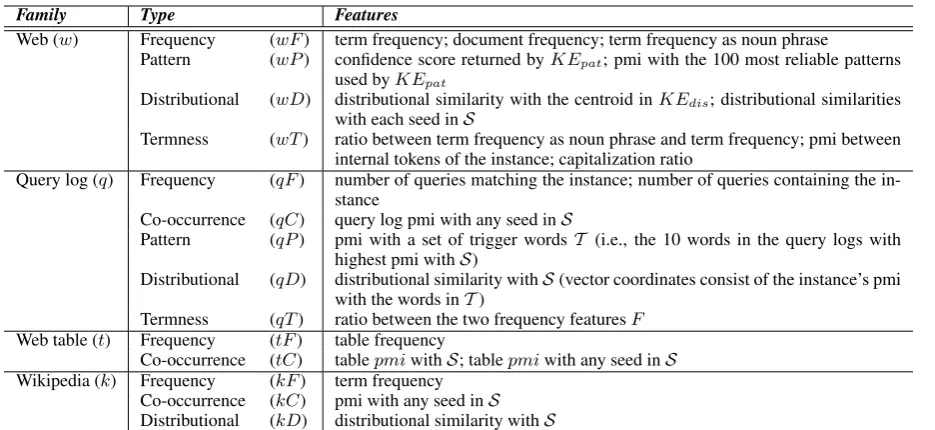
Web (w) Frequency (wF) term frequency; document frequency; term frequency as noun phrase
Pattern (wP) confidence score returned byKEpat; pmi with the 100 most reliable patterns used byKEpat
Distributional (wD) distributional similarity with the centroid inKEdis; distributional similarities with each seed inS
Termness (wT) ratio between term frequency as noun phrase and term frequency; pmi between internal tokens of the instance; capitalization ratio
Query log (q) Frequency (qF) number of queries matching the instance; number of queries containing the in-stance
Co-occurrence (qC) query log pmi with any seed inS
Pattern (qP) pmi with a set of trigger wordsT (i.e., the 10 words in the query logs with highest pmi withS)
Distributional (qD) distributional similarity withS(vector coordinates consist of the instance’s pmi with the words inT)
Termness (qT) ratio between the two frequency featuresF
Web table (t) Frequency (tF) table frequency
Co-occurrence (tC) tablepmiwithS; tablepmiwith any seed inS Wikipedia (k) Frequency (kF) term frequency
Co-occurrence (kC) pmi with any seed inS Distributional (kD) distributional similarity withS
Table 1: Feature space describing each candidate instance (Sindicates the set of seeds for a given class).
ert, 2005). Search engines such as Yahoo, Live, and Google collect large sets of entities (Pas¸ca, 2007; Chaudhuri et al., 2009) to better interpret queries (Tan and Peng, 2006), to improve query suggestions (Cao et al., 2008) and to understand query intents (Hu et al., 2009). Entity extraction differs from the similar task of named entity ex-traction, in that classes are more fine-grained and possibly overlapping.
Below, we propose a new method for entity ex-traction built on the ES framework (Section 3.1). Then, we comment on related work in entity ex-traction (Section 3.2).
3.1 ES Entity Extraction Model
In this section, we propose a novel entity ex-traction model following the Ensemble Semantics framework presented in Section 2. The sources of our systems can come from any textual corpus. In our experiments (described in Section 4.1), we ex-tracted entities from a large crawl of the Web, and generated features from this crawl as well as query logs and Wikipedia.
3.1.1 Knowledge extractors
Our system relies on two knowledge extractors: one pattern-based and the other distributional. Pattern-based extractor (KEpat). We
reimple-mented Pas¸ca et al.’s (2006) state-of-the-art web-scale fact extractor, which, given seed instances of a binary relation, finds instances of that relation. We extract entities of a class, such asActors, by instantiating typical relations involving that class
such asact-in(Actor, Movie). We instantiate such relations instead of the classicalis-apatterns since these have been shown to bring in too many false positives, see (Pantel and Pennacchiotti, 2006) for a discussion of such generic patterns. The extrac-tor’s confidence score for each instance is used by the Ranker to score the entities being extracted. Section 4.1 lists the system parameters we used in our experiments.
Distributional extractor (KEdis). We use
Pan-tel et al.’s (2009) distributional entity extractor. For each noun in our source corpus, we build a context vector consisting of the noun chunks pre-ceding and following the target noun, scored us-ing pointwise mutual information (pmi). Given a small set of seed entities S of a class, the ex-tractor computes the centroid of the seeds’ context vectors as a geometric mean, and then returns all nouns whose similarity with the centroid exceeds a thresholdτ (using the cosine measure between the context vectors). Full algorithmic details are pre-sented in (Pantel et al., 2009). Section 4.1 lists the threshold and text preprocessing algorithms used in our experiments.
TheAggregatorsimply takes a union of the en-tities discovered by the two extractors.
3.1.2 Feature generators
Our model includes four feature generators, which compute a total of 402 features (full set described in Table 1). Each generator extracts from a specific source afeature family, as follows:
[image:4.595.70.538.61.276.2]crawled from the Web at Yahoo! in 2008;
• Query logs (q): one year of web search queries issued to the Yahoo! search engine;
• Web tables: all HTML inner tables extracted from the aboveWebsource; and
• Wikipedia: an official Wikipedia dump from February 2008, consisting of about 2 million articles.
Feature families are further subclassified into five types: frequency (F) (frequency-based fea-tures);co-occurrence (C)(features capturing first order co-occurrences between an instance and class seeds);distributional (D)(features based on the distributional similarity between an instance and class seeds); pattern (P) (features indicat-ing class-specific lexical pattern matches); and
termness (T) (features used to distinguish well-formed terms such as‘Brad Pitt’from ill-formed ones such as‘with Brad Pitt’). The seedsS used in many of the feature families are the same seeds used by the KEpat extractor, described in
Sec-tion 3.1.1.
The different seed families are designed to cap-ture different semantic aspects: paradigmatic (D), syntagmatic (C and P), popularity (F), and term cohesiveness (T).
3.1.3 ML-based Ranker
Our Modeler adopts a supervised ML regression model. Specifically, we use a Gradient Boosted Decision Tree regression model - GBDT (Fried-man, 2001), which consists of an ensemble of de-cision trees, fitted in a forward step-wise manner to current residuals. Friedman (2001) shows that by drastically easing the problem of overfitting on training data (which is common in boosting al-gorithms), GDBT competes with state-of-the-art machine learning algorithms such as SVM (Fried-man, 2006) with much smaller resulting models and faster decoding time. The model is trained on a manually annotated random sample of enti-ties taken from theAggregator, using the features generated by the four generators presented in Sec-tion 3.1.2. TheDecoderthen ranks each entity ac-cording to the trained model.
3.2 Related Work
Entity extraction systems follow two main ap-proaches: pattern-based and distributional. The
pattern-based approachleverages lexico-syntactic patterns to extract instances of a given class. Most
commonly used are is-apattern families such as those first proposed by Hearst (1992) (e.g.,‘Y such as X’ for matching ‘actors such as Brad Pitt’). Minimal supervision is used in the form of small sets of manually provided seed patterns or seed in-stances. This approach is very common in both the NLP and Semantic Web communities (Cimi-ano and Staab, 2004; Cafarella et al., 2005; Pantel and Pennacchiotti, 2006; Pas¸ca et al., 2006).
Thedistributional approachuses contextual ev-idence to model the instances of a given class, following the distributional hypothesis (Harris, 1964). Weakly supervised, these methods take a small set of seed instances (or the class label) and extract new instances from noun phrases that are most similar to the seeds (i.e., that share similar contexts). Following Lin (1998), example sys-tems include Fleischman and Hovy (2002), Cimi-ano and Volker (2005), Tanev and Magnini (2006), and Pantel et al. (2009).
4 Experimental Evaluation
This section reports our experiments, showing the effectiveness of our entity extraction system and the importance of our different feature families.
4.1 Experimental Setup
Evaluated classes. We evaluate our system over three classes: Actors (movie, tv and stage ac-tors); Athletes(professional and amateur); Musi-cians(singers, musicians, composers, bands, and orchestras)
System setup. We instantiated our knowledge extractors,KEpatandKEdisfrom Section 3.1.1,
over ourWebcrawl of 600 million documents (see Section 3.1.2). The documents were preprocessed using Brill’s POS-tagger (Brill, 1995) and the Ab-ney’s chunker (Abney, 1991). ForKEdis, context
vectors are extracted for noun phrases recognized as NP-chunks with removed modifiers. The vec-tor space includes the 250M most frequent noun chunks in the corpus. KEdisreturns as instances
all noun phrases having a similarity with the seeds’ centroid aboveτ = 0.0051. The sets of seedsS
forKEdisinclude 10, 24 and 10 manually chosen
instances for respectively theActors,Athletesand
Musiciansclasses2. The sets of seedsPforKE pat
1Experimentally set on an independent development set. 2The higher number of seeds forAthletes is chosen to
Dataset Actors Athletes Musicians
KEpat 58,005 40,816 125,657
KEdis 72,659 24,380 24,593
KEpat∪KEdis 113,245 61,709 142,694
KEpat∩KEdis 17,419 3,487 7,556
R 500 500 500
P=80 P=258 P=134
[image:6.595.306.527.61.137.2]N=420 N=242 N=366
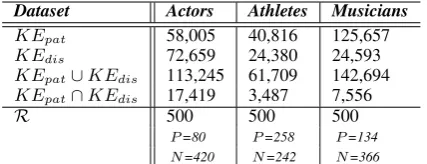
Table 2: Number of extracted instances and the sample sizes (P andN indicate positive and neg-ative annotations).
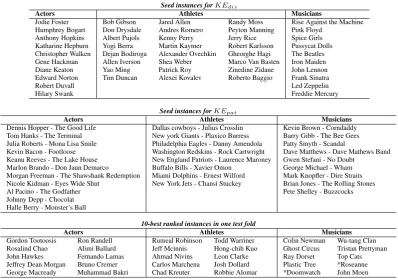
include 11, 8 and 9 pairs respectively for the Ac-tors(relationacts-in),Athletes(relationplays-for) andMusicians(relationpart-of-band) classes. Ta-ble 6 lists all seeds for both KEdis and KEpat.
TheGBDT rankeruses an ensemble of 300 trees.3
Goldset Preparation. The number of instances extracted by KEpat and KEdis for each class
is reported in Table 2. For each class, we ex-tract a random sample R of 500 instances from KEpat∪KEdis. A pool of 10 paid expert editors
annotated the instances of each class inRas posi-tive or negaposi-tive. Inter-annotator overlap was 0.88. Uncertain instances were manually adjudicated by a separate paid expert editor, yielding a gold stan-dard dataset for each class.
Evaluation Metrics. Entity extraction perfor-mance is evaluated using the average precision
(AP) statistic, a standard information retrieval measure for evaluating ranking algorithms, de-fined as:
AP(L) =
P|L|
i=1PP(i)·corr(i)
|L|
i=1corr(i)
(1)
whereLis a ranked list produced by an extractor, P(i)is the precision ofLat ranki, andcorr(i)is 1 if the instance at rankiis correct, and 0 otherwise. AP is computed overRfor each class.
We also evaluate thecoverage, i.e. the percent-age of instances extracted by a system wrt those extracted by all systems.
In order to accurately compute statistical signif-icance, our experiments are performed using 10-fold cross validation.
Baselines and comparisons. We compare our proposed ES entity extractor, using different fea-ture configurations, with state-of-the-art systems (referred to as baselinesB*below):
3GBDT model parameters were experimentally set on an
independent development set as follows: trees=300, shrink-age=0.01, max nodes per tree=12, sample rate=0.5.
System Actors Athletes Musicians
AP Cov AP Cov AP Cov
B1 0.729 51.2% 0.616 66.1% 0.570 88.1% B2 0.618 64.1% 0.687 39.5% 0.681 17.2% B3 0.676 100% 0.664 100% 0.576 100% B4 0.715 100% 0.697 100% 0.579 100%
ES-all 0.860‡ 100% 0.915‡ 100% 0.788‡ 100% Table 3: Average precision (AP) and coverage (Cov) results for our proposed systemES-alland the baselines. ‡ indicates AP statistical signifi-cance at the 0.95 level wrt all baselines.
ES-all.Our ES system, usingKEpatandKEdis,
the full set of feature families described in Section 3.1.2, and the GBDT ranker.
B1. KEpat alone, a state-of-the-art
pattern-based extractor reimplementing (Pas¸ca et al., 2006), where theRankerassigns scores to in-stances using the confidence score returned byKEpat.
B2. KEdisalone, a state-of-the-art distributional
system implementing (Pantel et al., 2009), where theRankerassigns scores to instances using the similarity score returned byKEdis
alone.
B3. A rule-based ES system, combiningB1and
B2. This system uses bothKEpatandKEdis
as extractors, and a Ranker that assigns scores to instances according to the sum of their normalized confidence scores.
B4. A state-of-the-art machine learning system based on (Mirkin et al., 2006). This ES system usesKEpatandKEdisas extractors.
The Ranker is a GBDT regression model, using the full sets of features derived from the two extractors, i.e., wP and wD (see Table 1). GBDT parameters are set as for our proposedES-allsystem.
4.2 Experimental Results
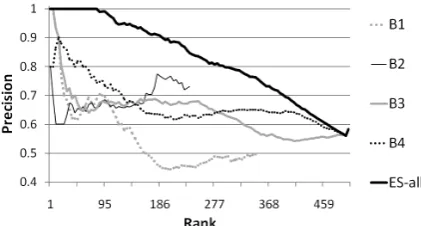
Table 3 summarizes the average-precision (AP) and coverage results for ourES-allsystem and the baselines. Figure 2 reports the precision at each rank for theAthletes class (the other two classes follow similar trends). Table 6 lists the top-10 en-tities discovered for each class on one test fold.
ES-alloutperforms all baselines in AP (all results are statistically significant at the 0.95 level), offer-ing at the same time full coverage4.
4Recall that coverage is reported relative to all instances
[image:6.595.73.287.62.144.2]Figure 2: Precision at rank for the different sys-tems on theAthletesclass.
Our simple rule-based combination baseline,
B3, leads to a large increase in coverage wrt the in-dividual extractors alone (B1andB2) without sig-nificant impact on precision. The supervised ML-based combination baseline (B4) consistently im-proves AP across classes wrt the rule-based com-bination (B3), but without statistical significance. These results corroborate those found in (Mirkin et al., 2006), where this ML-based combination was reported to be significantly better than a rule-based one on the task of lexical entailment acquisition.
The large set of features adopted in ES-all ac-counts for a dramatic improvement in AP, indicat-ing that existindicat-ing state-of-the-art systems for entity extraction (reflected by our baselines strategies) are not making use of enough semantic cues. The adoption of evidence other than distributional and pattern-based, such as features coming from web documents, HTML tables and query logs, is here demonstrated to be highly valuable.
The above empirical claim can be grounded and corroborated by a deeper semantic analysis. From a semantic perspective, the above results translate in the observation that distributional and pattern-based evidence do not completely capture all se-mantic aspects of entities. Other evidence, such as popularity, term cohesiveness and co-occurrences capture other aspects. For instance, in one of our
Actorsfolds, theB3system ranks the incorrect in-stance ‘Tom Sellek’ (a misspelling of ‘Tom Sel-leck’) in 9th position (out of 142), while ES-all
lowers it to the33rdposition, by relying on
table-based features (intuitively, tables contain much fewer misspelling than running text). Other than misspellings,ES-allfixes errors that are either typ-ical of distributional approaches, such as the in-clusion of instances of other classes (e.g. the movie‘Someone Like You’ often appears in con-texts similar to those of actors); errors typical of pattern-based approaches, such as incorrect
in-System AP MAP
Actors Athletes Musicians
B3 0.676 0.664 0.576 0.639
B4 0.715 0.697 0.579 0.664
B4+w 0.813‡ 0.908‡ 0.724‡ 0.815‡
B4+q 0.815‡ 0.905‡ 0.743‡ 0.821‡
B4+t 0.784† 0.825‡ 0.727‡ 0.779‡
B4+k 0.776† 0.825‡ 0.624 0.741†
B4+w+q 0.835‡ 0.915‡ 0.758‡ 0.836‡
B4+w+t 0.840‡ 0.906‡ 0.774‡ 0.840‡
B4+w+k 0.814‡ 0.903‡ 0.725‡ 0.814‡
B4+q+t 0.847‡ 0.910‡ 0.774‡ 0.844‡
B4+q+k 0.832‡ 0.906‡ 0.748‡ 0.829‡
B4+t+k 0.817‡ 0.861‡ 0.743‡ 0.807‡
B4+w+q+t 0.846‡ 0.917‡ 0.782‡ 0.849‡
B4+w+q+k 0.841‡ 0.916‡ 0.756‡ 0.838‡
B4+w+t+k 0.835‡ 0.906‡ 0.783‡ 0.841‡
Es-all 0.860‡ 0.915‡ 0.788‡ 0.854‡
Table 4: Overall AP results of the different feature configurations, compared to two baselines. † in-dicates statistical significance at the 0.95 level wrt
B3.‡indicates statistical significance at 0.95 level wrt bothB3andB4.
stances highly-associated with an ambiguous pat-tern (e.g., the patpat-tern ‘X of the rock band Y’for finding Musicians matched an incorrect instance
‘song submission’); or errors typical of both, such as the inclusion of common nouns (e.g. ‘country music hall’) or too generic last names (e.g. ‘John-son’). ES-allsuccessfully recovers all these error by using termness, co-occurrence and frequency features.
We also compare ES-allwith a state-of-the-art random walk system (RW) presented by Talukdar et al. (2008) (see Section 2.2 for a description). As we could not reimplement the system, we re-port the following indirect comparison. RW was evaluated on five entity classes, one of which,NFL players, overlaps with ourAthletesclass. On this class, they report 0.95 precision on the top-100 ranked entities. Unfortunately, they do not report coverage or recall statistics, making the interpre-tation of this analysis difficult. In an attempt to compareRW withES-all, we evaluated the preci-sion of our top-100Athletes, obtaining 0.99. Us-ing a random sample of our extractedAthletes, we approximate the precision of the top-22,000 Ath-letesto be0.97±0.01(at the 0.95 level).
4.3 Feature Analysis
[image:7.595.75.286.62.175.2]2-4 report AP for each class; and column 5 reports the mean-average-precision (MAP) across classes. In all configurations, except the k family alone, and along all classes, our system significantly out-performs (at the 0.95 level) the baselines.
Rows 3-6 report the performance of each fea-ture family alone. wandtare consistently better thanq andk, across all classes. kis shown to be the least useful family. This is mostly due to data sparseness, e.g., in our experiments almost 40% of the test instances in the Actorssample do not have any occurrence in Wikipedia. However, with-out access to richer resources such as a webcrawl or query logs, the features fromkdo indeed pro-vide large gains over current baselines (on average +10.2% and +7.7% overB3andB4).
Rows 7-12 report results for combinations of two feature families. All combinations (except those with k) appear valuable, substantially creasing the single-family results in rows 3-6, in-dicating that combining different feature families (as suggested by the ES paradigm) is helpful. Sec-ond, it indicates that q, w andt convey comple-mentary information, thus boosting the regression model when combined together. It is interesting to notice thatq+t tends to be the best combination, surprising given thattalone did not show high per-formance (row 5). One would expect the combina-tionq+wto outperformq+t, but the good perfor-mance ofq+tis mainly due to the fact that these two families are more complementary thanq+w. To verify this intuition, we compute the Spearman correlation coefficientr among the rankings pro-duced by the different combinations. As expected,
qandwhave a higher correlation (r = 0.82) than
qandt(r= 0.67) andwandt(r = 0.66), suggest-ing thatq andw tend to subsume each other (i.e. no added information for the regression model).
Rows 13-15 report results for combinations of three feature families. As expected, the best combination is q+w+t with an average precision nearly identical to the full ES-all system. If one has access to Web or query log sources, then the value of the Wikipedia features tends to be sub-sumed by our web and query log features.
Feature by feature analysis: The feature fam-ilies analyzed in the previous section consist of 402 features. For each trained GBDT model, one can inspect the resulting most important fea-tures (Friedman, 2001). Consistently, the two most important features for ES-all are, as
ex-System AP MAP
Actors Athletes Musicians
B4 0.715 0.697 0.579 0.664
B4+w 0.813 0.908 0.724 0.815
B4+wF 0.798 0.865 0.679 0.781
B4+wT 0.806 0.891 0.717 0.805
B4+t 0.784 0.825 0.727 0.779
B4+tF 0.760 0.802 0.701 0.781
B4+tC 0.771 0.815 0.718 0.805
B4+q 0.815 0.905 0.743 0.821
B4+qF 0.786 0.890 0.693 0.790
B4+qC 0.715 0.738 0.581 0.678
B4+qD 0.735 0.709 0.644 0.696
B4+qP 0.779 0.796 0.648 0.741
B4+qT 0.780 0.868 0.725 0.791
B4+qF+qW+qT 0.816 0.906 0.743 0.822
[image:8.595.309.521.62.237.2]ES-all 0.860 0.915 0.788 0.854
Table 5: Ablation study of the web (w), query-log (q) and table (t) features (bold letters indicate whole feature families).
pected, the confidence scores of KEpat and
KEdis. This suggests that syntagmatic and
paradigmatic information are most important in defining the semantics of entities. Also very im-portant, in third position, is a feature from qT, namely the ratio between the number of queries matching the instance and the number of queries containing it as a substring. This feature is a strong indicator of termness.
Webcrawl term frequencies and document fre-quencies (from the wF set) are also important. Very frequent and infrequent instances were found to be often incorrect (e.g., respectively‘song’and
‘Brad Pitttt’). Table PMI (a feature in theqC fam-ily) also ranked high in importance: instances that co-occurr very frequently in the same column/row with seeds S are often found to be correct (e.g., a column containing the seeds ‘Brad Pitt’ and
‘Tom Hanks’ will likely contains other actors). Other termness (T), frequency-based (F) and co-occurrence (C) features also play some role in the model.
Variable importance is only an intrinsic indi-cator of feature relevance. In order to better as-sess the actual impact of the single features on AP, we ran our system on each feature type: re-sults for the web (w), query log (q) and table (t) families are reported in Table 5. For reason of space constraints, we here only focus on some high level observations. The set of web termness features (wT) and frequency features (wF) are alone able to provide a large improvement overB4
Seed instances forKEdis
Actors Athletes Musicians
Jodie Foster Bob Gibson Jared Allen Randy Moss Rise Against the Machine Humphrey Bogart Don Drysdale Andres Romero Peyton Manning Pink Floyd
Anthony Hopkins Albert Pujols Kenny Perry Jerry Rice Spice Girls Katharine Hepburn Yogi Berra Martin Kaymer Robert Karlsson Pussycat Dolls Christopher Walken Dejan Bodiroga Alexander Ovechkin Gheorghe Hagi The Beatles Gene Hackman Allen Iverson Shea Weber Marco Van Basten Iron Maiden Diane Keaton Yao Ming Patrick Roy Zinedine Zidane John Lennon Edward Norton Tim Duncan Alexei Kovalev Roberto Baggio Frank Sinatra
Robert Duvall Led Zeppelin
Hilary Swank Freddie Mercury
Seed instances forKEpat
Actors Athletes Musicians
Dennis Hopper - The Good Life Dallas cowboys - Julius Crosslin Kevin Brown - Corndaddy Tom Hanks - The Terminal New york Giants - Plaxico Burress Barry Gibb - The Bee Gees Julia Roberts - Mona Lisa Smile Philadelphia Eagles - Danny Amendola Patty Smyth - Scandal
Kevin Bacon - Footloose Washington Redskins - Rock Cartwright Dave Matthews - Dave Mathews Band Keanu Reeves - The Lake House New England Patriots - Laurence Maroney Gwen Stefani - No Doubt
Marlon Brando - Don Jaun Demarco Buffalo Bills - Xavier Omon George Michael - Wham Morgan Freeman - The Shawshank Redemption Miami Dolphins - Ernest Wilford Mark Knopfler - Dire Straits Nicole Kidman - Eyes Wide Shut New York Jets - Chansi Stuckey Brian Jones - The Rolling Stones
Al Pacino - The Godfather Pete Shelley - Buzzcocks
Johnny Depp - Chocolat Halle Berry - Monster’s Ball
10-best ranked instances in one test fold
Actors Athletes Musicians
[image:9.595.99.498.61.340.2]Gordon Tootoosis Ron Randell Rumeal Robinson Todd Warriner Colin Newman Wu-tang Clan Rosalind Chao Alimi Ballard Jeff Mcinnis Hong-chih Kuo Ghost Circus Tristan Prettyman John Hawkes Fernando Lamas Ahmad Nivins Leon Clarke Ray Dorset Top Cats Jeffrey Dean Morgan Bruno Cremer Carlos Marchena Josh Dollard Plastic Tree *Roseanne George Macready Muhammad Bakri Chad Kreuter Robbie Alomar *Doomwatch John Moen
Table 6: Listing of all seeds used forKEdisand KEpat, as well as the top-10 entities discovered by ES-allon one of our test folds.
This suggests thatwT andwF capture very simi-lar information: they are indeed highly correlated (r = 0.80). Rows 5-7 refer to web table features: the features tC outperform and subsume the fre-quency features tF (r = 0.92). For query log features (rows 8-14), onlyqF,qP andqT signif-icantly increase performance. Distributional and co-occurrence features (qDandqC) have very low effect, as they are mostly subsumed by the others. The combination ofqF,qP andqT (row 14) per-forms as well as the wholeq(row 8).
Experiment conclusions: From our experi-ments, we can draw the following conclusions:
1. Wikipedia features taken alone outperform the baselines, however, web and query log features, if available, subsume Wikipedia fea-tures;
2. q, t andw are all important, and should be used in combination, as they drive mostly in-dependent information;
3. the syntagmatic and paradigmatic informa-tion conveyed by the two extractors are most relevant, and can be significantly boosted by adding frequency- and termness-based fea-tures from other sources.
5 Conclusions and Future Work
In this paper, we presented a general informa-tion extracinforma-tion framework, called Ensemble Se-mantics, for combining multiple sources of knowl-edge, and we instantiated the framework to build a novel ML-based entity extraction system. The system significantly outperforms state-of-the-art ones by up to 22% in mean average precision. We provided an in-depth analysis of the impact of our proposed 402 features, their feature families (Web documents, HTML tables, query logs, and Wikipedia), and feature types.
References
Steven Abney. 1991. Learning taxonomic rela-tions from heterogeneous sources of evidence. In Principle-Based Parsing. Kluwer Academic Pub-lishers.
Eric Brill. 1995. Transformation-based error-driven learning and natural language processing: A case study in part of speech tagging. Computational Lin-guistics, 21(4).
Michael J. Cafarella, Doug Downey, Stephen Soder-land, and Oren Etzioni. 2005. KnowItNow: Fast, scalable information extraction from the web. In Proceedings of EMNLP-2005.
Huanhuan Cao, Daxin Jiang, Jian Pei, Qi He, Zhen Liao, Enhong Chen, and Hang Li. 2008. Context-aware query suggestion by mining click-through and session data. In Proceedings of KDD-08, pages 875–883.
Surajit Chaudhuri, Venkatesh Ganti, and Dong Xin. 2009. Exploiting web search to generate synonyms for entities. InProceedings of WWW-09, pages 151– 160.
Philipp Cimiano and Steffen Staab. 2004. Learning by googling. SIGKDD Explorations, 6(2):24–34. Philipp Cimiano and Johanna Volker. 2005.
To-wards large-scale, open-domain and ontology-based named entity classification. In Proceedings of RANLP-2005, pages 166–172.
Philipp Cimiano, Aleksander Pivk, Lars Schmidt-Thieme, and Steffen Staab. 2005. Learning taxo-nomic relations from heterogeneous sources of ev-idence. In Ontology Learning from Text: Meth-ods, Evaluation and Applications, pages 59–73. IOS Press.
Michael Fleischman and Eduard Hovy. 2002. Classi-fication of named entities. InProceedings of COL-ING 2002.
Jerome H. Friedman. 2001. Greedy function approx-imation: A gradient boosting machine. Annals of Statistics, 29(5):1189–1232.
Jerome H. Friedman. 2006. Recent advances in pre-dictive (machine) learning. Journal of Classifica-tion, 23(2):175–197.
Zellig Harris. 1964. Distributional structure. In Jer-rold J. Katz and Jerry A. Fodor, editors,The Philos-ophy of Linguistics, New York. Oxford University Press.
Marti A. Hearst. 1992. Automatic acquisition of hy-ponyms from large text corpora. InProceedings of COLING-92, pages 539–545.
Jian Hu, Gang Wang, Fred Lochovsky, Jian tao Sun, and Zheng Chen. 2009. Understanding user’s query intent with Wikipedia. InProceedings of WWW-09, pages 471–480.
Dekang Lin. 1998. Automatic retrieval and clustering of similar words. InProceedings of COLING-ACL-98.
Joseph F. Mc Carthy and Wendy G Lehnert. 2005. Us-ing decision trees for coreference resolution. In Pro-ceedings of IJCAI-1995, pages 1050–1055.
Shachar Mirkin, Ido Dagan, and Maayan Geffet. 2006. Integrating pattern-based and distributional similar-ity methods for lexical entailment acquisition. In Proceedings of ACL/COLING-06, pages 579–586. Marius Pas¸ca and Benjamin Van Durme. 2008.
Weakly-supervised acquisition of open-domain classes and class attributes from web documents and query logs. InProceedings of ACL-08, pages 19–27. Marius Pas¸ca, Dekang Lin, Jeffrey Bigham, Andrei Lifchits, and Alpa Jain. 2006. Organizing and searching the world wide web of facts - step one: The one-million fact extraction challenge. In Pro-ceedings of AAAI-06, pages 1400–1405.
Marius Pas¸ca. 2007. Weakly-supervised discovery of named entities using web search queries. In Pro-ceedings of CIKM-07, pages 683–690, New York, NY, USA.
Patrick Pantel and Marco Pennacchiotti. 2006. Espresso: A Bootstrapping Algorithm for Automat-ically Harvesting Semantic Relations. In Proceed-ings of ACL-2006, Sydney, Australia.
Patrick Pantel, Eric Crestan, Arkady Borkovsky, Ana-Maria Popescu, and Vishnu Vyas. 2009. Web-scale distributional similarity and entity set expansion. In Proceedings of EMNLP-09, Singapore.
Ellen Riloff and Rosie Jones. 1999. Learning dic-tionaries for information extraction by multi-level bootstrapping. In Proceedings of AAAI-99, pages 474–479.
Partha Pratim Talukdar, Joseph Reisinger, Marius Pas¸ca, Deepak Ravichandran, Rahul Bhagat, and Fernando Pereira. 2008. Weakly-supervised acqui-sition of labeled class instances using graph random walks. InProceedings of EMNLP-08, pages 582– 590.
Bin Tan and Fuchun Peng. 2006. Unsupervised query segmentation using generative language mod-els and wikipedia. In Proceedings of WWW-06, pages 1400–1405.