52
The BEA-2019 Shared Task on Grammatical Error Correction
Christopher Bryant Mariano Felice Øistein E. Andersen Ted Briscoe ALTA Institute
Computer Laboratory University of Cambridge
Cambridge, UK
{cjb255,mf501,oa223,ejb}@cam.ac.uk
Abstract
This paper reports on the BEA-2019 Shared Task on Grammatical Error Correction (GEC). As with the CoNLL-2014 shared task, par-ticipants are required to correct all types of errors in test data. One of the main contributions of the BEA-2019 shared task is the introduction of a new dataset, the Write&Improve+LOCNESS corpus, which represents a wider range of native and learner English levels and abilities. Another contribu-tion is the introduccontribu-tion of tracks, which con-trol the amount of annotated data available to participants. Systems are evaluated in terms of ERRANT F0.5, which allows us to report a much wider range of performance statistics. The competition was hosted on Codalab and remains open for further submissions on the blind test set.
1 Introduction
The Building Educational Applications (BEA) 2019 Shared Task on Grammatical Error Correc-tion (GEC) continues the tradiCorrec-tion of the previ-ous Helping Our Own (HOO) and Conference on Natural Language Learning (CoNLL) shared
tasks (Dale and Kilgarriff,2011;Dale et al.,2012;
Ng et al., 2013, 2014) and was motivated by the
need to re-evaluate the field after a five year hia-tus. Although significant progress has been made since the end of the last CoNLL-2014 shared task, recent systems have been trained, tuned and tested on different combinations of metrics and
corpora (Sakaguchi et al., 2017; Yannakoudakis
et al., 2017; Chollampatt and Ng, 2018a; Ge
et al.,2018;Grundkiewicz and Junczys-Dowmunt,
2018; Junczys-Dowmunt et al., 2018; Lichtarge
et al., 2018;Zhao et al.,2019). Thus one of the
main aims of the BEA-2019 shared task is to once again provide a platform where systems can be re-evaluated under more controlled conditions.
With this in mind, another significant contribu-tion of the BEA-2019 shared task is the introduc-tion of a new annotated dataset, the Cambridge English Write & Improve (W&I) and LOCNESS corpus, which is designed to represent a much wider range of English levels and abilities than previous corpora. This is significant because sys-tems have traditionally only been tested on the CoNLL-2014 test set, which only contains 50 es-says (1,312 sentences) on 2 different topics
writ-ten by 25 South-East Asian undergraduates (Ng
et al.,2014). In contrast, the W&I+LOCNESS test
set contains 350 essays (4,477 sentences) on ap-proximately 50 topics written by 334 authors from around the world (including native English speak-ers). We hope that this diversity will encourage the development of systems that can generalise better to unseen data.
Another difference to the previous shared tasks is the introduction of tracks; namely the Re-stricted, Unrestricted and Low Resource track. While annotated data was comparatively scarce five years ago, it has since become more avail-able, so we can now control what resources par-ticipants have access to. The Restricted track is closest to the original shared tasks, in that we spec-ify precisely which annotated learner datasets par-ticipants should use, while the Unrestricted track allows use of any and all available datasets. The Low Resource track, in contrast, significantly lim-its the amount of annotated data available to par-ticipants and encourages development of systems that do not rely on large quantities of human-annotated sentences. A goal of the Low Resource track is thus to facilitate research into GEC for lan-guages where annotated training corpora do not exist.
Like CoNLL-2014, the main evaluation
met-ric was F0.5, which weights precision twice as
Input Travel by bus is exspensive , bored and annoying .
Output Travelling by bus is expensive , boring
and annoying .
Table 1: An example input and output sentence.
is calculated using the ERRANT scorer (Bryant
et al.,2017), rather than the M2scorer (Dahlmeier
and Ng,2012), because the ERRANT scorer can
provide much more detailed feedback, e.g. in
terms of performance on specific error types. Offi-cial evaluation is carried out on the Codalab com-petition platform, where a separate comcom-petition is created for each track. More details and links can
be found on the official shared task website.1
The remainder of this report is structured as
fol-lowed. Section 2 first summarises the task
in-structions and lists exactly what participants are
asked to do. Section 3 next introduces the new
W&I+LOCNESS corpus and describes how it was
compiled. Section 3also describes the other
cor-pora that allowed in the shared task, including their formats and how they were standardised, and reports on a cross-corpora error type comparison
for the first time. Section 4 next outlines each
of the tracks and their restrictions, while
Sec-tion 5 discusses the evaluation procedure.
Sec-tion 6next introduces the shared task participants
and summarises each of their approaches, before
Section 7 presents and analyses the final results.
Appendix A contains more details about corpora
and results.
2 Task Instructions
Participants are required to correct all grammati-cal, lexical and orthographic errors in written plain text files, one tokenised sentence per line, and are asked to produce equivalent corrected text files
as output (Table 1). All text is tokenised using
spaCy v1.9.0 and theen core web sm-1.2.0
model.2
Having produced a corrected text file, partici-pants can then upload it to Codalab where it is au-tomatically evaluated and a score returned. This procedure is the same for all tracks.
1
https://www.cl.cam.ac.uk/research/nl/ bea2019st/
2https://spacy.io/
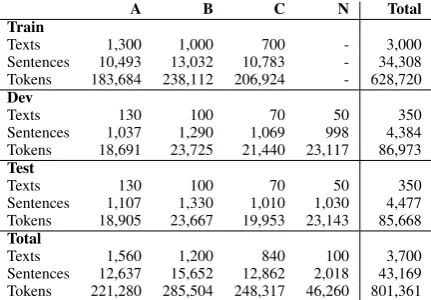
A B C N Total
Train
Texts 1,300 1,000 700 - 3,000 Sentences 10,493 13,032 10,783 - 34,308 Tokens 183,684 238,112 206,924 - 628,720 Dev
Texts 130 100 70 50 350
Sentences 1,037 1,290 1,069 998 4,384 Tokens 18,691 23,725 21,440 23,117 86,973 Test
Texts 130 100 70 50 350
Sentences 1,107 1,330 1,010 1,030 4,477 Tokens 18,905 23,667 19,953 23,143 85,668 Total
Texts 1,560 1,200 840 100 3,700 Sentences 12,637 15,652 12,862 2,018 43,169 Tokens 221,280 285,504 248,317 46,260 801,361
Table 2: W&I (A, B, C) and LOCNESS (N) corpus statistics.
3 Data
This shared task introduces new annotated datasets: the Cambridge English Write & Improve (W&I) and LOCNESS corpus.
3.1 Cambridge English Write & Improve
Write & Improve3 is an online web platform that
assists non-native English students with their
writ-ing (Yannakoudakis et al.,2018). Specifically,
stu-dents from around the world submit letters, stories, articles and essays in response to various prompts, and the W&I system provides automated feed-back. Since 2014, W&I annotators have manually annotated some of these submissions with
correc-tions and CEFR ability levels (Little,2006).
3.1.1 Corpus Compilation
Although users can submit any kind of text to the Write & Improve system, texts are first filtered before they are sent to the annotators to remove, for example, essay fragments, technical essays, copied website text, and non-English text. Al-though different versions of the same essays may be annotated to build up an annotated essay revi-sion history, we only selected final revirevi-sions for inclusion in the W&I corpus.
We also ignored essays that met at least one of the following conditions:
• The text contained fewer than 33 words.
• More than 1.5% of all characters in the text
were non-ASCII.
• More than 60% of all non-empty lines were
both shorter than 150 characters and did not end with punctuation.
[image:2.595.309.525.62.212.2]The precise values of these conditions were tuned manually such that they prioritised ‘cleaner’ texts while maintaining a large enough pool at each CEFR level. The last condition was designed to filter out texts that had been formatted to fit within a certain page width and so contained
ex-plicit new lines; e.g. “This is a \n broken
sen-tence.” Such sentences were often tokenised in-correctly.
Since evaluation in GEC is typically carried out at the sentence level, we also wanted to make sure there was an even distribution of sentences at each CEFR level. We thus split the data on this basis, taking into account the fact that beginner essays tend to be shorter than more advanced essays. As CEFR levels are originally assigned at the essay level, sentence level CEFR labels are an approx-imation, and it is possible that the same sentence might receive a different label in a different text.
We ultimately selected 3,600 annotated sub-missions from W&I, which we distributed across
training, development and test sets as shown in
Ta-ble 2. We additionally annotated the test set a total
of 5 times to better account for alternative
correc-tions (cf.Bryant and Ng,2015).
3.2 LOCNESS
Since most GEC research has traditionally focused on non-native errors, we also wanted to incorpo-rate some native errors into the shared task. To do this, we used the LOCNESS corpus, a collec-tion of approximately 400 essays written by native British and American undergraduates on various
topics (Granger,1998).4
Since these essays were typically much longer than the texts submitted to Write & Improve, we first filtered them to remove essays longer
than 550 words. We also removed essays that
contained transcription issue XML tags, such as
<quotation>and<illegible>.
There are not enough essays to create an anno-tated LOCNESS training set, so we extracted a de-velopment and test set which was annotated by the W&I annotators. Like the W&I corpus, we also controlled the amount of native data in each set in terms of sentences to ensure a roughly even dis-tribution at all levels. The test split was again an-notated a total of 5 times to match the W&I test
4https://uclouvain.be/en/
research-institutes/ilc/cecl/locness. html
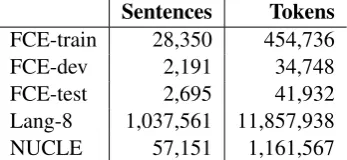
Sentences Tokens
FCE-train 28,350 454,736
FCE-dev 2,191 34,748
FCE-test 2,695 41,932
Lang-8 1,037,561 11,857,938
[image:3.595.330.504.63.143.2]NUCLE 57,151 1,161,567
Table 3: FCE, Lang-8 and NUCLE corpus statistics.
set. The statistics of this dataset are also shown in
Table 2.
3.3 Other Corpora
We allow the use of several existing learner cor-pora in the Restricted track of the shared task. Since these corpora were previously only available in different formats, we make new standardised
versions available with the shared task (Table 3).
FCE The First Certificate in English (FCE)
cor-pus is a subset of the Cambridge Learner Corpus (CLC) that contains 1,244
writ-ten answers to FCE exam questions (
Yan-nakoudakis et al.,2011).
Lang-8 Corpus of Learner English Lang-8 is an online language learning website which encourages users to correct each other’s
grammar. The Lang-8 Corpus of Learner
English is a somewhat-clean, English subset
of this website (Mizumoto et al.,2012;Tajiri
et al., 2012). It is distinct from the raw,
multilingual Lang-8 Learner Corpus.
NUCLE The National University of Singapore Corpus of Learner English (NUCLE) consists of 1,400 essays written by mainly Asian un-dergraduate students at the National
Univer-sity of Singapore (Dahlmeier et al.,2013). It
is the official training corpus for the CoNLL-2013 and CoNLL-2014 shared tasks.
3.4 Corpus Standardisation
Since FCE and NUCLE were annotated accord-ing to different error type frameworks and Lang-8 and W&I+LOCNESS were not annotated with error types at all, we re-annotated all corpora
au-tomatically using ERRANT (Bryant et al.,2017).
Specifically, we:
2. Used ERRANT to automatically classify the human edits in parallel FCE, NUCLE and W&I+LOCNESS sentences.
3. Used ERRANT to automatically extract and classify the edits in parallel Lang-8 sen-tences.
Note that as Lang-8 is not annotated with ex-plicit edits, it only consists of parallel sentence pairs. We consequently used ERRANT to align the sentences and extract the edits automatically. While we could have also done the same for the other corpora, we instead chose to preserve and
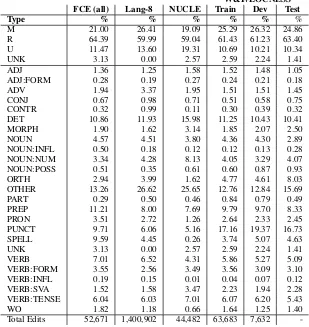
re-classify the existing human edits. Table 4thus
shows the ERRANT error type distributions for all these corpora, and makes them comparable for the first time.
In terms of edit operations, all corpora are fairly consistent with respect to the distribution of Miss-ing (M) Replacement (R) and Unnecessary (U) word edits. Replacement edits are by far the most frequent category and account for roughly 60-65% of all edits in all datasets. Missing word edits ac-count for roughly 20-25% of remaining edits, al-though this figure is noticeably lower in FCE and NUCLE. Unnecessary word edits account for 10-15% of all edits, although this figure rises to al-most 20% in NUCLE. One possible explanation for this is that the NUCLE corpus also has more determiner (DET) errors, which are known to be problematic for Asian learners. Each corpus also contains roughly 2-3% of Unknown (UNK) edits that annotators identified but were unable to cor-rect. UNK edits do not exist in Lang-8 because it was never annotated with edit spans.
NUCLE contains more than twice the propor-tion of noun number (NOUN:NUM) errors com-pared to the other corpora. This is possibly be-cause noun number was one of the five error types targeted in the CoNLL-2013 shared task. Annota-tor focus might also account for the slightly higher proportion of determiner and subject-verb agree-ment (SVA) errors, which were also among the five targeted error types.
There is a significant difference in the propor-tion of punctuapropor-tion (PUNCT) errors across cor-pora. Punctuation errors account for just 5% of all errors in NUCLE, but almost 20% in W&I. This is possibly because W&I contains data from a much wider range of learners than the other corpora. A similar pattern is observed with other (OTHER) errors, which account for over 25% of all errors
S This are a sentence .
A 1 2|||R:VERB:SVA|||is|||-REQUIRED-|||NONE|||0 A 3 3|||M:ADJ|||good|||-REQUIRED-|||NONE|||0 A 1 2|||R:VERB:SVA|||is|||-REQUIRED-|||NONE|||1 A -1 -1|||noop|||-NONE-|||REQUIRED|||-NONE-|||2
Figure 1: Example M2 format with multiple annota-tors.
in NUCLE and Lang-8, but roughly 13% of all er-rors in the FCE and W&I+LOCNESS. We surmise this is because edits are longer and noisier in the
first two corpora (cf.Felice et al.,2016) and so do
not fit into a more discriminative ERRANT error category.
3.5 Data Formats
All the above corpora are released in M2 for-mat, the standard format for annotated GEC files
since the CoNLL-2013 shared task. The FCE
and W&I+LOCNESS corpora are additionally leased in an untokenised JSON format in case re-searchers want to inspect the raw data.
In M2 format (Figure 1), a line preceded byS
denotes an original sentence while a line preceded
by Aindicates an edit annotation. Each edit line
consists of the start and end token offsets of the edit, the error type, the tokenised correction string, a flag indicating whether the edit is required or op-tional, a comment field, and a unique annotator ID. The penultimate two fields are rarely used in prac-tice however.
A ‘noop’ edit explicitly indicates when an anno-tator/system made no changes to the original sen-tence. If there is only one annotator, noop edits are optional, otherwise a noop edit should be included whenever at least 1 out of n annotators considered the original sentence to be correct. This is some-thing to be aware of when combining individual M2 files, as missing noops can affect results.
Figure 1can thus be interpreted as follows:
• Annotator 0 changed “are” to “is” and
in-serted “good” before “sentence” to produce the correction: “This is a good sentence .”
• Annotator 1 changed “are” to “is” to produce
the correction: “This is a sentence .”
• Annotator 2 thought the original was correct
W&I+LOCNESS
FCE (all) Lang-8 NUCLE Train Dev Test
Type % % % % % %
M 21.00 26.41 19.09 25.29 26.32 24.86 R 64.39 59.99 59.04 61.43 61.23 63.40 U 11.47 13.60 19.31 10.69 10.21 10.34 UNK 3.13 0.00 2.57 2.59 2.24 1.41 ADJ 1.36 1.25 1.58 1.52 1.48 1.05 ADJ:FORM 0.28 0.19 0.27 0.24 0.21 0.18 ADV 1.94 3.37 1.95 1.51 1.51 1.45 CONJ 0.67 0.98 0.71 0.51 0.58 0.75 CONTR 0.32 0.99 0.11 0.30 0.39 0.32 DET 10.86 11.93 15.98 11.25 10.43 10.41 MORPH 1.90 1.62 3.14 1.85 2.07 2.50 NOUN 4.57 4.51 3.80 4.36 4.30 2.89 NOUN:INFL 0.50 0.18 0.12 0.12 0.13 0.28 NOUN:NUM 3.34 4.28 8.13 4.05 3.29 4.07 NOUN:POSS 0.51 0.35 0.61 0.60 0.87 0.93 ORTH 2.94 3.99 1.62 4.77 4.61 8.03 OTHER 13.26 26.62 25.65 12.76 12.84 15.69 PART 0.29 0.50 0.46 0.84 0.79 0.49 PREP 11.21 8.00 7.69 9.79 9.70 8.33 PRON 3.51 2.72 1.26 2.64 2.33 2.45 PUNCT 9.71 6.06 5.16 17.16 19.37 16.73 SPELL 9.59 4.45 0.26 3.74 5.07 4.63 UNK 3.13 0.00 2.57 2.59 2.24 1.41 VERB 7.01 6.52 4.31 5.86 5.27 5.09 VERB:FORM 3.55 2.56 3.49 3.56 3.09 3.10 VERB:INFL 0.19 0.15 0.01 0.04 0.07 0.12 VERB:SVA 1.52 1.58 3.47 2.23 1.94 2.28 VERB:TENSE 6.04 6.03 7.01 6.07 6.20 5.43 WO 1.82 1.18 0.66 1.64 1.25 1.40 Total Edits 52,671 1,400,902 44,482 63,683 7,632
-Table 4: The ERRANT error type distributions of the FCE, Lang-8, NUCLE and W&I+LOCNESS corpora. See
Bryant et al.(2017) for more information about each error type. The distribution of the W&I+LOCNESS test data is averaged across all 5 annotators.
4 Tracks
As parallel training data is now more readily avail-able, a new feature of the BEA-2019 shared task is the introduction of three tracks: Restricted,
Un-restricted and Low Resource. Each track
con-trols the amount of annotated data that is
avail-able to participants. We place no restriction on
the amount of unannotated data (e.g. for
lan-guage modelling) or NLP tools (e.g. POS tag-gers, parsers, spellcheckers, etc.), provided the re-sources are publicly available.
4.1 Restricted Track
The Restricted Track is most similar to the pre-vious shared tasks in that participants are limited to using only the official datasets as annotated training data (i.e. the FCE, Lang-8, NUCLE and W&I+LOCNESS). Since we do not limit unanno-tated data however, system submissions are still not entirely comparable given that they might use, for example, different amounts of monolingual or artificially-generated data.
4.2 Unrestricted Track
The Unrestricted Track is the same as the Re-stricted Track except participants may use any and all datasets and resources to build systems, includ-ing proprietary datasets and software. The main aim of this track is to determine how much better a system can do if it has access to potentially much larger amounts of data and/or resources.
4.3 Low Resource Track
The Low Resource Track is the same as the Restricted Track, except participants are only allowed to use the W&I+LOCNESS development
set as annotated learner data. Since current
[image:5.595.144.453.68.395.2]5 Evaluation
Systems are evaluated on the W&I+LOCNESS
test set using the ERRANT scorer (Bryant et al.,
2017), an improved version of the MaxMatch
scorer (Dahlmeier and Ng, 2012) that was
pre-viously used in the CoNLL shared tasks. As in the previous shared tasks, this means that sys-tem performance is primarily measured in terms of
span-based correction using the F0.5metric, which
weights precision twice as much as recall.
In span-based correction, a system is only re-warded if a system edit exactly matches a refer-ence edit in terms of both its token offsets and cor-rection string. If more than one set of reference edits are available (there were 2 in CoNLL-2014 and 5 in BEA-2019), ERRANT chooses the
refer-ence that maximises the global F0.5 score, or else
maximises true positives and minimises false pos-itives and false negatives. ERRANT is also able to report performance in terms of span-based
detec-tion and token-based detecdetec-tion (Table 5).
Although the W&I+LOCNESS training and de-velopment sets are released as separate files for each CEFR level, the test set texts are combined and shuffled such that the sentence order in each essay is preserved, but the order of the CEFR levels is random. This is done because systems should not expect to know the CEFR level of an in-put text in advance and should hence be prepared
to handle all levels and abilities. In Section 7,
we nevertheless also report system performance in terms of different CEFR and native levels, as well as in terms of detection and error types.
5.1 Metric Justification
Since robust evaluation is still a hot topic in GEC
(cf. Asano et al., 2017; Choshen and Abend,
2018), we also wanted to provide some additional
evidence that ERRANT F0.5is as reliable as
Max-Match F0.5 and other popular metrics (Felice and
Briscoe, 2015;Napoles et al., 2015). We
evalu-ated ERRANT in relation to human judgements on the CoNLL-2014 test set using the same setup
as Chollampatt and Ng(2018b), and found
sim-ilar correlation coefficients (Table 6). Although
this table shows that no metric is superior in all settings, the main advantage of ERRANT is that it can also provide much more detailed feedback than the alternatives; e.g. in terms of error types. We hope that researchers can make use of this in-formation to build better systems.
6 Participants and Approaches
A total of 24 different teams took part in the BEA-2019 shared task across all 3 tracks. Of these, 21 submitted to the Restricted Track, 7 submitted to the Unrestricted Track, and 9 submitted to the Low Resource Track. This also meant 7 teams submit-ted to 2 separate tracks while 3 teams submitsubmit-ted to all 3 tracks.
Only 14 teams submitted system description pa-pers however, with a further 4 sending short de-scriptions by email. The full list of teams, their approaches, and the data and resources they used
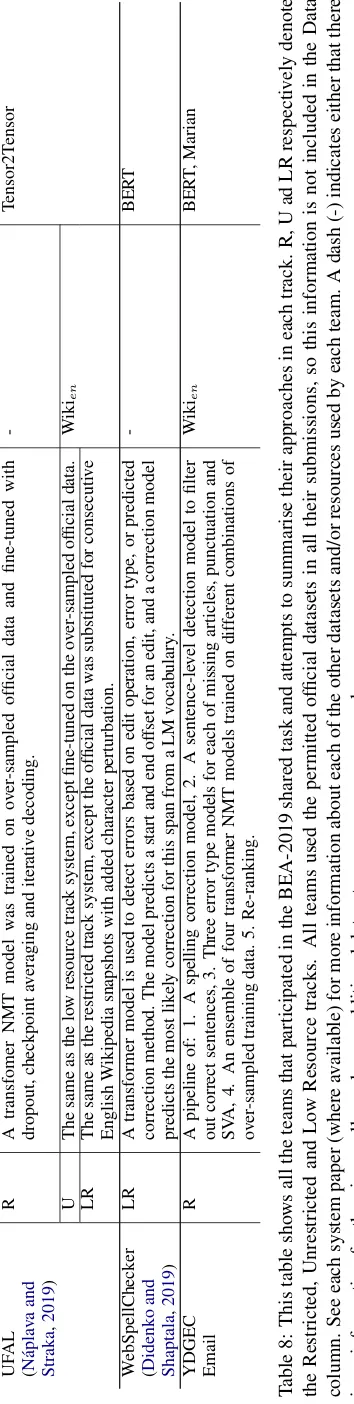
in each track are shown inTable 8(Appendix A.1).
We refer the reader to the system description pa-pers (where available) for more detailed informa-tion. Additionally: i) although Buffalo submitted to all 3 tracks, their paper does not describe their Low Resource system, ii) LAIX submitted exactly the same system to both the Restricted and Unre-stricted Track, and iii) TMU submitted 2 separate papers about their respective Restricted and Low Resource Track systems.
While past GEC systems have employed differ-ent approaches, e.g. rules, classifiers, and statis-tical machine translation (SMT), in contrast, ap-proximately two-thirds of all teams in the
BEA-2019 shared task5 used transformer-based neural
machine translation (NMT) (Vaswani et al.,2017),
while the remainder used convolutional neural net-works (CNN), or both. Although they were most
likely inspired byJunczys-Dowmunt et al.(2018)
andChollampatt and Ng(2018a), who previously
reported state-of-the-art results on the CoNLL-2014 test set, the main consequence of this is that systems could only be differentiated based on lower-level system properties, such as:
• How much artificial data was used, if any, and
how it was generated.
• How much over-sampled data was used, if
any, and in what proportion.
• How many models were combined or
ensem-bled.
• Whether system output was re-ranked.
• Whether the system contained an error
detec-tion component.
Original I often look at TV Span-based Span-based Token-based Reference [2, 4, watch] Correction Detection Detection Hypothesis 1 [2, 4, watch] Match Match Match
Hypothesis 2 [2, 4, see] No match Match Match
Hypothesis 3 [2, 3, watch] No match No match Match
Table 5: Different types of evaluation in ERRANT.
Corpus Sentence
Metric Pearson r Spearmanρ Kendallτ
ERRANT 0.64 0.626 0.623
M2 0.623 0.687 0.617
GLEU 0.691 0.407 0.567
[image:7.595.115.482.63.132.2]I-measure -0.25 -0.385 0.564
Table 6: Correlation between various evaluation met-rics and human judgements.
For example, Shuyao, UEDIN-MS and
Kakao&Brain respectively trained their systems on 145 million, 100 million and 45 million artificial sentences, while CAMB-CUED instead concentrated on optimising the ratio of official to artificial sentences. TMU meanwhile focused entirely on re-ranking in their Restricted Track system, and AIP-Tohoku, CAMB-CLED, Web-SpellChecker and YDGEC each incorporated sentence and/or token based detection compo-nents into their systems. Since most systems used different combinations of similar techniques, it is difficult to determine which were most successful. For example, several teams used artificial data, but they each generated it using different methods and corpora, so it is unclear which method performed best with respect to all the other uncontrolled system variables.
For the Low Resource track, many teams sub-mitted the same Restricted Track systems except
trained with the WikEd Corpus (Grundkiewicz
and Junczys-Dowmunt,2014) or other
Wikipedia-based revision data. Notable exceptions include CAMB-CUED, who used Finite State Transduc-ers (FST) to rank confusion sets with a language model; LAIX, who augmented their transformer NMT model with a series of 8 error-type specific classifiers; and TMU, who mapped ‘cross-lingual’ word embeddings to the same space to induce a phrase table for a SMT system. These systems hence represent promising alternatives in a heav-ily transformer NMT dominated shared task.
7 Results
All system output submitted to Codalab during the test phase was automatically annotated with ER-RANT and compared against the gold standard references. Although this meant there was a mis-match between the automatically annotated hy-potheses and the human annotated gold references, we deliberately chose this setting to remain faith-ful to the gold-standard training data and previous
shared tasks. SeeAppendix A.7for more on
com-paring gold and automatic references.
We also set a limit of a maximum of 2 submis-sions during the test phase to prevent teams from optimising on the test set. The best results, in
terms of span-based correction ERRANT F0.5, are
used for the official BEA-2019 shared task results,
and all scores are presented inTable 7.
7.1 Restricted Track - Overall
Since many teams used very similar approaches, it may be unsurprising that many of the Restricted Track scores were very similar. For example, the
F0.5 difference between the teams that ranked 3-5
was 0.17%, and the precision difference between the teams that ranked 4-6 was 0.47%. We thus carried out significance tests between all teams
in each track using the bootstrap method (Efron
and Tibshirani,1993) based on F0.5 (1,000
itera-tions, p > .05), and grouped systems that were
not significantly different. The resulting groups showed that, for example, there was no signifi-cant difference between the top 2 teams and that the top 11 teams fit into 4 statistically significant groups. Groups were defined such that all teams in each group were statistically similar. This means, for example, that although ML@IITB was simi-lar to YDGEC, it was different from Shuyao and the other teams in Group 2, and so was placed in Group 3 instead.
distri-Restricted
Group Rank Teams TP FP FN P R F0.5
1 12 UEDIN-MSKakao&Brain 31272709 1199894 20742510 72.2875.19 51.9160.12 69.4769.00
2
3 LAIX 2618 960 2671 73.17 49.50 66.78 4 CAMB-CLED 2924 1224 2386 70.49 55.07 66.75 5 Shuyao 2926 1244 2357 70.17 55.39 66.61 6 YDGEC 2815 1205 2487 70.02 53.09 65.83
3 78 ML@IITBCAMB-CUED 36782929 19201459 23402502 65.7066.75 53.9361.12 64.7363.72
4
9 AIP-Tohoku 1972 902 2705 68.62 42.16 60.97 10 UFAL 1941 942 2867 67.33 40.37 59.39 11 CVTE-NLP 1739 811 2744 68.20 38.79 59.22 5 12 BLCU 2554 1646 2432 60.81 51.22 58.62 6 13 IBM 1819 1044 3047 63.53 37.38 55.74
7 1415 TMUqiuwenbo 27201428 2325854 25462968 53.9162.58 32.4851.65 53.4552.80
8
16 NLG-NTU 1833 1873 2939 49.46 38.41 46.77 17 CAI 2002 2168 2759 48.01 42.05 46.69 18 PKU 1401 1265 2955 52.55 32.16 46.64 9 19 SolomonLab 1760 2161 2678 44.89 39.66 43.73 10 20 Buffalo 604 350 3311 63.31 15.43 39.06 11 21 Ramaiah 829 7656 3516 9.77 19.08 10.83
Unrestricted
Group Rank Teams TP FP FN P R F0.5
1 12 LAIXAIP-Tohoku 26182589 1078960 26712484 73.1770.60 51.0349.50 66.7865.57 2 3 UFAL 2812 1313 2469 68.17 53.25 64.55 3 4 BLCU 3051 2007 2357 60.32 56.42 59.50 4 5 Aparecium 1585 1077 2787 59.54 36.25 52.76 5 6 Buffalo 699 374 3265 65.14 17.63 42.33 6 7 Ramaiah 1161 8062 3480 12.59 25.02 13.98
Low Resource
Group Rank Teams TP FP FN P R F0.5
1 1 UEDIN-MS 2312 982 2506 70.19 47.99 64.24
2 2 Kakao&Brain 2412 1413 2797 63.06 46.30 58.80
3 34 LAIXCAMB-CUED 14431814 1450884 31752956 62.0155.58 38.0331.25 51.8150.88 4 5 UFAL 1245 1222 2993 50.47 29.38 44.13
5 67 SiteimproveWebSpellChecker 12992363 16193719 31993031 44.5238.85 43.8128.88 40.1739.75 6 8 TMU 1638 4314 3486 27.52 31.97 28.31 7 9 Buffalo 446 1243 3556 26.41 11.14 20.73
Table 7: Official BEA-2019 results for all teams in all tracks using the main overall span-based correction ER-RANT F0.5. The highest values (lowest for False Positives and False Negatives) are shown in bold.
butions and confusion sets, and 2) re-ranked their system output. In contrast, Shuyao used a similar method to generate artificial data, but did not re-rank, while CAMB-CLED used back-translation to generate artificial data, but did re-rank. This suggests that confusion set approaches to artifi-cial data generation are more successful than back-translated approaches.
7.2 Unrestricted Track - Overall
Since participants were allowed to use any and all datasets in the Unrestricted Track, we expected scores to be higher, but the highest scoring team actually submitted exactly the same system to the
Unrestricted Track as they did to the Restricted Track. The top 2 teams in the Restricted Track could thus also have scored highest on this track if they did the same.
Of the remaining teams, AIP-Tohoku and UFAL increased their scores by approximately
5 F0.5 using non-public Lang-8 and parallel
Wikipedia data respectively, BLCU added a more
modest 1 F0.5 similarly using non-public
Lang-8 data, and Buffalo added roughly 3 F0.5 using
artificial data generated from a subsection of the
English Gigaword corpus (Graff and Cieri,2003).
[image:8.595.130.470.64.521.2]results help quantify the extent to which perfor-mance can be improved by simply adding more data.
7.3 Low Resource Track - Overall
The teams that came top of the Restricted Track also dominated in the Low Resource Track. The UEDIN-MS system even outperformed 14 of the Restricted Track submissions despite the limited training data. This is most likely because UEDIN-MS and Kakao&Brain both made effective use of artificial data.
The CAMB-CUED system also achieved a fairly competitive score despite not using any par-allel training data. This contrasts with LAIX, who
scored higher by 1 F0.5 using a complicated
sys-tem of classifiers, CNNs and transformer NMT
models. The TMU system is also notable for
applying techniques from unsupervised SMT to
GEC for the first time (cf. Artetxe et al., 2018).
Although it performed poorly overall, it took several years to adapt supervised SMT to GEC
(Junczys-Dowmunt and Grundkiewicz, 2016), so
we hope researchers will continue to explore un-supervised SMT in future work.
8 Conclusion
It is undeniable that significant progress has been made since the last shared task on grammati-cal error correction five years ago. Transformer based neural machine translation proved effective, and teams generally scored significantly higher in BEA-2019 than in the previous CoNLL-2014 shared task. This is significant because we also introduced a new corpus, the Cambridge English Write & Improve + LOCNESS corpus, which con-tains a much wider range of texts at different abil-ity levels than previous corpora, yet systems still generalised well to this much more diverse dataset. Overall, the most successful systems were
sub-mitted by UEDIN-MS (Grundkiewicz et al.,2019)
and Kakao&Brain (Choe et al., 2019) who
re-spectively ranked first and second in both the Re-stricted and Low Resource Tracks. UEDIN-MS
additionally scored just 5 F0.5 lower in the Low
Resource Track (64.24) than the Restricted Track (69.47), which shows that it is possible to build a competitive GEC system without large quantities of human annotated training data.
Finally, we note that the appendix contains a much more fine-grained analysis of system
perfor-mance in terms of CEFR levels, edit operations, error types, single vs. multi token errors, detec-tion vs. correcdetec-tion, and a comparison with other metrics. Some key findings include:
• There was a clear indication that different
systems performed better at different CEFR levels.
• All systems still struggle most with content
word errors.
• Systems are significantly better at correcting
multi token errors than they were 5 years ago.
• The GLEU metric (Napoles et al., 2015)
strongly correlates with recall and seems to be less discriminative than other metrics.
We ultimately hope that the results and cor-pus statistics we report will serve as useful bench-marks and guidance for future work.
Acknowledgements
We are extremely grateful to Diane Nicholls and her team of annotators for annotating the entire
W&I+LOCNESS corpus. Our work was
sup-ported by Cambridge Assessment, University of Cambridge.
References
Mikel Artetxe, Gorka Labaka, and Eneko Agirre. 2018. Unsupervised statistical machine
transla-tion. In Proceedings of the 2018 Conference on
Empirical Methods in Natural Language Process-ing, pages 3632–3642, Brussels, Belgium. Associ-ation for ComputAssoci-ational Linguistics.
Hiroki Asano, Tomoya Mizumoto, and Kentaro Inui. 2017. Reference-based metrics can be replaced with reference-less metrics in evaluating grammat-ical error correction systems. In Proceedings of the Eighth International Joint Conference on
Natu-ral Language Processing (Volume 2: Short Papers),
pages 343–348. Asian Federation of Natural Lan-guage Processing.
Hiroki Asano, Tomoya Mizumoto, and Masato Mita. 2019. The AIP-Tohoku System at the BEA-2019 Shared Task. In Proceedings of the 14th Work-shop on Innovative Use of NLP for Building
Educa-tional Applications. Association for Computational
Linguistics.
for Computational Linguistics (Volume 1: Long
Pa-pers), pages 793–805, Vancouver, Canada.
Associa-tion for ComputaAssocia-tional Linguistics.
Christopher Bryant and Hwee Tou Ng. 2015. How far are we from fully automatic high quality grammati-cal error correction? InProceedings of the 53rd An-nual Meeting of the Association for Computational Linguistics and the 7th International Joint Confer-ence on Natural Language Processing (Volume 1:
Long Papers), pages 697–707, Beijing, China.
As-sociation for Computational Linguistics.
Yo Joong Choe, Jiyeon Ham, Kyubyong Park, and Yeoil Yoon. 2019. A Neural Grammatical Error Correction System Built On Better Pre-training and Sequential Transfer Learning. InProceedings of the 14th Workshop on Innovative Use of NLP for
Build-ing Educational Applications. Association for
Com-putational Linguistics.
Shamil Chollampatt and Hwee Tou Ng. 2018a. A Mul-tilayer Convolutional Encoder-Decoder Neural Net-work for Grammatical Error Correction. In Pro-ceedings of the Thirty-Second AAAI Conference on
Artificial Intelligence.
Shamil Chollampatt and Hwee Tou Ng. 2018b. A reassessment of reference-based grammatical error correction metrics. InProceedings of the 27th In-ternational Conference on Computational Linguis-tics, pages 2730–2741. Association for Computa-tional Linguistics.
Leshem Choshen and Omri Abend. 2018. Inherent bi-ases in reference-based evaluation for grammatical error correction. InProceedings of the 56th Annual Meeting of the Association for Computational
Lin-guistics (Volume 1: Long Papers), pages 632–642.
Association for Computational Linguistics.
Daniel Dahlmeier and Hwee Tou Ng. 2012. Better evaluation for grammatical error correction. In Pro-ceedings of the 2012 Conference of the North Amer-ican Chapter of the Association for Computational
Linguistics: Human Language Technologies, pages
568–572. Association for Computational Linguis-tics.
Daniel Dahlmeier, Hwee Tou Ng, and Siew Mei Wu. 2013. Building a large annotated corpus of learner English: The NUS corpus of learner english. In
Proceedings of the Eighth Workshop on Innova-tive Use of NLP for Building Educational
Applica-tions, pages 22–31, Atlanta, Georgia. Association
for Computational Linguistics.
Robert Dale, Ilya Anisimoff, and George Narroway. 2012. HOO 2012: A Report on the Preposition and Determiner Error Correction Shared Task. In Pro-ceedings of the Seventh Workshop on Building
Edu-cational Applications Using NLP, pages 54–62.
As-sociation for Computational Linguistics.
Robert Dale and Adam Kilgarriff. 2011. Helping Our Own: The HOO 2011 Pilot Shared Task. In Pro-ceedings of the 13th European Workshop on Natural
Language Generation, pages 242–249. Association
for Computational Linguistics.
Bohdan Didenko and Julia Shaptala. 2019. Multi-headed Architecture Based on BERT for Grammar Error Correction. InProceedings of the 14th Work-shop on Innovative Use of NLP for Building
Educa-tional Applications. Association for Computational
Linguistics.
B. Efron and R.J. Tibshirani. 1993. An Introduction to
the Bootstrap. Chapman & Hall, New York.
Mariano Felice and Ted Briscoe. 2015. Towards a stan-dard evaluation method for grammatical error detec-tion and correcdetec-tion. InProceedings of the 2015 Con-ference of the North American Chapter of the Asso-ciation for Computational Linguistics: Human
Lan-guage Technologies, pages 578–587. Association for
Computational Linguistics.
Mariano Felice, Christopher Bryant, and Ted Briscoe. 2016.Automatic extraction of learner errors in ESL sentences using linguistically enhanced alignments.
In Proceedings of COLING 2016, the 26th
Inter-national Conference on Computational Linguistics:
Technical Papers, pages 825–835, Osaka, Japan.
The COLING 2016 Organizing Committee.
Tao Ge, Furu Wei, and Ming Zhou. 2018. Fluency boost learning and inference for neural grammati-cal error correction. InProceedings of the 56th An-nual Meeting of the Association for Computational
Linguistics (Volume 1: Long Papers), pages 1055–
1065, Melbourne, Australia. Association for Com-putational Linguistics.
David Graff and Christopher Cieri. 2003. English gi-gaword ldc2003t05.
Sylviane Granger. 1998. The computer learner corpus: A versatile new source of data for SLA research. In Sylviane Granger, editor,Learner English on
Com-puter, pages 3–18. Addison Wesley Longman,
Lon-don and New York.
Roman Grundkiewicz and Marcin Junczys-Dowmunt. 2014. The wiked error corpus: A corpus of correc-tive wikipedia edits and its application to grammat-ical error correction. In Advances in Natural
Lan-guage Processing, pages 478–490, Cham. Springer
International Publishing.
Roman Grundkiewicz and Marcin Junczys-Dowmunt. 2018. Near human-level performance in grammati-cal error correction with hybrid machine translation.
InProceedings of the 2018 Conference of the North
American Chapter of the Association for Compu-tational Linguistics: Human Language
Technolo-gies, Volume 2 (Short Papers), pages 284–290, New
Roman Grundkiewicz, Marcin Junczys-Dowmunt, and Kenneth Heafield. 2019. Neural Grammatical Error Correction Systems with Unsupervised Pre-training on Synthetic Data. InProceedings of the 14th Work-shop on Innovative Use of NLP for Building
Educa-tional Applications. Association for Computational
Linguistics.
Marcin Junczys-Dowmunt and Roman Grundkiewicz. 2016. Phrase-based machine translation is state-of-the-art for automatic grammatical error correction.
In Proceedings of the 2016 Conference on
Empiri-cal Methods in Natural Language Processing, pages
1546–1556, Austin, Texas. Association for Compu-tational Linguistics.
Marcin Junczys-Dowmunt, Roman Grundkiewicz, Shubha Guha, and Kenneth Heafield. 2018. Ap-proaching neural grammatical error correction as a low-resource machine translation task. In Proceed-ings of the 2018 Conference of the North Ameri-can Chapter of the Association for Computational Linguistics: Human Language Technologies,
Vol-ume 1 (Long Papers), pages 595–606, New Orleans,
Louisiana. Association for Computational Linguis-tics.
Masahiro Kaneko, Kengo Hotate, Satoru Katsumata, and Mamoru Komachi. 2019. TMU Transformer System Using BERT for Re-ranking at BEA 2019 Grammatical Error Correction on Restricted Track.
InProceedings of the 14th Workshop on Innovative
Use of NLP for Building Educational Applications.
Association for Computational Linguistics.
Yoav Kantor, Yoav Katz, Leshem Choshen, Edo Cohen-Karlik, Naftali Liberman, Assaf Toledo, Amir Menczel, and Noam Slonim. 2019. Learning to combine Grammatical Error Corrections. In Pro-ceedings of the 14th Workshop on Innovative Use of
NLP for Building Educational Applications.
Associ-ation for ComputAssoci-ational Linguistics.
Satoru Katsumata and Mamoru Komachi. 2019. (Al-most) Unsupervised Grammatical Error Correction using a Synthetic Comparable Corpus. In Proceed-ings of the 14th Workshop on Innovative Use of NLP
for Building Educational Applications. Association
for Computational Linguistics.
Oph´elie Lacroix, Simon Flachs, and Anders Søgaard. 2019. Noisy Channel for Low Resource Grammat-ical Error Correction. In Proceedings of the 14th Workshop on Innovative Use of NLP for Building
Educational Applications. Association for
Compu-tational Linguistics.
Ruobing Li, Chuan Wang, Yefei Zha, Yonghong Yu, Shiman Guo, Qiang Wang, Yang Liu, and Hui Lin. 2019. The LAIX Systems in the BEA-2019 GEC Shared Task. In Proceedings of the 14th Work-shop on Innovative Use of NLP for Building
Educa-tional Applications. Association for Computational
Linguistics.
Jared Lichtarge, Christopher Alberti, Shankar Kumar, Noam Shazeer, and Niki Parmar. 2018. Weakly su-pervised grammatical error correction using iterative decoding.CoRR, abs/1811.01710.
David Little. 2006. The common european frame-work of reference for languages: Content, purpose, origin, reception and impact. Language Teaching, 39(3):167190.
Tomoya Mizumoto, Yuta Hayashibe, Mamoru Ko-machi, Masaaki Nagata, and Yuji Matsumoto. 2012.
The effect of learner corpus size in grammatical er-ror correction of ESL writings. InProceedings of
COLING 2012: Posters, pages 863–872. The
COL-ING 2012 Organizing Committee.
Jakub N´aplava and Milan Straka. 2019. CUNI Sys-tem for the Building Educational Applications 2019 Shared Task: Grammatical Error Correction. In Pro-ceedings of the 14th Workshop on Innovative Use of
NLP for Building Educational Applications.
Associ-ation for ComputAssoci-ational Linguistics.
Courtney Napoles, Keisuke Sakaguchi, Matt Post, and Joel Tetreault. 2015. Ground truth for grammati-cal error correction metrics. InProceedings of the 53rd Annual Meeting of the Association for Compu-tational Linguistics and the 7th International Joint Conference on Natural Language Processing
(Vol-ume 2: Short Papers), pages 588–593. Association
for Computational Linguistics.
Hwee Tou Ng, Siew Mei Wu, Ted Briscoe, Christian Hadiwinoto, Raymond Hendy Susanto, and Christo-pher Bryant. 2014. The CoNLL-2014 Shared Task on Grammatical Error Correction. InProceedings of the Eighteenth Conference on Computational
Natu-ral Language Learning: Shared Task, pages 1–14.
Association for Computational Linguistics.
Hwee Tou Ng, Siew Mei Wu, Yuanbin Wu, Christian Hadiwinoto, and Joel Tetreault. 2013. The CoNLL-2013 Shared Task on Grammatical Error Correction.
In Proceedings of the Seventeenth Conference on
Computational Natural Language Learning: Shared Task, pages 1–12. Association for Computational Linguistics.
Mengyang Qiu, Xuejiao Chen, Maggie Liu, Krishna Parvathala, Apurva Patil, and Jungyeul Park. 2019. Improving Precision of Grammatical Error Correc-tion with Cheat Sheet. InProceedings of the 14th Workshop on Innovative Use of NLP for Building
Educational Applications. Association for
Compu-tational Linguistics.
Keisuke Sakaguchi, Courtney Napoles, Matt Post, and Joel Tetreault. 2016. Reassessing the goals of matical error correction: Fluency instead of gram-maticality.Transactions of the Association for
Com-putational Linguistics, 4:169–182.
with neural reinforcement learning. InProceedings of the Eighth International Joint Conference on
Natural Language Processing (Volume 2: Short
Papers), pages 366–372, Taipei, Taiwan. Asian
Federation of Natural Language Processing.
Felix Stahlberg and Bill Byrne. 2019. The CUED’s Grammatical Error Correction Systems for BEA-2019. InProceedings of the 14th Workshop on Inno-vative Use of NLP for Building Educational
Appli-cations. Association for Computational Linguistics.
Toshikazu Tajiri, Mamoru Komachi, and Yuji Mat-sumoto. 2012. Tense and aspect error correction for ESL learners using global context. In Proceed-ings of the 50th Annual Meeting of the Associa-tion for ComputaAssocia-tional Linguistics (Volume 2: Short
Papers), pages 198–202. Association for
Computa-tional Linguistics.
Ashish Vaswani, Noam Shazeer, Niki Parmar, Jakob Uszkoreit, Llion Jones, Aidan N Gomez, Ł ukasz Kaiser, and Illia Polosukhin. 2017. Attention is all you need. In I. Guyon, U. V. Luxburg, S. Bengio, H. Wallach, R. Fergus, S. Vishwanathan, and R. Gar-nett, editors, Advances in Neural Information
Pro-cessing Systems 30, pages 5998–6008. Curran
As-sociates, Inc.
Felix Wu, Angela Fan, Alexei Baevski, Yann Dauphin, and Michael Auli. 2019. Pay less attention with lightweight and dynamic convolutions. In
Interna-tional Conference on Learning Representations.
Shuyao Xu, Jiehao Zhang, Jin Chen, and Long Qin. 2019. Singsound System for GEC-2019. In Pro-ceedings of the 14th Workshop on Innovative Use of
NLP for Building Educational Applications.
Associ-ation for ComputAssoci-ational Linguistics.
Liner Yang and Chencheng Wang. 2019. The BLCU System in the BEA 2019 Shared Task. In Proceed-ings of the 14th Workshop on Innovative Use of NLP
for Building Educational Applications. Association
for Computational Linguistics.
Helen Yannakoudakis, Øistein E. Andersen, Ardeshir Geranpayeh, Ted Briscoe, and Diane Nicholls. 2018. Developing an automated writing placement system for esl learners.Applied Measurement in Education, 31(3):251–267.
Helen Yannakoudakis, Ted Briscoe, and Ben Medlock. 2011. A new dataset and method for automatically grading ESOL texts. InProceedings of the 49th An-nual Meeting of the Association for Computational
Linguistics: Human Language Technologies, pages
180–189, Portland, Oregon, USA. Association for Computational Linguistics.
Helen Yannakoudakis, Marek Rei, Øistein E. Ander-sen, and Zheng Yuan. 2017. Neural sequence-labelling models for grammatical error correction.
In Proceedings of the 2017 Conference on
Empiri-cal Methods in Natural Language Processing, pages
2795–2806, Copenhagen, Denmark. Association for Computational Linguistics.
Zheng Yuan, Felix Stahlberg, Marek Rei, Bill Byrne, and Helen Yannakoudakis. 2019. Neural and FST-based approaches to grammatical error correction.
InProceedings of the 14th Workshop on Innovative
Use of NLP for Building Educational Applications.
Association for Computational Linguistics.
A A ppendix A.1 P articipants and A ppr oaches T eam T rack A ppr oach Data Resour ces AIP-T ohoku ( Asano et al. , 2019 ) R Multi-task learning w as used to predict the CEFR le v el of a sentence and whether it contained an y errors. Flagged sentences were then corrected by a transformer NMT model trained on of ficial and back-translated data. Artificial data, ASAP , ICLE, ICN ALE, T OEFL11, Simple W iki en BER T , F airseq U The same as abo v e, except the of ficial data w as augmented with EFCAMD A T and Lang-8 pr iv . EFCAMD A T , Lang-8 pr iv Aparecium U
-BLCU (Yang
and W ang , 2019 ) R Spelling errors were corrected by a conte xt sensiti v e spellcheck er and the output w as pipelined to an ensemble of eight transformer NMT systems. The NMT systems were trained on ar -tificial data and fine-tuned on of ficial data. The artificial data w as generated by uniformly inserting/replacing/deleting 30% of all tok ens in monolingual sentences. Artificial data, 1BW CyHunspell, F airseq, K enLM U The same as abo v e, except the of ficial data w as augmented with ∼ 6 million non-public Lang-8 sentences. Lang-8 pr iv Buf falo ( Qiu et al. , 2019 ) R An SMT and CNN encoder -decoder system were respecti v ely trained on of ficial data that had been augmented with repetitions of phrase pair edits in conte xt. -GIZA++, K enLM, Moses U The same as abo v e, except the system w as additionally trained on artificial data that tar geted six error types. Artificial data, AFP Ne ws (English Gig aw ord) LR -CAI R
-CAMB-CLED (Yuan
et al. , 2019 ) R A CNN encoder -decoder with auxiliary tok en-based and sentence-based detection functions w as combined with an ensemble of four transformer NMT and language models trai ned on of ficial and back-translated data. The n-best lists from each syst em were combined using an FST and then re-rank ed. Artificial data, 1BW , BNC, ukW aC, W iki en ELMo, fastT ext, GloV e, Hunspell, Jamspell, K enLM, OpenFST , SGNMT , Stanford P arser , T ensor2T ensor
CAMB-CUED (Stahlber
g and Byrne , 2019 ) R An ensem ble of four transformer NMT models were trained on dif ferent combinations of o v er -sampled of ficial data and back-translated artificial data. The best result came from a ratio of approx. 1:8 of ficial to artificial sentences. Artificial data, English Ne ws Cra wl SGNMT , T ensor2T ensor LR Confusion sets were generated using CyHunspell, a database of morphological inflections, and manual rules. The confusion sets were combined in a cascade of FSTs that were weighted by edit type. The resulting FST w as finally constrained by a transformer language model. English Ne ws Cra wl A GID, CyHunspell, OpenFST , SGNMT , T ensor2T ensor CVTE-NLP Email R A CNN encoder -decoder based on Chollampatt and Ng ( 2018a ).
-IBM (Kantor
Kakao&Brain (Choe et al. , 2019 ) R Spelling and orthograph y errors were corrected by a conte xt sensiti v e spellcheck er and the output w as pipelined to an ensemble of fi v e transformer NMT systems trained on of ficial and artificial da ta. The artificial data w as generated by applying edits that occurred more than four times in the W&I+LOCNESS de v set, or else occurred in a POS-based confusion set, to se v eral nati v e corpora (45 million sentenc es) based on the edit probability . The output w as then re-rank ed and type-filtered. Artificial data, Gutenber g, T atoeba, W ikiT ext-103 F airseq, Hunspell, SentencePiece LR The same as abo v e, except the artificial data w as only generated from the W&I+LOCNESS de v set and the system w as not fine-tuned.
LAIX (Li
et al. , 2019 ) R, U An ensemble of four CNN-based systems and an ensemble of eight transformer NMT models were combined using dif ferent system combination techniques. Common Cra wl -LR Eight bi-directional GR U classi fiers were trained to correct eight dif ferent error types. An ensemble of CNN and transformer NMT models were also trained on the W ikEd corpus. The systems were combined and augmented with some rules and a spellcheck er . Common Cra wl, W ikEd, W iki en Enchant ML@IITB Email R A sequence labelling mode l proposed edits in-place rather than re generating the whole sentence. In-place edits were restricted to the top 500 most common insertions and replacements in the training data, as well as a set of morphological transformations and spelling errors. -autocorrect, BER T NLG-NTU Email R A CNN encoder -decoder based on W u et al. ( 2019 ). -F airseq PKU R -qiuwenbo R -Ramaiah R, U
-Shuyao (Xu
et al. , 2019 ) R A comprehensi v e collection of confusion sets were desi gned and used to generate artificial data based on v arious properties of the of ficial data. An ensemble of four transformer NMT models were trained on the artificial data and fine-tuned on the of ficial data. Artificial data, 1BW , English Ne ws Cra wl NL TK, T ensor2T ensor Siteimpro v e ( Lacroix et al. , 2019 ) LR Confusion sets were generated from the W ikEd corpus and filtered to remo v e noise. Each candidate in each confusion set w as then ev aluated by tw o pretrained language models (BER T and GPT -2) in a noisy channel model. Beam search w as used to account for interacting errors. W ikEd, W iki en BER T , Enchant, GPT -2, Spac y, Unimorph, W iktionary , W ordnet SolomonLab R
-TMU (Kanek
o et al. , 2019 ; Katsumata and K omachi , 2019 ) R An ensemble of three transformer NMT models were trained on the of ficial data, and the output w as re-rank ed using the same features as Chollampatt and Ng ( 2018a ) along with a ne w BER T feature. Common Cra wl, W iki en BER T , F airseq, fastT ext, p yspellcheck er LR Finnish Ne ws Cra wl w as translated to English using Google T ranslate (source data). W ord embeddings were spearately trained on this and nati v e English Ne ws Cra wl (tar get data). The source and tar get w ord embedding were then mapped to the same ‘cross-lingual’ space, which w as used to induce a phrase table for a SMT system. 1BW , English Ne ws Cra wl, Finnish Ne ws Cra wl F astAlign, Google T ranslate, K enLM, Moses, p yspellcheck er
UEDIN-MS (Grundkie
A.2 CEFR Levels
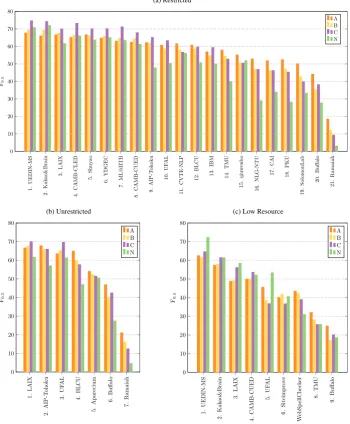
Since one of the main contributions of the BEA-2019 shared task was the introduction of new data annotated for different proficiency levels, we anal-ysed each team in terms of their CEFR and Native
level performance. The F0.5 results for each team
and level are thus plotted inFigure 2.
The top 10 teams in the Restricted Track all per-formed best on C level texts, while the bottom 11 systems typically performed best on A level texts: a clear indication that some systems are more bi-ased towards different learner levels than others. Different systems may also be differently suited to correcting different error types. For example, while punctuation errors are fairly rare at levels A and B, they are much more common at levels C and N. Conversely, noun number errors are com-mon at levels A and B, but are rarer at levels C and N. Consequently, system performance at different CEFR levels is affected by each system’s ability to correct specific error types.
The bottom 13 teams in the Restricted Track also typically struggled most with the native level
texts. For example, there is an almost 15 F0.5
gap between AIP-Tohoku’s N level result and their next lowest CEFR level. Since we did not release any native level training data, we note that some systems failed to generalise to the levels and do-mains that they could not train on. In contrast, Low Resource Track submissions tended to score highest on native level texts, perhaps because sev-eral were trained on corrupted native data which may be more similar to the N level texts than the genuine learner data.
A.3 Edit Operation
Results for each team in terms of Missing, Re-placement and Unnecessary word errors are shown
in Table 9. These results mainly provide a high
level overview of the types of errors systems were able to correct, but can also be used to help iden-tify different system strengths and weaknesses. For example, UEDIN-MS only ranked 7th in terms of correcting missing word errors, but made up for this by scoring much higher at replacement and unnecessary word errors, suggesting their system could be improved by paying more attention to missing word errors.
In contrast, Kakao&Brain scored highest at missing word errors, but came 2nd in terms of re-placement word errors and 7th in terms of
unnec-essary word errors. Although they also achieved the highest precision out of all teams in terms of unnecessary word errors, they did so at the cost of almost half the recall of the UEDIN-MS sys-tem. This suggest that Kakao&Brain should in-stead focus on improving unnecessary word error correction. That said, it is also worth reiterating that approximately 65% of all errors are replace-ment word errors, compared to 25% missing and 10% unnecessary, and so it is arguably more im-portant to focus on replacement word errors more than any other category.
In the Restricted Track, ML@IITB and BLCU respectively scored highest in terms of recall on missing and unnecessary word errors. This per-haps suggests that ML@IITB’s strategy of only paying attention to the top 500 most frequent miss-ing word errors paid off, while BLCU’s artificial data generation method treated all edit operations equally, and so was perhaps more highly opti-mised for unnecessary word errors.
In the Low Resource Track, UEDIN-MS was again the dominant system in terms of replace-ment and unnecessary word errors, although Kakao&Brain again came top in terms of
miss-ing word errors. There was also a larger
dis-crepancy between certain teams’ operation scores and, for example, UFAL scored 43.36 and 50.91
F0.5 on missing and replacement word errors, but
just 14.89 F0.5on unnecessary word errors, while
WebSpellChecker scored 60.40 F0.5 on missing
word errors, but just 34.13 and 28.63 on replace-ment and unnecessary word errors. These results suggest that some systems are more heavily bi-ased towards some edit operations than others, but researchers can hopefully use this information to overcome their system’s weaknesses.
A.4 Single vs. Multi Token Edits
In addition to error types, we also examined sys-tem performance in terms of single and multi to-ken edits, where a multi toto-ken edit is defined as any edit that contains 2 or more tokens on at least
one side of the edit; e.g. [eat → has eaten] or
[only can→can only]. Systems were evaluated in
this setting mainly becauseSakaguchi et al.(2016)
previously advocated fluent, rather than simply grammatical, edits in GEC, yet fluency edits
of-ten involve multi token corrections. WhenBryant
et al. (2017) evaluated the CoNLL-2014 systems
Restricted M R U
Team P R F0.5 P R F0.5 P R F0.5
UEDIN-MS 70.20 64.38 68.95 73.10 58.42 69.60 73.10 60.23 70.11
Kakao&Brain 79.39 65.70 76.22 72.51 47.83 65.73 76.33 33.91 61.05
LAIX 79.01 58.79 73.93 70.22 46.67 63.78 73.68 40.66 63.39
CAMB-CLED 73.30 64.32 71.31 69.88 50.27 64.82 66.05 59.51 64.63
Shuyao 75.53 61.14 72.14 67.36 53.13 63.94 72.61 53.62 67.81
YDGEC 75.72 59.99 71.95 69.60 47.86 63.80 60.92 64.17 61.54
ML@IITB 74.05 73.37 73.91 63.87 53.36 61.45 53.78 67.98 56.13
CAMB-CUED 67.81 66.84 67.62 66.35 47.59 61.50 65.40 56.47 63.39
AIP-Tohoku 71.56 48.63 65.39 69.26 37.73 59.34 61.56 54.70 60.05
UFAL 71.02 47.76 64.72 66.11 36.73 56.99 64.72 45.31 59.61
CVTE-NLP 68.50 40.22 60.05 68.96 38.55 59.56 62.91 37.20 55.27
BLCU 63.86 50.21 60.57 63.16 48.36 59.52 50.48 68.02 53.23
IBM 71.88 48.40 65.52 59.56 33.58 51.58 61.70 31.59 51.82
TMU 63.85 57.26 62.42 52.55 49.32 51.87 42.79 52.94 44.50
qiuwenbo 58.94 25.99 47.01 64.64 34.34 54.95 56.04 33.63 49.45
NLG-NTU 56.68 41.46 52.80 48.74 36.09 45.55 41.80 45.66 42.52
CAI 55.59 48.01 53.89 46.81 39.45 45.12 39.64 44.04 40.45
PKU 66.60 35.43 56.64 49.39 30.16 43.80 48.15 38.41 45.82
SolomonLab 53.18 25.38 43.62 45.62 44.18 45.33 33.72 38.26 34.54
Buffalo 57.43 7.38 24.37 64.24 17.62 42.01 62.24 16.22 39.71
Ramaiah 47.31 28.04 41.59 6.23 14.71 7.04 11.69 27.50 13.21
Unrestricted M R U
Team P R F0.5 P R F0.5 P R F0.5
LAIX 79.01 58.79 73.93 70.22 46.67 63.78 73.68 40.66 63.39
AIP-Tohoku 72.23 54.83 67.92 72.70 47.38 65.68 60.47 63.59 61.07
UFAL 69.21 54.28 65.60 69.47 51.38 64.90 61.03 61.23 61.07
BLCU 64.61 53.85 62.13 63.27 54.50 61.30 47.26 70.93 50.64
Aparecium 63.61 38.29 56.18 58.89 37.36 52.80 53.33 24.02 42.87
Buffalo 70.64 9.49 30.87 65.03 19.65 44.49 61.24 20.26 43.60
Ramaiah 55.06 31.99 48.12 9.14 22.02 10.35 11.53 28.48 13.09
Low Resource M R U
Team P R F0.5 P R F0.5 P R F0.5
UEDIN-MS 69.65 55.92 66.39 71.56 46.77 64.70 61.16 33.11 52.30
Kakao&Brain 70.12 61.76 68.27 59.00 41.10 54.28 60.98 31.45 51.33
LAIX 68.19 41.30 60.33 59.11 27.03 47.77 59.07 31.32 50.18
CAMB-CUED 55.05 22.13 42.42 57.65 41.97 53.64 46.46 45.30 46.22
UFAL 57.82 21.68 43.36 58.43 33.61 50.91 14.64 16.01 14.89
Siteimprove 80.10 17.16 46.21 42.76 33.33 40.47 34.78 22.71 31.44
WebSpellChecker 60.72 59.14 60.40 33.96 34.80 34.13 25.65 53.63 28.63
TMU 35.25 58.81 38.32 21.78 18.53 21.04 18.74 26.72 19.93
Buffalo 27.22 11.94 21.67 26.22 11.95 21.16 25.00 3.05 10.24
(a) Restricted
1.
UEDIN-MS
2.
Kak
ao&Brain 3.
LAIX
4.
CAMB-C
LE
D
5.
Sh
u
y
ao
6.
YDGEC
7.
ML@I
ITB
8.
CAMB-CUE
D
9.
AIP-T
ohoku
10.
UF
AL
11.
CVT
E
-NLP
12.
BLCU
13.
IBM
14.
TMU
15.
qiu
w
en
b
o
16.
NLG-NTU
17.
CAI
18.
PKU
19.
SolomonLab 20.
B
u
ff
al
o
21.
Ram
ai
ah
0 10 20 30 40 50 60 70 80
F0.
5
A B C N
(b) Unrestricted
1.
LAIX
2.
AIP-T
ohoku
3.
UF
AL
4.
BLC
U
5.
Aparecium 6.
Buffalo
7.
Ramaiah
0 10 20 30 40 50 60 70 80
F0
.
5
A B C N
(c) Low Resource
1.
UEDIN-MS
2.
Kak
ao&Brain 3.
LAIX
4.
CAMB-CUED
5.
UF
AL
6.
Siteimpro
ve
7.
W
ebSp
ellChec
ker
8.
TMU
9.
Buffalo
0 10 20 30 40 50 60 70 80
F0
.
5
[image:18.595.126.477.66.491.2]A B C N
Figure 2: The F0.5 scores for each team in each track in terms of CEFR and native levels: A (beginner), B (intermediate), C (advanced) and N (native).
that only 3 out of 12 teams achieved scores higher
than 10 F0.5, prompting them to conclude that
sig-nificant progress must be made before fluency cor-rections become a viable option.
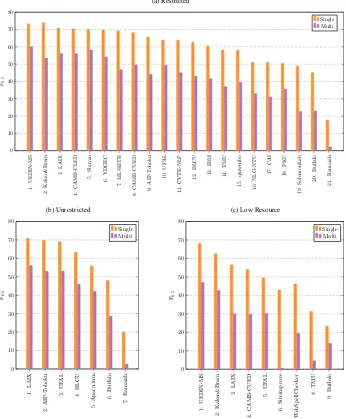
With this in mind, we are pleased to report that
Figure 3shows systems have indeed made
signif-icant progress in terms of correcting multi token edits, and in fact almost all teams scored higher
than 20 F0.5, with an average of 42 F0.5. While
systems still scored higher in terms of single token errors overall, this is most likely because single to-ken errors are not only typically easier to correct than multi token errors, but are also much more frequent and tend to account for roughly 70-80% of all edits.
It is also noteworthy that Kakao&Brain actually surpassed UEDIN-MS in terms of single token er-ror performance in the Restricted Track, but fell much shorter in terms of multi token edits. Shuyao was also particularly adept at correcting multi to-ken errors, coming second after UEDIN-MS over-all. In the Low Resource track meanwhile, Siteim-prove is notable for not correcting any multi token errors at all, however this was because their sys-tem only targeted a limited number of single token error types by design.
A.5 Detection vs. Correction
(a) Restricted
1.
UEDIN-MS
2.
Kak
ao&Brain 3.
LAIX
4.
CAMB-C
LE
D
5.
Sh
u
y
ao
6.
YDGEC
7.
ML@I
ITB
8.
CAMB-CUE
D
9.
AIP-T
ohoku
10.
UF
AL
11.
CVT
E
-NLP
12.
BLCU
13.
IBM
14.
TMU
15.
qiu
w
en
b
o
16.
NLG-NTU
17.
CAI
18.
PKU
19.
SolomonLab 20.
B
u
ff
al
o
21.
Ram
ai
ah
0 10 20 30 40 50 60 70 80
F0
.
5
Single Multi
(b) Unrestricted
1.
LAIX
2.
AIP-T
ohoku
3.
UF
AL
4.
BLC
U
5.
Aparecium 6.
Buffalo
7.
Ramaiah
0 10 20 30 40 50 60 70 80
F0
.
5
Single Multi
(c) Low Resource
1.
UEDIN-MS
2.
Kak
ao&Brain 3.
LAIX
4.
CAMB-CUED
5.
UF
AL
6.
Siteimpro
ve
7.
W
ebSp
ellChec
ker
8.
TMU
9.
Buffalo
0 10 20 30 40 50 60 70 80
F0
.
5
[image:19.595.128.474.65.484.2]Single Multi
Figure 3: The F0.5 scores for each team in each track in terms of single and multi token edits. A multi token is defined as any edit that has 2 or more tokens on at least one side of the edit.
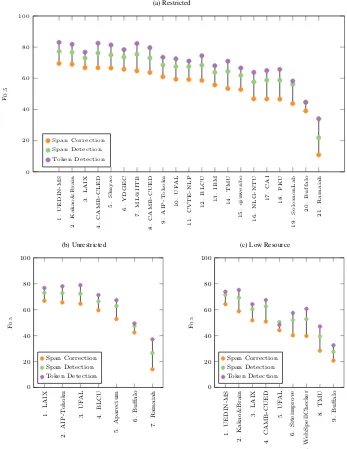
i.e. the extent to which a system can identify er-rors. This is significant because detection is an im-portant task in its own right as well as the first step
in GEC.Figure 4compares each team in terms of
span based detection, span based detection and
to-ken based correction F0.5.
In general, all systems were fairly consistent in terms of the difference between their detec-tion and correcdetec-tion scores, with most teams
scor-ing approximately 12-17 F0.5 higher on token
based detection than correction. CAMB-CLED and ML@IITB are noteworthy for achieving the 2nd and 3rd highest scores in terms of token detec-tion, although the former can be explained by the fact that CAMB-CLED explicitly modelled detec-tion in their approach. One of the main
applica-tions of this graph is thus to inform teams whether they should focus on improving the correction of errors they can already detect, or else extend their systems to detect new errors.
A.6 Main Error Types
The overall F0.5scores for each of the main 24
ER-RANT error types for each team in the Restricted
Track are shown inTable 10, while similar results
for the Unrestricted and Low Resource Tracks are
shown inTable 11. The cells in these tables have
(a) Restricted
1.
UEDIN-MS
2.
Kak
ao&Brai
n
3.
LAIX
4.
CAMB-CLED
5.
Sh
uy
ao
6.
YDGEC
7.
ML@I
ITB
8.
CAMB-CUED 9.
AIP-T
ohoku
10.
UF
AL
11.
CVTE-NLP 12.
BLCU
13.
IBM
14.
TMU
15.
qiu
w
en
b
o
16.
NLG-NTU
17.
CAI
18.
PKU
19.
SolomonLab 20.
Buffalo
21.
Ramaiah
0 20 40 60 80 100
F0
.
5
Span Correction
Span Detection
Token Detection
(b) Unrestricted
1.
LAIX
2.
AIP-T
oho
ku
3.
UF
AL
4.
BLCU
5.
Aparecium 6.
Buffalo
7.
Ramaiah
0 20 40 60 80 100
F0
.
5
Span Correction Span Detection Token Detection
(c) Low Resource
1.
UEDIN-MS
2.
Kak
ao&Brain 3.
LAIX
4.
CAMB-CUED
5.
UF
AL
6.
Siteimpro
v
e
7.
W
ebSp
ellChec
k
er
8.
TMU
9.
Buffalo
0 20 40 60 80 100
F0
.
5
[image:20.595.127.474.63.512.2]Span Correction Span Detection Token Detection
Figure 4: The difference in F0.5scores in terms of span based correction, span based detection, and token based detection (as defined inSection 5) for each team in each track.
With this in mind, the darkest columns in these tables include adjectives (ADJ), adverbs (ADV), conjunctions (CONJ), nouns (NOUN), other (OTHER), verbs (VERB) and word order (WO) errors. It should be made clear however, that these categories mainly contain word choice
errors, such as [eat → consume], and that
mor-phological errors, such as [eat→eating], are
var-iously subsumed under other categories. The re-sults indicate that while systems are fairly adept at correcting morphological and function word er-rors, they struggle with content word errors. Con-tent word errors require a deeper understanding of the text compared to morphological and function