e-ISSN: 2278-067X, p-ISSN: 2278-800X, www.ijerd.com
Volume 11, Issue 12 (December 2015), PP.20-24
Content Based Image Retrieval Using Multi-Resolution Wavelet
Features and Correlation
Bhimasen B.Kulkarni
1, D.S.Albur
2 1Asst. Professor, Department of ECE, New Horizon College of Engineering, Bangalore, India. 2
Assoc. Professor, Department of ECE,, KLE’s KLE Institute of Technology, Hubli, India.
Abstract:- This paper presents an efficient and simple approach for content based image retrieval. It utilizes the strength of multi-resolution wavelet features to extract colour features and correlation function for the comparison of query image with the images in database. The Wang‟s image database is used for testing the uploaded query image. The output is displayed into three categories which makes user to distinguish different accuracy levels of the output. The simulation is carried out using MATLAB R2011a.
Keywords:- Content Based Image Retrieval, Wavelets, Multiresolution, Correlation, Wang‟s Image Database.
I.
INTRODUCTION
The rapid growth of digital image processing over last few years is mainly due to the fast augmentation of imaging techniques. The experts from many areas are exploring the different chances to store, access and image data in the simplest possible way. They are also finding difficulty in searching an image in a large collection of images. Therefore the area of image retrieval has become an active area of research and development.
There were a lot of problems with the basic image indexing like accuracy, precision etc, which have made people to look forward for a technique which can automatically get similar type of images from a large database using the basic features of an image like colour, text and shape etc . A technology which retrieves images on the basis of their contents such as colour, texture and shapes, is generally referred as Content-Based Image Retrieval (CBIR).
The paper is organized as follows: Section II describes some of the existing CBIR techniques; Section III covers the proposed wavelet based colour feature extraction algorithm. Section IV, presents experimental results and analysis. Section V concludes the proposed algorithm followed by the references.
II.
THE
EXISTING
APPROACHES
Paper [1] proposed an efficient and simple approach for content based image retrieval. It utilized the strength of multi-resolution wavelet transform and edge histogram to extract colour and texture features. The wavelet based colour feature extraction scheme performs better than existing Mpeg-7 colour descriptors. Texture features are extracted from the edge histogram obtained from wavelet coefficients of the image at multiple resolution levels. The multi-resolution approach helps in collecting texture details from finer to coarser levels providing better performance than existing Mpeg-7 descriptors. The combination of the two features is trained and tested for Wang‟s image database. The results of retrieval are expressed in terms of precision and recall and compared with existing schemes.
Paper [2] put forward a model for a search engine where an image can be uploaded from the local database of the user to retrieve information about it from the internet. This is similar to the traditional keyword search used by most of the search engines with the only difference being that here an image are being uploaded as a query than textual keywords. The fact that the image being used as a query makes the search ever more complicated as the content of the image needs to be analysed and matched to find the information corresponding to uploaded image. This is most apt for searching information about images of historic monuments, places or any specific place or thing that is identifiable.
Paper [3] introduced another Content Based Image Retrieval System with relevance feedback where the global colour histogram for all the images in the database is computed and the feature vector is stored in a file. Then for every query image, its histogram is computed. Then the distance between the query image and ith image in the database is computed to obtain similarity between them.
correlation-weighted matrix, the Mahalanobis distance is adopted to measure the similarity because of the correlation between the concerned vectors. Comparisons are conducted between BPDE and other descriptors.
Paper [5] proposed a probabilistic model for the relevance feedback of users looking for target images. This model takes into account user errors and user uncertainty about distinguishing similarly relevant images. Based on this model, they have developed an algorithm, which selects images to be presented to the user for further relevance feedback until a satisfactory image is found. In each query session, the algorithm maintains weights on the images in the database which reflect the assumed relevance of the images. Relevance feedback is used to modify these weights. As a second ingredient, the algorithm uses a minimax principle to select images for presentation to the user: any response of the user will provide significant information about his query, such that relatively few feedback rounds are sufficient to find a satisfactory image.
Paper [6] introduced Content Based Image Retrieval using Fusion of Gabor Magnitude and Modified Block Truncation Coding a CBIR system which is implemented with the help of combination of features. BTC is mainly used for image compression. The proposed method is a modification in original block truncation coding (BTC) for content based image retrieval system. Texture features are found by calculating the standard deviation of the Gabor filtered image. Gabor Filter & Modified Block Truncation Coding based feature vector is extracted then compared with corresponding feature vector of images stored in the database. Images are retrieved based on the similarities features. The proposed method is tested on a database consisting of 1000 colour images for test. All images in database are ranked according to their similarity to query image. To assess the retrieval effectiveness precision and recall as statistical comparison parameters for the MBTC and Gabor Filter based feature vector is used.
III.
ALGORITHM
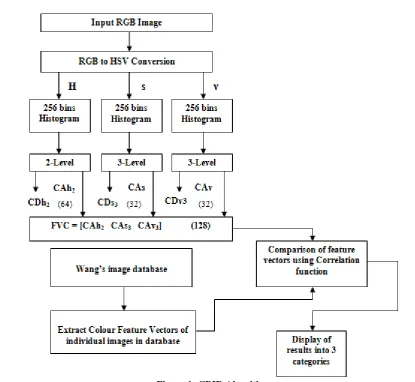
In the proposed CBIR scheme, the wavelet transform is utilized in colour feature extraction and the correlation function is used to compute the similarity between the query image and the images in the database. The detailed algorithm is as shown in Figure 1.
The proposed scheme also utilizes the HSV colour space. In SCD, the histograms are quantized and represented in only 16, 4 and 4 bins for H, S and V respectively. But in the proposed scheme, the full 256 bins histograms are used for each H, S and V colour channel, therefore, collecting maximum possible colour details at this level. At this stage, the total length of colour feature is 3×256 =768, which is too large. The Haar transform is used to reduce this number. In the HSV model, from the colour perception point of view, the value of „H‟ has more weightage in human visual perception as compared to „S‟ and „V‟. Therefore, to give more weightage to „H‟ histogram, it is decomposed at level 2 while histograms of S and V are decomposed at level 3. In Haar wavelet decomposition, the approximation coefficients are considered because they preserve the fundamental shape of histograms at several levels of decomposition. High frequency detailed coefficients are ignored as they only contribute to fast colour changes of noisy nature.
Figure 1: CBIR Algorithm
The algorithm steps are as follows:
(i) Convert RGB input image (I) into HSV colour space.
(ii) Compute full 256 bins histograms of each colour channel H, S and V.
(iii) Perform 2-level Haar wavelet decomposition for H-histogram (Hh) and 3-level Haar wavelet
decomposition for S-Histogram (Hs) and V-Histogram (Hv).
(iv) Select only approximation coefficients of these wavelet decompositions and concatenate them to form colour feature vector (fvc)
The size of each histogram is 256. The 2-level wavelet decomposition of (Hh) and 3-level
decomposition of (Hs) and (Hv) result in approximation coefficients of size 64, 32 and 32 respectively. Therefore,
the total length of colour feature vector becomes 128. Once the colour feature vector of the Query Image is obtained, the colour feature vectors of the images in the Wang‟s image database are obtained. The similarity between the query image and images in the database is found by calculating the correlation coefficients between those feature vectors.
IV.
E
XPERIMENTALR
ESULTSFor testing the proposed CBIR scheme using Multiresolution Wavelet Features and Correlation, the Wang‟s Image Database is used. This database consists of 1000 images. These 1000 images are grouped under 10 categories, each containing 100 images. The Wang‟s image database is readily available and can be downloaded with a free license.
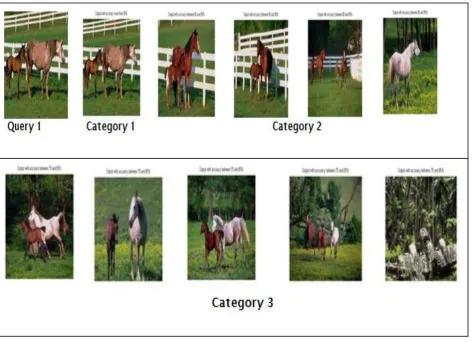
To test the retrieval performance, 2 test images from Wang‟s database are randomly selected from each category. These test images used as query images and are shown in Figure 2.
Figure 2: Query Image
The results are displayed in 3 different categories;
Category 1: The images which are more than 95% similar to the query image. Category 2: The images whose similarity lies between 85% and 95%. Category 3: The images whose similarity lies between 75% and 85%.
These 3 categories of the results provide user an extra feature of choosing the results between particular accuracy levels. The results for different Query images are obtained as shown below in Figure 3.
Figure 3: Results
V.
CONCLUSION
REFERENCES
[1]. C. Pathavardhan, A.K.Verma, C.Vasanth Lakshmi, “Robust Content Based Image Retrieval Based On Multi-Resolution Wavelet Features and Edge Histogram”, Proceedings of the 2013 IEEE Second International Conference on Image Information Processing (ICIIP-2013), Vol 1, pp. 447-453, 2013. [2]. Divya Ragatha Venkata, Dr.Divakar Yadav, “Image Query Based Search Engine Using Image Content
Retrieval”, 2012 14th International Conference on Modelling and Simulation, Vol 5, No.6, pp. 283-286,
2012.
[3]. Asmitha Deshmukh, Gargi Phadke, “An Improved Content Based Image Retreival” International Conference on Computer and Communication Technology (ICCCT-2011). , Vol 9, No.5, pp. 191-196, 2011
[4]. Zhao Shan, Wang Hao-tai, “Image Retrieval Based on Bit-plane Distribution Entropy”, 2008 International Conference on Computer Science and Software Engineering. , Vol 1, pp532-535, 2008. [5]. Alex Po Leung and Peter Auer, “An Efficient Search Algorithm for Content Based Image Retrieval
with User Feedback”, 2008 IEEE International Conference on Data Mining Workshops. , Vol 5, No.1, pp. 885-890, 2008.
[6]. H.B.Kekre, V.A.Bharadi, S.D.Thepade, B.K.Mishra, S.E.Ghosalkar, S.M.Sawant, “Content Based Image Retrieval using Fusion of Gabor Magnitude and Modified Block Truncation Coding ”, Third International Conference on Emerging Trends in Engineering and Technology , Vol 5, No.6, pp. 140-145, 2008
[7]. Ritendra Datta, Dhiraj Joshi, Jia Li, James Z. Wang, "Image Retrieval: Ideas, Influences, and Trends of the New Age", ACM journal of Computing Surveys, Vol. 40, No. 2, Article 5, pp. 1-60, 2008.
[8]. G. Rafiee, S. S. Dlay, W. L. Woo, "A Review of Content-Based Image Retrieval", Proceedings of 7th IEEE International Symposium on Communication Systems Networks and Digital Signal Processing (CSNDSP), pp. 775-779, 2010.
[9]. Zhou Huiyu, Sadka Abdul H., Swash Mohammad R. Swash, Azizi Jawid, Umar Abubakar S., “Content Based Image Retrieval and Clustering: A Brief Survey”, Recent Patents on Electrical Engineering, Vol. 2(3), pp. 187-199, 2009.
[10]. Q. Tian, N. Sebe, M. S. Lew, E. Loupias, T. S. Huang, "Content-Based Image Retrieval Using Wavelet-based Salient Points", SPIE Journal of Electronic Imaging, Vol. 10(4), pp. 835-849, 2001. [11]. Young Deok Chun, Nam Chul Kim, Ick Hoon Jang, "Content-Based Image Retrieval Using
Multiresolution Colour and Texture Features", IEEE Transactions on Multimedia, Vol. 10, No. 6, pp. 1073-1084, 2008.