Natural Language Generation with Tree Conditional Random Fields
Wei Lu1, Hwee Tou Ng1,2, Wee Sun Lee1,2 1Singapore-MIT Alliance
2Department of Computer Science National University of Singapore
{nght,leews}@comp.nus.edu.sg
Abstract
This paper presents an effective method for generating natural language sentences from their underlying meaning represen-tations. The method is built on top of a hybrid tree representation that jointly encodes both the meaning representation as well as the natural language in a tree structure. By using a tree conditional random field on top of the hybrid tree representation, we are able to explicitly model phrase-level dependencies amongst neighboring natural language phrases and meaning representation components in a simple and natural way. We show that the additional dependencies captured by the tree conditional random field allows it to perform better than directly inverting a previously developed hybrid tree semantic parser. Furthermore, we demonstrate that the model performs better than a previ-ous state-of-the-art natural language gen-eration model. Experiments are performed on two benchmark corpora with standard automatic evaluation metrics.
1 Introduction
One of the ultimate goals in the field of natural lan-guage processing (NLP) is to enable computers to converse with humans through human languages. To achieve this goal, two important issues need to be studied. First, it is important for comput-ers to capture the meaning of a natural language sentence in a meaning representation. Second, computers should be able to produce a human-understandable natural language sentence from its meaning representation. These two tasks are re-ferred to as semantic parsing and natural language generation (NLG), respectively.
In this paper, we use corpus-based statistical
methods for constructing a natural language gener-ation system. Given a set of pairs, where each pair consists of a natural language (NL) sentence and its formal meaning representation (MR), a learn-ing method induces an algorithm that can be used for performing language generation from other previously unseen meaning representations.
A crucial question in any natural language pro-cessing system is the representation used. Mean-ing representations can be in the form of a tree structure. In Lu et al. (2008), we introduced a
hybrid treeframework together with a probabilis-tic generative model to tackle semanprobabilis-tic parsing, where tree structured meaning representations are used. The hybrid tree gives a natural joint tree rep-resentation of a natural language sentence and its meaning representation.
A joint generative model for natural language and its meaning representation, such as that used in Lu et al. (2008) has several advantages over var-ious prevvar-ious approaches designed for semantic parsing. First, unlike most previous approaches, the generative approach models a simultaneous generation process for both NL and MR. One el-egant property of such a joint generative model is that it allows the modeling of both semantic parsing and natural language generation within the same process. Second, the generative process pro-ceeds as a recursive top-down Markov process in a way that takes advantage of the tree structure of the MR. The hybrid tree generative model pro-posed in Lu et al. (2008) was shown to give state-of-the-art accuracy in semantic parsing on bench-mark corpora.
While semantic parsing with hybrid trees has been studied in Lu et al. (2008), its inverse task – NLG with hybrid trees – has not yet been ex-plored. We believe that the properties that make the hybrid trees effective for semantic parsing also make them effective for NLG. In this paper, we de-velop systems for the generation task by building
on top of the generative model introduced in Lu et al. (2008) (referred to as the LNLZ08 system).
We first present a baseline model by directly “inverting” the LNLZ08 system, where an NL sen-tence is generated word by word. We call this model thedirect inversion model. This model is unable to model some long range global depen-dencies over the entire NL sentence to be gener-ated. To tackle several weaknesses exhibited by the baseline model, we next introduce an alterna-tive, novel model that performs generation at the phrase level. Motivated by conditional random fields (CRF) (Lafferty et al., 2001), a different
pa-rameterization of the conditional probability of the hybrid tree that enables the model to encode some longer range dependencies amongst phrases and MRs is used. This novel model is referred to as thetreeCRF-based model.
Evaluation results for both models are pre-sented, through which we demonstrate that the tree
CRF-based model performs better than the direct
inversion model. We also compare the tree CRF
-based model against the previous state-of-the-art model of Wong and Mooney (2007). Further-more, we evaluate our model on a dataset anno-tated with several natural languages other than En-glish (Japanese, Spanish, and Turkish). Evalua-tion results show that our proposed treeCRF-based
model outperforms the previous model.
2 Related Work
There have been substantial earlier research ef-forts on investigating methods for transforming MR to their corresponding NL sentences. Most of the recent systems tackled the problem through the architecture of chart generation introduced by Kay (1996). Examples of such systems include the chart generator for Head-Driven Phrase Struc-ture Grammar (HPSG) (Carroll et al., 1999; Car-roll and Oepen, 2005; Nakanishi et al., 2005), and more recently for Combinatory Categorial Gram-mar (CCG) (White and Baldridge, 2003; White, 2004). However, most of these systems only fo-cused on surface realization (inflection and order-ing of NL words) and ignored lexical selection (learning the mappings from MR domain concepts to NL words).
The recent work by Wong and Mooney (2007) explored methods for generation by inverting a system originally designed for semantic pars-ing. They introduced a system named WASP−1
that employed techniques from statistical ma-chine translation using Synchronous Context-Free Grammar (SCFG) (Aho and Ullman, 1972). The system took in a linearized MR tree as input, and translated it into a natural language sentence as output. Unlike most previous systems, their sys-tem integrated both lexical selection and surface realization in a single framework. The perfor-mance of the system was enhanced by incorpo-rating models borrowed from PHARAOH (Koehn,
2004). Experiments show that this new hybrid system named WASP−1++ gives state-of-the-art
accuracies and outperforms the direct translation model obtained from PHARAOH, when evaluated
on two corpora. We will compare our system’s performance against that of WASP−1++ in
Sec-tion 5.
3 The Hybrid Tree Framework and the LNLZ08 System
QUERY:answer(RIVER)
RIVER:longest(RIVER)
RIVER:exclude(RIVER1RIVER2)
RIVER:river(all) RIVER:traverse(STATE)
STATE:stateid(STATENAME)
STATENAME:texas
what is the longest river that does not run through texas
Figure 1: An example MR paired with its NL sen-tence.
Following most previous works in this area (Kate et al., 2005; Ge and Mooney, 2005; Kate and Mooney, 2006; Wong and Mooney, 2006; Lu et al., 2008), we consider MRs in the form of tree structures. An example MR and its corresponding natural language sentence are shown in Figure 1. The MR is a tree consisting of nodes called MR productions. For example, the node “QUERY :answer(RIVER)” is one MR
production. Each MR production consists of a semantic category (“QUERY”), a function symbol
QUERY:answer(RIVER)
RIVER:longest(RIVER)
RIVER:exclude(RIVER1RIVER2)
RIVER:traverse(STATE)
STATE:stateid(STATENAME)
STATENAME:texas
texas run through
that does not
RIVER:river(all)
river the longest
[image:3.595.319.518.279.351.2]what is
Figure 2: One possible hybrid treeT1
child semantic categories (“RIVER”).
Now we give a brief overview of the hybrid tree framework and the LNLZ08 system that was psented in Lu et al. (2008). The training corpus re-quired by the LNLZ08 system contains example pairs d(i) = (mb(i),wb(i)) for i = 1. . . N, where eachmb(i) is an MR, and eachwb(i)is an NL sen-tence. The system makes the assumption that the entire training corpus is generated from an under-lying generative model, which is specified by the parameter setΩ.
The parameter setΩincludes the following: the MR model parameterρ(mj|mi,argk)which mod-els the generation of an MR productionmj from its parent MR productionmias itsk-th child, the emission parameterθ(t|mi,Λ)that is responsible for generation of an NL word or a semantic cate-gorytfrom the MR productionmi (the parent of
t) under the contextΛ(such as the token to the left of the current token), and the pattern parameter
φ(r|mi), which models the selection of a hybrid
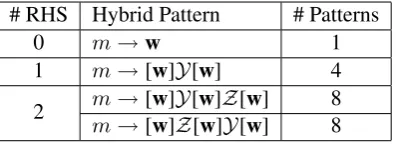
patternr that defines globally how the NL words and semantic categories are interleaved given a parent MR production mi. All these parameters are estimated from the corpus during the training phase. The list of possible hybrid patterns is given in Table 1 (at most two child semantic categories are allowed – MR productions with more child se-mantic categories are transformed into those with two).
In the table,mrefers to the MR production, the symbol w denotes an NL word sequence and is optional if it appears inside []. The symbolY and Z refer to the first and second semantic category under the MR productionmrespectively.
# RHS Hybrid Pattern # Patterns
0 m→w 1
1 m→[w]Y[w] 4 2 mm→→[w][w]YZ[w][w]ZY[w][w] 88
Table 1: The list of possible hybrid patterns, [] de-notes optional
The generative process recursively creates MR productions as well as NL words at each gen-eration step in a top-down manner. This pro-cess results in a hybrid tree for each MR-NL pair. The list of children under each MR pro-duction in the hybrid tree forms a hybrid se-quence. One example hybrid tree for the MR-NL pair given in Figure 1 is shown in Figure 2. In this hybrid tree T1, the list of children under the production RIVER : longest(RIVER) forms
the hybrid sequence “the longest RIVER : exclude(RIVER1 RIVER2)”. The yield of the hy-brid tree is exactly the NL sentence. The MR can also be recovered from the hybrid tree by record-ing all the internal nodes of the tree, subject to the reordering operation required by the hybrid pat-tern.
To illustrate, consider the generation of the hy-brid tree T1 shown in Figure 2. The model first generates an MR production from its parent MR production (empty as the MR production is the root in the MR). Next, it selects a hybrid pattern
followed by a semantic category. Finally, actual NL words and semantic categories are generated from the parent MR production. Now the genera-tion for one level is complete, and the above pro-cess repeats at the newly generated MR produc-tions, until the complete NL sentence and MR are both generated.
Mathematically, the above generative process yields the following formula that models the joint probability for the MR-NL pair, assuming the con-textΛfor the emission parameter is the preceding word or semantic category (i.e., the bigram model is assumed, as discussed in Lu et al. (2008)):
p T1(wb,mb) =ρ(QUERY:answer(RIVER)|−,arg1) ×φ(m→wY|QUERY:answer(RIVER)) ×θ(what|QUERY:answer(RIVER),BEGIN) ×θ(is|QUERY:answer(RIVER),what) ×θ(RIVER|QUERY :answer(RIVER),is) ×θ(END|QUERY:answer(RIVER),RIVER) ×ρ(RIVER:longest(RIVER)|
QUERY:answer(RIVER),arg1)×. . . (1)
whereT1(wb,mb)denotes the hybrid treeT1which contains the NL sentencewb and MRm.b
For each MR-NL pair in the training set, there can be potentially many possible hybrid trees asso-ciated with the pair. However, the correct hybrid tree is completely unknown during training. The correct hybrid tree is therefore treated as a hidden variable. An efficient inside-outside style algo-rithm (Baker, 1979) coupled with further dynamic programming techniques is used for efficient pa-rameter estimation.
During the testing phase, the system makes use of the learned model parameters to determine the most probable hybrid tree given a new natural lan-guage sentence. The MR contained in that hybrid tree is the output of the system. Dynamic pro-gramming techniques similar to those of training are also employed for efficient decoding.
The generative model used in the LNLZ08 sys-tem has a natural symmetry, allowing for easy transformation from NL to MR, as well as from MR to NL. This provides the starting point for our work in “inverting” the LNLZ08 system to gener-ate natural language sentences from the underly-ing meanunderly-ing representations.
4 Generation with Hybrid Trees
The task of generating NL sentences from MRs can be defined as follows. Given a training cor-pus consisting of MRs paired with their NL sen-tences, one needs to develop algorithms that learn how to effectively “paraphrase” MRs with natu-ral language sentences. During testing, the sys-tem should be able to output the most probable NL “paraphrase” for a given new MR.
The LNLZ08 system models p(T(wb,mb)), the joint generative process for the hybrid tree con-taining both NL and MR. This term can be rewrit-ten in the following way:
p(T(wb,mb)) =p(mb)×p(T(wb,mb)|mb) (2)
In other words, we reach an alternative view of the joint generative process as follows. We choose to generate the complete MRmb first. Givenm, web
generate hybrid sequences below each of its MR production, which gives us a complete hybrid tree T(wb,mb). The NL sentence wb can be constructed from this hybrid tree exactly.
We define an operationyield(T)which returns the NL sentence as the yield of the hybrid treeT. Given an MR m, we find the most probable NLb
sentencewb∗as follows:
b
w∗ =yieldargmax
T p(T |mb)
(3)
In other words, we first find the most probable hybrid tree T that contains the provided MR m.b
Next we return the yield ofT as the most probable NL sentence.
Different assumptions can be made in the pro-cess of finding the most probable hybrid tree. We first describe a simple model which is a direct in-version of the LNLZ08 system. This model, as a baseline model, generates a complete NL sentence word by word. Next, a more sophisticated model that exploits NL phrase-level dependencies is built that tackles some weaknesses of the simple base-line model.
4.1 Direct Inversion Model
Assume that a pre-order traversal of the MR mb gives us the list of MR productions
m1, m2, . . . , mS, whereS is the number of MR productions in m. Based on the independenceb
sequence. Denote the hybrid sequence gener-ated under the MR production ms as hs, for
s= 1, . . . , S. We call the list of hybrid sequences h = hh1, h2, . . . , hSi a hybrid sequence list associated with this particular MR. Thus, our goal is to find the optimal hybrid sequence list h∗ for
the given MRm, which is formulated as follows:b
h∗=hh∗
1, . . . , h∗Si= argmax h1,...,hS
S
Y
s=1
p(hs|ms) (4)
The optimal hybrid sequence list defines the op-timal hybrid tree whose yield gives the opop-timal NL sentence.
Due to the strong independence assumption in-troduced by the LNLZ08 system, the hybrid tree generation process is in fact highly decompos-able. Optimization of the hybrid sequence list hh1, . . . , hSican be performed individually since they are independent of one another. Thus, math-ematically, fors= 1, . . . , S, we have:
h∗
s= argmax hs
p(hs|ms) (5)
The LNLZ08 system presented three models for the task of transforming NL to MR. In this in-verse task, for generation of a hybrid sequence, we choose to use the bigram model (model II). We choose this model mainly due to its stronger abil-ity in modeling dependencies between adjacent NL words, which we believe to be quite important in this NL generation task. With the bigram model assumption, the optimal hybrid sequence that can be generated from each MR production is defined as follows:
h∗s = argmax
hs
p(hs|ms)
= argmax
hs
(
φ(r|ms)×
|hYs|+1
j=1
θ(tj|ms, tj−1)
)
(6)
whereti is either an NL word or a semantic cat-egory witht0 ≡ BEGINandt|hs|+1 ≡ END, and
ris the hybrid pattern that matches the hybrid se-quencehs, which is equivalent tot1, . . . , t|hs|.
Equivalently, we can view the problem in the log-space:
h∗s= argmin
hs
(
−logφ(r|ms)
+
|hXs|+1
j=1
−logθ(tj|ms, tj−1)
)
(7)
Note the term −logφ(r|ms) is a constant for a particular MR production ms and a particu-lar hybrid pattern r. This search problem can be equivalently cast as the shortest path problem which can be solved efficiently with Dijkstra’s al-gorithm (Cormen et al., 2001). We define a set of states. Each state represents a single NL word or a semantic category, including the special sym-bols BEGIN and END. A directed path between two different states tu and tv is associated with a distance measure −logθ(tv|ms, tu), which is non-negative. The task now is to find the short-est path betweenBEGINandEND1. The sequence
of words appearing in this path is simply the most probable hybrid sequence under this MR produc-tionms. We build this model by directly inverting the LNLZ08 system, and this model is therefore referred to as thedirect inversion model.
A major weakness of this baseline model is that it encodes strong independence assumptions dur-ing the hybrid tree generation process. Though shown to be effective in the task of transform-ing NL to MR, such independence assumptions may introduce difficulties in this NLG task. For example, consider the MR shown in Figure 1. The generation steps of the hybrid sequences from the two adjacent MR productions QUERY : answer(RIVER) and RIVER : longest(RIVER)
are completely independent of each other. This may harm the fluency of the generated NL sen-tence, especially when a transition from one hy-brid sequence to another is required. In fact, due to such an independence assumption, the model always generates the same hybrid sequence from the same MR production, regardless of its context such as parent or child MR productions. Such a limitation points to the importance of better uti-lizing the tree structure of the MR for this NLG task. Furthermore, due to the bigram assumption, the model is unable to capture longer range depen-dencies amongst the words or semantic categories in each hybrid sequence.
To tackle the above issues, we explore ways of relaxing various assumptions, which leads to an
1In addition, we should make sure that the generated
hy-brid sequencet0. . . t|hs|+1is a valid hybrid sequence that comply with the hybrid pattern r. For example, the MR production STATE :loc1(RIVER)can generate the
follow-ing hybrid sequence “BEGIN have RIVER END” but not this hybrid sequence “BEGIN have END”. This can be achieved by finding the shortest path fromBEGINto RIVER, which then gets concatenated to the shortest path from RIVER
QUERY:answer(RIVER)
RIVER:longest(RIVER)
RIVER:exclude(RIVER1RIVER2)
RIVER:river(all) RIVER:traverse(STATE)
STATE:stateid(STATENAME)
STATENAME:texas
what is RIVER1 the longest RIVER1 RIVER1 that does not RIVER2
river run through STATE1 STATENAME1
[image:6.595.108.492.61.193.2]texas
Figure 3: An MR (left) and its associated hybrid sequences (right)
alternative model as discussed next. 4.2 TreeCRF-Based Model
Based on the belief that using known phrases usu-ally leads to better fluency in the NLG task (Wong and Mooney, 2007), we explore methods for gen-erating an NL sentence at phrase level rather than at word level. This is done by generating hybrid sequences as complete objects, rather than sequen-tially one word or semantic category at a time, from MR productions.
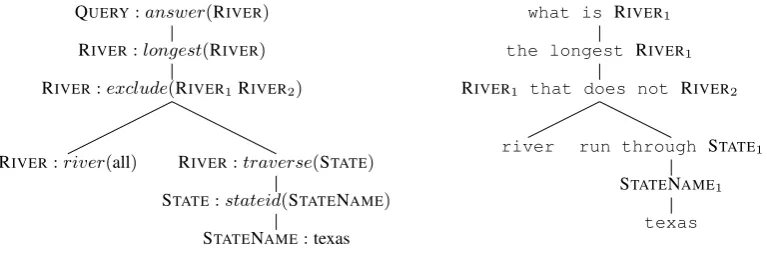
We assume that each MR production can gen-erate a complete hybrid sequence below it from a finite set of possible hybrid sequences. Each such hybrid sequence is called a candidate hybrid se-quenceassociated with that particular MR produc-tion. Given a set of candidate hybrid sequences as-sociated with each MR production, the generation task is to find the optimal hybrid sequence listh∗
for a given MRm:b
h∗= argmax
h p(h|mb) (8)
Figure 3 shows a complete MR, as well as a possible tree that contains hybrid sequences as-sociated with the MR productions. For exam-ple, in the figure the MR production RIVER : traverse(STATE)is associated with the hybrid
se-quencerun through STATE1. Each MR
pro-duction can be associated with potentially many different hybrid sequences. The task is to deter-mine the most probable list of hybrid sequences as the ones appearing on the right of Figure 3, one for each MR production.
To make better use of the tree structure of MR, we take the approach of modeling the conditional distribution using a log-linear model. Following the conditional random fields (CRF) framework
(Lafferty et al., 2001), we can define the probabil-ity of the hybrid sequence list given the complete MRm, as follows:b
p(h|mb) = Z(1mb)exp X
i∈V
X
k
µkgk(hi,mb, i)
+ X
(i,j)∈E
X
k
λkfk(hi, hj,mb, i, j)
!
(9)
whereV is the set of all the vertices in the tree, and
E is the set of the edges in the tree, consisting of parent-child pairs. The functionZ(mb)is the nor-malization function. Note that the dependencies among the features here form a tree, unlike the se-quence models used in Lafferty et al. (2001). The functionfk(hi, hj,mb, i, j)is a feature function of the entire MR treemb and the hybrid sequences at vertexiandj. These features are usually referred to as the edge features in theCRFframework. The
function gk(hi,mb, i) is a feature function of the hybrid sequence at vertexiand the entire MR tree. These features are usually referred to as the vertex features. The parameters λk andµk are learned from the training data.
hybrid sequences that can be associated with each MR production. The optimal hybrid tree generated by the Viterbi algorithm in this way is considered the “correct” hybrid tree for the MR-NL pair and is used as training data. While this does not provide hand-labeled training data, we believe the hybrid trees generated this way form a high quality train-ing set as both the MR and NL are available when Viterbi decoding is performed, guaranteeing that the generated hybrid tree has the correct yield.
There exist several advantages of such a model over the simple generative model. First, this model allows features that specifically model the depen-dencies between neighboring hybrid sequences in the tree to be used. In addition, the model can effi-ciently capture long range dependencies between MR productions and hybrid sequences since each hybrid sequence is allowed to depend on the entire MR tree.
For features, we employ four types of simple features, as presented below. Note that the first three types of features are vertex features, and the last are edge features. Examples are given based on Figure 3. All the features are indicator func-tions,i.e., a feature takes value 1 if a certain com-bination is present, and 0 otherwise. The last three features explicitly encode information from the tree structure of MR.
Hybrid sequence features : one hybrid sequence together with the associated MR production. For example:
g1 :hrun through STATE1, RIVER:traverse(STATE)i;
Two-level hybrid sequence features : one hy-brid sequence, its associated MR production, and the parent MR production. For example:
g2:hrun through STATE1, RIVER:traverse(STATE),
RIVER:exclude(RIVER1,RIVER2)i;
Three-level hybrid sequence features : one hy-brid sequence, its associated MR production, the parent MR production, and the grandpar-ent MR production. For example:
g3:hrun through STATE1, RIVER:traverse(STATE),
RIVER:exclude(RIVER1,RIVER2),
RIVER:longest(RIVER)i;
Adjacent hybrid sequence features : two adja-cent hybrid sequences, together with their as-sociated MR productions. For example:
f1 :hrun through STATE1, RIVER1 that does not RIVER2,
RIVER:traverse(STATE),
RIVER:exclude(RIVER1,RIVER2)i.
For training, we use the feature forest model (Miyao and Tsujii, 2008), which was originally designed as an efficient algorithm for solving max-imum entropy models for data with complex struc-tures. The model enables efficient training over packed trees that potentially represent exponen-tial number of trees. The tree conditional random fields model can be effectively represented using the feature forest model. The model has also been successfully applied to the HPSG parsing task.
To train the model, we run the Viterbi algorithm on the trained LNLZ08 model and perform convex optimization using the feature forest model. The LNLZ08 model is trained using an EM algorithm with time complexity O(MN3D) per EM itera-tion, where M andN are respectively the maxi-mum number of MR productions and NL words for each MR-NL pair, and D is the number of training instances. The time complexity of the Viterbi algorithm is alsoO(MN3D). For training the feature forest, we use the Amis toolkit (Miyao and Tsujii, 2002) which utilizes the GIS algorithm. The time complexity for each iteration of the GIS algorithm is O(MK2D), where K is the maxi-mum number of candidate hybrid sequences asso-ciated with each MR production. Finally, the time complexity for generating a natural language sen-tence from a particular MR isO(MK2).
5 Experiments
In this section, we present the results of our sys-tems when evaluated on two standard benchmark corpora. The first corpus is GEOQUERY, which
contains Prolog-based MRs that can be used to query a US geographic database (Kate et al., 2005). Our task for this domain is to generate NL sentences from the formal queries. The second corpus is ROBOCUP. This domain contains MRs
which are instructions written in a formal language called CLANG. Our task for this domain is to
GEOQUERY(880) ROBOCUP(300)
BLEU NIST BLEU NIST
[image:8.595.155.446.62.118.2]Direct inversion model 0.3973 5.5466 0.5468 6.6738 TreeCRF-based model 0.5733 6.7459 0.6220 6.9845
Table 2: Results of automatic evaluation of both models (boldtype indicates the best performing system).
GEOQUERY(880) ROBOCUP(300)
BLEU NIST BLEU NIST
WASP−1++ 0.5370 6.4808 0.6022 6.8976
TreeCRF-based model 0.5733 6.7459 0.6220 6.9845
Table 3: Results of automatic evaluation of our treeCRF-based model and WASP−1++.
English Japanese Spanish Turkish
BLEU NIST BLEU NIST BLEU NIST BLEU NIST
WASP−1++ 0.6035 5.7133 0.6585 4.6648 0.6175 5.7293 0.4824 4.3283
TreeCRF-based model 0.6265 5.8907 0.6788 4.8486 0.6382 5.8488 0.5096 4.5033
Table 4: Results on the GEOQUERY-250 corpus with 4 natural languages.
The GEOQUERY domain contains 880
in-stances, while the ROBOCUPdomain contains 300
instances. The average NL sentence length for the two corpora are 7.57 and 22.52 respectively. Fol-lowing the evaluation methodology of Wong and Mooney (2007), we performed 4 runs of the stan-dard 10-fold cross validation and report the aver-aged performance in this section using the stan-dard automatic evaluation metric BLEU(Papineni
et al., 2002) and NIST (Doddington, 2002)2. The
BLEU and NIST scores of the WASP−1++
sys-tem reported in this section are obtained from the published paper of Wong and Mooney (2007). Note that to make our experimental results directly comparable to Wong and Mooney (2007), we used the identical training and test data splits for the 4 runs of 10-fold cross validation used by Wong and Mooney (2007) on both corpora.
Our system has the advantage of always pro-ducing an NL sentence given any input MR, even if there exist unseen MR productions in the input MR. We can achieve this by simply skipping those unseen MR productions during the generation pro-cess. However, in order to make a fair comparison against WASP−1++, which can only generate NL
sentences for 97% of the input MRs, we also do not generate any NL sentence in the case of ob-serving an unseen MR production. All the ations discussed in this section follow this
evalu-2We used the official evaluation script (version 11b)
pro-vided by http://www.nist.gov/.
ation methodology, but we notice that empirically our system is able to achieve higher BLEU/NIST
scores if we allow generation for those MRs that include unseen MR productions.
5.1 Comparison between the two models
We compare the performance of our two models in Table 2. From the table, we observe that the tree CRF-based model outperforms the direct
in-version model on both domains. This validates our earlier belief that some long range dependen-cies are important for the generation task. In ad-dition, while the direct inversion model performs reasonably well on the ROBOCUPdomain, it
per-forms substantially worse on the GEOQUERY
do-main where the sentence length is shorter. We note that the evaluation metrics are strongly correlated with the cumulative matching n-grams between the output and the reference sentence (n ranges from 1 to 4 for BLEU, and 1 to 5 for NIST). The
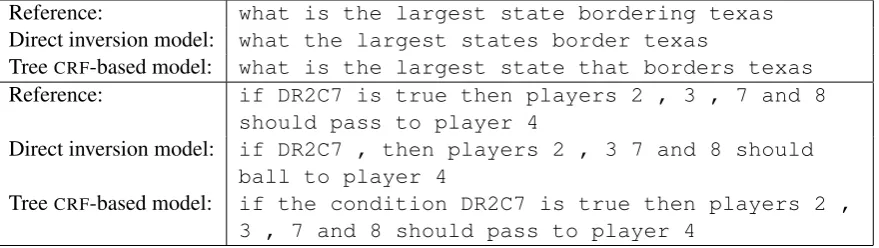
direct inversion model fails to capture the transi-tional behavior from one phrase to another, which makes it more vulnerable ton-gram mismatch, es-pecially when evaluated on the GEOQUERY
cor-pus where phrase-to-phrase transitions are more frequent. On the other hand, the tree CRF-based
Reference: what is the largest state bordering texas
Direct inversion model: what the largest states border texas
TreeCRF-based model: what is the largest state that borders texas
Reference: if DR2C7 is true then players 2 , 3 , 7 and 8 should pass to player 4
Direct inversion model: if DR2C7 , then players 2 , 3 7 and 8 should ball to player 4
TreeCRF-based model: if the condition DR2C7 is true then players 2 ,
[image:9.595.81.521.63.187.2]3 , 7 and 8 should pass to player 4
Figure 4: Sample outputs from the two models, for GEOQUERY domain (top) and ROBOCUP domain
(bottom) respectively.
5.2 Comparison with previous model
We also compare the performance of our treeCRF
-based model against the previous state-of-the-art system WASP−1++ in Table 3. Our treeCRF-based
model achieves better performance on both cor-pora. We are unable to carry out statistical sig-nificance tests since the detailed BLEU and NIST
scores of the cross validation runs of WASP−1++
as reported in the published paper of Wong and Mooney (2007) are not available.
The results confirm our earlier discussions: the dependencies between the generated NL words are important and need to be properly modeled. The WASP−1++ system uses a log-linear model
which incorporates two major techniques to at-tempt to model such dependencies. First, a back-off language model is used to capture dependen-cies at adjacent word level. Second, a technique that merges smaller translation rules into a single rigid rule is used to capture dependencies at phrase level (Wong, 2007). In contrast, the proposed tree
CRF-based model is able to explicitly and flexibly
exploit phrase-level features that model dependen-cies between adjacent phrases. In fact, with the hybrid tree framework, the better treatment of the tree structure of MR enables us to model some cru-cial dependencies between the complete MR tree and generated NL phrases. We believe that this property plays an important role in improving the quality of the generated sentences in terms of flu-ency, which is assessed by the evaluation metrics. Furthermore, WASP−1++ employs minimum
error rate training (Och, 2003) to directly optimize the evaluation metrics. We have not done so but still obtain better performance. In future, we plan to explore ways to directly optimize the evaluation metrics in our system.
5.3 Experiments on different languages Following the work of Wong and Mooney (2007), we also evaluated our system’s performance on a subset of the GEOQUERY corpus with 250
in-stances, where sentences of 4 natural languages (English, Japanese, Spanish, and Turkish) are available. The evaluation results are shown in Ta-ble 4. Our tree CRF-based model achieves better
performance on this task compared to WASP−1++.
We are again unable to conduct statistical signifi-cance tests for the same reason reported earlier.
6 Conclusions
In this paper, we presented two novel models for the task of generating natural language sentences from given meaning representations, under a hy-brid tree framework. We first built a simple di-rect inversion model as a baseline. Next, to ad-dress the limitations associated with the direct in-version model, a tree CRF-based model was
in-troduced. We evaluated both models on standard benchmark corpora. Evaluation results show that the treeCRF-based model performs better than the
direct inversion model, and that the treeCRF-based
model also outperforms WASP−1++, which was a
previous state-of-the-art system reported in the lit-erature.
Acknowledgments
The authors would like to thank Seung-Hoon Na for his suggestions on the presentation of this pa-per, Yuk Wah Wong for answering various ques-tions related to the WASP−1++ system, and the
References
Alfred V. Aho and Jeffrey D. Ullman. 1972. The Theory of Parsing, Translation and Compiling. Prentice-Hall, Englewood Clis, NJ.
James K. Baker. 1979. Trainable grammars for speech recognition. InProceedings of the Spring Confer-ence of the Acoustical Society of America, pages 547–550, Boston, MA, June.
John Carroll and Stephan Oepen. 2005. High ef-ficiency realization for a wide-coverage unification grammar. InProceedings of the 2nd International Joint Conference on Natural Language Processing (IJCNLP 2005), pages 165–176.
John Carroll, Ann Copestake, Dan Flickinger, and Vic-tor Poznanski. 1999. An efficient chart generaVic-tor for (semi-) lexicalist grammars. In Proceedings of the 7th European Workshop on Natural Language Generation (EWNLG 1999), pages 86–95.
Thomas H. Cormen, Charles E. Leiserson, Ronald L. Rivest, and Clifford Stein. 2001. Introduction to Algorithms (Second Edition). MIT Press.
George Doddington. 2002. Automatic evaluation of machine translation quality using n-gram co-occurrence statistics. InProceedings of the 2nd In-ternational Conference on Human Language Tech-nology Research (HLT 2002), pages 138–145. Ruifang Ge and Raymond J. Mooney. 2005. A
statis-tical semantic parser that integrates syntax and se-mantics. In Proceedings of the 9th Conference on Computational Natural Language Learning (CoNLL 2005), pages 9–16.
Rohit J. Kate and Raymond J. Mooney. 2006. Us-ing strUs-ing-kernels for learnUs-ing semantic parsers. In Proceedings of the 21st International Conference on Computational Linguistics and the 44th Annual Meeting of the Association for Computational Lin-guistics (COLING/ACL 2006), pages 913–920. Rohit J. Kate, Yuk Wah Wong, and Raymond J.
Mooney. 2005. Learning to transform natural to for-mal languages. InProceedings of the 20th National Conference on Artificial Intelligence (AAAI 2005), pages 1062–1068.
Martin Kay. 1996. Chart generation. InProceedings of the 34th Annual Meeting of the Association for Computational Linguistics (ACL 1996), pages 200– 204.
Philipp Koehn. 2004. Pharaoh: a beam search de-coder for phrase-based statistical machine transla-tion models. InProceedings of the 6th Conference of the Association for Machine Translation in the Americas (AMTA 2004), pages 115–124.
John D. Lafferty, Andrew McCallum, and Fernando C. N. Pereira. 2001. Conditional random fields: Probabilistic models for segmenting and labeling
sequence data. In Proceedings of the 18th Inter-national Conference on Machine Learning (ICML 2001), pages 282–289.
Wei Lu, Hwee Tou Ng, Wee Sun Lee, and Luke S. Zettlemoyer. 2008. A generative model for pars-ing natural language to meanpars-ing representations. In Proceedings of the 2008 Conference on Empirical Methods in Natural Language Processing (EMNLP 2008), pages 783–792.
Yusuke Miyao and Jun’ichi Tsujii. 2002. Maximum entropy estimation for feature forests. In Proceed-ings of the 2nd International Conference on Human Language Technology Research (HLT 2002), pages 292–297.
Yusuke Miyao and Jun’ichi Tsujii. 2008. Feature for-est models for probabilistic HPSG parsing. Compu-tational Linguistics, 34(1):35–80.
Hiroko Nakanishi, Yusuke Miyao, and Jun’ichi Tsujii. 2005. Probabilistic models for disambiguation of an HPSG-based chart generator. InProceedings of the 9th International Workshop on Parsing Technologies (IWPT 2005), volume 5, pages 93–102.
Franz J. Och. 2003. Minimum error rate training in statistical machine translation. InProceedings of the 41st Annual Meeting of the Association for Compu-tational Linguistics (ACL 2003), pages 160–167. Kishore Papineni, Salim Roukos, Todd Ward, and
Wei-Jing Zhu. 2002. Bleu: a method for automatic eval-uation of machine translation. InProceedings of the 40th Annual Meeting of the Association for Compu-tational Linguistics (ACL 2002), pages 311–318. Michael White and Jason Baldridge. 2003. Adapting
chart realization to CCG. InProceedings of the 9th European Workshop on Natural Language Genera-tion (EWNLG 2003), pages 119–126.
Michael White. 2004. Reining in CCG chart realiza-tion. InProceeding of the 3rd International Confer-ence on Natural Language Generation (INLG 2004), pages 182–191.
Yuk Wah Wong and Raymond J. Mooney. 2006. Learning for semantic parsing with statistical ma-chine translation. InProceedings of the Human Lan-guage Technology Conference of the North Ameri-can Chapter of the Association for Computational Linguistics (HLT/NAACL 2006), pages 439–446. Yuk Wah Wong and Raymond J. Mooney. 2007.
Generation by inverting a semantic parser that uses statistical machine translation. In Proceedings of the Human Language Technology Conference of the North American Chapter of the Association for Computational Linguistics (NAACL/HLT 2007), pages 172–179.