World Maritime University World Maritime University
The Maritime Commons: Digital Repository of the World Maritime
The Maritime Commons: Digital Repository of the World Maritime
University
University
World Maritime University Dissertations Dissertations
11-5-2017
Towards an integrated ocean governance regime and
Towards an integrated ocean governance regime and
implementation of the Sustainable Development Goal 14 in
implementation of the Sustainable Development Goal 14 in
Nigeria
Nigeria
Taoheed Olalekan Folami
Follow this and additional works at: https://commons.wmu.se/all_dissertations
Part of the Environmental Policy Commons
Recommended Citation Recommended Citation
Folami, Taoheed Olalekan, "Towards an integrated ocean governance regime and implementation of the Sustainable Development Goal 14 in Nigeria" (2017). World Maritime University Dissertations. 592.
https://commons.wmu.se/all_dissertations/592
WORLD MARITIME UNIVERSITY,
MALMÖ, SWEDEN
TOWARDS AN INTEGRATED OCEAN GOVERNANCE REGIME
AND IMPLEMENTATION OF THE SUSTAINABLE
DEVELOPMENT GOAL 14 IN NIGERIA
FOLAMI, TAOHEED OLALEKAN
NIGERIA
A dissertation submitted to the World Maritime University, Malmö in
partial fulfillment of the requirements for the award of the degree of
MASTER OF SCIENCE
IN
MARITIME AFFAIRS
OCEAN GOVERNANCE, SUSTAINABILITY AND MANAGEMENT
2017
ACKNOWLEDGEMENT
My immense gratitude goes to Almighty Allah for making it possible for me to
write this dissertation. I most heartedly appreciate the support and
encouragement of my Supervisor, Professor Ronan Long for his invaluable
guidance and useful advice in the course of writing the dissertation. I also
appreciate the intellectual mentorship of Professor Lawrence Hildebrand, Dr
Mary Wisz and all the WMU faculty and visiting professors that facilitated my
specialisation course.
I sincerely appreciate the fellowship opportunity and financial support of the
Sasakawa Peace Foundation for making it possible for me to attend this
renowned university. My immense appreciation goes to the Chairman, Yohei
Sasakawa and his able advisor, Admiral Kudo and Mr. Shinichi Ishikawa for their
special interest in my academic endeavour. I am most grateful to the Director
General, Nigerian Maritime Administration and Safety Agency, Dr. Dakuku
Peterside and the entire management for granting me the study leave to attend
this programme. My thanks also goes to Mr. O. A . Abass and Mallam Abdullahi
Mustapha for encouraging me to apply, and nominating me for this programme.
ABSTRACT
Title of Dissertation
: Towards an Integrated Ocean Governance Regime and
Implementation of the Sustainable Development Goal 14 in Nigeria
Degree:
MSc.
The need to develop a coordinated and integrated approach for the governance of coastal and marine resources and the protection of the marine environment from further degradation caused by natural and anthropogenic activities, particularly climate change, pollution from oil exploration and exploitation, sand mining, agricultural and industrial development has become imperative in Nigeria. This dissertation examines the need to adopt an integrated approach to ocean governance as a means of promoting the sustainable use and protection of the coastal and marine areas. It also suggests that an integrated ocean governance approach would enable Nigeria to meet her commitment to the implementation of the Sustainable Development Goal (SDG) 14 which concerns the Conservation and sustainable use of Ocean, Sea and Marine resources for Sustainable Development.The study examines the current approach to ocean governance in Nigeria and the steps the country can take to achieve an integrated ocean governance regime as a means of contributing to the implementation of the SDG 14. The dissertation concludes that the observed inefficiencies and limitations of the current sectoral approach to ocean governance cannot enable optimal utilisation of resources and the protection and conservation of marine and coastal environment.
Contents
LIST OF ABBREVIATIONS AND MEANINGS --- 7
LIST OF FIGURE --- 8
FIGURE 1. THE EFFECTS OF INSTITUTIONAL ARRANGEMENTS --- 8
FIGURE 2: OPERATION PHAKISA. --- 8
LIST OF TABLE --- 9
TABLE 1: SDG 14 TARGETS AND INDICATORS. --- 9
TABLE 2: NIGERIA’S SDG INDICATORS BASELINE DATA, 2016 --- 9
1.0 INTRODUCTION --- 9
1.1 BACKGROUND OF STUDY --- 9
1.2 OBJECTIVES --- 12
1.3 RESEARCH QUESTIONS --- 12
1.4 METHODOLOGY --- 13
1.5 SCOPE AND LIMITATIONS OF THE STUDY --- 13
1.6 RATIONALE OF THE STUDY --- 13
1.7 OUTLINE OF STUDY --- 13
2.0 INTEGRATED OCEAN GOVERNANCE: CONCEPTS AND PRACTICES --- 14
2.1 INTRODUCTION --- 14
2.2 INTEGRATED GOVERNANCE PRINCIPLES --- 14
2.3 A REVIEW OF GOVERNANCE AND ITS ROLE IN INTEGRATED OCEAN AND COASTAL MANAGEMENT --- 15
2.4 INTEGRATED OCEAN GOVERNANCE --- 16
2.5 THE MAIN GOALS OF INTEGRATED OCEAN GOVERNANCE --- 16
2.6 OCEAN GOVERNANCE FRAMEWORK: LEGAL, INSTITUTIONAL AND LEVELS OF IMPLEMENTATION --- 16
2.6.1 LEGAL FRAMEWORK --- 17
2.6.2 INSTITUTIONAL FRAMEWORK --- 17
2.6.3 LEVELS OF IMPLEMENTATION --- 18
3.0 OCEAN GOVERNANCE IN NIGERIA --- 19
3.1 BACKGROUND --- 19
3.2 THE COASTAL AND MARINE ENVIRONMENT OF NIGERIA --- 20
3.3 LEGAL AND INSTITUTIONAL FRAMEWORK FOR OCEAN GOVERNANCE IN NIGERIA --- 20
3.3.1 NIGERIA MARITIME JURISDICTION --- 20
3.3.3 GOVERNANCE OF NON-LIVING RESOURCES AND OCEAN ENERGY
INITIATIVE --- 22
3.3.4 MARINE ENVIRONMENT PROTECTION AND CLIMATE CHANGE --- 22
3.3.5 MARITIME AND PORT GOVERNANCE --- 23
3.3.6 MARITIME SECURITY --- 23
3.4 CONCLUDING REMARK --- 23
4.0 INTEGRATED OCEAN POLICY AND INSTITUTIONAL ARRANGEMENT FOR INTEGRATED OCEAN GOVERNANCE --- 24
4.1 INTRODUCTION --- 24
4.2 KEY THEMES AND COMPONENTS --- 25
4.2.1 COMMON CATALYSTS --- 26
4.2.2 THE NATURE OF NATIONAL OCEAN POLICY --- 26
4.2.3 OBJECTIVES OF NATIONAL OCEAN POLICIES --- 26
4.2.4 GUIDING PRINCIPLES --- 27
4.2.5 INSTITUTIONAL MECHANISM FOR THE IMPLEMENTATION OF OCEAN POLICY --- 27
4.2.6 STRATEGIC INITIATIVES, ACTION PLANS AND PROGRAMMES --- 28
4.3 KEY LESSONS FOR OCEAN POLICY DEVELOPMENT AND IMPLEMENTATION PROCESS --- 29
5.0 INTEGRATED OCEAN GOVERNANCE AND THE IMPLEMENTATION OF SDG 14 --- 30
5.1 INTRODUCTION --- 30
5.2 INTERRELATIONSHIPS AMONG THE SEVEN TARGETS AND THREE MEANS OF IMPLEMENTATION OF SDG 14 --- 33
5.2.1 RESEARCH CAPACITY --- 33
5.2.2 ACCESS TO ARTISANAL FISHERS --- 33
5.2.3 IMPLEMENTATION OF UNCLOS--- 33
5.3 INSTITUTIONAL, REGULATORY AND POLICY FRAMEWORK FOR THE IMPLEMENTATION OF 2030 AGENDA AND SDGS IN NIGERIA --- 34
5.4 IMPLEMENTATION OF SDG 14 IN NIGERIA --- 34
5.5 POLICY AND PROGRAMME DRIVERS TOWARDS ACHIEVING GOAL 14 TARGETS IN NIGERIA --- 34
CHALLENGES OF IMPLEMENTING SDG 14 IN NIGERIA --- 35
6.0 CONCLUSION AND RECOMMENDATIONS --- 35
6.1 CONCLUSION --- 35
6.12 A POSSIBLE FUTURE FOR INTEGRATED OCEAN GOVERNANCE IN NIGERIA --- 36
6.2 RECOMMENDATIONS --- 36
6.21 INITIATION OF NATIONAL OCEAN POLICY --- 36
6.22 ISSUES OF INTERESTS IN THE NOP --- 36
LIST OF ABBREVIATIONS AND MEANINGS
CBD- CONVENTION ON BIOLOGICAL DIVERSITY
DAFF- DEPARTMENT OF AGRICULTURE, FORESTRY AND FISHERIES
DEA- DEPARTMENT OF ENVIRONMENTAL AFFAIR
DMR- DEPARTMENT OF MINERAL RESOURCES
DOALOS- DIVISION FOR OCEAN AFFAIRS AND THE LAW OF THE SEA
DOT- DEPARTMENT OF TRANSPORT
DPME- DEPARTMENT OF PLANNING MONITORING & EVALUATION
EEZ- EXCLUSIVE ECONOMIC ZONE
FAO- FOOD AND AGRICULTURE ORGANIZATION
FGN- FEDERAL GOVERNMENT OF NIGERIA
FMOE- FEDERAL MINISTRY OF ENVIRONMENT
FMPR - FEDERAL MINISTRY OF PETROLEUM RESOURCES
GEF- GLOBAL ENVIRONMENT FACILITY
IEA- INTERNATIONAL ENERGY AGENCY
ILO- INTERNATIONAL LABOUR ORGANIZATION
IMO- INTERNATIONAL MARITIME ORGANIZATION
IOC- INTERGOVERNMENTAL OCEANOGRAPHIC COMMISSION
ICCAT- INTERNATIONAL COMMISSION FOR THE CONSERVATION OF ATLANTIC TUNAS
IUCN- International Union for Conservation of Nature
MPSG- MARINE PROTECTION SERVICES AND GOVERNANCE
ISA- INTERNATIONAL SEABED AUTHORITY
LDCS- LEAST DEVELOPED COUNTRIES; LESS DEVELOPED COUNTRY
LMES- LARGE MARINE ECOSYSTEMS
LOS- LAWS OF SEA
MARPOL- INTERNATIONAL CONVENTION FOR THE PREVENTION OF POLLUTION FROM
SHIPS, 1973 AS MODIFIED BY THE PROTOCOL OF 1978
MSP- MARINE SPATIAL PLANNING
NBS- NATONAL BUREAU OF STATISTICS
NDP- NATIONAL DEVELOPMENT PLAN
NGOS- NON-GOVERNMENTAL ORGANIZATIONS
NIMASA- NIGERIAN MARITIME ADMINISTRATION AND SAFETY AGENCY
NIOMR- NIGERIAN INSTITUTE FOR OCEANOGRAPHY & MARINE RESEARCH
OES- OCEAN ENERGY SYSTEM
OIMC- OCEAN INTER-MINISTERIAL COMMITTEE
OTEC- OCEAN THERMAL ENERGY CONVERSION
RFB- REGIONAL FISHERY BODIES
SDGS- SUSTAINABLE DEVELOPMENT GOALS
SIDS- SMALL ISLAND DEVELOPING STATES
SOLAS- SAFETY OF LIFE AT SEA
UNCED- UNITED NATIONS CONFERENCE ON ENVIRONMENT AND DEVELOPMENT
UNCLOS- UNITED NATIONS CONVENTION ON THE LAW OF THE SEA
UNDESA- UNITED NATIONS DEPARTMENT OF ECONOMIC AND SOCIAL AFFAIRS
UNESCO- UNITED NATIONS EDUCATIONAL, SCIENTIFIC AND CULTURAL ORGANIZATION
UNFCCC- UNITED NATIONS FRAMEWORK CONVENTION ON CLIMATE CHANGE
UNGA- UNITED NATIONS GENERAL ASSEMBLY
WSSD- WORLD SUMMIT ON SUSTAINABLE DEVELOPMENT
LIST OF FIGURE
LIST OF TABLE
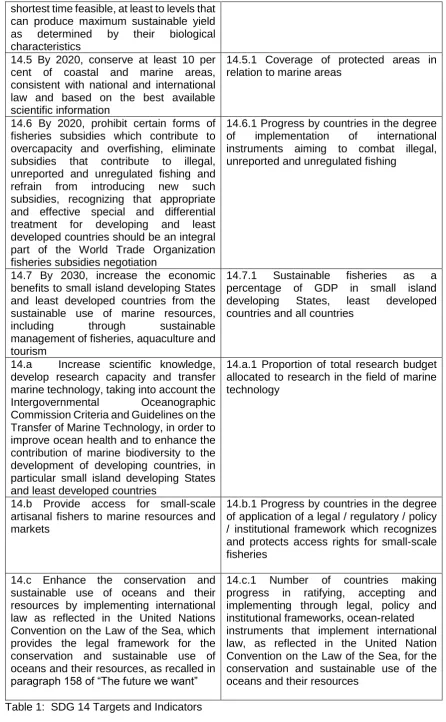
Table 1: SDG 14 Targets and Indicators.
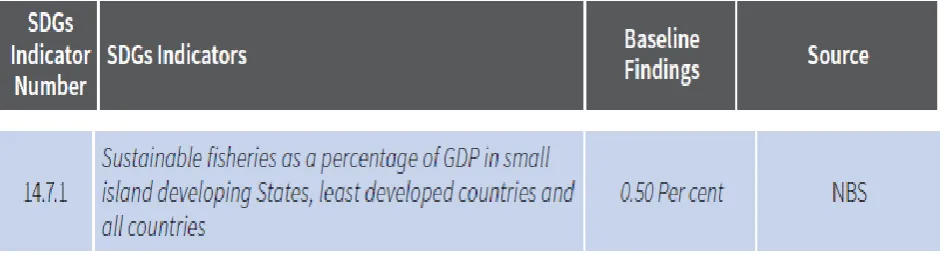
Table 2: Nigeria’s SDG Indicators Baseline Data, 2016
1.0 INTRODUCTION
1.1 BACKGROUND OF STUDY
Oceans contributes to human well-being, wealth and prosperity through the broad spectrum
of benefits and services it provides such as climate and weather regulation system, sea lanes
of communication, renewable energy production, bioprospecting and mineral mining(UNEP,
2016). However, anthropogenic-induced factors such as climate change, pollution, depletion
of marine resources and ocean acidification poses an adverse effect on the ecological integrity
of oceans resulting in loss of its habitats, biodiversity and an impairment of its ability to deliver
While it is generally acknowledged that the 1982 United Nations Convention on the Law of the
Sea (UNCLOS) declared international norms for future ocean governance and represents the
constitution of the world’s oceans detailing the rights, duties and obligations of nations in
relation to the ocean and its resources, however the convention offer little guidance to nations
on matters relating to the integrated governance of ocean resources, how to manage the
effects of one use on other uses or how to align ocean and coastal management (Cicin-Sain,
and Knecht, 1998). Chapter 17 of Agenda 21, the outcome document of the United Nation
Conference on Environment and Development (UNCED), whose theme focuses on the
protection of the oceans and seas of all kinds and coastal areas clearly highlights the important
role of oceans and coasts to the global life support system and the exceptional opportunity
these unique ecosystems offer for sustainable development and therefore recommends that
nations should outline new governance approach for the management of its resources which
should be ’integrated in content and precautionary and anticipatory in ambit’’(UN, 1992).
Paragraph 17.6 of Agenda 21 specifically recommended Coastal States to consider the
establishment, or strengthening of suitable coordinating mechanisms (such as a high-level
policy planning body) for the integrated management and sustainable development of their
coastal and marine areas and resources, at both the local and national levels. The
mechanisms should include consultation with the private sector, academic institutions, NGOs,
local communities, indigenous people and resource user groups. The outcome of the
coordinating mechanism is to enable government implement integrated plans and sustainable
development programmes for the coastal and marine areas at appropriate levels(UN, 1992).
A number of coastal nations have in the recent decade taken concrete steps to evolve and
implement an integrated vision of governance in their maritime zones in adherence to the
prescriptions of UNCLOS which stipulates that ‘the problems of ocean space are interrelated and must be treated as a whole’ and to respond to the conflicting uses of the ocean under
national jurisdiction by articulating national ocean policies that seeks to harmonize existing
uses and laws, protect marine biodiversity and ecosystems, promotes sustainable
development of ocean resources and coordinate institutions involved in ocean affairs(Balgos,
et.al., 2015).
Nigeria is a coastal state endowed with a coastline of 853 kilometres and an inland waterway
of 8,575 kilometres traversing two major Rivers- Niger and Benue and other smaller rivers and
creeks(NIMASA, 2009). The country has vast interests in the offshore oil and gas industry
which accounts for about 35 percent of Nigeria’s Gross Domestic Product in 2014 (DOALOS,
2016), fisheries, maritime trade and maritime security concerns, thereby making ocean affairs
a strategic interest to the nation.
Nigeria is a beneficiary of UNCLOS that came into force on 16 November 1994.The Federal
Republic of Nigeria signed and ratified the convention on 10 December 1982 and 14 August
maritime zone claim of 12-nautical mile territorial sea, 24-nautical mile contiguous zone and
an associated jurisdiction regarding archaeological and historical objects, 200-nautical mile
exclusive economic zone (EEZ) and a continental shelf which at a minimum is co-extensive
with the EEZ and beyond to an outer limit of 350 nautical miles from the coastal baselines or
100 nautical miles from the 2500 metre isobaths (DOALOS, 2011).As a dualist State, Nigeria
took steps in 2009 to domesticate the Law of the Sea (LOS) regime by initiating an executive
bill entitled, ‘A Bill for an Act to Repeal the Exclusive Economic Zone Act Cap. E17 LFN 2004
and the Territorial Waters Act Cap. TS LPN 2004 and Enact the Maritime Zones Act to Provide
for the Maritime Zones of Nigeria and for Matters Connected Therewith’, in the National
Assembly of Nigeria to enable the country properly define her maritime zone claims, sovereign
rights and jurisdictions under UNCLOS beyond those provided in current national legislations
(Chircop et al 2016; Federal Republic of Nigeria, 2009).The executive bill is yet to be passed
into law by the legislative arm of government as at the time of writing this thesis.
The 2016 National Policy on Environment Report identified a number of environmental
challenges affecting the coastal and marine environment in Nigeria which include pollution
from oil spills, gas flaring, sewage and solid wastes, industrial and agricultural effluents,
modification of ecosystem in the form of biodiversity loss, depletion of fisheries resources,
coastal erosion, flooding, deforestation, salt water intrusion and invasive/exotic
species(FMOE, 2016). Syndicated crimes perpetrated on the nation’s sea include illegal,
unreported and unregulated (IUU) fishing and overfishing, illegal arms and narcotic drugs
trafficking, illegal oil bunkering, crude oil theft and the worst of these crimes is human
trafficking by sea, all of which stretches the operational capacity of the Nigerian Navy beyond
measure(AU, 2012; Ezekobe, 2016).
The ocean and marine environment in Nigeria is governed through a legion of institutions,
legislations and sectoral policies that results in the problem of overlapping functions and
responsibilities, lack of cooperation and coordination amongst the implementing government
agencies and reliance on obsolete laws and regulations which are out of tune with the
challenges of the prevailing dispensation, and incompatible with the provisions of UNCLOS,
thereby impeding the nation from reaping its full potentials from the sustainable use and
conservation of its seas and marine resources for sustainable development (Agbakoba, O.
2006). The problem of coastal and marine environmental degradation in Nigeria is
exacerbated by weak and fragmented environmental governance that rely on a piecemeal
approach (FMOE, 2016).
The inclusion of an ocean goal and targets as part of the17 Sustainable Development Goals
(SDGs) and 169 targets constituting the 2030 Agenda for Sustainable Development
underscore the importance of the ocean to humanity and the planet (UN, 2015). The
implementation of the ocean goal, SDG 14, on conservation and sustainable use of the
help the world and coastal states realise immense benefits from the ocean. Some of the
targets of SDG 14 have implementation timelines that ranges between 2020, 2025 and 2030.
Specifically, three of the ten targets refer to oceans as ecosystems, two others focus on threats
to oceans from pollution and ocean acidification while three other targets are concerned with
ocean economy matters including fishery subsidies, access for small-scale artisanal fishers to
marine resources and markets and benefits for small island developing States (SIDS) and
least developed countries (LDCs). The remaining targets relates to scientific knowledge,
transfer of technology and most importantly the implementation of international law as
reflected in UNCLOS(Le Blanc,et.al., 2017). The implementation of these non-binding SDG
14 targets within the stipulated timelines should provide an impetus to Nigeria to promptly fast
track the introduction of an integrated ocean governance regime as a means of responding to
the challenges of effectively managing its coastal and ocean environment and resources.
This research effort will therefore attempt to carry out an in-depth study of how an integrated
ocean governance regime, adherence to the principles of sustainable development and
implementation of SDG 14 can be leveraged to achieve a paradigm shift in the management
of ocean affairs in Nigeria.
1.2 Objectives
Against the backdrop of observed inadequacies of the sectoral governance approach for
managing ocean affairs in Nigeria and the imperative of meeting Nigeria’s aspirations of
implementing SDG 14 and its associated targets as contained in the 2030 Agenda for
Sustainable Development, this research effort intends to fulfil the following objectives:
1. To describe the concept of an integrated ocean governance regime, its objectives and
application in managing ocean affairs in Nigeria.
2. To identify the limitations and drawbacks of the current ocean governance regime in
Nigeria and discuss the processes to be followed in articulating an integrated and
coherent ocean governance regime either by means of a legislative action or an
executive initiative.
3. To demonstrate the role of an integrated ocean governance regime in implementing
the goals and targets of SDG 14.
4. To propose the need, if feasible, for the establishment of a statutory body - National
Ocean Secretariat- as a vehicle for the coordination of all governance issues on coastal
and ocean matters in Nigeria.
1.3 Research Questions
The following research questions will be answered during this study:
1. What is the existing approach to ocean governance in Nigeria?
2. What steps should be taken by Nigeria to achieve an integrated ocean governance?
3. How can an integrated ocean governance regime contribute to the implementation of
1.4 Methodology
Ocean Governance and Sustainable Development are concepts that have attracted immense
scholarly studies and contributions as evidenced by the quantity and quality of literatures
available on these subjects. This study therefore adopts a descriptive conceptual framework
to gain an understanding of the proposed research subject and provide answers to the
research questions raised.
To apply the chosen research method to this dissertation, the study gathered both qualitative
and quantitative data from peer-reviewed journals, books and online publications from the
United Nations Department of Economic and Social Affairs (UNDESA) and Division of Ocean
Affairs and Law of the Sea (DOALOS).
1.5 Scope and limitations of the study
The study basically involves the use of available secondary data. Insufficient baseline and
updated recent country data is another factor limiting the research work, hence the
presentation is highly qualitative, in the absence of quantifiable data.
1.6 Rationale of the Study
The expected results of this research will bring about the following benefits:
1. It will provide a rationale for the review and reform of the ocean governance regime in
Nigeria.
2. It will stimulate a consideration of the importance of SDG 14 in the policy and decision
making process of the executive and legislative arms of governments.
3. It will draw attention to the deleterious consequences of the exposure of coastal and
marine ecosystem to the risks of pollution, climate change and loss of biodiversity
which may impair their ability to support seafood security and sustainable blue
economy due to ineffective ocean governance.
4. It will bring about a change in the institutional capacity of Nigeria to make informed,
coherent and effective contributions at international fora and negotiations on the
development of international ocean governance framework at regional and global level.
5. It will contribute to knowledge for future research.
1.7 Outline of Study
The dissertation will be divided into six chapters. The first chapter contain an overview of the
study, including the context and objectives of the research. Chapter two examine the concept
of integrated ocean governance and an overview of its framework at international, regional,
national and local levels through an in-depth examination of contemporary literature.
Chapter three discusses ocean governance in Nigeria while chapter four focused on integrated
implementation of SDG 14. Chapter six discusses the research questions, possible
recommendations and conclusion.
2.0 INTEGRATED OCEAN GOVERNANCE: CONCEPTS AND PRACTICES
2.1 Introduction
The underlying principle supporting the adoption of an integrated approach seems to be founded upon a presumption that the current framework (jurisdictional and otherwise) are inadequate to resolve conflict, achieve cooperation, and manage the exploration and exploitation of marine resources while ensuring the protection of the environment(Long and O’Hagan, 2006). The adoption of an integrated approach to ocean governance is therefore motivated by the imperative of making better use of available resources and knowledge, to promote economic efficiency, initiate better priority-setting for public and private sector actions and increased accountability to the public (IOC, 2007).
VanderZwaag (1996) observed that integration is a term that is commonly and loosely used in the ocean management discipline and a fundamental principle of sustainable development. The term implies the need to:
• Incorporate environmental and socio-economic considerations in all decision-making sectors;
• Streamline fragmentation in authorities, responsibilities and approval/licensing processes; • Regulate management arrangements to reflect ecosystem realities;
• Overcome conflicts of uses in a particular area; and
• Apply interdisciplinary integration of different types of knowledge.
Integrated ocean and coastal governance recognises the unique interrelationships existing among coastal and ocean uses and the environments they impact and thus articulate measures to overcome the fragmentation inherent in the sectoral management approach(UNESCO, 2006).
2.2 Integrated Governance Principles
Integrated ocean and coastal governance is guided by the application of the overarching principles of integration and sustainable development (Cicin-sain & Belfiore, 2006). The principle of sustainable development is now widely applied in national and international environmental instruments. It is firmly rooted on four principles:
The principle of intergenerational equity which requires natural resources to be conserved for the benefit of future generations;
The principle of equitable use which requires States to exploit the natural resources within their jurisdiction in an equitable manner by being considerate of the needs of other states;
The principle of sustainable use which require states to exploit their natural resources in a sustainable, prudent, balanced or suitable manner; and
The principle of sustainable development of oceans and coasts is concerned with maintaining a balance between the use of these ecosystems to maximize economic, social and cultural benefits without undermining their health and productivity(UNESCO, 2006).
An ecosystem-based approach to management (EBM) is therefore acknowledged as an effective route to sustainable development. EBM for all marine uses involves managing the broad range of human activities that affect marine resources and ecosystems, which includes fisheries, mining, shipping, sewage treatment and pollution from point and nonpoint sources(Curtin, Richard & Prellezo, 2010)
Long, et.al, 2015 carried out an extensive literature review of EBM and thus provided a comprehensive definition of the concept:
EBM is an interdisciplinary approach that balances ecological, social and governance principles at appropriate temporal and spatial scales in a distinct geographical area to achieve sustainable resource use. Scientific knowledge and effective monitoring are used to acknowledge the connections, integrity and biodiversity within an ecosystem along with its dynamic nature and associated uncertainties. EBM recognizes coupled social-ecological systems with stakeholders involved in an integrated and adaptive management process where decisions reflect societal choice.
Integration can be defined as the aggregation of the various aspects of coastal and marine planning and management into a single unified system(Kay & Alder,1999). Cicin-Sain & Knecht (1998) identified five dimensions of integration relevant to the governance and management of ocean and coastal areas:
Intersectoral integration: Aligning agencies and groups from various sectors such as fisheries, tourism, oil and gas development to work together;
Intergovernmental integration: Coordination of several levels of governments: national, state and local entities with authority in the coastal zone and ocean management;
Spatial integration: Comprehensive management of issues relating to the land side of the coastal zone (including up-river issues related to watersheds and river basins) and issues related to the ocean space;
Science-management integration: Applying practical knowledge from the natural and social sciences to managerial decisions about the oceans and coasts;
International integration: Careful consideration of important transboundary issues that transcends national boundaries.
2.3 A Review of Governance and its role in Integrated Ocean and Coastal Management
The academic literature lack consensus on a single agreed-upon definition of governance, evidently, governance means different things in different fields of study, application and contexts. Governance literature provide some of the following definitions, which include:
Hirst (2000) offered a general definition of the term stating that “governance can generally be defined as the means by which an activity or ensemble of activities is controlled or directed, such that it delivers an acceptable range of outcomes according to some established standard”. Scanlon and Burhenne-Guilmin (2004) opined that governance establishes the framework for management and it is “constituted by institutions, formal and informal agreements and behaviours, how resources are used, how problems and changes are assessed, the actions permitted or prohibited and the regulation and sanctions applied as the means by which society defines goals and priorities and advances cooperation; be it globally, regionally, nationally or locally. The arrangements are expressed through legal and policy frameworks, strategies and action plans and monitoring of performance.”
The best way to grasp the concept and meaning of governance is to give ‘governance’ an object. For example, corporate governance is the way a company is administered while environmental governance requires that management systems for environmental stewardship should be established should be based on shared ethical responsibilities to protect and prevent environmental crisis (Robinson, 2002). The ‘object’ concept has culminated in the use of governance in many facets of management, including resource management thereby providing a mechanism to respond to resource degradation and a vehicle for achieving sustainable development(Singh, 2008).
Governance of ocean affairs is well recognised as providing management programmes for the regulation of maritime safety and its environmental impacts in the form of transfer of invasive aquatic species through ships’ ballast water as well as threats from overexploitation of resources, pollution, habitat destruction and ocean acidification (Interwies and Khuchua, 2017). With respect to integrated coastal and ocean management, governance refers to the structures and processes used to regulate activities, resources and behaviour, both public and private, in coastal and ocean areas under national jurisdiction (Cicin-sain & Belfiore, 2006).
2.4 Integrated Ocean Governance
The literature review of the integrated ocean governance concept indicates that it has no single definition and like governance, it is quite loosely defined(Singh, 2008). Integrated ocean governance can also be described as the planning process that considers the comparative influence, power and time horizon of each marine industry in the ocean space with the aim of maximizing the benefits from their collective activities while minimizing their negative impacts on the environment and ecosystems(FAO, 2016). By the same token, coastal and ocean governance can be defined as the processes and institutions through which coastal and ocean areas are managed by public authorities in collaboration with different stakeholders such as communities, industries and NGOs using national, sub-national and international laws, policies and programmes and by considering customs, tradition and cultural practices, so as to improve the socioeconomic conditions of the communities that depend on these areas and their living resources(UNESCO, 2006).
Integrated ocean governance makes use of specific approaches and tools that are proactive, multi-sectoral, inclusive and transparent to assist with marine decision-making. The widely applied decision-making tools include: coastal zone management, EBM, marine protected areas (MPAs), marine spatial planning (MSP), cumulative effects, marine property rights and rights-based fishery management systems (Zacharias, 2014).
2.5 The Main Goals of Integrated Ocean Governance
According to Cicin-Sain, Biliana and Knecht (1998), the main goals of integrated ocean governance are namely:
• To achieve sustainable development of the multiple and competing uses of coastal and ocean areas;
• To preserve the integrity of ecological processes, life support systems and biological diversity;
• To address and manage concerns relating to vulnerability of the environment and inhabitants of coastal and marine areas to natural and human-induced hazards;
• To analyse and address the implications of development, conflicting uses and interrelationships among physical processes and human activities in ocean and coastal areas; and
• To promote linkages and harmonization among coastal and ocean sectors and activities.
2.6 Ocean Governance Framework: Legal, Institutional and Levels of implementation
2.6.1 LEGAL FRAMEWORK
The legal framework consists of international and regional conventions and soft laws such as commitments and targets agreed upon by nations to be implemented as part of their legislations and national plans of action for managing coastal and marine affairs. These include:
The UNCLOS and its two Implementing agreements – the Deep-Sea Mining Agreement and the Fish Stocks Agreement – which are the legal regimes agreed by sovereign states to promote international communication towards achieving peaceful uses of the seas and oceans, equitable and efficient use of their resources, conservation of marine living resources, scientific research and the preservation and protection of marine environment (DOALOS, 2012).
The UN General Assembly (UNGA) resolution to develop a binding agreement under UNCLOS for the conservation and sustainable use of marine biodiversity of areas beyond national jurisdiction.
Instruments and agreements developed by other UN Bodies to contribute to the realization of the sustainable use of oceans including:
International Maritime Organization (IMO)- for example, the International Convention for the Safety of Life at Sea (SOLAS), 1974, the International Convention for the Prevention of Pollution from Ships, 1973, as modified by the Protocol of 1978 relating thereto (MARPOL 73/78) and the International Convention for the Control and Management of Ships’ Ballast Water and Sediments, 2004
Food and Agriculture Organization of the United Nations (FAO): Agreement to Promote Compliance with International Conservation and Management Measures by Fishing Vessels on the High Seas (1993 FAO Compliance Agreement) and the Code of Conduct for Responsible Fisheries (CCRF)1995.
UNEP: Global Programme of Action for the Protection of the Marine Environment from Land-based Activities (GPA) and Regional Seas Conventions.
The outcome documents of 1992 UNCED: Agenda 21 and United Nations Conference on Sustainable Development (UNCSD): ‘’The future we want".
The 2030 Agenda on Sustainable Development which include SDG 14 (“Conserve and sustainably use oceans, seas and marine resources for sustainable development”).
2.6.2 INSTITUTIONAL FRAMEWORK
The institutional framework consists of the organisations and mechanisms that are authorised to engage in ocean management and how they coordinate and cooperate to deliver on their mandates. These include:
A. INSTITUTIONS ESTABLISHED BY UNCLOS
The provisions of UNCLOS facilitated the establishment of four institutions (Zacharias, 2014):
International Tribunal for the Law of the Sea which was established by virtue of Part XV of the Convention to promote a regime for the peaceful settlement of disputes.
Commission on the Limits of the Continental Shelf was established under ANNEX II of the convention as a specialist body to assist coastal States on matters related to the establishment of the outer limits of their continental shelf.
Meeting of States Parties to the Convention: Article 319 Paragraph 2 (e) of the Convention authorise the Secretary General of the UN to convene meeting of the State Parties to discuss matters relating to ocean affairs and other administrative issues.
B. United Nations Open-ended Informal Consultative Process on Oceans and the Law of the Sea (the Consultative Process):
In 1999, the UNGA established the United Nations Open-ended Informal Consultative Process on Oceans and the Law of the Sea (the Consultative Process) to support the General Assembly to review developments in ocean affairs and the law of the sea by considering the annual report of the Secretary-General on ocean affairs and the law of the sea and to identify issues requiring improvement in coordination and cooperation at the intergovernmental and inter-agency levels(DOALOS, 2012).
C. Regular Process for Global Reporting and Assessment of the State of the Marine Environment, including Socioeconomic Aspects:
The adoption by the UNGA of the recommendation of the 2002 World Summit on Sustainable Development (WSSD) for the establishment of a Regular Process for the Global Reporting and Assessment of the State of the Marine Environment, including Socioeconomic Aspects has resulted in the production, in 2015, of The First Global Integrated Marine Assessment – World Ocean Assessment I and the design of a baseline to be followed in conducting future assessments(DOALOS, 2016).
D. UN Oceans:
The UN-Oceans was formed in 2003 as an inter-agency forum to improve the coordination, coherence and effectiveness of competent organizations of the UN concerned with coastal and ocean matters(DOALOS, 2003)
2.6.3 LEVELS OF IMPLEMENTATION
The implementation of an ocean governance framework should take place at the local, national, regional and international levels in a coherent manner so as to facilitate cooperation and coordination and overcome fragmentation of decision-making and exclusion of relevant stakeholders at the various levels.
Local Level
At the local level, indigenous communities should be mobilised to work closely with government and relevant stakeholders under a community-based management mechanism that promotes the co-management of resources and ocean stewardship in adherence to principle 22 of the Rio Declaration on Environment and Development(UN, 1992).
National Level
The government should provide political support to institutions managing ocean and coastal issues to improve their communication, cooperation, coordination and decision-making capacity to a level that enable them pursue an integrated management strategy that is relevant to the environmental and socio-economic priorities of the nation (Vallejo, 1994).
Regional Level
The coordination of regional ocean governance is structured around three main mechanisms: Regional Seas Programmes, which is an initiative of UNEP; Regional Fishery Bodies (RFBs), established under the framework of FAO; and Large Marine Ecosystem (LME) mechanisms facilitated by the Global Environment Facility (GEF). These mechanisms help with the implementation of international agreements such as UNCLOS, Convention on Biological Diversity (CBD), and FAO mandates at the regional level (Rochette, et.al, 2015).
International Level
on ocean affairs and the law of the sea since 1994. The UNGA has also constituted a number of working groups and processes under its stewardship to monitor and address different issues affecting the marine environment (DOALOS, 2012).
3.0 OCEAN GOVERNANCE IN NIGERIA
3.1 BACKGROUND
Maritime activities and governance has been in existence in the territory now known as Nigeria long before her contact with European explorers and subsequent colonial rule. The traditional institutions existing in pre-colonial era appointed households in coastal jurisdictions to oversee the use and conservation of marine resources, including search and rescue operations, training of boat drivers and regulation of marine pollution. The palaces of the heads of the traditional institutions served as secretariats to the coastal communities’ and provided an avenue for divisional heads of communities to report on activities taking place within their domain with a view to analyse current issues and formulate maritime policies to address the prevailing challenges(NIMASA, 2013).
Nigeria became a single geo-political entity on 1st January, 1914, following the decision of its
British colonial authorities to amalgamate the Northern and Southern Protectorates of Nigeria that were administered separately for decades. The country later gained political independence on 1st October, 1960 and is currently governed as a federal state with a strong
3.2 THE COASTAL AND MARINE ENVIRONMENT OF NIGERIA
The coastal and marine environment of Nigeria covers about 853 km long of coastline consisting of inshore waters, coastal lagoons, estuaries and mangroves in the Niger delta. The States along the coast in Nigeria include: Akwa Ibom State, Bayelsa State, Cross River State, Delta state, Lagos State, Ogun State, Ondo State and Rivers State(FAO, 2010).
The geomorphology of the coastal zone is divided into 4 main physiographic zones:
• the Barrier lagoon coast lying between Badagry and Ajumo east of Lekki town;
• the Mahin mud coast stretches between Ajumo and the Benin river-estuary in the north-western margin of the Niger delta;
• the Niger Delta extends between the Benin river in the west and Imo river in the east; and • the Strand coastline originates from Imo river into the Nigerian/Cameroon border in the
east including Cross river (Awosika, et.al., 2002).
The Nigerian Continental Shelf stretches between 15km offshore Lagos to about 75km off the front of the Niger delta to about 85km offshore Calabar. The continental shelf is indented by three major canyons: Avon canyon, Mahin canyon and Calabar Canyon. The depth of the outer shelf is characterised by dead Holocene coral banks and ranges between 80 – 90 meters. Its bathymetry ranges from 0 to 100 meters and 120 meters distinguished by an often-steep continental slope (Awosika,et. al, 2002). The slope represents the starting point of what is termed the offshore ocean environment which is distinct from the near shore coastal ocean. The physical features of winds, waves and tides prevalent in the coastal zone originates from the offshore ocean. The physical feature of the offshore ocean alongside the near shore ocean and their drainage basins otherwise known as marine catchment basins constitute the geographical space named - LMEs (Isebor, 2004).
The coastal and marine areas of Nigeria is strategic to the socio-economic and ecological wellbeing of the country because of its natural endowment of rich biodiversity and fragile ecosystems such as mangroves, wetlands, barrier and lagoon systems, oil and gas deposits, fisheries, fauna and flora resources domiciled in these locations. The area attracts large human population and investments in industrial facilities worth billions of dollars(Awosika, et. al. 2002). However, the combined effects of natural hazards such as floods and anthropogenic factors linked to developmental pressures such as industrial and agricultural discharge of effluents, sewage and solid wastes, oil spills, gas flaring, invasive species, depletion of fisheries and alteration of ecosystems through loss of biodiversity have resulted in serious degradation and threats to the costal and marine environment(Awosika, 2008).
3.3 LEGAL AND INSTITUTIONAL FRAMEWORK FOR OCEAN GOVERNANCE IN NIGERIA
Ocean governance in Nigeria is superintended by a number of government Ministries, Departments and Agencies(MDAs), each administering legislations and policies relevant to their mandates. The MDAs pursue different objectives in isolation from one another to regulate the economic or technical activities within their sectors. This section highlights aspects of the legal and institutional framework used in ocean governance in Nigeria.
3.3.1 NIGERIA MARITIME JURISDICTION
bill to consolidate the Maritime Zone laws into a single statute by seeking an amendment from the National Assembly to the current Territorial Water Act and EEZ Act and an enactment into law of an Act to determine the Maritime Zones of Nigeria and for Matters Connected Therewith (Federal Republic of Nigeria, 2009).
Chircop, et. al 2016 observed a number of provisions in the proposed bill, which is yet to be passed into law, that will help Nigeria maximize maritime zone benefits. These include:
The definition of normal baselines and delineation of baselines provisions in section 1(1) – (3) of the bill substantially align with the stipulations in article 5 and articles 9-14 of UNCLOS on normal baselines;
The bill vests legal authority for the delineation of baselines and the designation of officially recognised geographical coordinates and charts in an official assigned with ministerial powers;
With respect to the delimitation of territorial sea boundaries with a neighbouring state, section 4 of the bill require the delimitation to be based on an agreement with the state and in the absence of an agreement the bill prescribes the median equidistance boundary in line with article 15 of UNCLOS;
The bill introduced the legislative provisions of a contiguous zone into Nigeria maritime zone legislation. This maritime zone will enable the country exercise preventive and enforcement jurisdictions to enforce compliance with the fiscal, customs, immigration and sanitary laws and regulations of Nigeria.
The activities of law enforcement agencies in the contiguous zone will be beneficial to a country like Nigeria which is faced with the challenges of combating crimes relating to illegal transboundary dumping and movement of hazardous wastes, syndicated trafficking of vulnerable people such as women and children and the illegal trafficking of endangered species through an effective enforcement of its customs, immigration and health regulations;
The bill included a provision on the exercise of jurisdiction for the protection of submerged archaeological and historical objects and prohibition of its trafficking in the contiguous zone in adherence with Article 303 of UNCLOS;
The provisions of the extant EEZ law of 1978 are essentially declaratory as it was enacted before the adoption of the final negotiating text of UNCLOS and as a result did not claim all the jurisdictional entitlements specified in Article 56 of UNCLOS. The bill will enable Nigeria to exercise full jurisdiction and sovereign rights over matters like marine environment protection and marine scientific research which were not claimed in the existing EEZ law;
Additionally, Section 10(3) of the bill took cognizance of the provisions contained in treaties and agreements which Nigeria may enter with other States such as the treaty concluded on Joint Development Zone with Sao Tome and Principe and Equatorial Guinea to permit modification to the sovereign rights exercised by Nigeria in the EEZ; The legislative provisions on the continental shelf regime in Nigeria is embodied in the
Petroleum Act of 1969, which is based on the Geneva Convention. The bill seeks an amendment to the existing provisions in the Petroleum Act to ensure its compliance with the full Article 76 definition in UNCLOS. With respect to the outer limits of the continental margin or continental shelf, the minister is empowered to seek recommendations from the National Boundary Commission to enable regulations to be issued on the charting of the geographical co-ordinates describing this maritime area.
3.3.2 GOVERNANCE OF LIVING RESOURCES
Department of Fisheries (FDF) and the Nigeria Institute of Oceanography and Marine Research (NIOMR). These institutions engage in policy formulation and implementation relating to national, regional and international initiatives; monitoring, control and surveillance; and research activities. The relevant legislations regulating fisheries governance in Nigeria include Sea Fisheries Act no. 71 of 1992, Sea Fisheries (Licensing) Regulations, 1992 and Inland Fisheries Act no. 108 of 1992(FAO, 2010).
The resource area for the exploitation of offshore marine fisheries in Nigeria is located between the continental shelf area and the 200-mile EEZ (Etim,et.al, 2015). Tuna and billfishes are the main species found in this area yielding about 10,000 to 15,000 tons/year. These migratory fishes are rarely exploited by Nigerians due to lack of technical capability to harvest it and as a result of the country’s inability to attract foreign investors due to its non-membership of the International Commission for the Conservation of Atlantic Tunas (ICCAT)(FAO, 2010).
3.3.3 GOVERNANCE OF NON-LIVING RESOURCES AND OCEAN ENERGY INITIATIVE
The governance of the non-living resources, particularly oil and gas resources, found in the coastal and marine areas of Nigeria is primarily implemented by a number of MDAs in the Federal Ministry of Environment (FMOE) and Federal Ministry of Petroleum Resources (FMPR). The laws and regulations on the protection of the environment as a result of the exploration and exploitation of oil and gas are executed by the Department of Petroleum Resources (DPR) and the National Oil Spill Detection and Response Agency (NOSDRA), which are agencies supervised by the FMPR and FMOE respectively. DPR derives its powers from the Petroleum Act 1969 and the 1991 Environmental Guidelines and Standards for PetroleumIndustry in Nigeria (EGASPIN) while NOSDRA implement and enforce compliance with the National Oil Spill Contingency plan (NOSCP) which is in line with the International Convention on Oil Pollution Preparedness, Response and Co-operation (OPRC) 1990, to which Nigeria is a signatory(UNEP, 2011).
A new Petroleum Industry Governance Bill passed by the Nigerian Senate Chamber on 25 May, 2017 seeks to merge the functions of the DPR with other existing bodies: Petroleum Inspectorate and the Petroleum Products Pricing Regulatory Agency (PPPRA)) to form a wholly independent commission to be known as the Nigerian Petroleum Regulatory Commission. The bill however need to be passed by the House of Representative and assented to by the President before coming into force(KPMG, 2017).
Nigeria became a contracting party to the Ocean Energy System (OES), a Technology Collaboration Programme created within the framework of the International Energy Agency (IEA), on 20 February 2013. NIOMR is the signatory entity representing Nigeria at the OES. The 2013 Country Report submitted by NIOMR to the OES indicate that Nigeria has commenced research into the process of identifying feasible and suitable locations offshore the continental shelf for the deployment of Ocean Thermal Energy Conversion (OTEC) facilities. The country’s membership of OES has also influenced the preparation of a draft policy on ocean energy and a proposal for the establishment of a CENTRE FOR OCEAN RENEWABLE ENERGY RESOURCES (CORER) within NIOMR(OES, 2013).
Sand mining is regulated by both the Nigeria Inland Water Authority (NIWA) and Federal Ministry of Mines and Steels Development (MMSD).
3.3.4 MARINE ENVIRONMENT PROTECTION AND CLIMATE CHANGE
(FMOE, 2015). However, Nigeria has not established a MPA to help conserve her marine resources and protect them from environmental degradation(Umana, 2002). The ministry actively represents Nigeria as a party at regional and global conferences such as the UNEP Regional Sea Programme, CBD and UNFCC.
The Nigerian Metrological Agency (NIMET) which was established under the NIMET Act 2003 and supervised by the Federal Ministry of Transport also participate in climate policy matters affecting the marine environment. NIMET represents Nigeria at the World Metrological Organisation(NIMET, 2003).
3.3.5 MARITIME AND PORT GOVERNANCE
The Federal Ministry of Transport (FMOT) coordinate the activities of institutions involved in ports and maritime affairs in Nigeria. The FMOT is currently developing a national blue economy policy and strategy to facilitate the sustainable development of deep seabed resources (NIMASA Press Release, 2017).
The leading agencies for the implementation of the policies and strategic goals of the ministry in relations to ports and maritime affairs are the Nigerian Maritime Administration and Safety Agency (NIMASA) and the Nigerian Port Authority (NPA). NIMASA perform the duties of a Maritime Administration. Its statutory powers are derived from the NIMASA Act 2007, Merchant Shipping Act 2007 and the Coastal and Inland Shipping (Cabotage) Act 2003. By virtue of its enabling legislations, NIMASA administers public policies to promote, regulate and enforce compliance with all aspects of its core functions including marine environment management, maritime safety and security, search and rescue operations, wreck receipt and removal, survey and certification of vessels, maritime labour administration, seafarers’ training and certification so as to protect the maritime interests of Nigeria, deepen indigenous participation and investment in the maritime industry and contribute to national economic prosperity(NIMASA, 2009).
As a maritime administration, NIMASA has a huge obligation as a flag state, coastal state and port state institution to implement the domesticated conventions of IMO and ILO in Nigeria towards safeguarding the technical and operational integrity of vessels, protection of the marine environment and the interests and welfare of dockworkers and seafarers. The agency represents Nigeria at ISA and coordinate the activities of the International Hydrographic Bureau in Nigeria(NIMASA, 2009).
Within the jurisdictional limits of ports and approaches to ports, the Nigerian Ports Authority (NPA) through its enabling legislation, NPA Act 2004, regulates the dredging of waterways, port marine services, provision of navigation aids and channels and act as landlord to private terminal operators(NIMASA, 2009).
3.3.6 MARITIME SECURITY
The Nigerian Navy (NN) provide security to secure the national maritime zone. NIMASA and the NN have a Memorandum of Understanding which created the Maritime Guard Command domiciled in NIMASA for the provision of security against illegal activities of ships in Nigeria waters (NIMASA Press Release, 2017b).
3.4 CONCLUDING REMARK
To overcome the shortcomings of sectoral governance, sovereign states now adopt a coordinated or integrated governance model for the regulation of all sectoral activities within their coastal and marine environment due to the observed inefficiencies and limitations of the sectoral approach to promote optimal utilisation of resources and the protection and conservation of marine and coastal environment. The integrated governance paradigm consider the relationship between the totality or combined impact of human use of resources and their cumulative impacts on the marine environment (DEA, 2012; Zacharias, 2014).
4.0 INTEGRATED OCEAN POLICY AND INSTITUTIONAL ARRANGEMENT FOR
INTEGRATED OCEAN GOVERNANCE
4.1 INTRODUCTION
The seminal article of Underdal (1980) provides far reaching theoretical insights into the concept of integrated ocean policy, describing what it is, why and how it can be accomplished. He posited that the diverse and rapidly changing processes of ocean use results in generating substantial exchange of externalities, which are unintended effects that are not directly envisaged. The overall goal of policy integration, therefore, is to improve coordination so as to realize efficiency through ‘’internalization of externalities’’. An integrated policy should thus overcome this problem because it aligns all interests involved in diverse policy components through a process that gives consideration to the comprehensiveness, aggregation and consistency of the policy(Underdal, 1980).
A national ocean policy is an aspect of public policy. Public policy can be expressed as laws, regulations, decisions or government actions which would be interpreted and executed by public and private entities (Birkland, 2011). A national integrated ocean policy articulates a framework that align and coordinate the management of all sector-based policies towards the protection of the economic, social and environmental values of the marine jurisdiction (Addison and Petrachenko, 2015).
This chapter provide an overview of the features of integrated ocean policies which constitutes the national ocean policy of coastal states and the institutional approaches used by states to implement the policy.
4.2 KEY THEMES AND COMPONENTS
The formulation of an integrated ocean policy and its implementation through the creation of an institutional framework that fosters cooperation and coordination amongst the entities involved in ocean governance brings about an expansion of the constituency or public support for ocean matters in the society (Kim, 2012) as shown in the figure below :
Fig.1. The Effects of Institutional Arrangements. Source: (Kim, 2012)
Hence, the design of an integrated ocean policy should take into consideration a number of fundamental national issues, including the following:
To identify matters of national priorities or catalysts prompting the initiation of the policy;
To decide on the nature or form of the policy;
To define the objectives of the policy that addresses the matters of national priorities;
To identify and select the guiding principles to achieve the objectives;
To articulate strategic options, action plans and programmes that should be executed to achieve the objectives;
To facilitate the institutional mechanism for the execution of the action plans and programmes;
The key elements of the above thematic issues relating to the development of an integrated ocean policy will be elaborated upon by drawing information from the experiences of different coastal countries and an African State, South Africa, as documented in available literature.
4.2.1 COMMON CATALYSTS
A number of factors that include, but not limited to, the imperative of redressing perceived inequities in benefits accruing to foreigners to the marginalisation of citizens from the use of the ocean area; multiple-use conflicts amongst uses, users and sectoral entities; environmental concerns; loss of economic opportunities occasioned by the negative impacts of human activities on marine ecosystems and the requirements of international conventions serves as catalysts to states to initiate policies for the sustainable use and conservation of ocean and coastal resources through an integrated management framework (Balgos,et. al, 2015). The development of integrated ocean policy in South Africa was triggered by the request of the National Development Plan (NDP) 2030 for a reappraisal of maritime sector resources to support a new growth plan that balances the goal of maximising ocean economy potentials with concerns for the protection of the ocean environment(DEA, 2014).
4.2.2 THE NATURE OF NATIONAL OCEAN POLICY
National ocean policies are usually expressed either as a legislative policy enacted as an Act of Parliament or an executive policy expressed as an executive order to direct the actions of MDAs. The ocean policies of countries such as Japan, Canada, Norway and United Kingdom are examples of legislative policies while the ocean policies of Australia, Mexico and United States are formulated as an executive policy(IOC, 2007).
The decision on the type of ocean policy adopted by a country depends, to a large extent, on the institutional and political structure prevailing in the country at the time of the policy development process and how that structure supports or hinders the ultimate policy choice. It is a well acknowledged fact that legislatively based policies are more enduring and resilient to political vicissitudes and changing circumstances compared to executive based policies which can easily be voided ‘with the stroke of a pen’ when a new government comes to power (Balgos, et. al, 2015).
In South Africa, the Department of Environmental Affairs (DEA) led the process of responding to the request of the NDP 2030 for a new ocean governance model by commissioning a study that resulted in the release of a gazetted green paper for public consultation. The Green Paper contends that integrated ocean governance cannot exclusively rely on the principles of cooperative governance it requires the drafting of a legislation such as an Ocean Act which will establish clear political, administrative and management framework for its implementation, stipulate the adoption of principles such as EBM and mechanism such as MSP for decision-making, and define the jurisdiction of the legislation and its linkages to extant legislations(DEA, 2012). Following contributions and comments received from the public on the green paper, an ocean policy white paper was thereafter released by the government which outlined the transition of ocean governance over a five-year period from a sectoral ocean management approach towards a coordinated cross-sectoral policy approach and the enactment of an Ocean Act for the implementation of an integrated ocean governance policy(DEA, 2014).
4.2.3 OBJECTIVES OF NATIONAL OCEAN POLICIES
on the state and function of the ocean; support regional and international governance mechanisms; and stimulate human and technical capacity building for better understanding of the uses of ocean resources and opportunities(DEA, 2014).
4.2.4 GUIDING PRINCIPLES
Most nations adopt principles recommended by international conventions and commitments such as Chapter 17 of Agenda, UNCLOS and CBD in developing their national ocean policy(IOC, 2007). The South Africa ocean policy is based on eight principles namely: sustainable development/ sustainability; the precautionary approach; protection of biodiversity and conservation of ecosystems; polluter pay principle; ecosystem based management; incentives for collaborative and cooperative governance; identification of economic opportunities for poverty alleviation; and strengthening human capacity to manage environmental change issues , including increasing sea-surface temperature, sea-level rise and ocean acidification and other effects of climate change(DEA, 2014).
4.2.5 INSTITUTIONAL MECHANISM FOR THE IMPLEMENTATION OF OCEAN POLICY
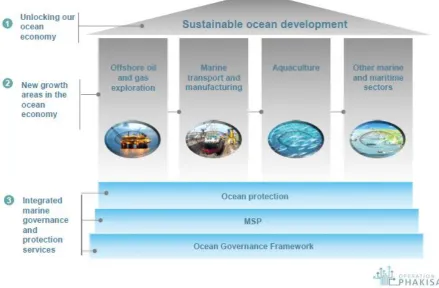
The further implementation of the recommendations in the ocean policy white paper was part of the strategic initiative of NDP 2030 to evolve an integrated ocean governance framework and promote sustainable ocean economy growth in South Africa through a programme known as ‘’Operation Phakisa: Unlocking the Economic Potential of South Africa's Oceans’’. The programme recognises Marine Protection Services and Governance (MPSG) as an aspect and critical success factor to unlock the ocean economy in sectors such as, Marine Transport and Manufacturing;Offshore Oil and Gas Exploration; andAquaculture as depicted in figure 2 below (Republic of South Africa, 2014). The President of South Africa inaugurated an Ocean Economy Lab constituted by a broad based team of experts and government officials to work on generating ideas for the implementation of the different aspects of the programme areas(Zuma, 2014).
Figure 2: Operation Phakisa. Source: MPSG Final Lab Report
The Ocean Inter-Ministerial Committee (OIMC) is the highest coordinating entity for the further development and implementation of South Africa’s ocean policy. The OIMC prioritise MSP and marine research and technology in the implementation of ocean policy. It also interfaces with stakeholders to resolve conflicts that cannot be handled at a lower level. The chairperson of the OIMC is the minister in the presidency for Department of Planning, Monitoring and Evaluation (DPME) and the members are the ministers in charge of the Department of Environmental Affairs (DEA), Department of Agriculture, Forestry and Fisheries (DAFF), Department of Transport (DOT) and Department of Mineral Resources (DMR) and other ministers may be included as required;
The Forum of South Africa’s Directors General (FOSAD) Oceans Subcommittee assists the OIMC to facilitate interdepartmental planning and advise on policy and regulation matters to strengthen ocean and coastal governance using reports and data on MSP to make recommendations on trade-offs and to resolve conflicts. The forum identifies learning opportunities in ocean governance and also coordinates national representations in regional and international oceans negotiations. The chairperson of the forum is the Director General (DG) of DEA and the other members are the DGs of DAFF, DOT, DMR, DPME, National Planning Commission (NPC) and other relevant departments as may be required;
The Ocean Secretariat is constituted as a permanent structure to provide secretariat support to the OIMC and FOSAD in respect of oversights and monitoring of coastal and ocean governance. The secretariat staff are assisted by Technical Working Groups (TWG) who act in an advisory capacity. Members of the TWG are not staff of the ocean secretariat.
This institutional framework will remain operational pending the enactment of an enabling legislation to institutionalise it as a permanent structure while the core mandates of the respective departments involved in ocean governance remain intact (Republic of South Africa, 2014).
4.2.6 STRATEGIC INITIATIVES, ACTION PLANS AND PROGRAMMES
The Ocean Secretariat coordinates a number of initiatives to strengthen ocean governance and protection in South Africa. These include:
REVIEW & ENANCHEMENT OF OCEAN-RELATED LEGISLATION
The ocean secretariat is coordinating an inter-departmental review of relevant international, regional and domestic marine and maritime legal instruments with a view to identify the limitations and areas of conflicts of these legislations and align the legislations with an overarching integrated ocean legislation that will define the scope of application of the integrated ocean governance regime; give legal effect to the establishment, powers and composition of new ocean governance structures, namely the OICM, FOSAD Sub-committee, and the Ocean Secretariat; clarify the main principles and goals of ocean governance; enforce the adoption and implementation of MSPs; specify procedures and mechanisms for dispute resolution; and authorise data collection responsibilities for the issuance of relevant authorisations and permits(Republic of South Africa, 2014). A draft national framework for MSP and a MSP bill has been completed. These instruments will regulate and provide legal authority for the use of ocean space and forestall users conflict issues. The legislative reform initiative has a medium target of producing results by March 2019 (Republic of South Africa, 2016).
MARINE PROTECTED AREAS (MPA) RESEARCH AND MONITORING PROGRAMME
programme to carry out a research of the state of biodiversity knowledge and status of Ecologically, Biologically Significant Areas so as to enhance the protection of the marine environment(Republic of South Africa, 2016).
ACCELERATED CAPACITY BUILDING IN OCEAN GOVERNANCE
The Ocean Secretariat coordinated a human capacity development assessment initiative to identify the skills, such as oceanography, marine ecology, MPA management, fisheries, climate change science, maritime law and judicial officers, required to enhance stewardship for coastal and ocean governance(Republic of South Africa, 2014). In total, 240 occupations have been identified in the Draft Organization Framework of Occupation (OFO) for the effective implementation of ocean governance. Plans are also in progress to commence post graduate training at the Nelson Mandela Metropolitan University in Master in Spatial Planning, MPhil in Maritime Studies and the LLM in Ocean Governance qualifications(Republic of South Africa, 2016).
INTEGRATED ENFORCEMENT PROGRAMME
The initiative coordinates an integrated and inter-departmental surveillance and enforcement mechanism to deal with all security concerns in the ocean and coastal areas in a manner that minimise costs and avoid overlaps so as to secure the areas and prevent illegal exploitation of resources, pollution, piracy, human trafficking, waste dumping and compliance with customs/excise/sanitary rules(Republic of South Africa, 2014).
MONITORING, EVALUATION AND FUNDING OF THE IMPLEMENTATION
The implementation of the MPSG initiatives have a deadline of 2019, the progress and milestones attained by the initiatives is monitored on a weekly basis by the DPME in the office of the President. The programme is estimated to cost ZAR 1.72 billion over a period of five years, 53% of the funds will come from funds already committed to Working with Coasts programme(Republic of South Africa, 2014).
4.3 KEY LESSONS FOR OCEAN POLICY DEVELOPMENT AND IMPLEMENTATION
PROCESS
The process requires consistent political support and understanding of the executive and legislative arms of government;
Public consultation and stakeholders support enhances the development and implementation of the policy;
It is crucial to develop the scientific, enforcement and governance skills of the human resources that will be involved in the implementation of the policy;
Enactment of new legislations and alignment of existing sectoral laws with the integrated governance framework will be necessary for the seamless implementation of the policy;
Establishment of an institutional arrangement such as an ocean secretariat or commission located at a high level within the government elevates its political profile and strengthen implementation of the ocean policy;
Funding and monitoring the progress of the development and actual implementation of the policy by the highest political institutions in a country is critical to its success