World Maritime University World Maritime University
The Maritime Commons: Digital Repository of the World Maritime
The Maritime Commons: Digital Repository of the World Maritime
University
University
World Maritime University Dissertations Dissertations
11-5-2017
A study on the effectiveness of the ISM Code on the seafarers'
A study on the effectiveness of the ISM Code on the seafarers'
awareness of safety culture
awareness of safety culture
Min Jung
Follow this and additional works at: https://commons.wmu.se/all_dissertations Part of the Environmental Policy Commons, and the Transportation Commons
Recommended Citation Recommended Citation
Jung, Min, "A study on the effectiveness of the ISM Code on the seafarers' awareness of safety culture" (2017). World Maritime University Dissertations. 561.
https://commons.wmu.se/all_dissertations/561
WORLD MARITIME UNIVERSITY
Malmö, Sweden
A STUDY ON THE EFFECTIVENESS OF THE
ISM CODE ON THE SEAFARERS' AWARENESS
OF SAFETY CULTURE
By
Min Jung
The Republic of Korea
A dissertation submitted to the World Maritime University in partial
fulfillment of the requirements for the award of the degree of
MASTER OF SCIENCE
In
MARITIME AFFAIRS
(MARITIME SAFETY AND ENVIRONMENT ADMINISTRATION)
2017
iii
ACKNOWLEDGEMENTS
First, I would like to express my deepest gratitude to Mr. Byoung-Gyu Seo, President
of the Korean Institute of Maritime Fisheries and Technology (KIMFT), for providing
me with the great opportunity to devote myself to my academic career for a year and
a half. This was a fruitful time for me to broaden my knowledge of maritime affairs. My
sincere gratitude also goes to my esteemed colleagues, professors and staff at my
institution (KIMFT) for supporting and encouraging me to accomplish this study at the
World Maritime University (WMU) in Sweden.
I am very much grateful to my distinguished supervisor, Professor Jens-Uwe
Schröder-Hinrichs of WMU, for his helpful comments, valuable resources and
immense support on this dissertation. I owe my deepest gratitude to Ms. Anne
Pazaver, Lecturer at WMU, for her sincere language review of my dissertation. Anne’s
advice and comments have been extremely helpful in improving my dissertation.
I also would like to express the deepest appreciation to Professor Daniel
Seong-Hyeok Moon of WMU, who was my esteemed captain 14 years ago at Korea Maritime
University. His constructive guidance and warm encouragement improved my
academic life at WMU. Also, I give special thanks to Professor Dong-Wook Song for
giving me motivational advice for my successful studies. In addition, I am thankful to
all professors and staff at WMU, and my fellows of 2017, especially MSEA students,
with whom I have studied and shared joy.
Last but not least, my heartfelt appreciation goes to my parents, Chel-Kyu Chung and
Yeon-Woo Seo, who always trust and support me. I would like to thank my
parents-in-law, Ok-Nam Kim and Ki-Hyun Kim, for wishing the success of this study. Above
all, I give my sincere thanks to my husband, Sung-Hoon Kim, and my lovely son,
iv
ABSTRACT
Title of Dissertation: A Study on the Effectiveness of the ISM Code on the Seafarers' Awareness of Safety Culture
Degree: MSc
The purpose of this dissertation is to explore whether the ISM Code is effective in promoting maritime safety culture. This dissertation measures seafarers’ perceptions of safety culture by distinguishing seafarers employed in ocean-going vessels applying the Code from those in domestic vessels not applying the Code. Through a comparison of the level of the consciousness of the two groups of seafarers on safety culture, it is possible to verify the effectiveness of the Code on safety culture. The dissertation assumes that the implementation of the Code impacts positively on safety culture.
To measure seafarers’ awareness of safety culture, a questionnaire including 43 items based on seven safety culture indicators was developed through a review of the relevant literature. A survey was conducted of Korean seafarers, and 208 responses were used for analysis.
The result showed that there were significant differences between the perceptions of safety culture between the two groups in organisational commitment, management involvement, reporting system, learning and reward system, and it was confirmed that the consciousness level of seafarers employed on ocean going vessels on these factors was high. Nevertheless, there were no significant differences between the two groups in employee empowerment and communication, so the Code could partly affect safety culture.
In this dissertation, the effectiveness of the ISM Code was verified by quantitative measurement of the perception of safety culture by Korean seafarers. This study is meaningful because it carried out empirical measurement of safety culture and it is expected that it can contribute to the establishment of measures to enhance safety culture.
v
TABLE OF CONTENTS
DECLARATION ... ii
ACKNOWLEDGEMENT ... iii
ABSTRACT ...iv
TABLE OF CONTENTS ... v
LIST OF TABLES
... viiLIST OF FIGURES ... viii
LIST OF ABBREVIATIONS ...ix
1. INTRODUCTION ... 1
1.1 Background ... 1
1.2 Objectives ... 4
1.3 The structure of the dissertation ... 5
2. THEORETICAL REVIEW OF SAFETY CULTURE ... 7
2.1 Historical background of safety culture... 7
2.2 Concept of safety culture and safety climate ... 9
2.3 ISM Code and safety culture ... 11
2.4. Approaches and related studies to assess safety culture ... 14
3.ISM CODE ... 19
3.1 The concept of the ISM Code ... 19
3.2 Implementation of the ISM Code in Korea ... 21
vi
4. RESEARCH METHODOLOGY ... 31
4.1 Research method and design appropriateness ... 31
4.2 Research model ... 32
4.3 Development of indicators for assessing safety culture ... 34
4.4 Relationship between factors of safety culture and ISM Code ... 35
4.5 Research questions and hypotheses ... 36
4.6 Design of the questionnaire ... 38
5. DATA ANALYSIS ... 39
5.1 Demographic characteristics of respondents ... 39
5.2 Reliability and validity of measurement instruments ... 40
5.3 Data analysis of safety culture indicators ... 44
5.3.1 Overall analysis of the survey result ... 44
5.3.2 Comparative analysis of average value of safety culture indicators ... 45
5.3.3 Analysis of the correlation of the safety indicators ... 46
5.4 Hypothesis testing ... 47
5.5 Summary of the main results ... 50
6. DISCUSSION AND CONCLUSION ... 52
6.1 Discussion of the findings ... 52
6.2 Conclusion ... 54
6.3 Limitation and future studies ... 56
REFERENCES ... 57
APPENDIX A ... 61
vii
LIST OF TABLES
Table 1 Guldenmund's approaches for study on safety culture edited
by author 15
Table 2 Measurement of safety culture 16
Table 3 Summaries of safety culture dimensions edited by the author 18
Table 4 Elements of ISM Code 21
Table 5 Audit status of SMS and DOC on Dec 31, 2009 23
Table 6 Licensed and Registered Vessels in Korea 24
Table 7 Status of the number of seafarers' employment in Korea 24
Table 8 Comparison of the ratio of accident between domestic vessels and ocean-going vessels 25
Table 9 The ratio of the number of registered ships and maritime accidents 26
Table 10 Status of maritime casualties of ocean-going merchant vessels from 2012 to 2016 27
Table 11 Status of maritime casualties of domestic merchant vessels from 2012 to 2016 28
Table 12 Legal improvements after the Sewol accident edited by the author
29
Table 13 Seven hypotheses 37
Table 15 Reliability of measurement items 41
Table 16 Result of the exploratory factor analysis 43
Table 17 Comparisons of perception on safety culture indicators 45
Table 18 Correlation analysis of the safety factor and the seven factors
46
Table 19 The result of independent sampled t-test analysis 47
viii
LIST OF FIGURES
Figure 1 Process of the study 6
Figure 2 Indicators of safety culture 11
Figure 3 Layer of document of safety management system 20
Figure 4 Concept of research model 33
Figure 5 Relation between Safety culture factors and the ISM Code
36
Figure 6 Comparisons of perception on safety culture indicators 44
ix
LIST OF ABBREVIATIONS
ABS American Bureau of Shipping
BBC/HP Bare boat charter with hire purchase
CANSO Civil Air Navigation Service Organisation
CASS Commercial aviation safety survey
DOC Document of Compliance
DWT Dead Weight Tonnage
IAEA International Atomic Energy Agency
ICS International Chamber of Shipping
IMO International Maritime Organisation
IMCO International Maritime Consultative Organisation
ISO 9000 International Organisation for Standardisation
ISM Code International Safety Management Code
JAIC Joint Accident Investigation Commission
KMST Korea Maritime Safety Tribunal
KMO Kaiser-Meyer-Olkin
KR Korea Register of Shipping
KTSA Korea Transportation Safety Authority
MAFRO Maritime Affairs and Fisheries Regional Offices
MLTM Ministry of Land, Transport and Maritime Affair
MODU Mobile offshore drilling units
MOF Minister of Oceans and Fisheries
NASA National Aeronautics and Space Administration
NLIC National Law Information Centre
NTSB National Transportation Safety Board
QMS Quality Management System
PSC Port State Control
x
SMC Safety Management Certificate
SMS Safety Management System
SOLAS International Convention for the Safety of Life at Sea
VDR
Voyage Data Recorder1
1. INTRODUCTION
1.1 Background
Since the International Maritime Organisation (IMO), which was formally known as the IMCO, was established in 1948, the IMO and its Member States have been contributing to prevent accidents at sea through developing and improving rules and regulations related not only to hardware such as ships’ hull design, stability and equipment but also human resources such as seafarers. Although these efforts have resulted in substantial improvements in the reliability of ships’ hardware as well as the quality of crews, maritime incidents are still a major concern for the shipping community (Rothblum, 2000; Ceyhun, 2014).
It has been shown in many studies that more than 80% of maritime accidents are caused by human error, for instance, failure of situational awareness, mistakes, slips and violations of regulations by crews on ships. However, at a deeper level, it can be seen that there are problems with organizational climate and management (KTSA, 2008).
2
investigations that deficiencies in safety culture lie in the management of companies' employees and ships’ crews (Lappalainen, 2016). These accidents remind the international community of the importance of the human element and the need to promote safety culture to ensure maritime safety.
With the perception of the importance of the safety culture in the maritime sector, the IMO has established measures to promote safety culture on ships. In 1994, the International Safety Management System (ISM) Code was implemented by the International Convention for the Safety of Life at Sea (SOLAS) and was promoted by the IMO with the safety culture on the maritime industries including ships and in ship owners (IMO, 2013; Anderson, 2015). In August 2016, the Secretary-General of IMO deemed that the Code was considered as the measure designed to directly influence maritime safety culture at a conference in Singapore (IMO, 2016).
The IMO set the objective of the ISM Code “to ensure safety at sea, prevention of human injury or loss of life and avoidance of damage to the marine environment (IMO, 1993, p.5)”. The Code includes provisions for establishing Safety Management System (SMS) to ships and ship owners to prevent human errors by assessing and identifying all risks and managing them.
According to the International Chamber of Shipping (ICS), the safety culture can be described as “the values and practices that management and personnel share to ensure that risks are always minimized and mitigated to the greatest degree possible.
(ICS, 2013, p.2)” The safety culture makes employees of shipping companies possible to improve their behaviour by allowing them to think and act based on safety and share a value of safety; thereby, it can bring enhancement of safety. Furthermore, the safety culture is essential for ships operation that is constantly exposed to potential risks, and it also an essential virtue required for personnel performing on-board operations and staff working for shipping companies.
3
and the Continental Express Flight 2574 accident in 1991 (von Thaden & Gibbons, 2008). Therefore, several studies have been carried out to assess safety culture, focusing on aviation pilots and traffic management operators.
In order to improve maritime safety, it is necessary to obtain an understanding of the detailed concepts of safety culture and establish a concrete approach to the safety culture. Therefore, a tool to assess the perception of safety culture can be a good measure to understand the characteristics of an organization, and make it possible to find a specific prescription to enhance safety culture.
Seafarers should work based on the perception that safety is the best way to prevent human error. It can be prevented by crews having high alertness about safety and an organizational culture should be promoted. Therefore, assessing seafarers’ awareness of safety culture can be a more active measure to prevent accidents on ships. In order to survey the awareness of the safety culture of the seafarers, it is important to apply an adequate tool that can be assessed quantitatively using reasonable indicators, and there are several studies to estimate seafarers’ awareness of safety culture.
With regard to the ISM Code, there is a question to whether the application of the Code has improved the awareness of safety culture of ship workers. As the Code has been enforced over the last two decades, many research and studies have evaluated the effectiveness of the ISM code. The IMO has also studied the impact of the ISM Code, which was introduced at eighty-first session of the Maritime Safety Committee (MSC) in 2006 (IMO, 2016). The study (IMO, 2005) found that the Code contributed to the enhancement of safety culture with positive benefits, and one of the recommendations was that further study was needed for the improvement of the Code reflecting safety culture. However, there were some studies relating negative effects of the Code. For instance, Bhattacharya (2012) argued that there were substantial gaps between seafarers’ and managers’ perception on the Code (Jung, 2016).
4
will be measured specifically based on the indicators by conducting surveys targeting crews working on the Code applied ships and non-applied ships.
Through this study, it is possible to understand the perception of the safety culture of seafarers, and to measure the level of safety culture on ships that apply and do not apply the ISM Code, so that the effectiveness of the ISM to the safety culture can be estimated. Furthermore, it is possible to compare and analyse its effectiveness based on the safety indicators, and it will be possible to identify the factors that need improvement to enhance the performance of ISM.
1.2 Objectives
This study aims to show a correlation between seafarers’ awareness of safety culture and ISM Code. Specifically, it aims to establish whether seafarers who are working on ships applying the ISM Code have a high level of consciousness of safety culture. Furthermore, the effectiveness of the Code in terms of promoting safety culture will be assessed based on indicators. In addition, the perception of the safety culture of seafarers will be compared and analysed based on the indicators by distinguishing crews working on the Code applied and non- the Code applied vessels.
For that purpose, the concept of safety culture will be examined in this study and optimum tool will be developed to assess seafarers’ perception of maritime safety culture. Therefore, this dissertation:
Studies the concept of safety culture by examining past studies in the aviation field and shipping industry.
Collects safety indicators for the assessment of safety culture based on past similar studies of aviation and the maritime sector.
Analyses elements of the ISM Code and the safety culture indicators, and develops optimum safety indicators, and develops a questionnaire based on the safety indicators.
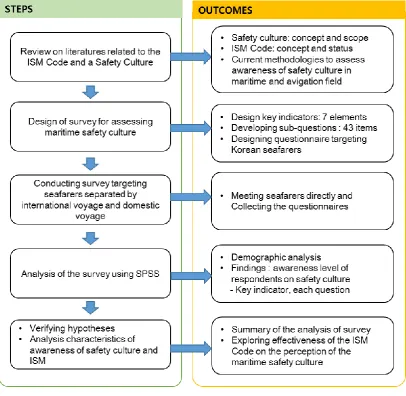
5
international and domestic ships using questionnaires. And analyses the results using SPSS.
Analyses the characteristics of the awareness of Korean seafarers and examines the correlation between ISM and the safety culture.
1.3 The structure of the dissertation
This study consists of seven chapters. Chapter one includes the background, the objectives and the structure of the thesis.
Chapter two will conduct a literature review related to the development of the concept of safety culture and relevant research to assess safety culture in the aviation and maritime fields. Furthermore, studies in terms of the effectiveness of the ISM Code will be reviewed.
Chapter three will examine the background, the role and the function of the ISM Code and elements of the Code. In addition, the implementation of the Code in Korea will be shown.
Chapter four will show the hypothesis and the methodology for this study. As the main hypothesis, the correlation between safety culture and the ISM will be suggested. With this hypothesis, other sub-hypotheses will be added in order to grasp the characteristics of Korean seafarers' perceptions of safety culture. Moreover, the design of the questionnaire will be shown in this chapter.
Chapter five contains an empirical analysis, which describes the characteristics of the data, evaluation of measurement items, and hypothesis testing. The collected questionnaires are analysed by using IBM SPSS Statistic 20, and analysis of frequencies, factors, reliabilities and t-test are conducted in order to enhance the objectivity of the research.
6
7
2. THEORETICAL REVIEW OF SAFETY CULTURE
2.1 Historical background of safety culture
The term safety culture was first introduced in the report of the Post-Accident Review Meeting written after the Chernobyl Accident by the International Nuclear Safety Group in 1986. According to the report, the IAEA indicated that the major cause of the nuclear power station accident was derived from a “poor safety culture” in the Soviet Union (IAEA, 1991).
Following the Chernobyl accident, a series of several major catastrophes occurred, for instance, a fire on the King’s Cross underground in 1987 and an explosion on the oil production platform, Piper Alpha, in 1988. The main causes of these accidents were also referred to as poor safety culture (Cox & Flin, 1998; Pidgeon, 1998: KTSA, 2008). Meanwhile, the explosion of the space shuttle Challenger in 1987 brought attention to safety culture in aviation. In addition, the Continental Express Flight2574
8
In the maritime field, safety culture has also begun to be recognized following a number of large-scale marine accidents, just as in the other industries. On 6th March
1987, the ro-ro passenger ferry Herald of free enterprise capsized in four minutes just after its departure, and there was a loss of 193 lives. This catastrophe brought about
full attention to safety culture in the maritime industry. Gill and Wahner (2012) and
Lappalainen (2016) indicated that the Herald of free enterprise, which was operated
by Townsend Car Ferries Limited, had a lack of safety culture among the ship’s crews
as well as the shore-based management. Moreover, the shore-side managers of the
ferry had always forced the crew to leave five minutes early from ports. On the day of
the incident, there was a hasty departure due to delayed shipments.At the time of the
departure of the ferry, the chief officer should have confirmed that the bow door of the
ship was closed. However, due to the climate of the company's management to make
a fast departure, he had to be on the navigational bridge. This climate of the
company’s management resulted in the chief officer’s mistake of failing to ensure that
the bow door was closed. Several months before the accident occurred, the master
asked the manager of the shipping company to install a means to indicate the closed
or open position of the bow doors, but the communication between the shore-based
manager and the master was not effective. It resulted from the corporate culture that
seeks to benefit rather than protect (Gill & Wahner, 2012).
Seven years following the Herald of Free Enterprise accident, another serious
maritime accident that raised awareness about safety culture occurred in the Baltic
Sea. On 28 September 1994, the car ferry Estonia capsized and sank due to a
separation of its bow visor in the rough sea. From the accident, 852 people died or
were missing and only 137 people survived. The direct cause was the separation of
the bow visor, which pulled off the watertight ramp behind it. After that, a huge amount
of water flooded into the ferry. According to the report of the Joint Accident
Investigation Commission (1997), prior to the Estonia accident, there had been
numerous failures involving bow visors on similar types of ships, which were
constructed at similar times, including one of the Estonia’s sister ships. However,
there had been no systematic remedies for existing ro-ro passenger ferries. Since
information or reports about those failures were not shared, the crew and master of
9
1997).
Safety culture has been introduced and studied to ensure safe working environment
and to prevent an accident as an important concept to manage risks in various
industries (Berg, 2013). It is clear that the importance of safety culture gains
recognition following a major disaster in any industry. If a safety culture is lacking in
any organisation, such as a ship or a company, it would be very difficult to manage
risk factors, and the lack of management can lead to major accidents.
2.2 Concept of safety culture and safety climate
The definition of safety culture has been studied since the 1980s following the occurrence of the Chernobyl disaster. Firstly, the IAEA (1991) defined safety culture as “Safety culture is that assembly of characteristics and attitudes in organizations and individuals which establish that, as an overriding priority, protection and safety issues receive the attention warranted by their significance. (p.4)” Since then, there have been many areas that deal with safety culture; however, there has been no consensual definition of safety culture (Guldenmund, 2000; Wiegmann, Zhang, von Thaden, Sharma & Mitchell, 2002). Many attempts have been made to define safety climate, along with studies on the definition of safety culture.
Zhang, Wiegmann, and von Thaden (2002) conducted comprehensive reviews on the concept of safety culture, along with safety climate, to better understand safety culture. The study analysed a total of 107 documents and papers, and 30 articles related to safety culture and safety climate.
According to the study (Zhang et al. 2002), safety culture was defined as the flowing:
10
learned from mistakes; and be rewarded in a manner consistent with these values. (p. 1406)
Furthermore, Zhang et al. (2002) defined safety climate as the flowing:
The temporal state measure of safety culture, subject to commonalities among individual perceptions of the organization. It is therefore situationally based, refers to the perceived state of safety at a particular place at a particular time, is relatively unstable, and subject to change depending on the features of the current environment or prevailing conditions. (p.1406)
Bhattacharya (2015) argued that there were differences between the concepts of safety culture and safety climate. Safety culture comes from inherent historical contexts or organizational operations, values, and traditions, and is formed over a long period (Cooper, 2000). On the other hand, safety climate is affected by the environment and the situation. By analogy, the safety climate can be relatively unstable and instantaneous, with the concept of a snapshot of the safety culture (Bhattacharya, 2015).
Safety culture is an inherent belief in a somewhat deeper core shared among its members and is expressed through a safety climate. In other words, if the safety climate is the environment in which the organization is located at that time, the safety culture is the nature of the organization (Cox & Flin, 1998). Therefore, most of the facts about safety culture are also true of safety climate (Guldenmund, 2000; Oltedal, 2011).
11
2.3 ISM Code and safety culture
According to the ISM Code, Ship Management System (SMS), which refers to a structured and documented system designed to ensure that a company’s employees can implement its policies for the safe operation of ships and the protection of the marine environment (IMO, 2013), shall be applied to ships. Moreover, the IMO encourages the establishment of a safety culture in the shipping sector through the establishment of the SMS (Anderson, 2015; IMO, 2013; Kongsvik, Størkersen, &
Antonsen, 2014;Schröder-Hinrichs, 2010).
The question has been raised as to what constitutes a good safety culture. Promoting safety culture can be effective to enhance the safety of an organisation (Lee, 2012). Wiegmann et al. (2002) identified the following features as to what is a “good” safety culture (Lappalanine, 2016). There are five organisational indicators of safety culture: “organizational commitment, management involvement, employee empowerment, reward systems, and reporting system” (Wiegmann et al., 2002, p.11).
The organizational commitment means upper-level management to promote safety culture. Practically, it entails a persistent attitude to safety, and adequate funding and allocation of resources for the development and implementation of safety (Wiegmann et al., 2002).
12
Management involvement refers to the degree to which senior management and middle managers are directly involved in important safety activities within the organization. This includes good communication between the top and bottom (Wiegmann et al., 2002).
Employee empowerment is the last defence to prevent errors by preventing worker errors (e.g. pilot) in the field. Organizations that have a good safety culture should delegate authority to employees to encourage them to actively participate and play an important role in promoting safety (Wiegmann et al., 2002).
Eiff (1999, p. 17) indicated that “One of the foundations of a true safety culture is
that it is a reporting culture.” The reporting system is a system for reporting incompatible elements and errors. It focuses on whether employees are encouraged to report safety issues without any difficulties, and whether they are well communicated (Wiegmann et al., 2002).
The reward system is necessary to establish an organizational culture, and both safe acts and unsafe acts need to be evaluated. A fair evaluation system will promote safety culture. Organizations with a good safety culture should look to ensure that the distinction between safe and unsafe behaviour is clear and has a clear and correct system of punishment (Wiegmann et al., 2002).
Lappalainen (2016) argued that the list of indicators developed by Wiegmann et al. (2002) does not clearly present a “continuous improvement process”, but stated that the reporting and rewarding system could be used as a practical tool for that purpose. Furthermore, Lappalainen (2016) indicated that there is no doubt that the characteristics of a good safety culture are implemented in the Code like a religious position.
13
A group of experts set up by the IMO surveyed to measure the effectiveness of the ISM Code, and a total of 3,109 respondents answered the questionnaire (IMO, 2005). An analysis by the expert groups showed that the ISM Code worked properly on ships and in shipping companies and improved maritime safety management positively. Furthermore, it showed that safety culture was promoted by implementing the ISM Code as the majority of respondents (96 to 99 percent) evaluated the ISM Code positively. However, the expert group noted that the survey was voluntary so respondents who participated in the survey had a positive attitude toward the ISM Code. Therefore, the survey had a limitation, whereby an overwhelmingly positive evaluation would have been made due to respondents who had positive attitudes to the survey (IMO, 2005).
Although the IMO determined that the evaluation of the effectiveness of the Code was positive, there have been several studies to suggest the implementation of the Code has negative aspects (Lappalainen, 2016). Bharttacharya (2011) indicated that managers had been bureaucratically applying the ISM Code by directing and enforcing guidelines to crew members in a top-down manner in implementing safety management. The crews applied their own experiences rather than using the ISM Code to conduct safe shipboard operations (Bhattacharya, 2012). These are the reasons why the effectiveness of the Code seems to be negative in the study. Besides, Anderson (2003) argued that the Code requires a lot of documentation on the part of seafarers, so it can be burdensome and complex, and Knudsen (2009) and Batalden and Sydnes (2014) noted that documents and procedures under the ISM Code are effectively applied to real work of seafarers. In addition, Bhattacharya (2012) noted that there was a considerable difference in the recognition of the crew members and the ship managers about the performance and execution of the ISM Code.
A recent study conducted interviews and observation on personnel's conceptions
of SMS and safety culture. Lappalainen (2016) scrutinised the views of personnel on
the impact of the ISM Code on maritime safety culture. As a result, perception of
safety culture was influenced by the ISM Code, but the effect seemed not to be strong.
Some interviewees had positive thinking on the SMS, and believed that the
14
However, there were negative views on the effectiveness of incident reporting and
documentation.
In Korea, the safety culture of seafarers has not been comprehensively studied. A
survey of seafarers' perceptions about safety culture was conducted. Kim (2013)
found that there were no differences in safety culture awareness among seafarers of
different ship types and ranks, and the main survey items were related to the
responsibility and attitude toward safety of seafarers. Furthermore, compliance with
the ISM Code can contribute to the promotion of safety culture.
In summary, most studies that have been conducted in the past have been related to the definition and concept of safety culture, and there have been few studies on the relationship between Safety Culture and the ISM Code (Guldenmund, 2010: Lappalainen, 2016). In addition, research on the effectiveness of the ISM Code itself has been conducted, but studies on whether it contributes to safety culture are not sufficient. In particular, there are no studies that quantitatively measure the effectiveness of the ISM Code on safety culture.
2.4 Approaches and related studies to assess safety culture
Since safety culture is covered in many fields such as nuclear power, road, railway, manufacturing and aviation, various research and evaluation methods exist. Furthermore, due to the importance of safety culture, many studies have been conducted to define and to assess safety culture (Wiegmann et al., 2002). Therefore, there is no standardised measurement tool that can be applied to all industrial fields (Cox & Flin, 1998).
15
of the culture. The last approach is an academic approach which is mainly conducted as a qualitative study, and it aims to grasp the status of a culture through interviews, observations anddocument studies (Guldenmund, 2010).
In recent years, combining these three approaches has been considered as useful in interpreting the concept of safety culture and understanding the safety management system. It would not be accurate to say that one method is perfect. By combining these approaches, one might be able to interpret the concepts of safety culture and apply them usefully to understanding the safety management system (Guldenmund, 2010).
As to methods of measurement of safety culture, Wiegmann et al. (2002) indicated that they could be practically divided into qualitative and quantitative methods as shown in Table 2. On the one hand, qualitative methods can be comprised of employee observation, focus group discussion, historical information review, and case studies. Through qualitative methodologies, deep and intensive information can be obtained based on the content discussed (Wiegmann et al., 2002). On the other hand, the quantitative approach measures safety culture by using standardized and coordinated procedures - interviews, surveys and questionnaires (Wiegmann et al., 2002). The culture can be assessed through a questionnaire, including safety factors or indicators, and it is easy to acquire people’s perceptions of the culture.
Table 1 Guldenmund (2010)'s approaches for study on safety culture edited by author
Approach objectives Tools & methodology Feature
Analytical Psychological safety
climate Questionnaires
- Quantitative methodology
Grasping the present culture
Pragmatic Assessment of the safety culture maturity of an organisation
Q-sort or rating scales for making appraisals
Expert opinions
Experience-based approach
Academic Understanding or
describing a culture Interviews, case study, observations or documentation
16
- Qualitative methodology
Each method has advantages and disadvantages. The qualitative approach can analyse and answer the internal factors through an in-depth approach to the questions and discussions, while the results can be biased according to the analyst's opinion. The quantitative approach can analyse the perception of the climate objectively by asking the opinions of the respondents through standardized questionnaires; however, it is difficult to analyse the responses of the participants in depth.
To assess safety climate, safety dimensions such as factors are needed. There have been several studies for developing tools to evaluate the level of safety culture in the aviation sector. The Korea Transportation Safety Authority [KTSA] (2008) conducted an assessment of safety culture and developed an index of safety culture for measuring the safety culture awareness level of aviation pilots. The survey developed a questionnaire utilizing the commercial aviation safety survey (CASS) scale which was developed by Wiegmann, Zhang, von Thaden, Sharman, and Gibbon (2003). Furthermore, the study utilised the indicators which were organisation commitment, management involvement, reward system, employee empowerment and reporting system. The CASS’s questionnaire originally contained 86 questions, but the KTSA limited their questionnaire to 46 questions due to realistic constraints such as pilots’ hectic schedule.
Table 2 Measurement of safety culture (Wiegmann et al., 2002; Lee, 2012)
17
Wang and Sun (2012) proposed a new index system for safety culture evaluation and showed its effectiveness and application for the assessment of safety culture at intrinsic and extrinsic levels, with seven sub-culture components: priority, standardizing, flexibility, learning, teamwork, reporting and just culture. Their survey, using a questionnaire, was carried out targeting a local aviation operator in Tanjin, China.
Song (2014) assessed safety climate in the aviation sector, targeting 30 traffic management operators and 25 pilots using a questionnaire with 50 questions. Safety factors developed by the Civil Air Navigation Service Organisation (CANSO) were utilised in the study. The factors were management skill, attitude, resource management, learning, communication, organisational structure, and management of change.
With regard to studies on assessment of maritime safety culture, Ek, Runefores and Borell (2013) conducted a study to assess the safety culture of six passenger ships. The study developed nine aspects of safety culture: flexibility, risk perception, behaviour, reporting, work situation, justness, attitudes, learning, communication and safety culture. The study presented the relationships between the nine aspects though using a questionnaire targeting crew working onboard the passenger ships.
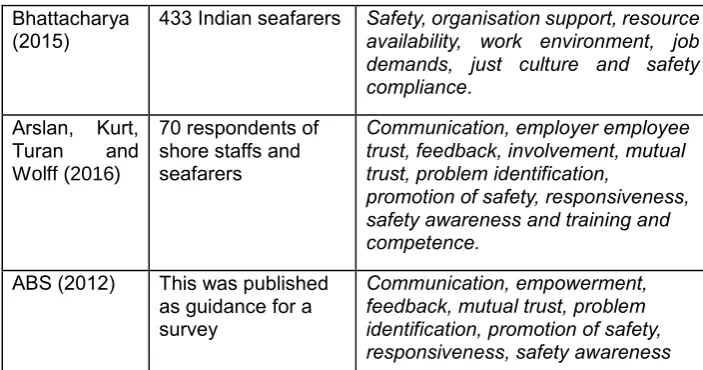
Bhattacharya (2015) carried out research to grasp the difference in perception of safety culture between seafarers, shore managers and ship owners. Among the seafarers, junior and senior officers' perception was also compared. In this study, five experts participated in the development of a questionnaire, and finally, all 19 items were used for the measurement of safety. In addition, the study analysed the correlation between the 19 items and seven safety drivers which were support on
Qualitative Measurement - Observation
- Focus group discussion
- Historical Information review
- Case study
Quantitative measurement -Structured interview
-Questionnaire
18
safety, organisation support, resource availability, work environment, job demands, just culture and safety compliance.
Moreover, Arslan, Kurt, Turan and Wolff (2016) determined that safety culture could
be scored on ten safety factors to assess safety culture for maritime organisations.
The factors were developed based on the index for measuring safety culture
developed by the American Bureau of Shipping (ABS, 2012). The factors were
communication, employer employee trust, feedback, involvement, mutual trust, problem identification, promotion of safety, responsiveness, safety awareness and training and competence. They utilised the index of ABS’s model as a basis for their questionnaire. To develop the questionnaire, a meticulous literature review was carried out, and the developed questionnaire, including 85 questions, was tested by experts. The survey was administered to both shore staff and crew members.
The above-listed studies mainly used a quantitative methodology, and it was found that various dimensions of safety culture were utilized for the survey. Table 3 summarizes the safety-related dimensions used in the studies. It can be seen that various dimensions have been utilised in the aviation and maritime sectors.
Division Study Survey target Dimensions or features
Aviation KTSA (2008) 248 pilots Organisation commitment,
management involvement, reward system, employee empowerment and reporting system.
Wang & Sun (2012)
123 civil aviation operators
Priority, standardizing, flexible, learning, teamwork, reporting and just culture
Song (2014) 30 traffic management operators and 25 pilots
Skill, attitude, resource management, learning, communication,
organisational structure, management of change.
Shipping
Sector
Ek et al.
(2013) 528 seafarers on six Swedish passenger ships
19
Table 3 Summaries of safety culture dimensions edited by the author
3.ISM CODE
In the previous chapter, a relationship of the ISM Code and safety culture was reviewed. A concept and a structure of the Code will be shown in this chapter. Furthermore, the current stage of the implementation of the ISM Code carried out and the problems faced by Korean shipping, such as a status of maritime accidents, will be explained.
3.1 The concept of the ISM Code
For an importance of human factor and a promotion of a safety culture in the maritime sector, the ISM Code was adopted by resolution A.741 (18) at the 18th
Bhattacharya
(2015) 433 Indian seafarers Safety, organisation support, resource availability, work environment, job demands, just culture and safety compliance.
Arslan, Kurt,
Turan and
Wolff (2016)
70 respondents of shore staffs and seafarers
Communication, employer employee trust, feedback, involvement, mutual trust, problem identification,
promotion of safety, responsiveness, safety awareness and training and competence.
ABS (2012) This was published as guidance for a survey
20
General Assembly of the IMO in 1993. At first, however, the Code was not a mandatory measure. Therefore, the IMO has enforced the Code through the establishment of Chapter 9 of the 1974/78 SOLAS Convention for the full and immediate implementation of the ISM Code in May 1994. Since 1998, the ISM Code has been phased into all the ratifying countries of the 1974/78 SOLAS Convention, and since July 1, 1998, all passenger ships and over 500 tons of oil tankers, chemical tankers, gas carriers, bulk carriers and high-speed cargo ships. In addition, the Code has been applied to mobile offshore drilling units (MODUs) over 500 tons since 1 July 2002 (IMO, 2013).
The ISM Code requires shipping companies to establish a safety management system for offshore department and ships and maintain their level above certain international standards. To this end, direct involvement of top management in the company and the responsibilities, abilities, Motivation is being encouraged. The SMS in the Code is used in the ISO 9000 family of quality management systems. In other words, while the ISO 9000 family quality management system is intended to improve the quality of the product, the SMS aims to ensure safety of ships and prevention of marine pollution. These objectives have pursued through software including Quality Management System (QMS) and SMS (MLTM, 2010).
21
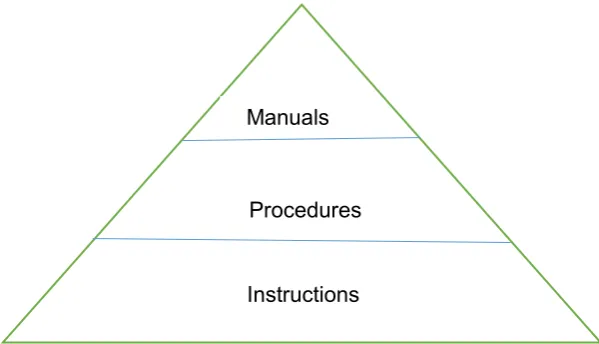
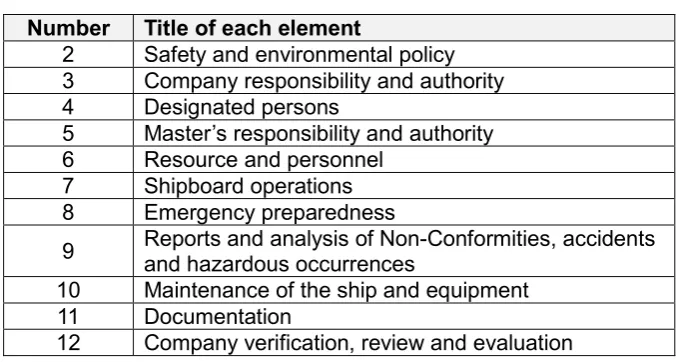
According to the Code, establishing a SMS shall be documented in the form of procedures or manuals for all duties of vessels and shore based operations carried out for safe navigation of ships. Furthermore, it is institutionalised so that the main duties may be carried out by the documented system. It means establishing a system that can check the implementation processes and identify irrelevant matters for correcting defects. Therefore, it is ideal that the system document has a hierarchical structure as shown in figure 3. Furthermore, twelve elements have been established as mandatory in the part A of the ISM Code as following Table 4.
Manuals
Procedures
Instructions
22
Table 4 Elements of ISM Code (IMO, 2013)
Number Title of each element
2 Safety and environmental policy 3 Company responsibility and authority
4 Designated persons
5 Master’s responsibility and authority
6 Resource and personnel
7 Shipboard operations
8 Emergency preparedness
9 Reports and analysis of Non-Conformities, accidents and hazardous occurrences
10 Maintenance of the ship and equipment
11 Documentation
12 Company verification, review and evaluation
3.2 Implementation of the ISM Code in Korea
With the enforcement of the ISM Code, the Korean government revised the Maritime Traffic Safety Act on Feb. 8, 1999 to establish the safety management system over ships flying the Korean flag and ship owners. The procedures for the SMS were in Section 2 of the Act. In the SOLAS Convention, the ISM Code is applied to all passenger ships engaged on international voyages, oil tankers, gas carriers, chemical carriers, bulk carriers and high-speed cargo ships of 500 gross tonnage and above, and this application standard was reflected in in the Korean Maritime Traffic Safety Act. On June 15, 2011, the Act was revised and promulgated to the Maritime Safety Act (MLTM, 2010).
23
Since the oil spill accident of the Very Large Crude Oil Carrier (VLCC) Hebei sprit, caused by a collision of crane barges towed by tugs on Dec. 7, 2007, there was a recognition of the necessity to apply the SMS to barges. Therefore, the relevant domestic regulation has been more stringently enforced compared to SOLAS. According to the Act, barges over 3,000 gross tons or tugs towing with lines more than 100 meters were included in the scope of the application of the SMS. Therefore, the application of the Act is as follows (NLIC, 2015).
a) Ships engaged in maritime passenger transportation business (except for the
domestic passenger transport business and the inner port passenger transport business)
b) Vessels of at least 500 gross tons (including barges tightly combined with
steamers), which engage in marine cargo transportation services, and other vessels as prescribed by the Presidential Decree
c) Carriers transporting catches of fish and mobile offshores with a gross tonnage
of 500 tons or more engaged in international voyages
d) Wig crafts
Furthermore, the Korean SMC shall contain the eleven elements in accordance with Article 46 (4) of the Act. However, under Article 15 (2) of the Enforcement Decree of the same Act, a simplified SMS can be established in the case of a domestic vessel, through exempting some of the 11 elements. As the ISM code was legislated to the domestic Act, the elements of the Code were thoroughly reflected in the Act.
24
Table 5 Audit status of SMS and DOC on Dec 31, 2009 (MLTM, 2010)
Division Shipping companies audited Ships audited organisation Audit
International voyages 137 678 KR
Domestic voyages 128 293 MAFRO
3.3 Challenges faced in Korean shipping society
The seaborne trade and shipbuilding industries have played a pivotal role in the Korean economy. As of 2016, the total world fleet of the world’s top 30 shipping countries was recorded as 1,657 million Dead Weight Tonnage (DWT), and Korea ranked fifth in the world, with a total 85.9 million tons (MOF, 2016). Table 7 shows the status of Korean Flagged ships. Over the past five years, the overall number of vessels has remained at a similar level without any big change. However, the number of vessels of Bare Boat Charter with Hire Purchase (BBC/HP) is increasing.
25
Table 6 Licensed and Registered Vessels in Korea
(Unit: Number, Ton, TEU, 31 Dec, 2015)
Kind of Ships Classifica tion
Total Passenger Vessels Conventional Cargo Vessels Container Ship Tankers Others
Number
of ships Gross Ton Number of ships Gross Ton Number of
ships Gross Ton TEU
Number
of ships Gross Ton Number of ships Gross Ton Number of ships Gross Ton
Total 3,824 64,924,680 145 97,273 1,105 36,652,353 1,215,766 316 13,583,020 662 13,340,626 1,596 1,251,407
Coastal
Line 2,225 1,972,190 145 97,273 265 536,049 - - - 246 252,025 1,569 1,086,842
Ocean-going ship
1,599 62,952,490 - - 840 36,116,304 1,215,766 316 13,583,020 416 13,088,601 27 164,565
Liner 313 13,461,756 - - 1 7,589 1,207,263 312 13,454,167 - - - -
Irregular
liner 1,286 49,490,734 - - 839 36,108,715 8,503 4 128,853 416 13,088,601 27 164,565 Note: 1. Based on licensed and registered vessels
2. Passenger ships include reserve ships on subsided remote island route, and others include barges
3. Includes BBC/HP ships
Source: Ministry of Oceans and Fisheries(MOF), Shipping Policy Division
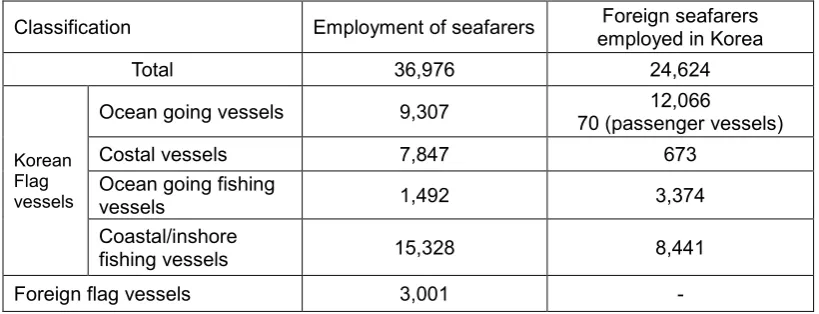
Table 7 Status of the number of seafarers' employment in Korea
(Unit: person, 31 Dec. 2015)
Classification Employment of seafarers employed in Korea Foreign seafarers
Total 36,976 24,624
Korean Flag vessels
Ocean going vessels 9,307 70 (passenger vessels) 12,066
Costal vessels 7,847 673
Ocean going fishing
vessels 1,492 3,374
Coastal/inshore
fishing vessels 15,328 8,441
Foreign flag vessels 3,001 -
26
According to the statistical yearbook of maritime and fisheries (MOF, 2016), the total number of domestic vessels registered in 2015 was 2,225, and there were 233 accidents, which was 10.4 percent among the vessels. While 1,599 ocean-going vessels were registered in the same year, the accident rate was 6.7 percent. As a result, ocean-going vessels experienced 21 percent fewer accidents than domestic vessels.
In light of the major causes of ship accidents, it can be ascertained that human errors are the major factors. Tables 10 and 11 show the causes of accidents that occurred in domestic and ocean-going vessels, judged by the Korea Maritime Safety Tribunal (KMST) from 2012 to 2016. There are also several causes of maritime accidents. Moreover, operational errors, such as improper maintenance of engine facilities and inappropriate safety procedures, are considered to belong to a category of human errors. While the rate of accidents caused by human error was 89.2 percent of 130 cases on ocean-going, as shown in Table 10, it was 93.2 percent of total 266 cases on domestic vessels. Therefore, it is possible to say that maritime accidents are mainly caused by human error, and it is important to reduce the human errors and improve human factors to reduce maritime casualties.
Table 8 Comparison of the ratio of accident between domestic vessels and ocean-going vessels
The number of registered vessel
The number of maritime accidents
The Ratio of registered vessels
to accidents
Domestic vessels 2,225 233 10.4%
Ocean-going
27
Table 9 The ratio of the number of registered ships and maritime accidents
Number
Year 2012 2013 2014 2015 2016
The number of registered
vessels (A) 84,466 80,647 77,730 76,500 -
The number of ships
involved in accidents (B) 1,854 1,306 1,565 2,362 2,549
The number of accidents 1,573 1,093 1,330 2,101 2,307
Maritime accidents
occurrence rate (B/A) 2.19% 1.62% 2.01% 3.09% -
28
Table 10 status of maritime casualties of ocean-going merchant vessels from 2012 to 2016 (Accidents of which judgment were completed by the KMST)
Type of ships Causes of marine accidents
Passe nger ship
Cargo
ship Tanker tug sum
Operati onal failures
Violation of navigation laws and regulations
for avoiding collisions 5 1 6 12
Failure to comply with general principles for navigation such as look out, position fixing and keeping ships’ course
3 34 18 3 58
Inappropriate departure preparation such as securing openings, checking loading
condition, charts and publications - - - - -
Failure to comply with duty orders and
inappropriate report and taking over duties - 2 - 1 3
Others 1 7 1 - 9
Sum 4 48 20 10 82
Inappropriate maintenance of engine facilities and
spare part 4 7 4 2 17
Inappropriate safety actions for accident prevention on
cargo, fishing and other onboard works - 6 11 - 17
Inadequate working environments such as rest hours
and measure for preventing dangers - - - - -
Safety defects on engine structure and machinery parts 1 1 2 - 4 Inadequate navigational facilities such as traffic routes
and aids to navigation - - - - -
Safety defects on electronic appliances and loading and
unloading equipment 1 1 2 - 4
Deficiencies in ship safety management - - - - -
Act of God - 3 - 1 4
others - - 1 - 1
Unknown of origins - 1 - - 1
Sum 9 67 39 15 130
29
Table 11 status of maritime casualties of domestic merchant vessels from 2012 to 2016 (Accidents of which judgment were completed by the KMST)
Type of ships Causes of marine accidents
Passe nger ship
Cargo
ship Tanker tug sum
Operati onal failures
Violation of navigation laws and regulations for
avoiding collisions 1 2 3 4 10
Failure to comply with general principles for navigation such as look out, position fixing and
keeping ships’ course 23 31 22 60 136
Inappropriate departure preparation such as securing openings, checking loading
condition, charts and publications 3 - - 3 6
Failure to comply with duty orders and
inappropriate report and taking over duties 1 1 1 3 6
Others 3 - - - 3
Sum 31 34 26 70 161
Inappropriate maintenance of engine facilities and
spare part 36 5 4 6 51
Inappropriate safety actions for accident prevention on
cargo, fishing and other onboard works 1 6 10 19 36
Inadequate working environments such as rest hours and
measure for preventing dangers - - - - -
Safety defects on engine structure and machinery parts 2 - - 2 4 Inadequate navigational facilities such as traffic routes
and aids to navigation - - - 2 2
Safety defects on electronic appliances and loading and
unloading equipment 1 1 - 2 4
Deficiencies in ship safety management - - 1 4 5
Act of God 1 1 - - 2
others - - 1 - 1
Unknown of origins - - - - -
Sum 72 47 42 105 266
Source: KMST (2016)
30
was trying to change its course. However, immediately after the accident, the crew did not make enough effort to get passengers to evacuate the listing ship, resulting in many victims. Also, despite the suggestion of the captain, the company placed excessive cargo on the ship, usually in favour of operating profit rather than the safety of the ship (KMST 2014). This is considered to be due to a serious lack of safety culture because the management had focused on profitability rather than safety and had not been able to communicate properly with the crew members.
Another example of a major accident that occurred recently is the Wuysan oil spill accident, caused by an allision with an oil pipe at the Gwangyang oil terminal in Korea. On December 31, 2014, a VLCC, Wuysan, collided with GS-Caltex Crulde Oil Dolphin, which is the name of one of the berths at the terminal, due to failing to reduce its speed as it approached the quay according to the pilot's control for berthing. In the safety investigation report, the lack of communication between the captain and the pilot was pointed out as an underlying cause in the social and cultural aspect (KMST 2015).
31
Table 12 Legal improvement after the Sewol accident edited by the author
Name of the ship
Subsequent improvements
Improvements relevant Law Title of
Ship’s facility
- Strengthen performance standards for cargo securing devices for car ferries
- 5 % of the maximum number of people on board the life vest near the muster station
- Revision of ship’s structure for increase of cargo for car ferries
- Mandatory installation of Voyage Data Recorder (VDR) for domestic passenger ships over 300 gross ton
- Standard of the structure and facilities of car ferry
- Ships’ safety Act
Crew qualification
-Five-year cycle of job aptitude test for captain working in a car ferry
- The captain and crew must not leave the ship until the passenger is rescued in an emergency.
- Seafarer Act
Management system
- Strengthen master’s responsibilities on inspection of seaworthiness and report to the ship owner - Ship owner who is noticed with problems from the
inspection shall take necessary measures to safely operate the ship
- Seafarer Act
Inspection - Introduction of maritime safety supervisor system (Unusual check for car ferries) - Strengthen passenger identification procedures
- Maritime safety Act
- Shipping Act
Organisation - Revision of government organisation (Maritime Police Organization absorbed into the
Ministry of Public Safety and Security) -
32
4. RESEARCH METHODOLOGY
4.1 Research method and design appropriateness
Through the review of previous studies in chapter 2, qualitative and quantitative research methodologies have been used primarily for the evaluation of safety culture, or it has been studied in a combined way. This study is carried out by a quantitative method that enables information collection and data analysis in a short period and use of standardised research methods on the related topic. Therefore, it is said to be less risky as a traditional way. Furthermore, the safety climate represents the aspect of safety culture, so measuring cultural aspects of seafarers can reveal the level of safety culture.
Meanwhile, in other industries such as aviation and nuclear power, research on safety climate has been carried out to improve safety culture since the 1990s. From the second half of 2000, several studies have evaluated the safety culture of maritime employees. However, in Korea, there are not enough studies on the safety culture of seafarers compared with other countries, and there is no study that verifies the correlation between the ISM Code and safety culture.
33
the seafarer.
To evaluate the effect of the implementation of the ISM Code on the recognition of safety culture by seafarers, the survey, using the questionnaire, was administered to crews employed in ocean going vessels that are fully covered by the ISM Code and seafarers employed in domestic vessels that are covered by the safety management system in the Korean domestic Law. Furthermore, the questionnaire was developed to obtain a high level of reliability and validity to ensure that the safety culture of the seafarers could be measured properly through a quantitative method, utilising a survey tool. The survey data was analysed by using the SPSS for the exploratory factor analysis to verify the reliability and validity of the measurement tool.
4.2 Research model
4.3 Development of indicators for assessing safety culture
The study requires the selection of proper indicators for safety cultural measurements, as the selection influences the validity of the survey result. As a result of reviewing the relevant literature in the previous Chapters, it was concluded that the indicators derived from the study of Wiegmann et al. (2003) were suitable as the safety indicators to be used in this study. This is because Wiegmann et al. (2003) had selected indicators based on a thorough review of sufficient literature on safety culture and safety climate. The author believes that these indicators comprehensively cover the various factors used in other studies (described in Table 3). In addition to the Wiegmann's indicators, two indicators of learning and communication supplemented the design of the questionnaire. Therefore, in this study, questionnaire items were constructed based on seven indicators which are “organisational commitment, management involvement, reward system, employee empowerment, reporting system, learning and communication” (Wiegmann et al., 2002, p.11).
- Organisational commitment
It is an indicator of the continued interest and support of management on safety, and whether safety is a core value in an organisation (Wiegmann et al. 2002).
- Management involvement
It refers to the degree to which management and middle managers participate in safety activities, and means active monitoring (Wiegmann et al. 2002).
- Reward system
Whether a behaviour is a safe or an unsafe behaviour within an organisation, it is evaluated and given a reward or punishment consistently according to the evaluation (Wiegmann et al. 2002).
- Employee empowerment
36
- Reporting system
The reporting system allows members to be willing to report their mistakes or near misses and to share that information. (Wiegmann et al. 2002).
- Learning
It is a proactive approach to monitoring and acquiring information and acquiring knowledge from the organisation, and it is necessary to be willing to implement improvements.(Ostrom, Wilhelmsen, & Kaplan, 1993: Ek, 2006)
- Communication
It is to make good communication in everyday work for proper decision making. Clear communication must be performed especially for safety culture. (Glendon & Stanton, 2000; Ostrom et al., 1993: Ek, 2006)
4.4 Relationship between factors of safety culture and ISM code
Although the effectiveness of the ISM Code remains controversial, it has been found (IMO, 2005) to have a positive effect on safety culture. To understand the direct relationship between the ISM Code and safety culture, the contents of the eleven elements constituting the Code were examined and linked to the relevant factors of safety culture.
As shown in Figure 5, the seven factors of safety culture were found to be associated with all elements of the Code without any separate concept. In this study, when the level of perception of the safety culture is quantitatively measured, the effectiveness of the ISM Code can be predicted in conjunction with the relationship. When the safety culture of the seafarers is highly perceived, the Code will be expected to be effective.
37
employed in domestic vessels, wherein the safety management system, the simplified version of the Code, is applied by Korean domestic Law.
Using the measurement tools in this study, it is possible to analyse the effectiveness of the Code when the consciousness of safety culture of seafarers on ships that apply and do not apply the ISM Code is measured and compared. In particular, it is possible to recognise which safety factors have a positive effect on the Code.
Figure 2 Relation between Safety culture factors and the ISM Code
4.5 Research questions and hypotheses
One of the major objectives of the ISM Code is to promote safety culture at sea. Although it is recognised that the implementation of the ISM Code has contributed to reducing maritime accidents, it is also true that substantial efforts were needed by seafarers and staff of shipping companies. At this point - approximately 20 years after the ISM Code was enforced in shipping - it would be necessary to see how the Code has contributed to enhancing safety culture and how it affects human behaviour.
38
behaviour through the implementation of an SMS appropriately. Furthermore, the IMO’s position is that safety culture and safety management are rooted in seafarer’s professionalism (Havold, 2010). Therefore, to reduce human error, which is the leading cause of accidents on ships, it is the best way for the seafarers to perform safety management with professionalism based on safety culture.
The fundamental research question is whether the implementation of the ISM Code has a positive impact on the safety culture. If the ISM Code contributes to promoting safety culture, seafarers aboard ships on which the ISM Code is applied would have a higher awareness of it than those on domestic ships. Under these assumptions, the main hypothesis was formulated as ‘the perception of the safety culture of seafarers employed in international sailing vessels is higher than that of seafarers engaged in domestic vessels”. Furthermore, the sub-hypotheses to be proved in this study are as detailed in Table 13:
Table 13 Seven hypotheses
H1 The awareness of organisational commitment of seafarers employed on ocean going vessels will be higher than that of seafarers on domestic vessels.
H2 The awareness of management involvement of seafarers employed on ocean going vessels will be higher than that of seafarers on domestic vessels.
H3 The awareness of reward system of seafarers of seafarers employed on ocean going vessels will be higher than that of seafarers on domestic vessels.
H4 The awareness of employ empowerment of seafarers employed on ocean going vessels will be higher than that of seafarers on domestic vessels.
H5 The awareness of reporting system of seafarers employed on ocean going vessels will be higher than that of seafarers on domestic vessels.
H6 The awareness of learning of seafarers employed on ocean going vessels will be higher than that of seafarers on domestic vessels.
39
4.6 Design of the questionnaire
To measure the safety climate of seafarers, the safety culture indicators and questionnaire items selected through literature review were revised and edited to fit the maritime crews. Meanwhile, considering the busy schedules of seafarers, a short questionnaire was required. Therefore, the questionnaire was comprised of 43 questions because it was necessary to survey the seafarers who were temporarily trained for a short period. Since seafarers are the subject of the implementation of the Code, the questionnaire was targeted at merchant officers, including captains and chief engineers and excluded members of rating and other departments such as the cooking department.
The studies of Wiegmann et al. (2003) and KTSA (2008) were utilised to develop the questionnaire items but modified to fit the maritime context. In addition, related to the learning and communication indicators, which were added, the relevant questions were prepared using the items that were developed in other studies (ABS, 2012; Song, 2014).