R E S E A R C H
Open Access
A low-complexity maximum likelihood
decoder for tail-biting trellis
Xiaotao Wang
1,2, Hua Qian
1,3,4*, Kai Kang
1,3,4and Weidong Xiang
5Abstract
Tail-biting trellises are defined on a circular time axis and can have a smaller number of states than equivalent conventional trellises. Existing circular Viterbi algorithms (CVAs) on the tail-biting trellis are non-convergent and sub-optimal. In this study, we show that the net path metric of each tail-biting path is lower-bounded during the decoding process of the CVA. This property can be applied to remove unnecessary iterations of the CVA and results in a convergent maximum likelihood (ML) decoder. Simulation results show that the proposed algorithm exhibits higher decoding efficiency compared with other existing ML decoders.
1 Introduction
For linear block codes, conventional trellis and tail-biting trellis representations have gained a great deal of attention in the past decades [1-3]. Trellis representations not only reveal the code structure, but also lead to efficient trellis-based decoding algorithms [4-8]. For the same linear block codes, the number of states in its tail-biting trellis can be as low as the square root of the number of states in its minimal conventional trellis [1,8], e.g., for the (24, 12) extended Golay code, the maximum number of states in its conventional trellis is 512 [8], while the maximum number of states in its time-varying tail-biting trellis is only 16 [1].
In addition, the tail-biting technique has been widely used in convolutional encoders to eliminate the rate loss caused by the known tail bits. For example, the World-wide Interoperability for Microwave Access (WiMAX) [9] and Long Term Evolution [10] standards both adopted tail-biting convolutional codes in the control channel or broadcasting channel. Consequently, a maximum like-lihood (ML) decoder with high decoding efficiency on tail-biting trellises is important and desirable for studying tail-biting codes.
Both the Viterbi algorithm and bidirectional effi-cient algorithm for searching code trees (BEAST) can
*Correspondence: [email protected]
1Shanghai Institute of Microsystem and Information Technology, Chinese Academy of Sciences, Shanghai 200050, China
3Shanghai Research Center for Wireless Communications, Shanghai 200335, China
Full list of author information is available at the end of the article
achieve ML decoding on conventional trellises [8]. In the case of a tail-biting trellis, due to the lack of a priori knowledge about the starting state, the Viterbi and BEAST decoder have to perform an exhaustive search on tail-biting trellises to find the ML code-word. BEAST can be more efficient if applied to the conventional trellis obtained by reducing the tail-biting code generator matrix to the minimum span form [8].
Another kind of decoder, the two-phase ML decoder, has been proposed to reduce the decoding complex-ity for tail-biting trellises [5,6]. This kind of algorithm performs Viterbi searches on tail-biting trellises in the first phase and records the accumulated path metric of each path at every section for the second phase. In the second phase, heuristic searches are perform-ing based on the result obtained from the first phase. Since the two-phase decoder is based on two dis-tinct algorithms, this makes it difficult for practical application.
The circular Viterbi algorithm (CVA)-based decoder greatly reduces the implementation complexity of a decoder for tail-biting trellises and provides near-optimal block error rate performance. However, the decoding pro-cess of the CVA is non-convergent and sub-optimal [4,7]. In this paper, we introduce a CVA-based ML decoder for tail-biting trellises. In this algorithm, the lower bound of the net path metric of each tail-biting path can be
Figure 1The tail-biting trellis of the (8, 4) convolutional code with octal generator polynomials of {7, 5}.
obtained to exclude impossible starting state candidates, which leads to convergence of the CVA. In addition, the net path metric of survivor paths can be used to termi-nate redundant searches without performing a full Viterbi iteration.
The following parts of this article are organized as fol-lows: In Section 2, a detailed description of the algorithm is presented. The performance of the proposed algorithm is demonstrated by simulations in Section 3. Section 4 concludes this paper.
2 Algorithm description 2.1 Variable definition
An example of a tail-biting trellis is shown in Figure 1, which has eight sections with four states at each section. For a tail-biting trellis with L sections, denote by Sl the set of states at location l, where 0 ≤ l ≤ L. From the definition of tail-biting trellises, we haveS0 ≡ SL. Any path that starts from and terminates at the same state forms a tail-biting path. All tail-biting paths that start from the same state construct a sub-tail-biting trellis of this state. In Figure 1, the branches of thick solid lines form a tail-biting path of state ‘01,’ and all solid lines compose the sub-tail-biting trellis of state ‘01’.
A conventional CVA-based decoder performs Viterbi iterations around the tail-biting trellis to find the opti-mal tail-biting path. This algorithm takes advantage of the circular property of tail-biting trellises and employs the path metrics accumulated in the ending states of the trellis to initialize the path metrics in the starting states for a new iteration until a prede-fined termination condition is fulfilled. In the follow-ing parts, we elaborate the decodfollow-ing process of CVA on tail-biting convolutional codes. The decoding pro-cess for general tail-biting trellises can be similarly obtained.
For tail-biting convolutional codes of rateb/c, the length of information bits isbLand the length of the correspond-ing codeword is cL. Binary code bits v(lj) ∈ {0, 1} are
mapped tox(lj) =
1−2v(lj) √
Eswith binary phase-shift keying (BPSK) modulation, where 0 ≤ j ≤ c−1 and
0≤l≤L−1. Without loss of generality, signal energyEs is normalized to 1. After passing through an additive white Gaussian noise (AWGN) channel with a double-sided noise power spectrum density ofN0/2, the corresponding received symbols arerl(j). The log-likelihood ratio ofrl(j)is
During the decoding process of the CVA, the accumu-lated path metric of the survivor path entering statesat locationlin theith iteration is
Mli(s)=
The weighted Hamming distance between on (1) and (2), the ML decoding on the tail-biting trellis is equivalent to solving the following equation:
x=arg max (3) since it is independent of specific codewords xand consequently is a constant for all paths on the tail-biting trellis.
The corresponding net path metric ofPi(βi(s),s)can be derived from (1) and (3):
Minet(βi(s),s)=Mli(s)−Mi0(βi(s)). (4)
Since the initial path metrics M0i+1(s) are different from Mi0(s) for each state s ∈ S0, different survivor paths can be obtained in each iteration. Denote by Pi
the ML path obtained in the ith iteration, where the ML path obtained from the first iteration has the least net path metric among all possible survivor paths [4]. Similarly, the ML tail-biting path obtained in the ith iteration is denoted byPi, which has the net path met-ric of Mi. Among the set of tail-biting paths {(Pi(s,s),
Mi(s,s)) | ∀s ∈ S0,i ≥ 1}, the optimal tail-biting path and its net path metric are denoted by PO and MO, respectively.
2.2 Lower bounds of the net path metrics
A conventional CVA-based decoder is non-convergent, and consequently, it cannot guarantee that the tail-biting path obtained is optimal when the decoding process is terminated [4,7]. In order to design a convergent ML decoder on tail-biting trellises, further informa-tion needs to be obtained from the decoding process of CVA. Based on the characteristics of CVA, we can derive a lower bound of the net path metric of each tail-biting path. This observation is summarized in Lemma 1.
Lemma 1.LetP(s,s)denote the ML tail-biting path on the sub-tail-biting trellis of state s, and the corresponding net path metric isM(s,s), where s∈S0. Define B(s)as of the metrics of all paths on the sub-tail-biting trellis of state s.
Proof.The tail-biting trellis defined on a circular time axis can be split at section l = 0 and duplicated on the time axis head-tail. Conventional CVA then becomes a general Viterbi decoder composed of sev-eral lengthLdecoding sections, where the Viterbi algo-rithm searches on the duplicated trellis by recording and repeating the received symbols. Consequently, com-bining (1) and (3), we find that the survivor path
Pi(βi(s),s) has the minimum accumulated path metric conclusion thatB(s)is a lower bound of the metrics of all paths on the sub-tail-biting trellis of states.
The lower boundB(s)defined in Lemma 1 is updated as iterations continue, and a more precise estimation ofB(s) can be obtained if more iterations are performed on the tail-biting trellis. According to (8), the maximal value of
B(s)isM(s,s).
Based on Lemma 1, we can reduce the decoding com-plexity of CVA on the tail-biting trellis by removing redundant computations and iterations during the decod-ing process and control the convergence of CVA. The improvements of the proposed decoder can be summa-rized into the following two aspects.
Firstly, during the decoding process, if the net path metric Minet(βi(s),s) of survivor path Pi(βi(s),s) is not less than MO, where MO is the optimal tail-biting path obtained in the firsti−1 iterations ands∈Sl, all searches that follow statescan be terminated (refer to Figure 2). In this case, the net path metric of any survivor path that starts from stateβi(s)and passes through statesis not less thanMO.
Secondly, denote bySiCthe set of survivor starting state candidates in theith iteration of the CVA, i.e.,
SiC= {s|B(s) <MO},
whereS1C=S0.
=0
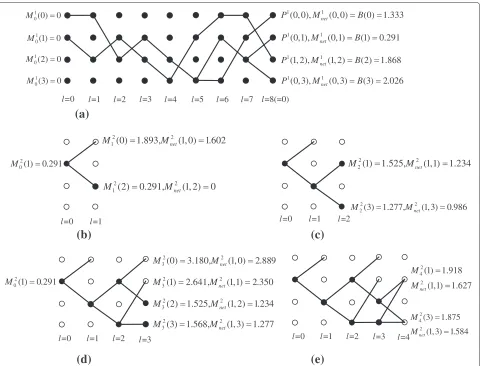
Figure 2Decoding process of the B-CVA ML decoder.For the first iteration, four survivor paths corresponding to each of the terminal states are shown on the tail-biting trellis in (a), where the tail-biting trellis has been split at locationl=0. For the second iteration, the decoding process is illustrated from (b) to (e). Searches following the circles with left incident branch are terminated according to step 2.1. The decoding process is terminated atl=4 since there are no survivor paths with net path metric less thanMO.
trellis shrinks and the decoder will converge to the global optimal solution eventually.
2.3 CVA-based ML decoder on tail-biting trellis
We summarize the above decoding process as follows: In the algorithm description, the operator ‘←’ denotes value assignment from the right-hand side to the left-hand side, and the operator ‘=’ denotes logic comparison between two operands.
From the description above, we find that the decoding process can only be terminated when SiC+1 = ∅in step 2.4. The number of entries inS1Cis finite, and as iterations continue, the size ofSiCwill reduce to zero.
Firstly, stateswith boundB(s) > MO is deleted from SiCin step 2.3 since the ML tail-biting path on the sub-tail biting trellis of statesis not better thanPO.
Secondly, after the (i+ 1)th iteration, if no state has been deleted from SiC+1, i.e., ∀ s ∈ SCi+1, B(s) < MO,
then equation SiC+1 = SiC+2 holds and the Viterbi algo-rithm will be performed on the sub-tail-biting trellis of states†in step 2.4, wheres† ∈ SiC+1. IfM(s†,s†) < MO, PO will be updated with P(s†,s†); else, if M(s†,s†) ≥
MO, this indicates thatP(s†,s†) is not better thanPO. Then state s† can be deleted from SiC+1 since the ML tail-biting path on its sub-tail-biting trellis has been found.
Algorithm description
1. Initialization:S1C←S0,M10(s)←0for alls∈S1C,
MO← +∞;
2. For iterationi,i≥1:
2.1 Perform Viterbi algorithm on the tail-biting trellis with the set of starting state candidatesSiC; during the decoding process,∀Pi(βi(s),s), where s∈Sl, ifMinet(βi(s),s)≥MO, terminate the search that follows statesas mentioned above; 2.2 Find ML tail-biting pathPiif it exists, update (PO, starting states†of ML pathPiand perform Viterbi algorithm on the sub-tail-biting trellis of states†, step 2.1 is also applied in this case; deletes†from
SiC+1; updatePOwithP(s†,s†)ifM(s†,s†) <MO; 2.5 ∀s∈SiC+1:M0i+1(s)←MiL(s);i←i+1; go back
to step 2;
3. Output the codeword associated withPO;
PO. In summary, the algorithm presented above is a con-vergent ML decoder on tail-biting trellises. We call this a bounded CVA (B-CVA) ML decoder.
The following example is used to explain the decoding process of the B-CVA.
Example 1.The tail-biting convolutional code that is represented by the tail-biting trellis in Figure 1 is selected in this example. The information sequence is {01011100}, and the corresponding codeword is {(00), (11), (10), (00), (01), (10), (01), (11)}. After passing through the AWGN channel where the signal-to-noise ratio (SNR) isEb/N0= 0 dB, the received sequence (for one realization) is {(1.144, 0.458), (−0.986, −1.234), (0.291, 1.364), (0.472, 0.350), (1.578,−1.594), (0.050,−0.399), (2.260, 0.359), (−1.501, 0.234)}. For convenience, states {00, 01, 10, 11} are
rep-resented by {0, 1, 2, 3}. For the first iteration, setS1C = decoding process of the second iteration is illustrated in Figure 2b, c, d, e. We find that with the control on the decoding process of the CVA, the second iteration termi-nates at sectionl = 4; and at each section, searches after states that hasM2net(1,s) ≥ MO are terminated. The statescorresponds to the circle with left incident branch on the trellis in Figure 2b, c, d, e. The decoding result is the codeword associated with the tail-biting pathPO. In the first iteration, there are 64 real additions and 32 logi-cal comparisons; and in the second iteration, the numbers of real additions and logical comparisons corresponding to each step are {(4, 2), (4, 2), (8, 4), (6, 4)}. In sum-mary, the decoding complexity of B-CVA is denoted by 86 real additions and 44 logical comparisons. As is shown in Appendix 1,, the decoding complexity of the two-phase decoder is denoted by 100 real additions and 101 logical comparisons.
3 Simulation results
In order to show the decoding efficiency, we compare the proposed B-CVA ML decoder with other widely cited tail-biting ML decoders in three aspects: the number of real additions, the number of logical comparisons, and average memory space consumption during the decoding process. The codewords are modulated to BPSK symbols and then passed through an AWGN channel. The results shown in the tables and figures are obtained by observing at least 100 block error events.
The conventional BEAST ML decoder should perform decoding on each sub-tail-biting trellis independently and consecutively to find the ML tail-biting path [8]. To improve its efficiency, we use the upper-bounding tech-nique on the thresholds used by BEAST. During the consecutive decoding process, the metric of the optimal tail-biting path obtained on the firstisub-tail-biting trel-lises are used to upper-bound the thresholds that will be used for decoding the remaining|S0| −isub-tail-biting trellises, where|S0|denotes the size of set S0. With this
Table 1 BLER performance of WAVA and ML decoders for (64, 32) tail-biting convolutional codes over the AWGN channel
SNR
BLER performance 0.0 dB 1.0 dB 2.0 dB 3.0 dB 4.0 dB
WAVA 3.95×10⁻¹ 1.49×10⁻¹ 2.80×10⁻² 2.70×10⁻³ 1.06×10⁻⁴
ML decoders 3.80×10⁻¹ 1.48×10⁻² 2.66×10⁻² 2.50×10⁻³ 0.96×10⁻⁴
Figure 3Average memory space required for decoding the (64, 32) tail-biting convolutional codes.Average memory space consumption by the WAVA and different ML decoders: advanced BEAST ML decoder, two-phase ML decoder and B-CVA ML decoder, for decoding the (64, 32) tail-biting convolutional codes over the AWGN channel.
Table 2 BLER performance of WAVA and ML decoders for (80, 40) tail-biting convolutional code over the AWGN channel
SNR
BLER performance 1.0 dB 2.0 dB 3.0 dB 4.0 dB 5.0 dB
WAVA 1.60×10⁻¹ 3.16×10⁻² 3.10×10⁻³ 1.45×10⁻⁴ 3.50×10⁻⁶ ML decoders 1.59×10⁻¹ 3.05×10⁻² 3.10×10⁻³ 1.44×10⁻⁴ 3.50×10⁻⁶ The ML decoders are the advanced BEAST ML decoder, two-phase ML decoder, or the B-CVA ML decoder.
upper-bounding technique, redundant searches can be terminated timely or reduced through the whole decoding process. For convenience, we call the BEAST decoder with this upper-bounding technique an advanced-BEAST ML decoder, which should be more efficient than the original BEAST decoder in [8]. Results presented in Appendix 4 are used to demonstrate this point.
In the first example, different decoders were applied for decoding the tail-biting convolutional codes (64, 32) with octal generator polynomials {345, 237}, which can be represented by a 128-state tail-biting trellis [7]. For the demonstration of the block error rate (BLER) per-formance of the B-CVA, we choose the most cited sub-optimal decoder proposed in [7] for comparison. This decoder is called the wrap-around Viterbi algorithm (WAVA). Because the WAVA is non-convergent, the max-imal allowed number of iterations is set as 20 during the decoding process. Table 1 shows the BLER performance
of different decoders. We find that of the sub-optimal decoders, WAVA has performance that is close to the optimal results.
Figure 3 shows the average memory space consumption of the different ML decoders during the decoding pro-cess. We find that the advanced BEAST decoder and the B-CVA decoder require almost constant memory space from the low- to high-SNR regions. However, we find that the WAVA decoder requires less memory space than the B-CVA. This is due to the fact that WAVA has no need of space for storingB(s)of every state inS0. The mem-ory space required by the two-phase decoder is about 2 ∼ 12 times more than that required by the B-CVA or BEAST decoders. This is due to the fact that the two-phase decoder has to store path metrics of all survivor paths obtained in the first phase and has to maintain the open stack and close table during the second phase.
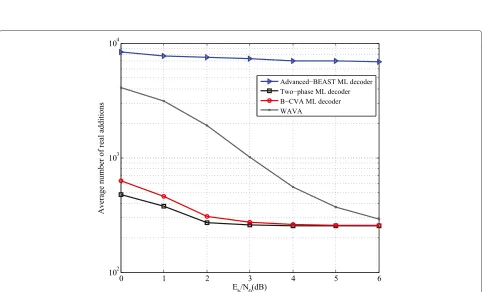
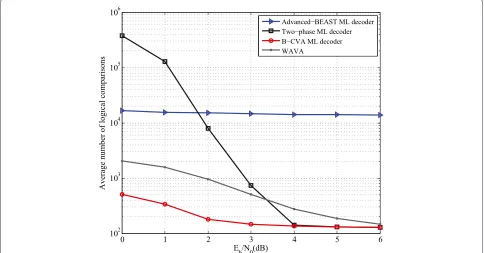
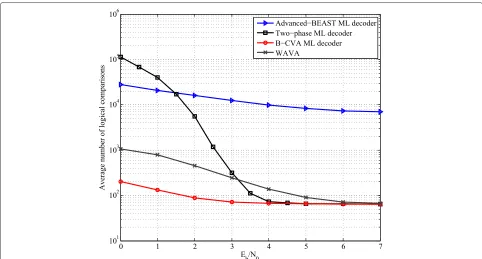
Figure 4 shows that the two-phase ML decoder which
Figure 6Average memory space required for decoding the (80, 40) tail-biting convolutional code.Average memory space consumption by the WAVA and different ML decoders: advanced BEAST ML decoder, two-phase ML decoder, and B-CVA ML decoder, for decoding the (80, 40) tail-biting convolutional codes over the AWGN channel.
Figure 8Average number of logical comparisons required for decoding the (80, 40) tail-biting convolutional code.Average number of logical comparisons that were performed during the decoding process of the WAVA and different ML decoders: advanced BEAST ML decoder, two-phase ML decoder and B-CVA ML decoder, for decoding the (80, 40) tail-biting convolutional codes over the AWGN channel.
is based on depth-first searches is a little better than the B-CVA ML decoder in the number of real addi-tions. The BEAST ML decoder which performs exhaus-tive searches on the tail-biting trellis shows the highest decoding complexity. Figure 5 shows that a larger num-ber of logical comparisons should be performed by the two-phase decoder than that performed by the B-CVA decoder. This is due to the fact that many logical com-parisons need to be performed to sort the open stack and to retrieve the close table in the low-SNR region. In fact, the length of the close table grows linearly as the searches continue. Figures 4 and 5 also show that the advanced BEAST decoder, which has to be performed on each sub-tail-biting trellis, exhibits high decoding complexity from the low- to high-SNR regions. Meanwhile, we find that the WAVA exhibits high decoding complexity from the
low-to medium-SNR regions; this is caused by circular traps existing in the CVA decoding process [4].
The second example adopts the tail-biting convolutional codes that have been used in WiMAX. The correspond-ing generator polynomials are {133, 171} in octal form [9]. The length of the information sequence is 40 bits, and the corresponding code is a long tail-biting convolu-tional code [7], which is denoted as an (80, 40) tail-biting convolutional code. The BLER of the WAVA and ML decoders are presented in Table 2, where the ML decoder in Table 1 refers to any kind of ML decoders mentioned in this paper: the advanced BEAST ML decoder, two-phase ML decoder, or BCVA decoder, since all of them exhibit exactly the same block error rate performance. We find that in the case of long tail-biting codes, the BLER performance of WAVA is close to that of ML decoders.
Table 3 Updates of the open stack and close table during heuristic searches of the two-phase ML decoder
Step Open stack Close table Complexity
1 {(1, 1, 0, 0.291)} ∅ {(6, 4)}
2 {(1, 2, 1, 0.291)} {(1, 1, 0)} {(6, 7)}
Table 4 Average numbers of real additions and logical comparisons in decoding the (80, 40) code used in WiMAX
SNR
Decoding complexity 0.0 dB 1.0 dB 2.0 dB 3.0 dB 4.0 dB 5.0 dB 6.0 dB 7.0 dB
Additions 10, 307 10, 083 9, 989 9, 583 9, 288 9, 222 9, 013 8, 999 BEAST Comparisons 20, 613 20, 167 19, 978 19, 165 18, 576 18, 443 18, 026 17, 998 Additions 5, 248 4, 395 3, 793 3, 411 3, 218 3, 048 2, 996 2, 930 Advanced BEAST Comparisons 10, 497 8, 790 7, 585 6, 821 6, 436 6, 096 5, 993 5, 860
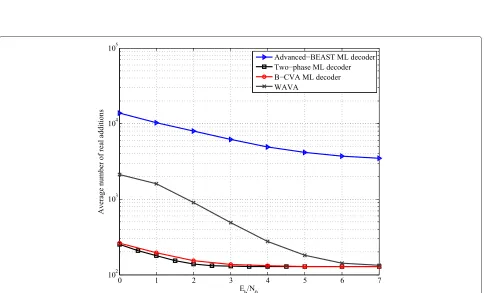
From Figures 6, 7 and 8, we come to almost the same conclusions as that in the first example. In Figure 6, the memory space required by the advanced BEAST decoder decreases slowly as system SNR grows. Figure 8 shows that, in the low-SNR region, many comparisons were performed to maintain the open stack and close table in the second phase of the two-phase ML decoder. In summary, the B-CVA decoder is an efficient ML decoder on tail-biting trellises both in memory space saving and decoding complexity reduction.
4 Conclusion
We propose a convergent CVA-based ML decoder for tail-biting trellises. The proposed algorithm takes advantage of the lower bound of the net path metric of the tail-biting path to control the decoding process of CVA. Simula-tion results show that, on tail-biting trellises, the B-CVA decoder exhibits high decoding efficiency while requir-ing relatively small memory space durrequir-ing the decodrequir-ing process. These advantages make it attractive to practical applications.
Appendices
Appendix 1: decoding process of the two-phase ML decoder
In Example 1, the decoding process of the two-phase ML decoder can be described as follows [6]: (1) During the first phase, the decoder stores the path metricMl1(s) of ∀s ∈ Sl and 0 ≤ l ≤ L; the decoding complex-ity of the first phase is the same as that of the B-CVA, which contains 64 real additions and 32 logical com-parisons; (2) in the second phase, heuristic searches are performed on the sub-tail-biting trellis of state 01; in each step, the heuristic search is performed following the top path in the open stack. There are 3 real additions and 4 logical comparisons for updating the values of the g -function,h-function, andf-function. The two successors will be saved in an open stack if the values of their f -functions are less thanM1. Meanwhile, the starting state, terminal state, and current sectionlof the top path will be saved in the close table. Then, the top path of the open stack will be compared with each entry of the close
table in three aspects: starting state, terminal state, and current location. With six heuristic searching steps, the decoding process is stopped. The decoding complexity in summary is denoted by 100 real additions and 105 logical comparisons. We have ignored the complexity of sorting the open stack according to ascending order of their f-function values. The open stack and the corre-sponding close table obtained in each step are shown in Table 3, where Open stack = {(starting state, cur-rent state, l-section,f-function)}, Close table = {(start-ing state, current state, l-section)}, and Complexity = {(the number of real additions, the number of logical comparisons)}.
Appendix 2: improvements of the BEAST ML decoder with upper-bounding technique
To show the decoding efficiency improvement of the advanced BEAST decoder, we use it and the original BEAST decoder [8] to decode a tail-biting convolu-tional code used in WiMAX. The length of the infor-mation sequence is 40 bits. The average numbers of real additions and logical comparisons are presented in Table 4. We find that the upper-bounding technique can cut the decoding complexity of the BEAST decoder by 1/2∼2/3.
Competing interests
The authors declare that they have no competing interests.
Acknowledgements
This work was supported in part by the Hundred Talents Program of the Chinese Academy of Sciences, the Shanghai Pujiang Talent Program No. 11PJ1408700, the National Science and Technology Major Project No. 2011ZX03003-003-04, the International Science and Technology Cooperation Program of Shanghai Municipality No. 11220705400, and the Science and Technology Commission Foundation of Shanghai No. 12511503400.
Author details
1Shanghai Institute of Microsystem and Information Technology, Chinese
Academy of Sciences, Shanghai 200050, China.2Graduate University of Chinese Academy of Sciences, Beijing 100049, China.3Shanghai Research
Center for Wireless Communications, Shanghai 200335, China.4Shanghai Internet of Things Co., Ltd., Shanghai 201899, China.5Electrical and Computer
Engineering Department, University of Michigan-Dearborn, Dearborn, MI 48128-2406, USA.
References
1. A Calderbank, G Forney, Vardy A, Minimal tailbiting trellises: Golay code and more. IEEE Trans. Inf. Theory.45(5), 1435-1455 (1999)
2. P Stahl, J Anderson, R Johannesson, Optimal and near-optimal encoders for short and moderate-length tailbiting trellises. IEEE Trans. Inf. Theory.
45(7), 2562–2571 (1999)
3. H Gluesing-Luerssen, E Weaver, Linear tail-biting trellises: characteristic generators and the BCJR-construction. IEEE Trans. Inf. Theory.57(2), 738–751 (2011)
4. X Wang, H Qian, J Xu, Y Yang, F Wang, inIEEE Global Telecommunications Conference. An efficient CVA-based decoding algorithm for tail-biting codes ((Houston, 5–9 Dec 2011), pp. 1–5
5. P Shankar, P Kumar, K Sasidharan, B Rajan, A Madhu, Efficient convergent maximum likelihood decoding on tail-biting (2007). http://arxiv.org/pdf/ cs/0601023v1.pdf. Accessed 10 Aug 2007
6. H Pai, Y Han, T Wu, P Chen, S Shieh, Low-complexity ML decoding for convolutional tail-biting codes. IEEE Commun. Lett.12(12), 883–885 (2008)
7. R Shao, S Lin, M Fossorier, Two decoding algorithms for tailbiting codes. IEEE Trans. Commun.51(10), 1658–1665 (2003)
8. IE Bocharova, R Johannesson, BD Kudryashov, M Loncar, BEAST decoding for block codes. Europ. Trans. Telecomm.15, 297–305 (2004)
9. IEEE,IEEE Std 802.16–2009, IEEE Standard for, Local and Metropolitan Area Networks Part 16: Air Interface for Broadband Wireless Access Systems. (IEEE, Piscataway, 2009)
10. 3rd Generation Partnership Project,3GPP TS 36.212, Technical Specification, Group Radio Access Network; Evolved Universal Terrestrial Radio Access (E-UTRA); Multiplexing and Channel Coding (Release 8). (ETSI, Sophia Antipolis, 2007)
doi:10.1186/1687-1499-2013-130
Cite this article as:Wanget al.:A low-complexity maximum likelihood decoder for tail-biting trellis.EURASIP Journal on Wireless Communications and Networking20132013:130.
Submit your manuscript to a
journal and benefi t from:
7Convenient online submission
7Rigorous peer review
7Immediate publication on acceptance
7Open access: articles freely available online
7High visibility within the fi eld
7Retaining the copyright to your article